Post-Dural Puncture Headache Following Spinal Anesthesia in Obstetric and Gynecological Patients.
- Qurat-ul-Ain Malik , Department of Anesthesia, Shalamar Hospital, Lahore.
- Amir Bashir , Department of Anesthesia, Shalamar Hospital, Lahore.
- Amir Waseem , Department of Anesthesia, Shalamar Hospital, Lahore.
- Fizza Saleem , Department of Anesthesia, Shalamar Hospital, Lahore.
- Kamil , Department of Anesthesia, Shalamar Hospital, Lahore.
- Itrat Kazmi , Department of Anesthesia, Shalamar Hospital, Lahore.
- Muhammad Mubeen , Department of Anesthesia, Shalamar Hospital, Lahore.
Article Information:
Abstract:
Background: Post-dural puncture headache (PDPH) is an important complication of neuraxial anesthesia, especially in obstetric patients. Local estimates based on clinically confirmed cases are needed to guide surveillance and quality improvement. Methods: This single-centre retrospective observational study included all 113 available records of women who received conventional spinal anesthesia or saddle block for obstetric or gynecological procedures at Shalamar Hospital, Lahore, Pakistan, from April through June 2025. Data were obtained from standardized anesthesia and perioperative records. PDPH was defined as a clinician-diagnosed postural headache after dural puncture; all identified cases had postural association confirmed on the paper proforma. Descriptive statistics, exact binomial confidence intervals, Fisher exact tests, and Mann–Whitney U testing were used; no multivariable model was fitted because only ten events occurred. Results: Ten participants developed PDPH, giving an incidence of 8.8% (10/113; exact 95% confidence interval [CI], 4.3%–15.7%). Median age was 30 years (interquartile range [IQR], 27–35 years); 89 procedures (78.8%) were lower-segment cesarean sections. All patients received a 25-G Quincke needle. Among PDPH cases, median onset was 48 hours (range, 20–72 hours); all had postural association. We noticed neck stiffness in 9 (90.0%) and nausea in 5 (50.0%). The only statistically significant exploratory comparison was recorded baricity (P = .002), but this involved only four isobaric records and was considered unstable. Conclusions: Clinically confirmed PDPH occurred in approximately one in eleven patients after spinal anesthesia in this real-world cohort. The study provides a local benchmark and supports standardized post-spinal symptom follow-up and larger comparative studies of needle and procedural strategies.
Keywords:
Article :
INTRODUCTION:
Spinal anesthesia is widely used for obstetric and gynecological surgery because it provides rapid, reliable neuraxial blockade while avoiding airway manipulation and minimizing systemic drug exposure. Post-dural puncture headache (PDPH), however, remains a clinically important complication of intentional or inadvertent dural puncture. The International Classification of Headache Disorders, third edition (ICHD-3), defines PDPH as a headache developing within five days of dural puncture and attributable to the procedure.[1] Loss of cerebrospinal fluid through the dural defect, with consequent intracranial hypotension and traction on pain-sensitive structures, is the leading explanatory mechanism.[2,3]
The syndrome is usually recognized by a positional pattern: pain worsens when the patient is upright and improves on recumbency. Neck stiffness, nausea, photophobia, hearing symptoms, and other associated features may occur. Although a typical postural headache is often clinically recognizable, postpartum and postoperative headache have a broad differential diagnosis. A structured assessment is therefore important to identify atypical features or warning signs that should trigger evaluation for alternative causes, including hypertensive, neurologic, infectious, or thrombotic disorders.[4,5]
Reported PDPH incidence varies substantially across clinical settings. The observed rate depends on the population studied, the definition and duration of follow-up, the mechanism of dural puncture, and technical factors such as needle gauge, needle tip, bevel orientation, and the number of attempts. The obstetric population is particularly relevant because many patients are young women and because a debilitating headache can interfere with recovery, mobility, infant care, and timely recognition of other postpartum disorders.[4,5]
Needle design is among the most consistently modifiable procedural determinants. Systematic reviews have found that atraumatic (pencil-point) needles reduce PDPH compared with cutting needles, while the effect of gauge depends on needle design and technical success.[6–8] In a randomized Pakistani study of women undergoing cesarean delivery, PDPH occurred in 8.3% of those receiving a 25-G Quincke needle, compared with 3.8% with a 27-G Quincke needle and 2.0% with a 27-G Whitacre needle.[9] These findings underline the value of local data, because procedural practice, patient mix, and follow-up pathways influence the rate that a department actually observes.
Institutional data on clinically confirmed PDPH after spinal anesthesia at Shalamar Hospital were not previously summarized. This study therefore aimed to estimate the incidence of PDPH among obstetric and gynecological patients undergoing spinal anesthesia, describe the timing and clinical features of identified cases, and explore unadjusted associations with the patient- and procedure-level variables available in the standardized perioperative records. The exploratory objective was intentionally limited to descriptive and sparse-data analyses; it was not designed to establish causal risk factors.
METHODOLOGY:
Study design and setting
A single-centre retrospective observational study was conducted at Shalamar Hospital, Lahore, Pakistan. The study period covered April through June 2025. The analysis included all 113 available eligible records for women who underwent conventional spinal anesthesia or saddle block for obstetric or gynecological procedures during the study period. The study used a convenience sample of available records.
Data source, eligibility, and data quality
Data were abstracted from standardized paper proformas and perioperative records. Records were included when the core procedure details and PDPH outcome could be determined from the standardized perioperative records. The de-identified dataset contained no direct patient identifiers.
Data quality checks were performed against the paper proformas before analysis. Records were checked against original documentation for completeness and internal consistency. One baricity value was missing and was retained as missing; analyses involving baricity used complete records only.
Outcome and variables
The primary outcome was PDPH. A case was classified as PDPH when a post-procedural headache had been clinically diagnosed as PDPH and had postural association documented on the standardized perioperative records. All ten headache cases in the dataset met this definition. The recorded onset time was summarized in hours after the procedure. Associated clinical features available for analysis were neck stiffness and nausea.
Available explanatory variables were age, procedure category, anesthetic technique, recorded intrathecal drug preparation, dose, baricity, needle brand, needle gauge, needle tip type, number of puncture attempts, and provider level. Needle gauge and tip were not tested as predictors because all records used a 25-G Quincke needle.
Statistical analysis
Continuous data are reported as median (IQR) because of the small number of outcome events and potential non-normality. Categorical variables are reported as frequency and percentage. PDPH incidence was calculated as the number of clinically confirmed cases divided by the 113 analyzed records, with an exact two-sided Clopper–Pearson 95% CI. Fisher exact tests were used for categorical exploratory comparisons because of sparse cell counts, and a two-sided Mann–Whitney U test compared age between participants with and without PDPH. All P values are two-sided, with P < .05 considered statistically significant; they are interpreted as exploratory rather than confirmatory. Multivariable logistic regression was not performed because only ten PDPH events were observed. No imputation was used. Analyses were performed in Python 3.12.13 using pandas 2.2.3 and SciPy 1.17.0.
RESULTS:
Participant and procedural characteristics
The final analytical cohort comprised 113 women. Median age was 30 years (IQR, 27–35 years; range, 20–65 years). Lower-segment cesarean section (LSCS) accounted for 89 procedures (78.8%), dilatation and curettage for 23 (20.4%), and vaginal hysterectomy for one (0.9%). Conventional spinal anesthesia was documented in 97 cases (85.8%) and saddle block in 16 (14.2%). All procedures used a 25-G Quincke needle; 93 patients (82.3%) had one puncture attempt. Table 1 shows participant and procedural characteristics.
Table 1. Participant and procedural characteristics (n = 113)
|
Characteristic |
Value |
|
Age, years, median (IQR) |
30 (27–35) |
|
Female sex |
113 (100.0) |
|
Procedure |
|
|
Lower-segment cesarean section |
89 (78.8) |
|
Dilatation and curettage |
23 (20.4) |
|
Vaginal hysterectomy |
1 (0.9) |
|
Anesthetic technique |
|
|
Conventional spinal |
97 (85.8) |
|
Saddle block |
16 (14.2) |
|
Recorded intrathecal preparation |
|
|
Pivacaine s/p |
61 (54.0) |
|
Bupivacaine |
52 (46.0) |
|
Recorded dose, mg |
|
|
15 |
87 (77.0) |
|
12.5 |
17 (15.0) |
|
12 |
4 (3.5) |
|
10 |
5 (4.4) |
|
Baricity |
|
|
Hyperbaric |
108 (95.6) |
|
Isobaric |
4 (3.5) |
|
Missing |
1 (0.9) |
|
Spinal needle characteristics |
|
|
25-G Quincke |
113 (100.0) |
|
Predominant recorded brand: Spine LP |
111 (98.2) |
|
Other recorded brands |
2 (1.8) |
|
Number of puncture attempts |
|
|
1 |
93 (82.3) |
|
2 |
13 (11.5) |
|
3 |
4 (3.5) |
|
4 |
3 (2.7) |
|
Provider level |
|
|
Postgraduate resident |
92 (81.4) |
|
Senior registrar |
21 (18.6) |
Note. Data are n (%) unless otherwise specified. IQR = interquartile range.
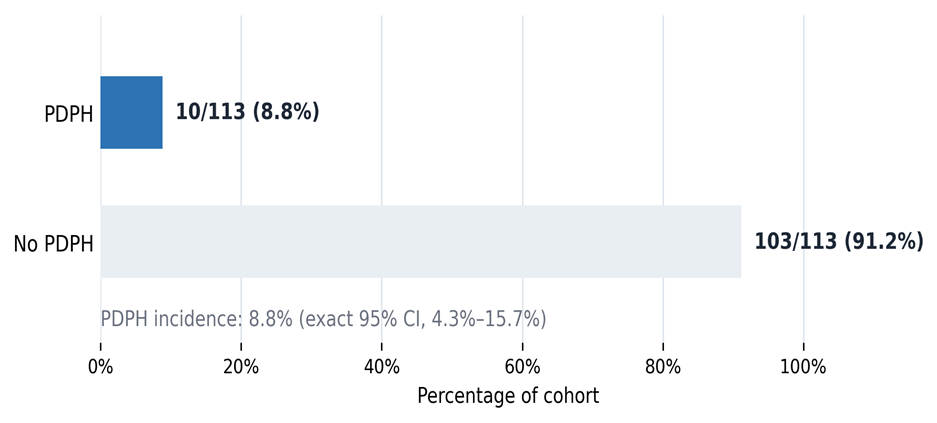
Figure 1. Incidence of clinically confirmed PDPH in the analytical cohort (n = 113).
Incidence and clinical profile of PDPH
10 of 113 participants developed clinician-confirmed PDPH, corresponding to an incidence of 8.8% (exact 95% CI, 4.3%–15.7%). The median onset time was 48 hours (range, 20–72 hours). Three cases (30.0%) began within 24 hours, five (50.0%) between 25 and 48 hours, and two (20.0%) between 49 and 72 hours. Postural association was confirmed on the standardized perioperative records in every case. Neck stiffness was recorded in 9 cases (90.0%) and nausea in 5 (50.0%) (Table 2).
Table 2. Clinical profile of confirmed PDPH cases (n = 10)
|
Clinical feature |
Value |
|
PDPH incidence in the cohort |
10/113 (8.8); exact 95% CI, 4.3–15.7 |
|
Onset, hours, median (range) |
48 (20–72) |
|
Onset within 24 hours |
3 (30.0) |
|
Onset 25–48 hours |
5 (50.0) |
|
Onset 49–72 hours |
2 (20.0) |
|
Postural association confirmed |
10 (100.0) |
|
Neck stiffness |
9 (90.0) |
|
Nausea |
5 (50.0) |
Note. Data are n (%) unless otherwise specified. CI = confidence interval.
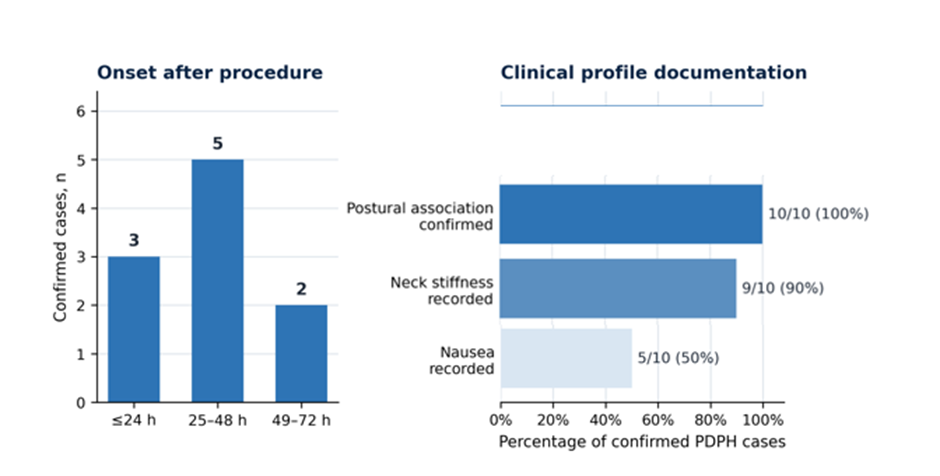
Figure 2. Timing and clinical-profile documentation among confirmed PDPH cases (n = 10).
Exploratory associations
Participants with PDPH had a median age of 29.5 years (IQR, 28.0–31.5 years) compared with 30.0 years (IQR, 27.0–35.5 years) among those without PDPH (Mann–Whitney U = 481.5; P = .738). The only statistically significant unadjusted comparison was recorded baricity: 7 of 108 hyperbaric records (6.5%) versus 3 of 4 isobaric records (75.0%) were classified as PDPH (two-sided Fisher exact P = .002). Because this finding is based on only four isobaric records, it is highly unstable and should be interpreted as hypothesis-generating. All other categorical comparisons were non-significant (Table 3).
Table 3. Exploratory associations with PDPH
|
Characteristic (comparison) |
PDPH, n/N (%) |
P value |
|
Procedure (LSCS vs non-LSCS) |
8/89 (9.0) vs 2/24 (8.3) |
1.000 |
|
Technique (conventional spinal vs saddle block) |
9/97 (9.3) vs 1/16 (6.2) |
1.000 |
|
Recorded preparation (Pivacaine s/p vs bupivacaine) |
5/61 (8.2) vs 5/52 (9.6) |
1.000 |
|
Dose (15 mg vs <15 mg) |
8/87 (9.2) vs 2/26 (7.7) |
1.000 |
|
Baricity (hyperbaric vs isobaric) |
7/108 (6.5) vs 3/4 (75.0) |
.002 |
|
Puncture attempts (≥2 vs 1) |
1/20 (5.0) vs 9/93 (9.7) |
.688 |
|
Provider (postgraduate resident vs senior registrar) |
10/92 (10.9) vs 0/21 (0.0) |
.204 |
Note. Two-sided Fisher exact tests were used. The baricity comparison uses 112 complete records and includes only four isobaric records. No regression model was fitted because ten outcome events were observed. LSCS = lower-segment cesarean section.
DISCUSSION:
In this single-centre observational cohort of 113 women undergoing spinal anesthesia or saddle block for obstetric and gynecological procedures, the incidence of clinician-confirmed PDPH was 8.8% (exact 95% CI, 4.3%–15.7%). The clinical pattern was consistent with the expected syndrome: all cases had postural association, and onset was concentrated between 20 and 72 hours after the procedure. Neck stiffness and nausea were commonly recorded.
The observed rate is close to the 8.3% frequency reported in a randomized Pakistani cesarean-delivery study using a 25-G Quincke needle.[9] That resemblance is useful as a contextual benchmark, but it should not be treated as a direct comparison. The present cohort included both obstetric and gynecological procedures and had a small number of events. Incidence estimates in the literature vary widely: a prospective cesarean cohort reported 25.7%, while another prospective spinal-anesthesia cohort reported 28.7%.[10,11] Differences in diagnostic criteria, case ascertainment, patient mix, needle characteristics, procedural difficulty, and follow-up intensity can all change the numerator and denominator of an incidence estimate.
The timing and symptom profile are clinically important. All cases in the present cohort occurred within the first 72 hours, and the median onset was 48 hours. This is consistent with the usual early post-puncture presentation described in evidence-based guidance and in the Pakistani randomized trial, where most events appeared on the first or second postoperative day.[4,9] A focused postoperative or post-discharge question about upright-worsening headache, together with neck stiffness and nausea, may therefore improve recognition. At the same time, positional symptoms should not be used to dismiss alternative diagnoses; in obstetric care, severe, atypical, non-postural, or neurologically associated headache warrants an appropriate differential diagnosis and escalation pathway.[4,5]
Needle selection deserves careful interpretation in this dataset. Every patient received a 25-G Quincke needle, so the present study cannot compare cutting with atraumatic needles or one gauge with another. Its incidence should not be attributed causally to the needle. Nevertheless, the consistency of external evidence is relevant to local quality planning. A Cochrane review found moderate-quality evidence that atraumatic needles reduce PDPH without increasing adverse effects, and a network meta-analysis of 61 randomized trials found that 26-G atraumatic needles had the most favorable probability of avoiding PDPH while achieving successful insertion.[6,7] A separate meta-analysis of 57 randomized trials found substantially lower PDPH with pencil-point than cutting needles (risk ratio, 0.41; 95% CI, 0.31–0.54).[8] These data support a future, adequately designed local comparison or implementation evaluation rather than a causal claim from the current homogeneous needle dataset.
The apparent association with recorded baricity deserves particularly cautious interpretation. PDPH was classified in three of four isobaric records versus seven of 108 hyperbaric records, producing a small Fisher exact P value. However, a denominator of four cannot support a stable effect estimate, and this crude comparison is vulnerable to selection, documentation, and unmeasured procedural differences. It should therefore be treated as a hypothesis-generating signal, not as evidence that isobaric preparation causes PDPH. The remaining comparisons with puncture attempts, provider level, anesthetic technique, recorded preparation, and dose were not statistically significant, but the small number of events means that non-significance cannot establish absence of clinical relevance. Other prospective cohorts have reported associations between PDPH and multiple attempts or needle-related factors.[10,11] For the present department, the practical implication is to continue recording attempts, needle details, baricity, and related procedural characteristics in a standardized manner so that a larger dataset can assess these relationships more reliably.
The study has immediate clinical relevance despite its size. PDPH may delay recovery and can coexist with, or be confused with, conditions requiring urgent assessment. Obstetric studies have associated PDPH with important longer-term and neurologic outcomes, although such outcomes were not measured here.[12,13] A concise institutional pathway could therefore include patient education before discharge, documentation of symptom onset and postural character, a named review pathway for suspected PDPH, and explicit red flags for medical reassessment. The current multisociety guidance provides a useful framework for diagnostic evaluation and evidence-based management, including timely consideration of an epidural blood patch when clinically indicated.[4]
Several strengths should be noted. The analysis was based on all 113 available eligible records, used standardized perioperative records confirmation for the clinical diagnosis and postural association of each PDPH case, and reported an exact confidence interval rather than a point estimate alone. Fisher exact testing and the decision not to fit an event-sparse regression model were appropriate to the observed data structure. The study also provides transparent procedural context: all patients received the same recorded needle gauge and tip, which makes the incidence estimate particularly relevant to that local practice pattern.
The limitations are equally important. This was a single-centre retrospective record-based analysis with only ten events, so the confidence interval is wide and the exploratory comparisons have low power. Causal inference is not possible. Needle gauge and tip did not vary, and other potentially relevant variables—such as body mass index, puncture level, patient position, bevel orientation, prior PDPH, detailed comorbidity, and duration or management of symptoms—were not collected. The results may also be affected by differences in documentation and follow-up after discharge. Future research should use a larger multicentre or longer-period design, prespecify five-day outcome surveillance, capture a fuller set of patient and technical variables, and prospectively compare carefully selected needle and procedural strategies.
CONCLUSION:
Among 113 obstetric and gynecological patients undergoing spinal anesthesia at a tertiary care hospital, clinically confirmed PDPH occurred in 8.8% (exact 95% CI, 4.3%–15.7%). Events typically presented within 24–72 hours and all had postural association. The unadjusted baricity finding was statistically significant but based on only four isobaric records and cannot support a causal conclusion; all other exploratory comparisons were non-significant. The findings offer a local incidence benchmark and support standardized clinical follow-up together with larger comparative studies of PDPH prevention strategies.
REFERENCES:
1. Headache Classification Committee of the International Headache Society (IHS). The International Classification of Headache Disorders, 3rd edition. Cephalalgia. 2018;38(1):1–211. doi:10.1177/0333102417738202.
2. Bezov D, Lipton RB, Ashina S. Post-dural puncture headache: Part I, diagnosis, epidemiology, etiology, and pathophysiology. Headache. 2010;50(7):1144–1152. doi:10.1111/j.1526-4610.2010.01699.x.
3. Kwak KH. Postdural puncture headache. Korean J Anesthesiol. 2017;70(2):136–143. doi:10.4097/kjae.2017.70.2.136.
4. Uppal V, Russell R, Sondekoppam RV, et al. Evidence-based clinical practice guidelines on postdural puncture headache: a consensus report from a multisociety international working group. Reg Anesth Pain Med. 2024;49(7):471–501. doi:10.1136/rapm-2023-104817.
5. Edwards W, Chow L, Zaphiratos V. Postdural puncture headache in obstetrics. Can J Anaesth. 2025;72(7):1163–1178. doi:10.1007/s12630-025-03013-2.
6. Arevalo-Rodriguez I, Muñoz L, Godoy-Casasbuenas N, et al. Needle gauge and tip designs for preventing post-dural puncture headache (PDPH). Cochrane Database Syst Rev. 2017;4(4):CD010807. doi:10.1002/14651858.CD010807.pub2.
7. Maranhao B, Liu M, Palanisamy A, Monks DT, Singh PM. The association between post-dural puncture headache and needle type during spinal anaesthesia: a systematic review and network meta-analysis. Anaesthesia. 2021;76(8):1098–1110. doi:10.1111/anae.15320.
8. Zorrilla-Vaca A, Mathur V, Wu CL, Grant MC. The impact of spinal needle selection on postdural puncture headache: a meta-analysis and metaregression of randomized studies. Reg Anesth Pain Med. 2018;43(5):502–508. doi:10.1097/AAP.0000000000000775.
9. Shaikh JM, Memon A, Memon MA, Khan M. Post dural puncture headache after spinal anaesthesia for caesarean section: a comparison of 25 g Quincke, 27 g Quincke and 27 g Whitacre spinal needles. J Ayub Med Coll Abbottabad. 2008;20(3):10–13. PMID:19610505.
10. Girma T, Mergia G, Tadesse M, Assen S. Incidence and associated factors of post dural puncture headache in cesarean section done under spinal anesthesia: 2021 institutional based prospective single-armed cohort study. Ann Med Surg (Lond). 2022;78:103729. doi:10.1016/j.amsu.2022.103729.
11. Weji BG, Obsa MS, Melese KG, Azeze GA. Incidence and risk factors of postdural puncture headache: prospective cohort study design. Perioper Med (Lond). 2020;9:32. doi:10.1186/s13741-020-00164-2.
12. Orbach-Zinger S, Eidelman LA, Livne MY, et al. Long-term psychological and physical outcomes of women after postdural puncture headache: a retrospective, cohort study. Eur J Anaesthesiol. 2021;38(2):130–137. doi:10.1097/EJA.0000000000001297.
13. Guglielminotti J, Landau R, Li G. Major neurologic complications associated with postdural puncture headache in obstetrics: a retrospective cohort study. Anesth Analg. 2019;129(5):1328–1336. doi:10.1213/ANE.0000000000004336.