Association Of Serum Amylase And Lipase With Prognosis In Organophosphorus Poisoning Patients.
- Dr. Neha Jhajharia , Resident, department of medicine, SPMC Bikaner
- Dr. Vijay kumar Tundwal , Professor, department of medicine, SPMC Bikaner
- Dr. Varun Singhania , Resident, department of medicine, SPMC Bikaner
- Dr. Priyanka Sunda , Assistant Professor, department of medicine, SPMC Bikaner
- Dr. Divyanshi Tundwal , MBBS, Krishna Multi Speciality Hospital, Bikaner
- Poonam Kumari , Nursing Tutor, Govt. college of nursing, SPMC Bikaner
- Dr. Manmahendra Singh , Assistant Professor, department of medicine, SPMC Bikaner
Article Information:
Abstract:
Background: Organophosphorus (OP) compounds are a major cause of morbidity and mortality worldwide, particularly in developing countries where these substances are commonly used as agricultural pesticides. AIM: To study the association between serum amylase, lipase levels and mortality in patients with organophosphorus poisoning. METHODOLOGY: This was a prospective observational study, conducted in the Department of General Medicine/Emergency Medicine/Intensive Care Unit, S.P. Medical College and P.B.M. Associated Group of Hospital, Bikaner. RESULT: Elevated serum amylase and serum lipase were significantly associated with greater poison consumption, higher POP scores, increased atropine and pralidoxime requirements, longer ICU and hospital stay, greater need for mechanical ventilation, and higher mortality (p < 0.05). CONCLUSION: Serum amylase and serum lipase are valuable early prognostic biomarkers of severity and mortality in acute organophosphorus poisoning. Their estimation at admission helps identify high-risk patients requiring intensive monitoring and aggressive management.
Keywords:
Article :
INTRODUCTION:
Organophosphorus (OP) compounds are a major cause of morbidity and mortality worldwide, particularly in developing countries where these substances are commonly used as agricultural pesticides.1 According to the World Health Organization (WHO), pesticide poisoning, including OP compound exposure, accounts for nearly 3 million poisonings annually, resulting in approximately 2,50,000 deaths globally, many of which occur in resource-constrained settings where access to emergency medical services is limited. Op compounds are known to exert their toxic effects primarily by inhibiting the enzyme acetylcholinesterase (AChE), leading to an excessive accumulation of acetylcholine at neuromuscular junctions and autonomic ganglia.2.
The classic presentation of OP poisoning thus involves both acute and potentially delayed symptoms, such as the intermediate syndrome and organophosphate-induced delayed polyneuropathy (OPIDP). In acute OP poisoning, the severity of poisoning correlates the decrease in pseudocholine esterase activity3. laboratory evaluation of OP poisoning, assessment of plasma cholinesterase is the most specific lab test for OP poisoning. 4,5 Acute pancreatitis is quite often in OP poisoning and increased serum amylase is less specific and sensitive. Moreover, the early recognition of elevated pancreatic enzymes can alert clinicians to the possibility of underlying pancreatitis, allowing for timely imaging, fluid resuscitation, and supportive care. This is particularly important as undiagnosed pancreatitis may worsen the clinical course and increase the risk of complications such as pseudocyst formation, systemic inflammatory response syndrome (SIRS), and multiorgan failure6.
Therefore, integrating serum amylase and lipase measurement into the initial evaluation of OP poisoning patients may have both diagnostic and prognostic value. Diagnosis is mainly clinical and may be supported by reduced serum cholinesterase levels and assessment tools such as the Peradeniya Organophosphorus Poisoning (POP) scale5,7. The biochemical parameters are inexpensive, widely available, and routinely measured in most healthcare settings. Studying their association with prognosis in OP poisoning patients may provide a simple and reliable tool for early risk stratification and prediction of complications and mortality. Therefore, this study is needed to evaluate whether serum amylase and lipase levels can serve as effective prognostic markers, thereby aiding clinicians in improving patient management and outcomes.
AIM
To study the association between serum amylase, lipase levels and mortality in patients with organophosphorus poisoning.
METHODOLOGY :
This was a prospective observational study, conducted in the Department of General Medicine/Emergency Medicine/Intensive Care Unit, S.P. Medical College and P.B.M. Associated Group of Hospital, Bikaner. Study duration between 1st July 2025 to 30th November 2025. All patients aged 18 years and above presenting with a history of organophosphorus compound ingestion or exposure and admitted for treatment were considered for inclusion. A consecutive sampling method was used, where all eligible patients attending the inpatient departments during the study period were considered until the sample size was reached. Patients with confirmed or suspected organophosphorus poisoning based on history, clinical features, and/or characteristic odor,Age ≥ 18 years,Patients presenting within 24 hours of ingestion and Patients or relatives who provided informed consent were included in the study. While Mixed poisoning (organophosphorus compound along with other toxins),Chronic pancreatitis or history of acute pancreatitis,Known pancreatic, hepatobiliary, or renal disorders affecting enzyme levels,Patients on medications known to elevate amylase/lipase (e.g., corticosteroids, thiazides), Pregnant women were excluded.
RESULTS:
Table 1. Baseline characteristics according to serum amylase and serum lipase (n=80)
|
Variable |
Category |
Serum Amylase |
Elevated n(%) |
Serum Lipase |
Elevated n(%) |
|
Age (years) |
<20 |
4 (10.3) |
6 (14.6) |
5 (16.7) |
5 (10.0) |
|
|
21–40 |
15 (38.4) |
12 (29.3) |
10 (33.3) |
17 (34.0) |
|
|
41–60 |
12 (30.8) |
12 (29.3) |
10 (33.3) |
14 (28.0) |
|
|
>60 |
8 (20.5) |
11 (26.8) |
5 (16.7) |
14 (28.0) |
|
|
P value |
0.986 |
0.719 |
||
|
Interval between ingestion and admission (hours) |
<5 |
13 (33.3) |
22 (53.7) |
11 (36.7) |
24 (48.0) |
|
|
6–10 |
16 (41.1) |
11 (26.8) |
11 (36.7) |
16 (32.0) |
|
|
11–15 |
10 (25.6) |
5 (12.2) |
8 (26.6) |
7 (14.0) |
|
|
>15 |
0 |
3 (7.3) |
0 |
3 (6.0) |
|
|
P value |
0.122 |
0.412 |
||
|
Amount ingested (mL) |
5 |
20 (51.3) |
12 (29.2) |
17 (56.7) |
15 (30.0) |
|
|
10 |
7 (17.9) |
6 (14.6) |
3 (10.0) |
10 (20.0) |
|
|
15 |
12 (30.8) |
10 (24.4) |
10 (33.3) |
12 (24.0) |
|
|
20 |
0 |
9 (22.0) |
0 |
9 (18.0) |
|
|
30 |
0 |
4 (9.8) |
0 |
4 (8.0) |
|
|
P value |
0.001 |
0.006 |
||
The majority of patients in both serum amylase and serum lipase groups were aged 21–60 years, with no significant association between age or interval between ingestion and admission and enzyme levels (amylase: p = 0.986 and 0.122; lipase: p = 0.719 and 0.412, respectively).
Table 2: Distribution of cases according to POP in relation to serum amylase and serum lipase
|
POP Score |
Serum Amylase |
t |
p |
|||
|
Normal (30-110) |
Elevated (>110) |
|||||
|
Mean |
SD |
Mean |
SD |
|||
|
0-3 (Mild) |
0.50 |
0.95 |
1.59 |
1.05 |
3.965 |
<0.001 |
|
4-7 (Moderate) |
4.43 |
0.53 |
5.00 |
0.00 |
4.836 |
<0.001 |
|
8-11 (Severe) |
- |
- |
- |
- |
- |
- |
|
POP Score |
Serum Lipase |
t |
p |
|||
|
Normal (30-110) |
Elevated (>110) |
|||||
|
Mean |
SD |
Mean |
SD |
|||
|
0-3 (Mild) |
0.41 |
0.75 |
1.48 |
1.19 |
3.975 |
<0.001 |
|
4-7 (Moderate) |
5.00 |
0.00 |
4.83 |
0.39 |
0.764 |
0.453 |
|
8-11 (Severe) |
- |
- |
- |
- |
- |
- |
Elevated serum amylase levels were associated with significantly higher mean POP scores in both mild (1.59 ± 1.05 vs. 0.50 ± 0.95; p < 0.001) and moderate poisoning (5.00 ± 0.00 vs. 4.43 ± 0.53; p < 0.001), while no patients belonged to the severe POP category.Similarly, elevated serum lipase levels were associated with significantly higher mean POP scores in mild poisoning (1.48 ± 1.19 vs. 0.41 ± 0.75; p < 0.001), whereas no significant difference was observed in moderate poisoning (4.83 ± 0.39 vs. 5.00 ± 0.00; p = 0.453), and no patients had severe POP scores.
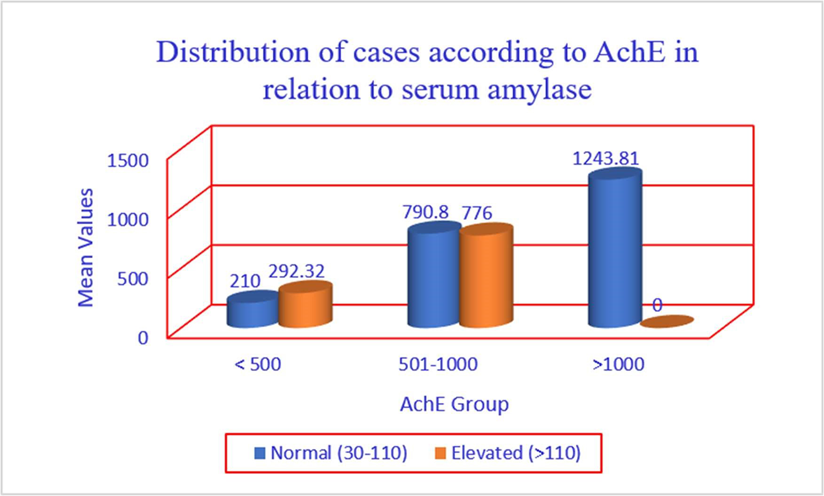
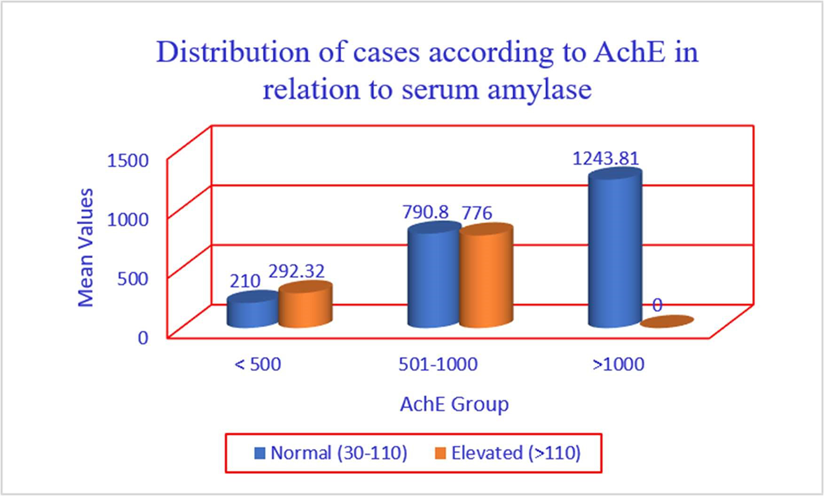
Figure 1,2:Comparison of AchE in relation to serum amylase and serum lipase
Among patients with organophosphorus poisoning, serum amylase showed no significant association with acetylcholinesterase (AchE) levels across any AchE category (all p > 0.05), whereas elevated serum lipase was significantly associated with lower AchE levels in patients with AchE values of 501–1000 U/L (p = 0.020), but not in the other AchE categories.No significant differences were observed between serum amylase or serum lipase groups in patients with AchE levels <500 U/L or >1000 U/L (all p > 0.05).
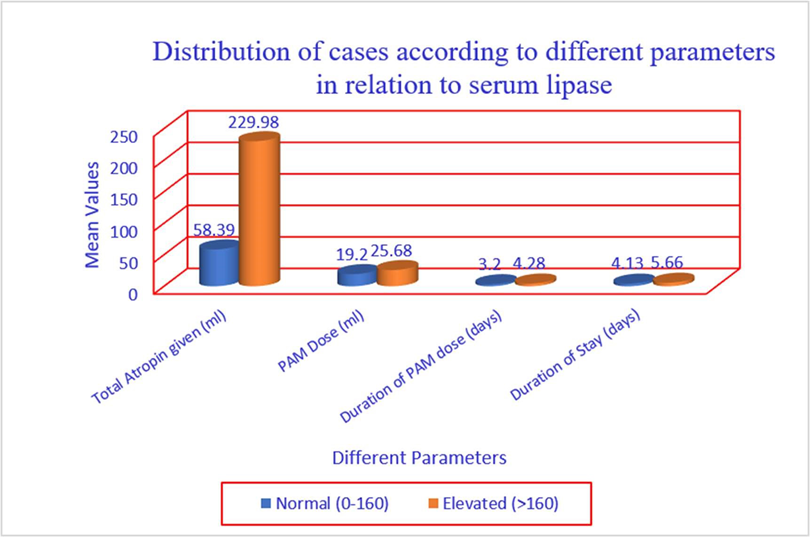
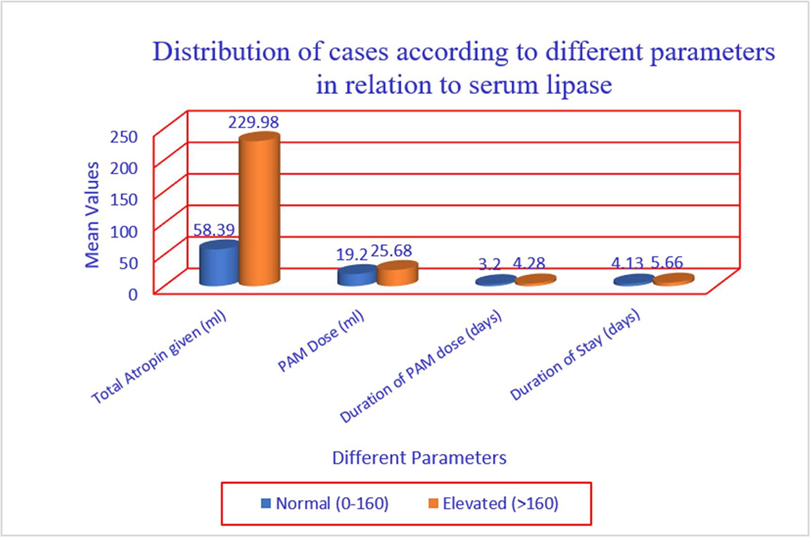
Figure 3,4:Comparison of different parameters with serum amylase and serum lipase
Hospital stay was not significantly different in the elevated serum amylase group (p = 0.366), it was significantly longer in patients with elevated serum lipase levels (p < 0.001).
Table 3 :Distribution of cases according to requirement of mechanical ventilation in relation to serum amylase and serum lipase
|
Mechanical Ventilation Required |
Serum Amylase |
Serum Lipase |
||||||
|
Normal (30-110) |
Elevated (>110) |
Normal (0-160) |
Elevated (>160) |
|||||
|
No. |
% |
No. |
% |
No. |
% |
No. |
% |
|
|
No |
30 |
76.9 |
24 |
58.5 |
27 |
90.0 |
27 |
54.0 |
|
Yes |
9 |
23.1 |
17 |
41.5 |
3 |
10.0 |
23 |
46.0 |
|
Total |
39 |
|
41 |
|
30 |
|
50 |
|
|
2 |
3.080 |
11.077 |
||||||
|
P |
0.079 |
0.001 |
|
|||||
Ventilatory support was required in 41.5% of patients with elevated serum amylase compared with 23.1% of those with normal serum amylase, and in 46.0% of patients with elevated serum lipase compared with 10.0% of those with normal serum lipase.
Table 4: Distribution of cases according to ICU admission in relation to serum amylase and serum lipase
|
ICU admission |
Serum Amylase |
Serum Lipase |
||||||
|
Normal (30-110) |
Elevated (>110) |
Normal (0-160) |
Elevated (>160) |
|||||
|
No. |
% |
No. |
% |
No. |
% |
No. |
% |
|
|
No |
29 |
74.4 |
19 |
46.3 |
26 |
86.7 |
22 |
44.0 |
|
Yes |
10 |
25.6 |
22 |
53.7 |
4 |
13.3 |
28 |
56.0 |
|
Total |
39 |
|
41 |
|
30 |
|
50 |
|
|
2 |
6.537 |
14.222 |
||||||
|
P |
0.011 |
<0.001 |
||||||
ICU care was required in 53.7% of patients with elevated serum amylase compared with 25.6% of those with normal serum amylase, and in 56.0% of patients with elevated serum lipase compared with 13.3% of those with normal serum lipase.
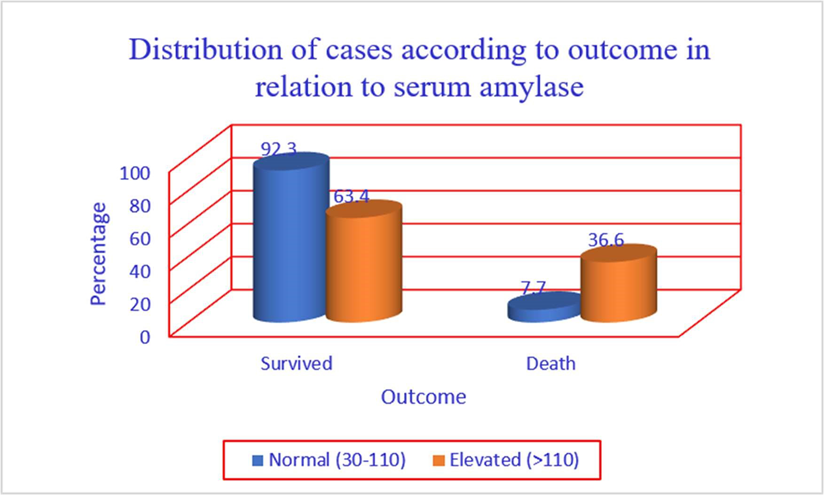
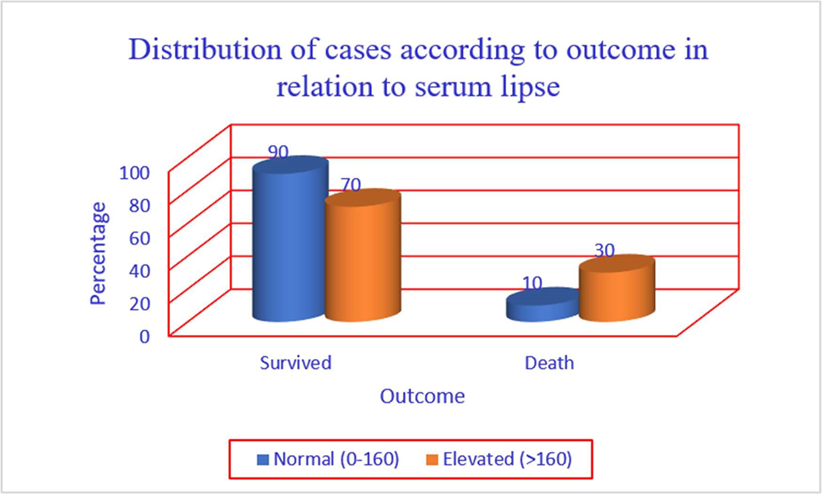
Figure 5,6:Distribution of cases according to outcome in relation to serum amylase and serum lipase
Death occurred in 36.6% of patients with elevated serum amylase versus 7.7% with normal serum amylase, and in 30.0% of patients with elevated serum lipase versus 10.0% with normal serum lipase.
Table 5:Multivariate logistic regression analysis for mortality
|
Parameters |
Β Coefficient |
Adjusted OR (AOR) |
95% CI |
p |
|
Elevated Serum Amylase (>110U/L) |
3.071 |
21.56 |
1.52-306.37 |
0.023 |
|
Elevated Serum Lipase (>160 U/L) |
2.907 |
0.055 |
0.003-0.947 |
0.046 |
|
GCS Score |
0.119 |
1.13 |
0.40-3.17 |
0.822 |
|
POP Score |
0.543 |
1.72 |
0.68-4.35 |
0.251 |
|
Ventilator Requirement |
2.356 |
10.55 |
2.22-50.01 |
0.003 |
Multivariate logistic regression analysis identified elevated serum amylase (AOR = 21.56; 95% CI: 1.52–306.37; p = 0.023) and ventilator requirement (AOR = 10.55; 95% CI: 2.22–50.01; p = 0.003) as significant independent predictors of mortality. Elevated serum lipase was also significantly associated with mortality (p = 0.046), whereas GCS score and POP score were not independent predictors after adjustment (p > 0.05).
DISCUSSION:
In our study, the mean age of patients with normal and elevated serum amylase was 44.67 ± 19.51 years and 44.59 ± 21.11 years, respectively, whereas the mean age of patients with normal and elevated serum lipase was 43.57 ± 20.08 years and 45.26 ± 20.48 years, respectively. The majority of patients belonged to the 21–40 years age group (33.8%), followed by the 41–60 years age group (30.0%). There was no statistically significant association between age and serum amylase (p=0.986) or serum lipase (p=0.719), indicating that pancreatic enzyme elevation occurred irrespective of age. Subedi et al8 conducted a prospective observational study involving 100 patients with acute organophosphorus poisoning and reported a mean age of 39.2 ± 15.6 years, with 62% of patients belonging to the 21–40-year age group.
In our study, the majority of patients (43.8%) reached the hospital within 5 hours of organophosphorus (OP) compound ingestion. Among patients with elevated serum amylase, 53.7% patients within 5 hours, whereas 48.0% of patients with elevated serum lipase also reached the hospital within the same period. The mean interval between ingestion and hospital admission was 5.98 ± 5.38 hours in patients with elevated serum amylase compared with 7.63 ± 3.90 hours in those with normal serum amylase (p=0.122). Similarly, patients with elevated serum lipase had a mean duration time of 6.44 ± 5.13 hours compared with 7.35 ± 4.09 hours among patients with normal serum lipase (p=0.412). Although patients with elevated pancreatic enzymes tended to our earlier, the differences were not statistically significant. Lee et al9 evaluated 121 patients with acute organophosphorus poisoning and observed that patients with hyperamylasemia generally presented with more severe cholinergic manifestations, including respiratory failure and shock.
Our study demonstrated a significant positive association between the quantity of organophosphorus compound ingested and pancreatic enzyme elevation. Patients with elevated serum amylase had consumed significantly larger quantities of poison than those with normal serum amylase (13.90 ± 7.78 mL vs. 8.97 ± 4.47 mL; p = 0.001). Similarly, patients with elevated serum lipase had ingested significantly larger quantities than those with normal serum lipase (13.10 ± 7.42 mL vs. 8.83 ± 4.68 mL; p = 0.006). Notably, none of the patients who consumed 20 mL or more had normal serum amylase or serum lipase values, suggesting a clear dose-dependent relationship between the quantity of poison ingested and pancreatic enzyme elevation.
Our study demonstrated mild poisoning (POP score 0–3), the mean POP score was significantly higher in patients with elevated serum amylase (1.59 ± 1.05) compared to those with normal serum amylase (0.50 ± 0.95, p<0.001). Similarly, patients with elevated serum lipase had significantly higher POP scores (1.48 ± 1.19) than those with normal serum lipase (0.41 ± 0.75, p<0.001). In patients with moderate poisoning (POP score 4–7), serum amylase continued to demonstrate a significant association with POP score (p<0.001), whereas the association between serum lipase and POP score was not statistically significant (p=0.453). No patient in our study belonged to the severe POP score category (8–11). These findings suggest that serum amylase correlates more consistently with increasing clinical severity than serum lipase. Similarly, Dungdung et al10 prospectively studied 100 patients and demonstrated a strong positive correlation between serum amylase and POP score. Patients with serum amylase values above 100 U/L had significantly higher POP scores, increased ventilator requirement (42% vs. 10%), prolonged hospitalization and greater mortality than patients with normal enzyme levels (p<0.001).
In our study, patients with elevated serum amylase generally had lower acetylcholinesterase activity, the differences were not statistically significant. Conversely, serum lipase demonstrated a significant association in patients with intermediate acetylcholinesterase levels (501– 1000 U/L), where patients with elevated serum lipase had significantly lower AChE activity than those with normal serum lipase (745.86 ± 120.44 U/L vs. 857.43 ± 175.98 U/L; p = 0.020). No significant association was observed in patients with very low (<500 U/L) or high (>1000 U/L) acetylcholinesterase values. Aygun et al11 demonstrated that although plasma cholinesterase activity decreased significantly with increasing poisoning severity, the correlation between cholinesterase activity and clinical outcome was weaker than that observed with serum pancreatic enzymes.
Patients with elevated serum amylase required significantly greater cumulative doses of atropine (250.56 ± 196.35 mg) compared with patients having normal serum amylase (76.34 ± 54.70 mg, p<0.001). Likewise, patients with elevated serum lipase required significantly larger atropine doses (221.76 ± 181.42 mg) than those with normal serum lipase (72.27 ± 53.18 mg, p<0.001). Similarly, Dungdung et al10 observed that patients with elevated serum amylase had significantly higher POP scores, prolonged atropine infusion and greater ventilator requirement. Hyperamylasemia was strongly associated with increased atropine requirement throughout hospitalization, supporting its role as an early biochemical marker of poisoning severity.
Our study demonstrated Patients with elevated serum amylase required significantly higher doses of pralidoxime than those with normal serum amylase (28.61 ± 16.42 g vs. 15.74 ± 9.83 g; p <0.001). Similarly, patients with elevated serum lipase also required significantly greater quantities of pralidoxime (27.84 ± 15.88 g) compared to patients with normal serum lipase (15.29 ± 9.45 g; p <0.001). Our study demonstrated Patients with elevated serum amylase had a significantly longer ICU stay and overall hospital stay than patients with normal serum amylase. Similar findings were observed among patients with elevated serum lipase, who also required significantly longer hospitalization (p <0.001).
Mortality in organophosphorus poisoning usually results from respiratory failure, refractory shock, aspiration pneumonia, intermediate syndrome or multiorgan dysfunction. Muley et al12 also demonstrated that mortality increased significantly among patients requiring mechanical ventilation, prolonged atropine therapy and intensive care support. Our findings therefore provide strong evidence that serum amylase and serum lipase are important prognostic biomarkers in acute organophosphorus poisoning.
CONCLUSION:
Acute organophosphorus poisoning affected young adults. Elevated serum amylase and serum lipase levels were significantly associated with greater severity of poisoning, as evidenced by higher POP scores, increased atropine and pralidoxime requirements, greater need for mechanical ventilation, higher rates of ICU admission, prolonged hospital stay, and increased mortality. Among the two biomarkers, serum amylase demonstrated a more consistent association with clinical severity, although both serum amylase and serum lipase showed significant prognostic value. As inexpensive, rapid, and widely available laboratory investigations, serum amylase and serum lipase can serve as useful adjuncts to clinical assessment and POP scoring for early risk stratification of patients with acute organophosphorus poisoning.
REFERENCES:
1. World Health Organization. Public health impact of pesticides used in agriculture. Geneva: WHO; 1990.
2. Eddleston M, Buckley NA, Eyer P, Dawson AH. Management of acute organophosphorus pesticide poisoning. Lancet. 2008;371 (9612):597–607.
3. Senanayake N, Karalliedde L. Neurotoxic effects of organophosphorus insecticides. An intermediate syndrome. N Engl J Med. 1987;316(13):761–3.
4. Kumar SV, Fareedullah M, Sudhakar Y, Venkateswarlu B, Ashok Kumar E. Current review on organophosphorus poisoning. Arch Appl Sci Res 2010;2:199‑215.
5. Amanvermez R, Baydýn A, Yardan T, Baþol N, Günay M. Emergency laboratory abnormalities in intentional patients with acute organophosphate poisoning. Turkish J Biochem 2010;35:29‑34.
6. Anand R, Binukumar BK, Gill KD. Oxidative stress and organophosphate neurotoxicity. Indian J Exp Biol. 2011;49(11): 933–45.
7. Peter JV, Moran JL, Pichamuthu K, Chacko B, Jeyaseelan L. Clinical scoring systems in organophosphate poisoning: Is there a place for serum amylase? J Crit Care. 2014;29(1):54–9.
8. Subedi B, Yadav GK, Raut A, Joshi N, Subedi BK, Joshi N, et al. The relationship of serum amylase levels in acute organophosphorus poisoning with its clinical severity and outcome: a cross-sectional study. Medicine (Baltimore). 2023;102(17):e33508.
9. Lee WC, Yang CC, Deng JF, Wu ML, Ger J, Lin HC, et al. The clinical significance of hyperamylasemia in organophosphate poisoning. J Toxicol Clin Toxicol 1998;36:673‑81.
10. Aygun D, Doganay Z, Altintop L, Guven H, Onar M, Deniz T, et al. The prevalence of pancreatitis in organophosphate poisonings. Hum Exp Toxicol. 2002;21(4):175-7.
11. Dungdung A, Kumar A, Kumar B, Preetam M, Tara RK, Saba MK. Correlation and prognostic significance of serum amylase, serum lipase, and plasma cholinesterase in acute organophosphorus poisoning. J Family Med Prim Care. 2020;9(4):1873-7.
12. Muley A, Shah C, Lakhani J, Bapna M, Mehta J. To identify morbidity and mortality predictors in acute organophosphate poisoning. Indian J Crit Care Med. 2014;18(5):297-300.