Awareness, Perception, and Attitudes Regarding Emerging Postgraduate (PG) Medical Branches Among Medical Students: A Cross-Sectional Study.
- Dr. Anshul Sharma , PG Resident, Department of Community Medicine, MGM Medical College, Indore, Madhya Pradesh, India
- Dr. Chhadit Diwakar , 2nd Year PG Resident, Department of Anesthesia, SMS Medical College, Jaipur, Rajasthan, India
- Dr. Deepankar Mathur , PG Resident, Department of Community Medicine, MGM Medical College, Indore, Madhya Pradesh, India
- Dr. Sanjay Silawat , Demonstrator, Department of Community Medicine, MGM Medical College, Indore, Madhya Pradesh, India
Article Information:
Abstract:
Background: As the healthcare landscape evolves, emerging postgraduate (PG) medical branches such as Emergency Medicine, Family Medicine, and Medical Genetics are gaining critical importance. However, traditional specialties (e.g., General Medicine, General Surgery) often dominate student preferences. Despite the growing demand for these new fields, awareness and optimal perception among undergraduate medical students often remain sub-optimal. Aim and Objectives: To assess the awareness, perception, and factors influencing the choice of emerging PG medical branches among medical students. Material and Methods: A cross-sectional observational study was conducted targeting a calculated sample size of 110 medical students. Data were collected via a pre-designed, semi-structured questionnaire (yielding 108 completed responses) covering sociodemographic details, career goals, awareness levels, perceptions, and factors influencing branch choice. Results: Out of 108 participants, 60.2% were male and 39.8% were female. Awareness was heavily reliant on informal channels, with 63% primarily learning about these branches through social media or YouTube. Emergency Medicine (63%) and Family Medicine (55.6%) were the top emerging branches considered by students. However, significant barriers exist: 64.8% cited a general "lack of awareness" as to why these branches are less popular, and 42.6% still believe an MD in General Medicine is superior to an MD in Family Medicine. Interestingly, a strong shift in priorities was noted, with 62% preferring a branch that offers a better Work-Life Balance over a high-prestige, high-stress branch. Conclusion: Medical students demonstrate a strong latent interest in emerging PG branches, particularly Emergency and Family Medicine, and value work-life balance highly. However, comprehensive knowledge regarding their scope remains inadequate. There is a pressing need for medical colleges to formally integrate exposure to these specialties into the core MBBS curriculum to bridge the gap between interest and actual career pursuit.
Keywords:
Article :
INTRODUCTION:
The postgraduate medical education ecosystem in India is undergoing a necessary structural transition. To address the country's dual burden of non-communicable diseases (NCDs), emerging infections, geriatric expansion, and trauma-induced acute morbidity, the health system requires a more balanced and diversified cadre of specialists [1-3]. Historically, postgraduate medical aspirants in India have overwhelmingly gravitated toward traditional clinical and procedural disciplines, such as General Medicine, General Surgery, Obstetrics and Gynaecology, Pediatrics, and Radiodiagnosis [1,3]. In response to national healthcare imperatives, newer and specialized clinical and non-clinical disciplines—including Emergency Medicine, Family Medicine, Geriatric Medicine, Palliative Medicine, and Medical Genetics—have been formally integrated into the national training framework [2-5].
Regulatory bodies have recognized this imperative. The National Medical Commission (NMC) codified this shift through the Minimum Requirements for Annual M.B.B.S. Admissions Regulations, 2020, making a fully functioning Department of Emergency Medicine mandatory for all medical colleges across the country [4]. Concurrently, the National Health Policy 2017 emphasized the revival of general practice through structured postgraduate programs in Family Medicine to provide comprehensive primary healthcare and reduce unnecessary tertiary care referrals [3,5]. Furthermore, the introduction of the Competency-Based Medical Education (CBME) curriculum for the Indian Medical Graduate aimed to re-orient medical training toward real-world societal health needs [6].
Despite these statutory advancements, the actual uptake and academic prestige of these emerging branches depend decisively on undergraduate medical students’ perceptions, attitudes, and career aspirations [7,8]. Classical career choice models in medical education indicate that specialty preferences are determined by a complex interplay of personal aptitude, societal prestige, earning potential, procedural orientation, peer and parental expectations, and institutional role-modeling [8-10]. Recent global and domestic evidence indicates an evolving paradigm: contemporary cohorts of medical graduates increasingly weigh "controllable lifestyle" and work-life balance when selecting future specialties [11-13].
However, in India, systematic exposure to emerging specialties during the undergraduate MBBS curriculum remains variable, and misconceptions regarding clinical scope, Diplomate of National Board (DNB) versus Doctor of Medicine (MD) parity, and long-term career progression persist [5,7,14]. Without systematic academic validation and clear visibility, students often revert to conventional choices by default. Therefore, this cross-sectional study was undertaken to evaluate the baseline awareness, perceptions, attitudes, and perceived structural barriers regarding emerging PG branches among medical students, providing empirical evidence to guide targeted curricular enhancements and medical career counseling.
Aim and Objectives
Primary Objective: To assess the awareness, perception, and attitudes regarding emerging Postgraduate (PG) medical branches among medical students.
Secondary Objectives:
1. To identify demographic and educational factors (such as current year of MBBS) in the study population.
2. To identify barriers in the optimal acceptance of these newer specialties, specifically focusing on perceived income, social prestige, and sources of information.
MATERIALS AND METHODS:
Study Design and Setting: This was an online, cross-sectional, observational study conducted among undergraduate medical students and interns.
Eligibility Criteria Inclusion criteria: Medical students currently enrolled in the MBBS curriculum (1st year to Interns) willing to provide informed consent. Exclusion criteria: Students from non-MBBS streams or those unwilling to participate.
Sample Size: The minimum sample size required for the study was calculated using the standard formula for cross-sectional study designs. Based on standard parameters (95% Confidence Interval, 50% assumed prevalence, and 9% absolute allowable error), the estimated required sample size was initially targeted at 110 participants. Against this requirement, a total of 108 completed responses were collected.
Data Collection: Tool Data were collected using a pre-tested, semi-structured digital questionnaire divided into various domains: (i) Sociodemographic details, (ii) Awareness Assessment, (iii) Perception and Interest, (iv) Curriculum, Barriers, and PSM Perspective, and (v) Factors Influencing Branch Choice.
Statistical Analysis: Data from the questionnaires were analyzed using descriptive statistics, including frequencies and percentages, to summarize the findings.
RESULTS:
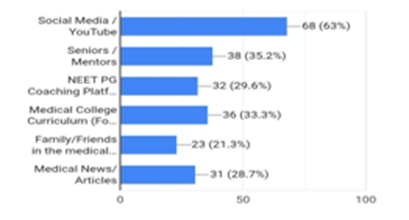
Awareness Regarding Emerging Branches Awareness levels were mixed and largely driven by informal sources. When asked how they primarily learned about these emerging branches, 63% cited "Social Media / YouTube," while 35.2% cited Seniors/Mentors. Only 33.3% learned about them through their formal Medical College Curriculum. Additionally, 57.4% of respondents were aware that the NMC has made 'Emergency Medicine' a mandatory department in medical colleges. When differentiating between a DNB and an MD in these newer branches, 53.7% admitted to only having a "Vague idea," and 22.2% had "No idea" at all.
Perception and Interest
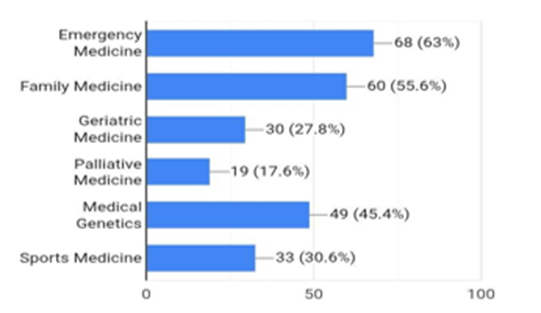
When asked to select their top three choices among emerging branches, Emergency Medicine led significantly at 63%, followed by Family Medicine (55.6%), Medical Genetics (45.4%), and Sports Medicine (30.6%). High technological reliance was acknowledged in specific fields, with 91.7% of respondents believing Medical Genetics or Nuclear Medicine are more dependent on advanced technology than purely clinical skills. Furthermore, a strong 87% of students expressed some level of interest (62% somewhat, 25% very interested) in branches that allow for Tele-medicine or Remote Consulting.
Barriers to Popularity
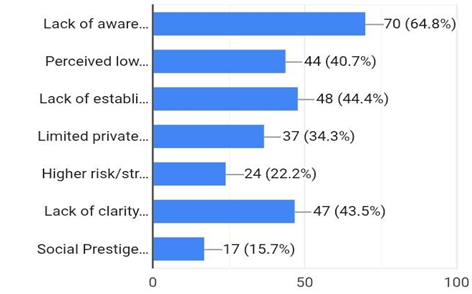
Despite the interest, practical execution of these career paths showed hurdles. When asked why these emerging branches are less popular than traditional ones, respondents cited:
● Lack of awareness (64.8%)
● Lack of established role models (44.4%)
● Lack of clarity on the career pathway (43.5%)
● Perceived lower income (40.7%)
● Limited private practice potential (34.3%)
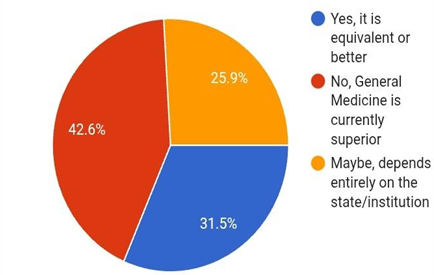
Regarding professional equivalence, 42.6% of respondents still believe an MD in General Medicine is superior to an MD in Family Medicine, highlighting a persistent prestige gap. Furthermore, the lack of clear Super-specialty (DM/MCh) options makes these newer branches less attractive to 50.9% of the cohort.
Factors Influencing Choice and Curriculum Gaps
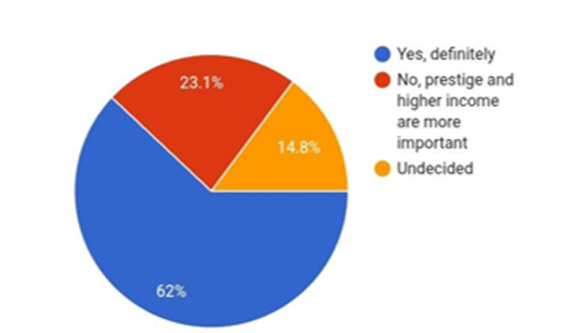
Attitudes toward quality of life were highly favorable for non-traditional metrics. A significant 62% stated they would "definitely" prefer a branch that offers better Work-Life Balance over a high-prestige, high-stress branch.
However, current educational frameworks are viewed as inadequate: 50.9% of students (32.4% Disagree, 18.5% Strongly Disagree) felt the current MBBS curriculum does not provide enough clinical exposure to these newer specialties. Conversely, students recognized the public health value of these fields, with 61.1% agreeing that the 'Public Health' and 'Preventive' aspects of Community Medicine are better addressed in practical branches like Family Medicine and Geriatrics. Positively, 50.9% of respondents would be more willing to serve their mandatory 'Rural Bond' if they could practice as a specialist in Family or Emergency Medicine during that time.
DISCUSSION:
This cross-sectional study evaluated the awareness and perceptions of 108 medical students regarding emerging PG branches. This study illuminates a critical paradox in contemporary Indian medical education: while undergraduate medical students exhibit notable enthusiasm for emerging postgraduate disciplines—led by Emergency Medicine (63.0%) and Family Medicine (55.6%)—their career decisions are constrained by pervasive information deficits, traditional prestige hierarchies, and curriculum inertia.
The Informational Disconnect and Curricular Voids
A salient finding of this study is that nearly two-thirds (63.0%) of respondents derived their knowledge of emerging branches from unstructured social media platforms and YouTube, while only 33.3% acquired this through their formal institutional curriculum. This aligns with observations by Subba et al. and Preece et al., who established that informal media platforms and personal networks frequently fill the vacuum left by structured institutional mentoring in medical colleges [8,13]. While digital platforms can generate initial curiosity, they rarely provide nuanced, evidence-based perspectives regarding accreditation standards, board certifications, and long-term career viability.
This informational deficit is further evidenced by the fact that over three-quarters of respondents had vague or no knowledge regarding the equivalence and practical distinction between DNB and MD qualifications in these newer branches. Although the National Medical Commission and the National Board of Examinations in Medical Sciences (NBEMS) maintain statutory parity between MD and DNB credentials for academic and clinical appointments, historical prejudices linger at the undergraduate level [5,7]. This stems largely from a lack of structured preclinical and clinical exposure within the foundational MBBS program [6,7].
Specialty Preferences: The Ascendancy of Emergency and Family Medicine
The heightened interest in Emergency Medicine (63.0%) observed in our cohort reflects both regulatory modernization and increasing clinical visibility. With the NMC mandating independent departments of Emergency Medicine across all medical colleges, undergraduates are progressively observing dedicated resuscitation bays, acute triage protocols, and dedicated emergency faculty [2,4,14]. As David et al. and Bhoi et al. documented, the evolution of Emergency Medicine from an ad-hoc casualty service run by rotating residents into an independent academic specialty has markedly improved its profile among young graduates [2,14].
Similarly, the substantial interest in Family Medicine (55.6%) highlights a growing recognition of comprehensive, continuous primary care. In a healthcare system characterized by fragmented sub-specialty clinics and escalating out-of-pocket health expenditures, Family Physicians serve as the foundational bedrock for universal health coverage, as envisioned in the National Health Policy 2017 [1,3,5]. Furthermore, 61.1% of our participants recognized that the preventive and promotive principles taught in Community Medicine find practical, patient-centric expression in Family and Geriatric Medicine, suggesting a clear opportunity to link public health training with clinical generalist specialties [5,15].
Structural Barriers: Prestige Hierarchy and Super-Specialty Culture
Despite favorable interest, 64.8% of students identified a general "lack of awareness" and 44.4% identified an "absence of visible role models" as major impediments to pursuing emerging branches. In Indian academic medicine, career choice has historically been modeled on visible departmental leadership [7,9,10]. Because many medical colleges have only recently established departments of Emergency Medicine, Family Medicine, or Medical Genetics, undergraduates routinely interact only with faculty from classical departments (e.g., General Medicine, General Surgery, Pediatrics) [5,7].
This institutional reality reinforces a deeply entrenched prestige bias: 42.6% of our respondents considered MD General Medicine to be superior to MD Family Medicine. As highlighted by Kumar, general practice in India underwent decades of de-professionalization, leading students to conflate Family Medicine with non-specialized general practice rather than viewing it as a rigorous, distinct postgraduate clinical specialty [5,15]. Moreover, over half (50.9%) of our respondents were deterred by the lack of direct super-specialty (DM/MCh) pipelines. In an increasingly sub-specialized urban healthcare marketplace, the perceived absence of immediate tertiary progression drives medical graduates back into conventional pathways that offer established super-specialty fellowships [8-10].
The Lifestyle Shift: Prioritizing Controllability and Well-Being
One of the most consequential findings of this study is that 62.0% of medical students expressed an explicit preference for a branch offering better work-life balance over a high-stress, high-prestige branch. This demonstrates that Indian medical trainees are undergoing a generational shift mirroring international trends described by Schwartz et al. and Dorsey et al. [11,12]. Historically, specialty selection in India was dominated almost entirely by financial reward and societal deference [8-10].
However, escalating resident burnout, unpredictable work hours, and lengthening training trajectories have driven modern graduates to place a premium on "controllable lifestyles"—defined by predictable working hours, personal time, and lower occupational distress [11-13]. Specialties such as Emergency Medicine (which offers distinct shift-based scheduling) and Family Medicine (which permits controlled ambulatory hours and tele-medicine practice, an area favored by 87.0% of our cohort) are uniquely positioned to meet this generational demand [12,13].
Public Health Implications and Policy Alignment
From a public health perspective, the willingness of 50.9% of students to serve mandatory rural bonds if deployed as specialists in Family Medicine or Emergency Medicine is highly significant. A chronic impediment to Indian rural healthcare delivery is the critical deficit of specialists at Community Health Centres (CHCs) and First Referral Units (FRUs) [1,3]. MBBS graduates routinely view rural bond postings as disruptive holding periods that stall their academic progress [1,15].
By creating formalized cadres for Family Physicians and Emergency Physicians within public health infrastructure, state health directorates can simultaneously resolve specialist shortages in secondary health centres and provide meaningful, specialized career pathways for young physicians [3,5,15].
Limitations
The study relies on self-reported data through a digital questionnaire, which may be susceptible to selection bias.
The findings reflect the viewpoints of 108 specific students, primarily in their 1st and 3rd years, which may not be entirely generalizable to the entire nationwide MBBS population.
CONCLUSION:
Medical students demonstrate a highly positive attitude toward emerging branches, recognizing their value in modern healthcare, tele-medicine, and personal work-life balance. However, critical gaps exist in formal clinical exposure within the curriculum. To maximize the workforce benefits of branches like Emergency and Family Medicine, medical colleges must integrate structured, active clinical rotations in these departments. Targeted educational initiatives—focusing on long-term career pathways, earning potential, and super-specialty opportunities—are essential to bridge the gap between initial student interest and ultimate specialization.
REFERENCES:
1. Rao M, Rao KD, Kumar AS, Chatterjee M, Sundararaman T. Human resources for health in India. Lancet. 2011;377(9765):587-598.
2. Bhoi S, Galwankar S, Soni KD, Dwyer KH, Bodiwala G, O'Shea J, et al. Emergency medicine in India: A contemporary perspective. J Emerg Trauma Shock. 2014;7(3):147-151.
3. Ministry of Health and Family Welfare, Government of India. National Health Policy 2017. New Delhi: Ministry of Health and Family Welfare; 2017.
4. National Medical Commission. Minimum Requirements for Annual M.B.B.S. Admissions Regulations, 2020. The Gazette of India: Extraordinary, Part III, Section 4. New Delhi: NMC; 2020.
5. Kumar R. Family medicine at AIIMS (All India Institute of Medical Sciences) like institutions: A historic opportunity to revive general practice in India. J Family Med Prim Care. 2012;1(1):1-3.
6. Medical Council of India. Competency Based Undergraduate Curriculum for the Indian Medical Graduate. New Delhi: Medical Council of India; 2018.
7. Sood R. Medical education in India—problems and prospects. J Assoc Physicians India. 2008;56:345-354.
8. Subba SH, Binu VS, Kotian MS, Joseph N, Mahalingam S, Kokane A, et al. Future specialization interests among medical students in southern India. Natl Med J India. 2012;25(4):226-229.
9. Kumar A, Mitra K, Garg S, Pradhan SK. A study of career preferences among undergraduate medical students in a medical college of New Delhi, India. J Family Med Prim Care. 2014;3(2):126-130.
10. Lal P, Malhotra C, Nath A, Jena PK, Kumar R, Ingle GK. Career aspirations and preferences of medical undergraduates in New Delhi. Indian J Community Med. 2007;32(3):217-219.
11. Schwartz RW, Haley JV, Kearney PA, Simpson WE Jr. The controllable lifestyle factor and students' attitudes about specialty selection. Acad Med. 1990;65(3):207-210.
12. Dorsey ER, Jarjoura D, Rutecki GW. Influence of controllable lifestyle on recent trends in specialty choice by US medical students. JAMA. 2003;290(9):1173-1178.
13. Preece R, Greenfield SM. Specialty choice in medical students: a systematic review of the literature. Postgrad Med J. 2021;97(1148):375-381.
14. David SS, Paul B, Rao A, Samuel P, Sridhar A. Emergency medicine in India: Current scenario and future prospects. Int J Emerg Med. 2010;3(4):301-306.
15. Kumar R. Academic family medicine in India: A burgeoning field of medical humanities. J Family Med Prim Care. 2020;9(1):1-5.