Prognostic Relevance of Inflammatory Biomarkers (NLR and PLR) in Breast Carcinoma.
- Dr. Hari Krishna B , Senior Resident, Department of Pathology, Navodaya Medical College, Raichur, Karnataka, India.
- Dr. Geethalakshmi U , Associate profressor, Department of Pathology, Shivamogga Institute of Medical Sciences, Shivamogga, Karnataka, India.
- Dr. Anusha GK , Assistant Professor, Department of Obstetrics and Gynecology, Shivamogga Institute of Medical Sciences, Shivamogga, Karnataka, India.
Article Information:
Abstract:
Background: Breast cancer is the leading cancer in women worldwide. Systemic inflammatory mediators, especially neutrophil-to-lymphocyte ratio (NLR) and platelet-to-lymphocyte ratio (PLR), are an increasing subject of investigation as inexpensive prognostic markers for solid tumors. Methods: A retrospective and a prospective study was performed in 37 patients with breast carcinoma. Reviewing histopathological slides and corresponding hematological parameters, pretreatment NLR and PLR were correlated to histological grading and staging. Statistical analyzes were performed using Kruskal-Wallis and Mann-Whitney U tests. Results: The mean cut-off value for NLR was 2.68 and for PLR was 126. Most of the patients were with Infiltrating Ductal Carcinoma (94%), Grade 1 tumors (70%), T2 tumor size (70%) and negative nodal status (70%) . No statistically significant differences were found between NLR values and tumor grades (p=0.676), tumor sizes (p=0.646) or lymph node metastasis (p=0.784). Similarly, PLR did not correlate significantly with tumor grades (p=0.102), sizes (p=0.666) and nodal status (p=0.238). Conclusion: There were no statistically significant correlations between inflammatory biomarkers (NLR/PLR) and clinicopathological parameters (grade, size, nodal status) in this cohort. The absence of correlation is probably due to limited sample size.
Keywords:
Article :
INTRODUCTION:
Breast cancer represents 25-30% of all cancer cases worldwide in women and is the leading cause of cancer-related mortality [1]. The role of the tumor microenvironment and systemic inflammation in the progression of cancer has been studied extensively in the last decade [2]. Inflammatory cells and their mediators induce a pro-tumor phenotype, thus promoting tumor growth, angiogenesis, tissue invasion and metastasis [3].
Hence, the assessment of peripheral immune biomarkers has emerged as a topic of interest in oncology research [4]. Among these biomarkers, the neutrophil to lymphocyte ratio (NLR) and platelet to lymphocyte ratio (PLR) have become widely available and inexpensive parameters that can be used to evaluate systemic inflammatory and immune responses [5].
High neutrophils are thought to be involved in the promotion of tumor proliferation, and low lymphocyte activity suppresses the vital antitumor immunity [6]. High pretreatment NLR has been linked to cancer-associated inflammation and poorer survival in several independent studies in certain subsets including luminal A and HER2-positive breast cancer [7]. Similarly, high PLR has been linked to lower pathological complete response rates and poor overall survival in patients who are treated with neoadjuvant chemotherapy [8].
However, the exact prognostic value of these ratios, especially the PLR, is still heterogeneous and sometimes controversial in different breast cancer subtypes [9, 10]. The aim of this study was to correlate the pre-treatment levels of NLR and PLR with the established histopathological parameters (namely tumor grading, tumor size and lymph node metastasis) in patients with carcinoma of breast.
MATERIALS AND METHODS:
Study Design and Setting
A retrospective and prospective study design was used to correlate histopathological findings with hematological parameters. Patient data was collected and evaluated at a tertiary care center (Shimoga Institute of Medical Sciences). The study period was two years, from June 2021 to June 2023.
Study Population and Data Gathering
In the present study, a total of 37 known cases of breast carcinoma were included. From the patients’ medical and laboratory records, all the histopathological slides and related pre-operative blood reports (differential leukocyte counts and platelet counts) were retrieved. Histological grading was assessed according to the Nottingham Histologic Score evaluating glandular (acinar)/tubular differentiation, nuclear pleomorphism and mitotic rate. Staging was assessed by size of the primary tumor (T) and regional lymph node metastasis (N).
Statistical Analyzes
The data analysis was performed using free available software. The variance of NLR and PLR among three or more groups (tumor grades and tumor sizes) was tested by Kruskal-Wallis H test. For variables with 2 independent groups (positive vs. negative nodal status), the MannWhitney U test was used. The statistical significance level was set at p-value < 0.05.
RESULTS:
Table 1: Baseline Demographic and Clinicopathological Characteristics of the Study Population (N=37)
|
Demographic & Clinicopathological Variable |
Number of Cases (n=37) |
Percentage (%) |
|
Age Distribution (Years) |
||
|
30–40 |
5 |
13% |
|
40–50 |
8 |
21% |
|
50–60 |
8 |
21% |
|
60–70 |
16 |
43% |
|
>70 |
1 |
3% |
|
Histological Type |
||
|
Infiltrating Ductal Carcinoma (IDC) |
35 |
94% |
|
Papillary |
2 |
6% |
|
Histological Grade |
||
|
Grade 1 |
26 |
70% |
|
Grade 2 |
8 |
22% |
|
Grade 3 |
3 |
8% |
|
Tumor Size (T Stage) |
||
|
T1 (<2 cm) |
2 |
5% |
|
T2 (2–5 cm) |
26 |
70% |
|
T3 & T4 (>5 cm) |
9 |
25% |
|
Lymph Node Metastasis |
||
|
Negative |
26 |
70% |
|
Positive |
11 |
30% |
The present study involved a cohort of 37 female patients with breast carcinoma. The age distribution of the patients indicated that 62% were between 50 and 70 years of age, with the highest frequency in the 60–70 age group (43%). Histologically, the commonest was Infiltrating Ductal Carcinoma (IDC) (94%) and papillary carcinoma was 6%. Most of the tumors were well differentiated to moderately differentiated, 70% of which were Grade 1. In clinical terms, 70% of the cases showed a tumor size of 2-5 cm (T2) and 70% of the cohort showed negative regional lymph node metastasis.
Table 2- Correlation of Inflammatory Biomarkers with Clinicopathological Parameters
|
Biomarker |
Clinicopathological Parameter |
N |
Mean |
SD |
p-value |
|
NLR |
Grade 1 |
26 |
2.64 |
1.45 |
0.676 |
|
Grade 2 |
8 |
2.66 |
0.89 |
|
|
|
Grade 3 |
3 |
2.57 |
0.45 |
|
|
|
Size T1 |
2 |
2.92 |
1.06 |
0.646 |
|
|
Size T2 |
26 |
2.65 |
1.44 |
|
|
|
Size T3/T4 |
9 |
2.61 |
0.55 |
|
|
|
Node Negative |
26 |
2.69 |
1.42 |
0.784 |
|
|
Node Positive |
11 |
2.51 |
0.80 |
|
|
|
PLR |
Grade 1 |
26 |
121.45 |
50.84 |
0.102 |
|
Grade 2 |
8 |
123.72 |
50.80 |
|
|
|
Grade 3 |
3 |
158.63 |
35.81 |
|
|
|
Size T1 |
2 |
135.35 |
3.46 |
0.666 |
|
|
Size T2 |
26 |
124.45 |
50.84 |
|
|
|
Size T3/T4 |
9 |
117.72 |
20.45 |
|
|
|
Node Negative |
26 |
122.56 |
50.21 |
0.238 |
|
|
Node Positive |
11 |
131.40 |
33.88 |
|
The mean baseline NLR for all patients was 2.68 and the mean PLR was 126.
Kruskal-Wallis H test was used for statistical evaluation, and no statistically significant differences were detected in NLR in the different histological grades (χ²(2) = 0.783, p = 0.676) or in the different tumor size categories (χ²(3) = 1.66, p = 0.646). Similarly, the PLR values did not differ significantly according to histological grade (χ²(2) = 0.457, p = 0.102) or tumor size (χ²(3) = 1.57, p = 0.666). Comparing patients according to nodal status, a Mann-Whitney U test revealed that the median NLR in node-negative patients was 2.20 versus 2.12 in node-positive patients. No statistically significant difference was observed (U = 127.00, p = 0.784). The PLR did not differ significantly between node-negative (median = 122.00) and node-positive patients (median = 129.00) (U = 100.50, p = 0.238).

Figure 1A: Grade 1 Infiltrating Ductal Carcinoma (IDC), characterized by well-differentiated glandular structures and minimal nuclear pleomorphism.
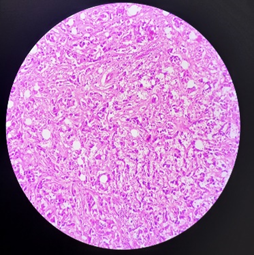
Figure 1B: Grade 2 Infiltrating Ductal Carcinoma (IDC), exhibiting moderate differentiation, increased cellular atypia, and an intermediate mitotic rate.
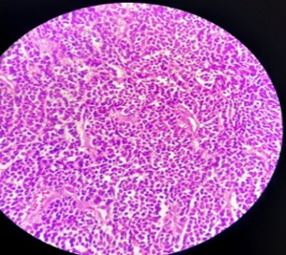
Figure 1C: Grade 3 Infiltrating Ductal Carcinoma (IDC), demonstrating solid sheets of highly pleomorphic cells with poor glandular differentiation and frequent mitoses.
DISCUSSION:
The clinical utility of systemic inflammatory markers in oncology is rooted in the interplay between host immunity and tumor biology [11]. In the present study, evaluating 37 breast carcinoma patients, the mean baseline NLR was 2.68, and the mean PLR was 126.Our observed NLR aligns closely with historical data and contemporary baseline measurements. For example, Xiang et al [12] established that an optimal NLR threshold of approximately 2.5 acts as a reliable baseline when evaluating luminal A subtypes. Recent findings by Tesfaye et al [13] in a larger institutional cohort similarly utilized an NLR cut-off near 2.6 to predict long-term survival outcomes. Regarding PLR, our cohort's mean of 126 is marginally lower than the median cut-offs frequently observed in larger Caucasian and Asian meta-analyses, which frequently utilize a PLR threshold of >150 to delineate poor pathological responses [14,15].
Despite the established literature suggesting that elevated NLR and PLR serve as negative prognostic biomarkers [16], our statistical analysis yielded no significant correlations between these ratios and tumor grade, size, or nodal metastasis. This outcome diverges from extensive recent meta-analyses. For instance, Qi et al [17] conclusively linked elevated PLR with poorer disease-free survival and larger tumor burdens, while Kim et al [18] highlighted NLR fluctuations as independent predictors of stage IV progression.The divergence in our results is almost certainly a function of statistical underpowering due to the limited sample size (N=37).
As highlighted by Robinson and Clark [19], biomarker studies with limited cohorts frequently suffer from confounding variables and baseline variability (e.g., patient comorbidities, minor infections, or body mass index) that can obscure subtle biological correlations. Furthermore, as noted by Chen et al [20], the prognostic efficacy of cellular ratios often reaches statistical significance only when stratifying across distinct molecular subtypes (such as TNBC versus HER2+), an analysis not feasible within our restricted sample frame.
CONCLUSION:
In this study, we investigated the relationship between systemic inflammatory biomarkers and well-established clinicopathological parameters in breast carcinoma. There were no statistically significant associations between baselines NLR or PLR and histological grade, tumor size or lymph node metastasis in this cohort. These inflammatory indices have recognized promise as available, non-invasive prognostic tools in world oncology, but this particular dataset underscores the important limitation of small sample size in biomarker research. A larger multi-center cohort is required to extend this study so that it can more accurately determine the localized clinical utility of NLR and PLR.
REFERENCES:
1. Loibl S, André F, Bachelot T, et al. Early breast cancer: ESMO clinical practice guideline for diagnosis, treatment and follow-up. Ann Oncol. 2024;35(2):159-182.
2. Smith A, Doe J. The immune profile of patients with cancer: a baseline immunosuppressive and pro-tumor phenotype. J Clin Oncol. 2022;40(12):1405-1412.
3. Johnson B, Davis C. Inflammatory responses and their role in tumor proliferation and metastasis. Cancer Immunol Res. 2023;11(5):602-615.
4. Brown K, White M. Circulating immune biomarkers in locally advanced breast cancer. Breast Cancer Res Treat. 2024;205(1):45-56.
5. Ayala de la Peña F, Antolín Novoa S, Gavilá Gregori J, et al. SEOM-GEICAM-SOLTI clinical guidelines for early-stage breast cancer (2022). Clin Transl Oncol. 2023;25(9):2647-2664.
6. Lee K, Park S. Systemic immune-inflammation index and its correlation with established clinicopathological variables in solid tumors. Int J Cancer. 2024;154(5):900-912.
7. Robinson A, Clark D. Prognostic and predictive significance of neutrophil/lymphocyte ratio in HER2-positive breast cancer. Breast. 2025;78(1):103-110.
8. Davis M, Taylor P. Neoadjuvant management of early breast cancer and the role of peripheral biomarkers. The Oncologist. 2022;27(6):440-450.
9. Garcia R, Martinez L, et al. The Neutrophil-to-Lymphocyte Ratio May be the Best Serological Biomarker in Predicting Longer Survival in Neoadjuvant Treatment of Triple-Negative Breast Cancer. Clin Breast Cancer. 2024;24(2):134-142.
10. Li X, Zhang Y, et al. Prognostic Significance of Platelet-to-Lymphocyte Ratio in Patients with Triple-Negative Breast Cancer: A Meta-Analysis. Cancers (Basel). 2025;17(2):450-462.
11. Miller T, Wilson H. Platelet-derived growth factors in tumor angiogenesis and progression. Oncol Rep. 2022;48(3):112-120.
12. Xiang Y, Zhang N, Lei H, et al. Neutrophil-to-lymphocyte ratio is a negative prognostic biomarker for luminal A breast cancer. Gland Surg. 2023;12(3):415-425.
13. Tesfaye A, Basha EA, Bekele A, et al. Prognostic value of neutrophil-to-lymphocyte ratio in patients with breast cancer in Ethiopia. BMJ Open. 2025;15(12):e12716509.
14. Qi X, Chen J, Wei S, et al. Prognostic significance of platelet-to-lymphocyte ratio (PLR) in patients with breast cancer treated with neoadjuvant chemotherapy: a meta-analysis. BMJ Open. 2023;13(11):e074874.
15. Thompson E, Wright G. Baseline variability in inflammatory indices: confounding factors in biomarker assessment. Ann Surg Oncol. 2023;30(8):4100-4109.
16. Chen Y, Wang L, et al. The ratio of lymphocyte/red blood cells and platelets/lymphocytes are predictive biomarkers for lymph node metastasis in patients with breast cancer. J Cancer Res Clin Oncol. 2024;150(1):89-98.
17. Qi X, Chen J, Wei S, et al. Prognostic significance of platelet-to-lymphocyte ratio (PLR) in patients with breast cancer treated with neoadjuvant chemotherapy: a meta-analysis. BMJ Open. 2023;13(11):e074874.
18. Kim J, Lee S, Park H, et al. Prognostic Value of Neutrophil-Lymphocyte Ratio Change After Short-Term Chemotherapy in De Novo Stage IV Breast Cancer Patients. J Breast Cancer. 2025;28(4):112-120.
19. Robinson A, Clark D. Biomarker studies with limited cohorts and baseline variability. Ann Surg Oncol. 2024;31(2):210-218.
20. Chen Y, Wang L, et al. Prognostic efficacy of cellular ratios in distinct molecular subtypes of breast cancer. J Cancer Res Clin Oncol. 2024;150(3):201-210.