Comparative Evaluation of Patient Satisfaction with Digital and Conventionally Fabricated Complete Dentures: A Clinical Study.
- Bimleshwar Kumar , Tutor, Department of Oral and Maxillofacial Surgery, Government Dental College, Rahui, Nalanda (Bihar).
- Jay Prakash Narayan , Lecturer, Department of Prosthodontics, Government Dental College, Rahui, Nalanda (Bihar).
- Nisha Kumari , Dental Surgeon, Department of Paediatric and Preventive Dentistry, Patna Dental College and Hospital, Patna (Bihar).
- Rachna Raj , Lecturer, Department of Community Dentistry, Patna Dental College and Hospital, Patna (Bihar).
- Vikash Vaibhav , Principal, Professor and Head, Department of Prosthodontics, Government Dental College, Rahui, Nalanda (Bihar).
Article Information:
Abstract:
Background: Digital technologies have increasingly been incorporated into complete denture fabrication, offering the potential for improved clinical efficiency and patient experience. This study aimed to compare patient satisfaction and selected clinical outcomes between digitally and conventionally fabricated complete dentures. Materials and Methods: This prospective comparative clinical study included 60 completely edentulous patients, randomly allocated into two groups of 30 each. Group I received conventionally fabricated complete dentures, while Group II received digitally fabricated complete dentures. Patient satisfaction was assessed at the 1-month follow-up using a 5-point Likert scale evaluating comfort, retention, stability, esthetics, mastication, phonetics, ease of adaptation, and overall satisfaction. The number of clinical visits and post-insertion adjustments was also recorded. Appropriate parametric and non-parametric statistical tests were applied, with p<0.05 considered statistically significant. Results: The digital denture group demonstrated significantly higher scores for comfort, retention, stability, mastication, ease of adaptation, and overall satisfaction (p<0.001). Overall satisfaction was 4.27 ± 0.52 in the digital group compared with 3.30 ± 0.60 in the conventional group. No significant differences were observed for esthetics (p=0.126) or phonetics (p=0.173). Digital dentures required significantly fewer clinical visits (3.23 ± 0.43 vs. 5.57 ± 0.50) and post-insertion adjustments (1.37 ± 0.56 vs. 2.03 ± 0.67), with p<0.001 for both comparisons. Conclusion: Digitally fabricated complete dentures provided greater patient satisfaction in several functional domains and reduced the number of clinical visits and post-insertion adjustments compared with conventional dentures. Digital complete dentures may offer an effective and clinically efficient alternative to conventional complete denture fabrication.
Keywords:
Article :
INTRODUCTION:
Complete edentulism continues to be an important oral health concern, particularly among older adults, as the loss of natural teeth can adversely affect mastication, speech, facial appearance, social interaction, and overall quality of life. Complete dentures remain one of the most commonly used treatment options for the rehabilitation of completely edentulous patients, particularly when implant-supported rehabilitation is not feasible or preferred. However, the success of complete denture treatment is not determined solely by the technical quality of the prosthesis. Patient-related factors such as comfort, retention, stability, esthetics, chewing ability, speech, and overall satisfaction are equally important in determining treatment acceptance and long-term success [1,2].
Conventionally fabricated complete dentures have been used successfully for many decades and remain an established treatment modality for edentulous patients. Their fabrication involves several clinical and laboratory procedures, including preliminary and definitive impressions, recording of maxillomandibular relations, arrangement of artificial teeth, wax try-in, processing, finishing, and subsequent adjustments. Although these procedures are well established, the conventional workflow can be time-consuming and technique-sensitive, and errors may occur at different stages of fabrication. Moreover, multiple clinical visits may be inconvenient for elderly patients, particularly those with limited mobility or difficulty attending repeated appointments [3]. The introduction of computer-aided design and computer-aided manufacturing (CAD-CAM) technology has considerably changed the approach to complete denture fabrication. Digital complete dentures can be designed virtually and manufactured using subtractive milling or additive three-dimensional (3D) printing techniques.
Digital workflows offer several potential advantages, including greater standardization, reproducibility of prosthesis design, digital storage of patient records, and reduction in clinical and laboratory procedures [3,4]. Advances in digital technology have also improved the accuracy and clinical applicability of these workflows, making digitally fabricated complete dentures an increasingly viable alternative to conventionally processed dentures [4]. From a clinical perspective, digital fabrication may influence denture adaptation, retention, stability, comfort, and the number of post-insertion adjustments required. Studies evaluating CAD-CAM complete dentures have reported favorable outcomes related to denture fit, clinical efficiency, and patient experience when compared with conventional fabrication techniques [4,5]. Digital workflows may also reduce the number of clinical appointments and overall treatment time in selected protocols, which may be particularly beneficial for elderly and medically compromised patients [5,6]. Despite these technological advantages, improved fabrication alone does not necessarily translate into greater patient satisfaction. Satisfaction with complete dentures is multidimensional and may be influenced by comfort, retention, stability, mastication, speech, esthetics, adaptation, and individual patient expectations [1,2].
Clinical studies comparing digital and conventional complete dentures have reported variable findings. Some studies have demonstrated comparable overall patient satisfaction between the two techniques, whereas differences have been observed in individual parameters such as comfort, retention, mastication, pronunciation, and the requirement for post-insertion adjustments [7]. More recent evidence suggests that digitally fabricated complete dentures may provide comparable or improved patient-centered outcomes; however, the available findings are not entirely consistent, highlighting the need for further clinical evaluation [8].
With the increasing incorporation of digital technology into contemporary prosthodontic practice, it is important to determine whether its technical and procedural advantages are reflected in the patient's experience. Direct comparison of patient satisfaction with digitally and conventionally fabricated complete dentures can provide clinically meaningful information regarding the acceptance and effectiveness of these treatment approaches. Therefore, the present study was undertaken to compare patient satisfaction with digital and conventionally fabricated complete dentures, with particular emphasis on patient-centered parameters relevant to successful complete denture rehabilitation.
MATERIALS AND METHODS:
Study Design and Setting
This prospective comparative clinical study was conducted over a period of one year in the Department of Prosthodontics and the Department of Oral and Maxillofacial Surgery, Government Dental College, Rahui, Nalanda, Bihar, India. Completely edentulous patients who reported to the outpatient department for complete denture rehabilitation were screened for eligibility according to the predefined inclusion and exclusion criteria. Before enrolment, all eligible participants were informed about the purpose and procedures of the study in a language they could understand, and written informed consent was obtained from each participant. The study was conducted in accordance with the ethical principles of the Declaration of Helsinki.
Sample Size Calculation
The sample size was estimated using G*Power software version 3.1.9.7 for the comparison of the primary outcomes between the two independent groups. Assuming a large standardized effect size (Cohen’s d = 0.80), a two-sided significance level (α) of 0.05, statistical power of 80%, and an allocation ratio of 1:1, the minimum required sample size was estimated to be 52 participants (26 participants per group). To compensate for possible dropouts or incomplete follow-ups, the final sample size was increased to 60 participants, with 30 participants allocated to each group.
Study Population
The study population comprised completely edentulous patients who reported to the outpatient department for rehabilitation with maxillary and mandibular complete dentures. Patients were screened according to the predefined eligibility criteria, and those fulfilling the inclusion and exclusion criteria were invited to participate in the study. A total of 60 eligible participants who provided written informed consent were enrolled in the study.
Inclusion Criteria
Patients aged 45–75 years who were completely edentulous and required rehabilitation with maxillary and mandibular complete dentures were considered eligible for the study. Patients with adequate interarch space and residual alveolar ridges suitable for complete denture rehabilitation were included. Participants were required to understand and respond to the patient satisfaction questionnaire and to be willing to attend the scheduled follow-up visits.
Exclusion Criteria
Patients with severely resorbed residual alveolar ridges, flabby ridges, or active oral mucosal pathologies were excluded from the study. Patients with temporomandibular disorders, severe xerostomia, neuromuscular disorders, or systemic conditions that could adversely affect denture retention, function, or adaptation were excluded. Patients with a history of implant-supported prosthetic rehabilitation and those unable or unwilling to attend scheduled follow-up visits were excluded.
Group Allocation
The 60 eligible participants were randomly allocated to two groups of 30 participants each using a computer-generated randomization sequence.
Group I (Conventional Denture Group): comprised 30 participants who received conventionally fabricated complete dentures.
Group II (Digital Denture Group): comprised 30 participants who received digitally fabricated complete dentures.
The same standardized clinical protocols were followed for all participants within each group to minimize the procedural variations.
Fabrication of Conventional Complete Dentures
For Group I, complete dentures were fabricated following the conventional clinical and laboratory protocols. Preliminary impressions of the maxillary and mandibular edentulous arches were made, followed by the fabrication of custom impression trays. Border moulding and definitive impressions were performed, and master casts were obtained. Maxillomandibular relations were recorded using occlusal rims, and the casts were mounted on an articulator. Artificial teeth were arranged according to the recorded jaw relations, followed by a clinical wax try-in to verify esthetics, phonetics, vertical dimension, and occlusion.
After satisfactory clinical verification, the dentures were processed using heat-polymerized acrylic resin. The processed dentures were finished and polished, and the necessary occlusal corrections were performed before insertion. At the time of denture delivery, the fit, extension, retention, stability, occlusion, esthetics, and phonetics were clinically evaluated, and necessary adjustments were made before final delivery.
Fabrication of Digital Complete Dentures
For Group II, complete dentures were fabricated using a digital CAD-CAM workflow. Preliminary impressions of the maxillary and mandibular edentulous arches were made using conventional impression procedures. The impressions and maxillomandibular relationship records were digitized using a laboratory scanner, and the resulting data were converted into Standard Tessellation Language (STL) files. The digital records were imported into dental CAD software, where virtual maxillary and mandibular casts were generated. The denture bases and artificial teeth were digitally designed, with particular attention to denture-base extension, tooth arrangement, occlusal relationships, vertical dimension, esthetics, and phonetics.
Following verification and approval of the virtual design, the definitive dentures were fabricated using a subtractive CAD-CAM milling technique from prepolymerized polymethyl methacrylate (PMMA) material. The denture bases and tooth components were milled according to the manufacturer's recommended protocol and subsequently assembled and finished. The completed dentures were polished and evaluated for surface quality and accuracy before clinical insertion. At the insertion appointment, denture extension, adaptation, retention, stability, occlusion, esthetics, and phonetics were clinically evaluated, and necessary adjustments were performed before final delivery.
Post-Insertion Follow-up
Following denture insertion, all participants were provided with standardized instructions regarding denture use, maintenance, and oral hygiene. Patients in both groups were recalled at 24 hours, 1 week, and 1 month after denture insertion for clinical evaluation and necessary adjustments. At each follow-up visit, complaints related to discomfort, pressure areas, retention, stability, mastication, speech, and esthetics were assessed and managed appropriately. Patient satisfaction was evaluated at the 1-month follow-up visit, allowing an adequate period for adaptation to the newly fabricated dentures.
Assessment of Patient Satisfaction
Patient satisfaction was assessed at the 1-month follow-up visit using a structured questionnaire adapted from the study by Sharma et al. [2]. The questionnaire evaluated eight patient-centered parameters related to complete denture rehabilitation: comfort, retention, stability, esthetics, mastication, phonetics, ease of adaptation, and overall satisfaction. Each parameter was assessed using a 5-point Likert scale, with responses scored as 1 – Very dissatisfied, 2 – Dissatisfied, 3 – Neutral, 4 – Satisfied, and 5 – Very satisfied. Higher scores indicated greater patient satisfaction. The scores for each parameter were recorded separately and subsequently compared between the conventional and digital complete denture groups.
Outcome Measures
The primary outcome of the study was overall patient satisfaction with the complete dentures at the 1-month follow-up. Secondary outcomes included patient satisfaction with comfort, retention, stability, esthetics, mastication, phonetics, and ease of adaptation. In addition, the total number of clinical visits required for denture fabrication and the number of post-insertion adjustments required during the follow-up period were recorded and compared between the conventional and digital complete denture groups.
Statistical Analysis
Data were entered into Microsoft Excel and analyzed using IBM SPSS Statistics for Windows, version 26.0 (IBM Corp., Armonk, NY, USA). Continuous variables were summarized as mean ± standard deviation (SD), while categorical variables were expressed as frequencies and percentages. Normality of continuous variables was assessed using the Shapiro–Wilk test. Patient satisfaction scores measured on the 5-point Likert scale were compared between the conventional and digital denture groups using the Mann–Whitney U test. Normally distributed continuous variables, including age, number of clinical visits, and number of post-insertion adjustments, were compared using the independent-samples t-test. Categorical variables were compared using the Chi-square test or Fisher’s exact test, as appropriate. The distribution of overall satisfaction across the five response categories was compared between the two groups using the Fisher–Freeman–Halton exact test. All statistical tests were two-tailed, and a p-value <0.05 was considered statistically significant.
RESULTS:
A total of 60 completely edentulous patients were included in the study and equally allocated to the conventional denture group (Group I, n=30) and digital denture group (Group II, n=30). The mean age was 61.3 ± 7.8 years in Group I and 60.7 ± 8.1 years in Group II, with no significant difference between the groups (p=0.772). Group I comprised 17 (56.7%) males and 13 (43.3%) females, while Group II comprised 16 (53.3%) males and 14 (46.7%) females. The sex distribution was also comparable between the groups (p=0.795) (Table 1).
Table 1. Baseline characteristics of participants in the two study groups
|
Variable |
Group I (Conventional Denture Group) (n=30) |
Group II (Digital Denture Group) (n=30) |
P-value |
|
Age (years) Mean ± SD |
61.3 ± 7.8 |
60.7 ± 8.1 |
0.772 |
|
Sex, n (%) |
|||
|
Male |
17 (56.7) |
16 (53.3) |
0.795 |
|
Female |
13 (43.3) |
14 (46.7) |
|
At the 1-month follow-up, significantly higher satisfaction scores were observed in the digital denture group for comfort (4.20 ± 0.55 vs. 3.27 ± 0.58), retention (4.30 ± 0.53 vs. 3.17 ± 0.59), stability (4.17 ± 0.59 vs. 3.13 ± 0.63), mastication (4.03 ± 0.56 vs. 3.30 ± 0.60), and ease of adaptation (4.20 ± 0.55 vs. 3.23 ± 0.63), with p<0.001 for all comparisons. Overall satisfaction was also significantly higher in Group II than in Group I (4.27 ± 0.52 vs. 3.30 ± 0.60; p<0.001). However, no statistically significant differences were observed for esthetics (4.07 ± 0.58 vs. 3.83 ± 0.59; p=0.126) or phonetics (3.93 ± 0.52 vs. 3.73 ± 0.58; p=0.173) (Table 2 and Figure 1).
Table 2. Comparison of patient satisfaction scores between conventional and digital complete denture groups at 1 month
|
Satisfaction parameter |
Group I (Conventional Denture Group) (n=30) |
Group II (Digital Denture Group) (n=30) |
P-value |
|
Comfort |
3.27 ± 0.58 |
4.20 ± 0.55 |
<0.001* |
|
Retention |
3.17 ± 0.59 |
4.30 ± 0.53 |
<0.001* |
|
Stability |
3.13 ± 0.63 |
4.17 ± 0.59 |
<0.001* |
|
Esthetics |
3.83 ± 0.59 |
4.07 ± 0.58 |
0.126 |
|
Mastication |
3.30 ± 0.60 |
4.03 ± 0.56 |
<0.001* |
|
Phonetics |
3.73 ± 0.58 |
3.93 ± 0.52 |
0.173 |
|
Ease of adaptation |
3.23 ± 0.63 |
4.20 ± 0.55 |
<0.001* |
|
Overall satisfaction |
3.30 ± 0.60 |
4.27 ± 0.52 |
<0.001* |
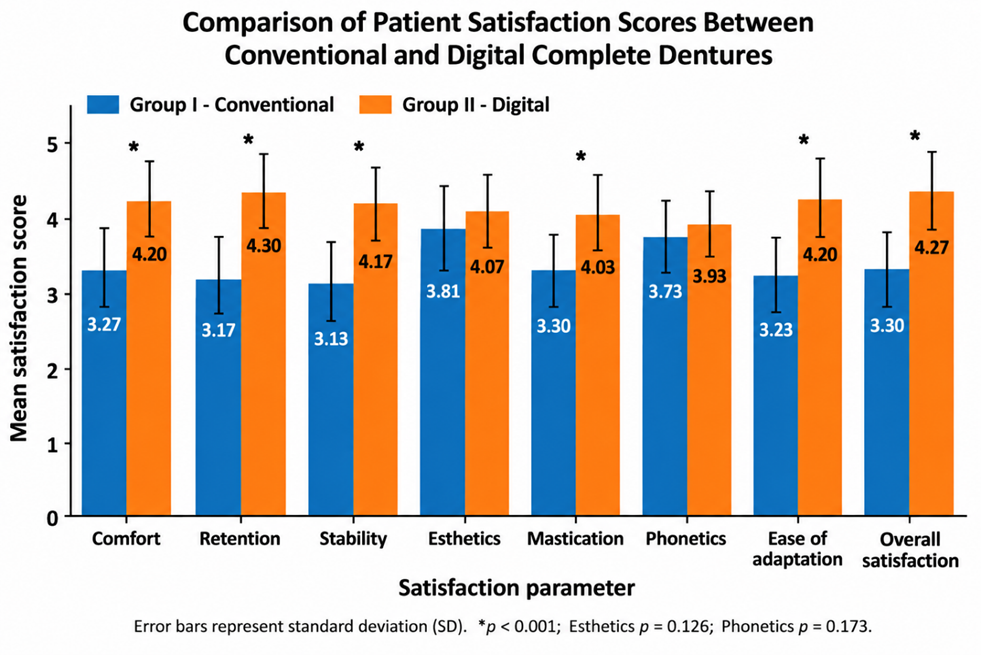
Figure 1. Comparison of mean patient satisfaction scores between conventional and digitally fabricated complete denture groups at the 1-month follow-up. Error bars represent standard deviation (SD).
The distribution of overall satisfaction showed a significant difference between the two groups (p=0.003). In Group II, 15 (50.0%) participants were very satisfied, and 12 (40.0%) were satisfied, compared with 4 (13.3%) and 11 (36.7%), respectively, in Group I. Neutral responses were reported by 8 (26.7%) participants in Group I and 3 (10.0%) in Group II. Six (20.0%) participants in Group I were dissatisfied, and 1 (3.3%) was very dissatisfied, whereas none of the participants in Group II reported dissatisfaction or marked dissatisfaction (Table 3 and Figure 2).
Table 3. Distribution of overall patient satisfaction at the 1-month follow-up
|
Overall satisfaction |
Group I (Conventional Denture Group) n (%) |
Group II (Digital Denture Group) n (%) |
P-value |
|
Very satisfied |
4 (13.3%) |
15 (50.0%) |
0.003* |
|
Satisfied |
11 (36.7%) |
12 (40.0%) |
|
|
Neutral |
8 (26.7%) |
3 (10.0%) |
|
|
Dissatisfied |
6 (20.0%) |
0 (0.0%) |
|
|
Very dissatisfied |
1 (3.3%) |
0 (0.0%) |
|
|
Total |
30 (100%) |
30 (100%) |
Comparison between groups was performed using the Fisher–Freeman–Halton exact test. *A p-value <0.05 was considered statistically significant.
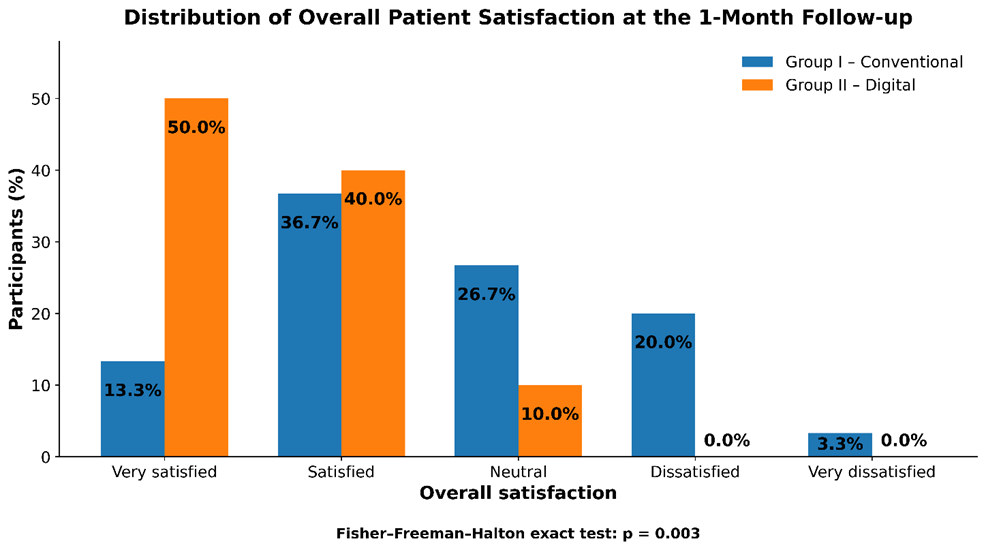
Figure 2. Distribution of overall patient satisfaction among conventional and digitally fabricated complete denture groups at the 1-month follow-up. The difference in satisfaction distribution between the groups was statistically significant (Fisher–Freeman–Halton exact test, p = 0.003).
A significant reduction in the number of clinical visits was observed with the digital workflow. The mean number of visits was 3.23 ± 0.43 in Group II compared with 5.57 ± 0.50 in Group I (p<0.001). The digital denture group also required fewer post-insertion adjustments, with a mean of 1.37 ± 0.56 compared with 2.03 ± 0.67 in the conventional denture group (p<0.001) (Table 4 and Figure 3).
Table 4. Comparison of the number of clinical visits and post-insertion adjustments between the two groups
|
Clinical parameter |
Group I (Conventional Denture Group) (n=30) |
Group II (Digital Denture Group) (n=30) |
P-value |
|
Number of clinical visits (Mean ± SD) |
5.57 ± 0.50 |
3.23 ± 0.43 |
<0.001* |
|
Number of post-insertion adjustments (Mean ± SD) |
2.03 ± 0.67 |
1.37 ± 0.56 |
<0.001* |
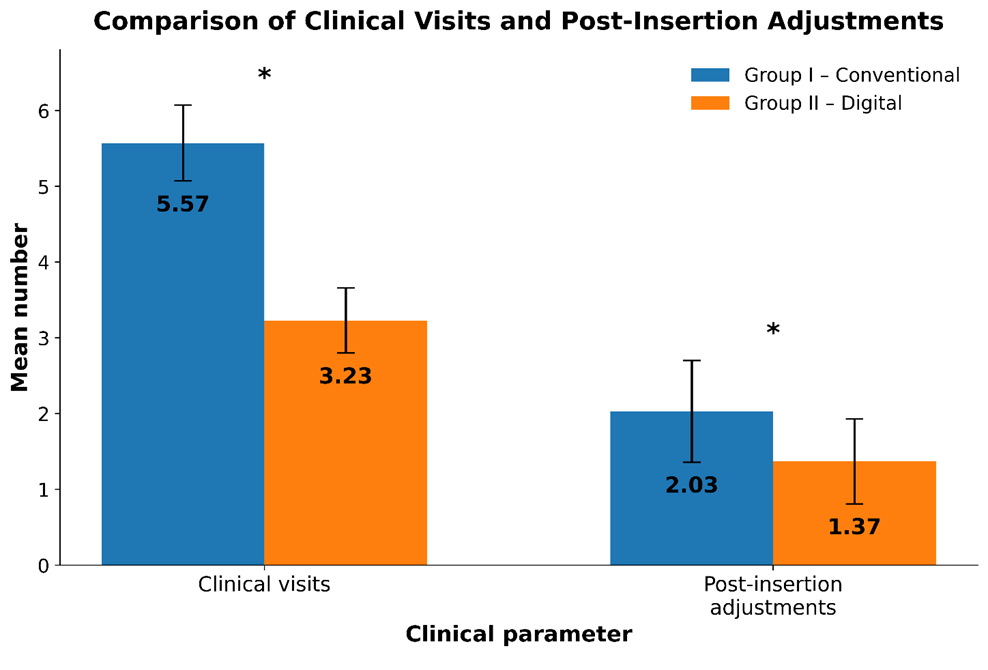
Figure 3. Comparison of the mean number of clinical visits and post-insertion adjustments between conventional and digitally fabricated complete denture groups. Error bars represent standard deviation (SD). p < 0.001 indicates a statistically significant difference between the groups.
DISCUSSION:
The present study compared patient satisfaction and clinical efficiency between digitally and conventionally fabricated complete dentures. The findings demonstrated significantly higher satisfaction with digital dentures for comfort, retention, stability, mastication, ease of adaptation, and overall satisfaction. In addition, the digital workflow required fewer clinical visits and fewer post-insertion adjustments. However, no significant differences were observed in esthetics or phonetics. These findings suggest that the advantages of digital denture fabrication may be particularly evident in functional aspects of complete denture treatment and in reducing the clinical burden associated with prosthetic rehabilitation.
The higher overall satisfaction observed with digital dentures in the present study is consistent with the findings of Kattadiyil et al. [9], who compared digital and conventional complete removable dental prostheses and reported significantly greater overall patient satisfaction with digitally fabricated dentures. Their patients also preferred the digital prostheses, while the digital fabrication process required considerably less clinical time. These observations support the present findings and suggest that patient acceptance of digital dentures may be influenced not only by the final prosthesis but also by the efficiency and convenience of the treatment process.
Retention was one of the parameters showing a clear advantage for the digital group in the present study. AlHelal et al. [10] similarly demonstrated significantly greater retention of CAD-CAM milled maxillary denture bases than conventionally heat-polymerized denture bases. This improved retention may be related to the manufacturing characteristics of digitally fabricated denture bases, particularly the avoidance of some dimensional changes associated with conventional polymerization. Better adaptation of the denture base to the supporting tissues may contribute to improved retention and stability and, consequently, greater comfort and confidence during function.
Patient-centered outcomes are especially important because the technical quality of a complete denture does not always correspond directly with the patient's perception of treatment success. Saponaro et al. [11], in their evaluation of patient experience with CAD-CAM complete dentures, reported generally favorable patient responses regarding digitally fabricated prostheses. In a separate clinical evaluation, Saponaro et al. [12] demonstrated the clinical feasibility of CAD-CAM complete dentures, with a relatively low number of appointments required for denture insertion. These studies support the clinical acceptability of digital complete denture workflows while emphasizing the importance of evaluating treatment from both the clinician's and the patient's perspective.
The favorable scores for comfort and ease of adaptation in the present study may also reflect the consistency of the digital fabrication process. Bidra et al. [13], in a prospective cohort study evaluating a two-visit CAD-CAM protocol, demonstrated the clinical feasibility of a substantially simplified digital workflow and reported patient-centered outcomes following treatment. Digital design and manufacturing permit greater standardization of several laboratory procedures and reduce the number of intermediate clinical and laboratory stages. This may limit the accumulation of processing errors and provide a more reproducible prosthesis, although the final outcome remains dependent on accurate clinical records and appropriate case selection.
It is important, however, not to interpret the present findings as evidence that digital dentures are universally superior to conventional dentures. A recent systematic review and meta-analysis by Jafarpour et al. [14] found that CAD-CAM and traditional complete dentures were broadly comparable in terms of overall patient satisfaction and oral health-related quality of life. The authors also observed that clinician-reported outcomes varied according to the manufacturing technique, with milled dentures showing advantages for some clinical outcomes. Thus, the benefits of digital dentures may depend on the particular workflow and manufacturing technique used rather than simply on whether the denture is classified as digital or conventional.
Similarly, Abo Heikal et al. [15], in a randomized clinical trial comparing conventional, CAD-CAM milled, and 3D-printed complete dentures, found no significant influence of manufacturing technique on overall patient satisfaction or retention. Such differences between studies may be related to variations in digital systems, denture materials, clinical protocols, follow-up periods, residual ridge anatomy, previous denture experience, and the methods used to assess satisfaction. Patient satisfaction itself is multidimensional and may therefore vary even when the technical characteristics of the prostheses are similar.
An interesting finding of the present study was that esthetic and phonetic satisfaction did not differ significantly between the two groups. This suggests that the advantages of the digital workflow were more pronounced for functional parameters than for appearance and speech. Alotaibi [16], in a systematic review of clinical studies comparing 3D-printed and conventional complete dentures, also found that overall satisfaction was generally comparable, while esthetics and pronunciation remained areas in which digital dentures did not consistently demonstrate superiority. These findings indicate that digital manufacturing alone may not guarantee improved esthetic or phonetic outcomes, which remain strongly influenced by tooth arrangement, lip support, occlusal vertical dimension, individual facial characteristics, and accurate clinical records.
Recent clinical evidence further illustrates the variability of patient-reported outcomes with different digital techniques. Elsarrif et al. [17], in a randomized crossover clinical trial, observed slightly higher satisfaction with 3D-printed dentures than with conventional dentures, although the difference was not statistically significant. Likewise, Emera et al. [18] found no significant difference between conventional and 3D-printed complete dentures in overall oral health-related quality of life or chewing efficiency during follow-up. These studies reinforce the view that digitally fabricated dentures can provide patient-centered outcomes at least comparable with those of conventional dentures, but the magnitude and direction of the difference may vary according to the fabrication method and outcome assessed.
The present study also demonstrated an important practical advantage of the digital workflow: the number of clinical visits decreased from 5.57 ± 0.50 with conventional dentures to 3.23 ± 0.43 with digital dentures. The number of post-insertion adjustments was also significantly lower in the digital group. This reduction is clinically relevant, particularly for older patients and those who may have difficulty attending repeated appointments. Digital records can also facilitate reproducibility and simplify future replacement or duplication of a prosthesis. A comprehensive review by Mubaraki et al. [19] similarly highlighted reduced clinical visits, chairside time, laboratory time, and post-insertion appointments among the potential advantages of digitally fabricated complete dentures.
Nevertheless, recent evidence indicates that the clinical performance of digital dentures is influenced by the specific digital technique employed. Ribeiro et al. [20], in a randomized crossover clinical trial comparing 3D-printed and conventional complete dentures, reported differences in individual patient-satisfaction domains and functional adaptation, while digitally fabricated dentures required fewer mandibular denture-base adjustments. Their findings emphasize that digital dentures may offer advantages in selected clinical outcomes without necessarily improving every component of patient satisfaction.
This is consistent with the present study, in which functional parameters and clinical efficiency favored the digital group, whereas esthetic and phonetic satisfaction remained comparable between the two approaches. Taken together, the findings of the present study add to the growing evidence supporting digital complete dentures as a clinically useful alternative to conventional fabrication. The higher satisfaction observed for several functional parameters, together with fewer clinical visits and post-insertion adjustments, indicates a potential advantage for both patients and clinicians. At the same time, the comparable esthetic and phonetic scores emphasize that conventional clinical principles remain essential irrespective of the manufacturing method. Careful patient selection, accurate impressions and jaw relation records, appropriate tooth arrangement, and meticulous clinical evaluation continue to determine the success of complete denture rehabilitation.
Limitations of the Study: The findings of the present study should be considered in light of certain limitations. The study was conducted at a single institution with a relatively modest sample size, which may limit the generalizability of the findings to a wider population. Patient satisfaction was evaluated after one month; therefore, the study primarily reflects early adaptation to the dentures rather than long-term satisfaction and prosthesis performance. In addition, satisfaction is inherently subjective and may be influenced by individual expectations, previous denture experience, psychological factors, and adaptation. Despite these limitations, the use of standardized clinical protocols, comparable study groups, and assessment of several patient-centered outcomes provides useful clinical information regarding the performance of digital and conventional complete dentures. Future multicenter studies with larger samples and longer follow-up periods would help determine whether these differences are maintained over time.
CONCLUSION:
The findings of the present study indicate that digitally fabricated complete dentures provide favorable patient-centered and clinical outcomes compared with conventionally fabricated dentures. Patients receiving digital dentures reported significantly greater satisfaction with comfort, retention, stability, mastication, ease of adaptation, and overall satisfaction. In addition, the digital workflow required fewer clinical visits and fewer post-insertion adjustments, highlighting its potential to make complete denture rehabilitation more convenient and efficient for both patients and clinicians. However, esthetic and phonetic satisfaction was comparable between the two techniques. Within the limitations of this study, digital complete dentures can be considered an effective and clinically efficient alternative to conventional complete dentures. Further studies with larger populations and longer follow-up periods are recommended to evaluate the long-term performance and patient acceptance of digitally fabricated complete dentures.
REFERENCES:
1. Oweis Y, Ereifej N, Al-Asmar A, Nedal A. Factors Affecting Patient Satisfaction with Complete Dentures. Int J Dent. 2022 Apr 8;2022:9565320. doi: 10.1155/2022/9565320. PMID: 35432542; PMCID: PMC9012642.
2. Sharma A, Dinesh Kumar BNVK, Saha P, Sagar S, Jain S, Shah A. Assessment of patient satisfaction and perception with digital and conventional complete dentures: a comparative study. Academia J Med. 2026;9(2):75-79. doi:10.48165/ajm.2026.9.02.15.
3. Bidra AS, Taylor TD, Agar JR. Computer-aided technology for fabricating complete dentures: systematic review of historical background, current status, and future perspectives. J Prosthet Dent. 2013 Jun;109(6):361-6. doi: 10.1016/S0022-3913(13)60318-2. PMID: 23763779.
4. Srinivasan M, Kamnoedboon P, McKenna G, Angst L, Schimmel M, Özcan M, Müller F. CAD-CAM removable complete dentures: A systematic review and meta-analysis of trueness of fit, biocompatibility, mechanical properties, surface characteristics, color stability, time-cost analysis, clinical and patient-reported outcomes. J Dent. 2021 Oct;113:103777. doi: 10.1016/j.jdent.2021.103777. Epub 2021 Aug 13. PMID: 34400250.
5. Chappuis Chocano AP, Venante HS, Bringel da Costa RM, Pordeus MD, Santiago Junior JF, Porto VC. Evaluation of the clinical performance of dentures manufactured by computer-aided technology and conventional techniques: A systematic review. J Prosthet Dent. 2023 Apr;129(4):547-553. doi: 10.1016/j.prosdent.2021.06.029. Epub 2021 Jul 29. PMID: 34332774.
6. Arakawa I, Al-Haj Husain N, Srinivasan M, Maniewicz S, Abou-Ayash S, Schimmel M. Clinical outcomes and costs of conventional and digital complete dentures in a university clinic: A retrospective study. J Prosthet Dent. 2022 Sep;128(3):390-395. doi: 10.1016/j.prosdent.2020.12.014. Epub 2021 Feb 18. PMID: 33610329.
7. Kang YJ, Oh KC, Kim GY, Moon HS. Comparative evaluation of digitally fabricated complete dentures versus conventional complete dentures: A randomized, single-blinded, cross-over clinical trial. J Prosthet Dent. 2024 Aug;132(2):408-418. doi: 10.1016/j.prosdent.2022.05.013. Epub 2022 Sep 10. PMID: 36096912.
8. Bors A, Szekely M, Beresescu L, Maier A, Beresescu F. Patient Satisfaction and Perception with Digital Complete Dentures Compared to Conventional Complete Dentures-A Pilot Study. Dent J (Basel). 2025 Jun 27;13(7):291. doi: 10.3390/dj13070291. PMID: 40710136; PMCID: PMC12293944.
9. Kattadiyil MT, Jekki R, Goodacre CJ, Baba NZ. Comparison of treatment outcomes in digital and conventional complete removable dental prosthesis fabrications in a predoctoral setting. J Prosthet Dent. 2015 Dec;114(6):818-25. doi: 10.1016/j.prosdent.2015.08.001. Epub 2015 Sep 26. PMID: 26412000.
10. AlHelal A, AlRumaih HS, Kattadiyil MT, Baba NZ, Goodacre CJ. Comparison of retention between maxillary milled and conventional denture bases: A clinical study. J Prosthet Dent. 2017 Feb;117(2):233-238. doi: 10.1016/j.prosdent.2016.08.007. Epub 2016 Oct 17. PMID: 27765399.
11. Saponaro PC, Yilmaz B, Johnston W, Heshmati RH, McGlumphy EA. Evaluation of patient experience and satisfaction with CAD-CAM-fabricated complete dentures: A retrospective survey study. J Prosthet Dent. 2016 Oct;116(4):524-528. doi: 10.1016/j.prosdent.2016.01.034. Epub 2016 Jul 9. PMID: 27402416.
12. Saponaro PC, Yilmaz B, Heshmati RH, McGlumphy EA. Clinical performance of CAD-CAM-fabricated complete dentures: A cross-sectional study. J Prosthet Dent. 2016 Sep;116(3):431-5. doi: 10.1016/j.prosdent.2016.03.017. Epub 2016 May 7. PMID: 27160780.
13. Bidra AS, Farrell K, Burnham D, Dhingra A, Taylor TD, Kuo CL. Prospective cohort pilot study of 2-visit CAD/CAM monolithic complete dentures and implant-retained overdentures: Clinical and patient-centered outcomes. J Prosthet Dent. 2016 May;115(5):578-586.e1. doi: 10.1016/j.prosdent.2015.10.023. Epub 2016 Jan 13. PMID: 26794695.
14. Jafarpour D, Haricharan PB, de Souza RF. CAD/CAM versus traditional complete dentures: A systematic review and meta-analysis of patient- and clinician-reported outcomes and costs. J Oral Rehabil. 2024 Sep;51(9):1911-1924. doi: 10.1111/joor.13738. Epub 2024 May 26. PMID: 38797954.
15. Abo Heikal MM, Abdel Nabi N, Elkerdawy MW. A study comparing patient satisfaction and retention of CAD/CAM milled complete dentures and 3D printed CAD/CAM complete dentures versus conventional complete dentures: a randomized clinical trial. Braz Dent Sci. 2022;25(1):e2785. doi:10.4322/bds.2022.e2785.
16. Alotaibi HN. Patient Satisfaction with CAD/CAM 3D-Printed Complete Dentures: A Systematic Analysis of the Clinical Studies. Healthcare (Basel). 2025 Feb 11;13(4):388. doi: 10.3390/healthcare13040388. PMID: 39997262; PMCID: PMC11855026.
17. Elsarrif HR, Elawady AF, Refai OM. Assessment of microbial adherence and patient satisfaction with conventional and digital 3D-printed complete removable dentures: A crossover randomized controlled clinical trial. J Prosthodont. 2026 Jan;35(1):37-46. doi: 10.1111/jopr.70017. Epub 2025 Aug 22. PMID: 40846679.
18. Emera RMK, Al Sultani ZF, Mahanna FF. Comparison of patients' oral health-related quality of life and chewing efficiency between conventional and 3D-printed complete dentures: A crossover clinical trial. J Dent Res Dent Clin Dent Prospects. 2025 Dec 31;19(4):233-241. doi: 10.34172/joddd.025.44430. PMID: 42145577; PMCID: PMC13179461.
19. Mubaraki MQ, Moaleem MMA, Alzahrani AH, Shariff M, Alqahtani SM, Porwal A, Al-Sanabani FA, Bhandi S, Tribst JPM, Heboyan A, Patil S. Assessment of Conventionally and Digitally Fabricated Complete Dentures: A Comprehensive Review. Materials (Basel). 2022 May 28;15(11):3868. doi: 10.3390/ma15113868. PMID: 35683165; PMCID: PMC9182039.
20. Ribeiro AKC, Veríssimo AH, de Freitas RFCP, de Melo JMDCA, Costa RTF, de Moraes SLD, et al. Functional and patient-reported outcomes of 3-dimensional-printed vs conventionally fabricated complete dentures: a randomized crossover clinical trial. J Am Dent Assoc. 2026. doi:10.1016/j.adaj.2026.03.027.