The comparative study of transdermal fentanyl patch and intravenous fentanyl infusion for postoperative pain management.
- Dr. Naddi Hariprasad , Junior Resident, Department of Anaesthesiology, Government Medical College and Hospital, Chhatrapati Sambhajinagar-431001, India.
- Dr. Milind Raman Raut , Assistant Professor, Department of Anaesthesiology, Government Medical College and Hospital, Chhatrapati Sambhajinagar-431001, India.
- Dr. Syed Anesa Begum Shoukat Ali , Assistant Professor, Department of Anaesthesiology, Government Medical College, Jubilee Park, Chhatrapati Sambhajinagar – 431001, India.
- Dr. Ramakant Alapure , Professor, Department of Anaesthesiology, Government Medical College, Jalgaon – 425001, India.
Article Information:
Abstract:
Background: Effective postoperative pain management is particularly important following oral malignancy surgery, where pain may contribute to physiological stress and delayed recovery. Intravenous fentanyl provides rapid and titratable analgesia, whereas transdermal fentanyl offers continuous drug delivery without the need for intravenous access. This study compared the efficacy of a transdermal fentanyl patch with intravenous fentanyl infusion for postoperative pain management in patients undergoing elective oral malignancy surgery under general anaesthesia. Aim: To evaluate the efficacy of transdermal fentanyl patch compared with intravenous fentanyl infusion for postoperative pain relief in patients undergoing elective oral malignancy surgery under general anaesthesia. Materials and Methods: This prospective, randomized comparative study included 60 adult patients undergoing elective oral malignancy surgery under general anaesthesia. Patients were randomly allocated into two equal groups of 30 each. Group A received a 25 µg/h transdermal fentanyl patch applied 12 hours before surgery, while Group B received intravenous fentanyl infusion at 25 µg/h initiated during premedication. Postoperative pain was assessed using the Visual Analogue Scale (VAS) at 4, 8, 12, 18, 24 and 48 hours. Heart rate was recorded perioperatively. Continuous variables were compared using the unpaired Student’s t-test, with p<0.05 considered statistically significant. Results: The two groups were comparable with respect to age, gender and ASA physical status. Mean age was 46.93±8.95 years in Group A and 48.60±8.18 years in Group B (p=0.455). Both groups had identical gender distribution, with 83.3% males and 16.7% females. ASA II constituted 73.3% of patients in each group. Heart rate was comparable at most time points, although significant differences were observed immediately after induction (p=0.046) and at completion of surgery (p=0.037). VAS scores were consistently lower in Group B. Significant differences were observed at 8 hours (p=0.003), 12 hours (p=0.009), 18 hours (p=0.001), 24 hours (p=0.049), and 48 hours (p=0.026). Conclusion: Both transdermal and intravenous fentanyl provided effective postoperative analgesia. However, intravenous fentanyl infusion produced significantly lower VAS scores during most postoperative assessment periods, indicating more consistent postoperative pain relief in patients undergoing elective oral malignancy surgery.
Keywords:
Article :
INTRODUCTION:
Many disease processes present with pain as a common feature and is associated with actual or impending tissue damage. The perioperative pain is defined as pain because of pre-existing disease, surgical procedure or a combination of these. It results in physiological and psychological responses in the patient which are detrimental to postoperative outcome. Despite advancements in pain management, moderate-to-severe acute postoperative pain remains a challenge (1).
Worldwide some associations and societies like the Agency for Health Care Policy and Research (AHCPR; US), the International Association of the Study of Pain, and the Royal College of Surgeons (UK) (RCSCA 1990; AHCPR 1992; IASP 1992) have recognized pain as a debilitating factor in postoperative period (2). Anxiety, sleep disturbance, demoralization, disturbed mental activity and social relations, increased heart rate and blood pressure, low immunity, decreased pulmonary functions, increased complications i.e., heart attack, deep venous thrombosis, pulmonary embolism, hypoxia, pneumonia, stroke will result from ineffectively treated and persistent postoperative pain. Reducing a pain to a manageable level is the goal of several pain management techniques. For a positive postoperative outcome, a balanced analgesia employs a variety of pain management techniques to create a pain-free and stress-free condition (3).
The systemic opioid administration is the most and continues to be a popular technique. Opioids are generally given by intramuscular, intravenous, subcutaneous routes. The intravenous route is most common and produces prompt and predictable blood levels, which allows for a precise titration of analgesic requirements. The continuous intravenous infusion provides a steady blood level of the drug but it must be remembered that it takes a long time to achieve 95% of the final steady state concentration of the drug. Thus, intravenous infusion results in inadequate analgesia in a patient which is dealt by intermittent IV boluses(3).
The beginning of new era has led to the development of transdermal drug delivery system which has become an integral part of pain management. Transdermal patches, though are costly but have become popular because of its advantages (4). They deliver a sufficient quantity of drug through the skin of the patient (5). The goal is to maximize the drug delivery through the skin into the systemic circulation and to minimize the retention and metabolism of the drug in the skin (6). It has various advantages like controlled absorption, steady plasma drug levels, improved bioavailability of the drug, minimal adverse effects, painless, ease of application and flexibility of terminating drug administration by simply removing the patch from the skin (4).
Because of increasing patient compliance, transdermal delivery systems are advantageous over injectable and oral routes. The drug absorption occurring through the percutaneous route becomes evident by the drug levels measurable in blood, drug and its metabolites excretion through urine and through the positive clinical response of the patient. Among opioids, fentanyl is the most commonly used. It is a synthetic opioid with a low molecular weight, smaller chemical structure, soluble in both fat and water and has high analgesic property because of which it can be a good choice for transdermal route of drug delivery (3).
In 1990, the US Food and Drug Administration listed the transdermal fentanyl patch (7). Transdermal fentanyl has been created and authorized for the treatment of chronic pain and cancer. It has also been shown to effectively relieve acute postoperative pain. access is not necessary with transdermal fentanyl, and the risk of infection is reduced (8). Based on a prior study that characterized the association between blood fentanyl concentrations and analgesic effects in patients undergoing abdominal surgery, the transdermal delivery system of fentanyl was chosen, with an anticipated delivery rate of 50 μg/h. Using administration rates of 25 μg/h, some trials showed a non-significant decrease in opioid needs. However, when treated with TDF 75 μg/h (given 8 hours before surgery), up to 9% of patients were at risk for respiratory depression (9). Applying transdermal fentanyl a few hours before surgery may be preferable for managing postoperative pain in order to get the lowest possible effective concentration before or concurrently with surgery (10).
Oral malignancies are the sixth most common malignancies in the world. In India, it is the most common cancer in men and is linked to gutka and tobacco usage. It is important to consider other, more common causes of oral cancer in India, even if the human papillomavirus has recently been linked to its development. The first course of treatment for oral cancer is surgery. One of the main anesthetic challenges during surgery is airway difficulties because of the smaller mouth opening and smaller inter incisor space. Restricted mouth opening and limited neck motion and extension are more common in patients with oral cancer receiving radiation therapy as their main treatment. Anaesthesiologist skill and judgment will undoubtedly reduce morbidity and death when these factors are taken into account (11).
Due to significant breakthroughs in head and neck reconstructive surgery, the use of free or pedicle flaps for defect restoration has grown in favor in recent years. In 1979, Ariyan developed the pectoralis major myocutaneous flap, which is being used in a number of head and neck reconstruction centers and is supplied by the pectoral branch of the thoracoacromial artery (12). Free flaps were often used for large head and neck abnormalities due to concerns about the flap reliability for certain defects. Free flaps therefore require a longer operating time and a greater degree of micro vascular surgical skill. Nonetheless, in the present era, two surgical teams—one at the donor site and the other at the recipient site—might reduce the length of the procedure. Conversely, a longer procedure lengthens the exposure to anesthetics (11).
Pain is one of the most prevalent causes of anxiety during the perioperative period. The pain management during this time is still crucial, and a lot of research is being done on the subject, especially with regard to patients with head and neck conditions. Pain is one of the many symptoms of cancer that contribute to a low quality of life (QoL) because it affects both physical and emotional functions (13, 14).
Many research done previously demonstrated that the nociceptive pain in the head and neck cancer is related to direct invasion and destruction of bones and soft tissue as well as also owing to the inflammation and compression of the nerve tissue. Head and neck cancer was shown to have the highest rate of cancer pain, surpassing gastrointestinal, gynecological, breast, and lung cancers, according to a meta-analysis of nearly 52 previous studies (15).
Depending on the relative duration and onset of analgesia, opioid treatments are the most effective option for managing pain in the majority of cancer patients. The patient ability to swallow, whether they are vomiting, or whether they have a nasogastric or gastrostomy tube in place all influence the drug and formulation selection. The synthetic opioid painkiller fentanyl acts quickly and has a brief half-life. It is a strong agonist for the brain μ-opioid receptors. The potency of fentanyl is 50–100 times that of morphine. Fentanyl availability in several forms of administration, including transdermal patches, sublingual tablets, intranasal sprays, pectin-based nasal sprays, and others, is one of its benefits (16).
Therefore, the present study was conducted to evaluate the efficacy of transdermal fentanyl patch with intravenous fentanyl infusion for postoperative pain relief in patients posted for elective oral malignancy surgeries under general anaesthesia.
AIMS AND OBJECTIVES
AIM:
The aim of this study was to evaluate the efficacy of transdermal fentanyl patch with intravenous fentanyl infusion for postoperative pain relief in patients posted for elective oral malignancy surgeries under general anaesthesia.
OBJECTIVES:
PRIMARY OBJECTIVE
1. To study the efficacy of a transdermal fentanyl patch compared to that of an intravenous fentanyl infusion.
SECONDARY OBJECTIVE
1. To study intraoperative hemodynamic stability
2. Adverse effects if any
MATERIALS AND METHODS:
Study Design
This was a prospective randomized comparative study conducted among patients undergoing elective oral malignancy surgery under general anaesthesia. The thesis describes two parallel groups of 30 patients each.
Study Population
The study population consisted of adult patients scheduled for elective oral malignancy surgery under general anaesthesia.
SAMPLE SIZE CALCULATION
Primary outcome: Mean VAS pain score (0–10) Standard deviation (σ): 0.51
Detectable difference (Δ): 10% of mean reference 3.91 ≈ 0.391 (Rallabhandi et al.) Two-sided α = 0.05
Power (1–β) = 80% Z(1-α/2) = 1.96
Z(1-β) = 0.842
Formula used:
n (per group) = [ 2 × σ² × (Z(1-α/2) + Z(1-β))² ] / Δ² n = [ 2 × (0.51)² × (1.96 + 0.842)² ] / (0.391)²
n = [ 2 × 0.2601 × (2.802)² ] / 0.1529 n = [ 0.5202 × 7.85 ] / 0.1529
n = 4.083 / 0.1529
n ≈ 26.7 ≈ 27 patients per group
To enhance the reliability and generalizability of the results, the sample size was increased to 30 patients per group, making the total sample size 60 patients, randomly assigned into two equal groups.
Inclusion Criteria
Patients were eligible if they:
1. Were aged 18–60 years.
2. Were of either sex.
3. Were scheduled for elective oral malignancy surgery under general anaesthesia.
4. Belonged to ASA physical status I, II or III.
Exclusion Criteria
Patients were excluded if they:
1. Refused participation.
2. Were ASA grade IV.
3. Were younger than 18 years or older than 60 years.
4. Were pregnant or breastfeeding.
5. Had morbid obesity.
6. Had significant respiratory, hepatic, cardiac or renal disease.
7. Had opioid addiction or allergy.
8. Were receiving chronic analgesic therapy.
Pre-Anaesthetic Assessment
All patients underwent routine pre-anaesthetic evaluation, including detailed history, clinical examination and relevant investigations. Investigations included complete haemogram, liver function tests, kidney function tests, blood glucose, ECG and chest radiography when indicated. Baseline pulse rate, blood pressure, respiratory rate, oxygen saturation and ECG were recorded.
Randomization and Study Groups
Sixty patients were randomly allocated into two groups of 30 patients each.
Group A – Transdermal Fentanyl Patch
Patients received a 25 µg/h transdermal fentanyl patch applied 12 hours before surgery.
Group B – Intravenous Fentanyl Infusion
Patients received intravenous fentanyl infusion at 25 µg/h initiated during premedication.
Study Procedure
All enrolled patients underwent elective oral malignancy surgery lasting approximately 120–180 minutes. General anaesthesia was administered using the protocol specified in the thesis. Fentanyl 2 µg/kg was used as part of the intraoperative anaesthetic technique, propofol 1–2 mg/kg was used for induction and vecuronium 0.1 mg/kg was used for neuromuscular blockade. Anaesthesia was maintained with 1–2% sevoflurane in a 50:50 mixture of oxygen and nitrous oxide. Neuromuscular blockade was antagonized with neostigmine 0.05 mg/kg and glycopyrrolate 0.02 mg/kg.
Intraoperative Monitoring
The following parameters were monitored:
· ECG
· Heart rate
· Non-invasive blood pressure
· Mean arterial pressure
· Respiratory rate
· SpO₂
· End-tidal CO₂
· Body temperature
Monitoring was continued throughout surgery and during the immediate postoperative recovery period.
Postoperative Pain Assessment
Pain intensity was assessed using the Visual Analogue Scale (VAS) at predefined postoperative time points.
The thesis reports VAS measurements at:
· 4 hours
· 8 hours
· 12 hours
· 18 hours
· 24 hours
· 48 hours
Sedation Assessment
Sedation was evaluated using the Ramsay Sedation Score (RSS) at the same postoperative assessment intervals.
Rescue Analgesia
Patients received 1 g paracetamol as rescue analgesia when the VAS score exceeded 5. The time to first rescue analgesia and total rescue analgesic requirement were recorded.
Assessment of Adverse Effects
Patients were monitored for opioid-related adverse effects, including:
· Sedation
· Bradycardia
· Nausea
· Vomiting
· Itching/pruritus
· Respiratory depression
· Oxygen saturation <90%
Ethical Considerations
After approval from Hospital Ethical Committee, informed consent was taken from the patient. Patient information obtained was kept confidential and only competent authorities like the Independent Ethics Committee, Institutional Review Board, The Government Health Authorities and / or its representatives can have direct access to the Records. Medical records were treated as confidential and only that data, which does not identify the patient, was shared with the above and may be published
Statistical Analysis
Continuous variables were expressed as mean ± standard deviation and compared using the unpaired Student's t-test. Categorical variables were expressed as frequencies and percentages and analyzed using the Chi-square test. Statistical analysis was performed using Microsoft Excel 2015 and IBM SPSS Statistics version 27.0. A p-value <0.05 was considered statistically significant.
RESULTS:
AGE DISTRIBUTION
The mean age of patients was comparable between Group A (46.93 ± 8.95 years) and Group B (48.60 ± 8.18 years). Statistical analysis was done using Chi-square test. In Group A, most patients were >50 years (40%) and 41–50 years (33.3%), while in Group B, the majority were 41–50 years and >50 years (43.3% each). Distribution across age groups was also similar between the groups (P = 0.623). Both the groups are comparable in terms of age distribution with p value = 0.455 which is not significant.
Table 1: Age distribution.
|
Age group |
Group A |
Group B |
P value |
||
|
N |
% |
N |
% |
||
|
Mean age |
46.93 ± 8.95 |
|
48.60 ± 8.18 |
|
0.455 |
|
<30 years |
2 |
6.7 |
1 |
3.3 |
0.623 |
|
31-40 years |
6 |
20 |
3 |
10 |
|
|
41-50 years |
10 |
33.3 |
13 |
43.3 |
|
|
>50 years |
12 |
40 |
13 |
43.3 |
|
|
Total |
30 |
100 |
30 |
100 |
|
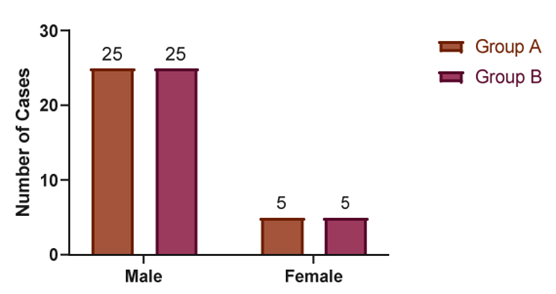
Figure 1: Age distribution.
GENDER DISTRIBUTION
Both groups had identical gender distribution, with 83.3% males and 16.7% females in each group. No statistical comparison was required as the proportions were the same.
Table 2: Gender distribution.
|
Gender |
Group A |
Group B |
P value |
||
|
N |
% |
N |
% |
||
|
Male |
25 |
83.3 |
25 |
83.3 |
NA |
|
Female |
5 |
16.7 |
5 |
16.7 |
|
|
Total |
30 |
100 |
30 |
100 |
|
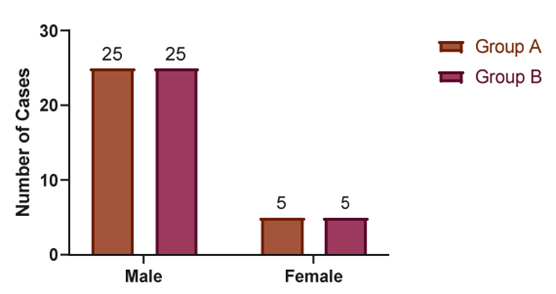
Figure 2: Gender distribution.
ASA GRADE
ASA grade distribution was identical in both groups, with 73.3% of patients in Grade 2, 23.3% in Grade 3, and 3.3% in Grade 1. As the distribution was the same, no statistical comparison was necessary.
Table 3: ASA Grade.
|
ASA Grade |
Group A |
Group B |
P value |
||
|
N |
% |
N |
% |
||
|
1 |
1 |
3.3 |
1 |
3.3 |
NA |
|
2 |
22 |
73.3 |
22 |
73.3 |
|
|
3 |
7 |
23.3 |
7 |
23.3 |
|
|
Total |
30 |
100 |
30 |
100 |
|
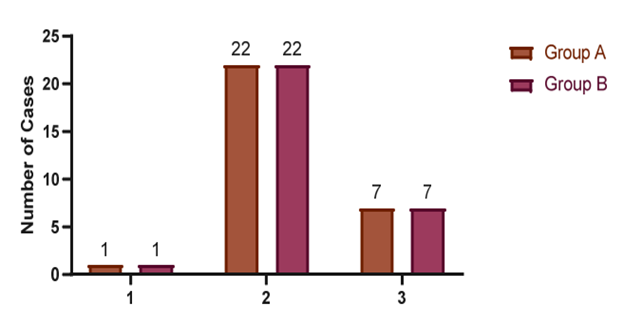
Figure 3: ASA Grade
HEART RATE
Heart rates were comparable between Group A and Group B at baseline and most postoperative time points. However, Group A showed significantly higher heart rates immediately after induction (P = 0.046) and at the time of completion of surgery (P = 0.037). No significant differences were observed at other intervals, indicating similar hemodynamic responses overall.
Table 4: Heart rate
|
Heart rate |
Group A |
Group B |
P value |
||
|
Mean |
SD |
Mean |
SD |
||
|
BL |
85.47 |
13.268 |
80.87 |
7.855 |
0.108 |
|
IAI |
82.40 |
14.680 |
75.57 |
11.060 |
0.046 |
|
1hr |
81.50 |
19.253 |
77.83 |
11.002 |
0.369 |
|
2hr |
77.37 |
13.260 |
76.80 |
10.902 |
0.857 |
|
3hr |
77.73 |
12.581 |
77.03 |
10.145 |
0.813 |
|
4hr |
79.67 |
11.018 |
77.67 |
8.318 |
0.431 |
|
CoS |
93.87 |
14.605 |
87.03 |
9.715 |
0.037 |
|
4hr |
85.20 |
13.780 |
79.03 |
11.433 |
0.064 |
|
8hr |
82.93 |
13.894 |
80.87 |
10.631 |
0.520 |
|
12hr |
82.60 |
12.339 |
80.03 |
9.434 |
0.369 |
|
18hr |
80.20 |
11.734 |
78.73 |
11.688 |
0.629 |
|
24hr |
79.63 |
12.127 |
78.13 |
10.840 |
0.615 |
|
48hr |
81.77 |
13.003 |
80.67 |
11.281 |
0.728 |
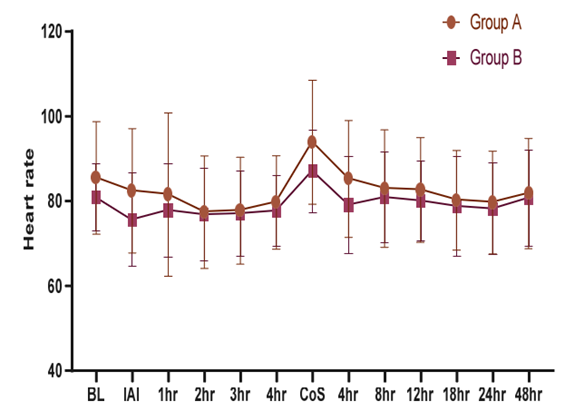
Figure 4: Heart rate.
VAS SCORE
VAS scores were lower in Group B compared to Group A at all assessed time points, indicating better pain control with intravenous fentanyl infusion. The difference was statistically significant at 8, 12, 18, 24, and 48 hours (P < 0.05), while the 4-hour difference approached significance (P = 0.081).
Table 5: VAS score.
|
VAS score |
Group A |
Group B |
P value |
||
|
Mean |
SD |
Mean |
SD |
||
|
4hr |
2.50 |
1.737 |
1.87 |
0.900 |
0.081 |
|
8hr |
2.63 |
1.790 |
1.33 |
1.422 |
0.003 |
|
12hr |
2.43 |
1.888 |
1.20 |
1.627 |
0.009 |
|
18hr |
2.20 |
1.669 |
0.73 |
1.337 |
0.001 |
|
24hr |
1.87 |
1.756 |
0.87 |
2.080 |
0.049 |
|
48hr |
1.53 |
1.479 |
0.60 |
1.673 |
0.026 |
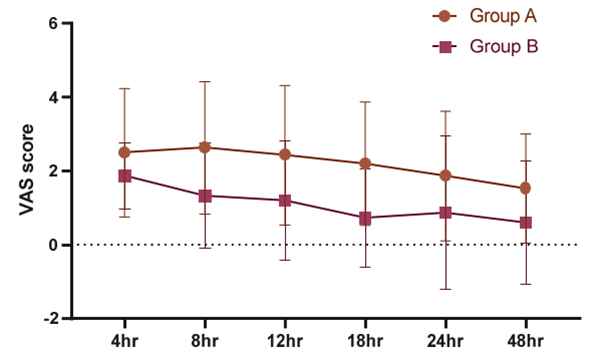
Figure 5: VAS score
DISCUSSION:
Present study was a prospective, randomized, double blind placebo controlled clinical trial was designed to evaluate the efficacy of transdermal fentanyl patch with intravenous fentanyl infusion for postoperative pain relief in patients posted for elective oral malignancy surgeries under general anaesthesia. For the purpose of the study, patients were randomized in 2 groups with 30 patients in each group. After elective oral cancer surgery, patients receiving a transdermal fentanyl patch (Group A) and those getting an intravenous fentanyl infusion (Group B) were compared for postoperative analgesic effects. In terms of baseline clinical and demographic characteristics, the two groups were well matched. Group A's mean age was 46.93 ± 8.95 years, whereas Group B's was 48.60 ± 8.18 years; there was no statistically significant difference (p=0.455). The majority of patients in both groups were over 40, and the age-group distribution was also similar (p=0.623) (Table 1). The possibility that age-related variations affected the comparison of postoperative analgesic results is decreased by this baseline consistency.
The sex distribution of both groups was the same, with 16.7% of each group being female and 83.3% being male (Table 2). The current study's male preponderance is in line with a number of other investigations including people with head and neck cancer who were treated with opioids. According to Higginson and Gao, patients with head and neck cancer often used opioids; Grond et al. and Konopka-Filippow et al. also included populations that were primarily male (17,18,19). With 73.3% of the groups categorized as ASA II and 23.3% as ASA III, the distribution of ASA physical status was also the same (Table 3). The validity of later intergroup comparisons was thus supported by the groups' clinical comparability at baseline.
At the majority of the measured intervals, heart rates were similar amongst the groups (Table 4). While statistically significant differences were seen at the end of the procedure (p=0.037) and just after induction (p=0.046), these differences were temporary and did not show up in the majority of later postoperative evaluations. The general consistency of heart-rate patterns indicates that neither analgesic method resulted in long-term cardiovascular instability. Grond et al. reported largely steady hemodynamic parameters with transdermal fentanyl administration (18), which is basically in line with this. Despite this, their research highlighted the significance of clinical and respiratory monitoring while titrating opioids.
The study's main conclusion was that intravenous fentanyl infusion provided better postoperative pain management. At every evaluated time point, Group B's VAS ratings were consistently lower than Group A's (Table 5). At four hours (p=0.081), the difference was not statistically significant; but, at eight hours (p=0.003), twelve hours (p=0.009), eighteen hours (p=0.001), twenty-four hours (p=0.049), and forty-eight hours (p=0.026), it became significant. At 18 hours, Group B's mean VAS score was 0.73 ± 1.34, whereas Group A's was 2.20 ± 1.67. This was the biggest difference. These results suggest that throughout the observation period, intravenous fentanyl produced more reliable postoperative analgesia.
The current results are significant since prior research has shown that transdermal fentanyl by itself can be an effective analgesic. Patients with advanced cancer who received transdermal fentanyl therapy showed significant decreases in pain intensity, according to Grond et al. (18). While methadone generated a higher reduction in neuropathic pain during the early stages of treatment, Haumann et al. showed that fentanyl significantly reduced pain in patients with head and neck cancer (19). Patients with head and neck cancer who received transdermal fentanyl during radiation therapy showed notable decreases in pain, according to Chang et al. (20). Similarly, after receiving transdermal fentanyl therapy, Guo et al. showed a gradual decrease in discomfort associated with oral mucositis (21). However, Merivirta et al. observed no statistically significant difference in postoperative pain between fentanyl patch and placebo after forefoot surgery, demonstrating the inconsistent efficacy of transdermal fentanyl in acute postoperative settings (22). The more consistent systemic distribution linked to intravenous injection may be the reason for the improved VAS profile shown with intravenous fentanyl in the current investigation. Intravenous infusion, as opposed to transdermal treatment, enables the direct and continuous distribution of fentanyl, enabling more rapid regulation of the analgesic impact. This might be especially helpful in the early postoperative phase following painful surgery for oral cancer.
Overall, the results from Tables 1–5 show that the two groups' baseline clinical and demographic features were similar, with postoperative pain ratings showing the largest variation. Consequently, intravenous fentanyl infusion offered more reliable postoperative analgesia than transdermal fentanyl patch within the parameters assessed in this trial. Rather than being applied to all clinical scenarios, this data should be understood in light of the current surgical population and dosage regimen.
CONCLUSION:
This comparative study demonstrated that both transdermal fentanyl patch (TFP) and intravenous fentanyl infusion provided effective postoperative analgesia in patients undergoing elective oral malignancy surgery under general anaesthesia. Age, gender, and ASA physical status were among the demographic traits that were similar between the two groups, indicating that the research populations were comparable. Throughout the perioperative phase, heart rates were generally similar between the groups; nevertheless, statistically significant differences were noted just after induction and at the end of the procedure. Crucially, the intravenous fentanyl group continuously had lower postoperative VAS ratings, with statistically significant differences at 8, 12, 18, 24, and 48 hours. Transdermal fentanyl also showed clinically meaningful analgesic effectiveness, however intravenous fentanyl infusion offered superior and more reliable postoperative pain management during the evaluated postoperative period. These results imply that when quick and titratable postoperative analgesia is needed, intravenous fentanyl could be the better option.
LIMITATIONS OF THE STUDY
The study had a relatively small sample size, with 30 patients in each treatment group, which may limit the statistical power and generalizability of the findings. Its application to other surgical populations is limited because research was carried out at a single facility and comprised patients undergoing elective oral cancer surgery. VAS pain evaluation is subjective and can be impacted by a patient's perception and communication skills. Longer-term analgesic effectiveness and results could not be investigated because the trial only analyzed postoperative outcomes over a 48-hour period. To verify these results, larger, multicentric investigations with longer follow-up are needed.
REFERENCES:
1. Venkateswaran R, Prasad K. Management of postoperative pain. Indian J Anaesth. 2006;50(5):345-54.
2. Mattia C, Coluzzi F. Acute postoperative pain management: focus on iontophoretic transdermal fentanyl. Ther Clin Risk Manag. 2007;3(1):19-27.
3. Rallabhandi S, Chakole V, Singam A. Comparison of Transdermal Fentanyl Patch and Intravenous Fentanyl for Postoperative pain relief in patients undergoing major abdominal surgeries under general Anaesthesia. Research Journal of Pharmacy and Technology. 2021;14(4):1915-8.
4. Rao TV, Kiran OR. Transdermal patch. Research Journal of Pharmaceutical Dosage Forms and Technology. 2013;5(1):12-6.
5. Saraswathi B, Satyanarayana T, Mounika K, Swathi G, Sravika K, Krishna M. Formulation and Characterization of Tramadol HCl Transdermal Patch. Asian Journal of Pharmacy and Technology. 2018;8(1):23-8.
6. Patel RP, Patel G, Patel H, Baria A. Formulation and evaluation of transdermal patch of aceclofenac. Research Journal of Pharmaceutical Dosage Forms and Technology. 2009;1(2):108-15.
7. Fu Q, Han N, Li N, Gui L, Shi C, Rong P, et al. Guidelines for rational clinical use of fentanyl transdermal patch. Drug Des Devel Ther. 2024:233-55.
8. Muijsers RB, Wagstaff AJ. Transdermal fentanyl: an updated review of its pharmacological properties and therapeutic efficacy in chronic cancer pain control. Drugs. 2001;61:2289-307.
9. R B. Influence of prolonged epidural blockade on blood sugar and cortisol response to operations upon the upper part of the abdomen and the thorax. Surg Gynecol Obstet. 1971;132:1051-6.
10. Esmat IM, Kassim DY. Comparative study between transdermal fentanyl and melatonin patches on postoperative pain relief after lumber laminectomy, a double-blind, placebo-controlled trial. Egyptian Journal of Anaesthesia. 2016;32(3):323-32.
11. Dash S, Bhalerao N, Gaurkar A, Chandak A, Shatalwar Sr AP. Anaesthetic challenges in a case of oral carcinoma with anticipated difficult airway posted for tumour excision and reconstruction surgery. Cureus. 2023;15(2).
12. Ariyan S. The pectoralis major myocutaneous flap. Plast Reconstr Surg.
13. 1979;63(1):73-81.
14. Viet C, Schmidt B. Biologic mechanisms of oral cancer pain and implications for clinical therapy. J Dent Res. 2012;91(5):447-53.
15. Cuffari L, de Siqueira JTT, Nemr K, Rapaport A. Pain complaint as the first symptom of oral cancer: a descriptive study. Oral Surgery, Oral Medicine, Oral Pathology, Oral Radiology, and Endodontology. 2006;102(1):56-61.
16. Van den Beuken-van Everdingen M, De Rijke J, Kessels A, Schouten H, Van Kleef M, Patijn J. Prevalence of pain in patients with cancer: a systematic review of the past 40 years. Ann Oncol. 2007;18(9):1437-49.
17. Giusti R, Bossi P, Mazzotta M, Filetti M, Iacono D, Marchetti P. The use of fentanyl in pain management in head and neck cancer patients: a narrative review. British Journal of Pain. 2018;12(3):155-62.
18. Higginson IJ, Gao W. Opioid prescribing for cancer pain during the last 3 months of life: associated factors and 9-year trends in a nationwide United Kingdom cohort study. J Clin Oncol. 2012;30(35):4373-9.
19. Grond S, Zech D, Lehmann KA, Radbruch L, Breitenbach H, Hertel D. Transdermal fentanyl in the long-term treatment of cancer pain: a prospective study of 50 patients with advanced cancer of the gastrointestinal tract or the head and neck region. Pain. 1997;69(1-2):191-8.
20. Haumann J, Geurts J, Van Kuijk S, Kremer B, Joosten E, van den Beuken-van Everdingen M. Methadone is superior to fentanyl in treating neuropathic pain in patients with head-and-neck cancer. Eur J Cancer. 2016;65:121-9.
21. Chang JT-C, Lin CY, Lin J-C, Lee M-S, Chen Y-J, Wang H-M. Transdermal fentanyl for pain caused by radiotherapy in head and neck cancer patients treated in an outpatient setting: a multicenter trial in Taiwan. Jpn J Clin Oncol. 2010;40(4):307-12.
22. Guo S-P, Wu S-G, Zhou J, Feng H-X, Li F-Y, Wu Y-J, et al. Transdermal fentanyl for pain due to chemoradiotherapy-induced oral mucositis in nasopharyngeal cancer patients: evaluating efficacy, safety, and improvement in quality of life. Drug Des Devel Ther. 2014:497-503.
23. Merivirta R, Pitkänen M, Alanen J, Haapoja E, Koivisto M, Kuusniemi K. Postoperative pain management with transdermal fentanyl after forefoot surgery: a randomized, placebo-controlled study. J Pain Res. 2015:39-45.