Prospective Comparative Study of Alvarado Score and NCCT Scan in Evaluation of Suspected Appendicitis.
- Dr. Anjaneya T. , Associate Professor, Department of General Surgery, Basaveshwara Medical College & Hospital, Chitradurga, Karnataka, India.
- Dr. Darshan A. , Postgraduate, Department of General Surgery, Karwar Institute of Medical Sciences, Karwar, Karnataka, India.
Article Information:
Abstract:
Background: Acute appendicitis is one of the most common surgical emergencies encountered worldwide. Early and accurate diagnosis remains challenging because of variable clinical presentation. Although computed tomography (CT) has high diagnostic accuracy, concerns regarding radiation exposure, cost, and availability persist. Clinical scoring systems such as the Alvarado score provide a simple and cost-effective method for evaluation of suspected appendicitis. This study was conducted to compare the diagnostic accuracy of the Alvarado score with Non-Contrast Computed Tomography (NCCT) scan in patients with suspected acute appendicitis. Objectives: 1.To determine the diagnostic accuracy of the Alvarado score when compared with NCCT scan findings. 2.To evaluate whether combined use of Alvarado score and NCCT scan improves diagnostic accuracy in suspected appendicitis. Methods: This prospective comparative study was conducted in the Department of General Surgery, Karwar Institute of Medical Sciences, Karwar. Patients presenting with clinical suspicion of acute appendicitis were evaluated using detailed history, clinical examination, laboratory investigations, Alvarado scoring, and NCCT abdomen. Final diagnosis was confirmed by histopathological examination of appendectomy specimens. Diagnostic parameters including sensitivity, specificity, positive predictive value, negative predictive value, and overall diagnostic accuracy were assessed and compared. Results: Both Alvarado score and NCCT scan were found to be useful diagnostic modalities in suspected acute appendicitis. NCCT scan demonstrated higher sensitivity and overall diagnostic accuracy compared to the Alvarado score alone. Higher Alvarado scores correlated significantly with positive radiological and histopathological findings. The combined use of Alvarado score and NCCT scan improved diagnostic confidence and reduced the incidence of negative appendectomy. Conclusion: The Alvarado score is a simple, reliable, non-invasive, and cost-effective tool for the initial evaluation of suspected acute appendicitis. NCCT scan offers superior diagnostic accuracy, particularly in equivocal and complicated cases. Combined use of clinical scoring systems and imaging modalities improves diagnostic precision and assists in appropriate surgical decision-making while minimizing unnecessary appendectomies.
Keywords:
Article :
INTRODUCTION:
Acute appendicitis is a globally prevalent condition and a primary reason for emergency abdominal surgery.[1,2] According to Global burden of diseases (GBD) study 2019, there were approximately 672,000 prevalent cases of appendicitis worldwide. The age-standardized prevalence rate was 8.7 cases per 100,000 population, representing a 20.8% increase from the rate of 7.2 per 100,000 recorded in 1990.[3] The diagnosis of acute appendicitis is established by integrating findings from the patient's medical history, physical examination, laboratory tests, and imaging studies.[4] Laboratory testing for suspected appendicitis typically involves a complete blood count (CBC) with differential.
A significant finding is mild leukocytosis, characterized by a white blood cell count exceeding 10,000/μL, which is observed in 67–90% of patients. Furthermore, a left shift (an increase in immature neutrophil forms) is present in approximately 80% of cases.[5] Computed tomography (CT) has become the primary imaging modality for evaluating suspected appendicitis in adult patients.[6] A key diagnostic criterion is persistent right lower quadrant pain combined with visualization of an appendix greater than 6 mm in diameter. Recent studies indicate that magnetic resonance imaging (MRI) is also highly effective, demonstrating sensitivity and specificity rates of approximately 96-97%.[7,8]
Various scoring systems, such as the Alvarado score, have been developed to assist in the clinical diagnosis of acute appendicitis. The Alvarado scoring system, introduced in 1986, is a 10-point clinical tool used for the early diagnosis of acute appendicitis. The score is calculated by assigning points across three categories: symptoms (1 point each for migration of pain to the right lower quadrant, anorexia, and nausea/vomiting), clinical signs (2 points for right lower quadrant tenderness, 1 point for rebound tenderness, and 1 point for a temperature ≥37.3°C), and laboratory data (2 points for leukocytosis and 1 point for a neutrophil count ≥75%).[9,10] The Alvarado scoring system is widely validated as a highly valuable diagnostic tool for acute appendicitis. This study compares the diagnostic accuracy of the Alvarado Score and non-contrast CT scan in suspected appendicitis and evaluates whether the Alvarado Score can effectively stratify patients who would benefit from CT imaging.
OBJECTIVES
1. To know diagnostic accuracy of Alvarado score when compared to NCCT scan findings
2. To know whether diagnostic accuracy increases when both Alvarado score and NCCT scan is used.
MATERIALS AND METHODS:
This diagnostic accuracy cross-sectional study was carried out in the Department of General Surgery at Karwar Institute of Medical Sciences, Karwar over a duration of 22 months, from March 2024 to December 2025, after obtaining approval from the Institutional Ethics Committee. A total of 95 patients admitted with a provisional diagnosis of acute appendicitis during the study period from March 2024 to December 2025 were included in the study. A structured proforma containing demographic details and relevant clinical findings was completed for each patient, and the Alvarado score was calculated for all enrolled patients, and a score of ≥7 was considered suggestive of Acute appendicitis.
Table 1: Alvarado Score
|
Symptoms |
Migratory RIF Pain Anorexia Nausea and Vomiting |
1 1 1 |
|
Signs |
Tenderness RIF Rebound Tenderness Elevated Temperature |
2 1 1 |
|
Laboratory Investigations |
Leucocytosis Shift to Left |
2 1 |
Details of additional investigations, including and computed tomography scans, were also documented in the proforma. NCCT abdomen was performed using a 16-slice multidetector CT scanner without intravenous contrast administration and without oral contrast. Images were acquired with a slice thickness of 5 mm using the lowest feasible radiation exposure according to patient body habitus. The obtained images were subsequently reconstructed into 2-mm sections to facilitate improved three dimensional visualization. CT findings were considered positive for acute appendicitis in the presence of one or more of the following features: appendiceal diameter greater than 6 mm, 66 appendiceal wall thickening exceeding 3 mm with enhancement, focal cecal wall thickening, or periappendiceal inflammatory changes such as fat stranding, localized fluid collection, phlegmon, or abscess formation. Minimal pelvic fluid in female patients without associated appendiceal or periappendiceal abnormalities was considered insignificant. At the completion of the study, histopathological examination reports of all patients who underwent appendectomy were reviewed and correlated with the clinical and radiological findings. Patients with histopathologically confirmed appendicitis were considered to have undergone therapeutic appendectomy.
Inclusion Criteria
1. All the patients who underwent laparoscopic or open appendectomy with pre operative Alvarado scoring and NCCT scan.
2. Pediatric patients are also included in the study aged upto 18 years.
Exclusion Criteria
1. Clinically patients with gynaecological and urological diseases were excluded from this study.
2. Patients who were managed conservatively were excluded.
3. Patients with recurrent appendicitis we’re excluded.
4. Patient with appendicular mass were excluded.
Sampling Technique
Statistical analysis was performed using IBM SPSS version 27. The Kolmogorov-Smirnov test was applied to assess normality (50 < n > 300). Categorical variables are expressed in terms of frequency (n) and percentage (%). Continuous variables are expressed in terms of mean, standard deviation (SD), median, interquartile range (IQR) depending on normality of data. Chi square test was used to compare categorical variables. Independent t test was used to compare continuous variables between 2 groups. P-value.
RESULTS:
The collected data was analysed using IBM SPSS software version 27.0. The study included 95 patients with suspected appendicitis, (n=95). whose ages ranged from 18 to 64 years, with a mean age of 40.03 ± 13.44 years. Age group analysis demonstrated that the largest proportion of patients belonged to the 18–30 years category (28.4%), Patients above 61–70 years were 11.6%. Thus, nearly three-fourths of cases (75.8%) occurred in individuals below 50 years of age, reaffirming that appendicitis is predominantly a disease of the younger adult population, although a considerable proportion of older patients were also represented. Among the 95 patients included in the study, 64 (67.4%) were male and 31 (32.6%) were female, demonstrating a clear male predominance with a male-to-female ratio of approximately 2.1:1. The duration of symptoms prior to presentation ranged from 6 to 71 hours, with a median duration of 37 hours and an interquartile range (IQR) of 17–53 hours.
WBC Count
The total leukocyte count among the 95 patients ranged from 7,507 to 16,346 cells/mm³, with a mean value of 11,842.4 ± 2,704.9 cells/mm³. The mean WBC count was above the normal reference range, indicating that leucocytosis was a common finding in the study population, consistent with the inflammatory nature of acute appendicitis.
Table 2: Alvarado Score
|
Alvarado Category |
Score Range |
n |
% |
|
Unlikely |
<5 |
17 |
17.9 |
|
Equivocal |
5–6 |
31 |
32.6 |
|
Probable appendicitis |
≥7 |
47 |
49.5 |
|
Total |
|
95 |
100 |
Classification of patients according to the Alvarado scoring system revealed that 47 patients (49.5%) fell into the probable appendicitis category (score ≥7), while 31 patients (32.6%) were in the equivocal range (scores 5–6). Only 17 patients (17.9%) were categorized as unlikely to have appendicitis (score <5).
Table 3: Distribution of NCCT Imaging Findings in Suspected Appendicitis (n = 95)
|
NCCT Finding of Appendicitis |
Frequency(n) |
Percentage (%) |
|
Present |
85 |
89.5% |
|
Absent |
10 |
10.5% |
|
Total |
95 |
100 |
Among the 95 patients evaluated with non-contrast CT, findings of appendicitis was observed in 85 patients (89.5%), while 10 patients (10.5%) did not have any finings of appendicitis.
Histopathological examination, which served as the gold standard, confirmed appendiceal pathology in all 95 patients (100%). Acute appendicitis was the predominant finding, observed in 88 patients (92.6%), while chronic appendicitis was identified in 7 patients (7.4%). Chronic appendicitis cases were categorized as negative appendectomies, resulting in a negative appendectomy rate of 7.4%. Fisher’s exact test = 29.8, df = 2, p value = 0.001
Among patients with NCCT finding of appendicitis all patients 85(89.5%) had histopathological confirmation of appendicitis of which 83(87.4%) had acute appendicitis, 2(2.1%) had chronic appendicitis. Among patient with absence of NCCT finding of appendicitis 5(5.2%) had chronic appendicitis and 5(5.3%) had chronic appendicitis. Fishers exact test showed that there is statistically significant association between NCCT findings of appendicitis and histopathological confirmation of appendix with a p value of 0.001.
Table 4: Distribution of Alvarado score Among Histopathologically Confirmed Appendicitis Cases (n = 95)
|
Alvarado Score |
Histopathological Findings |
Total n (%) |
|
|
|
Acute appendicitis n (%) |
Chronic appendicitis n (%) |
|
|
<5(unlikely) |
13(13.7%) |
4(4.2%) |
17(17.9%) |
|
5-6 (equivocal) |
29(30.5%) |
2(2.1%) |
31(32.6%) |
|
>7(probable appendicitis) |
46(48.4%) |
1(1.1%) |
47(49.5%) |
|
Total |
88(92.6%) |
7(7.4%) |
95(100%) |
|
Fisher’s exact test = 8.43, df = 2, p value = 0.019 |
|||
Among patients with Alvarado score <5, 13(13.7%) had acute appendicitis and 4(4.2%) had chronic appendicitis. In the 5-6 group, 29(30.5%) participants had acute appendicitis and 2(2.1%) participants had chronic appendicitis. In the ≥7 score group, 46 patients (48.4%) had acute appendicitis and 1(1.1%) had chronic appendicitis. Fishers exact test showed that there is statistically significant association between Alvarado scores and histopathological confirmation of appendix with p value of 0.019.
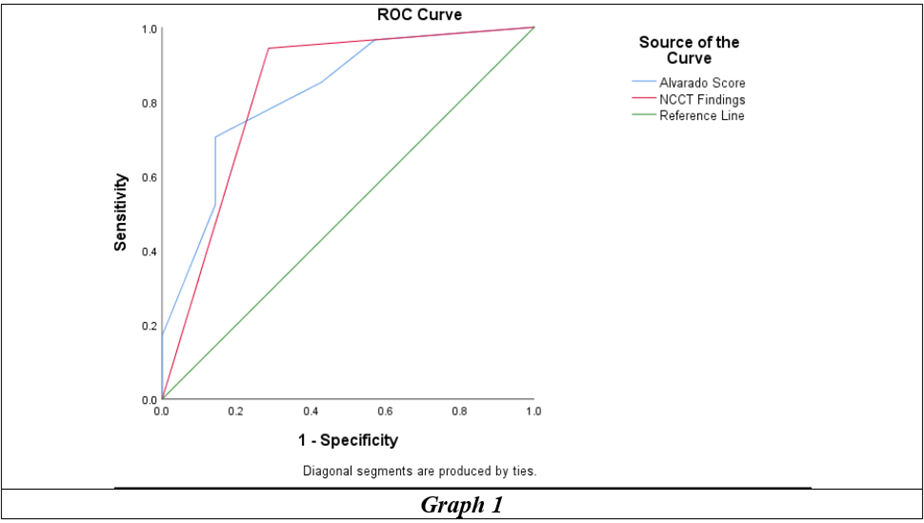
Using a cutoff value of 7 for the Alvarado score, the sensitivity, specificity, positive predictive value, and negative predictive value were 70.45%, 85.71%, 98.41%, and 18.75%, respectively, with an AUC of 0.823. Similarly, for NCCT, the sensitivity, specificity, positive predictive value, and negative predictive value were 94.32%, 71.43%, 97.65%, and 50%, respectively, with an AUC of 0.829. Overall, NCCT demonstrated better diagnostic performance than the Alvarado score.
Comparison of the two diagnostic modalities demonstrated an overall superiority of NCCT over the Alvarado score across key performance indices. NCCT exhibited a higher sensitivity of 94.32% compared to 70.45% for the Alvarado score, indicating a greater ability to correctly identify cases of appendicitis. Although the specificity of NCCT (71.43%) was lower than that of the Alvarado score (85.71%), both modalities demonstrated high positive predictive values, with the Alvarado score showing a slightly higher PPV (98.41% vs 97.65%). Notably, the negative predictive value was considerably higher with NCCT (50%) compared to the Alvarado score (18.75%), suggesting improved reliability in excluding the diagnosis. Furthermore, the area under the curve (AUC) was marginally higher for NCCT (0.829) than for the Alvarado score (0.823), reflecting better overall diagnostic performance. Collectively, these findings indicate that NCCT provides more reliable diagnostic accuracy than the Alvarado score.
DISCUSSION:
Sociodemographic Parameters
We studied 95 patients aged 18 to 64 years, with a mean age of 40.03 years. The largest group was aged 18–30 (28.4%), but a significant 24.2% were over 50 years old. We observed a strong male predominance, with 67.4% of participants being male, resulting in a male-to-female ratio of approximately 2.1:1. Gunes Tatar I et al.[11] (Turkey)in their study of 53 surgical patients reported a very similar demographic profile to ours, with a mean age of 43 years and a comparable male predominance of 69.8%. Apisarnthanarak P et al[12] (Thailand) showed 158 hospitalized patients had a mean age of 38.7 years, which is very close to the mean age in our study. However, their gender distribution was the opposite of ours, with a clear female predominance (58.2% female). Dhammapal Sable et al[13] (India) in their study of 100 patients had a mean age of 26.45 years, making it one of the youngest cohorts. It also showed a female predominance. Our study's demographic profile presents several interesting points for discussion when compared to the existing literature. Our study's mean age of 40.03 years is substantially higher than the classical epidemiological picture of appendicitis, which typically peaks in the second and third decades of life. This is clearly illustrated by the much younger mean ages reported by Adnan N[14] (28.9 years), Al-Faouri AF[15] (26.1 years), and Dhammapal Sable[13] (26.4 years). However, our findings are not an outlier. They align very closely with the study by Apisarnthanarak P12 (38.7 years) and Gunes Tatar I[11] (43 years). Because our study required a Non-Contrast CT scan for evaluation, it may have preferentially included older patients. It is clinical routine that younger patients (e.g., those under 30) with classic symptoms are often taken directly to surgery without imaging, while older patients, who present more atypically and require a broader differential diagnosis, are more likely to be enrolled in a study that mandates a CT scan.
Strengthening our Study's Conclusion
This older demographic actually strengthens the clinical relevance of our research question. Diagnosing appendicitis in patients over 40 is notoriously difficult due to atypical presentations. Therefore, our study is evaluating the Alvarado Score and NCCT in precisely the population where diagnostic tools are most critical. We may find that the Alvarado Score underperforms in our cohort compared to studies done on younger populations, thereby making the case for a lower threshold for NCCT in middle-aged and older adults. Our finding of a strong male predominance (2.1:1) is another key feature. This aligns perfectly with the surgical series from Gunes Tatar I11 (2.3:1), suggesting that in populations where the diagnosis is confirmed (often surgically or by CT), males are more frequently affected. Adnan N[14] and Dhammapal Sable[13] both reported either equal gender distribution or a female predominance. This could be because their cohorts included a broader group of patients with "suspected appendicitis" at an earlier stage, including many women with gynecological pain mimicking appendicitis. This is a classic challenge in emergency departments.
Histopathology & Disease Severity
Our Study: 100% of participants positive for appendicitis. Chronic appendicitis was classified as negative appendectomy and thus Negative appendectomy rate: 7.4%. Pathology breakdown: Acute appendicitis (92.6%) and Chronic appendicitis (7.4). Dhammapal Sable[13] showed negative appendectomy rate of 7%, with 83% of acute appendicitis
Alvarado Score Performance
Our Study showed 17.9% of study participants had Alvarado score < 5 while 32.6% had score of 5-6 and 49.5% had score of > 7. AUC was 0.823. Sensitivity/Specificity at cut off ≥7 was 70.45% / 85.71%. Al-Faouri15 showed much higher performance (Sens 84.96%, Spec 59.57%). Noted a significant sex disparity (good in males, poor in females). Dhammapal Sable[13] showed exceptionally high performance with cut-off 7 (Sens 92.47%, Spec 85.71%). Tan WJ[16] demonstrated that only extreme cut-offs (≥9 or ≥10) provide good specificity, but at the cost of very low sensitivity.
CT Imaging Findings
In Our Study 89.5% of participants had findings of appendicitis whereas 10.5% did not have any findings of appendicitis. AUC showed 0.829. Sensitivity/Specificity: 94.32%/ 71.43%. Kadi[17] in their study showed 94.9% participants had findings of appendicitis while 5.1% did not have any findings of appendicitis. Gunes Tatar[11] in their study showed similar results of sensitivity ~90.6% after accounting for false negatives and specificity high).
The Strengths of our study
1. Prospective Design: Standardized and systematic data collection with uniform assessment using Alvarado score and NCCT, improving internal validity.
2. Histopathology as Gold Standard: All cases confirmed surgically, ensuring definitive diagnosis and reliable correlation with clinical and imaging findings.
3. Direct Modality Comparison: Head-to-head evaluation of Alvarado score and NCCT in the same cohort strengthens comparative conclusions.
4. Broad Disease Spectrum: Inclusion of acute and chronic appendicitis increases clinical relevance.
5. Statistically Significant Findings: Both NCCT (p = 0.001) and Alvarado score (p = 0.019) showed significant association with histopathology, with NCCT performing better.
Limitations of the Study
1. Moderate Sample Size & Single Center: Limited generalizability and reduced power for subgroup analysis.
2. Selection Bias: Inclusion of CT-evaluated patients may overrepresent atypical or complicated cases.
3. Lack of Blinding: Potential observer bias in clinical and radiological assessment.
4. No Comparison with Other Modalities: Lack of USG or contrast CT comparison limits evaluation of relative diagnostic performance.
CONCLUSION:
The present study demonstrates that the Alvarado score has poor diagnostic accuracy (AUC 0.498) and is unreliable as a standalone tool for evaluating suspected acute appendicitis, particularly due to its high false-negative and false-positive rates. In contrast, non-contrast CT scan exhibits excellent diagnostic performance with 93.8% sensitivity, 96.7% specificity, and 94.7% accuracy, showing a highly significant correlation with histopathological findings (p < 0.001).
Given the substantial proportion of patients with equivocal clinical scores (32.6%) and complicated disease (18.9%), NCCT should be the preferred imaging modality in the evaluation of suspected appendicitis in adults. Routine use of NCCT can significantly reduce negative appendectomy rates, prevent misdiagnosis, and facilitate timely surgical intervention, particularly in patients with atypical presentations or intermediate Alvarado scores.
REFERENCES:
1. Lee JH, Park YS, Choi JS. The epidemiology of appendicitis and appendectomy in South Korea: national registry data. J Epidemiol 2010;20:97-105.
2. Snyder MJ, Guthrie M, Cagle S. Acute appendicitis: efficient diagnosis and management. Am Fam Physician 2018;98:25-33.
3. Guan L, Liu Z, Pan G, et al. The global, regional, and national burden of appendicitis in 204 countries and territories, 1990–2019: a systematic analysis from the Global Burden of Disease Study 2019. BMC Gastroenterol 2023;23:44.
4. Moris D, Paulson EK, Pappas TN. Diagnosis and management of acute appendicitis in adults: a review. JAMA 2021;326:2299-311.
5. Di Saverio S, Podda M, De Simone B, et al. Diagnosis and treatment of acute appendicitis: 2020 update of the WSES Jerusalem guidelines. World J Emerg Surg 2020;15:27.
6. Puylaert JB. Acute appendicitis: US evaluation using graded compression. Radiology 1986;158:355-60.
7. Yildirim E, Karagulle E, Kirbas I, et al. Alvarado scores and pain onset in relation to multislice CT findings in acute appendicitis. Diagn Interv Radiol 2008;14:14-8
8. Birnbaum BA, Wilson SR. Appendicitis at the millennium. Radiology 2000;215:337-48.
9. Alvarado A. A practical score for the early diagnosis of acute appendicitis. Ann Emerg Med 1986;15:557-64.
10. Ahmed AM, Vohra LM, Khaliq T, et al. Diagnostic accuracy of Alvarado score in the diagnosis of acute appendicitis. Pak J Med Sci 2009;25:118-21.
11. Gunes Tatar I, Yilmaz KB, et al. Evaluation of clinical Alvarado scoring system and CT criteria in the diagnosis of acute appendicitis. Radiol Res Pract 2016;2016:9739385.
12. Apisarnthanarak P, Suvannarerg V, Pattaranutaporn P, et al. Alvarado score: can it reduce unnecessary CT scans for evaluation of acute appendicitis? Am J Emerg Med 2015;33:266-70.
13. Sable D, Jaware S, Junagade T, et al. Exploring the diagnostic accuracy of Alvarado score in acute appendicitis: a prospective study from Western Maharashtra. Res J Med Sci 2024;18:75-8.
14. Adnan N. Prospective diagnostic accuracy of Alvarado score and CT scan in evaluation of suspected appendicitis. Surg Curr Res 2024;14:1-4.
15. Al-Faouri AF, Ajarma KY, Al-Abbadi AM, et al. The Alvarado score versus computed tomography in the diagnosis of acute appendicitis: a prospective study. Med J Armed Forces India 2016;72:332-7.
16. Tan WJ, Acharyya S, Goh YC, et al. Prospective comparison of the Alvarado score and CT scan in the evaluation of suspected appendicitis: a proposed algorithm to guide CT use. J Am Coll Surg 2015;220:218-24.
17. Uapdhyay AJ, Ade A, Khandare R. Modified alvarado score versus ultrasonographic findings: which predicts histopathology-confirmed acute appendicitis more accurately? Journal of Contemporary Clinical Practice 2025;11(11):874-80.