Lamotrigine-Induced DRESS Syndrome in a Child: A Rare Cause of rash with Acute Hepatitis - A case report.
- Jajati Kishore Mallick , Department of Pediatrics, SVPPGIP, Srirama Chandra Bhanja Medical College and Hospital, Cuttack, Odisha, India.
- Sunil Kumar Agarwalla , Department of Pediatrics, SVPPGIP, Srirama Chandra Bhanja Medical College and Hospital, Cuttack, Odisha, India.
- Chinmay Kumar Sahoo , Department of Pediatrics, SVPPGIP, Srirama Chandra Bhanja Medical College and Hospital, Cuttack, Odisha, India.
- Arpita Jalan , Department of Pediatrics, SVPPGIP, Srirama Chandra Bhanja Medical College and Hospital, Cuttack, Odisha, India.
- Jigeesha Das , Department of Pediatrics, SVPPGIP, Srirama Chandra Bhanja Medical College and Hospital, Cuttack, Odisha, India.
- Imman Kalyani Jena , Department of Pediatrics, SVPPGIP, Srirama Chandra Bhanja Medical College and Hospital, Cuttack, Odisha, India.
Article Information:
Abstract:
Background: Drug-induced hypersensitivity syndrome(DIHS) or Drug Reaction with Eosinophilia and Systemic Symptoms , well known by its acronym DRESS is an idiosyncratic drug reaction characterised by rash, fever, lymphadenopathy, facial puffiness and internal organ involvement.1 The actual incidence of DRESS is unknown, because it may vary depending on the type of medication and the immune status of each patient; also, because many cases remain undiagnosed or untreated. The drugs most associated with DRESS include anti epileptics, antibiotics, antitubercular drugs, and NSAID.2 Reactivation of the human herpes virus HHV6 is the hallmark of the disease.Its diagnosis is sometimes made late and can become a challenge . Rapid diagnosis is crucial as prompt withdrawal of the offending drug is the key of the treatment while the potential role of corticosteroid remains controversial. The diagnostic criteria proposed by international Registry of Severe Cutaneous Adverse Reaction (RegiSCAR) help to establish the diagnosis through a score system based on clinical and laboratory findings.2 First step is to identify the culprit is through his clinical history aided by patch test and skin biopsy. Regarding prognosis, the mortality due to DRESS ranges from 3.8 - 10% .3 Death predominantly by fulminant hepatitis and liver necrosis. Here in we report a case of DIHS/ DRESS in which fever and liver dysfunction were the features.
Keywords:
Article :
INTRODUCTION:
Drug reaction with eosinophilia and systemic symptoms syndrome, which is also termed as drug induced hypersensitivity syndrome by Japanese experts is one of the drug induced severe cutaneous adverse reactions (SCARs).4 It is a life-threatening disease with cutaneous presentation and internal organ involvement. It starts with Prodromal symptoms like malaise and fever, which then subsequently progresses to skin and systemic involvement along with facial edema, as well as haematological abnormalities. Some patients can manifest only with organ involvement in the absence of cutaneous symptoms. In clinical practice, a diagnosis of dress syndrome is frequently overlooked and easily missed due to its variable and complicated manifestations.
CASE PRESENTATION:
An 8 year male child weighing 22kgs presented to our department with fever , generalised maculopapular rash and jaundice for 10 days . He had a history of two episodes of abnormal body movement for which he was started on lamotrigine 15 days back somewhere. On physical examination, during admission, the temperature was 38.5°C with rest other vitals being within normal limits. Erythematous maculopapular rash was present extensively involving face, trunk, and all 4 limbs . Skin felt thick with few infiltrated skin lesions. Icterus was evident.
There was no evidence of pharyngitis or tonsillitis or epidermal peeling or bullae or pustules. No evidence or history of photosensitivity or malar rash or arthritis. No conjunctival congestion , diarrhea vomitting or evidence of carditis. Blood tests showed 2880 eosinophils /microlitre (range 2-500), with no atypical lymphocytes with total bilirubin of 8.4 mg/dL (range 0.4-1.4) and direct bilirubin 5.7 mg/dL, ALT 730 IU/L ,AST 443 IU/L (N<40) and ALP 524 U/L (N<140).1 Other investigations revealed no abnormalities. RegiSCAR score was suggestive of DRESS syndrome secondary to Lamotrigine . It was decided to suspend the drug and steroid therapy was started with topical hydrocort , emollients and inj methylprednisolone @20mg/kg OD for 3 days then converted to oral prednisolone @2mg/kg. Improvement in the form of resolution of rash and overall clinical improvement was seen. The child was discharged with oral prednisolone and emollients and upon followup after 2 weeks , rash had resolved. Tapering dose advised.
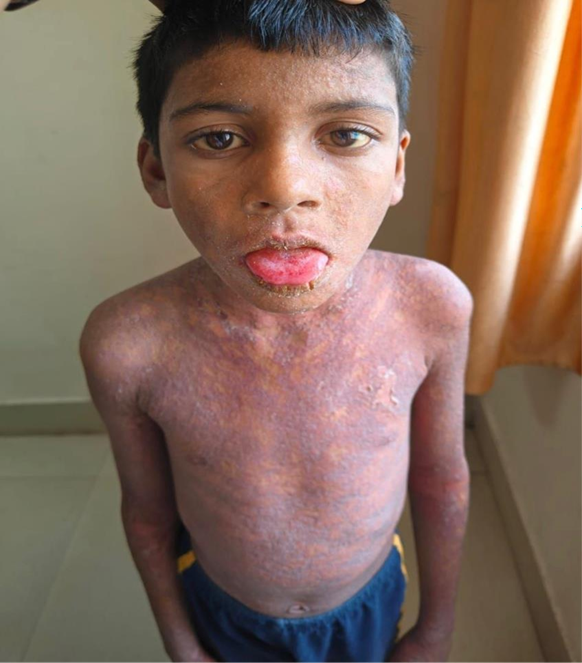
Diffuse maculopapular and purpuric rash present on day of hospitalisation
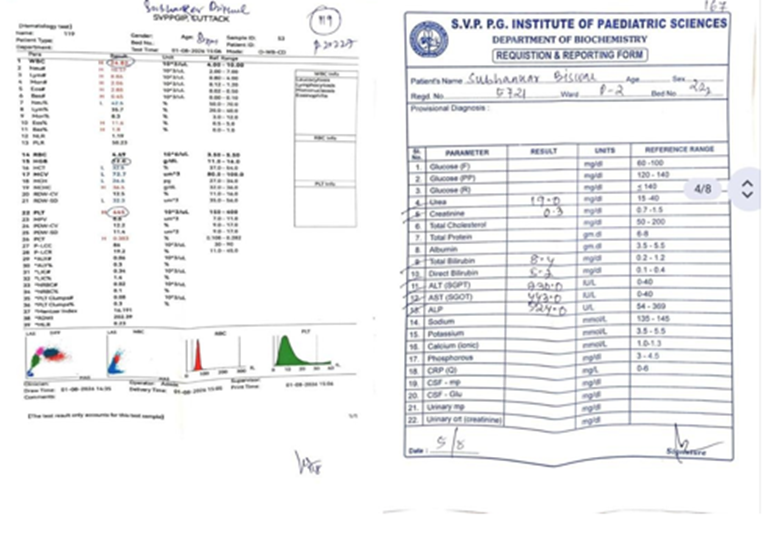
Before starting treatment- fig 1.CBC and DC suggestive of eosinophilia and leukocytosis.(TLC-24K , Eosinophil-2.88k) fig2.LFT showing elevated liver enzymes.(ALT-730,AST-443) and total and direct bilirubins.
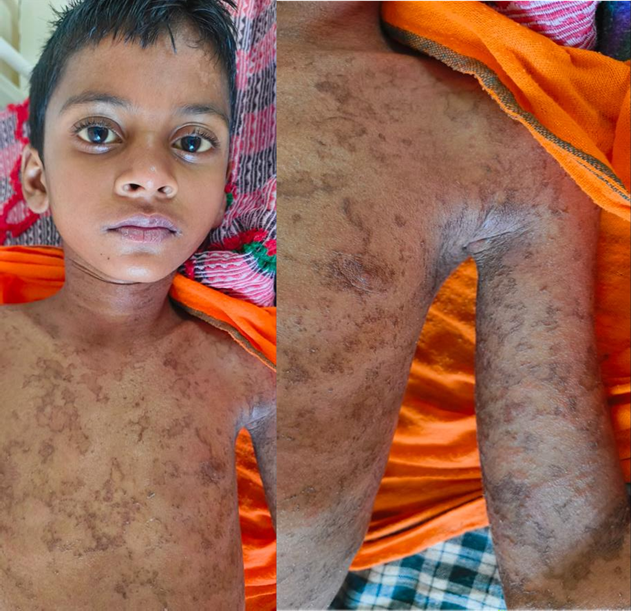
After 5 days of hospitalisation and starting treatment.
DISCUSSION:
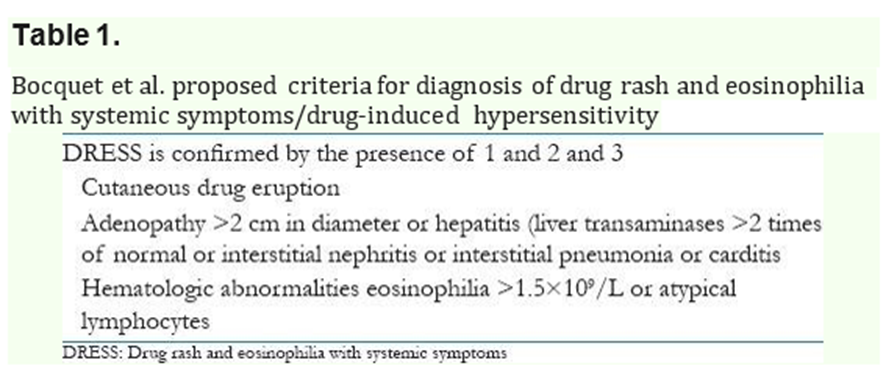
Drug-induced hypersensitivity syndrome was first described in 1936 During treatment with anti convulsant drugs. Later on , The association with other drugs was established and the name DRESS Syndrome’ was suggested to describe this entity. The syndrome is characterised by rash, fever , lymphadenopathy, and internal organ involvement(single or multiple). A variety of drugs like anticonvulsants, sulphonamides , dapsone, allopurinol, NSAIDs are the commonest. The liver is the most common internal organ affected in this syndrome. The findings may range from a transitory increase in liver enzymes to liver necrosis with fulminant hepatic failure , that is thought to be mediated by infiltration of eosinophils, resulting in death and liver transplant. The kidney lung and heart are the other organs that can be affected.4 Fever and rash appearing days after starting a commonly offending drug can lead to a diagnostic dilemma. Our case was one and the offending drug was lamotrigine in our case. Prompt evaluation of the clinical features aided by internal organ involvement evident by elevated liver enzymes and elevated eosinophil count helped us reach the diagnosis. Both the Bocquet et al diagnostic criteria and the RegiSCAR criteria were fullfilled.
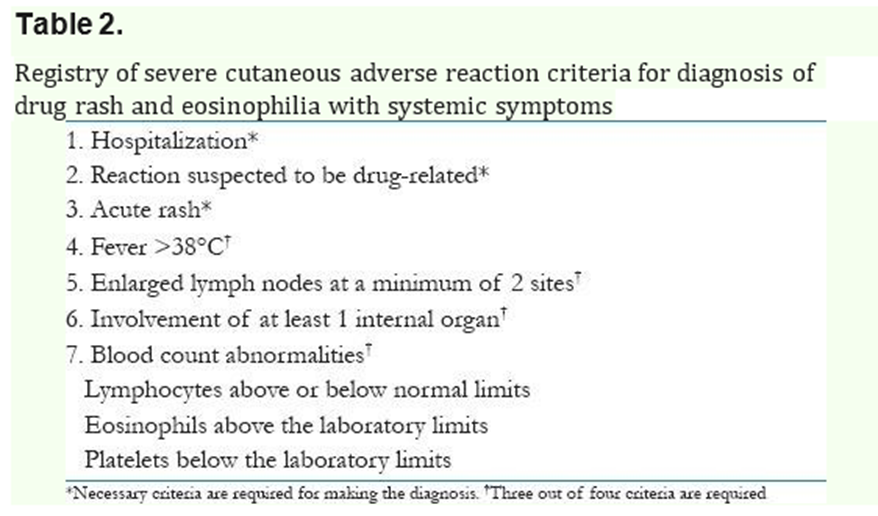
Prompt discontinuation of lamotrigine and initiation of corticosteroid led to rapid clinical improvement. This case highlights the imprtance of early recognition and management of Lamotrigine- induced DRESS in pediatric patients.
REFERENCES:
1. Cardoso CS, Vieira AM, Oliveira AP. DRESS syndrome: a case report and literature review. BMJ Case Rep. 2011 Jun 3;2011:bcr0220113898. doi: 10.1136/bcr.02.2011.3898. PMID: 22693316.
2. Calle AM, Aguirre N, Ardila JC, Cardona Villa R. DRESS syndrome: A literature review and treatment algorithm. World Allergy Organ J. 2023 Apr 8;16(3):100673. doi: 10.1016/j.waojou.2022.100673. PMID: 37082745; PMCID: PMC10112187.
3. Chen YC, Chiu HC, Chu CY. Drug reaction with eosinophilia and systemic symptoms: a retrospective study of 60 cases. Arch Dermatol. 2010 Dec;146(12):1373-9. doi: 10.1001/archdermatol.2010.198. Epub 2010 Aug 16. PMID: 20713773.
4. Cho YT, Yang CW, Chu CY. Drug Reaction with Eosinophilia and Systemic Symptoms (DRESS): An Interplay among Drugs, Viruses, and Immune System. Int J Mol Sci. 2017 Jun 9;18(6):1243. doi: 10.3390/ijms18061243. PMID: 28598363; PMCID: PMC5486066.
5. Pannu AK, Saroch A. Diagnostic criteria for drug rash and eosinophilia with systemic symptoms. J Family Med Prim Care. 2017 Jul-Sep;6(3):693-694. doi: 10.4103/2249-4863.222050. PMID: 29417040; PMCID: PMC5787987.