Hypokalemia and its association with mechanical ventilation and in-hospital mortality in acute organophosphorus compound poisoning: a hospital-based cross-sectional study from South India.
- Dr. Sanket Patil G , Assistant Professor, Department of General Medicine, Raichur institute of medical sciences (Rims), Raichur, Karnataka, India
- Dr. Sharanabasavaraj Devareddy , Senior Resident, Department of General Medicine, Sri Siddhartha Institute of Medical Sciences & Research Centre, Bangalore, Karnataka, India.
Article Information:
Abstract:
Background: Hypokalemia is frequently observed in acute organophosphorus (OP) compound poisoning, but its prognostic value has rarely been quantified. We examined the frequency of admission hypokalemia and its association with ventilatory need and in-hospital mortality. Methods: In this hospital-based cross-sectional study, 50 patients admitted with OP poisoning to a tertiary toxicology ward in Raichur, India (July–December 2013) were enrolled; patients with known renal or cardiac disease or diuretic use were excluded. Admission serum potassium was classified as hypokalemia (<3.5 mmol/L) or not. Outcomes were in-hospital death, need for and duration of mechanical ventilation, and hospital stay. Age-adjusted odds ratios (OR) were estimated by logistic regression. Results: Hypokalemia was present in 24 patients (48.0%; 95% CI 34.8–61.5). Mortality was 41.7% (10/24) with hypokalemia versus 15.4% (4/26) without (OR 3.93, 95% CI 1.03–14.99; χ² p = 0.039; Fisher p = 0.059). After age adjustment the OR was 3.54 (0.84–14.95), whereas each 1 mmol/L higher potassium remained associated with lower odds of death (adjusted OR 0.45, 0.22–0.92). Mortality rose across descending potassium strata (trend p = 0.002). Hypokalemic patients more often required ventilation (70.8% vs 42.3%; OR 3.31, 1.02–10.72) and had more ventilator days (mean 2.79 vs 1.42; difference 1.37, 95% CI 0.09–2.65). Potassium discriminated death with an area under the curve of 0.75 (0.58–0.91). Age, sex, compound, sodium and hospital stay did not differ by potassium status. Conclusion: Admission hypokalemia was common and accompanied greater ventilatory need and higher mortality, with an inverse potassium–mortality gradient that persisted after age adjustment. Serum potassium is an inexpensive marker that may aid early risk stratification, pending validation in larger, severity-adjusted cohorts.
Keywords:
Article :
INTRODUCTION:
Self-poisoning with agricultural pesticides remains one of the commonest methods of suicide worldwide. A systematic review estimated that approximately 258,000 people die each year from pesticide self-poisoning, about 30% of global suicides 1. A later update covering 2010–2014 recorded a substantial decline, largely driven by falling suicide rates in China, yet still attributed about 110,000 deaths each year (13.7% of suicides) to pesticides; correcting for under-reporting in India raised this to 168,000 deaths 2. In India, a nationally representative mortality survey estimated about 187,000 suicide deaths in 2010, roughly half of them from poisoning, chiefly pesticide ingestion 3. Organophosphorus (OP) insecticides account for the largest share of these deaths, with case fatality commonly exceeding 15% even in hospitalised patients 4. National bans on highly hazardous pesticides reduce pesticide-specific and overall suicide mortality 5, but until such regulation is universal, the burden falls on district and tertiary hospitals that must triage and treat large numbers of poisoned patients with limited intensive care capacity.
OP compounds inhibit acetylcholinesterase, producing a cholinergic crisis with muscarinic, nicotinic and central nervous system features. Death usually follows respiratory failure, which may arise from central respiratory depression, bronchorrhoea and bronchospasm, or failure of neuromuscular transmission 4,6. A distinct phase of proximal limb, neck flexor, cranial nerve and respiratory muscle paralysis appearing 24 to 96 hours after poisoning—the intermediate syndrome—was characterised in 1987 and remains an important cause of late ventilatory dependence 7. OP poisoning is also not a single entity: in a prospective Sri Lankan cohort of 802 patients, case fatality and the need for intubation differed markedly between chlorpyrifos, dimethoate and fenthion 8. Standard care consists of resuscitation, atropine, oximes and ventilatory support 4,9. Clinical severity scales such as the Peradeniya Organophosphorus Poisoning (POP) scale 10 and cholinesterase assays assist triage, but cholinesterase measurement is not available in many public hospitals, and there remains a practical need for inexpensive, routinely measured markers that identify patients at risk of respiratory failure and death.
Electrolyte disturbances have been described in OP poisoning for more than four decades. In 1975, Lyzhnikov and colleagues reported hypokalemia and hypernatremia together with severe rhythm and conduction disorders in 73 patients poisoned with OP insecticides 11. Hypokalemia was subsequently documented among the biochemical abnormalities in a Turkish series of 269 anticholinesterase poisonings 12, in four of 14 adults in a Puerto Rican series 13, and in the laboratory profile of emergency department cases from south-eastern Turkey 14. Several mechanisms are plausible. Nicotinic stimulation of sympathetic ganglia and the adrenal medulla raises circulating catecholamines, and epinephrine at concentrations seen in acute stress lowers plasma potassium through β2-adrenoceptor-mediated cellular uptake 15. Vomiting, diarrhoea and salivary losses deplete total body potassium, renal tubular dysfunction including transient distal renal tubular acidosis has been reported 16, and concurrent hypomagnesaemia impairs potassium repletion 17.
Hypokalemia is clinically relevant because it reduces skeletal muscle excitability and prolongs myocardial repolarisation 17. In OP poisoning, both effects act on systems that are already compromised: neuromuscular transmission is impaired by persistent nicotinic receptor stimulation, and QTc prolongation has been associated with mortality in some cohorts 18, although others have not found it to predict short-term outcome 19,20. Hypokalemia could therefore plausibly contribute to respiratory muscle failure and ventricular arrhythmia, or at least act as a marker of the catecholamine surge that accompanies severe poisoning.
Evidence on the prognostic role of potassium nonetheless remains inconsistent. In a prospective study of 152 patients from Kashmir, hypokalemia (<3.5 mmol/L) was present in 72.7% of non-survivors compared with 34.7% of survivors 21. In contrast, a prospective study of 133 patients from rural Karnataka found no strict relationship between electrolyte disturbance and outcome 22, and a trajectory analysis of 299 intensive care patients in Karachi identified sodium, urea and creatinine, but not potassium, as markers of ICU mortality 23. In a Chinese cohort, shock and serum creatinine rather than potassium predicted death 24. Most of these studies examined potassium as one of many laboratory variables, reported unadjusted comparisons of means, and seldom related potassium to ventilatory outcomes, which are the main determinants of resource use. Whether admission hypokalemia identifies patients at higher risk, and whether that association is explained by age or other patient characteristics, therefore remains uncertain, particularly in Indian public-sector hospitals where OP poisoning is common and cholinesterase assays are often unavailable.
There is also a resource argument for examining ventilatory outcomes specifically. In most public hospitals in India, the number of patients with OP poisoning who need mechanical ventilation at any one time can exceed the number of ventilators and staffed intensive care beds. Respiratory failure may develop abruptly during the cholinergic phase or insidiously during the intermediate syndrome 7, and delayed recognition is a recognised contributor to avoidable death 4. A marker that flags, at the point of admission, the patients most likely to need ventilation would help clinicians decide whom to observe in a high-dependency area and when to arrange transfer, even if it did not change specific treatment. Potassium is measured routinely on admission in almost every hospital, its result is available within an hour, and it costs a fraction of a cholinesterase assay, so its prognostic value deserves to be quantified with effect estimates rather than inferred from case reports. We hypothesised that hypokalemia at admission would be associated with a greater need for and duration of mechanical ventilation and with higher in-hospital mortality among patients with acute OP compound poisoning.
OBJECTIVES
(i) To estimate the frequency of hypokalemia at admission among patients with acute organophosphorus compound poisoning.
(ii) To examine the association of hypokalemia with clinical and biochemical parameters (age, sex, compound ingested, serum sodium) and with outcomes, namely the need for and duration of mechanical ventilation, length of hospital stay and in-hospital mortality.
MATERIALS AND METHODS:
Study design and setting
This was a hospital-based analytical cross-sectional study with ascertainment of in-hospital outcomes, reported in accordance with the Strengthening the Reporting of Observational Studies in Epidemiology (STROBE) statement. The study was conducted in the toxicology ward of the Institute of Internal Medicine, , Raichur institute of medical sciences (Rims), Raichur, Karnataka, India , a public tertiary referral centre that receives poisoned patients from Raichur and neighbouring districts, frequently after initial treatment elsewhere, over six months from July to December 2013.
Participants
Patients admitted to the toxicology ward with a history of organophosphorus compound poisoning were eligible. The diagnosis was based on the history of exposure, the compound identified from the history or container, and clinical features of cholinergic toxicity; cholinesterase activity was not measured. No age limit was specified, and the youngest participant was 15 years old. Patients with known chronic kidney disease, known heart disease, or current diuretic therapy were excluded because these conditions independently alter serum potassium. Eligible patients were enrolled as they were admitted during the study period until the target of 50 participants was reached; the number of eligible admissions not enrolled was not documented.
Study size
The sample size of 50 was fixed by the feasibility of recruitment within the study period; no formal sample size calculation was performed. With 50 participants, the observed prevalence of hypokalemia carried a 95% Wilson confidence interval of 34.8% to 61.5%, which defines the precision of the primary descriptive estimate.
Data collection
After informed consent, a structured proforma was completed for each patient, recording demographic details, occupation, presenting complaints, compound ingested, past and treatment history, drug allergy, vital signs, and general and systemic examination (cardiovascular, respiratory, abdominal and central nervous systems). Serum potassium, serum sodium and renal function tests were measured in all patients on a single blood sample drawn at admission to the toxicology ward, in the hospital laboratory; the time of sampling relative to treatment received before admission and the analytical method were not documented.
Patients were treated by the ward team according to the standard approach of the unit: decontamination; intravenous atropine in boluses of 1–3 mg titrated to atropinisation (dry mucous membranes, reduced secretions, clear lungs, heart rate of at least 80 per minute and systolic blood pressure of at least 90 mmHg), followed by an atropine infusion of up to 2 mg per hour; pralidoxime; and endotracheal intubation with mechanical ventilation for respiratory failure. Individual drug doses, the specific criteria for intubation and weaning, and potassium replacement were left to the treating team and were not recorded in the study dataset. Patients were followed until discharge or death.
Variables and definitions
The exposure was hypokalemia, defined as an admission serum potassium below 3.5 mmol/L; patients with values of 3.5 mmol/L or above were classified as non-hypokalemic. The original study protocol specified a cut-off of 3.6 mEq/L; because no participant had a value between 3.1 and 4.1 mmol/L, classification was identical under both definitions. Potassium was also analysed as a continuous variable and in four strata (<2.5, 2.5–2.9, 3.0–3.4 and ≥3.5 mmol/L) to examine a gradient. Hyponatremia was defined as serum sodium of 135 mmol/L or below, as in the original analysis; results using the conventional threshold of below 135 mmol/L are also reported. The primary outcome was in-hospital mortality. Secondary outcomes were the need for mechanical ventilation, the duration of mechanical ventilation in days (recorded as zero for patients who were not ventilated), and the length of hospital stay in days.
Outcome ascertainment
Outcomes were recorded prospectively by the investigator during the admission and abstracted from the case notes at discharge or death. Death was any death occurring during the index admission. A patient was counted as requiring mechanical ventilation if endotracheal intubation and invasive ventilation were undertaken at any time during the admission; the duration of ventilation was counted in whole days from intubation to successful extubation or death. Length of stay was counted in whole days from admission to discharge or death. The outcome was recorded as death or discharge for every participant; no patient left against medical advice or was transferred out before an outcome was recorded.
Data management and quality control
Proforma entries were transcribed into a master chart containing, for every participant, sex, age, compound ingested, admission serum potassium and sodium, duration of hospital stay, duration of mechanical ventilation and outcome. For the present report, the master chart was transcribed electronically, range checks were applied to all numerical variables, and the transcription was verified by reproducing every summary statistic, contingency table and test result reported in the original dissertation before additional analyses were undertaken. Two discrepancies between the narrative and the master chart in the original dissertation were identified and resolved in favour of the patient-level data: the number of hypokalemic patients requiring ventilation (17, not 18) and the definition of hyponatremia (sodium ≤135 mmol/L, which yields the reported 14 patients).
Bias
Conditions and drugs that alter potassium homeostasis were excluded to reduce confounding of the exposure. All biochemical measurements were made in a single hospital laboratory, and the outcomes (death, ventilation and length of stay) were objective events recorded in the case notes. Clinical severity scores, cholinesterase activity and time since ingestion were not recorded, so confounding by poisoning severity could not be addressed; this is considered in the Discussion.
Statistical analysis
Data were entered into the proforma and analysed originally with the SPSS statistical package. For this report, the anonymised master dataset was re-analysed in Python 3 using SciPy 1.18.1 and statsmodels 0.15.0 to add effect estimates and confidence intervals; all values from the original analysis were reproduced. Continuous variables are summarised as mean ± standard deviation (SD) and, where skewed, median and interquartile range (IQR); they were compared with the independent-samples t test (with Levene's test for equality of variances) and, because ventilation duration was skewed with many zero values, also with the Mann–Whitney U test. Categorical variables are summarised as counts and percentages with denominators and were compared with Pearson's χ² test; Fisher's exact test is reported alongside because of the modest sample size. All expected cell counts in the 2 × 2 outcome tables were at least 5 (minimum expected count 6.72). The association between compound and potassium status was examined with a 15 × 2 χ² test, which is reported descriptively because most cells were sparse.
Risk ratios and odds ratios (OR) with 95% confidence intervals (CI) were calculated for mortality and ventilation. Binary logistic regression was used to estimate the association of hypokalemia, and of potassium as a continuous variable, with death and ventilation, unadjusted and adjusted for age (per 10 years). Age was the only covariate because it was associated with mortality and has been reported as a predictor in previous work 21, and because 14 deaths permitted no more than one or two covariates. A trend in mortality across the four potassium strata was tested with the Cochran–Armitage test. The ability of admission potassium to discriminate non-survivors was assessed with the area under the receiver operating characteristic curve (AUC), with the 95% CI estimated by the Hanley–McNeil method, and the optimal cut-off identified by the Youden index. Correlations were assessed with Spearman's coefficient (ρ). There were no missing values for the analysed variables. All tests were two-sided, and exact p values are reported.
Several sensitivity analyses were specified to test the robustness of the main comparisons: Fisher's exact and continuity-corrected χ² tests for the binary outcomes; non-parametric tests for ventilation duration and length of stay; analysis of ventilation duration restricted to ventilated patients, to separate the probability of ventilation from its duration; and reclassification of hyponatremia using the conventional threshold of below 135 mmol/L. Because the study was not designed to develop a prediction rule, the optimal potassium cut-off from the ROC analysis is reported as exploratory and was not internally validated.
Ethical considerations
The study was approved by the Institutional Ethics Committee of , Raichur institute of medical sciences (Rims), Raichur, Karnataka, India .Written informed consent was obtained from each patient or, where the patient was unable to consent, from a relative. Participation was voluntary, patients could withdraw at any time without affecting their care, and the dataset was anonymised before analysis.
RESULTS:
Participant characteristics
Fifty patients were enrolled and analysed (Figure 1). The mean age was 36.16 ± 13.75 years (range 15–75), and 39 (78.0%) were men. Fifteen different OP compounds were involved; monocrotophos (15, 30.0%) and chlorpyrifos (11, 22.0%) were the most frequent. The mean admission serum potassium was 3.77 ± 1.08 mmol/L (range 2.0–5.3) and the mean serum sodium was 136.64 ± 2.03 mmol/L (range 131–140); no patient had hypernatremia. Four patients (8.0%) had potassium values above 5.0 mmol/L (5.2–5.3 mmol/L) and were included in the non-hypokalemic group.
Frequency of hypokalemia and associated characteristics
Hypokalemia was present in 24 patients (48.0%; 95% CI 34.8–61.5), with a mean potassium of 2.70 ± 0.33 mmol/L compared with 4.75 ± 0.32 mmol/L in the 26 non-hypokalemic patients; seven patients had potassium below 2.5 mmol/L. Characteristics by potassium status are shown in Table 1. Patients with hypokalemia were on average 4.26 years older (38.38 ± 14.11 vs 34.12 ± 13.36 years; 95% CI −3.55 to 12.07; p = 0.278). Hypokalemia occurred in 20 of 39 men (51.3%) and 4 of 11 women (36.4%) (p = 0.382; Fisher p = 0.501). Serum sodium of 135 mmol/L or below was found in 6 of 24 hypokalemic (25.0%) and 8 of 26 non-hypokalemic patients (30.8%) (p = 0.650); using the threshold of below 135 mmol/L, the corresponding numbers were 3 and 4. Potassium and sodium were not correlated (ρ = −0.15, p = 0.294).
The distribution of compounds is shown in Table 2. Hypokalemia occurred in 8 of 15 patients poisoned with monocrotophos and 6 of 11 with chlorpyrifos, whereas none of the nine patients poisoned with acephate, anilofos, diazinon, dimethoate, phosphamidon or temephos was hypokalemic. The overall association between compound and potassium status was not significant (χ² = 12.765, 14 degrees of freedom, p = 0.545), although the test had little power given the sparse cells. Deaths were concentrated among patients poisoned with monocrotophos (7 of 15) and chlorpyrifos (3 of 11).
In-hospital mortality
Fourteen patients died (28.0%; 95% CI 17.5–41.7), all of whom had required mechanical ventilation. Mortality was 41.7% (10/24) among patients with hypokalemia and 15.4% (4/26) among those without, an absolute difference of 26.3 percentage points (Table 3, Figure 2). The risk ratio was 2.71 (95% CI 0.98–7.50) and the OR 3.93 (95% CI 1.03–14.99). The difference was significant by Pearson's χ² test (χ² = 4.276, p = 0.039) but not after continuity correction (p = 0.080) or by Fisher's exact test (p = 0.059). Ten of the 14 deaths (71.4%) occurred in hypokalemic patients. Treated as a continuous variable, admission potassium was lower in non-survivors than in survivors (3.14 ± 1.06 vs 4.01 ± 1.00 mmol/L; median 2.65 vs 4.5 mmol/L; Mann–Whitney p = 0.007) (Figure 3A). Potassium discriminated non-survivors with an AUC of 0.75 (95% CI 0.58–0.91); the Youden-optimal cut-off of 2.7 mmol/L or below had a sensitivity of 57.1% and a specificity of 91.7% (Figure 3B). Mortality increased as potassium fell (Table 4, Figure 4): 5 of 7 patients (71.4%) with potassium below 2.5 mmol/L died, compared with 4 of 8 (50.0%) at 2.5–2.9 mmol/L, 1 of 9 (11.1%) at 3.0–3.4 mmol/L, and 4 of 26 (15.4%) at 3.5 mmol/L or above (Cochran–Armitage trend p = 0.002). Mortality in the mildest hypokalemic stratum was thus similar to that in non-hypokalemic patients.
Effect of adjustment for age
Non-survivors were older than survivors (44.71 ± 15.77 vs 32.83 ± 11.48 years; p = 0.005), and each additional 10 years of age was associated with higher odds of death (adjusted OR 1.85, 95% CI 1.12–3.06). After adjustment for age, the OR for death associated with hypokalemia was 3.54 (95% CI 0.84–14.95; p = 0.085). Potassium as a continuous variable remained independently associated with mortality: each 1 mmol/L higher admission potassium was associated with lower odds of death, unadjusted (OR 0.44, 95% CI 0.23–0.86; p = 0.016) and after adjustment for age (OR 0.45, 95% CI 0.22–0.92; p = 0.029) (Table 5). Sex was not associated with mortality (12 of 39 men and 2 of 11 women died; Fisher p = 0.705).
Mechanical ventilation
Twenty-eight patients (56.0%; 95% CI 42.3–68.8) required mechanical ventilation. Ventilation was needed in 17 of 24 hypokalemic patients (70.8%) and 11 of 26 non-hypokalemic patients (42.3%) (χ² p = 0.042; Fisher p = 0.052), an OR of 3.31 (95% CI 1.02–10.72) and a risk ratio of 1.67 (95% CI 1.00–2.81) (Table 3). After age adjustment the OR was 3.01 (95% CI 0.90–10.07; p = 0.074) (Table 5). Across all patients, the mean duration of ventilation was 2.79 ± 2.45 days with hypokalemia and 1.42 ± 2.06 days without, a difference of 1.37 days (95% CI 0.09–2.65; t test p = 0.037); medians were 3 (IQR 0–4) and 0 (IQR 0–3) days (Mann–Whitney p = 0.030). Among the 28 ventilated patients only, the duration of ventilation did not differ materially (3.94 ± 1.95 days in 17 hypokalemic vs 3.36 ± 1.86 days in 11 non-hypokalemic patients; Mann–Whitney p = 0.400). The greater ventilator burden in the hypokalemic group therefore reflected mainly the larger proportion requiring ventilation. Admission potassium was weakly and inversely correlated with ventilation days (ρ = −0.28, p = 0.050).
Length of hospital stay
The mean length of stay was 6.29 ± 3.01 days in hypokalemic and 6.08 ± 2.99 days in non-hypokalemic patients (difference 0.21 days, 95% CI −1.49 to 1.92; p = 0.802), and potassium was not correlated with length of stay (ρ = 0.04, p = 0.772). Non-survivors had a shorter stay than survivors (5.29 ± 2.61 vs 6.53 ± 3.07 days; p = 0.188), indicating that length of stay in this cohort was shortened by early death.
Sensitivity analyses
The direction of every comparison was unchanged across the sensitivity analyses, but their statistical significance was not uniformly robust. For mortality and the need for ventilation, the Pearson χ² p values were below 0.05 whereas the Fisher exact and continuity-corrected p values lay between 0.05 and 0.08. For ventilation duration, the non-parametric test agreed with the t test. The continuous potassium measure, the trend across strata and the comparison of potassium between survivors and non-survivors gave consistent results with smaller p values than the dichotomised comparisons. Reclassifying hyponatremia with the conventional threshold did not reveal an association with potassium status.
Table 1. Characteristics of patients with acute organophosphorus poisoning by admission potassium status (N = 50)
|
Characteristic |
Hypokalemia (n = 24) |
No hypokalemia (n = 26) |
Total (N = 50) |
p value |
|
Age, years, mean ± SD |
38.38 ± 14.11 |
34.12 ± 13.36 |
36.16 ± 13.75 |
0.278ᵃ |
|
Male sex, n (%)ᵇ |
20 (83.3) |
19 (73.1) |
39 (78.0) |
0.382ᶜ |
|
Female sex, n (%)ᵇ |
4 (16.7) |
7 (26.9) |
11 (22.0) |
|
|
Serum potassium, mmol/L, mean ± SD |
2.70 ± 0.33 |
4.75 ± 0.32 |
3.77 ± 1.08 |
— |
|
Serum potassium <2.5 mmol/L, n (%) |
7 (29.2) |
0 |
7 (14.0) |
— |
|
Serum sodium, mmol/L, mean ± SD |
136.75 ± 2.31 |
136.54 ± 1.77 |
136.64 ± 2.03 |
— |
|
Serum sodium ≤135 mmol/L, n (%) |
6 (25.0) |
8 (30.8) |
14 (28.0) |
0.650ᶜ |
|
Serum sodium <135 mmol/L, n (%) |
3 (12.5) |
4 (15.4) |
7 (14.0) |
— |
|
Monocrotophos poisoning, n (%) |
8 (33.3) |
7 (26.9) |
15 (30.0) |
see Table 2 |
|
Chlorpyrifos poisoning, n (%) |
6 (25.0) |
5 (19.2) |
11 (22.0) |
see Table 2 |
Hypokalemia: admission serum potassium <3.5 mmol/L. ᵃ Independent-samples t test (equal variances; Levene p = 0.159); mean difference 4.26 years (95% CI −3.55 to 12.07). ᵇ Percentages are column percentages; hypokalemia occurred in 20/39 men (51.3%) and 4/11 women (36.4%). ᶜ Pearson χ² test; Fisher exact p = 0.501 (sex) and 0.757 (sodium). Sodium ≤135 mmol/L was the threshold used in the original analysis. SD, standard deviation; CI, confidence interval.
Table 2. Organophosphorus compounds ingested and admission potassium status (N = 50)
|
Compound |
Total, n |
Hypokalemia, n |
No hypokalemia, n |
|
Monocrotophos |
15 |
8 |
7 |
|
Chlorpyrifos |
11 |
6 |
5 |
|
Parathion |
3 |
2 |
1 |
|
Methyl parathion |
3 |
2 |
1 |
|
Diazinon |
3 |
0 |
3 |
|
Chlorthiophos |
2 |
1 |
1 |
|
Malathion |
2 |
2 |
0 |
|
Temephos |
2 |
0 |
2 |
|
Fenthion |
2 |
1 |
1 |
|
Triazophos |
2 |
1 |
1 |
|
Profenofos |
1 |
1 |
0 |
|
Anilofos |
1 |
0 |
1 |
|
Phosphamidon |
1 |
0 |
1 |
|
Acephate |
1 |
0 |
1 |
|
Dimethoate |
1 |
0 |
1 |
|
Total |
50 |
24 |
26 |
Pearson χ² = 12.765, 14 degrees of freedom, p = 0.545; the test is unreliable because most expected cell counts were below 5 and is shown for completeness only. Compound names follow standard nomenclature (source records: monochrotophos, prophenophos, anilphos, phosphomidon).
Table 3. Outcomes by admission potassium status (N = 50)
|
Outcome |
Hypokalemia (n = 24) |
No hypokalemia (n = 26) |
Effect estimate (95% CI) |
p value |
|
In-hospital death, n (%) |
10 (41.7) |
4 (15.4) |
OR 3.93 (1.03–14.99); RR 2.71 (0.98–7.50) |
0.039ᵃ |
|
Mechanical ventilation required, n (%) |
17 (70.8) |
11 (42.3) |
OR 3.31 (1.02–10.72); RR 1.67 (1.00–2.81) |
0.042ᵃ |
|
Ventilation duration, days, all patients, mean ± SD |
2.79 ± 2.45 |
1.42 ± 2.06 |
MD 1.37 (0.09–2.65) |
0.037ᵇ |
|
Ventilation duration, days, all patients, median (IQR) |
3 (0–4) |
0 (0–3) |
— |
0.030ᶜ |
|
Ventilation duration, days, ventilated patients only, mean ± SD |
3.94 ± 1.95 (n = 17) |
3.36 ± 1.86 (n = 11) |
— |
0.400ᶜ |
|
Length of hospital stay, days, mean ± SD |
6.29 ± 3.01 |
6.08 ± 2.99 |
MD 0.21 (−1.49 to 1.92) |
0.802ᵇ |
|
Length of hospital stay, days, median (IQR) |
6 (5–7) |
5 (5–6.75) |
— |
— |
ᵃ Pearson χ² test; for death, continuity-corrected p = 0.080 and Fisher exact p = 0.059; for ventilation, Fisher exact p = 0.052. ᵇ Independent-samples t test. ᶜ Mann–Whitney U test. OR, odds ratio; RR, risk ratio; MD, mean difference; SD, standard deviation; IQR, interquartile range; CI, confidence interval.
Table 4. In-hospital mortality and need for mechanical ventilation across admission potassium strata (N = 50)
|
Serum potassium, mmol/L |
Patients, n |
Deaths, n (%) |
Ventilated, n (%) |
Ventilation days, mean |
|
<2.5 |
7 |
5 (71.4) |
6 (85.7) |
3.00 |
|
2.5–2.9 |
8 |
4 (50.0) |
7 (87.5) |
3.12 |
|
3.0–3.4 |
9 |
1 (11.1) |
4 (44.4) |
2.33 |
|
≥3.5 |
26 |
4 (15.4) |
11 (42.3) |
1.42 |
|
Total |
50 |
14 (28.0) |
28 (56.0) |
2.08 |
Cochran–Armitage test for trend in mortality across strata: z = −3.15, p = 0.002. Percentages are row percentages. No patient had a potassium value between 3.1 and 4.1 mmol/L, so the 3.0–3.4 stratum contains values of 3.0–3.1 mmol/L.
Table 5. Logistic regression of in-hospital mortality and need for mechanical ventilation on admission potassium (N = 50)
|
Model and variable |
Odds ratio (95% CI) |
p value |
|
In-hospital death (14 events) |
|
|
|
Model 1: hypokalemia (unadjusted) |
3.93 (1.03–14.99) |
0.045 |
|
Model 2: hypokalemia, adjusted for age |
3.54 (0.84–14.95) |
0.085 |
|
Age, per 10 years |
1.85 (1.12–3.06) |
0.016 |
|
Model 3: potassium, per 1 mmol/L higher (unadjusted) |
0.44 (0.23–0.86) |
0.016 |
|
Model 4: potassium, per 1 mmol/L higher, adjusted for age |
0.45 (0.22–0.92) |
0.029 |
|
Age, per 10 years |
1.86 (1.12–3.07) |
0.016 |
|
Mechanical ventilation (28 events) |
|
|
|
Model 5: hypokalemia (unadjusted) |
3.31 (1.02–10.72) |
0.046 |
|
Model 6: hypokalemia, adjusted for age |
3.01 (0.90–10.07) |
0.074 |
|
Age, per 10 years |
1.47 (0.92–2.35) |
0.111 |
Binary logistic regression; Wald p values. Hypokalemia: serum potassium <3.5 mmol/L. Adjustment was limited to age because of the small number of outcome events. Area under the ROC curve for potassium as a predictor of death 0.75 (95% CI 0.58–0.91). CI, confidence interval; ROC, receiver operating characteristic.
FIGURE LEGENDS
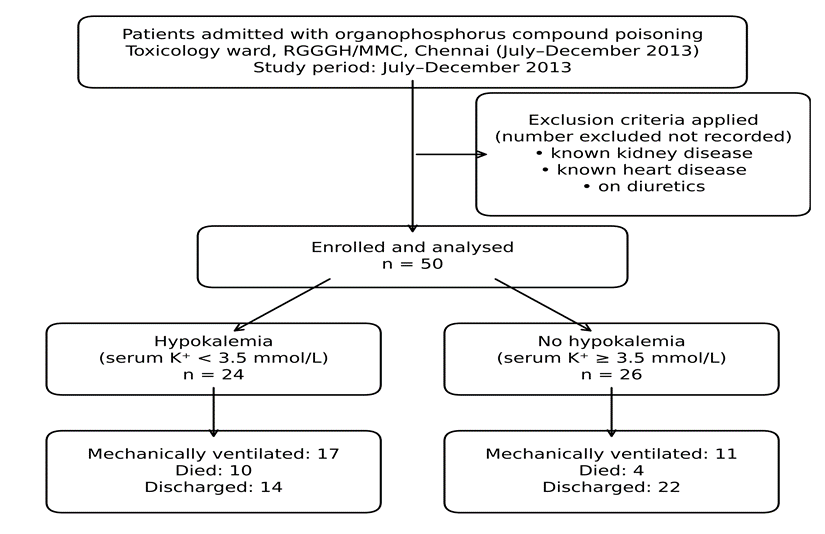
Figure 1. Flow of participants through the study, with outcomes by admission potassium status (STROBE). The numbers of patients screened and excluded were not recorded in the source dataset.
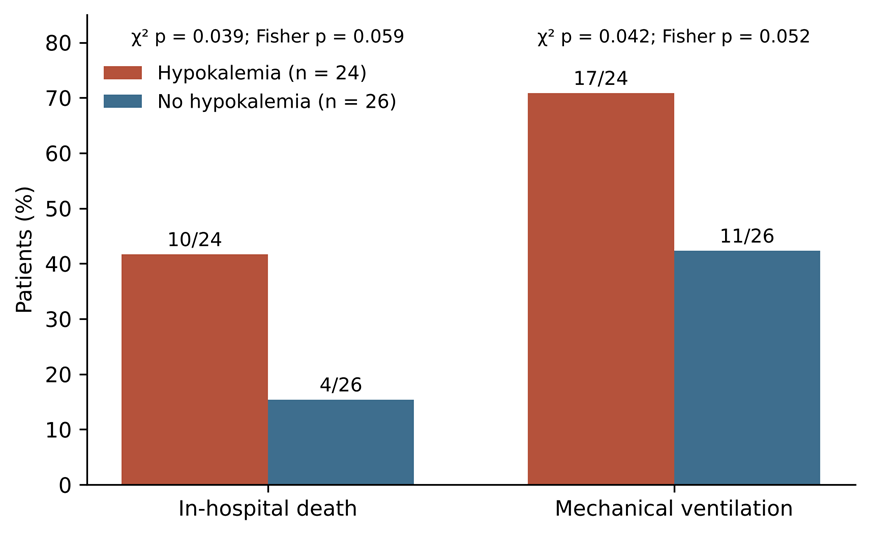
Figure 2. In-hospital mortality and need for mechanical ventilation in patients with (n = 24) and without (n = 26) hypokalemia at admission. Bars show percentages; numbers above bars are n/N. p values from Pearson χ² and Fisher exact tests.
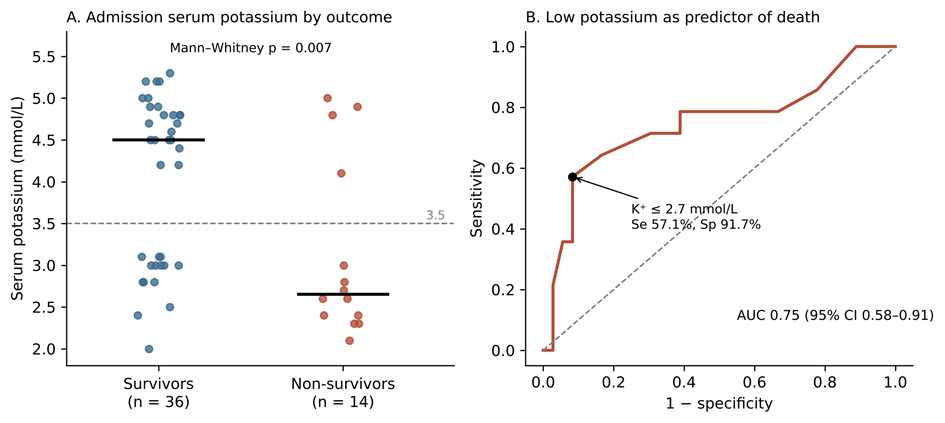
Figure 3. (A) Admission serum potassium in survivors (n = 36) and non-survivors (n = 14); each point is one patient (horizontal jitter added), horizontal bars show medians, and the dashed line marks 3.5 mmol/L. (B) Receiver operating characteristic curve for low admission potassium as a predictor of in-hospital death; the marked point is the Youden-optimal cut-off (≤2.7 mmol/L). AUC, area under the curve; Se, sensitivity; Sp, specificity.
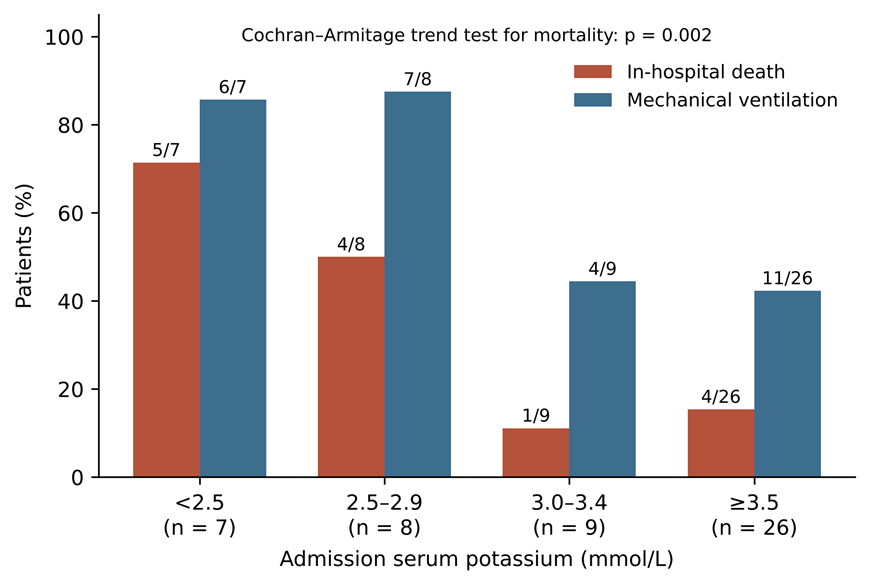
Figure 4. In-hospital mortality and need for mechanical ventilation across admission serum potassium strata. Numbers above bars are n/N. Trend in mortality tested with the Cochran–Armitage test.
DISCUSSION:
In this cohort of 50 patients with acute OP compound poisoning, nearly half were hypokalemic at admission. Hypokalemia was accompanied by a higher in-hospital mortality and a greater need for mechanical ventilation, and mortality rose in a graded fashion as potassium fell. The association between hypokalemia as a binary variable and death was attenuated and became imprecise after adjustment for age, but the inverse association between potassium as a continuous measure and mortality persisted. Hypokalemia was not related to age, sex, compound, serum sodium or length of hospital stay.
The frequency of hypokalemia in our study (48.0%) lies between the 34.7% observed among survivors and the 72.7% observed among non-survivors in the Kashmir cohort 21, and is higher than the four of 14 patients reported from Puerto Rico 13. Differences in case mix probably explain much of this variation. Our patients were treated in a tertiary referral toxicology ward, the case fatality of 28.0% was considerably higher than the 7.2% reported from Kashmir 21 or the 13.7% ICU mortality in Karachi 23, and the compound mix was dominated by monocrotophos. Because sicker patients have a greater catecholamine surge, more vomiting and more intravenous fluid therapy, a high prevalence of hypokalemia is to be expected in a referral population with severe poisoning. The timing of sampling matters as well: potassium drawn after several hours of dextrose-containing fluids will be lower than a true pre-treatment value.
Our finding that hypokalemia was associated with mortality agrees with the earliest clinical description, in which hypokalemia and hypernatremia accompanied fatal rhythm and conduction disorders 11, with an Indian study of 50 patients in which serum potassium fell with increasing clinical severity, ventilatory support was needed at a mean potassium of 3.27 ± 0.10 mmol/L and death occurred at a mean of 2.90 ± 0.06 mmol/L 25, and with the Kashmir cohort, in which hypokalemia was one of several early metabolic markers of death together with acidosis, hyperlactataemia, hyperglycaemia and older age 21. It differs from the Karnataka study, which found no strict relationship between electrolytes and outcome 22, and from two cohorts in which sodium, urea, creatinine and shock, rather than potassium, predicted death 23,24. Several factors may explain the discordance. Potassium is labile and is often corrected within hours, so studies that analysed repeated values or late trajectories may have missed the prognostic information carried by the admission value 23. Studies that compared mean potassium between survivors and non-survivors may have been diluted by the many patients with near-normal values. Finally, different compounds produce different clinical courses 8, and the predominance of monocrotophos in our cohort, a compound associated with intermediate syndrome 7, may have strengthened the link between potassium and respiratory outcomes.
The stratified analysis adds a point that dichotomised analyses miss. Patients with mild hypokalemia (3.0–3.4 mmol/L) had a mortality similar to normokalemic patients, whereas mortality rose steeply below 3.0 mmol/L, and the cut-off that best separated survivors from non-survivors was 2.7 mmol/L. This pattern suggests that the conventional threshold of 3.5 mmol/L, which is appropriate for defining a laboratory abnormality 17, may not be the most informative threshold for prognosis in OP poisoning. It also explains why the binary OR lost precision after age adjustment while the continuous measure did not: dichotomising at 3.5 mmol/L groups patients at very different risk together and discards information. The strata were small, however, and the 2.7 mmol/L cut-off was derived and tested in the same data, so it is likely to be optimistic and should be regarded as hypothesis-generating rather than as a decision threshold.
Age was the strongest single predictor of death in our data, consistent with the Kashmir cohort, in which non-survivors were on average 18 years older than survivors 21, though at variance with the Karnataka study, which reported higher mortality in younger patients 22. Hypokalemic patients in our cohort were about four years older than non-hypokalemic patients, and part of the crude association between hypokalemia and death may therefore reflect age. The relatively small change in the OR for hypokalemia after adjustment (from 3.93 to 3.54) suggests that age explained only a modest share of the association; the widening of the confidence interval reflects the small number of deaths more than a loss of effect. Nevertheless, age is unlikely to be the only confounder. Poisoning severity, the dose ingested, the delay to presentation and the compound are all likely to influence both potassium and outcome, and none of these could be adjusted for.
The original thesis interpreted the longer mean ventilation time in hypokalemic patients as prolongation of ventilation. Our re-analysis indicates that this difference was driven by the larger proportion of hypokalemic patients who required ventilation; once ventilated, the duration was similar in the two groups. This distinction matters clinically. It suggests that hypokalemia marks patients who progress to respiratory failure, rather than identifying a subgroup whose ventilator weaning is delayed by ongoing potassium deficit. Respiratory failure is the principal mode of death in OP poisoning 4,6, and in our cohort every patient who died had been ventilated. Recent prognostic work has identified acidosis and depressed consciousness as predictors of the need for ventilation 26; whether potassium adds to such scores remains to be tested.
Two broad explanations for the association are possible. Hypokalemia may contribute directly to adverse outcomes. Low extracellular potassium hyperpolarises the muscle membrane and reduces excitability, which could compound the post-synaptic neuromuscular junction defect that underlies respiratory muscle weakness in severe OP poisoning and intermediate syndrome 7,17. Hypokalemia also prolongs ventricular repolarisation, and the arrhythmic deaths described by Lyzhnikov and colleagues occurred in hypokalemic patients 11. The prognostic value of QTc prolongation in OP poisoning is itself disputed 18,19,20, and we did not record electrocardiograms, so we cannot judge whether arrhythmia contributed to deaths here. Alternatively, hypokalemia may be a marker of severity rather than a cause of harm. Nicotinic stimulation of sympathetic ganglia and the adrenal medulla produces a catecholamine surge whose β2-adrenergic effect shifts potassium into cells 15; the depth of hypokalemia may therefore track the intensity of the cholinergic crisis. Gastrointestinal losses, renal tubular dysfunction 16 and magnesium depletion 17 add further plausible pathways. Our design cannot separate these explanations, and both may operate.
Hypokalemia was not associated with serum sodium in our cohort, and no patient had hypernatremia, in contrast to the hypernatremia reported alongside hypokalemia by Lyzhnikov and colleagues 11. Sodium trajectories predicted ICU mortality in the Karachi cohort 23, but our single admission measurement and the narrow range of sodium values limited the ability to detect such an association. Length of hospital stay was not related to potassium. This should not be read as evidence that hypokalemia lacks clinical impact: death shortened hospital stay, so length of stay mixes favourable and unfavourable outcomes, and ventilator-free days or survival-adjusted measures would be more informative outcome measures in future studies.
The statistical evidence should be read with appropriate caution. The original dissertation concluded that hypokalemia significantly increased mortality and could be used as a reliable marker. With 14 deaths, the association between binary hypokalemia and death was significant by Pearson's χ² test but sat just above the conventional threshold by Fisher's exact test, and its confidence interval was wide. We have therefore reported both tests and emphasised effect sizes rather than significance alone. The consistency of the findings across complementary analyses—the continuous measure, the gradient across strata, the comparison of distributions between survivors and non-survivors, and the parallel association with ventilation—is more persuasive than any single p value, and it supports a genuine association. It does not establish that potassium is a reliable stand-alone predictor; an AUC of 0.75 indicates moderate discrimination, and the sensitivity at the best cut-off was only 57.1%.
Iatrogenic factors deserve consideration when interpreting admission potassium. Patients with OP poisoning commonly receive large volumes of intravenous fluid, often containing dextrose, and repeated doses of atropine. Dextrose stimulates insulin release and drives potassium into cells, and potassium losses through vomiting and gastric lavage are seldom replaced early 17. If the admission sample in some patients was drawn after initial treatment at a referring hospital, part of the hypokalemia observed may have been treatment-related. This would not invalidate potassium as a marker of risk, because sicker patients receive more intensive treatment, but it would complicate any causal interpretation and reinforces the case for recording the timing of sampling and prior treatment in future studies.
No individual compound was significantly associated with hypokalemia, but the analysis had little power. Seven of the 15 patients poisoned with monocrotophos died, six of whom were hypokalemic, and confounding by compound cannot be excluded. Given the substantial differences in toxicity between OP compounds 8, future studies should identify the compound by laboratory assay where possible and adjust for it.
Strengths
The study addresses a practical prognostic question with a test that is available in every hospital. Conditions and drugs that independently alter potassium were excluded. The complete patient-level dataset was available and was re-analysed to reproduce the original results, to report effect sizes with confidence intervals alongside p values, and to examine potassium both as a binary and as a continuous variable with a stratified gradient. Mortality and ventilation are objective, clinically important outcomes, and there were no missing data for the analysed variables.
Limitations
The study has important limitations. It was conducted at a single tertiary centre with 50 patients and 14 deaths, so estimates are imprecise and the multivariable analysis could adjust only for age. Poisoning severity (for example, the POP scale 10), cholinesterase activity, the amount ingested, the time from ingestion to admission and the intent of poisoning were not recorded, so residual confounding by severity is likely. Potassium was measured once, and its timing relative to treatment and the use of potassium replacement were not documented. Magnesium, acid–base status and electrocardiograms were not recorded, which precludes analysis of mechanisms. Exclusion of patients with renal or cardiac disease and diuretic use improves internal validity but limits generalisability to older patients with comorbidity, and women were under-represented. The method of enrolment and the number of patients screened were not documented. The data were collected in 2013, and the compounds used and practices in management may have changed since. Finally, the optimal potassium cut-off was derived from the same data and requires external validation.
Clinical implications
Admission serum potassium is inexpensive and universally available. In settings where cholinesterase assays and intensive care beds are scarce, a potassium value below 3.0 mmol/L at admission may help identify patients who need closer monitoring for respiratory failure and earlier transfer to a ventilated bed. Correction of hypokalemia is good practice irrespective of its prognostic role, together with assessment of magnesium; magnesium sulfate has shown possible benefit as an adjunct in OP poisoning, although the evidence remains insufficient for routine use 27. Potassium should be interpreted alongside clinical severity, not used as a stand-alone triage criterion.
Future research
Larger prospective, multicentre cohorts should measure potassium before treatment and serially, together with magnesium, arterial blood gases, cholinesterase activity, a validated severity score and electrocardiographic intervals. Such studies could establish whether potassium adds prognostic information beyond existing scores, define a validated threshold, and examine whether early, protocolised correction of potassium and magnesium changes ventilatory outcomes. Analyses using ventilator-free days and time-to-event methods would capture outcomes more fully than length of stay.
CONCLUSION:
Hypokalemia was present in almost half of patients admitted with acute OP compound poisoning and was associated with a greater need for mechanical ventilation and higher in-hospital mortality. Mortality increased steeply below a potassium of 3.0 mmol/L, and the inverse association between admission potassium and death persisted after adjustment for age. Serum potassium is a simple, inexpensive marker that may support early risk stratification in OP poisoning, but its independent prognostic value should be confirmed in larger cohorts with adjustment for poisoning severity before it is used to guide triage.
REFERENCES:
1. Gunnell D, Eddleston M, Phillips MR, Konradsen F. The global distribution of fatal pesticide self-poisoning: systematic review. BMC Public Health. 2007;7:357. doi:10.1186/1471-2458-7-357
2. Mew EJ, Padmanathan P, Konradsen F, Eddleston M, Chang SS, Phillips MR, et al. The global burden of fatal self-poisoning with pesticides 2006-15: systematic review. J Affect Disord. 2017;219:93-104. doi:10.1016/j.jad.2017.05.002
3. Patel V, Ramasundarahettige C, Vijayakumar L, Thakur JS, Gajalakshmi V, Gururaj G, et al. Suicide mortality in India: a nationally representative survey. Lancet. 2012;379(9834):2343-51. doi:10.1016/S0140-6736(12)60606-0
4. Eddleston M, Buckley NA, Eyer P, Dawson AH. Management of acute organophosphorus pesticide poisoning. Lancet. 2008;371(9612):597-607. doi:10.1016/S0140-6736(07)61202-1
5. Gunnell D, Knipe D, Chang SS, Pearson M, Konradsen F, Lee WJ, et al. Prevention of suicide with regulations aimed at restricting access to highly hazardous pesticides: a systematic review of the international evidence. Lancet Glob Health. 2017;5(10):e1026-37. doi:10.1016/S2214-109X(17)30299-1
6. Eddleston M, Chowdhury FR. Organophosphorus poisoning: the wet opioid toxidrome. Lancet. 2021;397(10270):175-7. doi:10.1016/S0140-6736(20)32749-5
7. Senanayake N, Karalliedde L. Neurotoxic effects of organophosphorus insecticides. An intermediate syndrome. N Engl J Med. 1987;316(13):761-3. doi:10.1056/NEJM198703263161301
8. Eddleston M, Eyer P, Worek F, Mohamed F, Senarathna L, von Meyer L, et al. Differences between organophosphorus insecticides in human self-poisoning: a prospective cohort study. Lancet. 2005;366(9495):1452-9. doi:10.1016/S0140-6736(05)67598-8
9. Goel A, Aggarwal P. Pesticide poisoning. Natl Med J India. 2007;20(4):182-91.
10. Senanayake N, de Silva HJ, Karalliedde L. A scale to assess severity in organophosphorus intoxication: POP scale. Hum Exp Toxicol. 1993;12(4):297-9. doi:10.1177/096032719301200407
11. Lyzhnikov EA, Savina AS, Shepelev VM. [Pathogenesis of disorders of cardiac rhythm and conductivity in acute organophosphate insecticide poisoning]. Kardiologiia. 1975;15(9):126-9. Russian.
12. Oztürk MA, Keleştimur F, Kurtoğlu S, Güven K, Arslan D. Anticholinesterase poisoning in Turkey--clinical, laboratory and radiologic evaluation of 269 cases. Hum Exp Toxicol. 1990;9(5):273-9. doi:10.1177/096032719000900503
13. Rivera JA, Rivera M. Organophosphate poisoning. Bol Asoc Med P R. 1990;82(9):419-22.
14. Kara IH, Güloğlu C, Karabulut A, Orak M. Sociodemographic, clinical, and laboratory features of cases of organic phosphorus intoxication who attended the Emergency Department in the Southeast Anatolian Region of Turkey. Environ Res. 2002;88(2):82-8. doi:10.1006/enrs.2001.4320
15. Brown MJ, Brown DC, Murphy MB. Hypokalemia from beta2-receptor stimulation by circulating epinephrine. N Engl J Med. 1983;309(23):1414-9. doi:10.1056/NEJM198312083092303
16. Narayan R, Abdulla MC, Alungal J. Transient distal renal tubular acidosis in organophosphate poisoning. Indian J Crit Care Med. 2017;21(3):170-1. doi:10.4103/ijccm.IJCCM_298_16
17. Kardalas E, Paschou SA, Anagnostis P, Muscogiuri G, Siasos G, Vryonidou A. Hypokalemia: a clinical update. Endocr Connect. 2018;7(4):R135-46. doi:10.1530/EC-18-0109
18. Liu SH, Lin JL, Weng CH, Yang HY, Hsu CW, Chen KH, et al. Heart rate-corrected QT interval helps predict mortality after intentional organophosphate poisoning. PLoS One. 2012;7(5):e36576. doi:10.1371/journal.pone.0036576
19. Yurumez Y, Yavuz Y, Saglam H, Durukan P, Ozkan S, Akdur O, et al. Electrocardiographic findings of acute organophosphate poisoning. J Emerg Med. 2009;36(1):39-42. doi:10.1016/j.jemermed.2007.08.063
20. Akdur O, Durukan P, Ozkan S, Avsarogullari L, Vardar A, Kavalci C, et al. Poisoning severity score, Glasgow coma scale, corrected QT interval in acute organophosphate poisoning. Hum Exp Toxicol. 2010;29(5):419-25. doi:10.1177/0960327110364640
21. Parrey AH, Koka M, Ismail M, Ashraf M, Lone H. Early markers in severe organophosphorus poisoning and their association with mortality. J Emerg Med. 2025;73:95-101. doi:10.1016/j.jemermed.2024.12.004
22. Banday TH, Tathineni B, Desai MS, Naik V. Predictors of morbidity and mortality in organophosphorus poisoning: a case study in rural hospital in Karnataka, India. N Am J Med Sci. 2015;7(6):259-65. doi:10.4103/1947-2714.159331
23. Farooqui WA, Uddin M, Qadeer R, Shafique K. Latent class trajectories of biochemical parameters and their relationship with risk of mortality in ICU among acute organophosphorus poisoning patients. Sci Rep. 2022;12(1):11633. doi:10.1038/s41598-022-15973-2
24. Xu B, Zeng W, Chen F, Lin G, Wang M, Ding J, et al. Clinical characteristics and early prediction of mortality risk in patients with acute organophosphate poisoning-induced shock. Front Med (Lausanne). 2023;9:990934. doi:10.3389/fmed.2022.990934
25. Prasad DRMM. Reduced levels of serum potassium and plasma cholinesterase in acute organophosphate poisoning: possible predictive markers. Asia Pac J Med Toxicol. 2014;3(2):68-72. doi:10.22038/apjmt.2014.3046
26. Sagah GA, Sobeeh FG, Nassar EH, Selim AF, Sharif AF. PGI score: a promising alternative to serum cholinesterase for predicting mortality and adverse outcomes in acute organophosphorus poisoning: a cross-sectional study. Basic Clin Pharmacol Toxicol. 2025;137(6):e70145. doi:10.1111/bcpt.70145
27. Brvar M, Chan MY, Dawson AH, Ribchester RR, Eddleston M. Magnesium sulfate and calcium channel blocking drugs as antidotes for acute organophosphorus insecticide poisoning - a systematic review and meta-analysis. Clin Toxicol (Phila). 2018;56(8):725-36. doi:10.1080/15563650.2018.1446532.