Tramadol vs Pethidine for the Control of Shivering during Spinal Anaesthesia.
- Dr. Sruthy R , Assistant Professor, Department of Anaesthesiology, Sree Uthradam Thirunal Academy of Medical Sciences, Thiruvananthapuram, Kerala, India.
- Dr. Deepa Franklin , Professor, Department of Anaesthesiology, Government Medical College, Trivandrum, Kerala, India.
- Dr. Sreeja Ravindranath , PhD Research Fellow, Neuroanaesthetist, Sree Chitra Thirunal Institute of Medical Sciences, Thiruvananthapuram, Kerala, India.
Article Information:
Abstract:
Background: Regional anaesthesia is a popular and safe method of anaesthesia, but shivering occurs in 40 to 60 percent of patients.[1,2] Severe shivering increases the metabolic rate and oxygen consumption by up to 600%.[1] Objective: To study the efficacy of Tramadol in comparison to Pethidine for the control of shivering after spinal anaesthesia, along with their hemodynamic effects and complications. Methods: A cross-sectional study was conducted on 80 patients (ASA I & II, aged 20-70) who developed shivering following spinal anaesthesia. Patients were divided into two groups of 40. One group received Tramadol (1 mg/kg IV) and the other received Pethidine (0.5 mg/kg IV). Results: Shivering disappeared in 1.43 minutes in the Tramadol group compared to 3.39 minutes in the Pethidine group. Recurrence occurred in 7.5% of the Tramadol group and 25% of the Pethidine group. Nausea and vomiting were observed in 10% and 20% of the Tramadol and Pethidine groups, respectively. Both drugs maintained good hemodynamic stability. Conclusion: Tramadol (1 mg/kg) is more effective than Pethidine (0.5 mg/kg) in treating shivering after regional anaesthesia due to its rapid onset, effective control, lower recurrence rate, and minimal side effects.
Keywords:
Article :
INTRODUCTION:
Regional anaesthesia is a common and safe anaesthetic treatment for a variety of surgical procedures. Spinal anaesthesia offers numerous advantages over general anaesthesia, including lower costs, fewer adverse respiratory effects, and excellent muscle relaxation. However, a significant drawback is post-anaesthetic shivering, which affects approximately 40-60% of patients undergoing regional anaesthesia.[1,2]
Shivering is a physiological response to a drop in core body temperature, exacerbated by prolonged impairment of thermoregulatory autonomic functions under anaesthesia, cold operating rooms, and cold infusion fluids. Mild shivering increases oxygen consumption akin to light exercise, but severe shivering can increase metabolic rate and oxygen demand by 100-600%.[3,4] This physiological stress can induce arterial hypoxemia, lactic acidosis, increased intraocular and intracranial pressures, and interfere with patient monitoring.[5]
Various techniques exist to control shivering, ranging from non-pharmacological methods like forced-air warmers and warm intravenous fluids to pharmacological interventions.[6] Centrally acting analgesics and opioid receptor agonists are highly effective.[7] Historically, Pethidine (meperidine) has been the gold standard, acting principally on the central nervous system via mu and kappa opioid receptors.[4,8]
However, it can induce respiratory depression and increase the incidence of nausea and vomiting. Tramadol, a synthetic opioid, acts as a weak mu-opioid receptor agonist and inhibits the reuptake of norepinephrine and 5-hydroxytryptamine (serotonin).[3,9] It produces analgesia without significant ventilation depression. This study aims to compare the efficacy, hemodynamic effects, and complication rates of Tramadol and Pethidine in controlling shivering after spinal anaesthesia.
MATERIALS AND METHODS:
Thiruvananthapuram, following Institutional Ethical Committee approval. The study included 80 patients aged 20 to 70 years, categorized under American Society of Anesthesiologists (ASA) Physical Status I and II, scheduled for surgeries under spinal anaesthesia.
Exclusion criteria included patients with fever, thyroid disease, obesity, drug allergies, diabetes, and compromised cardiorespiratory or renal functions.
Patients who experienced post-spinal anaesthesia shivering were consecutively sampled and allocated into two groups of 40:
1. Tramadol Group: Received 1 mg/kg Tramadol intravenously.
2. Pethidine Group: Received 0.5 mg/kg Pethidine intravenously.
Shivering intensity was graded on a scale of 0 to 4 (from no shivering to violent muscular activity). Observations were recorded at 1, 3, and 5 minutes, and subsequently every 10 minutes up to 60 minutes. Primary outcomes included the time taken for shivering cessation, while secondary outcomes measured recurrence rates, hemodynamic changes (blood pressure, pulse rate, oxygen saturation), and adverse effects such as nausea and vomiting.
RESULTS:
The two study groups were well-matched with respect to demographic and clinical variables. The overall mean age of the study population was 40.3 ± 11.15 years, and the mean weight was 58.48 ± 8.04 kg. Table 1 displays the baseline demographic and clinical characteristics of the patients distributed between the Tramadol and Pethidine groups.
Table 1: Patient Demographics and Baseline Characteristics
|
Parameter |
Tramadol Group (n=40) |
Pethidine Group (n=40) |
|
Age (years, Mean ± SD) |
40.3 ± 11.15 |
40.3 ± 11.15 |
|
Gender (Male / Female) |
24 / 16 |
24 / 16 |
|
Weight (kg, Mean ± SD) |
58.48 ± 8.04 |
58.48 ± 8.04 |
|
ASA Physical Status (I / II) |
20 / 20 |
25 / 15 |
Time for Control of Shivering
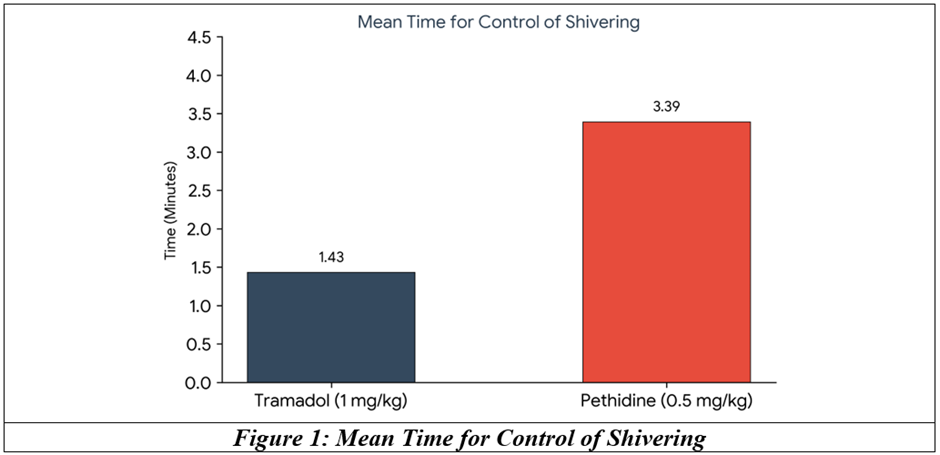
There was a statistically significant difference in the time required for complete shivering cessation. As illustrated in Figure 1, shivering was controlled in a mean time of 1.43 ± 0.71 minutes in the Tramadol group, compared to 3.39 ± 3.12 minutes in the Pethidine group (p = 0.001).
Shivering Characteristics and Recurrence
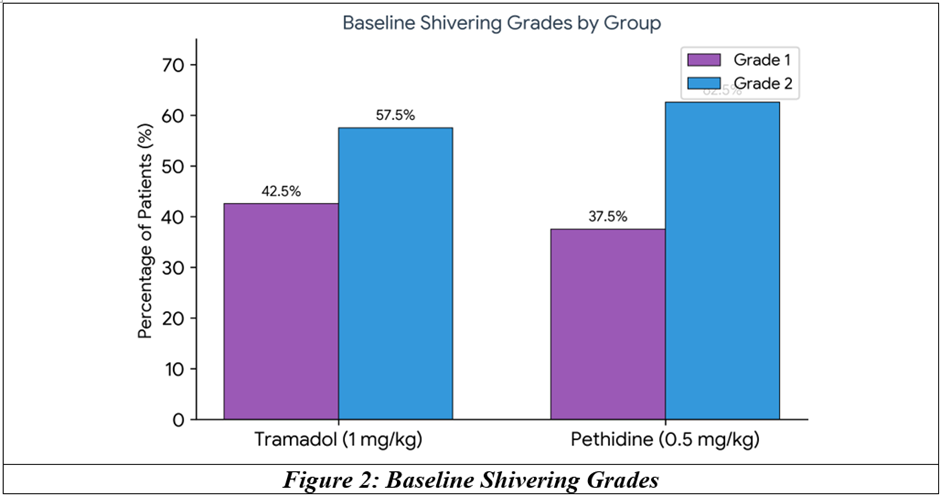
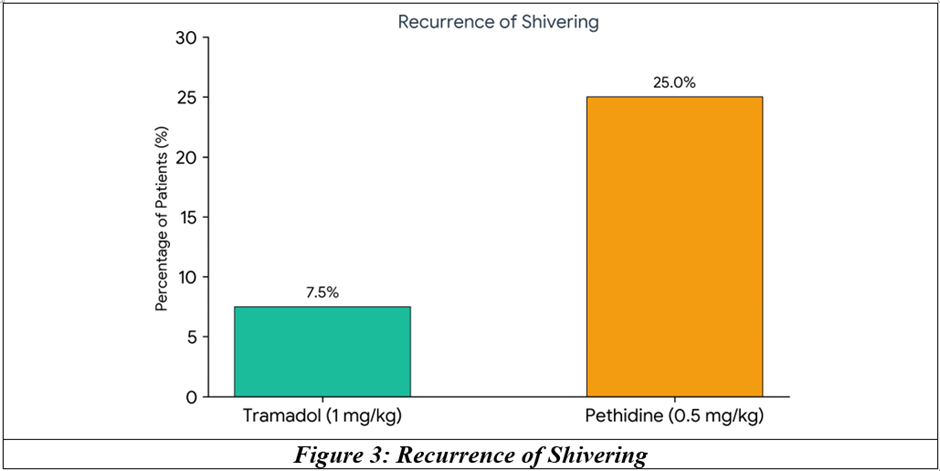
Baseline shivering grades before intervention were primarily Grade 1 and Grade 2 (Figure 2). Following intervention, recurrence of shivering (Figure 3) was observed in only 3 patients (7.5%) in the Tramadol group, which was significantly lower than the 10 patients (25%) in the Pethidine group (p = 0.034).
Hemodynamic Stability and Adverse Effects
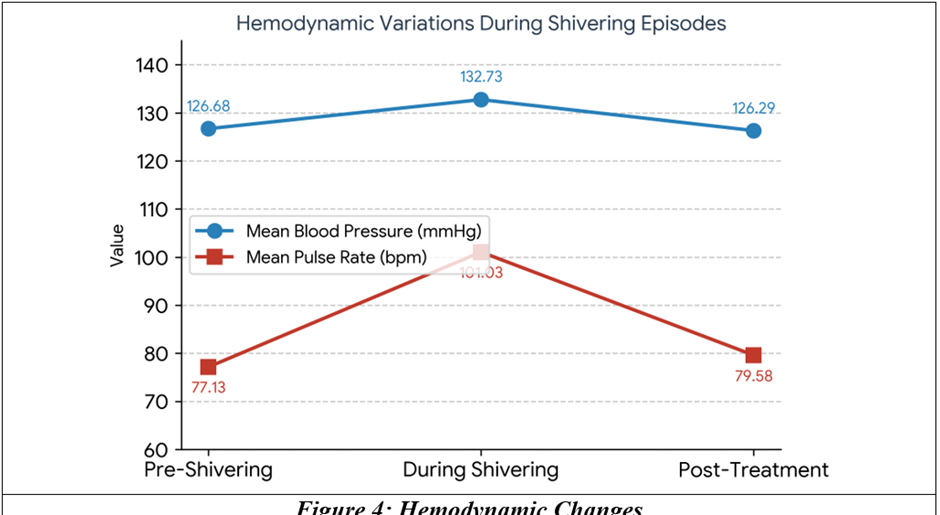
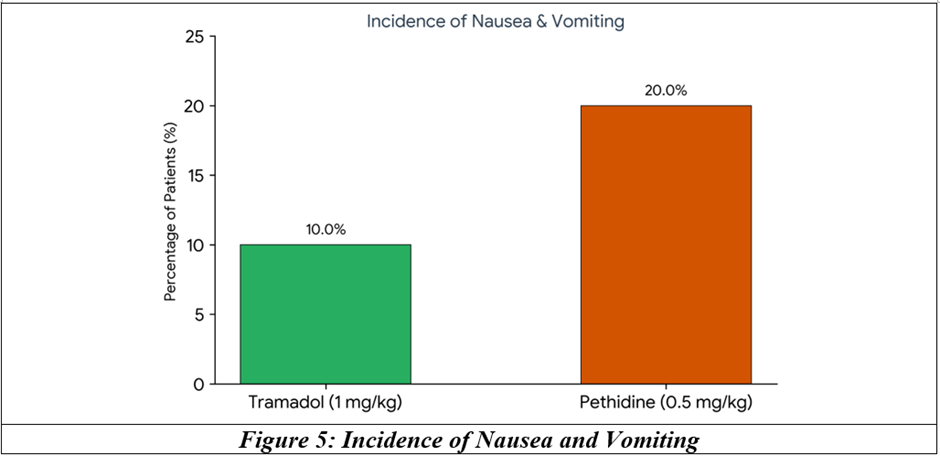
Both medications provided good hemodynamic stability throughout the observation period. Statistically significant transient changes were noted in pulse rate and blood pressure during the shivering episodes, which returned to baseline post-treatment (Figure 4). These parameters remained within safe physiological limits. Adverse effects, specifically nausea and vomiting, were notably lower in the Tramadol group (10%) compared to the Pethidine group (20%), as depicted in Figure 5.
DISCUSSION:
Post-anaesthetic shivering is a multifaceted and highly distressing complication of regional anaesthesia that requires prompt, effective, and safe management to prevent excessive physiological stress. This is particularly critical in patients with low cardiorespiratory reserves, where the sudden surge in metabolic demand can be detrimental.[5] The pathophysiology of shivering during spinal anaesthesia involves a core-to-peripheral redistribution of body heat, driven by anesthetic-induced vasodilation and the subsequent impairment of central thermoregulatory autonomic functions.[1,2] As highlighted by De Witte and Sessler,[1] the consequences of severe shivering are not merely discomfort; they include a massive increase in oxygen consumption and metabolic rate-up to 600%-which can quickly lead to arterial hypoxemia, lactic acidosis, and dangerous elevations in both intraocular and intracranial pressures.[5]
Given these severe physiological ramifications, effective interventions are paramount. While non-pharmacological methods, such as forced-air warming and the administration of warmed intravenous fluids, remain the first line of defense for maintaining normothermia, they are often insufficient on their own to rapidly terminate an active shivering episode. Kranke et al.[6] emphasized the absolute necessity of effective pharmacological interventions when non-pharmacological warming fails or is too slow to achieve the desired clinical stability. In this context, our current study strongly corroborates earlier research indicating the superiority of Tramadol in managing post-anaesthetic shivering compared to the traditional standard, Pethidine.
Historically, Pethidine has been utilized as the "gold standard" pharmacological treatment for shivering.[4,8] Its mechanism of action is primarily mediated through the stimulation of kappa-opioid receptors, which lowers the shivering threshold.[8] However, Pethidine's clinical utility is frequently limited by its significant side effect profile, which includes dose-dependent respiratory depression and a high incidence of postoperative nausea and vomiting.[8] Tramadol, conversely, presents a unique and highly advantageous pharmacological profile. It prevents shivering through a synergistic mechanism: while it is a weak mu-opioid receptor agonist, its primary antishivering efficacy is derived from the potent inhibition of norepinephrine and serotonin (5-hydroxytryptamine) reuptake in the central nervous system.[3] This action enhances the descending inhibitory pathways in the spinal cord, effectively modulating the body's thermoregulatory response without triggering the severe respiratory depression typical of pure opioid agonists.[9]
Our clinical observations distinctly highlight the pharmacokinetic superiority of Tramadol in acute settings. In our study, Tramadol halted shivering at a significantly faster rate (mean time of 1.43 minutes) than Pethidine (3.39 minutes). This rapid onset is highly consistent with the landmark study by Aditi Dhimar et al.[4] which noted the complete disappearance of shivering within 5 minutes for Tramadol-treated patients, compared to a prolonged 20 minutes for those receiving Pethidine. Similarly, Faisal Wahid et al.[10] demonstrated rapid and superior control of shivering with Tramadol compared to Pethidine in a comparable cohort. The rapid pharmacokinetic action of Tramadol is crucial in the operating theater or post-anaesthesia care unit (PACU), where minimizing the duration of a shivering episode directly correlates with a reduction in myocardial oxygen demand and overall patient morbidity.[5]
Furthermore, the recurrence of shivering is a critical metric for evaluating the sustained efficacy of an anti-shivering agent. A drug that acts quickly but wears off rapidly leaves the patient vulnerable to secondary shivering episodes, requiring repeat dosing and compounding the risk of adverse effects. In our study, the recurrence rate was a mere 7.5% for Tramadol, compared to a substantial 25% for Pethidine. This finding aligns closely with the extensive research conducted by Bhatnagar et al.[3] who reported excellent sustained efficacy with Tramadol. Onyekwulu et al.[9] also specifically noted that intravenous Tramadol effectively prevents the reappearance of shivering for extended periods without causing notable respiratory depression in spinal anaesthesia settings, making it particularly valuable for procedures like caesarean sections where maternal and fetal safety are paramount.
Adverse effects play a pivotal role in final drug selection, heavily influencing patient satisfaction and recovery times. Postoperative nausea and vomiting (PONV) is already a significant concern following anaesthesia, and administering an emetogenic drug to treat shivering can severely compound the patient's discomfort. In our study, nausea and vomiting were twice as prevalent in the Pethidine group (20%) compared to the Tramadol group (10%). Dabir et al.[8] similarly found that Pethidine is associated with a significantly higher incidence of postoperative nausea compared to other analgesics like fentanyl or morphine, limiting its overall appeal as a first-line treatment. Tramadol’s lower emetogenic potential observed in our study further solidifies its position as a more patient-friendly option.
Finally, maintaining hemodynamic stability during the administration of anti-shivering medications is crucial, as the patient is already experiencing the sympathetic blockade induced by spinal anaesthesia. Both drugs in our study demonstrated robust hemodynamic stability. While transient changes in pulse rate and blood pressure were observed during the active shivering phase—a natural physiological response to the muscular exertion-these parameters quickly returned to baseline and remained within safe physiological limits following treatment with either drug. This finding is heavily supported by Matsota et al.'s[7] comprehensive systematic review on pharmacological approaches to shivering, which concluded that when dosed appropriately, both agents exhibit safe cardiovascular profiles. However, when weighing the equivalent hemodynamic stability against Tramadol’s faster onset, prolonged duration of action (evidenced by lower recurrence), and reduced emetogenic potential, Tramadol (1 mg/kg) emerges clearly as the superior choice over Pethidine (0.5 mg/kg) for clinical practice.
CONCLUSION:
Based on the results of this comprehensive study, Tramadol (1 mg/kg) is definitively more effective than Pethidine (0.5 mg/kg) in treating shivering following regional anaesthesia. Tramadol provides a significantly faster onset of shivering control, a substantially lower rate of shivering recurrence, and fewer distressing side effects such as nausea and vomiting. While both drugs adequately preserve hemodynamic stability, Tramadol's superior safety profile, rapid action, and sustained efficacy strongly support its adoption as the primary first-line pharmacological treatment for post-anaesthetic shivering.
REFERENCES:
1. De Witte J, Sessler DI. Perioperative shivering: physiology and pharmacology. Anesthesiology 2002;96(2):467-84.
2. Sessler DI, Ponte J. Shivering during epidural anesthesia. Anesthesiology 1990;72(5):816-21.
3. Bhatnagar S, Saxena A, Kannan TR, et al. Tramadol for postoperative shivering: a double-blind comparison with pethidine. Anaesth Intensive Care 2001;29(2):149-54.
4. Dhimar DAA, Patel DMG, Swadia VN. Tramadol for control of shivering (comparison with pethidine). Indian J Anaesth 2007;51(1):28-31.
5. Lopez MB. Postanaesthetic shivering – from pathophysiology to prevention. Romanian J Anaesth Intensive Care 2018;25(1):73-81.
6. Kranke P, Eberhart LH, Roewer N, et al. Pharmacological treatment of postoperative shivering: a quantitative systematic review of randomized controlled trials. Anesth Analg 2002;94(2):453-60.
7. Matsota PK, Koliantzaki IK, Kostopanagiotou GG. Pharmacological approach for the prevention of postoperative shivering: a systematic review of prospective randomized controlled trials. Asian J Anesthesiol 2019;57(3):66-84.
8. Dabir S, Jahandideh M, Abbasinazari M, et al. The efficacy of a single dose of pethidine, fentanyl and morphine in treating postanesthesia shivering. Pak J Pharm Sci 2011;24(4):513-7.
9. Onyekwulu F, Agu E, Amucheazi A. Efficacy of intravenous tramadol in the control of shivering following spinal anaesthesia for caesarean section. Niger Postgrad Med J 2016;23(3):116-20.
10. Wahid F, Hussain A. Comparison of tramadol and pethidine for the treatment of shivering during spinal anesthesia. J Coll Physicians Surg Pak 2011;21(11):666-9.