Knowledge, Attitude, and Practice Refarding Red Flag Signs of Still birth.
- Dr. Nandani Jha , Senior Resident, Department of Obstetrics and Gynaecology, Shree Narayan medical institute and Hospital, Saharsa, Bihar, India.
Article Information:
Abstract:
Background: Stillbirth is a preventable cause of perinatal mortality, mostly low and middle income contries. For timely health-seeking behavior and prevention of fetal loss early identification of red flag signs by antenatal women required. Knowledge, attitude, and practice related study may help to identify gaps in awareness and perception which may contribute to delayed care. Methods: A cross-sectional, questionnaire-based KAP study was conducted at Department of Obstetrics and Gynaecology, Shree Narayan Medical Institute and Hospital, Saharsa, from April 2025 to March 2026. A structured proforma with five questions on red flag signs of stillbirth was administered using google forms, printed questionnaires, and volunteer assistance for illiterate participants. Results: Among 300 participants, majority between 26–35 years (61%) and 69.7% were from rural areas. 91.8% of women identified reduced fetal movement as a danger sign by. 57.1% reported weight loss during pregnancy as harmful by while excessive weight gain was under-recognized. Raised blood pressure was considered as a risk factor by 41%, whereas awareness of hyperglycemia was reported by 59.4%. Knowledge regarding sleep position was vary in study participants. Conclusion: Women were aware regarding some red flag signs like reduced fetal movements, however there was gaps in understanding other modifiable risk factors. Giving health education focusing antenatal care may help to identify risk and prevention of stillbirth.
Keywords:
Article :
INTRODUCTION:
Stillbirth is a major public health problem mostly related to low- and middle-income countries. Eaver year globally millions of pregnancies end due to stillbirth. It causes deep psychological, social, and economic consequences to affected families. Many stillbirths are preventable through timely identification of maternal and fetal-risk factors and proper ante natal care.[1]
Red flag signs are reduced or absent fetal movement, vaginal bleeding, severe abdominal pain, leakage of fluid per vaginam, fever, severe headache, and visual disturbances.[2] Early recognition of these warning signs by pregnant women and their families and appropriate and timely use of healthcare services, plays an important role in preventing fetal loss. However, delays in recognizing danger signs, deciding to seek care, and reaching to health facilities lead to increase stillbirth rates.[3]
For this, knowledge, attitude, and practice (KAP) studies are important tool to assess community awareness and behavioral responses related to health conditions. for this stillbirth, knowledge of red flag signs, attitudes toward pregnancy-related complications and their actual practices during warning signs is essential for identifying gaps between awareness and action.[4] Misconceptions, cultural beliefs, low health literacy and inadequate antenatal counseling may adversely influence women’s perceptions and responses to these critical warning signs. [5,6]
A KAP study provides evidence that can guide targeted health education, strengthen antenatal counseling, and inform policy interventions. Doing this we can improve maternal and perinatal outcomes. Therefore, this study aims to evaluate the knowledge, attitude and practices of pregnant women regarding red flag signs associated with stillbirth and to identifying modifiable risk factors that can help reduce preventable stillbirths through improved awareness and timely care-seeking behaviour.[6]
MATERIALS AND METHODS:
Source of Data
The study participants were antenatal women attending the antenatal outpatient department of Rajshree Medical Research Institute, Bareilly, Uttar Pradesh. Primary data were obtained directly from eligible participants using a predesigned, structured, and interviewer-assisted questionnaire. The questionnaire collected information regarding sociodemographic and obstetric characteristics and the participants’ knowledge, attitudes, and practices concerning red-flag signs and risk factors associated with stillbirth.
Study Design
The study was conducted as a hospital-based, descriptive cross-sectional questionnaire-based Knowledge, Attitude, and Practice (KAP) study.
Study Location
The study was carried out in the Department of Obstetrics and Gynaecology, Shree Narayan Medical Institute and Hospital, Saharsa. Participants were recruited primarily from the antenatal outpatient department of the institute.
Study Duration
The study was conducted over 12 months, from April 2025 to March 2026. This period included participant recruitment, administration of the questionnaire, data verification, data entry, statistical analysis, and interpretation of the findings.
Study Population
The study population consisted of pregnant women attending the antenatal outpatient department during the study period. Women who satisfied the eligibility criteria and provided written informed consent were enrolled in the study.
Sample Size
A total of 300 antenatal women were included in the study.
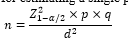
The sample size was calculated using the formula for estimating a single population proportion:
Where:
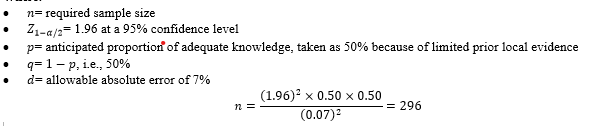
The calculated sample size was approximately 296. It was rounded to 300 participants for ease of recruitment and analysis.
Sampling Technique
Eligible antenatal women attending the study setting during the specified period were recruited by consecutive sampling until the required sample size of 200 was achieved. Each eligible woman was approached only once, and duplicate participation was prevented by checking the registration details.
Inclusion Criteria
The study included:
1. Pregnant women attending the antenatal outpatient department during the study period.
2. Women of any reproductive age and at any gestational age.
3. Both primigravida and multigravida women.
4. Women who were able to understand Hindi, English, or the local language.
5. Women who provided written informed consent to participate.
6. Women who were willing and able to complete the questionnaire independently or with assistance from a trained investigator or volunteer.
Exclusion Criteria
The following women were excluded:
1. Women who did not provide informed consent.
2. Women who were unwilling to complete the questionnaire.
3. Women who were severely ill or required immediate emergency obstetric management at the time of recruitment.
4. Women who had cognitive, psychiatric, hearing, or communication difficulties that prevented reliable participation.
5. Women who submitted incomplete questionnaires with substantial missing information.
6. Women who had already participated in the study during an earlier antenatal visit.
Study Tool
A predesigned and structured questionnaire was used for data collection. The questionnaire was prepared after reviewing relevant literature and established maternal and fetal danger signs. It was designed to assess awareness and behavioural responses concerning red-flag signs associated with stillbirth.
The questionnaire contained the following sections:
Section A: Sociodemographic Information
This section recorded age, area of residence, educational status, occupation, socioeconomic characteristics, and access to healthcare services.
Section B: Obstetric Information
Information was collected regarding gravidity, parity, gestational age, previous adverse pregnancy outcomes, history of stillbirth, number of antenatal visits, and the presence of maternal medical or obstetric risk factors.
Section C: Knowledge
Knowledge-related questions assessed whether participants recognized important warning signs and risk factors, including:
· Reduced or absent fetal movements
· Vaginal bleeding
· Leakage of fluid per vaginam
· Severe abdominal pain
· Fever
· Severe headache or visual disturbances
· Raised blood pressure
· Hyperglycaemia
· Abnormal maternal weight gain or weight loss
· Maternal sleep position and other modifiable behaviours
Section D: Attitude
Attitude-related items assessed the perceived seriousness of warning signs, the importance of regular antenatal care, willingness to seek medical advice, perceived preventability of stillbirth, and trust in institutional healthcare services.
Section E: Practice
Practice-related questions assessed attendance at antenatal visits, monitoring of fetal movements, adherence to medical advice, control of blood pressure and blood glucose, and healthcare-seeking behaviour following the appearance of a danger sign.
The questionnaire was reviewed by experts from Obstetrics and Gynaecology and Community Medicine for relevance, clarity, and content validity. It was pilot-tested among a small group of antenatal women who were not included in the final study. Necessary modifications were made to simplify ambiguous or difficult questions.
Procedure and Methodology
Eligible antenatal women were identified when they attended the antenatal outpatient department. The investigator explained the purpose, nature, expected benefits, and voluntary nature of the study in a language understood by each participant. Participants were informed that refusal to participate would not affect their routine antenatal care.
Written informed consent was obtained before enrolment. Each consenting participant was assigned a unique identification number to maintain confidentiality. Sociodemographic and obstetric information was recorded using the structured study proforma.
The questionnaire was administered according to the participant’s educational status and familiarity with digital platforms. Participants comfortable with digital technology completed the questionnaire through a Google Form. Literate participants who preferred a paper-based format completed a printed questionnaire. Women who were unable to read or had difficulty understanding the written questions were interviewed by a trained investigator or volunteer.
For interviewer-administered questionnaires, each question was read exactly as written and explained in the participant’s preferred language. The interviewer recorded the response given by the participant without suggesting an answer or changing its meaning. A neutral interviewing technique was followed to minimize interviewer and social-desirability bias.
Participants were provided sufficient privacy and time to answer the questions. The completed forms were checked on the same day for completeness, internal consistency, and missing responses. When necessary, missing information was clarified immediately with the participant without influencing her original response.
Knowledge, attitude, and practice responses were coded according to a predefined coding system. Correct knowledge responses and appropriate practices were assigned a score of one, whereas incorrect, “do not know,” and inappropriate responses were assigned a score of zero. Attitude responses were coded according to the options provided in the questionnaire. Individual item responses and, where applicable, composite KAP scores were calculated.
After completion of the questionnaire, participants received brief counselling regarding important pregnancy danger signs, daily awareness of fetal movements, regular antenatal attendance, and the need to seek immediate medical care if warning symptoms developed.
Sample Processing
No blood, urine, tissue, or other biological specimen was collected because the study was questionnaire-based. Therefore, laboratory sample collection and processing were not applicable.
For the purpose of data processing, each completed questionnaire was treated as an individual study record. Paper questionnaires were reviewed, serially numbered, coded, and entered into an electronic database. Responses collected through Google Forms were downloaded and merged with the manually entered data. The combined dataset was checked for duplication, incomplete records, impossible values, and inconsistencies.
A random subset of entered records was cross-verified against the original questionnaires to identify data-entry errors. The final cleaned dataset was anonymized before statistical analysis.
Data Collection
Data were collected prospectively throughout the study period. The investigator or trained research assistant approached eligible antenatal women after completion of their routine clinical consultation or while they waited for antenatal services.
The three modes of data collection were:
1. Online administration: Participants familiar with digital platforms completed the questionnaire using a Google Form.
2. Self-administered printed questionnaire: Literate participants completed a printed version of the same questionnaire.
3. Interviewer-assisted administration: For participants who were illiterate or had reading difficulties, trained investigators or volunteers explained the questions in the local language and recorded their responses.
The wording and sequence of questions were kept uniform across all three modes. Completed data were entered into Microsoft Excel using a predefined coding sheet. Personal identifiers were removed from the analytical dataset, and access to the data was restricted to the research team.
Study Variables
The principal outcome variables were:
· Knowledge of red-flag signs associated with stillbirth
· Attitude toward pregnancy complications and timely care-seeking
· Reported preventive and healthcare-seeking practices
· Recognition of reduced fetal movement as a danger sign
· Awareness of maternal hypertension, hyperglycaemia, abnormal weight change, and sleep position as possible risk factors
The explanatory variables included age, residence, education, occupation, socioeconomic status, gravidity, parity, gestational age, previous stillbirth or pregnancy loss, number of antenatal visits, and source of antenatal information.
Statistical Methods
The collected data were entered into Microsoft Excel, cleaned, coded, and analysed using an appropriate statistical software package. Statistical analysis was performed at a 5% level of significance, and 95% confidence intervals were reported wherever applicable.
Categorical variables, including residence, parity, educational status, individual knowledge responses, attitudes, and practices, were summarized using frequencies and percentages. Continuous variables, such as age and gestational age, were assessed for normality and presented as mean with standard deviation when normally distributed or median with interquartile range when the distribution was skewed.
The chi-square test was used to assess associations between categorical variables, such as adequate knowledge and sociodemographic or obstetric characteristics. Fisher’s exact test was applied when the expected frequency in any cell was small. Independent-samples t test or one-way analysis of variance was used to compare normally distributed continuous variables between two or more groups. Corresponding non-parametric tests were used when the assumptions of parametric tests were not satisfied.
Where composite scores were calculated, knowledge, attitude, and practice scores were reported using suitable descriptive statistics. Internal consistency of multi-item domains was assessed using Cronbach’s alpha, where applicable. Variables showing a clinically meaningful association or a univariable p value below the predetermined selection criterion were considered for multivariable logistic regression. Adjusted odds ratios with 95% confidence intervals were calculated to identify independent factors associated with adequate knowledge or appropriate practices. All tests were two-tailed. A p value of less than 0.05 was considered statistically significant.
Ethical Considerations
The study was conducted after obtaining approval from the Institutional Ethics Committee of Rajshree Medical Research Institute, Bareilly. Written informed consent was obtained from every participant before data collection. Participation was voluntary, and participants were free to withdraw at any stage without affecting their treatment.
RESULTS:
Table 1: Socio demographic profile of the study participants (n = 300)
|
Variable |
Category |
Number |
Percentage |
|
Age group |
< 25 years |
60 |
20.0 |
|
26–35 years |
183 |
61.0 |
|
|
> 35 years |
33 |
11.0 |
|
|
Area of residence |
Rural |
209 |
69.7 |
|
Urban |
91 |
30.3 |
|
|
Parity |
≤ 2 |
77 |
25.6 |
|
2–4 |
178 |
59.2 |
|
|
≥ 5 |
45 |
15.2 |
Table 1 show that out of 300 women more than half were age between 26–35 years followed by less than 25 years (20.0%) and more than 35 years (11.0%). Majority of were from rural areas (69.7%). Majority of women had 2–4 children and only15.2% had parity ≥5.
Table 2: Perception of changes in fetal movement (n = 300)
|
Fetal movement pattern |
Number |
Percentage |
|
Reduced fetal movement |
275 |
91.8 |
|
Excessive fetal movement |
25 |
8.2 |
Table 2 shows that Majority of women (91.8%) identified reduced fetal movement as a red flag sign for stillbirth, whereas only 8.2% reported excessive fetal movement as a warning sign.
Table 3: Awareness regarding changes in weight during pregnancy (n = 300)
|
Weight change pattern |
Number |
Percentage |
|
Excessive weight gain |
52 |
17.4 |
|
Weight loss |
171 |
57.1 |
|
Both weight gain and loss |
77 |
25.5 |
Table 3 shows that 57.1% women percieved weight loss during pregnancy as a danger sign, whereas 17.4% belelive excessive weight gain as risk, and 25.5% recognized both weight gain and loss as potential red flags.
Table 4: Perception of the blood pressure during antenatal period (n = 300)
|
Blood Pressure Status |
Number |
Percentage |
|
Raised blood pressure |
123 |
41 |
|
Low blood pressure |
114 |
38 |
|
Both high or low BP |
33 |
11 |
|
No role of BP |
30 |
10 |
Table 4 shows different perceptions regarding blood pressure for stillbirth. 41% women identify increased blood pressure as a risk factor, while 38% believed low blood pressure as risk factor for still birth. 11% said both high and low blood pressure as harmful and 10% believed blood pressure had no role in stillbirth.
Table 5: Knowledge regarding other red flag signs of stillbirth (n = 300)
A. Role of sleep position during pregnancy
|
Sleep Position |
Number |
Percentage |
|
Supine |
109 |
36.2 |
|
Right lateral |
78 |
26 |
|
Left lateral |
22 |
7.2 |
|
No effect |
91 |
30.6 |
In Table 5A, regarding sleep position, 109(36.2%) women reported supine sleep as harmful, 78 (26.0%), and 22 (7.2%) identified right and left lateral position as concerning respectively. Whereas 91 (30.6%) believed sleep position had no effect.
B. Awareness regarding hyperglycemia in pregnancy as a red flag sign
|
Response |
Number (n) |
Percentage (%) |
|
Yes |
178 |
59.4 |
|
No |
23 |
7.8 |
|
Don’t know |
99 |
32.8 |
Table 5B shows that more than half women were aware of hyperglycemia as a red flag sign for stillbirth, 23 (7.8%) responded negatively, and 99 (32.8%) were unsure.
DISCUSSION:
The socio-demographic distribution in our study shows that most participants were aged between 26–35 years (61.0%) and resided in rural areas (69.7%), with 74.4% having parity more than two. This profile aligns with published evidence showing stillbirth disproportionately affects women from rural. Altijani et al. (2018) done a systematic review and meta-analysis of 142 studies from low and middle-income countries and found that rural residence pooled OR 1.26, 95% CI 1.15–1.38) and parity of more than 3(pooled OR 1.23) was significantly associated with stillbirth. [7]
Similarly, a study by McClure et al. (2011) showed higher stillbirth rates among multiparous women and those with limited access to healthcare. [8] These findings are similar to our population as one inherently vulnerable to adverse perinatal outcomes.
In our study awareness of reduced fetal movement was high (91.8%). This is similar to growing global emphasis on fetal movement awareness. The meta-analysis by Thompson et al. (2021) showed that decreased fetal movement in the preceding 2 weeks (adjusted OR 2.33, 95% CI 1.73–3.15) was associated with stillbirth. [9]
Similarly, Auckland Stillbirth Study by Stacey et al. (2011) reported that women who reported reduced fetal movements had a significantly increased risk of late stillbirth (adjusted OR 2.37). [10] While our findings show 8.2% perceived excessive movement.
In contrast, knowledge regarding maternal weight changes was incomplete. In present study only 17.4% showed excessive weight gain as a red flag, whereas 57.1% reported weight loss as danger sign. Aune et al. (2014 done meta-analysis of 38 studies, reported that maternal obesity was associated with increased risk stillbirth (RR 1.96, 95% CI 1.72–2.23). [11]
Altijani et al. (2018) also similarly found maternal overweight/obesity significantly associated with stillbirth (pooled OR 1.59). [7] The under-recognition of excessive weight gain in our study shows gap between established biomedical evidence and maternal perception.
In our study, 41% women recognized raised blood pressure as a risk factor whereas 38% believed low blood pressure was responsible and 10% believed blood pressure had no role in stillbirth. Altijani et al. (2018) showed that pre-eclampsia/eclampsia was associated with increased risk of stillbirth (OR 3.19). [7] Similarly a WHO Multi-Country Survey by Vogel et al. (2014) showed hypertensive disorders as major contributors to perinatal mortality. [12] The difference from our study shows insufficient awareness of hypertensive complications as preventable causes of fetal loss.
In our study, 36.2% of participants considered supine sleep harmful, while 30.6% believed sleep position had no effect on stillbirth. Similarly, Stacey et al. (2011) reported that supine sleep (adjusted OR 2.54) was associated with late stillbirth. [10] Same as a meta-analysis by Cronin et al. (2019) found supine going-to-sleep position associated with increased risk of late stillbirth (OR-2.6). [13]
Awareness of hyperglycemia as a red flag was moderate in our cohort (59.4% responded “yes”), though 32.8% were uncertain. Diabetes is a known modifiable risk factor. Flenady et al. (2011), in systematic review of causes and risk factors for stillbirth in high-income countries, show diabetes as significantly increasing risk (pooled OR 2.90). [14]
Similarly, Altijani et al. (2018) reported a pooled OR of 1.74 for diabetes in low- and middle-income settings. [7] The considerable proportion of uncertainty in our study show incomplete translation of clinical risk information into community knowledge.
Overall, comparison with similar studies shows that awareness of reduced fetal movements is relatively more common in our population, understanding of medical and lifestyle-related risk factors particularly hypertension, obesity, diabetes and sleep position remains inadequate. Bridging this knowledge gap by structured, evidence-based antenatal counselling is required to align maternal perceptions with established scientific evidence and reduce preventable stillbirths.
CONCLUSION:
The present KAP study conclude that majority of antenatal women showed good awareness regarding key red flag signs of stillbirth. Red flag sign reported were reduced fetal movements, abnormal weight changes, raised blood pressure, and hyperglycemia. There were a misconception regarding the role of sleep position and the implications of both high and low blood pressure during pregnancy. There was need for strengthened antenatal counselling at the primary care level mostly in rural area. Focused health education and repeated reinforcement of danger signs during routine antenatal visits are required for timely recognition and improve care-seeking behavior, thereby reducing preventable stillbirths.
REFERENCES:
1. Gopichandran V, Subramaniam S, Kalsingh MJ. Psycho-social impact of stillbirths on women and their families in Tamil Nadu, India—a qualitative study. BMC Pregnancy Childbirth. 2018;18:109. doi:10.1186/s12884-018-1742-0.
2. Fowler JR, Mahdy H, Vadakekut ES, Jack BW. Antepartum care in the second and third trimester. In: Encyclopedia of Adolescence. 2nd ed. Vol. 1. 2024. p. 341–355. doi:10.1016/B978-0-323-96023-6.00117-2.
3. Gelaw KA, Atalay YA, Zerefu F, Gebeyehu NA. Delays in the decision to seek care and associated factors among mothers who delivered in rural health centers in Wolaita Zone, Southern Ethiopia. Front Glob Womens Health. 2024;4:1236242. doi:10.3389/fgwh.2023.1236242.
4. Bashir S, Ansari AH, Sultana A. Knowledge, attitude, and practice on antenatal care among pregnant women and its association with sociodemographic factors: a hospital-based study. J Patient Exp. 2023;10:23743735231183578. doi:10.1177/23743735231183578.
5. Mesele TT, Syuom AT, Molla EA. Knowledge of danger signs in pregnancy and their associated factors among pregnant women in Hosanna Town, Hadiya Zone, Southern Ethiopia. Front Reprod Health. 2023;5:1097727. doi:10.3389/frph.2023.1097727.
6. Ota E, da Silva Lopes K, Middleton P, Flenady V, Wariki WMV, Rahman MO, et al. Antenatal interventions for preventing stillbirth, fetal loss and perinatal death: an overview of Cochrane systematic reviews. Cochrane Database Syst Rev. 2020;2020:CD009599. doi:10.1002/14651858.CD009599.pub2.
7. Altijani N, Carson C, Choudhury SS, Rani A, Sarma UC, Knight M, et al. Stillbirth among women in nine states in India: rate and risk factors in study of 886,505 women from the Annual Health Survey. BMJ Open. 2018;8:e022583. doi:10.1136/bmjopen-2018-022583.
8. McClure EM, Saleem S, Pasha O, Goldenberg RL. Stillbirth in developing countries: a review of causes, risk factors and prevention strategies. J Matern Fetal Neonatal Med. 2009;22:183–190. doi:10.1080/14767050802559129.
9. National Guideline Alliance (UK). Maternal sleep position during pregnancy. In: Antenatal Care: Evidence Review W. London: National Institute for Health and Care Excellence; 2021.
10. Stacey T, Thompson JMD, Mitchell EA, Ekeroma AJ, Zuccollo JM, McCowan LME. Association between maternal sleep practices and risk of late stillbirth: a case-control study. BMJ. 2011;342:d3403. doi:10.1136/bmj.d3403.
11. Aune D, Saugstad OD, Henriksen T, Tonstad S. Maternal body mass index and the risk of fetal death, stillbirth, and infant death: a systematic review and meta-analysis. JAMA. 2014;311:1536–1546. doi:10.1001/jama.2014.2269.
12. Vogel JP, Souza JP, Mori R, Morisaki N, Lumbiganon P, Laopaiboon M, et al. Maternal complications and perinatal mortality: findings of the World Health Organization Multicountry Survey on Maternal and Newborn Health. BJOG. 2014;121 Suppl 1:76–88. doi:10.1111/1471-0528.12633.
13. Cronin RS, Li M, Thompson JMD, Gordon A, Raynes-Greenow CH, Heazell AEP, et al. An individual participant data meta-analysis of maternal going-to-sleep position, interactions with fetal vulnerability, and the risk of late stillbirth. EClinicalMedicine. 2019;10:49–57. doi:10.1016/j.eclinm.2019.03.014.
14. Flenady V, Koopmans L, Middleton P, Frøen JF, Smith GC, Gibbons K, et al. Major risk factors for stillbirth in high-income countries: a systematic review and meta-analysis. Lancet. 2011;377:1331–1340. doi:10.1016/S0140-6736(10)62233-7.