Correlation Between Serum 25-Hydroxyvitamin D Concentrations and Pain Intensity in Patients with Chronic Low Back Pain: A Cross-Sectional Observational Study.
- Dr. Sharadhi R. , Assistant Professor, Department of Anaesthesiology, Sapthagiri Institute of Medical Sciences and Research Centre, Bangalore, Karnataka, India.
- Dr. Shobha Yavagal , Assistant Professor, Department of Anaesthesiology, Sapthagiri Institute of Medical Sciences and Research Centre, Bangalore, Karnataka, India.
- Dr. Gautam Das , Director, Department of Pain Medicine, Daradia: The Pain Clinic, Bangalore, Karnataka, India.
Article Information:
Abstract:
Background: Vitamin D deficiency has been implicated in musculoskeletal pain, although its relationship with chronic low back pain (CLBP) severity remains uncertain. This study examined the association between serum 25-hydroxyvitamin D [25(OH)D] and pain intensity in adults attending a pain clinic. Methods: The current retrospective cross-sectional observational study included 70 adults aged 18–70 years with low back pain lasting more than three months, with visits recorded from 6 January to 17 June 2025. Serum 25(OH)D was classified as deficient (<20 ng/mL), insufficient (20–<30 ng/mL), or sufficient (≥30 ng/mL). Pain was assessed on a 0–10 numerical scale. Spearman rank correlation and Kruskal–Wallis testing were used. Results: Mean age was 45.5±12.5 years, and 35 (50.0%) participants were women. Vitamin D concentrations were deficient in 26 (37.1%), insufficient in 29 (41.4%), and sufficient in 15 (21.4%). Serum 25(OH)D correlated inversely with pain intensity (Spearman ρ=-0.873, p<0.001). Mean pain scores were 6.38±0.70, 5.00±0.76 and 4.07±0.80, respectively (Kruskal–Wallis H=43.09, p<0.001). Conclusion: Lower serum 25(OH)D concentrations were associated with higher pain scores among patients with chronic low back pain. The cross-sectional findings do not establish causality, and the strong correlation should be assessed in independently recruited cohorts.
Keywords:
Article :
INTRODUCTION:
Low back pain remains among the most consequential causes of disability worldwide. Global Burden of Disease estimates suggested that approximately 619 million people were affected in 2020, with a substantial further increase anticipated as populations age.[1] Chronic symptoms rarely have a single explanatory mechanism. Musculoskeletal loading, deconditioning, psychosocial distress, neurological involvement and degenerative changes may coexist, and the severity of symptoms does not always correspond closely to imaging abnormalities.[2] Contemporary recommendations therefore emphasise a biopsychosocial assessment rather than treatment directed exclusively at anatomical findings.[3]
An additional consideration is vitamin D status. The burden of hypovitaminosis D in India has been documented across age groups and clinical settings.[4] Vitamin D is relevant to bone and skeletal muscle physiology, making deficiency a plausible contributor to diffuse musculoskeletal discomfort and reduced physical capacity. Serum 25-hydroxyvitamin D [25(OH)D] is the usual biochemical index of vitamin D status. However, thresholds vary between studies and professional recommendations, and recent guidance has cautioned against indiscriminate testing or attributing diverse chronic symptoms to a single serum concentration.[5,6]
Indian pain-clinic work has reported a substantial proportion of patients with CLBP having suboptimal vitamin D concentrations, although pain intensity did not consistently track with deficiency in every analysis.[7] Gokcek and Kaydu observed an inverse relation between vitamin D and low back pain severity,[8] while a North Indian observational study reported a negative Spearman correlation in patients with non-specific CLBP.[9] In contrast, Çalık and Aygün found no significant association with pain intensity in a chronic low back–leg pain cohort.[10] A systematic review of observational evidence likewise concluded that a deficiency–pain intensity relationship was inconsistent.[11]
Against this unsettled background, the present study assessed the correlation between serum 25(OH)D concentration and recorded pain intensity in patients with CLBP. Secondary objectives were to describe vitamin D status, compare pain severity across vitamin D categories, and explore associations with demographic, anthropometric and clinical characteristics.
MATERIALS AND METHODS:
Study Design, Setting and Period
This retrospective cross-sectional observational study included 70 adults attending at Daradia the pain clinic kolkata in the Department of Pain Medicine / Anaesthesiology. Recorded visits extended from 6 January to 17 June 2025.
Study Population and Eligibility
Eligibility criteria comprised adults aged 18–70 years with low back pain persisting for more than three months, willingness to provide informed consent and availability of serum 25(OH)D testing. Exclusion criteria defined in the protocol were acute low back pain; spinal trauma, malignancy, tuberculosis or recent spinal surgery; inflammatory arthritis; severe neurological deficit or cauda equina syndrome; vitamin D supplementation in the preceding three months; chronic kidney or liver disease; hyperparathyroidism; metabolic bone disease; and pregnancy.
Clinical and Biochemical Assessment
Clinical variables included age, sex, occupation, height, weight, recorded body mass index (BMI), physical activity (minutes/week), self-reported sunlight exposure (minutes/day), duration of low back pain (months), radicular or non-radicular pain pattern, analgesic use and MRI diagnosis when available. Pain intensity was recorded on a 0–10 numerical scale and grouped as mild (1–3), moderate (4–6) or severe (7–10), with 0 indicating no pain.
Serum 25(OH)D was expressed in ng/mL and categorised using the study thresholds: deficient (<20 ng/mL), insufficient (20 to <30 ng/mL), and sufficient (≥30 ng/mL). MRI was not a mandatory study investigation.
Sample-Size Justification and Statistical Analysis
An expected absolute correlation coefficient of 0.35, two-sided α=0.05 and 80% power were used for sample-size planning. Fisher’s z-transformation for detecting a non-zero correlation yielded n=[(Z1−α/2+Z1−β)/atanh(0.35)]²+3≈61.8, corresponding to a minimum of 62 participants. The planned minimum was set at 65, with a recruitment target of 70 to allow for incomplete records.
All 70 participants had paired vitamin D and pain measurements. Continuous variables were summarised using mean±standard deviation (SD) or median (interquartile range, IQR); categorical variables were reported as counts and percentages. Pain scores were non-normally distributed (Shapiro–Wilk p<0.001), and Spearman rank correlation was therefore used for the primary analysis. The Kruskal–Wallis test compared pain intensity across vitamin D categories. Pairwise Mann–Whitney U tests used Holm adjustment for multiple comparisons.
Secondary Spearman correlations explored age, BMI, pain duration, physical activity and sunlight exposure, and exploratory rank-based partial correlations estimated the vitamin D–pain association after adjustment for these covariates. Demographic characteristics, clinical history, serum 25-hydroxyvitamin D concentrations and recorded pain intensity scores were extracted from existing patient records. Mann–Whitney U tests compared outcomes by sex. Tests were two-sided and p<0.05 denoted statistical significance.
Data Management and Ethical Considerations
Study participants were represented by coded identifiers to preserve confidentiality. The study protocol specified prior Institutional Ethics Committee review and written informed consent. Clinical investigations were part of routine assessment, and no therapeutic intervention was allocated by the study.
RESULTS:
Participant Characteristics
Seventy adults were analysed, including 35 women and 35 men. Mean age was 45.53±12.52 years (range 23–70) and the recorded mean BMI was 25.41±2.43 kg/m². Median low back pain duration was 18 (11–26.75) months. Radicular symptoms were present in 12 (17.1%) participants, and 43 (61.4%) used analgesics. MRI findings were available for 45 participants (64.3%), including two normal reports; imaging was not performed in 25. Baseline characteristics are shown in Table 1.
Table 1. Demographic and clinical characteristics of participants
|
Characteristic |
Total (n=70) |
|
Age (years), mean±SD |
45.53±12.52 |
|
Female sex, n (%) |
35 (50.0) |
|
Male sex, n (%) |
35 (50.0) |
|
BMI (kg/m²), mean±SD |
25.41±2.43 |
|
LBP duration (months), median (IQR) |
18 (11–26.75) |
|
Physical activity (minutes/week), median (IQR) |
105 (70–150) |
|
Sunlight exposure (minutes/day), median (IQR) |
30 (20–40) |
|
Radicular pain, n (%) |
12 (17.1) |
|
Non-radicular pain, n (%) |
58 (82.9) |
|
Analgesic use, n (%) |
43 (61.4) |
|
MRI performed, n (%) |
45 (64.3) |
|
MRI not performed, n (%) |
25 (35.7) |
|
Serum 25(OH)D (ng/mL), mean±SD |
22.89±7.88 |
|
Pain score (0–10), median (IQR) |
5 (5–6) |
|
IQR, interquartile range; LBP, low back pain; MRI, magnetic resonance imaging; SD, standard deviation |
|
Vitamin D status and pain distribution
Mean serum 25(OH)D concentration was 22.89±7.88 ng/mL (range 9–43), and median pain intensity was 5 (5–6). Vitamin D deficiency was present in 26/70 participants (37.1%; 95% Wilson CI 26.8–48.9%), insufficiency in 29/70 (41.4%) and sufficiency in 15/70 (21.4%; Figure 1).
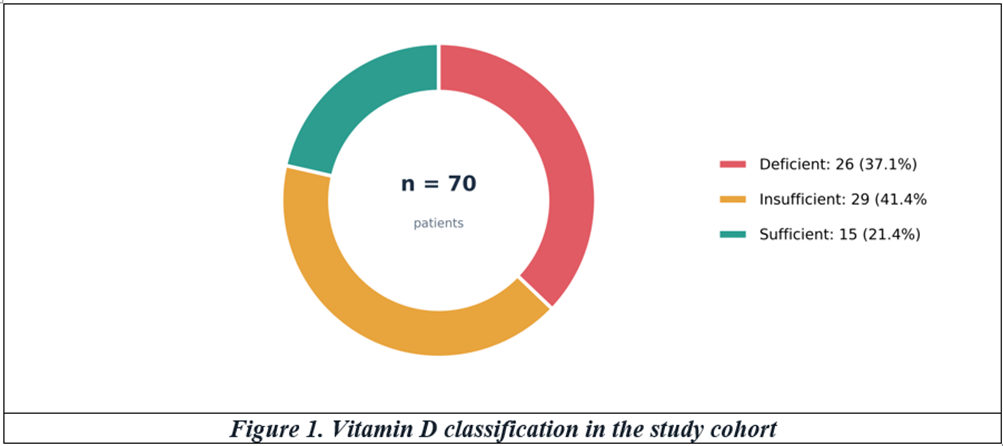
Donut sectors represent the proportion and number of participants in each vitamin D category. Mild pain was recorded in 4 (5.7%) participants, moderate pain in 54 (77.1%) and severe pain in 12 (17.1%). Severe pain occurred in 11 of 26 deficient participants, one of 29 insufficient participants and none of the 15 participants with sufficient vitamin D. The joint distribution is detailed in Table 2 and Figure 2.
Table 2. Cross-tabulation of vitamin D status and pain severity (n=70)
|
25(OH)D status |
Total n (%) |
Mild n (%) |
Moderate n (%) |
Severe n (%) |
|
Deficient |
26 (37.1) |
0 (0.0) |
15 (57.7) |
11 (42.3) |
|
Insufficient |
29 (41.4) |
0 (0.0) |
28 (96.6) |
1 (3.4) |
|
Sufficient |
15 (21.4) |
4 (26.7) |
11 (73.3) |
0 (0.0) |
|
Total |
70 (100.0) |
4 (5.7) |
54 (77.1) |
12 (17.1) |
Percentages within category rows use each vitamin D group as the denominator. Total-row percentages refer to all 70 participants. Pain: mild 1–3, moderate 4–6 and severe 7–10.
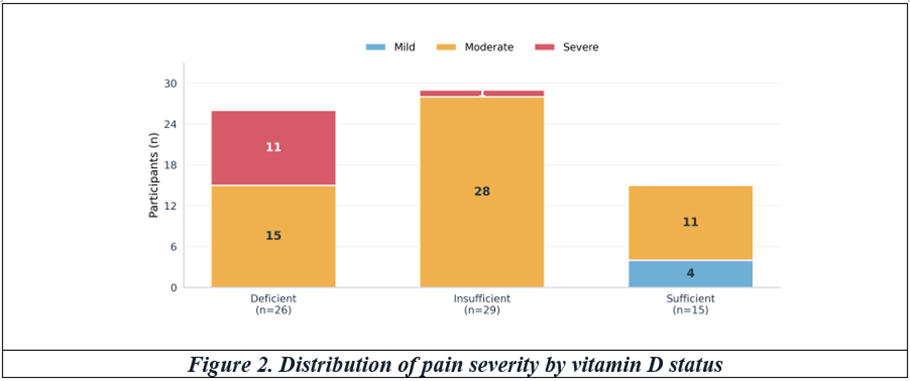
Stacked bars display observed participant counts by pain severity within each vitamin D category.
Primary correlation and between-group comparison
Mean pain scores were 6.38±0.70 in the deficient group, 5.00±0.76 in the insufficient group and 4.07±0.80 in the sufficient group (Table 3 and Figure 3). Across-group differences were statistically significant (Kruskal–Wallis H=43.09, p<0.001). Holm-adjusted pairwise comparisons were significant for deficient versus insufficient (p<0.001), deficient versus sufficient (p<0.001), and insufficient versus sufficient (p=0.001).
Table 3. Pain intensity according to serum vitamin D classification
|
Vitamin D group |
n |
25(OH)D (ng/mL) mean±SD |
Pain mean±SD |
Pain median (IQR) |
|
Deficient |
26 |
15.12±3.06 |
6.38±0.70 |
6 (6–7) |
|
Insufficient |
29 |
23.93±2.91 |
5.00±0.76 |
5 (5–5) |
|
Sufficient |
15 |
34.33±4.13 |
4.07±0.80 |
4 (3.5–5) |
Kruskal–Wallis comparison: H=43.09, p<0.001. Pairwise Mann–Whitney U tests were adjusted using the Holm method. Vitamin D categories: deficient <20, insufficient 20–<30, sufficient ≥30 ng/mL.
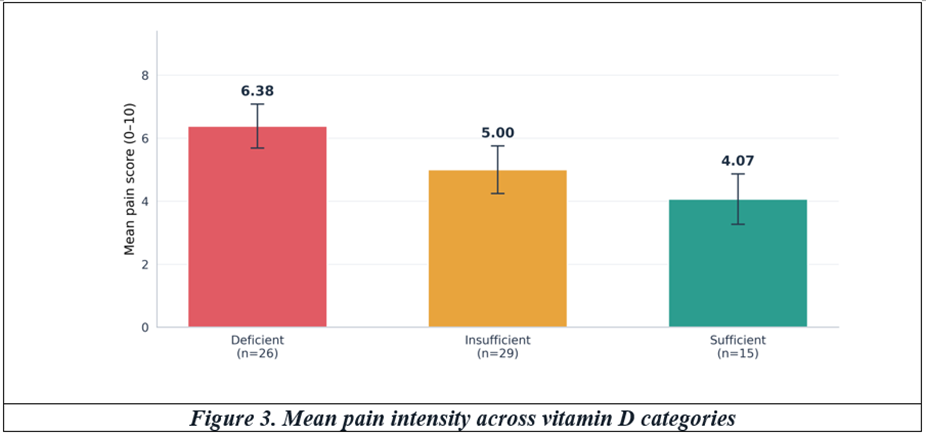
Bar heights indicate group mean pain score; error bars show ±1 standard deviation. Serum 25(OH)D concentration showed a strong inverse association with pain intensity (Spearman ρ=-0.873, p<0.001; Figure 4). In an exploratory rank-based partial correlation adjusting for age, the association remained inverse (ρ=-0.570, p<0.001). Additional adjustment for BMI, pain duration, physical activity and sunlight exposure yielded ρ=-0.549 (p<0.001).
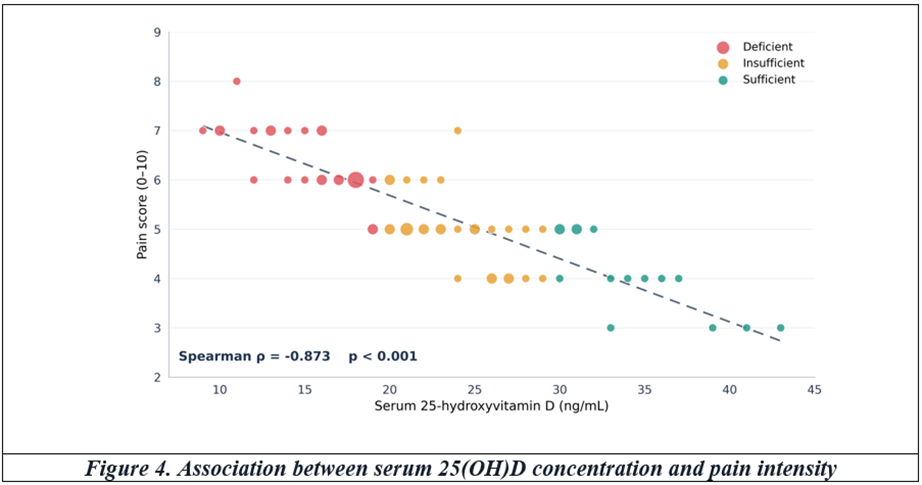
Bubbles represent observed vitamin D–pain score combinations; larger bubbles indicate overlapping observations. The dashed line is an unadjusted descriptive linear fit.
Exploratory Clinical Associations
Higher age, BMI and duration of back pain were associated with lower vitamin D concentrations and greater pain intensity. Physical activity and sunlight exposure tended to correlate positively with vitamin D and inversely with pain (Table 4). Neither vitamin D (Mann–Whitney U p=0.226) nor pain intensity (p=0.730) differed significantly by sex. These exploratory associations were unadjusted and do not establish independent effects.
Table 4. Exploratory Spearman correlations with serum vitamin D and pain intensity
|
Characteristic |
ρ with 25(OH)D |
p-value |
ρ with pain |
p-value |
|
Age (years) |
-0.858 |
<0.001 |
0.824 |
<0.001 |
|
BMI (kg/m²) |
-0.714 |
<0.001 |
0.640 |
<0.001 |
|
LBP duration (months) |
-0.864 |
<0.001 |
0.834 |
<0.001 |
|
Physical activity (minutes/week) |
0.739 |
<0.001 |
-0.595 |
<0.001 |
|
Sunlight exposure (minutes/day) |
0.508 |
<0.001 |
-0.309 |
0.009 |
Unadjusted exploratory rank correlations; p-values refer to two-sided Spearman tests. Multiple comparisons were not adjusted in this table.
DISCUSSION:
Serum 25(OH)D concentration was inversely related to pain intensity in this cross-sectional cohort of 70 adults with chronic low back pain. Vitamin D deficiency affected 37.1% of participants and a further 41.4% had concentrations below 30 ng/mL. Participants with lower vitamin D levels generally reported higher pain scores, but the clinical meaning of this relationship requires careful interpretation. The association was measured at a single point in time, and it cannot demonstrate that vitamin D deficiency produced or amplified the pain.
The observed correlation (ρ=-0.873) was stronger than estimates in several earlier clinical studies. Gokcek and Kaydu reported a negative association between vitamin D concentration and pain severity,[8] while Kanaujia and colleagues described a similar inverse pattern among patients with non-specific chronic low back pain in northern India.[9] Such findings lend biological and clinical plausibility, but they are not uniform. Çalık and Aygün found no significant relationship with pain intensity despite examining vitamin D concentrations in patients with chronic low back–leg pain.[10] A systematic review of observational studies also identified heterogeneous findings and limited evidence for an association with pain intensity.[11] Different patient populations, pain phenotypes, analytic approaches and deficiency thresholds may contribute to this variability. Thus, the present correlation is best interpreted as a cohort-specific association that needs replication.
Chronic low back pain encompasses more than a single mechanism. Degenerative imaging findings, radicular involvement, movement-related discomfort, psychological distress and central pain processes may contribute in different proportions.[2,3] Within the present cohort, radicular symptoms affected a minority of participants, and MRI information was absent for more than one-third. These clinical differences may influence both the expression of pain and the circumstances in which biochemical testing is performed. A serum vitamin D value cannot replace neurological examination, assessment of functional limitation or evaluation of structural disease when indicated.
Age, BMI and pain duration were associated with both exposure and outcome, suggesting that some of the unadjusted relationship might reflect common determinants. Importantly, the inverse association remained after exploratory rank-based adjustment for age (partial ρ=-0.570), and after adjustment for age, BMI, pain duration, physical activity and sunlight exposure (partial ρ=-0.549). These additional analyses suggest that the observed pattern was not explained entirely by the recorded covariates, but they cannot address unmeasured confounders, selection effects or error in self-reported activity and sunlight exposure. The strong interrelationships among these covariates also limit the precision of adjusted interpretations.
Larger population-based work has not consistently supported vitamin D as an independent determinant of back pain. Sha and colleagues analysed the UK Biobank and found that apparent associations between serum 25(OH)D status and low back pain weakened with comprehensive adjustment, and were not sustained in longitudinal analyses.[12] Although the present patients were selected from a clinical setting rather than a general population, that contrast illustrates why associations observed in a cross-sectional clinic sample should not be assumed to extend to risk prediction or treatment response.
The evidence for supplementation is likewise distinct from the evidence for association. Ghai and colleagues reported improvements in pain and disability after vitamin D treatment among deficient Indian patients with chronic low back pain, although their open-label single-arm design could not isolate treatment effects.[13] A systematic review of comparative studies found no persuasive analgesic advantage of vitamin D supplementation for low back pain.[14] A subsequent meta-analysis of randomised controlled trials similarly concluded that supplementation had limited efficacy.[15] A broader review of chronic musculoskeletal pain also emphasised variability between study populations and outcomes.[16] Vitamin D replacement should therefore be considered according to nutritional and skeletal indications, not presented as an established treatment for chronic low back pain.
For Indian pain-clinic practice, these findings support clinical awareness without routine attribution of pain to hypovitaminosis D. Dietary patterns, outdoor activity, clothing, sun exposure and chronic comorbidity can differ markedly between patients. Where deficiency is clinically suspected or documented, assessment can be integrated with exercise-based rehabilitation, patient education, ergonomic advice and evaluation of psychosocial barriers.[3,4] Thresholds also matter: the categorisation used in this study was prespecified for analysis, whereas recent endocrine guidance does not endorse universal concentration cut-offs for disease prevention.[6]
Strengths and Limitations
The study included complete paired serum 25(OH)D and pain observations for all 70 patients and recorded several relevant demographic and clinical covariates. Limitations include modest sample size, single pain-clinic sampling, absence of a pain-free comparator, incomplete MRI coverage, and lack of standardised functional disability or psychological measures. Details of the vitamin D assay, specific 0–10 pain measurement instrument, recruitment method and concomitant treatments were not established in the available clinical documentation. Self-reported sunlight and physical activity are susceptible to recall and measurement error. Although exploratory adjusted correlations were conducted, this design cannot determine temporal direction or remove residual confounding. The strong association should be independently validated.
Future studies should use standardised pain instruments, transparently documented laboratory methods, prespecified adjustment variables and broader recruitment across pain-clinic and primary-care settings. Longitudinal studies could clarify whether vitamin D changes precede changes in pain intensity, whereas randomised trials would be required to assess analgesic benefit from supplementation.
CONCLUSION:
In this cohort of 70 adults with chronic low back pain, lower serum 25(OH)D concentrations were associated with greater pain intensity. The inverse relationship persisted in exploratory adjusted analyses, although residual confounding and selection effects remain possible. Vitamin D status may contribute useful information to a comprehensive assessment in selected patients, but the findings do not establish causality or justify pain-directed supplementation without evidence of clinical benefit.
REFERENCES:
1. GBD 2021 Low Back Pain Collaborators. Global, regional, and national burden of low back pain, 1990–2020, its attributable risk factors, and projections to 2050: a systematic analysis of the Global Burden of Disease Study 2021. Lancet Rheumatol 2023;5(6):e316-29.
2. Hartvigsen J, Hancock MJ, Kongsted A, Louw Q, Ferreira ML, Genevay S, et al. What low back pain is and why we need to pay attention. Lancet 2018;391(10137):2356–67.
3. Foster NE, Anema JR, Cherkin D, Chou R, Cohen SP, Gross DP, et al. Prevention and treatment of low back pain: evidence, challenges, and promising directions. Lancet 2018;391(10137):2368–83.
4. Aparna P, Muthathal S, Nongkynrih B, Gupta SK. Vitamin D deficiency in India. J Family Med Prim Care 2018;7(2):324–30.
5. Holick MF, Binkley NC, Bischoff-Ferrari HA, Gordon CM, Hanley DA, Heaney RP, et al. Evaluation, treatment, and prevention of vitamin D deficiency: an Endocrine Society clinical practice guideline. J Clin Endocrinol Metab 2011;96(7):1911–30.
6. Demay MB, Pittas AG, Bikle DD, Diab DL, Kiely ME, Lazaretti-Castro M, et al. Vitamin D for the prevention of disease: an Endocrine Society clinical practice guideline. J Clin Endocrinol Metab 2024;109(8):1907–47.
7. Ghai B, Bansal D, Kapil G, Kanukula R, Lavudiya S, Sachdeva N. High prevalence of hypovitaminosis D in Indian chronic low back patients. Pain Physician 2015;18(5):E853–62.
8. Gokcek E, Kaydu A. Assessment of relationship between vitamin D deficiency and pain severity in patients with low back pain: a retrospective, observational study. Anesth Essays Res 2018;12(3):680–4.
9. Kanaujia V, Yadav RK, Verma S, Jain S, Patra B, Neyaz O. Correlation between vitamin D deficiency and nonspecific chronic low back pain: a retrospective observational study. J Family Med Prim Care 2021;10(2):893–7.
10. Çalık Y, Aygün Ü. Evaluation of vitamin D levels in patients with chronic low back-leg pain. Acta Orthop Traumatol Turc 2017;51(3):243–7.
11. Zadro J, Shirley D, Ferreira M, Carvalho-Silva AP, Lamb SE, Cooper C, et al. Mapping the association between vitamin D and low back pain: a systematic review and meta-analysis of observational studies. Pain Physician 2017;20(7):611–40.
12. Sha S, Chen LJ, Brenner H, Schöttker B. Serum 25-hydroxyvitamin D status and vitamin D supplements use are not associated with low back pain in the large UK Biobank cohort. Nutrients 2024;16(6):806.
13. Ghai B, Bansal D, Kanukula R, Gudala K, Sachdeva N, Dhatt SS, et al. Vitamin D supplementation in patients with chronic low back pain: an open label, single arm clinical trial. Pain Physician 2017;20(1):E99–105.
14. Zadro JR, Shirley D, Ferreira M, Carvalho-Silva AP, Lamb SE, Cooper C, et al. Is vitamin D supplementation effective for low back pain? A systematic review and meta-analysis. Pain Physician 2018;21(2):121–45.
15. Lee TJ, Tsai RY, Ho CC, Chen CM, Li CP. Updated meta-analysis reveals limited efficacy of vitamin D supplementation in chronic low back pain. In Vivo. 2024;38(6):2955–67.
16. Alonso-Pérez JL, Martínez-Pérez I, Romero-Morales C, Abuín-Porras V, López-Bueno R, Rossettini G, et al. Relationship between serum vitamin D levels and chronic musculoskeletal pain in adults: a systematic review. Nutrients 2024;16(23):4061.