A Prospective Randomized Comparative Study to Assess the Efficacy and Effects of Propofol–Ketamine and Propofol–Fentanyl for Sedation in Patients Undergoing Colonoscopy.
- Dr. Nibedita Patnaik , Assistant Professor, Department of Anaesthesia and Critical Care, MKCG Medical College & Hospital, Berhampur, Odisha, India.
- Dr. Kunal Patra , Assistant Professor, Department of Anaesthesia and Critical Care, MKCG Medical College & Hospital, Berhampur, Odisha, India.
- Dr. M. Siva Rama Krishna , Senior Resident, Department of Plastic Surgery, MKCG Medical College & Hospital, Berhampur, Odisha, India.
- Dr. Satyajit Sahu , Senior Resident, Department of Anaesthesia, DHH, Jajpur, Odisha, India.
Article Information:
Abstract:
Background: Colonoscopy is a crucial diagnostic and therapeutic treatment that frequently needs sufficient anaesthesia to guarantee patient comfort and effective completion. Propofol is commonly used for procedural sedation; however, its combination with analgesic agents may influence haemodynamic stability, respiratory function and recovery. The purpose of this study was to examine the safety and effectiveness of PK (Propofol–Ketamine) and PF (Propofol–Fentanyl) combinations for sedation during colonoscopy. Methods: This prospective randomized comparative study included 100 patients aged 15–65 years with ASA (American Society of Anesthesiologists) physical status I and II undergoing elective colonoscopy. Patients were divided into two groups of fifty at random. Group PF received fentanyl 1 µg/kg and propofol 1 mg/kg intravenously, while Group PK received ketamine 0.5 mg/kg and propofol 1 mg/kg. The Ramsay Sedation Scale was used to measure sedation. Peripheral oxygen saturation, heart rate, systolic blood pressure, and breathing rate were all tracked. Procedural difficulties, recuperation time, and further propofol doses were also noted. Results: Both drug combinations provided adequate sedation during colonoscopy. Statistically significant differences in heart rate, systolic blood pressure and respiratory rate were observed at selected time intervals, although these changes were not clinically significant. Oxygen saturation remained above 95% in both groups. A significant difference in the Ramsay Sedation Score was observed at 15 minutes (p=0.03). The mean additional propofol requirement was significantly higher in Group PK (105.68 ± 54.57 mg) compared to Group PF (49.46 ± 55.68 mg; p<0.0001). Mean recovery times were comparable between Group PK (79.76 ± 44.19 minutes) and Group PF (81.56 ± 30.78 minutes). Complications were minimal in both groups. Conclusion: Propofol–ketamine and propofol–fentanyl combinations are equally effective and safe for sedation during colonoscopy in ASA I and II patients, with comparable recovery profiles and minimal complications.
Keywords:
Article :
INTRODUCTION:
Colonoscopy is an essential diagnostic and therapeutic procedure for the evaluation and management of various intestinal disorders, including colorectal cancer. However, pain and discomfort experienced during the procedure may necessitate premature termination before complete visualization of the colon and may discourage patients from undergoing subsequent examinations. Furthermore, pre-procedural and intra-procedural anxiety can adversely affect patient cooperation and willingness to undergo colonoscopy. Therefore, appropriate sedation techniques are essential to improve patient comfort, cooperation and overall procedural experience.[1] Opioids have historically been utilised extensively as analgesics during procedural sedation. Nevertheless, their usage is linked to a number of negative consequences, such as psychosis, respiratory depression, reduced gastrointestinal function, postoperative nausea and vomiting, itching, and urine retention. Additionally, the potential risk of opioid dependence and addiction has increased interest in alternative analgesic agents with lower addiction potential and fewer respiratory complications.[2]
Sedation plays an important role in providing analgesia, anxiolysis and patient comfort during gastrointestinal endoscopic procedures. Moderate sedation, commonly achieved using a combination of midazolam and fentanyl, allows patients to remain responsive to verbal commands or minimal tactile stimulation. However, deep sedation using propofol may result in significant cardiorespiratory depression and can potentially progress to general anaesthesia. Consequently, propofol administration requires appropriate expertise, continuous monitoring and the availability of trained anaesthesia personnel to ensure patient safety.[3-5]
Propofol is widely preferred for procedural sedation because of its rapid onset and short duration of action. However, its lack of intrinsic analgesic properties necessitates its combination with an appropriate analgesic agent. Ketamine, a dissociative anaesthetic with potent analgesic properties, may offer advantages in maintaining cardiovascular stability and reducing opioid-related adverse effects. Alternatively, fentanyl provides effective analgesia but may increase the risk of respiratory depression when combined with propofol.
AIMS AND OBJECTIVES
The aim of the present study was to compare the efficacy and effects of propofol–fentanyl and propofol–ketamine combinations for sedation under monitored anaesthesia care in patients undergoing colonoscopy. The primary objectives were to assess and compare the depth of sedation between the two groups and evaluate the effects of both drug combinations on haemodynamic parameters, including heart rate, blood pressure and respiratory rate. The secondary objectives were to assess post-procedural recovery time, determine the time required for patient discharge, compare the additional dose of propofol required during the procedure and identify and evaluate any complications associated with the two sedation techniques.
MATERIALS AND METHODS:
Study Design
The present study was a prospective randomized controlled study conducted in the Department of Anaesthesia at Apollo Hospital, Navi Mumbai, over a period of 12 months. The study was designed to compare the efficacy and safety of propofol–ketamine and propofol–fentanyl combinations for sedation in patients undergoing colonoscopy under monitored anaesthesia care.
Inclusion and Exclusion Criteria
Patients aged between 15 and 65 years who were posted for colonoscopy and classified as ASA (American Society of Anesthesiologists) physical status I and II were included in the study. Patients who were unwilling to provide informed consent, those with ASA physical status III and above, patients with difficult airways, obstructive sleep apnoea, morbid obesity, children below 15 years of age, patients allergic to the study drugs, those with hepatic or renal impairment, and patients with gastric outlet obstruction were excluded from the study.
Sample Size Calculation
100 patients with 50 patients in each group.
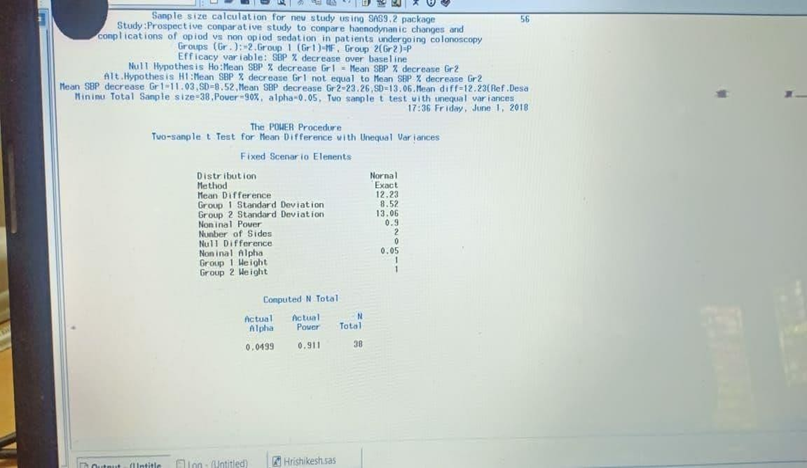
Image 1.1
Patients were randomized by random allocation table and the anaesthesiologist administering the drugs and monitoring the patient during the procedure were different and anaesthesiologist monitoring the patient was not aware of the drugs administered to the patient.
Sample size: calculation for a new study using SAS9.2 package.
Study: Prospective comparative study to compare haemodynamic changes and complications of opioid vs non opioid sedation in patients undergoing colonoscopy Groups (Gr.):- 2. Group 1 (Gr1) = MF, Group 2 (Gr2) = P Efficacy variable: SBP % decrease over baseline Null Hypothesis Ho: Mean SBP % decrease Gr1= Mean SBP %decrease Gr2 Alt Hypothesis H1: Mean SBP % decrease Gr1 not equal to Mean SBP % decrease Gr2 Mean SBP decrease Gr1=11.03, SD-8.52. Mean SBP decrease Gr 2-23.26, SD-13.06. Mean diff-12.23. Total sample size = 38. Power = 90%, alpha = 0.05. Two sample t test with unequal variances.
The POWER Procedure
Two-sample t test for mean difference with unequal variances
Table 1
|
Fixed Scenario to Elements |
|
|
Distribution |
normal |
|
Method |
Exact |
|
Mean Difference |
12.23 |
|
Group 1 Standard Deviation |
8.52 |
|
Group 2 Standard Deviation |
13.06 |
|
Nominal power |
0.9 |
|
Number of Sides |
2 |
|
Null Difference |
0 |
|
Nominal Alpha |
0.05 |
|
Group 1 weight |
1 |
|
Group 2 weight |
1 |
|
Computed N Total |
|
|
Actual Alpha |
0.0499 |
|
Actual Power |
0.911 |
|
N Total |
38 |
Data Collection Procedure
Following written informed permission and approval from the Institutional Ethics Committee, eligible patients scheduled for colonoscopies were divided into two groups at random. Fentanyl 1 μg/kg and propofol 1 mg/kg were administered intravenously to patients in the PF group, whereas ketamine 0.5 mg/kg and propofol 1 mg/kg were administered to patients in the PK group. A premedication of 0.03 mg/kg of midazolam was administered. The medications given were hidden from the anaesthesiologist keeping an eye on the patients.
Heart rate, blood pressure, SpO₂, and breathing rate were among the baseline indicators that were noted and tracked during the process. The Ramsay Sedation Score was used to measure sedation at baseline, upon induction, and every five minutes. Rescue propofol was given as necessary, and the extra dose was noted. Adverse events and the need for assisted ventilation were documented and managed appropriately.
Following the procedure, recovery was assessed using the Aldrete score every 5 minutes until a score of 10 was achieved. The time to first response to verbal commands, achievement of an Aldrete score of 10 and independent urination were recorded to assess recovery and discharge time. Total propofol dose, haemodynamic parameters, sedation scores, adverse events and recovery time were documented and subjected to appropriate statistical analysis.
Statistical Analysis
Both descriptive and inferential statistical studies were carried out. Heart rate, systolic blood pressure, SpO₂, respiratory rate, total propofol dose, and Ramsay Sedation Score are examples of continuous variables that were expressed as mean ± standard deviation (SD) with minimum and maximum values; age, gender, weight, ASA status, and adverse events are examples of categorical variables that were presented as frequencies and percentages.
The two groups' continuous variables were compared using the independent samples t-test. At the 5% level (p < 0.05), statistical significance was evaluated. For statistical analysis and sample size computation, SAS software version 9.2 was utilised. P-values were classified as strong significance (p ≤ 0.01), moderate significance (0.01 < p ≤ 0.05), and suggestive significance (0.05 < p < 0.10).
RESULTS:
Table 2. Demographic and Baseline Characteristics of the Study Participants
|
Characteristic |
Category / Statistic |
PK Group (n=50) |
PF Group (n=50) |
P Value |
|
Age (years) |
Mean ± SD |
45.28 ± 13.21 |
45.28 ± 13.21 |
0.4 (NS) |
|
Age group (years) |
15–30 |
6 (12%) |
7 (14%) |
— |
|
|
30–45 |
21 (42%) |
25 (50%) |
— |
|
|
45–60 |
18 (32%) |
11 (22%) |
— |
|
|
60–65 |
7 (14%) |
7 (14%) |
— |
|
Gender |
Female |
37 (74%) |
32 (64%) |
— |
|
|
Male |
13 (26%) |
18 (36%) |
— |
|
Weight (kg) |
Mean ± SD |
70.88 ± 14.66 |
62.40 ± 12.36 |
0.02 (S) |
|
ASA physical status |
I |
21 (42%) |
29 (58%) |
— |
|
|
II |
29 (58%) |
21 (42%) |
— |
Table 1 illustrates the demographic and baseline characteristics of patients in the two study groups. The mean age was reported as 45.28 ± 13.21 years in both groups, with no statistically significant difference (p = 0.4). Female participants constituted 74% of the PK group and 64% of the PF group. The mean body weight was higher in the PK group (70.88 ± 14.66 kg) than in the PF group (62.40 ± 12.36 kg), and this difference was statistically significant (p = 0.02). ASA physical status I was observed in 42% and 58% of the PK and PF groups, respectively, while ASA II was observed in 58% and 42%, respectively.
Table 3. Comparison of Heart Rate and Systolic Blood Pressure between the Study Groups
|
Time Point |
PK Group |
PF Group |
P Value |
|
Heart Rate (beats/min) |
|
|
|
|
Baseline |
77.54 ± 13.90 |
83.08 ± 10.74 |
0.03 |
|
Post-induction |
76.80 ± 14.70 |
81.38 ± 12.39 |
0.1 |
|
5 min |
72.27 ± 13.78 (n=48) |
78.30 ± 9.92 |
0.01 |
|
10 min |
73.80 ± 14.20 (n=45) |
78.60 ± 8.81 |
0.048 |
|
15 min |
74.83 ± 14.27 (n=36) |
80.81 ± 8.50 (n=43) |
0.02 |
|
20 min |
75.62 ± 12.14 (n=21) |
82.76 ± 12.17 (n=29) |
0.046 |
|
25 min |
79.20 ± 18.98 (n=5) |
83.00 ± 9.71 (n=13) |
0.6 |
|
30 min |
78.00 (n=1) |
83.00 ± 7.77 (n=6) |
0.6 |
|
Systolic Blood PRESSURE (mmHg) |
|
|
|
|
Baseline |
130.80 ± 25.09 |
123.38 ± 23.26 |
0.1 |
|
Post-induction |
114.84 ± 20.47 |
123.58 ± 19.99 |
0.03 |
|
5 min |
116.33 ± 20.46 (n=48) |
118.08 ± 24.07 |
0.5 |
|
10 min |
111.80 ± 20.76 (n=45) |
121.60 ± 16.82 |
0.01 |
|
15 min |
115.25 ± 23.98 (n=36) |
117.98 ± 17.18 (n=43) |
0.6 |
|
20 min |
116.76 ± 16.77 (n=21) |
120.17 ± 17.24 (n=29) |
0.5 |
|
25 min |
113.75 ± 16.97 (n=8) |
128.21 ± 20.59 (n=14) |
0.1 |
|
30 min |
97.00 (n=1) |
123.33 ± 12.93 (n=6) |
0.1 |
Table 2 demonstrates the time-wise comparison of heart rate and systolic blood pressure between the PK and PF groups. Heart rate was significantly higher in the PF group at baseline and at 5, 10, 15 and 20 minutes (p = 0.03, 0.01, 0.048, 0.02 and 0.046, respectively), whereas the differences at post-induction, 25 minutes and 30 minutes were not statistically significant. For systolic blood pressure, statistically significant between-group differences were reported post-induction (p = 0.03) and at 10 minutes (p = 0.01).
Table 4. Comparison of Respiratory Rate and Peripheral Oxygen Saturation (SpO₂)
|
Time Point |
PK Group |
PF Group |
P value |
|
Respiratory Rate (breaths/min) |
|
|
|
|
Baseline |
17.12 ± 3.56 |
18.00 ± 3.71 |
0.2 |
|
Post-induction |
16.02 ± 3.03 |
18.10 ± 3.26 |
0.001 |
|
5 min |
18.60 ± 4.85 (n=48) |
18.50 ± 3.67 |
0.03 |
|
10 min |
16.96 ± 4.01 (n=45) |
19.80 ± 4.13 |
0.001 |
|
15 min |
16.83 ± 3.49 (n=35) |
19.65 ± 4.47 (n=43) |
0.003 |
|
20 min |
17.45 ± 4.22 (n=20) |
20.24 ± 3.98 (n=29) |
0.02 |
|
25 min |
19.29 ± 4.31 (n=7) |
20.23 ± 4.46 (n=13) |
0.3 |
|
30 min |
19.00 (n=1) |
21.83 ± 4.71 (n=6) |
0.5 |
|
Oxygen Saturation (%) |
|
|
|
|
Baseline |
99.78 ± 1.02 |
99.92 ± 0.27 |
0.3 |
|
Post-induction |
99.82 ± 0.44 |
99.88 ± 0.44 |
0.5 |
|
5 min |
99.69 ± 1.17 (n=48) |
99.88 ± 0.44 |
0.4 |
|
10 min |
99.44 ± 1.78 (n=45) |
99.96 ± 0.20 |
0.04 |
|
15 min |
99.83 ± 0.75 (n=35) |
99.98 ± 0.15 (n=43) |
0.2 |
|
20 min |
99.85 ± 0.49 (n=20) |
100.00 ± 0.00 (n=29) |
0.1 |
|
25 min |
99.71 ± 0.76 (n=7) |
100.00 ± 0.00 (n=13) |
0.2 |
|
30 min |
100.00 (n=1) |
99.83 ± 0.41 (n=6) |
0.7 |
Table 3 compares respiratory rate and SpO₂ at the recorded time points. Respiratory rate was significantly higher in the PF group post-induction and at 5, 10, 15 and 20 minutes (p = 0.001, 0.03, 0.001, 0.003 and 0.02, respectively). No statistically significant difference was reported at baseline, 25 minutes or 30 minutes. SpO₂ values were comparable between groups at all recorded time points except 10 minutes, when the difference was statistically significant (p = 0.04), with a lower mean value in the PK group.
Table 5. Comparison of Ramsay Sedation Scores between the Study Groups
|
Time Point |
PK Group |
PF Group |
P Value |
|
Baseline |
1.00 ± 0.00 |
1.00 ± 0.00 |
— |
|
Post-induction |
5.52 ± 0.71 |
5.42 ± 0.87 |
0.5 |
|
5 min |
5.87 ± 0.48 |
5.76 ± 0.48 |
0.3 |
|
10 min |
5.51 ± 0.59 (n=48) |
5.66 ± 0.52 |
0.2 |
|
15 min |
5.17 ± 0.82 (n=35) |
5.55 ± 0.90 (n=43) |
0.03 |
|
20 min |
4.95 ± 1.05 (n=20) |
5.29 ± 0.82 (n=29) |
0.2 |
|
25 min |
4.88 ± 1.25 (n=7) |
5.31 ± 0.75 (n=13) |
0.3 |
|
30 min |
6.00 (n=1) |
5.33 ± 0.82 (n=6) |
0.5 |
Table 4 illustrates the comparison of Ramsay Sedation Scores between the PK and PF groups. The mean scores were similar at baseline, post-induction, and at 5, 10, 20, 25 and 30 minutes, with no statistically significant between-group differences. A statistically significant difference was observed at 15 minutes, when the mean score was higher in the PF group than in the PK group (5.55 ± 0.90 versus 5.17 ± 0.82; p = 0.03).
Table 6. Comparison of Adverse Events in the Study Groups
|
Adverse Event |
PK Group, n (%) |
PF Group, n (%) |
|
None |
48 (96.0) |
48 (96.0) |
|
Tachycardia |
0 (0.0) |
0 (0.0) |
|
Desaturation |
0 (0.0) |
0 (0.0) |
|
Hypotension |
1 (2.0) |
0 (0.0) |
|
Delayed recovery |
0 (0.0) |
0 (0.0) |
|
Hypertension |
1 (2.0) |
2 (4.0) |
|
Total |
50 (100.0) |
50 (100.0) |
Table 5 demonstrates the incidence of adverse events in the two groups. No adverse event was recorded in 48 patients (96%) in each group. In the PK group, hypotension and hypertension were each reported in one patient (2%). In the PF group, hypertension was reported in two patients (4%), while no hypotension was recorded. No tachycardia, desaturation or delayed recovery was tabulated in either group.
Table 7. Comparison of Total Propofol Dose Required during Colonoscopy
|
Parameter |
PK Group (n=50) |
PF Group (n=50) |
Test Statistic |
P Value |
|
Total propofol dose (mg) |
105.68 ± 54.57 |
49.46 ± 55.68 |
5.1 |
<0.0001 |
Table 6 shows the comparison of the total propofol dose required during the procedure. The mean total propofol dose was higher in the PK group (105.68 ± 54.57 mg) than in the PF group (49.46 ± 55.68 mg). This difference was statistically significant (test statistic = 5.1; p < 0.0001).
Table 8. Comparison of Recovery Time between the Study Groups
|
Parameter |
PK Group (n=50) |
PF Group (n=50) |
Test Statistic |
P Value |
|
Recovery time assessed by spontaneous voiding of urine (minutes) |
79.76 ± 44.19 |
81.56 ± 30.78 |
0.2 |
0.8 |
Table 7 compares recovery time, assessed by the time taken for the patient to void urine independently. The mean recovery time was 79.76 ± 44.19 minutes in the PK group and 81.56 ± 30.78 minutes in the PF group. The difference between the groups was not statistically significant (test statistic = 0.2; p = 0.8).
DISCUSSION:
Colonoscopy is a commonly performed endoscopic procedure that requires adequate sedation, analgesia and patient cooperation to ensure procedural success. Although general anaesthesia provides optimal operating conditions, it is associated with certain disadvantages. Hence, procedural sedation using combinations of anaesthetic agents has become an increasingly preferred approach. The present observational study evaluated 100 ASA I–II patients aged 15–65 years undergoing colonoscopy, comparing the efficacy and safety of Propofol-Ketamine (PK) and Propofol-Fentanyl (PF) combinations.
Procedural Sedation
A crucial part of colonoscopy is sedation; the strategy chosen will depend on the patient's condition, the needs of the procedure, and the desired degree of sedation. During interventional endoscopic procedures, Seifert H et al.[6] (2000) contrasted propofol + midazolam with propofol alone. They found that although the combination needed a lower total propofol dose, it was linked to a shorter recovery after the procedure and did not offer greater sedative efficacy. Similarly, Rex DK et al.[7] highlighted the safety margin offered by moderate sedation compared with deep sedation and general anaesthesia. Bahrami Gorji F,[8] in a clinical trial involving 72 adult patients undergoing ERCP, compared propofol-ketamine with propofol-fentanyl. While analgesia was much better in the PF group (P < 0.05), both groups showed similar sedative effects (P > 0.05). At the eighth minute, the PK group's blood pressure was greater. The groups did not substantially differ in heart rate, respiration rate, or arterial oxygen saturation (P > 0.05). Recovery time, patient satisfaction, and endoscopist satisfaction were all similar.
Deep Sedation with Propofol, Ketamine, Opioids and Benzodiazepines
Various agents, including propofol, midazolam, fentanyl, ketamine, alfentanil and dexmedetomidine, have been used individually or in combination for endoscopic sedation. Zeynep T[9] (2007) conducted a randomized controlled trial involving 90 children aged 1–16 years undergoing upper gastrointestinal endoscopy. Propofol-fentanyl (PF; n = 44) or propofol-ketamine (PK; n = 46) were administered to the patients. Heart rate, systolic arterial pressure, SpO2, and respiratory rate did not differ significantly between the groups. While restlessness was more prevalent in the PF group, three patients in the PK group and four in the PF group had brief drops in SpO2. Megan E VanNatta et al[7] (2006) compared different propofol-based sedation regimens in 200 paediatric patients undergoing colonoscopy. In comparison to administering propofol alone to achieve profound sedation, they found that combining propofol with fentanyl and/or midazolam produced adequate sedation with quicker recovery durations. Lawrence B Cohen[10] (2004) evaluated moderate sedation using low-dose propofol, meperidine/fentanyl and midazolam in 100 patients. The mean doses were 79 mg of propofol, 0.8 mg of midazolam, 63 mcg of fentanyl and 42 mg of meperidine for EGD procedures. With no major side effects, 71% of patients resumed their regular activities after two hours of being discharged, and 98% of patients expressed satisfaction with the sedation.
Guit et al[11] reported that propofol-fentanyl combination produces greater haemodynamic depression, whereas propofol-ketamine maintains more stable haemodynamics. In the present study, respiratory rate and heart rate were lower in the PF group compared with the PK group. Combining anaesthetic agents may reduce the requirement for individual drugs and thereby minimise dose-related adverse effects. Sub-dissociative-dose ketamine and fentanyl were compared by Messenger DW et al.[12] (2008) as an addition to propofol for procedural sedation and analgesia in emergency departments. Despite the fact that the ketamine group needed larger dosages of propofol, they came to the conclusion that ketamine was safer than fentanyl and equally effective. According to Mamula P et al.[13] intravenous sedation with fentanyl and midazolam was safe for paediatric gastrointestinal endoscopy, with few major side effects and no children needing hospitalisation. In the present study, systolic blood pressure showed a statistically significant difference between the PK and PF groups immediately after induction and at 10 minutes (p < 0.001). The fall in systolic blood pressure was greater in the PK group; however, it was not clinically significant, as no intervention was required. Respiratory rate also showed significant differences immediately after induction and up to 20 minutes, without any associated decrease in SpO2 or requirement for intervention. Towards the end of the procedure, no significant differences were observed. Heart rate showed statistically significant differences at baseline and at 5, 10, 15 and 20 minutes. Although the decrease was greater in the PK group, the mean heart rate did not fall below 70 beats/min.
The mean total rescue propofol requirement was 105.68 ± 54.57 mg in the PK group and 49.46 ± 55.68 mg in the PF group, indicating a higher requirement for additional propofol in patients receiving the PK combination.
Intraprocedural and Postprocedural Complications
The sedation-related side effects of propofol and conventional non-propofol medications, such as midazolam, meperidine, pethidine, remifentanil, and fentanyl, were compared by Wadhwa et al.[14] (2017). They came to the conclusion that, in comparison to conventional medications, propofol sedation had a comparable risk of cardiopulmonary side effects. Complications related to propofol sedation during advanced endoscopic procedures, such as ERCP, EUS, and small-bowel enteroscopy, were assessed by Cote GA et al.[15] (2010). 12.8% of patients had hypoxaemia (SpO2 < 90%), 0.5% had hypotension, and 0.6% had an early termination. Hypoxia and airway intervention were found to be independently predicted by increased BMI, male sex, and ASA class 3 or above. They concluded that propofol could be safely administered during advanced endoscopic procedures by trained anaesthesiologists. In the present study, among the 50 patients in the PK group, one patient developed hypotension and one developed hypertension, while the remaining 48 patients had no complications. In the PF group, only one patient developed hypertension, which was clinically insignificant and did not require intervention. These findings suggest that both combinations were associated with a low incidence of clinically significant complications.
Recovery Time
Recovery time is an important consideration in procedural sedation, particularly in outpatient endoscopic procedures, as it influences patient discharge and overall procedural efficiency. Paspatis GA et al.,[16] compared intravenous propofol alone with oral midazolam followed by intravenous propofol in paediatric patients undergoing diagnostic upper gastrointestinal endoscopy. They reported significantly shorter recovery in the propofol-alone group (7.7 ± 3.6 minutes) compared with the midazolam-propofol group (25.9 ± 4.1 minutes) (P < 0.01). Wai-Meng Ho et al.,[17] (2012) compared alfentanil and fentanyl as adjuncts to propofol sedation for gastrointestinal endoscopy and colonoscopy. They found no significant differences in propofol consumption, awake time, recovery time, cardiopulmonary complications or patient satisfaction between the two groups, except for the higher cost of alfentanil.
Seifert H et al.,[6] (2000), comparing propofol-midazolam with propofol alone, reported mean recovery times of 19 ± 7 minutes and 25 ± 8 minutes, respectively. In the present study, the mean recovery time was 79.76 ± 44.19 minutes in the PK group and 81.56 ± 30.78 minutes in the PF group. The difference was statistically insignificant, indicating comparable recovery profiles with both drug combinations. The present study demonstrates that propofol-ketamine and propofol-fentanyl provide comparable recovery times and a low incidence of clinically significant complications during colonoscopy. Although differences in haemodynamic parameters were observed, they did not require clinical intervention. However, the higher rescue propofol requirement in the PK group is an important finding. Both combinations can therefore be considered effective sedation regimens for colonoscopy, with appropriate monitoring and individualised drug administration.
CONCLUSION:
Colonoscopy is a complex procedure commonly performed on a day-care basis, and patients may often be uncooperative during the procedure. Therefore, adequate deep sedation is essential to ensure successful completion of the procedure while minimizing patient discomfort and procedure-related complications. Based on the findings of our study, we conclude that both propofol–ketamine and propofol–fentanyl combinations provide comparable efficacy and safety in ASA physical status I and II patients undergoing colonoscopy. Both sedation techniques offer effective sedation, a low incidence of complications, and a satisfactory recovery profile.
REFERENCES:
1. Ahlawat R, Hoilat GJ, Ross AB. Esophagogastroduodenoscopy. In StatPearls [Internet] StatPearls Publishing 2023.
2. Aziz M, Weissman S, Fatima R, et al. Impact of propofol sedation versus opioid/benzodiazepine sedation on colonoscopy outcomes: a systematic review with meta-analysis. Endoscopy International Open 2020;8(6):E701-7.
3. Ferreira AO, Torres J, Barjas E, et al. Non-anesthesiologist administration of propofol sedation for colonoscopy is safe in low risk patients: results of a noninferiority randomized controlled trial. Endoscopy 2016;48(8):747-53.
4. Yldzdas D, Yapcoglu H, Ylmaz HL. The value of capnography during sedation or sedation/analgesia in pediatric minor procedures. Pediatric Emergency Care 2004;20(3):162-5.
5. Canpolat DG, Esmaoglu A, Tosun Z, et al. Ketamine-propofol vs ketamine-dexmedetomidine combinations in pediatric patients undergoing burn dressing changes. Journal of Burn care & Research 2012;33(6):718-22.
6. Seifert H, Schmitt TH, Gultekin T, et al. Sedation with propofol plus midazolam versus propofol alone for interventional endoscopic procedures: a prospective, randomized study. Alimentary Pharmacology and Therapeutics 2000;14(9):1207-14.
7. VanNatta ME, Rex DK. Propofol Alone Titrated to Deep Sedation Versus Propofol in Combination with Opioids and/or Benzodiazepines and Titrated to Moderate Sedation for Colonoscopy. Am J Gastroenterol 2006;101(10):2209-17.
8. Gorji FB, Amri P, Shokri J, et al. Sedative and analgesic effects of propofol-fentanyl versus propofol-ketamine during endoscopic retrograde cholangiopancreatography: a double-blind randomized clinical trial. Anesthes Pain Med 2016;6(5):e39835.
9. Tosun Z, Aksu R, Guler G, et al. Propofol‐ketamine vs propofol‐fentanyl for sedation during pediatric upper gastrointestinal endoscopy. Pediatr Anesth 2007;17(10):983-8.
10. Cohen LB, Hightower CD, Wood DA, et al. Moderate level sedation during endoscopy: a prospective study using low-dose propofol, meperidine/fentanyl, and midazolam. Gastrointestinal Endoscopy 2004;59(7):795-803.
11. Guit JB, Koning HM, Coster ML, et al. Ketamine as analgesic for total intravenous anaesthesia with propofol. Anaesthesia 1991;46(1):24-7.
12. Messenger DW, Murray HE, Dungey PE, et al. Subdissociative-dose ketamine versus fentanyl for analgesia during propofol procedural sedation: a randomized clinical trial. Acad Emerg Med 2008;15(10):877-86.
13. Mamula P, Markowitz JE, Neiswender K, et al. Safety of intravenous midazolam and fentanyl for pediatric GI endoscopy: prospective study of 1578 endoscopies. Gastrointestinal Endoscopy 2007;65(2):203-10.
14. Wadhwa V, Issa D, Garg S, et al. Similar risk of cardiopulmonary adverse events between propofol and traditional anesthesia for gastrointestinal endoscopy: a systematic review and meta-analysis. Clinical Gastroenterology and Hepatology 2017;15(2):194-206.
15. Coté GA, Hovis RM, Ansstas MA, et al. Incidence of sedation-related complications with propofol use during advanced endoscopic procedures. Clinical Gastroenterology and Hepatology 2010;8(2):137-42.
16. Paspatis GA, Charoniti I, Manolaraki M, et al. Synergistic sedation with oral midazolam as a premedication and intravenous propofol versus intravenous propofol alone in upper gastrointestinal endoscopies in children: a prospective, randomized study. Journal of Pediatric Gastroenterology and Nutrition 2006;43(2):195-9.
17. Ho WM, Yen CM, Lan CH, et al. Comparison between the recovery time of alfentanil and fentanyl in balanced propofol sedation for gastrointestinal and colonoscopy: a prospective, randomized study. BMC Gastroenterology 2012;12(1):164.