Effect of Epidural Analgesia on Progression of Labour, Mode of Delivery and Neonatal APGAR in Term Primigravida
- Dr Harshitha P , Assistant professor, Department of Obstetrics and Gynaecology, Kanachur Institute of Medical Sciences, Mangalore, Karnataka, India
- Dr Manoj S , Associate professor, Department of Anaesthesia, Viraat Ramayan Institute of Medical Sciences, East Champaran, Bihar, India
- Dr Rosalyn Fiona Cyril , Associate professor, Anaesthesia, National Institute of Medical Sciences, Jaipur, Rajasthan, India
Article Information:
Abstract:
Background: Labour pain is a significant physiological and psychological stressor during childbirth. Epidural analgesia is widely regarded as the most effective method for intrapartum pain relief; however, its effects on labour progression, mode of delivery, and neonatal outcomes remain a subject of concern, particularly in term primigravida women. Objectives: To evaluate the effect of epidural analgesia on labour progress, mode of delivery, and neonatal APGAR scores in term primigravida women. Methods: This prospective comparative observational study was conducted in a tertiary care teaching hospital. A total of 352 term primigravida women were enrolled and divided into two equal groups: those receiving epidural analgesia (Group E, n = 176) and those not receiving epidural analgesia (Group C, n = 176). Labour progress, requirement of oxytocin augmentation, mode of delivery, and neonatal APGAR scores at 1 and 5 minutes were recorded. Statistical analysis was performed using appropriate tests, and a p value of <0.05 was considered statistically significant. Results: The mean duration of the first stage of labour was significantly shorter in the epidural group (5.8 ± 1.4 hours) compared to the control group (6.4 ± 1.6 hours; p = 0.001), while the second stage was significantly prolonged (74.2 ± 18.6 minutes vs 58.5 ± 16.2 minutes; p < 0.001). Oxytocin augmentation was required more frequently in the epidural group (53.4% vs 37.5%; p = 0.003). Instrumental vaginal delivery was significantly higher in women receiving epidural analgesia (17.0% vs 8.0%; p = 0.04), whereas caesarean section rates were comparable between the two groups (17.0% vs 15.9%). There was no statistically significant difference in neonatal APGAR scores at 1 or 5 minutes between the groups. Conclusion: Epidural analgesia significantly influences labour dynamics in term primigravida women by shortening the first stage and prolonging the second stage of labour, with an increased need for oxytocin augmentation and instrumental vaginal delivery. However, it does not increase caesarean section rates or adversely affect immediate neonatal outcomes. Epidural analgesia is a safe and effective option for labour pain relief when administered with appropriate monitoring and standardized labour management protocols.
Keywords:
Article :
Introduction:
Labour pain is a complex physiological and emotional experience resulting from uterine contractions, cervical dilatation, and distension of the birth canal. Its perception is influenced by multiple factors including maternal anxiety, parity, cultural background, and obstetric conditions. Effective intrapartum pain relief is now considered an integral component of quality obstetric care, as severe unmanaged pain can negatively affect the labour experience, maternal cooperation, and satisfaction with childbirth. Among the available methods of labour analgesia, epidural analgesia is widely regarded as the most effective technique, providing superior pain relief while allowing the mother to remain conscious and actively participate in the birthing process [1].
Globally, the use of epidural analgesia has increased substantially over the past few decades, particularly in high-income countries where it forms a routine part of intrapartum care. Reports suggest that epidural analgesia is utilized in approximately 30% of labours in the United Kingdom and up to 60% in the United States, reflecting its acceptance as a safe and effective method for labour pain management [1]. Advances in anaesthetic techniques, especially the use of low-dose local anaesthetic–opioid combinations, have improved maternal mobility and reduced motor blockade, thereby addressing earlier concerns related to labour dystocia and operative interventions [2].
Despite its proven analgesic benefits, the impact of epidural analgesia on the progression of labour and mode of delivery remains a subject of ongoing debate. Earlier studies and meta-analyses raised concerns about prolongation of labour, increased need for oxytocin augmentation, and higher rates of instrumental vaginal delivery among women receiving epidural analgesia [2]. However, contemporary evidence suggests that with modern low-concentration regimens, epidural analgesia does not significantly increase the rate of caesarean section, although a modest prolongation of the second stage of labour and increased likelihood of assisted vaginal delivery may still be observed [2,3]. International guidelines now emphasize that epidural analgesia should not be withheld due to fear of adverse labour outcomes when appropriately administered and monitored [3,4].
The effect of epidural analgesia is particularly relevant in term primigravida women, who generally experience longer labour duration, increased pain perception, and greater anxiety compared to multigravida women. Primigravidae also have a higher baseline risk of labour interventions, making them an ideal group for evaluating the true impact of epidural analgesia on labour progress and delivery outcomes. Several studies, including those from Indian populations, have demonstrated that while epidural analgesia may prolong the second stage of labour in primigravida women, it does not necessarily increase the rates of caesarean section or adversely affect overall obstetric outcomes when managed using standardized labour protocols [5].
Neonatal outcome is another crucial consideration when evaluating intrapartum interventions. The APGAR score at 1 and 5 minutes remains a simple, rapid, and universally accepted method to assess immediate neonatal wellbeing following birth. Concerns related to epidural analgesia include potential indirect neonatal effects due to maternal hypotension, intrapartum fever, or placental drug transfer. However, evidence from systematic reviews and large observational studies indicates that epidural analgesia does not have a clinically significant adverse effect on neonatal APGAR scores when appropriate maternal monitoring and timely management of complications are ensured [2,3].
In the Indian context, the utilization of epidural analgesia remains limited and inconsistent across healthcare settings, despite growing awareness and demand. Studies from India reveal that a majority of antenatal women are unaware of epidural labour analgesia, yet show high acceptance once informed about its benefits and safety [6]. Major barriers to widespread use include limited availability of trained anaesthesiologists, cost constraints, high patient load in public hospitals, and misconceptions among both patients and healthcare providers regarding adverse maternal and neonatal outcomes [7]. These challenges highlight the need for locally generated evidence from prospective studies conducted in Indian tertiary care centres.
Therefore, a prospective evaluation of the effect of epidural analgesia on labour progress, mode of delivery, and neonatal APGAR scores in term primigravida women is essential to generate context-specific data, guide evidence-based counselling, and support the rational expansion of safe labour analgesia services in India.
AIM
To study the effect of epidural analgesia on labour progress, mode of delivery and neonatal APGAR scores in term primigravida.
OBJECTIVES
1. To assess the effect of epidural analgesia on the progression of labour in term primigravida.
2. To evaluate the mode of delivery in term primigravida receiving epidural analgesia.
3. To assess neonatal outcome using APGAR scores at 1 and 5 minutes.
Materials and Methods:
Study design
A Prospective comparative (non-randomized) observational study.
Study setting
Department of Obstetrics & Gynaecology in collaboration with the Department of Anaesthesiology at a tertiary care teaching hospital.
Study population
Term primigravida women in labour with singleton, cephalic presentation.
Study groups
Participants will be allocated into two groups based on receipt of epidural analgesia:
- Group E (Epidural group): Women receiving labour epidural analgesia on request/availability.
- Group C (Control group): Women not receiving epidural analgesia (routine labour care ± non-epidural analgesics as per institutional protocol).
Labour management (augmentation, second stage management, and decision for operative delivery) will follow standard departmental protocols in both groups to minimize bias.
Eligibility criteria
Inclusion criteria
1. Primigravida.
2. Gestational age 37+0 to 41+6 weeks.
3. Singleton pregnancy with cephalic presentation.
4. Spontaneous or induced labour in active phase (e.g., cervical dilatation ≥4 cm with regular contractions).
5. Reassuring foetal heart rate tracing at enrolment.
6. Willing to participate and provide written informed consent.
Exclusion criteria
1. Multiple pregnancy, malpresentation.
2. Preterm labour (<37 weeks).
3. Previous uterine surgery.
4. Medical/obstetric complications likely to affect labour outcomes (e.g., severe preeclampsia/eclampsia, placenta previa, abruption, major fetal anomaly, IUGR with abnormal Doppler, chorioamnionitis at admission).
5. Contraindications to epidural (coagulopathy/thrombocytopenia, local infection at site, sepsis, raised ICP, spinal deformity, refusal).
6. Elective caesarean section.
Sample size
A prior Indian prospective study among nulliparous women reported instrumental delivery 16.7% in epidural group vs 6.67% in control group.
So:
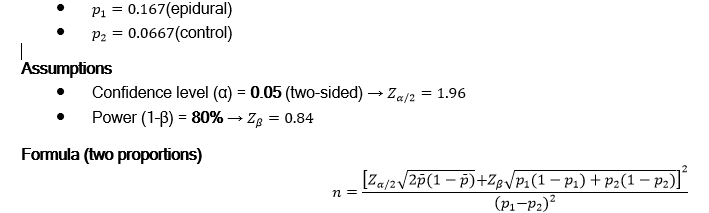

Final sample size = 176 per group (Total = 352 participants).
Sample size methodology reference: WHO manual on sample size determination.
Sampling method
Consecutive eligible term primigravida women fulfilling inclusion criteria will be recruited until sample size is reached.
Study procedure
Baseline assessment (on enrolment)
- Demographics: age, BMI, socioeconomic/education details (optional).
- Obstetric details: gestational age, onset of labour (spontaneous/induced), Bishop score (if induced).
- Clinical exam: cervical dilatation, effacement, station, membrane status.
- Baseline maternal vitals and foetal heart rate.
Epidural technique (Group E)
- Epidural placement by an anaesthesiologist at lumbar interspace (e.g., L2–L3 / L3–L4) using aseptic precautions.
- Test dose as per institutional protocol.
- Low-dose local anaesthetic + opioid regimen (institutional standard), with maintenance via intermittent bolus or infusion.
- Maternal monitoring: BP, pulse, RR, SpO₂, pain score; fetal monitoring (CTG/intermittent auscultation as per protocol).
- Management of hypotension: left uterine displacement, IV fluids, vasopressors as per protocol.
Control group (Group C)
- Routine labour care; non-epidural analgesics if used will be recorded (drug, dose, timing).
Labour management (both groups)
- Partograph monitoring for progress of labour.
- Oxytocin augmentation when indicated (record indication, dose, duration).
- Second stage management as per standard protocol.
- Indications for instrumental delivery/LSCS will be documented in detail.
Outcome measures
Primary outcomes
1. Labour progress
o Duration of first stage (active phase to full dilatation)
o Duration of second stage (full dilatation to delivery)
o Need for augmentation with oxytocin
2. Mode of delivery
o Normal vaginal delivery / Instrumental vaginal delivery / Caesarean section
Secondary outcomes
1. Neonatal outcome
o APGAR score at 1 minute and 5 minutes
o NICU admission (yes/no) and indication (optional but recommended)
2. Maternal adverse effects (recommended)
o Hypotension, nausea/vomiting, fever, urinary retention, pruritus, postpartum haemorrhage (recorded)
Data collection tool
A pre-designed proforma will be used to record all maternal, intrapartum, and neonatal variables in real time.
Statistical analysis
Data collected were entered into Microsoft Excel and analysed using Statistical Package for Social Sciences (SPSS) software. Descriptive statistics were used to summarize the data. Continuous variables such as duration of labour stages and APGAR scores were expressed as mean ± standard deviation and compared between the two groups using the independent t-test. Categorical variables such as mode of delivery, need for oxytocin augmentation, and NICU admission were expressed as frequencies and percentages and compared using the Chi-square test or Fisher’s exact test, wherever appropriate. A p value of less than 0.05 was considered statistically significant.
Results:
A total of 352 term primigravida women were included in the study and divided equally into two groups:
Group E (Epidural analgesia) – 176 women
Group C (Control) – 176 women
Table 1: Baseline Age Comparison Between the Two Groups
|
Group |
Mean age (years) ± SD |
p value |
|
Group E |
24.6 ± 3.2 |
0.62 |
|
Group C |
24.8 ± 3.4 |
Interpretation:
The mean age was comparable between the two groups, and the difference was not statistically significant (p > 0.05), indicating good baseline comparability.
Table 2: Duration of Labour Stages
|
Labour stage |
Group E (Mean ± SD) |
Group C (Mean ± SD) |
p value |
|
First stage (hours) |
5.8 ± 1.4 |
6.4 ± 1.6 |
0.001 |
|
Second stage (minutes) |
74.2 ± 18.6 |
58.5 ± 16.2 |
<0.001 |
Interpretation:
The first stage of labour was significantly shorter, while the second stage was significantly prolonged in the epidural group compared to the control group (p < 0.05), demonstrating the effect of epidural analgesia on labour progression.
Table 3: Requirement of Oxytocin Augmentation
|
Oxytocin augmentation |
Group E n (%) |
Group C n (%) |
p value |
|
Required |
94 (53.4) |
66 (37.5) |
0.003 |
|
Not required |
82 (46.6) |
110 (62.5) |
Interpretation:
A significantly higher proportion of women receiving epidural analgesia required oxytocin augmentation compared to controls (p < 0.05), indicating altered labour dynamics.
Table 4: Mode of Delivery
|
Mode of delivery |
Group E n (%) |
Group C n (%) |
p value |
|
Normal vaginal delivery |
116 (65.9) |
134 (76.1) |
0.04 |
|
Instrumental vaginal delivery |
30 (17.0) |
14 (8.0) |
|
|
Caesarean section |
30 (17.0) |
28 (15.9) |
Interpretation:
Instrumental vaginal delivery was significantly higher in the epidural group, while caesarean section rates were comparable between the two groups, showing that epidural analgesia did not increase caesarean delivery rates.
Table 5: Neonatal Outcome – APGAR Scores
|
APGAR score |
Group E n (%) |
Group C n (%) |
p value |
|
APGAR ≥7 at 1 minute |
162 (92.0) |
168 (95.5) |
0.18 |
|
APGAR ≥7 at 5 minutes |
174 (98.9) |
175 (99.4) |
0.56 |
Interpretation:
There was no statistically significant difference in APGAR scores at 1 and 5 minutes between the two groups, indicating that epidural analgesia had no adverse effect on immediate neonatal outcome.
Discussion:
In the present study, epidural analgesia significantly influenced labour progression among term primigravida women. The mean duration of the first stage of labour was significantly shorter in the epidural group (5.8 ± 1.4 hours) compared to the control group (6.4 ± 1.6 hours, p = 0.001). This suggests that effective pain relief may reduce maternal stress and catecholamine release, thereby facilitating better uterine contractility and cervical dilatation. Similar findings were reported by Wong et al., who observed that early neuraxial analgesia did not prolong the first stage of labour and was not associated with delayed cervical dilatation [10]. Ohel et al. also reported no significant prolongation of the first stage with early initiation of epidural analgesia, supporting the findings of the present study [11].
However, the second stage of labour was significantly prolonged in women receiving epidural analgesia in the present study (74.2 ± 18.6 minutes vs 58.5 ± 16.2 minutes in controls; p < 0.001). This prolongation can be attributed to reduced maternal expulsive efforts and partial motor blockade. The COMET trial similarly demonstrated a longer second stage in women receiving traditional epidural techniques, particularly among nulliparous women [12]. Indian evidence from Sahu and Shivgan also reported a statistically significant prolongation of the second stage in women receiving epidural analgesia, closely mirroring the magnitude observed in the present study [13].
The present study showed a significantly higher requirement of oxytocin augmentation in the epidural group (53.4%) compared to the control group (37.5%, p = 0.003). This indicates that epidural analgesia may necessitate pharmacological augmentation to maintain adequate uterine contractions. Similar observations were noted in international literature, where epidural analgesia was associated with increased oxytocin use to counteract reduced uterine activity [12]. Indian studies have also documented higher oxytocin requirements ranging between 50–55% among women receiving epidural analgesia, findings that are consistent with the present study [13].
In the present study, the rate of instrumental vaginal delivery was significantly higher in the epidural group (17.0%) compared to the control group (8.0%, p = 0.04). However, the caesarean section rate was comparable between the epidural and control groups (17.0% vs 15.9%). These findings indicate that while epidural analgesia may increase the likelihood of assisted vaginal delivery, it does not increase the overall caesarean section rate.
These results are consistent with the findings of the COMET trial, which reported higher instrumental delivery rates with epidural analgesia but no significant increase in caesarean deliveries [12]. Srebnick et al. also observed an increased rate of operative vaginal deliveries among nulliparous women receiving epidural analgesia, while caesarean section rates remained unaffected [14]. Indian studies have similarly reported higher instrumental delivery rates in epidural groups, supporting the observations of the present study [13].
Neonatal outcomes assessed using APGAR scores at 1 and 5 minutes showed no statistically significant difference between the epidural and control groups in the present study. At 1 minute, 92.0% of neonates in the epidural group and 95.5% in the control group had APGAR scores ≥7 (p = 0.18). At 5 minutes, the corresponding values were 98.9% and 99.4%, respectively (p = 0.56). These findings indicate that epidural analgesia did not adversely affect immediate neonatal wellbeing.
Similar conclusions were drawn by Anim-Somuah et al., who reported no clinically significant differences in neonatal APGAR scores between epidural and non-epidural groups [15]. Indian studies by Singh et al. also demonstrated comparable APGAR scores and neonatal outcomes in both groups, reinforcing the neonatal safety of epidural analgesia [16].
Conclusion:
The present prospective study demonstrates that epidural analgesia is an effective and safe method of pain relief in term primigravida women. Epidural analgesia was associated with a significant influence on the progression of labour, characterized by a shorter first stage and a prolonged second stage of labour, along with an increased requirement for oxytocin augmentation and a higher rate of instrumental vaginal delivery. However, the rate of caesarean section was comparable between women who received epidural analgesia and those who did not.
Importantly, epidural analgesia did not have any adverse effect on neonatal outcome, as evidenced by comparable APGAR scores at 1 and 5 minutes in both groups. These findings indicate that while epidural analgesia alters certain aspects of labour dynamics, it does not compromise maternal or neonatal safety when administered using appropriate protocols and monitoring.
Overall, epidural analgesia can be offered as a safe and effective option for labour pain relief in term primigravida women, provided that it is accompanied by vigilant intrapartum monitoring, timely labour augmentation when required, and adherence to standardized obstetric and anaesthetic practices.
References:
1. Halliday L, Suliman M. Epidural analgesia in labor: A narrative review. Int J Gynaecol Obstet. 2022;158(2):251–259.
2. Anim-Somuah M, Smyth RMD, Cyna AM, Cuthbert A. Epidural versus non-epidural or no analgesia for pain management in labour. Cochrane Database Syst Rev. 2018;5:CD000331.
3. American College of Obstetricians and Gynaecologists. ACOG Practice Bulletin No. 209: Obstetric Analgesia and Anaesthesia. Obstet Gynecol. 2019;133(3):e208–e225.
4. National Institute for Health and Care Excellence (NICE). Intrapartum care. NICE guideline NG235. London: NICE; 2023.
5. Agrawal D, Makhija B, Arora M, Haritwal A, Gurha P. Effect of epidural analgesia on labour, mode of delivery and neonatal outcome in nulliparous women. J Clin Diagn Res. 2014;8(10): OC03–OC06.
6. Kamakshi G, Grewal A, Sharma T, et al. Epidural analgesia during labor: Attitudes among expectant mothers and care providers. Anesth Essays Res. 2018;12(2):501–505.
7. Hussain SST, Maheswari P. Barriers to labour analgesia in South India: Knowledge and attitude of stakeholders. Indian J Anaesth. 2017;61(2):170–173.
8. Wong CA, Scavone BM, Peaceman AM, McCarthy RJ, Sullivan JT, Diaz NT, et al. The risk of cesarean delivery with neuraxial analgesia given early versus late in labor. N Engl J Med. 2005;352(7):655–665. doi:10.1056/NEJMoa042573.
9. Ohel G, Gonen R, Vaida S, Barak S, Gaitini L. Early versus late initiation of epidural analgesia in labor: does it increase the risk of cesarean section? Am J Obstet Gynecol. 2006;194(3):600–605.
10. Wong CA, Scavone BM Cesarean delivery with neuraxial analgesia N Engl J Med. 2004;232(1):170–175.
11. Ohel G, Gonen R, Vaida S, Barak S, Gaitini L. Early versus late initiation of epidural analgesia in labor: Does it increase the risk of cesarean section? Am J Obstet Gynecol. 2006;194(3):600–605.
12. Comparative Obstetric Mobile Epidural Trial (COMET) Study Group. Effect of low-dose mobile versus traditional epidural techniques on mode of delivery: A randomised controlled trial. Lancet. 2001;358(9275):19–23.
13. Sahu RR, Shivgan SM. To study the effect of epidural analgesia on second stage of labour and mode of delivery. Indian J Obstet Gynecol Res. 2018;5(4):553–558.
14. Srebnik N, Barkan O, Rottenstreich M, Ioscovich A, Farkash R, Rotshenker-Olshinka K, et al. The impact of epidural analgesia on the mode of delivery in nulliparous women who attain the second stage of labor. J Matern Fetal Neonatal Med. 2020;33(14):2451–2458.
15. Anim-Somuah M, Smyth RMD, Cyna AM, Cuthbert A. Epidural versus non-epidural or no analgesia for pain management in labour. Cochrane Database Syst Rev. 2018;5:CD000331.
16. Singh S, Prasad C, Dubey PK. Low-dose epidural analgesia during labour: Maternal and neonatal outcome. J Obstet Gynaecol India. 2011;61(4):404–407.