Impact of Gamification on Student Engagement and Knowledge Retention in Undergraduate Medical Education
- Gouthami Balli , Associate professor, Department of Pathology, GEMS&H, Srikakulam, Andhra Pradesh, India
- Karukola Pratyusha , Assistant professor, Department of Pathology, GEMS&H, Srikakulam, Andhra Pradesh, India
- LK Vijay Kumar , Assistant professor, Department of General Medicine, GEMS&H, Srikakulam, Andhra Pradesh, India
- Yavvari Raghu Srinivas , Associate professor, Department of Physiology, GEMS&H, Srikakulam, Andhra Pradesh, India
- Pavani Velamala , Assistant professor, Department of Pathology, GEMS&H, Srikakulam, Andhra Pradesh, India
- Sunil Kumar Dogga , Assistant professor, Department of Pathology, GEMS&H, Srikakulam, Andhra Pradesh, India
- B. Jyotchna Devi , Professor & HOD, Department of Biochemistry, MEU co-ordinator, GEMS&H, Srikakulam, Andhra Pradesh, India
- Priyanka Pappala , Professor, Department of Pathology, GEMS&H, Srikakulam, Andhra Pradesh, India
Article Information:
Abstract:
Background: Introduction: Conventional didactic lectures in medical education are often associated with decreased student engagement and attention. To overcome this, interactive approaches such as gamification, which involves the application of game design elements and mechanics to non-game contexts, are increasingly being used to improve learning outcomes. Methods: A qualitative study was carried out on 148 Phase II MBBS students of GEMS & Hospital. Gamification sessions were conducted on RBC disorders using Google Forms, Quizizz, Crosswords, and Bingo. Student’s perceptions were gathered using a validated questionnaire with a 5-point Likert scale and open-ended questions. Data was statistically analyzed. Results: Of 148 students, 117 participated in all four gamification sessions. Responses were obtained through Google Forms, using both open-ended and closed questions. A large number of students agreed or strongly agreed that gamification helped improve their understanding 109(93.1%), increased engagement 105(89.7%), made learning fun 113 (96.6%), and improved retention 101(86.3%). Moreover, gamification helped promote collaboration 106(90.6%) and served as a motivator for 105 students (89.7%). Quizzes by 56(47.9%) and crosswords by 53 (45.4%) were the most popular, while Google Forms by 6(4.8%) and Bingo by 2(1.9%) were less popular. Conclusions: The study indicates that gamification is an effective method for improving engagement and retention in medical education, and thus its incorporation into the regular curriculum along with traditional teaching methods.
Keywords:
Article :
INTRODUCTION:
The current state of medical education is also experiencing a major shift, from the conventional lecture format to more interactive approaches that are much more effective. Let's be honest: conventional lectures just don't seem to hold students' interest very well, especially when the topic gets complicated. To improve learning, educators are increasingly turning to more interactive approaches that require students to participate actively and think more deeply [1]. Technology is at the forefront of this change. Technology not only transmits information more effectively, but it also provides avenues for interaction between students and teachers, which is precisely what students want [2].
Take gamification, for instance. By incorporating elements such as points, rankings, and rewards, educators can leverage students' motivations in ways that simple text cannot [3]. However, there is a major caveat to this: this should not replace conventional teaching. The human element of having a teacher is still essential for retaining information, so a combination of both is the best approach [4]. Nevertheless, the evidence is encouraging. Current research indicates that when game-based learning is done properly, it increases engagement and motivation, which in turn leads to improved learning outcomes [5, 6].Then there are crossword puzzles. They may appear to be very simple, but they actually make the learning process more enjoyable and help to solidify information into long-term memory much better than many traditional learning methods. They also promote active learning, as they require students to reinforce their knowledge and improve their logical thinking skills [7]. Not to mention that they not only help to memorize information but also help learners to recognize the connections between words and improve their problem-solving skills [8]. It is no surprise that these learning methods are becoming more popular, as they really do provide a great boost to cognitive engagement and understanding in medical education.
From the technical perspective, Google Forms is definitely one of the most useful tools. It is very easy to use, and it integrates perfectly with Google Sheets, giving instant access to survey results [9]. From the educator's perspective, it makes the creation of quizzes, tests, and lesson plans much simpler, while also making it easy to collect and analyze student feedback. Moreover, the fact that it is free and accessible makes it a great addition to teaching and learning improvement [10].Within the framework of contemporary medical education, there is a need to adjust to the learning style of the students, who are deeply engaged in digital technology. Gamification, as well as other interactive tools such as crossword puzzles and Google Forms, is an innovative way of addressing the educational needs of contemporary learners. These methods also meet the needs of the clinician,in extending ,clinical knowledge and skills to include digital literacy, teamwork, and leadership skills [11].
The addition of Bingo as a learning tool further adds to the development of critical thinking and retention. This modality utilizes spaced repetition, a method widely acknowledged for its efficacy in assisting learners for longtime retention of difficult information [12, 13]. Bingo puzzles also assist in solidifying key concepts, which is especially helpful in subjects such as pathology, in which learners often have difficulty remembering difficult mechanisms and terms. By challenging the mind and increasing vocabulary, Bingo puzzles add to a more dynamic and efficient learning environment [14].
The outbreak of the COVID-19 pandemic has given educators the opportunity to look for innovative ways of teaching in which the use of gamified elements in education can be considered a promising approach to enhance current teaching practices [15]. This development in medical education is aimed to be more innovative and interactive, thus promoting student engagement, and increasing long-term retention of scientific concepts.
MATERIALS AND METHODS:
Study Design
The gamification-based teaching sessions were planned based on the accepted principles of educational and motivational theories and were implemented using Keller’s ARCS Model (Attention, Relevance, Confidence, and Satisfaction) for delivering dynamic lectures. This is a prospective qualitative study that was performed in the Department of Pathology at GEMS & Hospital, Srikakulam, Andhra Pradesh, India, during the academic year 2024-2025.
The study was approved by the Institutional Ethics Committee of GEMS & Hospital, and the reference number is 194/IEC/GEMS&H/2024. The study was performed after obtaining voluntary consent from all the students participating in the study. Using purposive sampling, 117 of the 148 students enrolled in the final study sample were selected based on the predefined inclusion criteria.
Inclusion Criteria:
MBBS Phase II students from GEMS & Hospital
Attendance in all four gamification-based sessions
Exclusion Criteria:
Students who were absent for any one or more of the gamified sessions to maintain consistency in exposure to the intervention
Incomplete or missing feedback form responses
The main topic chosen for the gamification-based teaching sessions was "RBC Disorders”.The topic was split into four subtopics, and each subtopic was intervened using a different gamification strategy by teachers who were trained before implementation. The subtopic and gamification strategy used were as follows:
Iron Deficiency Anemia – Google Forms
Nutritional Anaemias (Iron Deficiency & Megaloblastic Anaemia) – Quizizz
Thalassemia – Bingo Game
Sickle Cell Anaemia and Immune Haemolytic Anaemia – Crossword Puzzle
A customized quiz was developed using Google Forms, consisting of multiple-choice questions (MCQs), picture-based questions, and fill-in-the-blank questions. The link to the quiz was provided to the students at the end of the teaching session, and the students were asked to submit their answers online.The Quizizz application was used to perform an interactive quiz consisting of multiple-choice questions (MCQs), match-the-following, drag-and-drop, and fill-in-the-blank question types after the teaching session. The Bingo game was performed offline using pre-prepared cards with the corresponding answers. A crossword puzzle was developed using an online application, with clues based on the subtopics. Printouts of the puzzle were provided to the students, and theywere given a 10-minute time limit to submit it. The completed responses were then collected for evaluation. Due to feasibility and availability at the current institution, these four specific methods were adopted, and the students were already aware of Google Forms.
The participants were encouraged to provide feedback using a structured questionnaire delivered using Google Forms. The feedback tool consisted of a 14-item validated scale using a five-point Likert response scale: Strongly Agree, Agree, Neutral, Disagree, and Strongly Disagree. Besides the Likert scale items, two open-ended questions were used to gather qualitative data. The questions asked students to state the aspects of gamification they enjoyed the most and provide suggestions for possible improvements or further observations regarding the gamified sessions.
The internal consistency of the Likert scale responses was assessed using Cronbach’s alpha (α = k/(k−1) [1 − ∑σi2/σT2]). The frequency and percentage of responses for each option were calculated for all 14 items. The open-ended responses were analyzed using thematic
analysis.
RESULTS:
Of the 148 enrolled undergraduate students, 117 (79.1%) attended all four gamification-based sessions and were included in the final sample. Data collection was done using an online survey conducted using Google Forms, which included both closed-ended (Likert scale) and open-ended questions to gather students’ perceptions of gamification in terms of engagement, motivation, enjoyment, preference, collaboration, and academic outcomes.
Content validity was ensured through expert validation in medical education and facilitated by a thorough literature review. Items were assessed for relevance, clarity, and representativeness, and subsequent changes were implemented based on feedback. Descriptive statistics for the responses are shown in Table 1
Table 1: Survey questionnaire of both open ended and closed questions
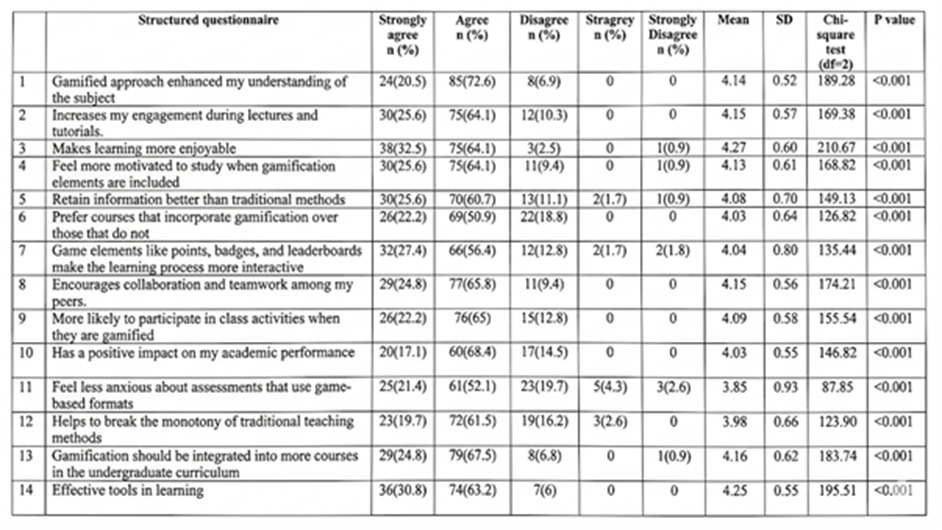
The scale had a good level of reliability, with a Cronbach’s alpha of 0.87, indicating that the items were highly interrelated. Each item in the questionnaire employed a five-point scale ranging from 1 (strongly disagree) to 5 (strongly agree). A higher score indicates a positive attitude towards gamification. For each item, we presented the mean score and standard deviation (SD).
To examine the students' preference for gamification tools, a chi-squared goodness-of-fit test was performed for each item of the Likert scale. The results were presented in three groups: positive (agree/strongly agree), neutral, and negative (disagree/strongly disagree). The students generally held a positive attitude towards gamification (p < 0.001). Significance was set at p < 0.05.
A total of 105 students (89.7%) found gamified aspects of lectures and tutorials more engaging, of which 25.6% strongly agreed and 64.1% agreed (Figure 1). Additionally, 109 students (93.1%) found gamification useful for understanding the topic, with 20.5% strongly agreeing and 72.6% agreeing. Few students (10.3%) were neutral, and no student disagreed.
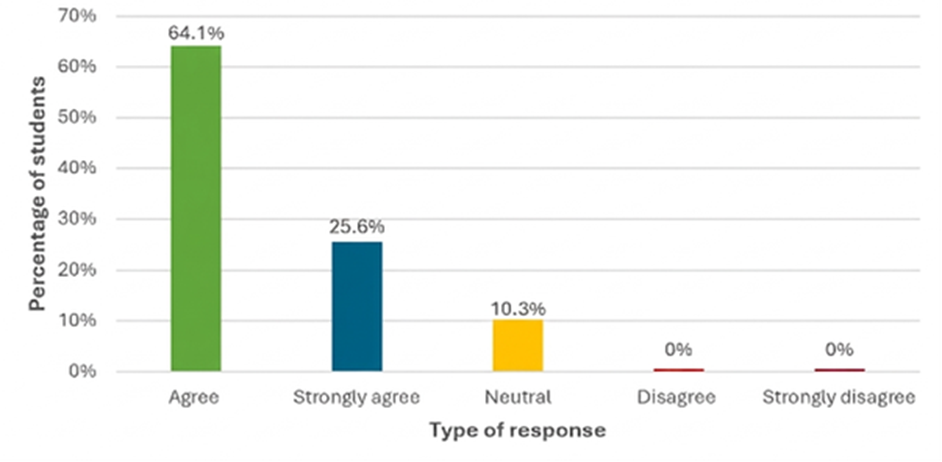
Figure 1: Responses to the statement “Gamification increases engagement during lectures and tutorials.”
The enjoyment of learning increased with gamification, as 113 students (96.6%) agreed that learning is more enjoyable, and 105 students (89.7%) agreed that they are motivated to study. This shows a positive response to gamification in terms of student engagement.
Gamification also had better retention rates than the traditional method of teaching, as 101 students (86.3%) agreed (60.7%) or strongly agreed (25.6%) (Figure 2). Moreover, 95 students (81.2%) also preferred interactive classes.
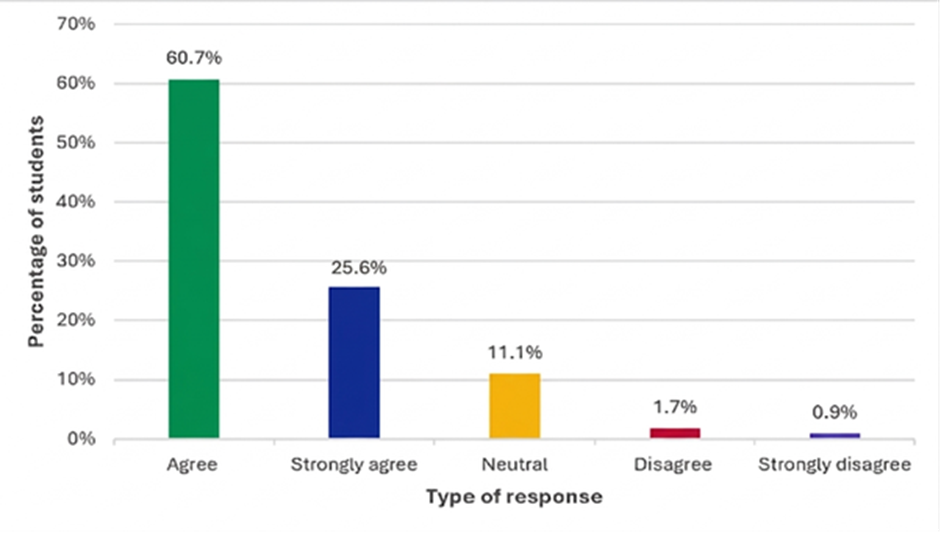
Figure 2: Gamification and information retention
A total of 98 students (83.8%) agreed that the use of tools such as badges and leader boards made the learning process more interactive, indicating that gamification is able to capture the attention and concentration of learners. Almost 106 students (90.6%) agreed that gamification made teamwork and communication between learners better. Also, 102 students (87.2%) agreed that gamification made active participation in class activities better.
A substantial 100 students (85.5%) agreed that their performance in class improved using a gamified approach. Gamification also reduced anxiety associated with assessment for the majority (73.5%), although a small percentage (6.9%) were neutral. Furthermore, 95 students (81.2%) agreed that gamification made classroom activity more interesting by breaking the monotony of the traditional teaching approach.
A total of 108 students (92.3%) agreed that gamification should be used as a normal teaching aid in the undergraduate program. Also, 110 students (94%) agreed that gamification is an effective teaching aid.
When asked to select a gamification aid that is more engaging, 56 students (47.90%) preferred Quizziz, followed by crossword puzzles preferred by 53 students (45.44%). These aids were found to be more interactive and improve retention ( Figure 3). However, Google Forms were preferred by 6 students (4.76%) and Bingo by 2 students (1.90%), indicating that students preferred aids that are more interactive, competitive, and provide instant feedback
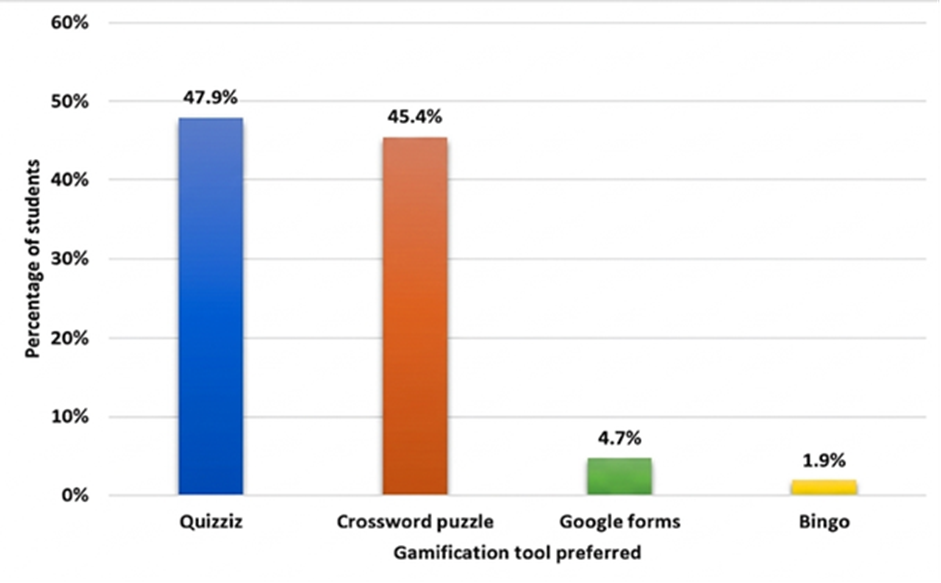
Figure 3 above shows the distribution of student preferences on the various gamified aids used in the sessions
A statistical test using the chi-square goodness of fit test was performed to determine if students had an equal preference for the four gamification tools. The findings showed a statistically significant difference in the students' preferences, with a chi-square value of χ²(3) = 87.61 and p < 0.001, indicating that Quizizz and crossword puzzles were more preferred than Google Forms and Bingo.
Thematic analysis was conducted using the six-step process as outlined by Braun and Clarke. Coding was done through open coding of the students' responses and then themed based on conceptual similarity. The coding of the qualitative data was done by a single researcher who has extensive experience in conducting research in medical education. The coding was done using an inductive approach, and the themes were developed through an iterative process of reviewing and refining the codes. The inter-rater reliability was not calculated since the coding was done by a single researcher.
The open-ended questions provided rich narrative data that allowed for a deeper exploration of the students' attitudes and expectations. A number of themes emerged, including the students' appreciation for gamification and their expectation for it to be incorporated as an integral part of their learning experience. The quotes from the participants are shown in the Table 2 below.
Table 2: Qualitative responses/quotes from students
|
S.no. |
Qualitative responses/quotes from students |
|
1. |
I expect more activities to be conducted as such |
|
2. |
Integrate into more courses in the undergraduate curriculum |
|
3. |
I want the quiz questions to be saved so that I can go through them during the exams. |
|
4. |
We want Quizizz daily in which questions are based on that day’s topic, and we also want to review our incorrectly attempted questions |
|
5. |
At times there are net issues as well as the site keeps getting logged out |
|
6. |
Inform before day before conducting anything. |
|
7. |
Let us know about the topic before quizzes so we can be more interactive. |
DISCUSSION:
This research aimed to assess the perceptions of undergraduate students regarding gamification as a powerful tool to increase engagement, motivation, understanding, and effectiveness. The results showed a predominantly positive response, which supports the inclusion of game-based learning in medical education [3,5]. One of the major results showed a marked increase in understanding (93.1%) and engagement (89.7%) with the use of gamified strategies. Similar results have been shown by Archana Bhat et al. [1], where most of the MBBS Phase II students agreed that gamification helped increase comprehension and active learning. Similar results were shown by Shrivastava and Shrivastava [2], where the authors found that gamification helped increase effective student engagement and attentiveness during medical lectures.
Engagement is a known factor that influences learning success. The interactive elements of game design, such as real-time feedback, points, and challenges, help increase active learning, thus increasing cognitive engagement with educational content [6]. In this study, these aspects were appreciated by the students, where 83.8% agreed that points, badges, and leaderboards made the learning process more interactive. The results also show that gamification significantly increases the affective aspects of learning. More than 96% of students felt that learning became more enjoyable, and nearly 90% felt more motivated. Enjoyment and motivation are critical for long-term retention and achievement in medical education [4,5]. These findings imply that positive affective experiences in learning environments are critical for improving academic performance [12].
There is a better retention of knowledge, with 86.3% of students agreeing that information recall has been improved compared to the traditional method of teaching. This is consistent with the findings of Mohan et al. [8] and Zamani et al. [7] study, which showed that puzzle gamification, such as crosswords, improves memory consolidation and concept reinforcement. These cognitive advantages were reflected in the students' perception (85.5%) that gamification had a positive effect on their academic performance.Moreover, the tools used, especially quizziz and crosswords, were found to be more effective than passive methods such as Google Forms, consistent with the findings of Nur Fitria [9] and Ramaraj [10], which highlighted the lack of interactivity in online forms as a limitation in sustaining interest.
The teamwork aspect of gamification was strongly perceived, with 90.6% of students agreeing that teamwork has increased. This is important in medical teaching, where teamwork is a critical component [11,13]. Organized games such as group quizzes and team games can help to improve communication, problem-solving skills, and alleviate individual stress.
The gamified classes motivated students to take part, with 87.2% of students engaging in activities which is in line with the conclusions of Grellinger et al. [14], who successfully used Bingo games to increase interaction and performance in physiology tutorials. Gamification can be used to decrease assessment-related anxiety. About 73.5% of students felt less anxious during game-based assessments, which is in line with Haripriya (2019) and Sannathimmappa et al. [13], who showed that activity-based assessments can decrease exam-related anxiety and increase confidence. Moreover, 81.2% of students felt that gamification assisted in alleviating the monotony of conventional lectures. This is in line with a move away from static , teacher-centered approaches to more dynamic and student-centered approaches to learning [3,4]. 92.3% of students agreed that gamification should be incorporated into undergraduate programs, and 94% agreed that it is an effective learning tool . Studies such as those by Xu et al. [5] and Ratheepa et al. [12] support the incorporation of gamification into teaching programs as a recognized teaching tool, especially during the early and pre-clinical years of medical education.
Qualitative responses from this study also emphasized the need for access to quiz materials outside the classroom and for the use of tools such as Quizizz on a daily basis, which shows that the students understand that gamification is for engagement , self-directed learning, and exam preparation. The greater preference for Quizizz (47.9%) and crossword puzzles (45.4%) shows that students are engaged and receive instant feedback in gamified learning. Crossword puzzles have also been proven to enhance understanding and retention of scientific concepts [7,8]. Google Forms and Bingo received the lowest preference since they do not incorporate important aspects of games such as points, badges, and leaderboards, which makes them less interactive. Google Forms were more of a test, which caused anxiety, while Bingo did not provide feedback and engagement thus preferring the gamified tools that are interactive, challenging, and provide instant feedback, while ensuring alignment with course objectives.
Limitations
This research has very limited drawbacks. There was no control group to compare the gamification method with the conventional teaching method. The research was carried out in one institution only, which is a limitation to generalization. There was no measurement of student engagement prior to the intervention, which is a limitation to the evaluation of the impact. Furthermore, there are digital accessibility concerns, such as internet lag, which may have influenced the level of participation and the outcome.
CONCLUSION:
In conclusion, this research demonstrates that students were very receptive to gamification-based teaching, finding it engaging, enjoyable, and motivating with active participation and collaborative learning. With these key findings in mind, educators and institutions should look beyond one-off events and explore ways and means of incorporating gamification into the regular curriculum. The process should be practical and accessible to all. Furthermore, future studies should adopt longitudinal and mixed-methods designs to determine whether the significant perceived benefits of this study can be realized in terms of enhanced knowledge retention, academic achievement, and other professional readiness skills.
REFERENCES:
1. Archana Bhat , Smitha Bhat , J Manjunath: Perceptions of MBBS Phase II Students on Gamification: Journal of Medical Sciences and Health 2023: 9: 3: 251-255DOI: 10.46347/jmsh.v9i3.23.243
2. Shrivastava SR, Shrivastava PS. Gamification in medical education: An approach to enhance active engagement of students. J Sci Soc 2023;50:10 2.DOI:10.4103/jss.jss_113_21
3. 3.Gaalen VA, Brouwer J, Adema SJ, Timmer BT, Jaarsma AD, Georgiadis JR. Gamification of health professions education: A systematic review. Advances in Health Sciences Education. 2021;26:683–711DOI: 10.1007/s10459-020-10000-3
4. Muntasir M, Franka M, Atalla B, Siddiqui S, Mughal U, Hossain IT. The gamification of medical education: A broader perspective. Med Educ Online 2015;20:30566DOI: 10.3402/meo.v20.30566
5. Xu M, Luo Y, Zhang Y, Xia R, Qian H and Zou X (2023) Game-based learning in medical education. Front. Public Health 11:1113682. DOI: 10.3389/fpubh.2023.1113682
6. Oestreich, J. H., & Guy, J. W. (2022). Game-Based Learning in Pharmacy Education. Pharmacy: Journal of Pharmacy Education and Practice, 10(1), 11.DOI: 10.3390/pharmacy10010011
7. Zamani P, Biparva Haghighi S, Ravanbakhsh M. The use of crossword puzzles as an educational tool. J Adv Med Educ Prof. 2021;9(2):102-108. Doi: 10.30476/jamp.2021.87911.1330
8. Mohan BS, Nambiar V, Gowda S, ArvindakshanR.Crossword puzzle: a tool for enhancing medical studentslearning in microbiology and immunology.Int J Res Med Sci2018;6:756-9. DOI: 10.18203/2320-6012.ijrms 20180591
9. Nur Fitria, Tira. (2023). Using Google Forms as an Online Learning Assessment Tool for Non-EFL Students. Journal of English Language Teaching Linguistics and Literature Studies. 3. 64-80. DOI:10.30984/jeltis.v3i2.2641
10. Ramaraj, Sivakumar. (2019). Google forms in education.Journal of Contemporary Educational Research and Innovation. 2019;9(1):35-39.
11. McCoy L, Lewis JH, Dalton D. Gamification and Multimedia for Medical Education: A Landscape Review. J Am Osteopath Assoc. 2016 Jan;116(1):22-34. doi: 10.7556/jaoa.2016.003. PMID: 26745561.DOI: 10.7556/jaoa.2016.003
12. Sannathimmappa MB, Nambiar V, Aravindakshan R. Engaging students through activity-based bingo games in immunology course: Determining students' perception and measuring its influence on academic performance. J Educ Health Promot. 2024 Jul 29;13:258.DOI: 10.4103/jehp.jehp_2074_23
13. Grellinger KT, Phan H, Sheakley M, Bouma GJ, Bayer A, Shah BA. BINGO! Elevating Medical Physiology Tutorials Through Gamification. MedEdPORTAL. 2025;21:11491. DOI:10.15766/mep_2374-8265.11491
14. Haripriya R. Effect of bingo puzzle game in understanding pathology. Int J Clinicopathol Correl 2019;3:26- 31. DOI:10.4103/ijcpc.ijcpc_7_19
15. Xu M, Luo Y, Zhang Y, Xia R, Qian H, Zou X. Game-based learning in medical education. Frontiers in public health. 2023 Mar 3;11:1113682.DOI:10.3389/fpubh.2023.1113682