STUDY OF RISK FACTORS, CLINICAL PROFILE AND COMPLICATIONS OF DEEP VEIN THROMBOSIS IN ADMITTED GERIATRIC PATIENTS IN GENERAL MEDICINE WARDS
- Dr Rahul Dilip Wadile , Senior Medicine Resident, Department of Medicine, Lokmanya Tilak Municipal Medical College and General Hospital, Sion, Mumbai, Maharashtra, India
- Dr Dharmendra Brijgopal Pandey , Associate Professor, Department of Medicine, Lokmanya Tilak Municipal Medical College and General Hospital, Sion, Mumbai, Maharashtra, India
- Dr. Abhilash Ramesh Ari , Junior Medicine Resident, Department of Medicine, Lokmanya Tilak Municipal Medical College and General Hospital, Sion, Mumbai, Maharashtra, India
- Dr Sangeeta Jayant Pednekar , Professor and Unit Head, Department of Medicine, Lokmanya Tilak Municipal Medical College and General Hospital, Sion, Mumbai, Maharashtra, India
- Dr Niteen D Karnik , Professor and Head of the Department, Department of Medicine, Lokmanya Tilak Municipal Medical College and General Hospital, Sion, Mumbai, Maharashtra, India
Article Information:
Abstract:
Background: Deep vein thrombosis (DVT) is an important cause of morbidity in elderly hospitalized patients. Objectives: To assess the risk factors, clinical profile, complications, and preventive measures related to DVT in geriatric patients. Methods: This prospective observational study was conducted over 18 months at a tertiary care hospital. One hundred patients aged >60 years with Doppler-confirmed DVT were included. Postoperative patients were excluded. Data on demographics, clinical features, associated risk factors, D-dimer findings, complications, and preventive measures were analyzed as frequencies and percentages. Results: The most common age group was 61-70 years (46%), and the male:female ratio was 2.03:1. Lower-limb DVT was present in 97% of patients. Unilateral swelling (46%) and pain/tenderness (42%) were the most frequent presenting features. Hypertension (28%), diabetes mellitus (19%), and recent hospitalization (17%) were the commonest associated factors. D-dimer was elevated in 51% of patients. Pneumonia and pulmonary embolism were observed in 9% and 7% of patients, respectively. Measures used to reduce complications included mobilization (52%), DVT stockings (48%), and low-molecular-weight heparin (29%). Conclusion: DVT in geriatric patients was seen predominantly in men and most often involved the lower limb. Limb swelling and pain were the main presenting features. Early suspicion, Doppler-based diagnosis, and appropriate preventive measures remain important in this high-risk group.
Keywords:
Article :
INTRODUCTION:
Deep vein thrombosis (DVT) remains an important cause of morbidity in hospitalized patients. It is associated with prolonged hospital stay, added treatment burden, and the risk of pulmonary embolism, which is one of its most serious complications.[1,2] Although effective preventive strategies are available, venous thromboembolism continues to occur in routine practice because risk is not always recognized early and prophylaxis may be inadequate or inconsistently applied.[1-3]
The burden of DVT is particularly important in older adults. Advancing age is linked with reduced mobility, higher prevalence of chronic disease, repeated hospital exposure, and physiological changes that favour thrombosis.[4,6] Elderly patients often have multiple coexisting illnesses, which further increase thrombotic risk and make both prevention and diagnosis more difficult.[4,6] In addition, factors such as sex and body habitus may influence venous thromboembolism risk, suggesting that patient vulnerability is shaped by both biological and clinical determinants.[5]
Hospitalization itself is a major trigger for DVT. Acute illness, immobility, infection, and critical care needs may all contribute to venous stasis and hypercoagulability.[2,3] This is especially relevant in geriatric patients, in whom frailty and comorbidity often coexist with reduced reserve. As a result, older inpatients represent a high-risk group in whom DVT may present with significant morbidity and may be missed unless actively suspected.[4,6]
Despite the clinical importance of this condition, data focusing specifically on geriatric hospitalized patients remain limited in many settings. Local evidence on the risk factors, clinical presentation, and complications of DVT in the elderly is particularly important for improving prevention and early diagnosis. The present study was therefore undertaken to assess the risk factors associated with deep vein thrombosis in geriatric patients, to describe their clinical profile, to evaluate the complications observed in this group, and to identify measures that may help reduce these complications.
Study Objectives
The present study was conducted to assess the risk factors associated with deep vein thrombosis in geriatric patients, to study the clinical profile of deep vein thrombosis, to evaluate the complications associated with the condition, and to suggest measures that may help reduce these complications.
Specifically, the study aimed:
1. To assess the risk factors associated with deep vein thrombosis in geriatric patients.
2. To study the clinical profile of deep vein thrombosis in elderly patients.
3. To evaluate the complications associated with deep vein thrombosis in this population.
4. To suggest measures that may help decrease complications of deep vein thrombosis.
MATERIALS AND METHODS:
Study design and setting
This was a prospective observational study conducted at a tertiary care teaching hospital. The study was carried out over a period of 18 months. The objective was to evaluate the risk factors, clinical profile, complications, and preventive measures associated with deep vein thrombosis in geriatric patients.
Study population
The study included geriatric patients presenting to the hospital with clinically suspected or confirmed deep vein thrombosis. Patients were evaluated in both inpatient and outpatient settings. A total of 100 patients who fulfilled the study criteria were included.
Inclusion criteria
Patients were included in the study if they met the following criteria:
- Age greater than 60 years.
- Clinically suspected or confirmed deep vein thrombosis based on history and clinical examination.
- Patients with DVT confirmed by Doppler ultrasonography.
- Patients who provided informed consent to participate in the study.
Exclusion criteria
Patients were excluded from the study if they met any of the following criteria:
- Age less than 60 years.
- Postoperative patients with deep vein thrombosis.
- Patients who did not provide consent to participate in the study.
Data collection
After obtaining informed consent, a detailed clinical history and physical examination were performed for all eligible patients. Data were collected using a structured case record proforma. Information recorded included demographic characteristics, presenting symptoms and signs, associated comorbidities, and possible risk factors for deep vein thrombosis.
Diagnostic evaluation
All patients underwent Doppler ultrasonography for confirmation of deep vein thrombosis. Additional laboratory investigations were performed as required, including D-dimer estimation and routine blood investigations. Clinical findings, laboratory results, and imaging findings were documented.
Outcome measures
The primary outcomes assessed in the study included:
- Demographic characteristics of the study population
- Clinical presentation of deep vein thrombosis
- Associated comorbidities and risk factors
- Diagnostic findings including Doppler and D-dimer results
- Complications observed during the course of illness
- Preventive and supportive measures used to reduce complications
Statistical analysis
Data were entered into Microsoft Excel and analyzed using Statistical Package for the Social Sciences (SPSS) version 22. The analysis was descriptive in nature. Categorical variables were summarized as frequencies and percentages.
Ethical considerations
The study was conducted after obtaining approval from the Institutional Ethics Committee of the participating tertiary care hospital. Written informed consent was obtained from all patients prior to enrollment in the study. Patient confidentiality was maintained throughout the study, and all procedures were carried out in accordance with accepted ethical standards for clinical research.
RESULTS:
1. Study population and baseline characteristics
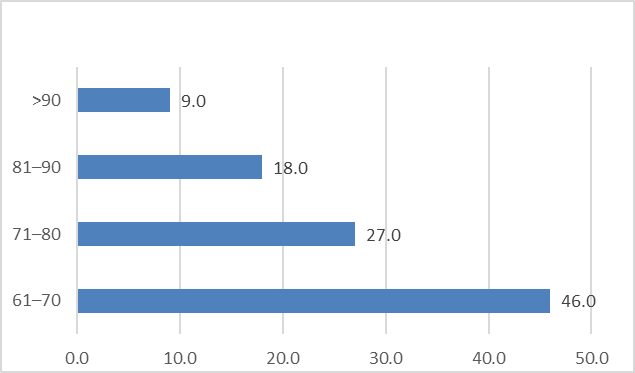
A total of 100 geriatric patients with deep vein thrombosis were included in the study. The largest proportion of patients belonged to the 61–70-year age group (46%), followed by 71–80 years (27%), 81–90 years (18%), and >90 years (9%). There was a clear male predominance, with 67 men and 33 women, giving a male:female ratio of 2.03:1. Lower-limb thrombosis accounted for the vast majority of cases (97%), whereas upper-limb involvement was uncommon (3%). ( Table 1 and figure1)
Table 1. Baseline demographic and clinical characteristics of the study cohort
|
Variable |
n (%) |
|
Total study population |
100 |
|
Age group (years) |
|
|
61–70 |
46 (46.0) |
|
71–80 |
27 (27.0) |
|
81–90 |
18 (18.0) |
|
>90 |
9 (9.0) |
|
Sex |
|
|
Male |
67 (67.0) |
|
Female |
33 (33.0) |
|
Site of DVT involvement |
|
|
Lower limb |
97 (97.0) |
|
Upper Limb |
3( 3.0) |
Figure1.Age distribution of the study cohort
2. Clinical presentation at diagnosis
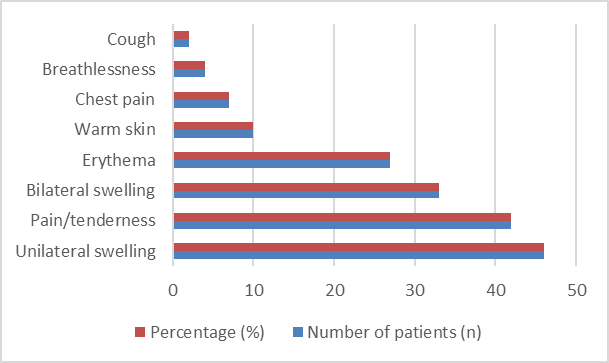
The clinical presentation of deep vein thrombosis in this geriatric cohort was predominantly characterized by local limb symptoms and signs. Unilateral limb swelling was the most common presenting feature, observed in 46% of patients, followed by pain or tenderness in 42% and bilateral swelling in 33%. Erythema was present in 27% of patients, whereas increased local warmth was less frequent, being noted in 10%. Symptoms suggestive of thoracic involvement were comparatively uncommon, with chest pain reported in 7%, breathlessness in 4%, and cough in 2% of cases.( table 2,figure2)
Table 2. Presenting clinical features in geriatric patients with deep vein thrombosis
|
Clinical feature |
n (%) |
|
Unilateral swelling |
46 (46.0) |
|
Pain/tenderness |
42 (42.0) |
|
Bilateral swelling |
33 (33.0) |
|
Erythema |
27 (27.0) |
|
Warm skin |
10 (10.0) |
|
Chest pain |
7 (7.0) |
|
Breathlessness |
4 (4.0) |
|
Cough |
2 (2.0) |
|
Clinical feature |
n (%) |
Figure 2. Frequency of presenting clinical features in geriatric patients with deep vein thrombosis
3. Associated comorbidities and risk-factor profile
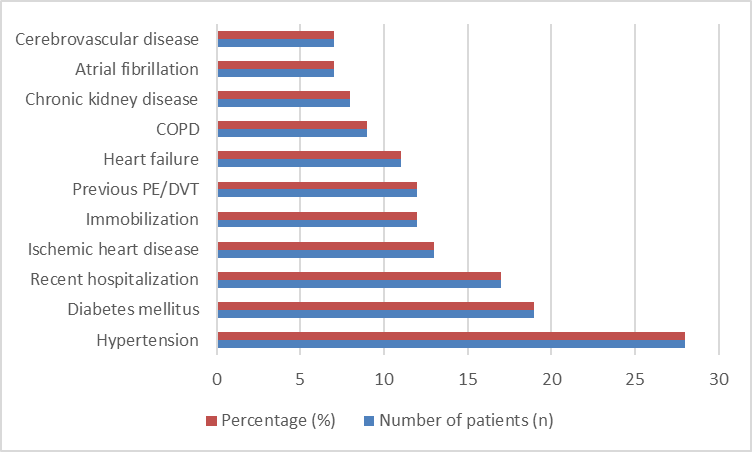
The study cohort demonstrated a substantial burden of associated comorbidities and clinical risk factors. Hypertension was the most frequently recorded associated factor, present in 28% of patients, followed by diabetes mellitus in 19% and a history of recent hospitalization in 17%. Ischemic heart disease was noted in 13% of patients, while immobilization and previous pulmonary embolism/deep vein thrombosis were each present in 12%. Heart failure was observed in 11%, chronic obstructive pulmonary disease in 9%, chronic kidney disease in 8%, and both atrial fibrillation and cerebrovascular disease in 7% of patients.
Table 3. Associated comorbidities and risk factors among geriatric patients with deep vein thrombosis
|
Risk factor / comorbidity |
n (%) |
|
Hypertension |
28 (28.0) |
|
Diabetes mellitus |
19 (19.0) |
|
Recent hospitalization |
17 (17.0) |
|
Ischemic heart disease |
13 (13.0) |
|
Immobilization |
12 (12.0) |
|
Previous PE/DVT |
12 (12.0) |
|
Heart failure |
11 (11.0) |
|
COPD |
9 (9.0) |
|
Chronic kidney disease |
8 (8.0) |
|
Atrial fibrillation |
7 (7.0) |
|
Cerebrovascular disease |
7 (7.0) |
Figure3. Distribution of associated comorbidities and risk factors among geriatric patients with deep vein thrombosis
4. Diagnostic findings
All patients included in the study had deep vein thrombosis confirmed on Doppler examination. As shown in Table 4, D-dimer levels were elevated in 51% of patients, while 49% had D-dimer values within the reported normal range.
Table 4. Diagnostic findings among geriatric patients with deep vein thrombosis
|
Diagnostic parameter |
n (%) |
|
Doppler-confirmed DVT |
100 (100.0) |
|
Elevated D-dimer |
51 (51.0) |
|
Normal D-dimer |
49 (49.0) |
The diagnostic profile of the cohort indicates that Doppler ultrasonography served as the confirmatory modality in all enrolled cases. As presented in Table 4, D-dimer elevation was observed in only about half of the study population, suggesting that a normal D-dimer value did not exclude confirmed thrombosis in a substantial proportion of elderly patients. These findings support the importance of imaging-based diagnosis in geriatric patients with suspected DVT, particularly in the presence of compatible clinical features.
5. In-hospital complications and measures used to reduce complications
In-hospital complications recorded in the study were relatively limited in number. As shown in Table 5, pneumonia was the most frequently reported complication, occurring in 9% of patients, followed by pulmonary embolism in 7%.
Table 5. In-hospital complications and measures used to reduce complications among geriatric patients with deep vein thrombosis
|
Variable |
n (%) |
|
Complications |
|
|
Pneumonia |
9 (9.0) |
|
Pulmonary embolism |
7 (7.0) |
|
Measures used to reduce complications |
|
|
Mobilization |
52 (52.0) |
|
DVT stockings |
48 (48.0) |
|
LMWH |
29 (29.0) |
DISCUSSION:
Deep vein thrombosis remains an important cause of morbidity in older patients, and its burden increases with age. Elderly individuals are particularly vulnerable to venous thromboembolism because advancing age often coexists with frailty, comorbidity, reduced mobility, and repeated hospital exposure.[7-9] In the present study, most patients were aged 61 to 70 years, and men were more commonly affected. This pattern is consistent with earlier reports showing that DVT incidence rises in later life and remains clinically relevant across older age groups.[8,9] Our finding of male predominance also agrees with larger geriatric series and trauma-based datasets.[8,16] The presence of patients aged more than 90 years further supports the continued relevance of DVT in the very elderly, although previous work suggests that risk may remain persistently high across later decades rather than rise sharply only after 90 years.[15]
The clinical presentation in our cohort was dominated by local limb symptoms. Unilateral swelling and pain or tenderness were the most common findings, while erythema and warm skin were less frequent and respiratory symptoms were uncommon. This pattern is broadly in keeping with the usual presentation of lower-limb DVT. At the same time, diagnosis in older adults may be difficult because symptoms can be less typical or less pronounced than in younger patients.[9] The Indian study by Chinglensana et al. also identified swelling and pain as common presenting features, supporting the relevance of our findings in a regional context.[14]
The risk-factor profile in our study reflects the multimorbidity that characterizes many elderly patients with DVT. Hypertension was the most frequent associated condition, followed by diabetes mellitus and recent hospitalization. Other commonly observed factors included ischemic heart disease, immobilization, previous PE/DVT, heart failure, COPD, chronic kidney disease, atrial fibrillation, and cerebrovascular disease. Previous studies have similarly shown that venous thrombosis in the elderly usually occurs in the setting of multiple overlapping risks rather than a single isolated trigger.[7,9,10] In particular, recent hospitalization and immobilization are clinically important because they expose vulnerable patients to acute medical illness, infection, reduced ambulation, and other prothrombotic states.[11,12]
Our diagnostic findings also merit attention. All patients had DVT confirmed on Doppler examination, reflecting the study entry criteria. However, D-dimer was elevated in only 51% of cases, while nearly half had values within the reported normal range. This finding highlights an important limitation of relying on conventional D-dimer interpretation in older adults. Schouten et al. showed that the specificity of conventional D-dimer thresholds declines markedly with age, and that age-adjusted cut-offs improve clinical utility without major loss of sensitivity.[13] Taken together, these findings support the continued central role of imaging in the diagnosis of DVT in geriatric patients.
The complication profile in our cohort was limited but clinically important. Pneumonia was reported in 9% of patients and pulmonary embolism in 7%. Pulmonary embolism remains the most serious complication of DVT and contributes substantially to venous thromboembolism-related morbidity in older adults.[8,9] In our study, the occurrence of PE in a meaningful minority of patients underlines the need for early recognition and timely treatment. Preventive measures such as mobilization, DVT stockings, and LMWH were used in varying proportions. This suggests that both mechanical and pharmacologic strategies were employed, although not uniformly. Previous studies have also shown that prophylaxis is often underused or delayed in elderly high-risk patients. [9,11,16]
Our findings should be interpreted in light of certain limitations. This was a single-center study with a relatively small sample size, and the analysis was descriptive. The recorded factors therefore represent associated comorbidities rather than independent predictors. Nevertheless, the study provides useful data from an underrepresented geriatric hospital population and shows that DVT in elderly patients is closely linked to multimorbidity, hospitalization, and reduced mobility. Early suspicion, prompt Doppler-based diagnosis, and consistent preventive measures remain essential in this vulnerable group. [7-9,13]
Limitations
It was conducted at a single tertiary care center and included a relatively small sample size. The analysis was descriptive, so causal relationships cannot be established. The reported associated factors should not be interpreted as independent predictors because there was no control group without DVT and no multivariable model to estimate adjusted effects. In addition, some complications and preventive practices may have been influenced by local admission patterns and institutional protocols. Even so, the study adds clinically relevant data from a geriatric Indian hospital population, which remains underrepresented in the literature.[14]
CONCLUSION:
Deep vein thrombosis in geriatric patients was seen predominantly in men and most often involved the lower limb. Limb swelling and pain were the most common presenting features. Hypertension, diabetes mellitus, recent hospitalization, and immobilization were frequent associated factors. Pulmonary embolism occurred in a clinically important minority of patients. These findings emphasize the importance of early clinical suspicion, prompt Doppler-based diagnosis, and consistent preventive measures in elderly hospitalized patients.
REFERENCES:
1. Okuhara, A., Navarro, T. P., Procópio, R. J., Bernardes, R. D. C., Oliveira, L. D. C. C., & Nishiyama, M. P. (2014). Incidence of deep vein thrombosis and quality of venous thromboembolism prophylaxis. Revista do Colégio Brasileiro de Cirurgiões, 41(1), 2–6. https://doi.org/10.1590/S0100-69912014000100002
2. Geerts, W. H., Bergqvist, D., Pineo, G. F., Heit, J. A., Samama, C. M., Lassen, M. R., & Colwell, C. W. (2008). Prevention of venous thromboembolism: American College of Chest Physicians evidence-based clinical practice guidelines. Chest, 133(6 Suppl), 381S–453S. https://doi.org/10.1378/chest.08-0656
3. Cook, D., McMullin, J., Hodder, R., Heule, M., Pinilla, J., Dodek, P., & Canadian Critical Care Trials Group. (2001). Prevention and diagnosis of venous thromboembolism in critically ill patients: A Canadian survey. Critical Care, 5(6), 336–342. https://doi.org/10.1186/cc1066
4. Ali, M. S., & Czarnecka-Kujawa, K. (2016). Venous thromboembolism in the elderly. Current Geriatrics Reports, 5(2), 132–140.
5. Severinsen, M. T., Johnsen, S. P., Tjønneland, A., Overvad, K., Dethlefsen, C., & Kristensen, S. R. (2010). Body height and sex-related differences in incidence of venous thromboembolism: A Danish follow-up study. European Journal of Internal Medicine, 21(4), 268–272. https://doi.org/10.1016/j.ejim.2010.03.013
6. Gross, P. L., & Chan, N. C. (2021). Thromboembolism in older adults. Frontiers in Medicine, 7, 470016. https://doi.org/10.3389/fmed.2020.470016
7. Engbers, M. J., van Hylckama Vlieg, A., & Rosendaal, F. R. (2010). Venous thrombosis in the elderly: Incidence, risk factors and risk groups. Journal of Thrombosis and Haemostasis, 8(10), 2105–2112.
8. Silverstein, M. D., Heit, J. A., Mohr, D. N., Petterson, T. M., O’Fallon, W. M., & Melton, L. J., III. (1998). Trends in the incidence of deep vein thrombosis and pulmonary embolism: A 25-year population-based study. Archives of Internal Medicine, 158(6), 585–593.
9. Piazza, G., Seddighzadeh, A., & Goldhaber, S. Z. (2008). Deep-vein thrombosis in the elderly. Clinical and Applied Thrombosis/Hemostasis, 14(4), 393–398. https://doi.org/10.1177/1076029608317942
10. Sellier, E., Labarere, J., Sevestre, M. A., Belmin, J., Thiel, H., Couturier, P., Richard, D., & Bosson, J. L. (2008). Risk factors for deep vein thrombosis in older patients: A multicenter study with systematic compression ultrasonography in postacute care facilities in France. Journal of the American Geriatrics Society, 56(2), 224–230.
11. Rogers, M. A., Levine, D. A., Blumberg, N., Flanders, S. A., Chopra, V., & Langa, K. M. (2012). Triggers of hospitalization for venous thromboembolism. Circulation, 125(17), 2092–2099.
12. Sartori, M., Favaretto, E., & Cosmi, B. (2021). Relevance of immobility as a risk factor for symptomatic proximal and isolated distal deep vein thrombosis in acutely ill medical inpatients. Vascular Medicine, 26(5), 542–548.
13. Schouten, H. J., Geersing, G. J., Koek, H. L., Zuithoff, N. P., Janssen, K. J., Douma, R. A., Candel, M. J. J. M., Hoes, A. W., Moons, K. G. M., & Reitsma, J. B. (2013). Diagnostic accuracy of conventional or age adjusted D-dimer cut-off values in older patients with suspected venous thromboembolism: Systematic review and meta-analysis. BMJ, 346, f2492.
14. Chinglensana, L., Rudrappa, S., Anupama, K., Gojendra, T., Singh, K. K., & Chandra, S. T. (2013). Clinical profile and management of deep vein thrombosis of lower limb. Journal of Medical Society, 27(1), 10–14.
15. Yayan, J., & Bals, R. (2016). Relative risk of deep vein thrombosis in very elderly patients compared with elderly patients. Clinical and Applied Thrombosis/Hemostasis, 22(1), 77–84.
16. Prabhakaran, K., Gogna, S., Lombardo, G., & Latifi, R. (2020). Venous thromboembolism in geriatric trauma patients—Risk factors and associated outcomes. Journal of Surgical Research, 254, 327–333.