Mortality after non cardiac surgery: A 4 Year follow up and prospective analysis comparing Accelerated and Delayed surgery in patients with hip fractures
- Alen Sigamani , Associate Professor, Dept of Orthopedics, TDMCH Alappuzha, Kerala.
- Manesh Stephen , Associate Professor, Dept of Orthopedics, GMC Ernakulam, Kerala.
Article Information:
Abstract:
MINS or myocardial injury after non cardiac surgery due to a mismatch in myocardial perfusion, is an independent predictor of 30 days and one year mortality in non-cardiac surgery This was a prospective randomized control study to assess the impact of MINS on overall mortality in patients undergoing hip surgery divided into accelerated care group and delayed care group. We included a total of 57 patients, the incidence of MINS was 12 percent or 7 patients, Death related to MINS occurred in 5 out of the total of 13 patients at 4 years follow up. This study indicates that due to the emergent management of MINS by multi-disciplinary team the death due to the same had decreased. Thus, using this predictor of mortality resulted in better management.
Keywords:
Article :
INTRODUCTION:
MINS or myocardial injury after non-cardiac surgery caused by ischemia occurs within 30 days after a non-cardiac surgery. It is estimated that the incidence of hip fracture is likely to go up to 6 million by 2050 with half of these fractures occurring in Asia. The general understanding is that one-year mortality for hip fractures is about 30 percent and one month mortality around 10 percent though this is decreasing with better care and management of perioperative and post op complications. MINS is a predictor of mortality in hip fractures and also MACE (major adverse cardiac event). Low energy or osteopenic hip fractures in the elderly with the added comorbidities cause inflammatory chemicals release due to muscle damage, Anemia, blood loss, perioperative hypotension along with physiological stress can contribute to MINS. MINS is detected by an elevated cardiac troponin level, with or without myocardial infarction. This study was done to determine the cause, incidence and mortality in 2 group of patients with hip fractures one group operated within 6 hours or accelerated group and another group operated after 24 hours or delayed group.
METHODOLOGY:
After getting the ethical clearance from the institutional committee. A total of 57 patients were recruited attending the casualty or outpatient services. After detailed history, clinical examination, Xray and obtaining a detailed informed consent, patients were randomized into two groups. Group A or accelerated surgery group where surgery was performed within 6 hours of admission and Group B delayed surgery group where the surgery was performed after 24 hours. All of them were evaluated with routine blood investigation, ECG, echocardiography. Post op troponin values were estimated on the 2nd and 3rd day.
All patients were operated under spinal anesthesia with proximal femoral nailing for intertrochanteric fractures and hemiarthroplasty for neck of femur fractures. Intra op monitoring, intravenous tranexamic acid and period of hypotension, blood transfusion was all documented and recorded. Highly sensitive Troponin, 4th generation was done on post op 1st,2nd and 3rd day. Patient were mobilized on first post op day, bed mobilization for nailing group and full weight bearing for hemiarthroplasty group. Patients were followed up on routine bases 3 months, 6 months and last follow up at 4 years after surgery. All adverse event were recorded and in the event of death cause of death was recorded and documented.
RESULTS:
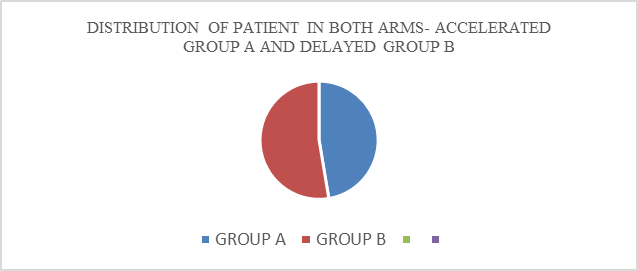
Total number of patients 57 mean age 68.7 years (63 - 91), female 50 and male 7 number. These patients were randomized into 27 patients in accelerated arm (Group A) and 30 in delayed arm (Group B) chart 1. The associated co morbidities were diabetic mellitus(DM) 15 patient all on oral hypoglycemic drugs , 8 in accelerated arm and 7 in delayed arm .Out of the 15, 14 patients were uncontrolled DM , HbA1C more than 7.5 , 8 in delayed arm and 5 in accelerated arm .31 patients had hypertension , 12 in accelerated arm and 19 in delayed arm .Out of the 31 , 22 patients were on single antihypertensive (calcium channel blocker or telmisartan /losartan ), 9 patients on dual anti-hypertensive .12 patients had intraoperative hypotension,Intra operative hypotension was defined as a drop in blood pressure more than 20 mm hg for more than 10 minutes compared to the pre spinal anesthesia reading or needing inotropic agents or blood transfusion . 5 patients in Accelerated arm and 7 in delayed arm had intraop hypotension. 7 patients had MINS, raised troponin (0.06 -1.3) normal value less than 0.01, 3 in accelerated arm and 4 in delayed arm. We had one immediate post op death in accelerated arm due to pulmonary thromboembolic event secondary to deep vein thrombosis, confirmed by leg doppler and pulmonary angiography. At 4 year follow up there were a total 13 , including immediate post op death , 7 in delayed arm and 6 in accelerated arm Out of the 13 deaths 2 in first year and 2 in second year and 9 after 2 years .No autopsies were performed and they were was confirmed by phone call and certified as natural cause age related, out of the 13 deaths, 10 deaths occurred above age of 68 years .
CHART 1
Co morbidities in both groups: Table 1
|
|
GROUP A |
GROUP B |
|
DIABETIC MELLITIS |
8 |
7 |
|
HYPERTENSION |
12 |
19 |
|
INTRAOP HYPOTENSION |
5 |
7 |
|
MINS |
4 |
3 |
|
MINS RELATED DEATH |
2 |
3 |
DISCUSSION:
Low energy or osteopenic hip fractures are common in the elderly and is a leading cause of morbidity and mortality. Most hip fractures occur in females . Incidence of hip fracture is expected to be around 6 million worldwide with half of that occurring in Asia 1, With the increase in the elderly population the burden on the health system can be an unsurmountable challenge so it is mandatory to reduce the complication due to this fracture 2,7.MINS is a clinical condition defined by increase in troponin values within 30 days after surgery but lacks symptoms of myocardial infarction. Myocardial infarction occurs as a result of myocardial injury due to vascular obstruction leading to myocardial damage and associated chest symptoms like pain, sweating, ECG variation and echocardiography changes. The pathophysiology in MINS is due to the oxygen supply – demand mismatch referred to as type 2 myocardial damage which occurs due to reduced myocardial perfusion as a result of anemia, post-traumatic stress, perioperative hypotension, tachycardia in the absence of sepsis or pulmonary embolism and triggered by inflammatory markers of muscle damage following hip fractures in an already compromised elderly patient. Out of the 57 patients 7 patients had MINS or12.2 %,5 of them in the accelerated arm and 7 in the delayed arm. There were a total of 13 deaths,2 in the first year with one due to thromboembolic catastrophe, and another due to acute exacerbation of bronchial asthma. 2 patients with MINS who died within 2 years had intraoperative hypotension and all them (detected to have MINS with elevated troponin) were hypertensive and diabetic. Senthil Narayanan 3 in his study suggested that the overall mortality in hip fractures at 30 days was 2.4%- and one-year mortality 14.9%. He suggested that ASA grade 2 and delaying surgery more than 48 hours were a significant contributor to mortality. He states that for one day increase between injury and surgery, the chance of mortality is likely to be 11% more or about 1.11 times higher compared to those who undergo surgery on the same day of injury3,4,5. In our study with random allocation there were no significant differences in mortality whether the patients were operated early or late and the deaths due to MINS occurred in 12 percent of the recruited, The rest were due to natural age related Hence there was no co relation with MINS and related death for the first 2 years .This could be due to the fact that all patients were on Low molecular weight heparin post op and any raise in Troponin was treated aggressively in consultation with cardiologist with statins and single or dual antiplatelets and supportive measures. They were on regular follow up and repeat troponin and echocardiography till stable.
CONCLUSION:
MINS can be a predictor of mortality and gives a window to expected complications associated with hip fracture surgery in the elderly, although our study suggests that there is no significant difference in mortality in patients treated within 6 hours , accelerated care or after 24 hours, delayed surgery this may be due to the emergent management of MINS which significantly reduced the mortality associated with it.
REFERENCES:
1. Cooper C, Campion G, Melton L. Hip fractures in the elderly: a world-wide projection. Osteoporos Int. 1992;2(6):285-9. [Google Scholar].
2. Zhang C, Feng J, Wang S, Gao P, Xu L, Zhu J. Incidence of and trends in hip fracture among adults in urban China: A nationwide retrospective cohort study. China; PLOS ONE medicine. PLoS Med. 2020;17(8). [Google Scholar] [Crossref].
3. Senthil Narayanan V, U. T Vassan , Prabu Vairavan Pragasam, Sathyanarayana V: One month and one year mortality of hip fractures in a tertiary care hospital in south India- A retrospective cohort study. Indian Journal of Orthopaedics Surgery. 9(4):243-249, 2023. | https://doi.org/10.18231/j.ijos.2023.046.
4. Nia A, Popp D. Predicting 30-Day and 180-Day Mortality in Elderly Proximal Hip Fracture Patients: Evaluation of 4 Risk Prediction Scores at a Level I Trauma Center. Diagnostics (Basel). 2021;11(3). [Google Scholar].
5. Ram G, Govardhan P. In-Hospital Mortality following Proximal Femur Fractures in Elderly Population. Surg J (N Y). 2019;5(2):e53-6. [Google Scholar].
6. Anjali Kulkarni, Maura Marcucci and Julie M.V. Nguyen: Myocardial injury after noncardiac surgery, CMAJ May 21, 2024 196 (19) E661; DOI: https://doi.org/10.1503/cmaj.231355.
7. Smilowitz NR, Redel-Traub G, Hausvater A, et al: Myocardial injury after noncardiac surgery: a systematic review and meta-analysis. Cardiol Rev 2019;27:267–73.PubMedGoogle Scholar.