IMPACT OF RAMADAN FASTING ON BLOOD PRESSURE OF YOUNG ADULT MALES.
- Umme Salma Khan , Junior Resident, Department of Physiology, Seth G.S. Medical College and K.E.M. Hospital, Mumbai.
- Esha Angane , Assistant Professor, Department of Physiology, Seth G.S. Medical College and K.E.M. Hospital, Mumbai.
- Sharad Patel , Associate Professor, Department of Physiology, Seth G.S. Medical College and K.E.M. Hospital, Mumbai.
- Surabhi Beronica Lakra , Junior Resident, Department of Physiology, Seth G.S. Medical College and K.E.M. Hospital, Mumbai.
Article Information:
Abstract:
Background: Religious fasting is practiced by people of all faiths, including Christianity, Islam, Buddhism, Jainism, as well as Hinduism, Judaism, and Taoism. There are hundreds of millions of people that practice the commitments of Ramadan, a part of which includes abstinence from eating and drinking from sunrise to sunset. The world is experiencing an increase in the emergence of non-communicable diseases (NCDs) : leading cause of the global mortality. Environmental and behavioural risk factors related to lifestyle such as smoking, excessive alcohol consumption, unhealthy diet and sedentarity have a casual association with NCDs. This study aims to study the effects of Ramadan fasting on Blood Pressure and the time period of persistence of the same effects. There are limited studies conducted in Indian setting on this topic, hence this study. Materials and Methods: Present study is prospective observational study, conducted in 55 randomly selected males from a government office who practice fasting during Ramadan, falling in the age group of 30-40 years. They were followed up fortnightly to study the effects of Ramadan fasting on their Blood Pressure. Results: There is decrease in blood pressure (both systolic & diastolic) after initiation of fasting. The beneficial effect of fasting on blood pressure is seen even after 30 days of end of fasting. The time period of persistence of the effects of Ramadan fasting on blood pressure is found to be upto 30 days after the last day of fasting. Conclusion: From the above analysis it can be concluded that fasting has beneficial effect on both systolic and diastolic blood pressure. The effects are sustained upto 30 days after the last day of fasting.
Keywords:
Article :
INTRODUCTION:
Religious fasting is practiced by people of all faiths, including Christianity, Islam, Buddhism, Jainism, as well as Hinduism, Judaism, and Taoism. There are hundreds of millions of people that practice the commitments of Ramadan, a part of which includes abstinence from eating and drinking from sunrise to sunset. Ramadan falls on the ninth lunar month of the Islamic calendar and is considered as the holiest month of the year. The world is experiencing an increase in the emergence of non-communicable diseases (NCDs) : leading cause of the global mortality. Environmental and behavioural risk factors related to lifestyle such as smoking, excessive alcohol consumption, unhealthy diet and sedentarity have a casual association with NCDs. During this month, water and food consumption are exclusively nocturnal and the typical dietary practice during Ramadan fasting consists of consuming one substantial meal after sunset and one lighter meal before dawn.[1] The majority of practitioners consume two meals, one after sunset (Iftar) and one before dawn (Sohor).[2]
The period of fasting is not necessarily sedentary, and simple exercises can be safely done to boost the physical capacity of the body as well.[3] Studies have shown that cardiovascular risk factors have found to be modified during fasting, with a significant lower plasma cholesterol, triglycerides, LDL-c, VLDL-c, systolic blood pressure, body mass index and waist circumference after Ramadan. [4]
A meta-analysis of various fasting regimens shows that Ramadan fasting is associated with significant improvements in body weight and visceral lean mass, high- density lipoprotein cholesterol (HDL-c), and with reductions in low-density lipoprotein cholesterol (LDL-c) and total cholesterol (T- chol), especially in cardiac patients.[5] There is evidence that during the period of Ramadan, those who fast lose on an average about a kilogram of weight over 4 weeks. [6].
Ramadan Nutrition Plans can further add to this by achieving improved clinical outcomes, glycemic control and variability in individuals with type 2 Diabetes Mellitus.[7] Ramadan fasting has been found to have beneficial influences on the inflammatory state, as well as metabolic and anthropometric parameters.[8]
This study aims to study the effects of Ramadan fasting on Blood Pressure and the time period of persistence of the same effects. There are limited studies conducted in Indian setting on this topic, hence this study.
OBJECTIVES
1. To study the effects of Ramadan fasting on Systolic Blood Pressure (SBP) and Diastolic Blood Pressure (DBP).
2. To observe the time period of persistence of the effects of Ramadan fasting on blood pressure.
MATERIALS AND METHODS:
· The study is a prospective observational study.
· The study was conducted over a period of 9 weeks.
· The study was conducted from the 3rd of March 2024 to the 10th of May 2024.
A complete list of employees with their name, age, sex and shift of duty was obtained from the selected government office. The study was then conducted on 60 randomly selected males
from a government office who practice fasting during Ramadan, falling in the age group of 30 - 40 years, having sedentary lifestyle.
A brief history was taken from the subjects and accordingly the subjects were included or excluded in the study depending upon the inclusion and exclusion criteria. They were explained the purpose of the study. For the selected participants, written informed consent was obtained in the language best understood by the participants.
The Blood Pressure was measured in the left arm of the subject with an appropriate cuff size. The first reading was taken a week before Ramadan fasting commenced. The second reading was taken on the fifteenth day of Ramadan fasting. The other 3 readings were taken fortnightly thereafter till one month after Ramadan ended.
Before taking the reading the participants were asked to be seated comfortably for 10 minutes in a quiet environment. The reading was taken in the afternoon at around the same time in every 5 visits that were made. A digital sphygmomanometer was used to measure the Blood Pressure and it was measured while the subject was in sitting position.
Inclusion Criteria :
· Males in the age group of 30-40 years
· Healthy males following Ramadan fasting.
· Males having sedentary lifestyle
· Males willing to give consent to study
Exclusion criteria:
1. Females
2. Individuals with any co-morbidities.
3. Those in intense workout.
4. Those who take any medications or supplements.
5. Those who have undergone any surgery.
6. Those consuming alcohol.
7. Smokers.
8. Individuals not consenting to participate
Data was analysed using appropriate statistical tests.
RESULTS:
· The mean age of the participants was found to be 36 years.
· The mean Blood Pressure (SBP & DBP) during different phases of the study is depicted in table number 1
Table 1- Mean Systolic and Diastolic Blood Pressure.
|
Time / Condition |
Mean systolic blood pressure (mm of Hg) |
Mean diastolic blood pressure (mm of Hg) |
|
A week before Fasting begins |
132 |
84 |
|
15 days in to Fasting |
118 |
75 |
|
Immediately after 30 days of fasting |
118 |
72 |
|
15 days after last day of fasting |
111 |
72 |
|
A month after the last day of fasting |
126 |
83 |
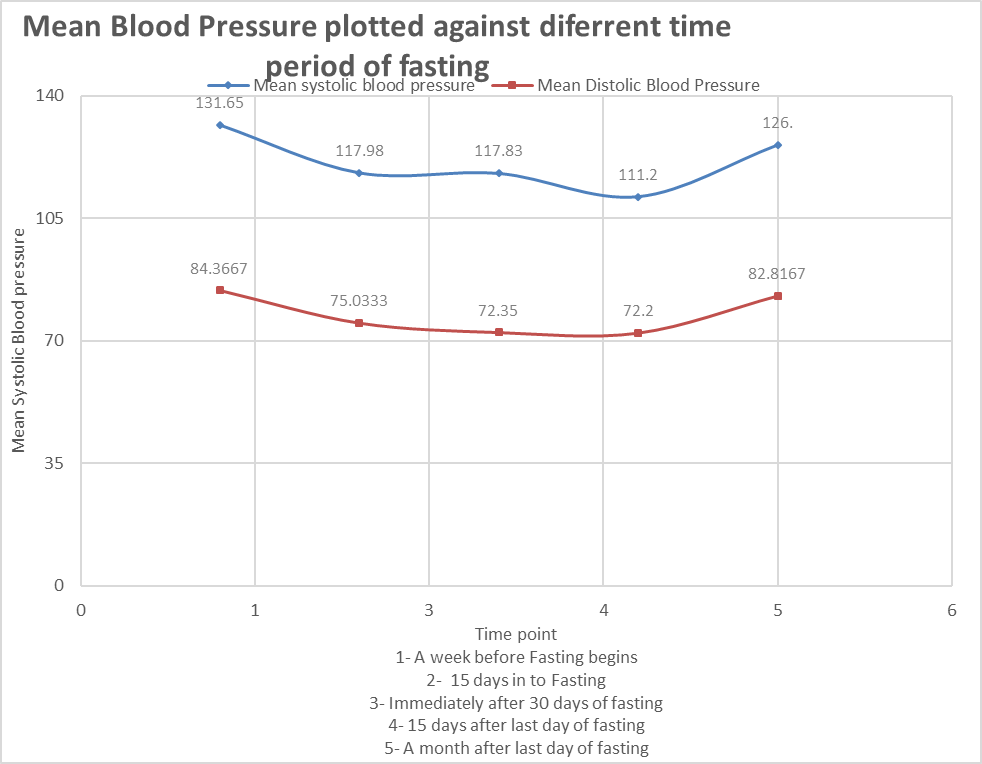
· There is decrease in blood pressure (both systolic and diastolic) after initiation of fasting.
· The beneficial effect of fasting on blood pressure is seen even after 30 days of end of fasting.
· The time period of persistence of the effects of Ramadan fasting on Blood Pressure is found to be upto 30 days after the last day of fasting.
Statistical Analysis
Descriptive:
|
Time / Condition |
Mean |
SD |
Sample Size |
|
A week before Fasting begins |
131.65 |
8.90 |
60 |
|
15 days in to Fasting |
117.98 |
9.17 |
60 |
|
Immediately after 30 days of fasting |
117.83 |
10.54 |
60 |
|
15 days after last day of fasting |
111.2 |
11.62 |
60 |
|
A month last day of fasting |
126 |
12.31 |
60 |
ANOVA Table
|
|
Sum of Squares |
df |
Mean Sum of Squares |
F |
p |
Partial eta squared |
|
Between Time Points |
15214.1 |
4 |
3803.525 |
41.7769 |
0 |
0.4145 |
|
Between Subjects |
11646.2667 |
59 |
197.3944 |
|
|
|
|
Error |
21486.3 |
236 |
91.0436 |
|
|
|
|
Total |
48346.6667 |
|
|
|
|
|
Interpretation- a repeated measures ANOVA was conducted to determine whether there were statistically significant differences in SBP over the course and after Ramadan fasting. the test showed that for all the subjects who fast during Ramadan the difference in SBP between first time point (M=131.65, SD=8.9), second time point (M=117.98, SD=9.17), third time point (M=117.83, SD=10.54), fourth time point (M=111.2, SD=11.62) and fifth time point (M=126, SD=12.31) were statistically significant, F(4,59)=41.77, p=<0.001, partial η2=0.41
Descriptive:
|
Time / Condition |
Mean |
SD |
Sample Size |
|
A week before Fasting begins |
84.36 |
7.46 |
60 |
|
15 days in to Fasting |
75.03 |
7.27 |
60 |
|
Immediately after 30 days of fasting |
72.35 |
7.48 |
60 |
|
15 days after last day of fasting |
72.2 |
7.90 |
60 |
|
A month last day of fasting |
82.81 |
8.66 |
60 |
ANOVA Table
|
|
Sum of Squares |
df |
Mean Sum of Squares |
F |
p |
Partial eta squared |
|
Between Time Points |
8160.4467 |
4 |
2040.1117 |
47.9531 |
0 |
0.4484 |
|
Between Subjects |
7787.7467 |
59 |
131.9957 |
|
|
|
|
Error |
10040.3533 |
236 |
42.5439 |
|
|
|
|
Total |
25988.5467 |
|
|
|
|
|
Interpretation- a repeated measures ANOVA was conducted to determine whether there were statistically significant differences in DBP over the course and after Ramadan fasting. the test showed that for all the subjects who fast during Ramadan the difference in DBP between first time point (M=84.36, SD=7.46), second time point (M=75.03, SD=7.27), third time point (M=72.35, SD=7.48), fourth time point (M=72.2, SD=7.90) and fifth time point (M=82.81, SD=8.66) were statistically significant, F(4,59)=47.95, p=<0.001, partial η2=0.44
DISCUSSION:
To the best of our knowledge this is the first study which shows the effects of Ramadan fasting on Blood Pressure in males in the age group of 30-40 years having a sedentary lifestyle in an Indian setting. In this study, a population following sedentary lifestyle was chosen. Although , despite sedentary lifestyle we could prove that modifying our eating habits can have positive effects on our health, inculcating some physical activity in our day to day life is always advised as it is beneficial.
Studies suggest that Ramadan fasting may have a positive affect on blood pressure, especially in young adults. This could be due to reduced caloric intake , dietary modifications and increased spiritual mindfulness during the fasting period of Ramadan. Fasting may lead to a temporary reduction in systolic and diastolic blood pressure due to changes in hydration, reduced intake of sodium and enhanced stress regulation as a result of reduction in stress hormones viz. cortisol, insulin.
A notable decrease in systolic and diastolic blood pressure during Ramadan fasting is found most likely due to catecholamine inhibition during fasting. The reduction in stress-related hormones may have contributed to improve cardiovascular outcomes during fasting period.
Fasting in Ramadan has been shown to have some effects on the circulating levels of several biochemical markers which are known to be associated with vascular and metabolic disorders, including cholesterol. [10]. Modest weight loss during Ramadan along with improved lipid profiles reduced LDL cholesterol and increased HDL cholesterol) may further support reduction in blood pressure. Fasting may have a protective effect, as hunger has been associated with catecholamine inhibition and a reduced venous return, which cause a decrease in the sympathetic tone leading to a fall in blood pressure, heart rate and cardiac output.[11]
Hypertension is a silent killer. High blood pressure is a key factor of cardiovascular diseases. Most people in our country are diagnosed with Hypertension quite late in their life. This study not only helped people understand their underlying health conditions but also educated them that fasting could help maintain their blood pressure within the normal range. This study aided as a routine check up for the participants. It was also observed that no subject was hypotensive as a result of fasting.
Alinezhad et al.[12] noted a significant change in systolic BP in three studies ; while for diastolic BP, three of the five studies showed non-significant change before and after Ramadan fasting and the other two studies showed a reduction in diastolic BP after Ramadan fasting.[13]
Ramadan type of intermittent fasting has many health benefits in terms of reduction in body weight and body fat. It gives solution to obesity which has been recognised as a serious risk factor for mortality and morbidity due to cardiovascular diseases, stroke , diabetes mellitus , in the general population.
Thus, it is beneficial if the diet pattern is framed according to the routine followed in Ramadan on regular intervals. Future research should consider a larger sample sizes along with long-term follow up and assessment of more parameters of cardiovascular health for better understanding.
CONCLUSION:
From the above analysis it can be concluded that fasting has beneficial effect on both systolic and diastolic blood pressure. The effects are sustained upto 30 days after the last day of fasting. The findings are consistent with studies done by Jahrami et al. (2021)[14] and Faris et al. (2020)[15] in which they found that Ramadan fasting caused significant decrease in diastolic and systolic blood pressure respectively. Our study therefore is suggestive of beneficial effects of Ramadan fasting on Blood pressure and supports Ramadan fasting as a safe religious practice with respect to blood pressure
REFERENCES:
1. Ibrahim WH, Habib HM, Jarrar AH, Al Baz AS. Effect of Ramadan fasting on markers of oxidative stress and serum biochemical markers of cellular damage in healthy subjects. Ann Nutr Metab. (2008) 53:175–81. doi: 10.1159/000172979.
2. Bencharif M, Sersar I, Bentaleb M, Boutata FZ, Benabbas Y. Ramadan Fasting and NCDs-Example of the Diabetes. Front Nutr. 2022 Mar 2;9:787571.
3. Kammoun N, Hidouri S, Ghram A, Ammar A,Masmoudi L, Driss T, Knechtle B, Weiss K, Hammouda O, Chlif M. Effects of Walking Football During Ramadan Fasting on Heart Rate Variability and Physical Fitness in Healthy Middle-Aged Males Am J Mens Health. 2022 May- Jun;16(3):15579883221103418.
4. Nematy M, Alinezhad-Namaghi M, Rashed MM, Mozhdehifard M, Sajjadi SS, Akhlaghi S, Sabery M, Mohajeri SA, Shalaey N, Moohebati M, Norouzy A. Effects of Ramadan fasting on cardiovascular risk factors: a prospective observational study. Nutr J. 2012 Sep 10;11:69.
5. Sarro AA, Payedimarri AB, Concina DD, Farsoni MF, Piu NN, Rinaldi C, Panella MP. The efficacy of fasting regimens on health outcomes: a systematic overview. Minerva Gastroenterol (Torino). 2021 Sep; 67(3):289298.
6. Hajek P, Myers K, Dhanji AR, West O, McRobbie H.Weight change during and after Ramadan fasting.
7. Journal of Public Health. 2012 Aug 1;34(3):377-81. Hasbullah FY, Mohd Yusof BN, Wan ZukimanWZHH, Abu Zaid Z, Omar N, Liu RXY, Marczewska A, Hamdy O. Effects of structured Ramadan Nutrition Plan on glycemic control and variability using continuous glucose monitoring in individuals with type 2 diabetes: A pilot study. Diabetes Metab Syndr. 2022 Oct; 16(10):102617.
8. Unalacak M, Kara IH, Baltaci D, Erdem O, Bucaktepe PG. Effects of Ramadan fasting on biochemical and hematological parameters and cytokines in healthy and obese individuals. Metab Syndr Relat Disord. 2011 Apr; 9(2):157-61.
9. El Bilbeisi AH, Hosseini S, Djafarian K. Association of dietary patterns with diabetes complications among type 2 diabetes patients in Gaza Strip, Palestine: a cross sectional study. J Health, Populat Nutrition 2017; 36(1): 37
10. Zadegan N, Atashi M, Naderi G, Baghai A, Asgary S, et al. The Effect Of Fasting In Ramadan on the Values and Interrelations Between Biological, Coagulation and Hematological Factors. Annals of Saudi Medicine. 2000; 20: 5–6
11. Azizi F. Medical aspects of Islamic fasting. Med J Islamic Rep Iran. 1996;10:241–246
12. Alinezhad-Namaghi M, Salehi M. Effects of Ramadan fasting on blood pressure in hypertensive patients: a systematic review. Journal of Fasting and Health 2016; 4(1): 17–21.
13. El Bilbeisi AH, Hosseini S, Djafarian K. Association of dietary patterns with diabetes complications among type 2 diabetes patients in Gaza Strip, Palestine: a cross sectional study. J Health, Populat Nutrition 2017; 36(1): 37.
14. Jahrami HA, Faris IE, Janahi A, Janahi MI, Abdelrahim DN, et al. Does four-week consecutive, dawn-to-sunset intermittent fasting during ramadan affect cardiometabolic risk factors in healthy adults? A systematic review, metaanalysis, and meta-regression. Nutr Metab Cardiovasc Dis. (2021) 31:2273– 301. doi: 10.1016/j.numecd.2021.05.002.
15. Faris MA, Jahrami HA, Alsibai J, Obaideen AA. Impact of ramadan diurnal intermittent fasting on the metabolic syndrome components in healthy, nonathletic muslim people aged over 15 years: a systematic review and meta-analysis. Br J Nutr. (2020) 123:1–22. doi: 10.1017/S000711451900254X.