A STUDY OF THE PREVALENCE OF MICROALBUMINURIA IN THE PATIENTS OF TYPE 2 DIABETES MELLITUS AND ITS CORRELATION WITH CAROTID ARTERY INTIMA-MEDIA THICKNESS
- Abdul Wahid , Associate Professor, Department of Medicine, Sudha Medical College & Hospital, Jagpura, Kota, Rajasthan.
- Neetu Ramkumar Soni , Professor, Department of Medicine, Sudha Medical College & Hospital, Jagpura, Kota, Rajasthan.
- Amit Jakhar , Junior specialist (General Medicine), District Hospital, Laxmangarh, Sikar.
Article Information:
Abstract:
Background: Objectives: The objective of this study is to find out the prevalence of microalbuminuria in patients of type 2 diabetes mellitus (T2DM) and its correlation with carotid artery intima-media thickness (CCIMT). Methods: This was a hospital-based descriptive study, in which 100 patients of T2DM were studied, after fulfilling pre-defined inclusion and exclusion criteria and after taking informed and written consent. All patients were evaluated for basic metabolic profile, urine albumin-creatinine ratio (UACR) and measurement of CCIMT, and the data were analyzed. Result: Microalbuminuria was present in 35 patients (35%). Mean CCIMT was found to be higher in patients with microalbuminuria (P <0.0001), with 57.14 % of the patients with microalbuminuria having elevated mean CCIMT. The CCIMT had a positive correlation with microalbuminuria (P <0.0001). Conclusion: This study demonstrates the presence of microalbuminuria in a significant number of patients of T2DM. Further, microalbuminuria had a statistically significant relationship with CCIMT. Thus, screening of all patients of T2DM for microalbuminuria may be a reasonable strategy to predict the presence of future macrovascular complications including ischemic stroke.
Keywords:
Article :
INTRODUCTION:
The term diabetes mellitus represents a set of diseases that share certain characteristics, foremost among which is hyperglycemia. The hyperglycemia itself results from a combination of defects in insulin secretion, insulin action, or both. [1] These disease states, labelled as diabetes, are characterized by the development of end-organ damage in vital organs of the body, including the retina, the renal glomerulus, and peripheral nerves. One of the most severe complications of diabetes is the development of diabetic nephropathy and it is the leading cause of end-stage renal disease (ESRD) worldwide. Diabetic nephropathy is responsible for nearly 30% of chronic renal failures in India. [2-4] Albuminuria is considered an early stage of diabetic nephropathy. The prevalence of albuminuria in patients with T2DM has been reported from 20% to 61%. [5-7] Microalbuminuria is a major risk factor for renal & cardiovascular events. [8, 9] Microalbuminuria, now termed as moderately increased albuminuria, is defined as 24-hour urinary albumin 30-299 mg (Albumin Excretion Ratio or AER), urine albumin 20-199 μg/min (overnight or timed) or spot urine albumin-to-creatinine ratio (UACR) 30-299mg/g of creatinine. [10-12]
Diabetes is an important risk factor for atherosclerosis and its complications, including myocardial infarction (MI), stroke, and vascular death. Compared with subjects without diabetes, diabetes patients have a two-fold higher risk of cardiovascular disease (CVD) events [13] and cardiovascular death [13, 14] ; in some cohorts, it is even higher (up to sixfold) and comparable to the event risk in established coronary heart disease. [15] Microalbuminuria is a well-established risk factor for atherosclerosis in patients with T2DM. [16,17] Intima-media thickness of the carotid arteries is a preclinical stage of atherosclerosis, or in other words, an index of early atherosclerosis. [18] Common Carotid intima-media thickness (CCIMT) is an ultrasound biomarker of atherosclerosis. People with diabetes exhibit a greater CCIMT, as compared with those without diabetes. [19-21] When measured once (at baseline), CCIMT is predictive of future CVD events in the general population, [22] even when adjusted for a wide range of established CVD risk factors. The present study makes an attempt to look at the prevalence of microalbuminuria in patients of T2DM, and determining its correlation with carotid artery intima-media thickness.
AIMS AND OBJECTIVES
To study the prevalence of microalbuminuria in patients of T2DM.
To study the correlation between microalbuminuria and CCIMT in patients of T2DM.
MATERIALS AND METHODS:
Study design and population: It was a hospital-based, cross-sectional study conducted in a tertiary centre, Kota, Rajasthan. 100 patients having type 2 diabetes mellitus who attended Medicine OPD or got admitted in various wards of Medical College and Associated Group of Hospitals, Kota after obtaining informed consent were selected for the study.
INCLUSION CRITERIA:
• All established and newly diagnosed cases of T2DM of both sexes (age 30-60 years).
EXCLUSION CRITERIA:
The study excluded patients with diabetes mellitus other than type 2, those with hypertension, significant proteinuria (macroalbuminuria), ischemic heart disease, structural or valvular heart diseases, thyroid disease, stroke, active urinary tract infection, acute kidney injury or chronic kidney disease, chronic liver disease and those refusing to give informed consent for the study.
METHODOLOGY:
• The diagnosis of T2DM was made on the basis of fasting blood glucose ≥126 mg/dL, 2-hour post-prandial blood glucose ≥200 mg/dL or random blood glucose ≥200 mg/dL plus classical symptoms of diabetes or hyperglycemic crisis and HbA1c ≥6.5%. [23]
All patients underwent-
Detailed history and scrutiny of previous medical records
Thorough clinical examination including anthropometry
Following investigations were conducted-
• Complete blood count, blood glucose – fasting and 2-hour post prandial, HbA1c, renal function tests, lipid profile, urine analysis
• Urine albumin-creatinine ratio (UACR):
Calculated by dividing albumin concentration in milligrams (by Immunoturbidimetry assay) by creatinine concentration in grams (by Spectrophotometry).
• Bilateral Carotid Artery Colour Doppler:
Ultrasonography (US) of common, external and internal carotid arteries of both sides was done by experienced Radiologist, using BPL ALPINION ECUBE 15 PLATINUM colour doppler ultrasound machine equipped with a linear transducer of frequency 3-12 MHz. CCIMT was assessed at about 1.0 cm proximal to the carotid bulb. The carotid wall shows parallel echogenic lines separated by a hypoechoic region (media). The inner line is the lumen – intima interface and the outer is the media – adventitia interface. CCIMT is defined as the distance from the leading edge of the first echogenic line to the leading edge of the second echogenic line on the scans and was measured at the diastolic phase of the distal segment of the common carotid artery, the carotid bifurcation, and the internal carotid artery on both sides [24], with a duplex ultrasound system with 7.5 MHz scanning frequency in the B-mode, pulsed Doppler mode and colour mode. CCIMT of both sides was measured, and a mean of right & left CCIMT was taken. Value of more than 0.08 cm was considered to be suggestive of significant atherosclerosis. In this study, mean CCIMT (average CCIMT of right and left common carotid artery) >0.08 cm was taken as raised CCIMT. [25]
STATISTICAL ANALYSIS
Continuous variables were analyzed with the unpaired t test. Categorical variables were analyzed with the Chi-Square Test. Linear association between two independent variables was analyzed with Pearson Correlation Coefficient. For all the statistical tests of significance a p-value of <0.05 was considered statistically significant.
RESULTS:
Table 1: Baseline gender-wise and total mean ± SD of various variables of the study population
|
0 |
Characteristics |
Males |
Females |
Total |
|||
|
Mean |
SD |
Mean |
SD |
Mean |
SD |
||
|
1 |
Age (yrs) |
47.54 |
47.35 |
5.29 |
47.47 |
5.43 |
|
|
2 |
Duration of diabetes (years) |
5.67 |
2.35 |
4.86 |
2.29 |
5.37 |
2.35 |
|
3 |
BMI (kg/m2) |
24.32 |
2.17 |
24.5 |
2.51 |
24.39 |
2.29 |
|
4 |
UACR (mg/g) |
42.87 |
37.05 |
45.15 |
46.91 |
43.71 |
40.76 |
|
5 |
HbA1c (%) |
8.1 |
0.89 |
8.24 |
0.9 |
8.15 |
0.89 |
|
6 |
Mean CCIMT (cm) |
0.08 |
0.01 |
0.08 |
0.01 |
0.08 |
0.01 |
|
7 |
Triglyceride (mg/dl) |
143.86 |
28.25 |
133.65 |
23.56 |
140.08 |
26.94 |
|
8 |
Total Cholesterol (mg/dl) |
175.78 |
15.6 |
178.32 |
18.13 |
176.72 |
16.54 |
|
9 |
HDL-C (mg/dl) |
48.24 |
5.63 |
49.51 |
6.04 |
48.71 |
5.79 |
|
10 |
LDL-C (mg/dl) |
92.62 |
14.24 |
92.81 |
15.5 |
92.69 |
14.64 |
|
11 |
VLDL-C (mg/dl) |
29.3 |
5.79 |
27.27 |
4.75 |
28.55 |
5.49 |
|
|
|
|
|
|
|
|
|
Demographic profile:
A total of 100 patients, 63 males and 37 females were included in this study. Mean age (Mean ± SD) of the patients was 47.47 ± 5.43 years (47.54 ± 5.55 years in males and 47.35 ± 5.29 years in females).
Chart 1: Prevalence of microalbuminuria in the study population.
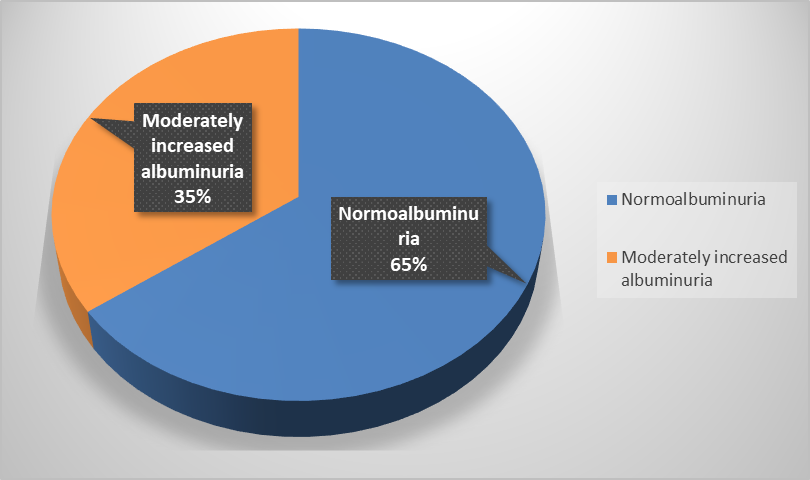
The overall prevalence of microalbuminuria was 35% (n=35) and the remaining 65% patients (n=65) were found to be negative for microalbuminuria.
Chart 2: Correlation of UACR with HbA1c.
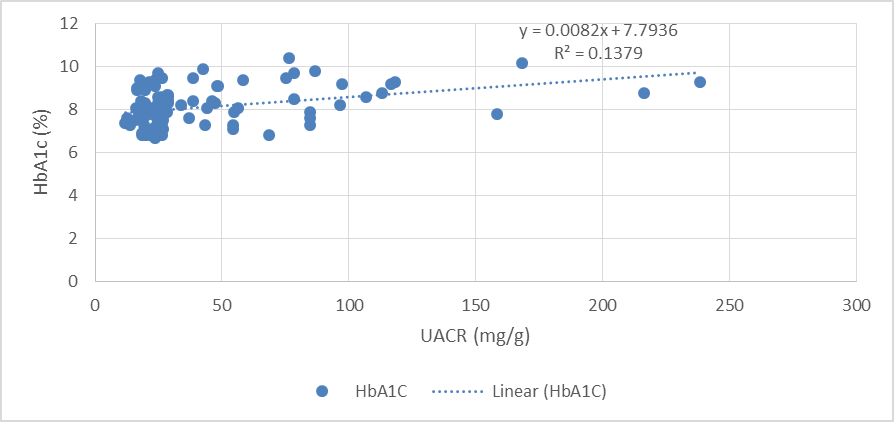
Mean HbA1c in patients with microalbuminuria was 8.59 ± 0.92 % and in patients with normoalbuminuria was 7.91 ± 0.77 %, showing that HbA1c was significantly higher in patients with microalbuminuria than those without albuminuria (P<0.001). HbA1c also had a positive linear correlation with UACR (Pearson’s Correlation Coefficient, r=+0.37, P <0.001).
Chart 3: Relation between microalbuminuria and mean CCIMT.
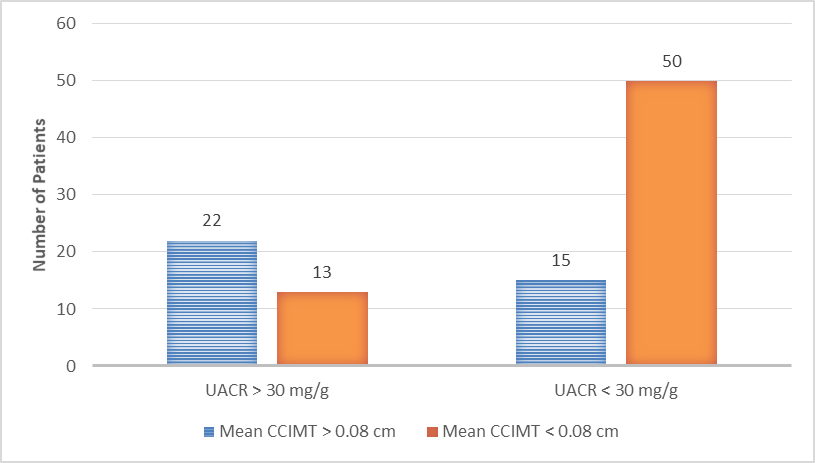
Mean CCIMT was increased in 37% (n=37) patients of T2DM. Among the 35 patients with microalbuminuria, 22 patients had increased mean CCIMT (62.86%). Among 65 patients without microalbuminuria, only 15 patients had increased mean CCIMT (23.08%). Those with microalbuminuria were more likely than normoalbuminurics to have increased mean CCIMT (P <0.001).
Chart 4: Correlation of UACR with Mean CCIMT
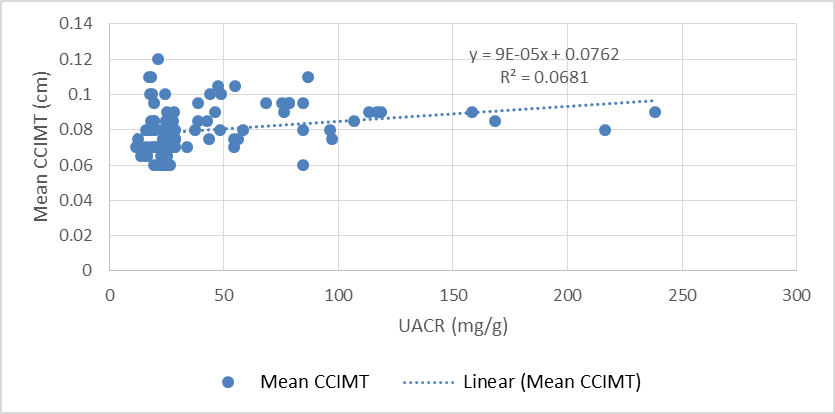
In patients without microalbuminuria, mean CCIMT (cm) was 0.08 ± 0.01 and in patients with albuminuria it was 0.09 ± 0.01 (P <0.0001). Microalbuminuria had statistically significant positive linear correlation with increased CCIMT (r =+0.26, P <0.001).
Table 2: Comparison of Mean ± Standard Deviation of Various variables in those with and without microalbuminuria.
|
|
UACR >30 mg/g |
UACR <30 mg/g |
P-value |
|
1. Age (years) |
51 ± 4.39 |
45.57 ± 4.92 |
<0.00001 |
|
2. BMI kg/m2) |
0.067092 |
||
|
3. Duration of Diabetes (years) |
6.66 ± 2.45 |
4.68 ± 1.95 |
|
|
4. HbA1c (%) |
8.59 ± 0.92 |
7.91 ± 0.77 |
<0.001 |
|
5. Mean CCIMT (cm) |
<0.0001 |
||
|
6. Triglyceride (mg/dl) |
155.86 ± 26.83 |
131.58 ± 22.62 |
<0.00001 |
|
7. Total cholesterol (mg/dl) |
182.28 ± 18.92 |
173.72 ± 14.08 |
<0.05 |
|
8. HDL-Cholesterol (mg/dl) |
46.97 ± 5.29 |
49.65 ± 5.79 |
<0.05 |
|
9. LDL-Cholesterol (mg/dl) |
98 ± 16.18 |
89.83 ± 12.73 |
<0.01 |
|
10. VLDL-Cholesterol (mg/dl) |
31.66 ± 5.6 |
26.88 ± 4.59 |
<0.0001 |
Upon comparison of mean values of various variables used in this study, it was seen that age, body mass index, duration of diabetes, HbA1c, mean common carotid intima-media thickness, triglyceride, total cholesterol, HDL-cholesterol, LDL-cholesterol and VLDL-cholesterol had statistically significant difference among those patients with and without microalbuminuria.
DISCUSSION:
Diabetes mellitus is a chronic, progressive disease leading to many micro- and macrovascular complications. The gap between the onset of the disease and clinical diagnosis of diabetes leads to the development of these chronic complications, which are the leading causes of premature mortality among diabetic patients. Microalbuminuria, an early stage of diabetic nephropathy, is proposed to be a marker of widespread endothelial dysfunction, which may result in left ventricular overload & hypertrophy as well as thickening of carotid arteries leading to ischemic stroke. [26, 27] Our study showed that the prevalence of microalbuminuria was 35% (n=35, 22 males and 13 females) in type 2 diabetes mellitus patients. The prevalence of albuminuria in patients with T2DM has been reported from 20% to 61%. [5-7] .
HbA1c was significantly higher in albuminurics than those without microalbuminuria (P<0.001). HbA1c also had a positive linear correlation with UACR (Pearson’s Correlation Coefficient, r=+0.37, P <0.001). In a study conducted by Huang X, Zhou Y. Xu B, et al, HbA1c significantly correlated with UACR after adjustment for confounders. (all p values <0.0001) HbA1c was independently associated with an increased risk of low-grade albuminuria. [28]
Increased CCIMT was present in 37 % patients (n=37) of T2DM. Among the 35 patients with microalbuminuria, 22 had increased CCIMT (62.86%) and 13 did not have increased CCIMT. Among 65 patients without microalbuminuria, only 15 patients had increased CCIMT (23.08%). Microalbuminuria had statistically significant positive linear correlation with increased CCIMT (r =+0.26, P <0.001).
Kota SK, Mahapatra GB et al, in their study found that microalbuminuria had a significant correlation (P < 0.0001) with CCIMT in diabetics.[29]
CONCLUSION:
Despite limitations of our study like a limited number of patients, the use of single cut-off value for measurement of variables such as CCIMT irrespective of sex, age, and ethnicity of the patients, the results are in accordance with many of the published studies, and hence, important conclusions can be drawn from it. There is presence of microalbuminuria in significant number of patients with T2DM. There was a statistically significant positive correlation between microalbuminuria CCIMT. These findings imply an underlying vascular relationship between microalbuminuria and CCIMT. Therefore, screening of all patients of type 2 diabetes mellitus for microalbuminuria may be a reasonable strategy to predict the presence of ongoing vascular damage and the future risk for macrovascular complications including ischemic stroke.
BIBLIOGRAPHY:
1. Kahn SE. The relative contributions of insulin resistance and beta-cell dysfunction to the pathophysiology of type 2 diabetes. Diabetologia. 2003; 46:3–19.
2. Mani MK. Prevention of chronic renal failure at community level. Kidney Int Suppl. 2003 Feb;(83): S86-9.
3. Management of diabetes in chronic renal failure, Indian J Nephrol 2005;15, Supplement 1: S23-31.
4. Viswanathan V. Diabetes Could Cost You Your Kidneys, Act Now! JAPI. 2003 November; 51:1043-4.
5. Ahmedani MY, Hydrie MZ, Iqbal A et al. Prevalence of microalbuminuria in type 2 diabetic patients in Karachi: Pakistan: A multi‑center study. J Pak Med Assoc 2005; 55:382‑6.
6. Varghese A, Deepa R, Rema M et al. Prevalence of microalbuminuria in type 2 diabetes mellitus at a diabetes centre in Southern India. Postgrad Med J 2001; 77:399‑402.
7. Ghosh S, Lyaruu I, Yeates K. Prevalence and factors associated with microalbuminuria in type 2 diabetic patients at a diabetes clinic in Northern Tanzania. Afr J Diabetes Med. 2012; 20:43‑6.
8. Stehouwer CD, Smulders YM. Microalbuminuria and risk for cardiovascular disease: Analysis of potential mechanisms. J Am Soc Nephrol. 2006 Aug;17(8):2106-11.
9. Márquez DF, Ruiz-Hurtado G, Segura J, Ruilope L. Microalbuminuria and cardiorenal risk: old and new evidence in different populations. F1000Res. 2019 Sep 19;8: F1000 Faculty Rev-1659.
10. American Diabetes Association. Diabetes Care 2002 Jan; 25(suppl 1): s85-s89. doi:10.2337/diacare.25. 2007.S85, assessed on 7-11-19.
11. https://kdigo.org/wp-content/uploads/2017/02/Gansevoort_how-to-measure-albuminuria.pdf.
12. Tang S., Sharma K., Comprehensive Clinical Nephrology, Elsevier Publications, 6th edition, Page 365.
13. Sarwar N, Gao P, Seshasai SRK, et al; Emerging Risk Factors Collaboration. Diabetes mellitus, fasting blood glucose concentration, and risk of vascular disease: a collaborative meta-analysis of 102 prospective studies [published correction appears in Lancet 2010;376:958]. Lancet 2010; 375:2215–2222.
14. Woodward M, Zhang X, Barzi F, et al, .; Asia Pacific Cohort Studies Collaboration. The effects of diabetes on the risks of major cardiovascular diseases and death in the Asia-Pacific region. Diabetes Care 2003; 26:360–366.
15. Haffner SM, Lehto S, Rönnemaa T, Pyörälä K, Laakso M. Mortality from coronary heart disease in subjects with type 2 diabetes and in nondiabetic subjects with and without prior myocardial infarction. N Engl J Med 1998; 339:229–234.
16. Gall MA, Borch-Johnsen K, Hougaard P et al: Albuminuria and poor glycemic control predict mortality in NIDDM. Diabetes 44:1303–1309, 1995.
17. Mykkanen L, Zaccaro D, O’Leary D et al: Microalbuminuria and carotid artery intima-media thickness in nondiabetic and NIDDM subjects: the Insulin Resistance Atherosclerosis Study (IRAS). Stroke 28:1710–1716, 1997.
18. O’Leary DH, Polak JF, Kronmal RA et al: Carotid artery intima-media thickness as a risk factor for myocardial infarction and stroke in older adults. N Engl J Med 340:14–22, 1999.
19. Wagenknecht LE, D’Agostino RB Jr, Haffner SM, Savage PJ, Rewers M. Impaired glucose tolerance, type 2 diabetes, and carotid wall thickness: The Insulin Resistance Atherosclerosis Study. Diabetes Care 1998; 21:1812–1818.
20. Temelkova-Kurktschiev TS, Koehler C, Leonhardt W, et al. Increased intimal-medial thickness in newly detected type 2 diabetes: risk factors. Diabetes Care 1999; 22:333–338.
21. Brohall G, Odén A, Fagerberg B. Carotid artery intima-media thickness in patients with type 2 diabetes mellitus and impaired glucose tolerance: a systematic review. Diabet Med 2006; 23:609–616.
22. Lorenz MW, Markus HS, Bots ML, Rosvall M, Sitzer M. Prediction of clinical cardiovascular events with carotid intima-media thickness: a systematic review and meta-analysis. Circulation 2007; 115:459–467.
23. Modified from American Diabetes Association. Standards of medical care in diabetes2010. Diabetes Care. 2010;29: s11-s61.
24. Francesco AB, Francesca M, Giovanni T, et al. Prognostic value of ultrasonographic measurement of carotid intima media thickness in dialysis patients. J Am Soc Nephrol. 2001; 12:2458–64.
25. Bluth EI, Johnson SI et al. Diagnostic Ultrasound, 5th Ed. USA: Elsevier; 2018, p. 919.
26. Parving HH: Renoprotection in diabetes: genetic and non-genetic risk factors and treatment. Diabetologia 41:745–759, 1998.
27. Lane JT. Microalbuminuria as a marker of cardiovascular and renal risk in type 2 Diabetes Mellitus: A temporal perspective. Am J Physiol-Renal Physiol. 2004 Mar;286(3):F442-50.
28. Huang X, Zhou Y, Xu B, et al. Glycated haemoglobin A1c is associated with low-grade albuminuria in Chinese adults. BMJ Open 2015;5:e007429.
29. Kota SK, Mahapatra GB, Kota SK, et al. Carotid intima media thickness in type 2 diabetes mellitus with ischemic stroke. Indian J Endocrinol Metab. 2013;17(4):716-722.