Prevalence of Palmaris Longus Agenesis: A Cadaveric Study from Western Indian Population
- Lakshmi Kiruba N. , Assistant Professor, Department of Anatomy, SMBT IMS & RC, Nashik, Maharashtra, India
- Sonali Satpute. , Tutor, Department of Anatomy, SMBT IMS & RC, Nashik, Maharashtra, India.
- Swapna Parate. , Professor & Head, Department of Anatomy, SMBT IMS & RC, Nashik, Maharashtra, India.
Article Information:
Abstract:
Background: The palmaris longus (PL) muscle, a phylogenetically regressive superficial flexor of the forearm, exhibits considerable anatomical variability and is widely used as a tendon graft in reconstructive surgeries of the upper limb, ptosis correction, and lip augmentation. Population specific prevalence data are important for surgical planning, particularly in underrepresented regional cohorts such as individuals from Western India. Objective: To determine the prevalence and any morphological variations of palmaris longus in an adult cadaveric sample from a West Indian population. Materials and Methods: A prospective cadaveric study was conducted in the Anatomy Dissection Hall of SMBT Institute of Medical Sciences & Research Centre, Dhamangaon, Maharashtra, India. The anterior forearm was dissected in 36 embalmed cadavers (72 upper limbs) following standard anatomical Dissection techniques mentioned in Cunningham’s Manual of dissection. Skin and deep fascia were reflected from the cubital fossa to the flexor retinaculum. The PL was identified medial to flexor carpi radialis, and its tendon was traced distally to the palmar aponeurosis. In suspected cases of absence, the palmar aponeurosis was carefully examined to confirm lack of the PL tendon. Variations in muscle belly and tendon were recorded. Results: Palmaris longus was absent in 4 of the 72 upper limbs (5.56% prevalence of agenesis). Bilateral absence was observed in 1 cadaver (2.78%), and unilateral absence in 2 cadavers (one right and one left, together accounting for 5.56% of limbs). No notable morphological variations in the belly or tendon were observed among the limbs where the muscle was present. Conclusion: This study reports a relatively low prevalence of palmaris longus agenesis (5.56%) in these West Indian cadavers, lower than the commonly reported global range of 15–20%. These findings have practical implications for tendon harvesting strategies in regional surgical practice and reinforce the importance of using preoperative clinical tests to confirm PL presence before considering it as a graft source.
Keywords:
Article :
INTRODUCTION:
Palmaris longus is a superficial muscle located in the flexor compartment of the forearm. It originates from the medial epicondyle of the humerus as part of the common flexor tendon, as well as from adjacent intermuscular septa and deep fascia. The muscle has a slender, fusiform belly that becomes tendinous in the mid forearm, passes anterior to the flexor retinaculum, and fans out to form the palmar aponeurosis in the palm. By inserting into the palmar aponeurosis, it acts as a weak flexor of the wrist and helps stabilize the skin and fascia of the hand against horizontal shearing forces. Anatomical variations of the palmaris longus are well documented in the literature.[1] Palmaris longus is considered a regressive muscle in the phylogeny of higher vertebrates and is frequently regarded as vestigial.[2]
However, its long tendon makes it widely used in reconstructive, plastic, and cosmetic surgeries, where it serves as one of the most readily available sources of tendon graft material. [3] Using patient’s own tendon is an added advantage as rejection of graft is reduced, the body accepts its own tendon rather than from a donor it does not introduce foreign material into the body.[4] The presence or absence of the palmaris longus muscle has not been shown to be associated with any significant reduction in grip or pinch strength.[5] This study aims to determine the presence or absence of the palmaris longus muscle and to examine any morphological variations in its muscle belly and tendon.
MATERIALS AND METHODS:
This study was carried out in the Anatomy dissection hall of SMBT Institute of Medical Sciences & Research Centre (SMBTIMSRC). Thirty six cadavers were used; total of 72 upper limbs was dissected to expose the flexor muscles of the anterior compartment of forearm. The skin of the forearm was reflected and the deep fascia was incised from the cubital fossa to the proximal margin of the flexor retinaculum, thereby exposing the underlying muscles.[6]
The superficial group of flexor muscles was identified and labelled. The palmaris longus muscle was identified by its attachment to the distal part of the medial supracondylar ridge and the medial epicondyle of the humerus, and by its position medial to the flexor carpi radialis. Tendon was traced distally as it passed superficial to the flexor retinaculum and inserted into the palmar aponeurosis. The presence or absence of the palmaris longus, as well as any morphological variations in the muscle belly and tendon, were recorded.
RESULTS:
Out of 36 cadavers examined, the palmaris longus muscle was absent in 3 cadavers. In one of these cadavers the muscle was bilaterally absent, whereas in the other two it was unilaterally absent (one on the right side and one on the left). To confirm the absence of the tendon, the palmar aspect of the hand was dissected and the palmar aponeurosis was examined in each of these cases. [Figure 1&2].
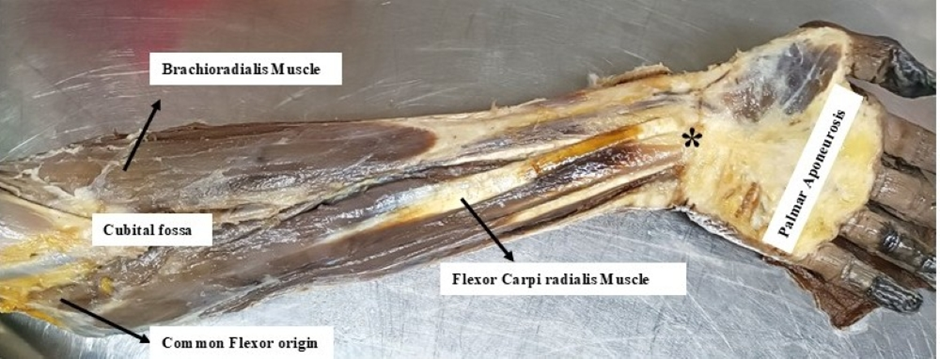
Fig:1. Left Anterior compartment of Forearm Showing *Absence of Palmaris Longus Muscle with Tendon.
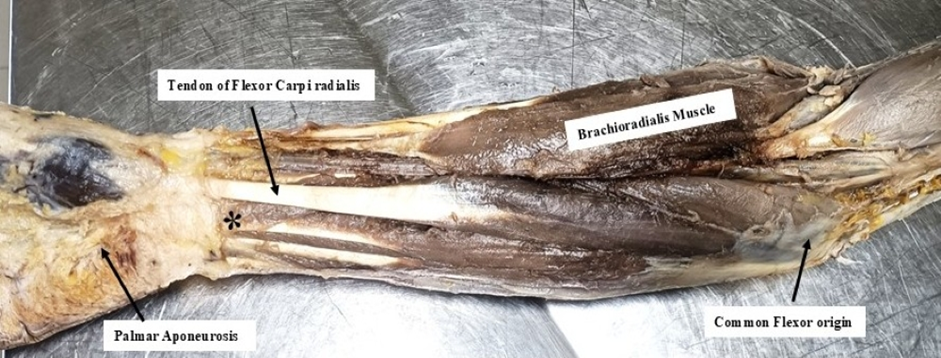
Fig:2. Right Anterior compartment of Forearm Showing *Absence of Palmaris Longus Muscle with Tendon.
Overall, out of 72 upper limbs, the palmaris longus tendon was absent in 4 limbs, giving a prevalence of agenesis of 5.56% per limb. Among the 36 cadavers, the prevalence of agenesis was 8.33% (3 out of 36 cadavers) in the present sample, with unilateral absence observed in two cadavers (5.56%) and bilateral absence in one cadaver (2.78%).
DISCUSSION:
Agenesis of the palmaris longus has often been linked to Mendelian or multifactorial inheritance, and its absence varies considerably across different racial and ethnic groups. [7] In many studies, absence rates have been reported around 16–25% in white Caucasians and as low as about 4% in Mongoloid populations, with an often quoted average of roughly 10% in the general population. [8]
A recent systematic review and meta analysis reported by Yammine K an overall palmaris longus agenesis (PLA) rate of 20.25%, significantly higher than the often quoted 15%, with marked variation by ethnicity (lowest in East and South East Africans and highest in Arab Middle Eastern populations). In contrast, our West Indian cadaveric series showed a PLA rate of only 5.56%, underscoring substantial regional differences in the prevalence of palmaris longus absence.[9] Pai MM et al. reported palmaris longus agenesis in 26%, Supporting the concept that absence of the muscle exhibits individual variation within racial groups and even among ethnic subgroups,[8]
this finding underscores that palmaris longus agenesis can differ not only between major racial groups but also among subpopulations within larger regions The relatively low prevalence in our dissection based study may also reflect the advantage of detailed anatomical dissection in giving a more accurate assessment of tendon presence or absence, as compared with clinical tests that rely solely on visual inspection or palpation, which are commonly used in larger population based surveys.[10] Palmaris longus transfer provides a reliable, low morbidity option for flexor pollicis longus reconstruction, supporting its continued use as a valuable tendon graft in our study population.[11] The median nerve is more susceptible to injury in the absence of the palmaris longus, making it important for surgeons in each region to be aware of the local incidence of agenesis before using this tendon for grafting or other reconstructive procedures.[12]
This cadaveric study reports a relatively low prevalence of palmaris longus agenesis (5.56% in 72 upper limbs), with unilateral absence in 2 cadavers and bilateral absence in 1 cadaver. The findings support the view that the absence of palmaris longus exhibits individual and regional variation, even within larger populations. Despite its phylogenetic degeneration and variable presence, palmaris longus remains a valuable tendon graft source in a wide range of reconstructive procedures, including forearm and upper limb surgery such as distal biceps and collateral ligament reconstruction of the elbow and metacarpophalangeal joints, as well as ptosis correction and lip augmentation. If the palmaris longus is not available for harvesting in an individual, the anatomically homologous plantaris muscle in the leg may be used as an alternative graft. [13,14]
CONCLUSION:
The findings support the view that the absence of palmaris longus shows individual and regional variation, yet it remains a safe and versatile tendon graft in reconstructive, maxillofacial, and selected ENT and head–neck procedures, underscoring the importance of preoperative assessment of its presence in the target population before surgical planning and graft selection. This further emphasizes the clinical relevance of understanding palmaris longus anatomy and agenesis in the local population.
Conflict of Interest
The authors declare no conflict of interest.
Acknowledgements
The authors would like to thank the Department of Anatomy and the staff of the dissection hall for their support during the study. We also acknowledge the voluntary body donors and their families for their invaluable contribution to medical education and research.
Declaration
The authors Declares the use of Perplexity Ai for assistance with grammar refinement and paraphrasing during manuscript preparation.
REFERENCES:
1. Standring S, editor. Gray's Anatomy: The Anatomical Basis of Clinical Practice. 42nd ed. Philadelphia: Elsevier; 2021.
2. Pai MM, Prabhu LV, Nayak SR, et al. The palmaris longus muscle: its anatomic variations and functional morphology. Rom J Morphol Embryol 2008; 49:215-7.
3. Yong MW, Yusof N, Rampal L, Arumugam M. Prevalence of absence of palmaris longus and its association with gender, hand dominance and absence of FDS tendon to little finger among Malay population. J Hand Surg Asian Pac Vol. 2017 Dec;22(4):484–9. doi: 10.1142/S021881041750054X. PMID: 29117832.
4. Kulkarni SV, John S. Autologous tendon grafts used in upper limb surgery. Open J Orthopedics. 2013;3(2):73–77. doi: 10.4236/ojo.2013.032014.
5. Sebastin SJ, Lim AY, Bee WH, Wong TC, Methil BV. Does the absence of the palmaris longus affect grip and pinch strength? J Hand Surg Br. 2005 Aug;30(4):406–8. doi: 10.1016/j.jhsb.2005.03.011. PMID: 15935531.
6. Koshi R, ed. Cunningham’s Manual of Practical Anatomy Volume 1: General Anatomy, Upper and Lower Limbs. 16th ed. Oxford: Oxford University Press; 2021
7. Thomas A, Alapatti VK. A case report of unilateral absence of palmaris longus. Int J Health Sci Res. 2019;9(7):285–8
8. Pai MM, Prabhu LV, Nayak SR, Madhyastha S, Vadgaonkar R, Krishnamurthy A, Kumar A. The palmaris longus muscle: its anatomic variations and functional morphology. Rom J Morphol Embryol. 2008;49(2):215–7
9. Yammine K. Clinical prevalence of palmaris longus agenesis: a systematic review and meta-analysis. Clin Anat. 2013 Sep;26(6):709-18. doi: 10.1002/ca.22289. Epub 2013 Jul 3. PMID: 23825029.
10. Soltani AM, Peric M, Francis CS, Nguyen TT, Chan LS, Ghiassi A, Stevanovic MV, Wong AK. The variation in the absence of the palmaris longus in a multiethnic population of the United States: an epidemiological study. Plast Surg Int. 2012;2012:282959. doi: 10.1155/2012/282959. PMID: 23213502; PMCID: PMC3503284.
11. Koh S, Horii E, Hattori T. Flexor pollicis longus reconstruction using the palmaris longus in anterior interosseous nerve syndrome. Hand Surg. 2014;19(2):189–92. doi: 10.1142/S021881041450018X. PMID: 24875501
12. Kannan R, Thenmozhi MS. The prevalence of absence of palmaris longus. Int J Curr Res. 2017;9(8):56432–4.
13. Jakubietz MG, Jakubietz DF, Gruenert JG, Zahn R, Meffert RH, Jakubietz RG. Adequacy of palmaris longus and plantaris tendons for tendon grafting. J Hand Surg Am. 2011;36(4):695–8. doi: 10.1016/j.jhsa.2011.01.007. PMID: 21463731
14. Vlaic J, Josipovic M, Nizic D, Simunovic M, Schauperl Z, Jelic M. Plantaris tendon autograft can restore patellar stability in adolescent medial patellofemoral ligament reconstruction: a technical note. Arch Bone Jt Surg. 2024;12(4):283–8. doi: 10.22038/ABJS.2024.75154.3476. PMID: 38716173; PMCID: PMC11070679.