A Randomized Placebo-Controlled Study to Evaluate the Efficacy of Nebulized Dexmedetomidine Premedication for Attenuation of Hemodynamic Stress Response During Laparoscopic Cholecystectomy Under General Anaesthesia
- A Monika. , Senior Resident, Department of Anaesthesiology, Vinayaga Mission Medical College, Karaikkal, Tamilnadu, India.
- N Induja. , Senior Resident, Department of Anaesthesiology, Vinayaga Mission Medical College, Karaikkal, Tamilnadu, India.
- A C Malarvizhi , Professor and Head, Department of Anaesthesiology, Madha Medical College and Research Institute, Kundrathur, Chennai, Tamilnadu, India.
Article Information:
Abstract:
Background: Intravenous dexmedetomidine is widely used to attenuate hemodynamic stress during laparoscopic cholecystectomy; however, its clinical utility is limited by dose-dependent bradycardia, hypotension, and delayed emergence. This study evaluated whether preoperative nebulization with dexmedetomidine provides effective and sustained hemodynamic stabilization throughout laparoscopic cholecystectomy without the adverse effects associated with intravenous administration. Methods: This prospective, randomized, double-blind, placebo-controlled trial enrolled 60 ASA physical status I–II patients aged 18–60 years undergoing elective laparoscopic cholecystectomy under general anaesthesia. Patients were randomized to receive nebulization with dexmedetomidine 1 μg/kg in 5 ml normal saline (Group D, n=30) or 5 ml normal saline alone (Group C, n=30), administered 15 min before induction. Heart rate, mean arterial pressure, inspired sevoflurane volume percentage, Ramsay Sedation Scale score, and Modified Aldrete Score were recorded at defined perioperative time intervals and compared using the unpaired t-test and chi-square test (P < 0.05 considered significant). Results: Heart rate and mean arterial pressure were significantly lower in Group D compared to Group C following intubation, pneumoperitoneum creation, intraoperative surgical stimulation, and extubation (P < 0.05 at all intervals). Overall mean inspired sevoflurane was significantly lower in Group D (1.24 ± 0.29%) versus Group C (2.69 ± 0.28%), representing a 53% reduction (P = 0.001). Ramsay Sedation Scale scores, extubation time, and recovery time were comparable between groups (P > 0.05). No adverse effects were observed in either group. Conclusions: Preoperative nebulization with dexmedetomidine (1 μg/kg) effectively attenuates the hemodynamic stress response during laparoscopic cholecystectomy and significantly reduces intraoperative sevoflurane requirement without delaying recovery or producing adverse effects. It represents a safe, non-invasive, and economical alternative to intravenous dexmedetomidine for perioperative hemodynamic stabilization.
Keywords:
Article :
INTRODUCTION:
Laparoscopic cholecystectomy is now universally accepted as the standard surgical approach for symptomatic cholelithiasis, offering patients reduced postoperative pain, accelerated convalescence, and shorter hospitalization compared to conventional open surgery.1 However, beneath its minimally invasive exterior lies a physiologically demanding procedure. Carbon dioxide (CO2) insufflation to generate the pneumoperitoneum elevates intra-abdominal pressure, promotes systemic CO2 absorption, and — acting in concert with the hemodynamic stimuli of laryngoscopy, tracheal intubation, surgical manipulation, and extubation — produces a sustained composite stress response characterized by acute elevations in heart rate (HR), systolic blood pressure (SBP), diastolic blood pressure (DBP), and mean arterial pressure (MAP), alongside increased vascular resistance and diminished cardiac output.1 These perturbations carry significant clinical implications, particularly in patients with pre-existing cardiovascular disease, in whom they may precipitate myocardial ischemia, arrhythmia, and serious perioperative morbidity.
Various pharmacological strategies have been investigated to attenuate this response, including opioids, beta-adrenergic antagonists, calcium channel blockers, and volatile anesthetic agents — each with partial efficacy and its own adverse effect burden.2 Among these, alpha-2 (α-2) adrenergic agonists have assumed increasing prominence by virtue of their ability to simultaneously suppress central sympathetic outflow, provide sedation and analgesia, and reduce anesthetic requirements without clinically relevant respiratory depression.2
Dexmedetomidine, the most selective clinically available α-2 agonist with a receptor selectivity ratio of 1620:1, mediates its principal effects through α-2A receptor subtypes in the locus coeruleus, inhibiting norepinephrine release from sympathetic nerve terminals and producing dose-dependent reductions in HR and arterial pressure alongside sedative and opioid-sparing analgesic properties.3 Intravenous (IV) dexmedetomidine has been extensively studied as an anesthetic adjunct during laparoscopic cholecystectomy, with multiple randomized controlled trials confirming its capacity to attenuate hemodynamic fluctuations while reducing volatile anesthetic consumption.4,5 Notwithstanding these benefits, its IV administration carries a dose-dependent risk of bradycardia and hypotension — reported in up to 14% of patients — along with prolonged sedation and delayed emergence.4,5
The transmucosal pharmacokinetic properties of dexmedetomidine provide a compelling rationale for nebulized delivery. Bioavailability data confirm systemic availability of 82% via the buccal mucosa and 62% via the intranasal route following extravascular dosing.6 Nebulization generates a more gradual and attenuated plasma concentration-time profile relative to intravenous bolus administration, expected to preserve therapeutic efficacy while substantially reducing peak concentration-dependent adverse effects. Recent prospective randomized trials have confirmed that nebulized dexmedetomidine (1 μg/kg) significantly blunts the intubation pressor response and reduces intraoperative anesthetic consumption in adult surgical patients without hemodynamic instability or delayed recovery.7,8
Despite this growing evidence base, the role of nebulized dexmedetomidine in attenuating the complete and sustained hemodynamic stress response of laparoscopic cholecystectomy — which extends well beyond intubation to encompass the prolonged insult of CO2 pneumoperitoneum and continuous intraabdominal dissection — has not been systematically investigated. We therefore conducted this prospective, randomized, double-blind, placebo-controlled trial with the primary objective of determining whether preoperative nebulization with dexmedetomidine (1 μg/kg), administered 15 min before induction, effectively attenuates the hemodynamic stress response at all critical stimulation points during laparoscopic cholecystectomy. The secondary objectives were its effects on intraoperative sevoflurane requirement, perioperative sedation, recovery profile, and adverse effects.
MATERIALS AND METHODS:
This prospective, randomized, double-blind, placebo-controlled clinical trial was conducted in the Department of Anaesthesiology at Madha Medical College and Research Institute, Chennai, India, from September 2023 to September 2024, following Institutional Ethics Committee approval. Patients aged 18–60 years of either sex with ASA physical status I or II, scheduled for elective laparoscopic cholecystectomy under general anaesthesia, were eligible. Exclusion criteria were: patient refusal; known hypersensitivity to study drugs; predicted difficult airway; body mass index exceeding 30 kg/m2; pregnancy; ASA status III or higher; uncontrolled systemic hypertension; and significant pre-existing cardiopulmonary, hepatic, renal, endocrine, neurological, or psychiatric disease.
Sixty eligible patients were randomized 1:1 into Group C (placebo: nebulized normal saline 5 ml, n=30) and Group D (nebulized dexmedetomidine 1 μg/kg in 5 ml normal saline, n=30) using a computer-generated random number table with allocation concealment by sequentially numbered, opaque, sealed envelopes. Double blinding was maintained by having a designated anaesthesiologist — not involved in subsequent study procedures — prepare identical-appearing syringes. The study drug was dexmedetomidine hydrochloride 100 μg/ml (Inj Dexem, 1 ml; NEON Laboratories). Nebulization was delivered in the sitting position via a standard nebulizer mask using wall-mounted oxygen at 8 L/min (50 psi) for 10 min, 15 min before induction.
In the operating theatre, multiparameter monitoring was established including non-invasive blood pressure, SpO2, ECG, end-tidal CO2, anesthetic gas monitoring, and BIS. Standard IV premedication was administered to all patients: glycopyrrolate 0.2 mg, midazolam 0.02 mg/kg, fentanyl 2 μg/kg, and ondansetron 4 mg. Anaesthesia was induced with IV propofol (2 mg/kg) and IV succinylcholine (1.0–1.5 mg/kg) after 3 min of pre-oxygenation, followed by tracheal intubation. Anaesthesia was maintained with IV vecuronium, sevoflurane in N2O:O2 (50:50), targeting end-tidal CO2 30–40 mmHg. Sevoflurane was titrated to maintain BIS 40–60 and MAP within 20% of baseline. Pneumoperitoneum was created with CO2 at 12–14 mmHg. Sevoflurane was discontinued at scope removal. Reversal was achieved with neostigmine (0.04–0.08 mg/kg) and glycopyrrolate (0.01 mg/kg).
Hemodynamic parameters and inspired sevoflurane volume% were recorded at 17 perioperative time points from baseline through 10 min post-extubation. Ramsay Sedation Scale (RSS)16 was recorded before and after nebulization and post-extubation every 2 min until RSS ≤ 2. Extubation time was defined as the interval from sevoflurane cessation to extubation; recovery time as the interval from extubation to Modified Aldrete Score ≥ 9. Hypotension (MAP fall > 20% of baseline) was treated with IV mephentermine 6 mg and bradycardia (HR fall > 20% of baseline) with IV atropine 0.6 mg. Statistical analysis was performed using SPSS version 20.0; continuous variables were compared using the independent samples t-test and categorical variables with the chi-square test (P < 0.05 considered significant).
RESULTS:
Of 68 patients screened, 8 were excluded: 2 had predicted difficult airways, 2 had baseline MAP below 60 mmHg, 2 had resting HR below 60 beats/min, and 2 declined consent. The remaining 60 patients were randomized (n=30 per group) and all completed the study without dropouts or protocol deviations (Figure 1).
Both groups were well matched for all demographic and operative variables (P > 0.05 for all; Table 1).
Table 1: Comparison of demographic profile, duration of surgery, and duration of anaesthesia between the two groups
|
Parameter |
Group C (n=30) |
Group D (n=30) |
P value |
|
Age (years) |
44.00 ± 12.90 |
45.97 ± 9.23 |
0.539 |
|
Weight (kg) |
66.17 ± 7.12 |
62.00 ± 7.44 |
0.171 |
|
Height (cm) |
157.43 ± 2.91 |
159.20 ± 3.70 |
0.157 |
|
Gender (Male/Female) |
12/18 |
13/17 |
0.808 |
|
Duration of surgery (min) |
51.36 ± 18.22 |
56.20 ± 9.58 |
0.070 |
|
Duration of anaesthesia (min) |
70.70 ± 16.26 |
72.60 ± 11.58 |
0.588 |
Data presented as Mean ± SD or number. NS = not significant (P > 0.05).
Baseline hemodynamic parameters were statistically comparable between groups at all pre-stimulation time points (P > 0.05). Immediately following tracheal intubation, mean HR and MAP were significantly lower in Group D compared to Group C (P < 0.05), and this inter-group difference was sustained at every subsequent time point through 10 min after extubation — encompassing intubation, pneumoperitoneum, all intraoperative intervals, and extubation (Table 2, Figure 2). On intra-group analysis, hemodynamic parameters in Group D showed no statistically significant deviation from baseline at any time point (P > 0.05), while Group C exhibited a significant and sustained rise in mean SBP and MAP from intubation through extubation (P < 0.05). The maximum percentage rise from baseline for all four hemodynamic variables — SBP (10.6% vs 3.7%), DBP (3.1% vs 1.6%), MAP (13.1% vs 6.0%), and HR (24.2% vs 13.5%) — occurred at pneumoperitoneum creation and was significantly greater in Group C (P < 0.05 for all).
Table 2: Comparison of mean heart rate (beats/min) and mean arterial pressure (mmHg) between the two groups across all perioperative time intervals
|
Time Interval |
Group C |
Group D |
P |
Group C |
Group D |
P |
|
|
HR (beats/min) |
|
|
MAP (mmHg) |
|
|
|
Baseline |
89.93±10.26 |
80.43±8.52 |
0.338 |
97.53±9.36 |
96.23±8.35 |
0.229 |
|
After nebulization |
89.73±8.64 |
80.93±13.96 |
0.404 |
95.53±11.68 |
96.83±9.34 |
0.857 |
|
Pre-premedication (OT) |
90.90±6.96 |
89.17±13.30 |
0.267 |
97.16±7.10 |
96.83±8.34 |
0.893 |
|
After induction |
90.86±7.18 |
87.03±15.58 |
0.956 |
98.40±6.13 |
96.83±7.72 |
0.871 |
|
Post intubation* |
107.96±9.74 |
90.45±16.44 |
<0.001 |
100.50±11.38 |
98.23±4.90 |
0.001 |
|
3 min intubation* |
107.16±9.98 |
90.43±14.64 |
<0.001 |
103.50±11.23 |
98.23±4.75 |
0.034 |
|
5 min intubation* |
103.93±6.62 |
90.43±14.90 |
<0.001 |
103.53±12.98 |
98.16±4.38 |
0.033 |
|
Skin incision* |
108.97±6.63 |
90.83±17.37 |
<0.001 |
101.76±6.78 |
98.16±5.77 |
0.005 |
|
Post insufflation* |
111.73±8.15 |
100.43±17.37 |
<0.001 |
110.76±8.02 |
102.83±13.98 |
0.001 |
|
15 min insufflation* |
109.07±9.22 |
97.63±16.63 |
<0.001 |
105.76±10.23 |
102.83±14.50 |
0.042 |
|
30 min insufflation* |
103.93±4.00 |
95.63±14.54 |
<0.001 |
106.56±14.95 |
96.90±14.60 |
0.011 |
|
45 min insufflation* |
108.23±11.25 |
88.33±12.87 |
0.029 |
107.46±4.30 |
99.23±8.86 |
0.009 |
|
Exsufflation* |
100.13±8.45 |
90.86±14.50 |
<0.001 |
108.50±11.17 |
99.53±4.92 |
0.017 |
|
Post reversal* |
109.47±7.51 |
88.50±13.82 |
<0.001 |
117.00±8.62 |
99.73±6.33 |
<0.001 |
|
Post extubation* |
108.06±7.32 |
88.50±12.01 |
<0.001 |
118.06±19.96 |
100.73±15.43 |
0.042 |
|
5 min extubation* |
108.33±4.69 |
81.73±11.03 |
<0.001 |
106.35±14.60 |
96.63±10.85 |
0.012 |
|
10 min extubation* |
63.87±7.12 |
87.05±9.92 |
0.029 |
95.10±7.34 |
88.31±7.83 |
0.029 |
Data presented as Mean ± SD. * P < 0.05: significant inter-group difference. HR = Heart Rate; MAP = Mean Arterial Pressure; OT = Operating Theater.
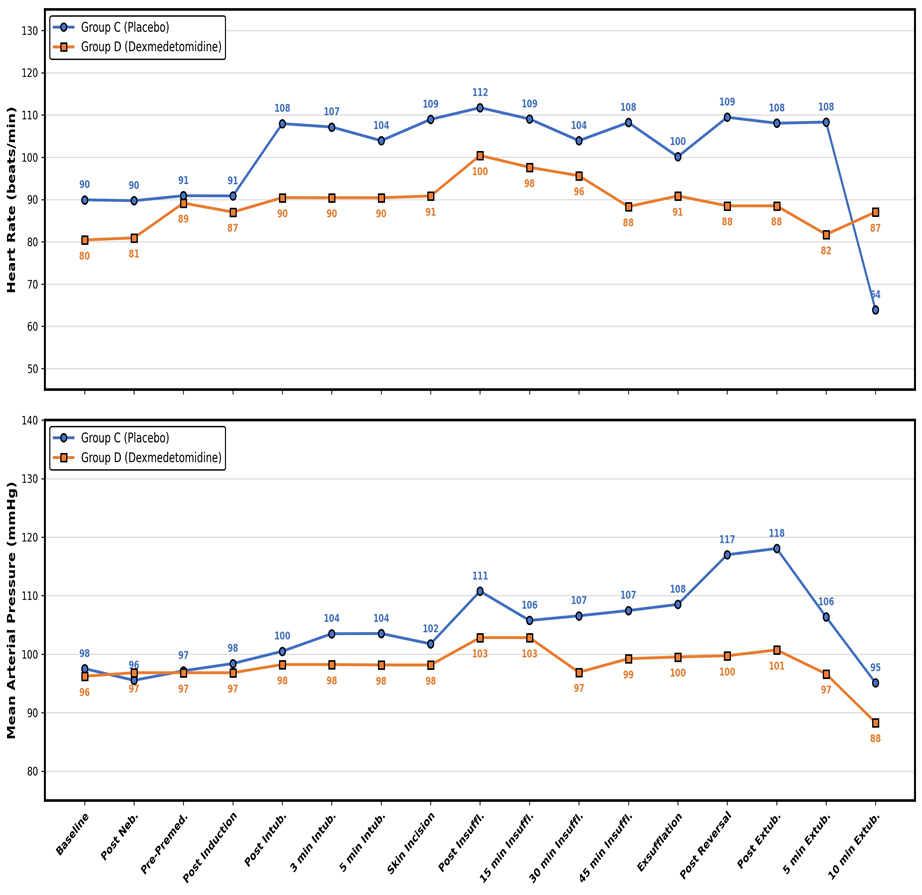
Figure 2: (A) Mean heart rate (beats/min) and (B) mean arterial pressure (mmHg) across all perioperative time intervals in Group C (Placebo) and Group D (Dexmedetomidine).
Mean inspired sevoflurane volume percentage was significantly lower in Group D than in Group C at every intraoperative time interval (P = 0.00 at each point). The overall mean intraoperative sevoflurane concentration was significantly reduced in Group D compared to Group C, representing a 53% reduction (P = 0.001; Figure 3, Table 3).
Table 3: Comparison of intraoperative sevoflurane requirement and postoperative recovery profile between the two groups
|
Parameter |
Group C (n=30) |
Group D (n=30) |
P value |
|
Overall mean inspired sevoflurane (vol%) |
2.69 ± 0.28 |
1.24 ± 0.29 |
0.001 |
|
Reduction in sevoflurane requirement |
— |
53% |
— |
|
Extubation time (min) |
9.43 ± 1.07 |
8.96 ± 1.27 |
0.065 |
|
Recovery time to Modified Aldrete ≥ 9 (min) |
9.86 ± 1.04 |
9.53 ± 1.00 |
0.106 |
Data presented as Mean ± SD. Extubation time = sevoflurane cessation to tracheal extubation. Recovery time = extubation to Modified Aldrete Score ≥ 9. P < 0.05 considered statistically significant.
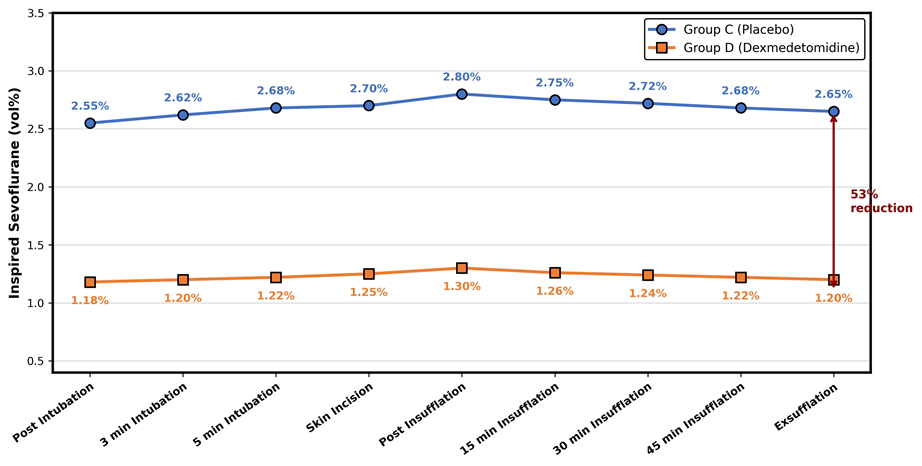
Figure 3: Mean inspired volume percentage of sevoflurane across all intraoperative time intervals in Group C (Placebo) and Group D (Dexmedetomidine), with 53% reduction annotation.
Extubation time was comparable between Group C (9.43 ± 1.07 min) and Group D (8.96 ± 1.27 min) (P = 0.065), as was recovery time to Modified Aldrete Score ≥ 9 — Group C (9.86 ± 1.04 min) versus Group D (9.53 ± 1.00 min) (P = 0.106). RSS score distribution was comparable between groups after nebulization and after extubation through 10 min post-extubation (P > 0.05 at all time points; Figure 4). No adverse events — including hypotension, bradycardia, respiratory depression, nausea, or vomiting — were recorded in either group throughout the study.
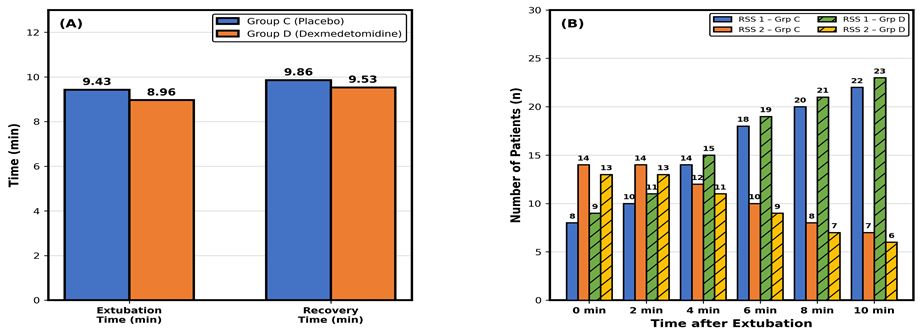
Figure 4: (A) Extubation time and recovery time (min) in Group C and Group D. (B) Ramsay Sedation Scale (RSS) score distribution after extubation up to 10 min in both groups
DISCUSSION:
The present study demonstrates that preoperative nebulization with dexmedetomidine (1 μg/kg) effectively attenuated the hemodynamic stress response throughout laparoscopic cholecystectomy, maintaining significantly lower HR and MAP than placebo across all critical perioperative stimulation events — from intubation through extubation — while producing a clinically substantial reduction in intraoperative sevoflurane requirement, without any compromise in recovery profile or occurrence of adverse effects. These findings establish that the hemodynamic benefits of dexmedetomidine can be reproduced through the nebulized route without the cardiovascular and sedative risks inherent to its intravenous administration.
The mechanism underlying the hemodynamic stabilization observed in Group D is well-characterized. By binding to α-2A receptor subtypes in the locus coeruleus, dexmedetomidine suppresses central sympathetic outflow and inhibits norepinephrine release from peripheral sympathetic nerve terminals, thereby attenuating the catecholamine surges that drive the pressor responses to intubation, pneumoperitoneum, and extubation.14 The most pronounced hemodynamic challenge predictably occurred at pneumoperitoneum creation — consistent with established evidence that CO2 insufflation is the dominant driver of intraoperative cardiovascular instability during laparoscopic surgery.1 The substantially attenuated rise in HR and MAP in Group D at this critical time point confirms sustained sympatholytic protection across the entire operative course, not merely at intubation.
These hemodynamic findings are broadly concordant with earlier trials of nebulized dexmedetomidine in adult surgical patients. Kumar et al.8 and Misra et al.7 both demonstrated significant attenuation of HR and MAP responses to laryngoscopy and intubation with nebulized dexmedetomidine (1 μg/kg), with additional reductions in intraoperative anesthetic and opioid consumption. In a recent systematic review and meta-analysis by Gupta et al.,17 which pooled data from all available randomized controlled trials on nebulized dexmedetomidine, nebulization was confirmed to significantly attenuate the hemodynamic pressor response to endotracheal intubation across all included studies without increasing the incidence of bradycardia or hypotension — lending high-level evidence support to the safety and efficacy profile observed in our study.
The 53% reduction in overall mean inspired sevoflurane concentration in Group D is a particularly noteworthy finding, mechanistically attributable to α-2A receptor-mediated suppression of locus coeruleus tonic firing, which reduces cortical arousal and lowers minimum alveolar concentration requirements for volatile agents.14 Studies employing IV dexmedetomidine in laparoscopic cholecystectomy have consistently reported analogous reductions in volatile anesthetic consumption,5,11 and the magnitude of sevoflurane reduction in our study is comparable to those IV protocols — suggesting that the nebulized single dose of 1 μg/kg achieves pharmacologically active plasma concentrations for clinically meaningful anesthetic-sparing effects despite its lower absolute bioavailability.6
The adverse effect profile sharply differentiates the nebulized route from reported intravenous protocols. Neither bradycardia nor hypotension was observed in Group D at any time point, in notable contrast to the IV literature where these events have been documented in 10–14% of patients.4,10 Panchgar et al.10 and Manne et al.12 specifically reported significant incidences of bradycardia, hypotension, and prolonged postoperative sedation with IV dexmedetomidine infusion requiring vasopressor and anticholinergic rescue. The absence of any such events in the present study reflects the attenuated plasma concentration profile of the nebulized route, previously identified by Gu et al.13 as the key pharmacokinetic differentiator between the two routes.
Two recent studies provide particularly compelling supportive evidence. Shankar et al.18 conducted a three-arm prospective double-blind trial comparing nebulized dexmedetomidine, IV dexmedetomidine, and IV fentanyl in laparoscopic surgeries and demonstrated that nebulized dexmedetomidine achieved hemodynamic stability and opioid-sparing effects comparable to IV dexmedetomidine, with significantly lower incidence of bradycardia and hypotension. Singla et al.19 reported in a 2024 randomized double-blind comparative study that nebulized and IV dexmedetomidine produced comparable hemodynamic attenuation with a markedly superior safety profile for the nebulized group. These findings, together with our data, converge on the conclusion that nebulized dexmedetomidine at 1 μg/kg occupies a pharmacokinetically favorable therapeutic window — achieving sufficient sympatholysis for clinical efficacy while remaining below the threshold for dose-dependent complications.
Sedation scores were equivalent between groups preoperatively and postoperatively, consistent with findings from Kumar et al.,8 Misra et al.,7 and Thomas et al.,9 all of whom reported no significant inter-group differences in sedation depth with nebulized dexmedetomidine versus placebo. The comparable extubation and recovery profiles further reinforce this conclusion, contrasting with the delayed emergence consistently reported with IV bolus-infusion protocols.12 The present study has several limitations: invasive arterial blood pressure monitoring was not employed; plasma dexmedetomidine concentrations were not measured; sevoflurane was quantified as inspired volume percentage rather than total consumption; and the exclusion of ASA III patients and those with BMI > 30 kg/m2 limits generalizability to higher-risk populations.
CONCLUSION:
Preoperative nebulization with dexmedetomidine, administered before induction of general anaesthesia, provides effective and sustained attenuation of the hemodynamic stress response throughout laparoscopic cholecystectomy — encompassing tracheal intubation, pneumoperitoneum, intraoperative surgical dissection, and extubation. It significantly reduces intraoperative volatile anesthetic requirement without prolonging recovery or producing adverse hemodynamic or sedative effects, demonstrating a clear safety advantage over intravenous administration. Nebulized dexmedetomidine represents a safe, non-invasive, reproducible, and economically accessible premedication strategy for perioperative hemodynamic stabilization in laparoscopic cholecystectomy under general anaesthesia, and its incorporation into routine clinical practice is strongly supported by the accumulating evidence base.
List of Abbreviations
ASA — American Society of Anesthesiologists; BIS — Bispectral Index; CO2 — Carbon Dioxide; DBP — Diastolic Blood Pressure; HR — Heart Rate; IV — Intravenous; MAP — Mean Arterial Pressure; NIBP — Non-Invasive Blood Pressure; OT — Operating Theater; PACU — Post-Anaesthesia Care Unit; RSS — Ramsay Sedation Scale; SBP — Systolic Blood Pressure; SpO2 — Peripheral Oxygen Saturation.
Conflicts of Interest: None declared.
Authors' Contributions: Dr. Monika: Study concept and design, acquisition of data, analysis and interpretation, drafting of the manuscript. Dr. Malarvizhi AC: Critical revision of the manuscript for important intellectual content, statistical analysis, study supervision.
Funding: No external funding was received for this study.
REFERENCES:
1. Atkinson TM, Giraud GD, Togioka BM, Jones DB, Cigarroa JE. Cardiovascular and ventilatory consequences of laparoscopic surgery. Circulation. 2017;135(7):700–10.
2. Khan FA, Ullah H. Pharmacological agents for preventing morbidity associated with the haemodynamic response to tracheal intubation. Cochrane Database Syst Rev. 2013;(7):CD004087.
3. Weerink MAS, Struys MMRF, Hannivoort LN, Barends CRM, Absalom AR, Colin P. Clinical pharmacokinetics and pharmacodynamics of dexmedetomidine. Clin Pharmacokinet. 2017;56(8):893–913.
4. Vora KS, Baranda U, Shah VR, Modi M, Parikh GP, Butala BP. The effects of dexmedetomidine on attenuation of hemodynamic changes and their effects as adjuvant in anesthesia during laparoscopic surgeries. Saudi J Anaesth. 2015;9(4):386–92.
5. Sharma P, Gombar S, Ahuja V, Jain A, Dalal U. Sevoflurane sparing effect of dexmedetomidine in patients undergoing laparoscopic cholecystectomy: a randomized controlled trial. J Anaesthesiol Clin Pharmacol. 2017;33(4):496–502.
6. Anttila M, Penttila J, Helminen A, Vuorilehto L, Scheinin H. Bioavailability of dexmedetomidine after extravascular doses in healthy subjects. Br J Clin Pharmacol. 2003;56(6):691–3.
7. Misra S, Behera BK, Mitra JK, Sahoo AK, Jena SS, Srinivasan A. Effect of preoperative dexmedetomidine nebulisation on the hemodynamic response to laryngoscopy and intubation: a randomized control trial. Korean J Anesthesiol. 2021;74(2):150–7.
8. Kumar NR, Jonnavithula N, Padhy S, Sanapala V, Vasram Naik V. Evaluation of nebulised dexmedetomidine in blunting haemodynamic response to intubation: a prospective randomised study. Indian J Anaesth. 2022;64(10):874–9.
9. Thomas D, Chacko L, Raphael PO. Dexmedetomidine nebulisation attenuates postoperative sore throat in patients undergoing thyroidectomy: a randomised, double-blind, comparative study with nebulised ketamine. Indian J Anaesth. 2020;64(10):863–8.
10. Panchgar V, Shetti AN, Sunitha HB, Dhulkhed VK, Nadkarni AV. The effectiveness of intravenous dexmedetomidine on perioperative hemodynamics, analgesic requirement, and side effects profile in patients undergoing laparoscopic surgery under general anesthesia. Anesth Essays Res. 2017;11(1):72–7.
11. Khare A, Sharma SP, Deganwa ML, Sharma M, Gill N. Effects of dexmedetomidine on intraoperative hemodynamics and propofol requirement in patients undergoing laparoscopic cholecystectomy. Anesth Essays Res. 2017;11(4):1040–5.
12. Manne GR, Upadhyay MR, Swadia V. Effects of low dose dexmedetomidine infusion on haemodynamic stress response, sedation and post-operative analgesia requirement in patients undergoing laparoscopic cholecystectomy. Indian J Anaesth. 2014;58(6):726–31.
13. Gu W, Xu M, Lu H, Huang Q, Wu J. Nebulized dexmedetomidine-lidocaine inhalation as a premedication for flexible bronchoscopy: a randomized trial. J Thorac Dis. 2019;11(11):4663–70.
14. Grewal A. Dexmedetomidine: new avenues. J Anaesthesiol Clin Pharmacol. 2011;27(3):297–302.
15. Zanaty OM, El Metainy SA. A comparative evaluation of nebulized dexmedetomidine, nebulized ketamine, and their combination as premedication for outpatient pediatric dental surgery. Anesth Analg. 2015;121(1):167–71.
16. Riessen R, Pech R, Trankle P, Blumenstock G, Haap M. Comparison of the Ramsay score and the Richmond agitation sedation score for the measurement of sedation depth. Crit Care. 2012;16 Suppl 1:326.
17. Gupta M, Rohilla R, Gupta P, Tamilchelvan H, Joshi U, Kanwat J. Nebulized dexmedetomidine for attenuating hemodynamic response to laryngoscopy and endotracheal intubation in adult patients undergoing surgeries under general anaesthesia: a systematic review and meta-analysis of randomized controlled trials. BMC Anesthesiol. 2023;23(1):406.
18. Shankar K, Rangalakshmi S, Kailash P, Priyanka D. Comparison of hemodynamics and opioid sparing effect of dexmedetomidine nebulization and intravenous dexmedetomidine in laparoscopic surgeries under general anesthesia. Asian J Anesthesiol. 2022;60(1):33–40.
19. Singla A, Saraswat RK, Bharadwaj A, Singh S. Nebulized versus intravenously administered dexmedetomidine for obtunding hemodynamic responses to laryngoscopy and tracheal intubation: a randomized double-blind comparative study. Cureus. 2024;16(2):e54768.