A COMPARATIVE STUDY BETWEEN SETON TREATMENT USING KSHARASUTRA AND CONVENTIONAL SURGERY IN FISTULA IN AΝΟ
- Sourav Maji , Assistant Professor, MBBS, MS (General Surgery), Department of General Surgery, Rampurhat Government Medical College, Rampurhat, Birbhum, West Bengal.
- Prasenjit Mukhopadhyay , Associate Professor, MBBS, MS (General Surgery), Department of General Surgery, Medical College, College Street, Kolkata, West Bengal.
- Dheeraj Kumar Anchlia. , Assistant Professor, MBBS, MS (General Surgery), Department of General Surgery, Rampurhat Government Medical College, Rampurhat, Birbhum, West Bengal.
Article Information:
Abstract:
Introduction: Fistula-in-ano is defined as an abnormal epithelialized tract connecting the anal canal to the perianal skin. It is a common anorectal disorder affecting adults worldwide, with an estimated prevalence of 1.2–2.8 per 10,000 population. Aims and objectives: The aim of the present study is to compare the effectiveness of Seton treatment using Ksharasutra with conventional surgical management in patients with fistula in ano. The study focuses on evaluating clinical outcomes such as healing time, postoperative pain, complications, duration of hospital stay, and recurrence rate in order to determine the safety and overall effectiveness of both treatment modalities. Materials & Methods: This study was conducted as a hospital-based prospective comparative study in the Department of General Surgery, Rampurhat Government Medical College and Hospital. The study was carried out from January 2020 to June 2021, including a total of 96 patients. Result: Among the 96 patients, the majority had low anal fistula (64.6%), while 35.4% had high anal fistula. The distribution of fistula types was similar in both the Ksharasutra and conventional surgery groups, and the difference was not statistically significant (p = 0.67). Conclusion: We concluded that fistula in ano, the current comparative study assessed the efficacy of Seton treatment utilizing Ksharasutra and traditional surgical care. Ninety-six patients in all were split equally between two groups. According to the study's findings, Ksharasutra therapy outperformed traditional surgery in terms of postoperative results.
Keywords:
Article :
INTRODUCTION:
Fistula-in-ano is defined as an abnormal epithelialized tract connecting the anal canal to the perianal skin. It is a common anorectal disorder affecting adults worldwide, with an estimated prevalence of 1.2–2.8 per 10,000 population [1]. The condition often results from chronic infection of the anal glands, leading to abscess formation, persistent discharge, pain, and recurrent infections, thereby significantly affecting patients’ quality of life [2].
The etiology of fistula-in-ano is multifactorial. Cryptoglandular infection accounts for the majority of cases, arising from obstruction and subsequent infection of the anal glands located in the intersphincteric space [3]. Less commonly, fistulas may develop secondary to trauma, inflammatory bowel disease, tuberculosis, or malignancy; however, cryptoglandular origin represents approximately 90% of cases [4].
Proper classification of fistulas is critical for surgical planning. According to the Parks classification, fistulas are categorized as intersphincteric, transsphincteric, suprasphincteric, or extrasphincteric, which helps guide treatment decisions [5].Conventional surgical approaches remain the standard treatment for fistula-in-ano. Fistulotomy, which involves laying open the fistulous tract, is preferred for simple low fistulas but carries a risk of sphincter damage and postoperative incontinence in high or complex fistulas [6,7]. Fistulectomy, the complete excision of the tract, reduces recurrence rates but is associated with longer wound healing, higher postoperative pain, and increased risk of complications [8]. Other surgical options, such as advancement flap procedures or ligation of the intersphincteric fistula tract (LIFT), aim to preserve sphincter function while eradicating the tract, but their long-term efficacy varies [8].Ayurvedic management offers a minimally invasive alternative in the form of Ksharasutra therapy. Ksharasutra is a medicated seton thread coated with herbal alkaline preparations, which gradually cuts through the fistulous tract while promoting healing and preventing infection.The therapy is rooted in the principles of Shalya Tantra, emphasizing minimal trauma and preservation of sphincter function. Clinical studies have demonstrated that Ksharasutra therapy results in lower recurrence rates, minimal postoperative pain, shorter hospital stays, and satisfactory functional outcomes compared to conventional surgery .Several comparative studies have evaluated the efficacy of Ksharasutra versus conventional surgical methods. Findings suggest that Ksharasutra provides comparable, if not superior, outcomes in terms of recurrence, wound healing, and preservation of continence, particularly in complex or high fistulas.
MATERIALS AND METHODS:
Type of Study: A hospital-based prospective comparative study.
Place of Study: Department:General Surgery Rampurhat Govt MCH
Study Duration: January 2020 to June 2021
Sample Size: 96 patients
Inclusion Criteria:
• Patients clinically diagnosed with fistula in ano.
• Patients aged 18 years and above.
• Both male and female patients.
• Patients willing to undergo either Ksharasutra (seton) treatment or conventional surgical treatment.
• Patients who provided informed written consent to participate in the study.
Exclusion Criteria:
• Patients with fistula in ano associated with systemic diseases such as Crohn’s disease, tuberculosis, or malignancy.
• Patients with recurrent fistula in ano who had undergone previous surgical treatment.
• Patients with severe uncontrolled systemic illness (e.g., uncontrolled diabetes, severe cardiac disease).
• Patients with HIV infection or immunocompromised conditions.
• Patients who were unwilling to participate in the study or did not provide consent.
Study Variables:
• Age
• Gender
• Type of treatment
• Time required for healing of fistula.
• Postoperative pain.
• Postoperative complications.
• Duration of hospital stay.
• Recurrence rate of fistula.
• Time required for complete fistula tract cut-through or closure.
Statistical Analysis:
Data were entered into Excel and subsequently analyzed using SPSS and GraphPad Prism. Continuous variables were summarized as means with standard deviations, while categorical variables were presented as counts and percentages. Comparisons between independent groups were performed using two-sample t-tests, and paired t-tests were applied for correlated (paired) data. Categorical data were compared using chi-square tests, with Fisher’s exact test applied when expected cell counts were small. A p-value of ≤ 0.05 was considered statistically significant..
RESULTS:
Table 1: Distribution of Demographic
|
Age Group (Years) |
Variables |
Ksharasutra |
Conventional Surgery |
Total |
p-value |
|
20–30 |
12 (25.0%) |
10 (20.8%) |
22 (22.9%) |
0.81 |
|
|
31–40 |
16 (33.3%) |
18 (37.5%) |
34 (35.4%) |
||
|
41–50 |
13 (27.1%) |
12 (25.0%) |
25 (26.0%) |
||
|
>50 |
7 (14.6%) |
8 (16.7%) |
15 (15.6%) |
||
|
Gender |
Male |
38 (79.2%) |
36 (75.0%) |
74 (77.1%) |
0.62 |
|
Female |
10 (20.8%) |
12 (25.0%) |
22 (22.9%) |
Table 2: Distribution of Type of Fistula
|
Type of Fistula |
Ksharasutra |
Conventional Surgery |
Total |
p-value |
|
Low anal fistula |
30 (62.5%) |
32 (66.7%) |
62 (64.6%) |
0.67 |
|
High anal fistula |
18 (37.5%) |
16 (33.3%) |
34 (35.4%) |
Table 3: Distribution of Post-operative Pain
|
Pain Score |
Ksharasutra |
Conventional Surgery |
p-value |
|
Mild |
28 (58.3%) |
15 (31.3%) |
0.01 |
|
Moderate |
16 (33.3%) |
22 (45.8%) |
|
|
Severe |
4 (8.3%) |
11 (22.9%) |
Table 4: Distribution of Post-operative Complications
|
Complication |
Ksharasutra |
Conventional Surgery |
p-value |
|
Infection |
3 (6.3%) |
8 (16.7%) |
0.03 |
|
Bleeding |
2 (4.2%) |
6 (12.5%) |
|
|
Incontinence |
1 (2.1%) |
4 (8.3%) |
|
|
No complication |
42 (87.5%) |
30 (62.5%) |
Table 5: Distribution of Recurrence Rate
|
Recurrence |
Ksharasutra |
Conventional Surgery |
Total |
p-value |
|
Yes |
4 (8.3%) |
12 (25.0%) |
16 (16.7%) |
0.04 |
|
No |
44 (91.7%) |
36 (75.0%) |
80 (83.3%) |
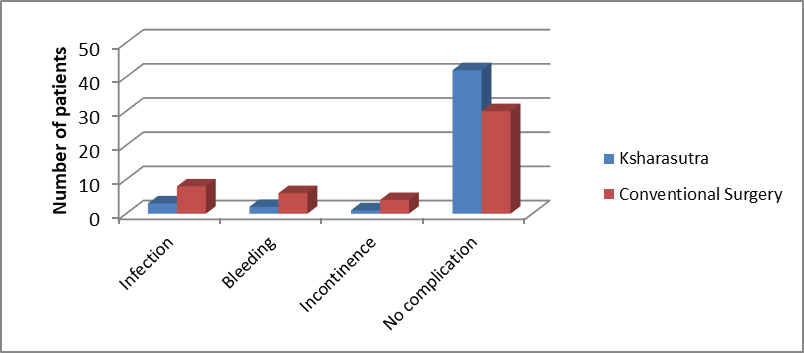
Figure 1: Post-operative Complications
In our study, a total of 96 patients with fistula in ano were included, with 48 patients undergoing Ksharasutra treatment and 48 patients undergoing conventional surgery. The majority of patients belonged to the 31–40 years age group (34 patients, 35.4%), followed by 41–50 years (25 patients, 26.0%), 20–30 years (22 patients, 22.9%), and >50 years (15 patients, 15.6%). Male patients predominated, accounting for 74 patients (77.1%), while 22 patients (22.9%) were females. There was no statistically significant difference in age and gender distribution between the two groups (p = 0.81 and p = 0.62 respectively). Regarding the type of fistula, 62 patients (64.6%) had low anal fistula and 34 patients (35.4%) had high anal fistula, with no significant difference between the groups (p = 0.67). Post-operative pain assessment revealed that mild pain was more common in the Ksharasutra group (28 patients, 58.3%), whereas moderate (22 patients, 45.8%) and severe pain (11 patients, 22.9%) were more frequent in the conventional surgery group, showing a statistically significant difference (p = 0.01). Post-operative complications were lower in the Ksharasutra group, where 42 patients (87.5%) had no complications, compared to 30 patients (62.5%) in the conventional surgery group, and complications such as infection, bleeding, and incontinence were more frequent in the conventional surgery group (p = 0.03). Recurrence occurred in 4 patients (8.3%) in the Ksharasutra group and 12 patients (25.0%) in the conventional surgery group, demonstrating a significantly lower recurrence rate with Ksharasutra treatment (p = 0.04). Overall, Ksharasutra treatment showed better outcomes in terms of post-operative pain, complications, and recurrence compared to conventional surgery.
DISCUSSION:
The present study was conducted to compare the effectiveness of Ksharasutra seton therapy and conventional surgical management in patients with fistula in ano. A total of 96 patients were included and equally divided into two groups. The results of the present study demonstrated that Ksharasutra therapy was associated with less postoperative pain, fewer complications, and lower recurrence rates compared to conventional surgery, indicating its effectiveness in the management of fistula in ano. In the present study, the majority of patients belonged to the 31–40 years age group (35.4%), and male predominance (77.1%) was observed. Similar findings were reported by Sharma et al. (2017) in a study of 60 patients, where 65% of patients were in the 30–40 years age group and 75% were males [9]. These findings suggest that fistula in ano commonly affects the young and middle-aged male population. Regarding the type of fistula, the present study found that 64.6% of patients had low anal fistula and 35.4% had high anal fistula. A comparable observation was reported by Singh et al. (2019) in their study of 72 patients, where 68% had low anal fistula and 32% had high anal fistula [10].
This similarity indicates that low anal fistula is the most frequently encountered type in clinical practice.In terms of postoperative pain, the present study showed that mild pain was more common in the Ksharasutra group (58.3%), while moderate pain (45.8%) and severe pain (22.9%) were more frequent in the conventional surgery group, and the difference was statistically significant (p = 0.01). Similar results were reported by Gupta et al. (2018) in a comparative study of 80 patients, where 70% of patients treated with Ksharasutra experienced mild postoperative pain compared to only 40% in the conventional surgery group (p < 0.05) [11].
Postoperative complications were also lower in the Ksharasutra group in the present study, where 87.5% of patients had no complications, compared to 62.5% in the conventional surgery group, and this difference was statistically significant (p = 0.03). A similar observation was reported by Meena et al. (2018) in a study involving 50 patients, where 80% of patients treated with Ksharasutra had no postoperative complications, while complications occurred in 36% of patients undergoing conventional surgery (p < 0.05) [12].Another important finding of the present study was the lower recurrence rate in the Ksharasutra group (8.3%) compared to the conventional surgery group (25.0%), which was statistically significant (p = 0.04). A comparable result was reported by Kumar et al. (2021) in a study of 90 patients, where the recurrence rate was 10% in the Ksharasutra group compared to 28% in the conventional surgery group (p < 0.05) [13].
CONCLUSION:
We concluded that fistula in ano, the current comparative study assessed the efficacy of Seton treatment utilizing Ksharasutra and traditional surgical care. Ninety-six patients in all were split equally between two groups. According to the study's findings, Ksharasutra therapy outperformed traditional surgery in terms of postoperative results. Ksharasutra-treated patients had better overall clinical results, including less postoperative discomfort, fewer complications, and a lower recurrence rate. Additionally, the study found that young and middle-aged guys were more likely to have ano fistulas, with low anal fistulas being the most common form. After Ksharasutra therapy, the fistula in ano healed satisfactorily, and the process was shown to be both safe and successful. Overall, the findings point to Ksharasutra seton therapy as a dependable and clinically successful therapeutic option that, in certain patients, may be a better option than traditional surgical management because of its benefits in lowering postoperative morbidity and recurrence.
REFERENCES:
1. Parks AG, Gordon PH, Hardcastle JD. A classification of fistula-in-ano. Br J Surg. 1976;63(1):1–12.
2. Morris C, Spencer R, Chandrasekaran V. Anal fistula: Epidemiology and impact on quality of life. Colorectal Dis. 2017;19(4):O111–O119.
3. Abcarian H. Fistula-in-ano. Surg Clin North Am. 2002;82(6):1219–1236.
4. García-Aguilar J, Belmonte C, Wong WD, Goldberg SM, Madoff RD. Anal fistula surgery: Factors associated with recurrence and incontinence. Dis Colon Rectum. 1996;39(7):723–729.
5. Parks AG. Pathogenesis and treatment of fistula-in-ano. Br Med J. 1961;1:463–469.
6. Armstrong D, Radcliffe AG. Anal fistula surgery: Current concepts. Br J Surg. 2007;94(8):873–883.
7. Abcarian H. Management of complex fistulas-in-ano. Clin Colon Rectal Surg. 2012;25(2):88–96.
8. Rojanasakul A. Ligation of intersphincteric fistula tract: A new technique for fistula-in-ano. Dis Colon Rectum. 2009;52(2):232–238.
9. Sharma A, Sharma R, Gupta A. Clinical evaluation of Ksharasutra therapy in fistula in ano. J Ayurveda Integr Med. 2017;8(3):162-166.
10. Singh K, Sharma D, Yadav R. Clinical profile and management outcomes in fistula in ano: A prospective study. Int Surg J. 2019;6(5):1682-1686.
11. Gupta PJ, Heda PS, Kalaskar S. Ksharasutra versus fistulectomy in management of fistula in ano: A comparative study. Indian J Surg. 2018;80(4):341-345.
12. Meena S, Verma RK, Sharma P. Evaluation of efficacy of Ksharasutra therapy in fistula in ano. J Clin Diagn Res. 2018;12(6):PC05-PC08.
13. Kumar N, Singh S, Patel A. Comparative study of Ksharasutra and conventional surgery in fistula in ano. Int J Colorectal Dis. 2021;36(4):721-726.