Peripheral Neuropathy in Chronic Kidney Disease: Association with Disease Severity and Dialysis Exposure.
- Balmoori Sreejan , Postgraduate, Department of General Medicine, Mamata Medical College, Khammam, Telangana.
- K. Siva Rama Krishna , Professor, Department of General Medicine, Mamata Medical College, Khammam, Telangana.
- L. Ajay Babu , Senior Resident, Department of General Medicine, Mamata Medical College, Khammam, Telangana.
- Afeera Tufheem , Postgraduate, Department of General Medicine, Mamata Medical College, Khammam, Telangana.
- Kovvuri Pavani , Postgraduate, Department of General Medicine, Mamata Medical College, Khammam, Telangana.
- Kondaparthi Sahithi , Postgraduate, Department of General Medicine, Mamata Medical College, Khammam, Telangana.
Article Information:
Abstract:
Chronic kidney disease (CKD) is a progressive systemic disorder associated with multiple complications, including peripheral neuropathy, which significantly impairs quality of life. Despite its clinical importance, neuropathy remains underdiagnosed, particularly in non-diabetic CKD populations. Limited regional data exist regarding its prevalence and associated risk factors in Indian settings. Aim of the study was to determine the prevalence of peripheral neuropathy among patients with CKD stage 3 and above and to evaluate its association with clinical and biochemical parameters. Material and Methods: This hospital-based cross-sectional analytical study was conducted among 75 patients with CKD stage ≥3 at a tertiary care center in Telangana. Patients with other causes of neuropathy, including diabetes mellitus and vitamin B12 deficiency, were excluded. Peripheral neuropathy was assessed using the Michigan Neuropathy Screening Instrument (MNSI) and Semmes–Weinstein monofilament testing. Clinical, biochemical, and dialysis-related parameters were recorded. Statistical analysis was performed using SPSS, with p <0.05 considered significant. Results: The prevalence of peripheral neuropathy was 56.0%. Neuropathy was significantly associated with advanced CKD stage (p <0.001), dialysis status (p = 0.002), and duration of dialysis (p = 0.002). Patients with neuropathy had significantly lower mean eGFR (18.1 ± 12.2 vs 29.9 ± 14.2 ml/min/1.73m², p <0.001) and higher serum creatinine levels (6.5 ± 2.3 vs 4.6 ± 1.7 mg/dL, p <0.001). Monofilament test abnormality strongly correlated with neuropathy (p <0.001). No significant association was observed with gender, BMI, duration of CKD, or hemoglobin levels. Conclusion: Peripheral neuropathy is highly prevalent among CKD patients, particularly in advanced stages and those undergoing prolonged dialysis. Disease severity and renal dysfunction are key determinants. Routine screening using simple bedside tools such as MNSI and monofilament testing is recommended for early detection and improved patient outcomes.
Keywords:
Article :
INTRODUCTION:
Chronic kidney disease (CKD) is a progressive and irreversible disorder defined by reduced glomerular filtration rate or evidence of kidney damage persisting for more than three months, and it has emerged as a major global health burden affecting approximately 10–13% of the adult population (1,2). The rising prevalence is largely driven by increasing rates of diabetes, hypertension, and aging populations, particularly in low- and middle-income countries such as India, where prevalence ranges from 8–17% (3,4). CKD is not merely a renal disorder but a systemic condition associated with multiple complications including cardiovascular disease, anemia, mineral bone disorders, and neurological dysfunction (5). Among these, peripheral neuropathy represents one of the most common yet under-recognized complications, typically manifesting as a distal symmetrical sensorimotor polyneuropathy characterized by numbness, paresthesia, and progressive motor weakness (6). The pathogenesis of uremic neuropathy is multifactorial, involving accumulation of uremic toxins, oxidative stress, electrolyte imbalances, and microvascular ischemia leading to axonal degeneration (7). Evidence suggests that the prevalence of peripheral neuropathy increases with advancing stages of CKD, particularly from stage 3 onwards, with reported rates ranging from 40–70% in dialysis populations (8). However, variability in diagnostic criteria and confounding factors such as diabetes complicate accurate estimation of its true burden.Several studies have explored the association between CKD severity and neuropathy. Jha et al. and Agarwal et al. demonstrated a significant correlation between declining renal function and worsening nerve conduction parameters (3,9). A recent cohort study further confirmed that reduced estimated glomerular filtration rate is independently associated with impaired nerve function even after excluding diabetic patients (10). Additionally, studies have reported partial reversibility of neuropathic symptoms following adequate dialysis or renal transplantation, highlighting the clinical importance of early detection (11). Despite these findings, most available literature includes heterogeneous populations with mixed etiologies, making it difficult to isolate the specific contribution of uremia to neuropathy. In the Indian context, limited regional studies have systematically evaluated peripheral neuropathy exclusively in non-diabetic CKD patients, and many lack stage-wise analysis. Furthermore, early neuropathy often remains asymptomatic and is frequently missed without structured screening tools such as the Michigan Neuropathy Screening Instrument or monofilament testing, which are underutilized in routine clinical practice (12).
The key research gap lies in the paucity of recent, region-specific data evaluating the prevalence of peripheral neuropathy across different stages of CKD after excluding other major causes such as diabetes mellitus, hypothyroidism, and vitamin B12 deficiency. Existing studies are either outdated, institutionally limited, or confounded by comorbidities, thereby limiting their applicability to current clinical scenarios. Moreover, there is insufficient evidence correlating neuropathy with clinical and biochemical parameters in Indian tertiary care settings, particularly in rapidly evolving regions like Telangana. Addressing this gap is essential for improving early diagnosis, preventing complications such as foot ulcers and falls, and enhancing quality of life.
In this context, the present study aims to evaluate the prevalence of peripheral neuropathy among patients with CKD stage 3 and above and to analyze its association with disease severity and clinical parameters in a tertiary care hospital setting. By generating contemporary, region-specific data using standardized screening methods, the study seeks to provide a clearer understanding of the burden of uremic neuropathy and contribute to improved patient management strategies.
MATERIALS AND METHODS:
Study Design and Setting
This study was conducted as a hospital-based cross-sectional analytical study in the Department of General Medicine at Mamata Medical College and Teaching Hospital, Khammam, Telangana. The cross-sectional design enabled estimation of the prevalence of peripheral neuropathy among chronic kidney disease (CKD) patients at a defined time point and facilitated analysis of its association with disease severity.
Study Population and Sampling
The study included patients diagnosed with CKD stage 3 and above, defined by an estimated glomerular filtration rate (eGFR) <60 ml/min/1.73 m² along with ultrasonographic evidence of chronic kidney disease. A sample size of 75 was calculated using the formula n = 4pq/l² based on an assumed prevalence of 65%. Consecutive sampling was employed, and all eligible patients providing informed consent were included until the required sample size was achieved.
Inclusion Criteria
· Patients of all age groups and both sexes diagnosed with CKD
· CKD stage 3 and above (eGFR <60 ml/min/1.73 m²)
· Patients admitted in medical wards or undergoing dialysis
· Ultrasound evidence confirming chronic kidney disease
Exclusion Criteria
· Patients who underwent renal transplantation
· Patients with other causes of neuropathy, including:
o Diabetes mellitus
o Hypothyroidism
o Chronic alcoholism
o Tuberculosis
o Vitamin B12 deficiency
o Malignancy
o Drug-induced neuropathy
· Patients unwilling to provide informed consent
Study Tool
Peripheral neuropathy was assessed using standardized and validated tools:
· Michigan Neuropathy Screening Instrument (MNSI): Included both questionnaire and clinical examination components assessing neuropathic symptoms and signs
· Semmes–Weinstein Monofilament Test (10 g): Used to evaluate protective sensation at standard plantar sites
· Neuropathy was diagnosed based on standard scoring criteria and graded according to severity
Data Collection
· Clinical history: Age, gender, duration of CKD, dialysis status, comorbidities, and neuropathic symptoms
· General examination: Pulse, blood pressure, pallor, pedal edema, BMI, and waist circumference
· Neurological assessment:
o Sensory: vibration, pain, temperature, proprioception
o Motor: muscle tone, bulk, power (MRC grading)
o Reflexes: especially ankle jerk
· Investigations:
o Renal function tests (urea, creatinine, eGFR)
o Complete blood count
o Serum electrolytes
o Ultrasound abdomen
o Fasting blood glucose (to exclude diabetes)
o Thyroid function tests and vitamin B12 levels (when indicated)
Statistical Analysis
Data were entered into Microsoft Excel and analyzed using SPSS software. Continuous variables were expressed as mean ± standard deviation, while categorical variables were presented as frequencies and percentages. The Chi-square test was used to assess associations between peripheral neuropathy and CKD stages, and Student’s t-test was applied for comparison of means. A p-value <0.05 was considered statistically significant.
RESULTS:
Table 1. Baseline Characteristics of Study Participants (n = 75)
|
Variable |
Category |
n (%) |
|
Age (years) |
35–45 |
21 (28.0) |
|
45–55 |
22 (29.3) |
|
|
55–65 |
20 (26.7) |
|
|
>65 |
12 (16.0) |
|
|
Gender |
Male |
40 (53.3) |
|
Female |
35 (46.7) |
|
|
Dialysis |
No |
37 (49.3) |
|
Yes |
38 (50.7) |
|
|
CKD Stage |
Stage 3 |
20 (26.7) |
|
Stage 4 |
28 (37.3) |
|
|
Stage 5 |
27 (36.0) |
The baseline characteristics of the study population are summarized in Table 1. The majority of patients belonged to the middle-aged group, with 45–55 years constituting the largest proportion (29.3%), followed by 35–45 years (28.0%) and 55–65 years (26.7%), while patients aged above 65 years accounted for 16.0%. There was a slight male predominance in the study, with males comprising 53.3% and females 46.7% of the participants. With respect to dialysis status, the study population was almost equally distributed, with 50.7% of patients undergoing dialysis and 49.3% not on dialysis. Regarding disease severity, a higher proportion of patients were in advanced stages of chronic kidney disease, with Stage 4 accounting for 37.3% and Stage 5 for 36.0%, whereas Stage 3 constituted 26.7% of the study population.
Figure 1. Prevalence of Peripheral Neuropathy and Screening Findings (n = 75)
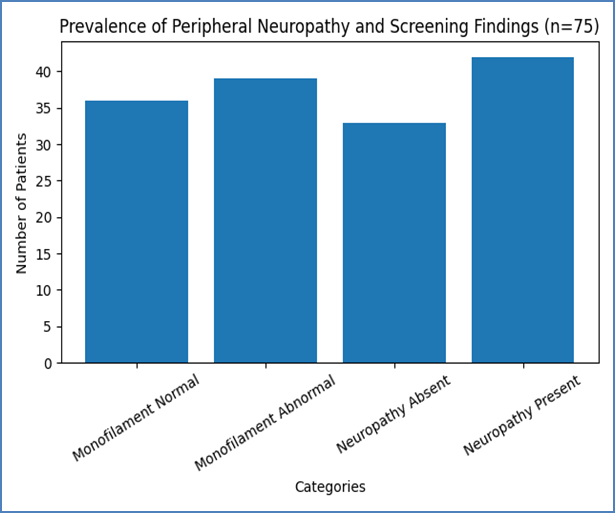
The figure 1 shows the distribution of monofilament test findings and the prevalence of peripheral neuropathy among the study participants. A slightly higher proportion of patients demonstrated abnormal monofilament test results (52.0%) compared to normal findings (48.0%), indicating a considerable burden of sensory impairment. Similarly, peripheral neuropathy was present in 56.0% of patients, exceeding those without neuropathy (44.0%). The close alignment between abnormal monofilament findings and neuropathy prevalence suggests a strong clinical correlation, highlighting the effectiveness of monofilament testing as a simple bedside screening tool for early detection of peripheral neuropathy in patients with chronic kidney disease.
Table 2. Comparison of Clinical and Biochemical Parameters
|
Variable |
Neuropathy Absent (Mean ± SD) |
Neuropathy Present (Mean ± SD) |
p-value |
|
BMI (kg/m²) |
23.4 ± 4.0 |
24.9 ± 4.2 |
0.15 |
|
Duration of CKD (years) |
6.6 ± 2.3 |
5.8 ± 2.5 |
0.18 |
|
Duration of Dialysis (months) |
6.9 ± 12.5 |
17.0 ± 17.3 |
0.002* |
|
eGFR (ml/min/1.73m²) |
29.9 ± 14.2 |
18.1 ± 12.2 |
<0.001* |
|
Serum Creatinine (mg/dL) |
4.6 ± 1.7 |
6.5 ± 2.3 |
<0.001* |
|
Hemoglobin (g/dL) |
9.0 ± 1.4 |
9.6 ± 1.4 |
0.08 |
|
MNSI Score |
1.7 ± 0.9 |
5.8 ± 1.3 |
<0.001* |
The comparison of clinical and biochemical parameters between patients with and without peripheral neuropathy is presented in Table 3. There was no statistically significant difference in body mass index (BMI) and duration of chronic kidney disease between the two groups (p = 0.15 and p = 0.18, respectively). However, duration of dialysis was significantly higher among patients with neuropathy (17.0 ± 17.3 months) compared to those without neuropathy (6.9 ± 12.5 months), indicating a significant association (p = 0.002). Renal function parameters showed a strong correlation with neuropathy, as patients with neuropathy had significantly lower mean eGFR (18.1 ± 12.2 vs 29.9 ± 14.2 ml/min/1.73m², p <0.001) and higher serum creatinine levels (6.5 ± 2.3 vs 4.6 ± 1.7 mg/dL, p <0.001). Hemoglobin levels did not show a statistically significant difference between the groups (p = 0.08). The Michigan Neuropathy Screening Instrument (MNSI) score was significantly higher in patients with neuropathy (5.8 ± 1.3) compared to those without neuropathy (1.7 ± 0.9), demonstrating a strong association (p <0.001). Overall, these findings suggest that worsening renal function and longer dialysis duration are key determinants of peripheral neuropathy in CKD patients.
Table 3. Association Between Clinical Variables and Peripheral Neuropathy
|
Variable |
Category |
Neuropathy Present n (%) |
Neuropathy Absent n (%) |
p-value |
|
Age (years) |
35–45 |
17 (81.0) |
4 (19.0) |
|
|
45–55 |
12 (54.5) |
10 (45.5) |
||
|
55–65 |
7 (35.0) |
13 (65.0) |
||
|
>65 |
6 (50.0) |
6 (50.0) |
0.03* |
|
|
Gender |
Male |
20 (50.0) |
20 (50.0) |
|
|
Female |
22 (62.9) |
13 (37.1) |
0.35 |
|
|
Dialysis |
No |
14 (37.8) |
23 (62.2) |
|
|
Yes |
28 (73.7) |
10 (26.3) |
0.002* |
|
|
CKD Stage |
Stage 3 |
4 (20.0) |
16 (80.0) |
|
|
Stage 4 |
16 (57.1) |
12 (42.9) |
||
|
Stage 5 |
22 (81.5) |
5 (18.5) |
<0.001* |
|
|
Monofilament |
Normal |
7 (19.4) |
29 (80.6) |
|
|
Abnormal |
35 (89.7) |
4 (10.3) |
<0.001* |
The association between clinical variables and peripheral neuropathy is depicted in Table 4. A statistically significant association was observed between age group and peripheral neuropathy (p = 0.03), with the highest prevalence seen in the 35–45 years group (81.0%). However, no significant association was found between gender and neuropathy (p = 0.35), although a higher proportion of females (62.9%) were affected compared to males (50.0%). Dialysis status showed a strong and significant association, with neuropathy being more prevalent among patients on dialysis (73.7%) compared to those not on dialysis (37.8%) (p = 0.002). A highly significant association was observed between CKD stage and neuropathy (p <0.001), with prevalence increasing progressively from 20.0% in Stage 3 to 81.5% in Stage 5, indicating worsening neuropathy with advancing disease severity. Additionally, monofilament test findings showed a strong correlation with neuropathy (p <0.001), as 89.7% of patients with abnormal results had neuropathy compared to only 19.4% among those with normal findings. Overall, these results highlight that disease severity, dialysis status, and sensory impairment are key factors associated with peripheral neuropathy in CKD patients.
Table 4. Predictors of Peripheral Neuropathy (Multivariate Logistic Regression Analysis)
|
Variable |
Adjusted Odds Ratio (AOR) |
95% Confidence Interval |
p-value |
|
CKD Stage (per stage increase) |
3.45 |
1.85 – 6.42 |
<0.001* |
|
Dialysis Duration (per month) |
1.08 |
1.03 – 1.14 |
0.002* |
|
eGFR (per unit increase) |
0.91 |
0.87 – 0.95 |
<0.001* |
|
Serum Creatinine (per mg/dL) |
1.32 |
1.12 – 1.56 |
<0.001* |
|
Monofilament Abnormality |
9.75 |
3.21 – 29.64 |
<0.001* |
The multivariate logistic regression analysis identified several independent predictors of peripheral neuropathy among CKD patients. Advancing CKD stage emerged as a strong predictor, with each stage increase associated with a 3.45-fold higher risk of neuropathy (AOR: 3.45; 95% CI: 1.85–6.42; p <0.001). Duration of dialysis was also significantly associated, with a gradual increase in risk for each additional month of dialysis (AOR: 1.08; 95% CI: 1.03–1.14; p = 0.002). Renal function parameters demonstrated a significant inverse relationship, as higher eGFR was associated with reduced odds of neuropathy (AOR: 0.91; 95% CI: 0.87–0.95; p <0.001), indicating a protective effect. Conversely, elevated serum creatinine levels were associated with increased risk (AOR: 1.32; 95% CI: 1.12–1.56; p <0.001), reflecting the role of uremic toxin burden in neuropathy development. Among clinical assessment tools, abnormal monofilament findings showed the strongest association, with nearly a tenfold increased risk of neuropathy (AOR: 9.75; 95% CI: 3.21–29.64; p <0.001). Overall, these results highlight that disease severity, dialysis exposure, and impaired renal function are key independent determinants of peripheral neuropathy in CKD patients.
DISCUSSION:
The present study was undertaken to evaluate the prevalence of peripheral neuropathy among patients with chronic kidney disease (CKD) stage 3 and above and to analyze its association with clinical and biochemical parameters. The findings of this study demonstrate that peripheral neuropathy is a common and clinically significant complication of CKD, with a prevalence of 56.0% in the study population. This observation is consistent with previously reported prevalence rates ranging from 40% to 70% among CKD patients, particularly in advanced stages (13,14).
In the present study, more than half of the CKD patients were found to have peripheral neuropathy. Similar findings were reported by Raju et al., who observed a prevalence of 58% in CKD patients using clinical and electrophysiological methods (13). Likewise, Aggarwal et al. documented neuropathy in 62% of patients undergoing dialysis (14). The slightly lower prevalence in the present study may be attributed to exclusion of diabetic patients, which eliminates a major confounding factor and provides a more accurate estimate of uremic neuropathy.
The majority of patients in this study belonged to the middle-aged group (45–55 years), reflecting the increasing burden of CKD in relatively younger populations. A significant association between age and neuropathy was observed (p = 0.03), with higher prevalence in younger age groups. This finding contrasts with studies by Krishnan et al., where neuropathy increased with advancing age (6). The discrepancy may be due to regional variations, differences in disease duration, or sample distribution.
Gender distribution showed a slight male predominance; however, no statistically significant association was found between gender and neuropathy (p = 0.35). This is consistent with findings by Bolton et al., who also reported no gender-based differences in uremic neuropathy (11).
A strong and statistically significant association was observed between CKD stage and peripheral neuropathy (p < 0.001), with prevalence increasing from 20.0% in stage 3 to 81.5% in stage 5. This trend is in agreement with studies by Said et al., which demonstrated progressive worsening of neuropathy with declining renal function (8). Similarly, a study by Sharma et al. reported that advanced CKD stages are associated with greater nerve conduction abnormalities (15). These findings reinforce the role of uremic toxin accumulation and metabolic derangements in the pathogenesis of neuropathy.
In the present study, neuropathy was significantly more common in patients on dialysis (73.7%) compared to those not on dialysis (37.8%), with a significant association (p = 0.002). Furthermore, duration of dialysis showed a strong association with neuropathy (p = 0.002). These findings are consistent with studies by Tesfaye et al., who demonstrated that prolonged dialysis exposure contributes to nerve damage due to inadequate clearance of middle molecules (16). However, some studies suggest that optimized dialysis may improve neuropathic symptoms, indicating a complex relationship (11).
The present study demonstrated a significant association between declining renal function and neuropathy. Patients with neuropathy had significantly lower eGFR and higher serum creatinine levels (p < 0.001). These findings are in line with Zhang et al., who reported that reduced eGFR independently predicts impaired nerve conduction (10). Elevated creatinine reflects increased uremic toxin burden, which plays a central role in neuronal damage.
No significant association was observed between BMI and neuropathy (p = 0.15), which is consistent with findings by Singh et al., suggesting that body composition may not directly influence neuropathy in CKD (17). Similarly, duration of CKD did not show a significant association (p = 0.18), indicating that disease severity rather than duration is a more critical determinant.
Hemoglobin levels were not significantly associated with neuropathy (p = 0.08), although anemia has been suggested as a contributing factor in some studies due to reduced oxygen delivery to peripheral nerves (18). The lack of significance in the present study may be due to uniformly low hemoglobin levels across the study population.
The study utilized the Michigan Neuropathy Screening Instrument (MNSI) and monofilament testing for assessment. A strong association was observed between abnormal monofilament test and neuropathy (p < 0.001), with 89.7% of patients showing abnormal findings . This supports the findings of Feldman et al., who emphasized the utility of simple bedside tools in early detection of neuropathy (12).
MNSI scores were significantly higher in neuropathy patients (p < 0.001), confirming its reliability as a diagnostic tool. Similar observations were reported by Herman et al., who validated MNSI as an effective screening instrument in clinical practice (19).
Multivariate analysis identified CKD stage, dialysis duration, eGFR, serum creatinine, and monofilament abnormality as significant predictors of neuropathy. These findings highlight that neuropathy is primarily driven by disease severity and metabolic derangements rather than demographic factors. Comparable results were reported by Hassan et al., who identified renal dysfunction parameters as independent predictors of neuropathy (20).
CONCLUSION:
The present study demonstrates that peripheral neuropathy is a highly prevalent complication among patients with chronic kidney disease, affecting more than half of the study population. The prevalence increases significantly with advancing CKD stage and is strongly associated with reduced eGFR, elevated serum creatinine, and longer duration of dialysis. Clinical screening tools such as MNSI and monofilament testing were found to be effective for early detection.
These findings emphasize the importance of routine neurological evaluation in CKD patients, particularly in advanced stages, to facilitate early diagnosis and timely intervention. Identification of modifiable risk factors such as dialysis adequacy may help reduce disease burden and improve quality of life. The study contributes valuable regional data and underscores the need for integrated nephrology and neurological care in CKD management.
REFERENCES:
1. Kidney Disease: Improving Global Outcomes (KDIGO) CKD Work Group. KDIGO clinical practice guideline for the evaluation and management of chronic kidney disease. Kidney Int Suppl. 2013;3(1):1–150.
2. Hill NR, Fatoba ST, Oke JL, Hirst JA, O’Callaghan CA, Lasserson DS, et al. Global prevalence of chronic kidney disease – a systematic review and meta-analysis. PLoS One. 2016;11(7):e0158765.
3. Jha V, Garcia-Garcia G, Iseki K, Li Z, Naicker S, Plattner B, et al. Chronic kidney disease: global dimension and perspectives. Lancet. 2013;382(9888):260–72.
4. Singh AK, Farag YM, Mittal BV, Subramanian KK, Reddy SR, Acharya VN, et al. Epidemiology and risk factors of chronic kidney disease in India – results from the SEEK study. Clin Exp Nephrol. 2018;22(4):902–9.
5. GBD Chronic Kidney Disease Collaboration. Global, regional, and national burden of chronic kidney disease, 1990–2017: a systematic analysis. Lancet. 2020;395(10225):709–33.
6. Krishnan AV, Kiernan MC. Uremic neuropathy: clinical features and new pathophysiological insights. Neurol Clin. 2007;25(1):373–85.
7. Vanholder R, De Smet R, Glorieux G, Argilés A, Baurmeister U, Brunet P, et al. Review on uremic toxins: classification, concentration, and interindividual variability. Kidney Int. 2003;63(5):1934–43.
8. Said G. Chronic kidney disease and neuropathy. Lancet Neurol. 2016;15(11):1126–38.
9. Agarwal SK, Dash SC, Irshad M, Raju S, Singh R, Pandey RM. Prevalence of peripheral neuropathy in patients with chronic kidney disease. Indian J Nephrol. 2015;25(4):206–11.
10. Zhang L, Long J, Jiang W, Shi Y, He X, Zhou Z, et al. Association between chronic kidney disease and peripheral nerve conduction abnormalities. Clin Neurophysiol. 2023;145:45–52.
11. Bolton CF. Neuropathy in chronic renal failure. Muscle Nerve. 2008;38(2):138–46.
12. Feldman EL, Callaghan BC, Pop-Busui R, Zochodne DW, Wright DE, Bennett DL, et al. Diabetic neuropathy. Diabetes Care. 2019;42(7):1364–79.
13. Raju S, Singh R, Agarwal SK. Prevalence and risk factors of peripheral neuropathy in chronic kidney disease patients. Indian J Nephrol. 2018;28(2):127–32.
14. Aggarwal HK, Sood S, Jain D, Yadav S. Evaluation of peripheral neuropathy in patients on hemodialysis. J Assoc Physicians India. 2017;65(6):24–28.
15. Sharma R, Bansal P, Kumar S, Sharma S. Nerve conduction studies in chronic kidney disease patients and its correlation with disease severity. Neurol India. 2019;67(2):456–61.
16. Tesfaye S, Boulton AJM, Dyck PJ, Freeman R, Horowitz M, Kempler P, et al. Diabetic and uremic neuropathies: mechanisms and management. Diabetologia. 2011;54(5):1003–14.
17. Singh NP, Ingle GK, Saini VK, Jami A, Beniwal P, Lal M. Body composition and metabolic abnormalities in chronic kidney disease patients. Indian J Med Res. 2016;143(4):449–55.
18. Mohapatra S, Rath B, Mishra S, Dash SC. Association of anemia with peripheral neuropathy in chronic kidney disease patients. J Clin Diagn Res. 2020;14(3):OC10–OC13.
19. Herman WH, Pop-Busui R, Braffett BH, Martin CL, Cleary PA, Albers JW, et al. Use of the Michigan Neuropathy Screening Instrument as a measure of distal symmetrical peripheral neuropathy. Diabetes Care. 2012;35(9):1884–90.
20. Hassan A, Gupta R, Kumar V, Sharma A. Predictors of uremic neuropathy in chronic kidney disease: a clinical study. Clin Neurol Neurosurg. 2021;203:106573.