Evaluation of the Effects of the Movement Control Order (MCO) Period on the Psychosocial Well-Being of Staff at Selected Universities in Perak, Malaysia during the COVID-19 Pandemic.
- Ashok Gnanasekaran , Professor of Microbiology, Faculty of Medicine, Director, Centre for Botanicals and Clinical Research (CBCR), Quest International University (QIU), Ipoh, Perak, Malaysia.
- Prashantini A/P Sivaram , Medical Officer UD10, Hospital Bukit Mertajam, Jalan Kulim, 14000, Bukit Mertajam, Pulau Pinang, Malaysia.
- Samel Sharmilla A/P Advin Simon , Medical Officer UD10, Hospital Bahagia Ulu Kinta , Jalan Besar, 31250 Tanjung, Rambutan, Perak, Malaysia.
- Jevishya A/P Jayaprakash , Medical Officer UD10, Tampin District Health Office, Tampin, Negeri Sembilan, Malaysia.
- Arthini A/P Govindarajan , Medical Officer UD9, Hospital Pulau Pinang, Malaysia.
- Chahat Antil , American University of Antigua, University Park, Jabberwock Beach Road, PO Box W1451, Coolidge, Antigua, West Indies, North America.
- Pugazhandhi Bakthavatchalam , Department of Anatomy and Physiology, American University of Antigua, University Park, Jabberwock Beach Road, PO Box W1451, Coolidge, Antigua, West Indies, North America.
Article Information:
Abstract:
Background: Aim: To assess the levels of depression, anxiety, and stress among university staff in Perak, Malaysia during phases 1–4 of the COVID-19 Movement Control Order (MCO). Objectives: To evaluate psychological impact (depression, anxiety, stress) during the MCO period, To examine the effects of movement restrictions on university staff, To generate evidence for developing mental health interventions during pandemics. Materials and Methods: A cross-sectional online survey was conducted among university staff in Perak, Malaysia. Data were collected using a structured questionnaire that included sociodemographic details, questions on the impact of the MCO, and the Depression, Anxiety, and Stress Scale (DASS-21). A total of 278 participants were recruited using convenience sampling. Results: The study identified varying levels of depression, anxiety, and stress among university staff during the MCO period, indicating a significant psychological impact associated with pandemic-related restrictions. Conclusion: The findings highlight the need for timely, crisis-oriented psychological interventions and policies to mitigate mental health effects during pandemics and similar public health emergencies
Keywords:
Article :
INTRODUCTION:
The emerging novel severe acute respiratory syndrome coronavirus (SARS-Cov-2), also referred to as the coronavirus disease (COVID-19), is posing a serious threat to the world's civilized nation just as it enters the most critical point of this millennium[1]. According to government reports, the virus was first discovered in bats and spread to humans in December 2019 in the Chinese province of Hubei, primarily through an unidentified intermediate host species in Wuhan, China[2]. The problem was discovered when multiple adults in Wuhan showed up to the local hospitals suffering from severe pneumonia of unknown origin. According to information provided from China, many of the primary cases shared a common history of having visited the live animal-trading Huanan wholesale seafood market recently before experiencing respiratory system symptoms. As a result, the local monitoring system was promptly turned on, and patient respiratory samples were transferred to the Wuhan reference lab for additional analysis[3]. On December 31, 2019, China formally reported the epidemic to the World Health Organization. On January 1, 2020, the Huanan seafood market was closed because it was thought to be the hub of local transmission based on patient reports of illness history from nearby hospitals[4]. Reverse transcriptase-polymerase chain reaction (RT-PCR) and next-generation sequencing were used to isolate the novel coronavirus from confirmed cases of pneumonia on January 7, 2020, as part of extensive continuing research to culture the causal agent. With the help of these techniques, the virus under study was able to be extremely specifically characterized. It was discovered that the virus shared over 70% of its characteristics with the 2002 SARS-CoV outbreak and more than 95% of its homogeneity with the bat coronavirus[4].
As of January 23, 2020, 32 Chinese provinces, municipalities, and special administrative regions—including Hong Kong, Macau, and Taiwan—had reported a continuous string of confirmed COVID-19 instances. In addition, some cases of the new coronavirus SARS-CoV-2 infection have been recorded outside of China during a comparable time frame[5]. According to Singhal (2020), the nations listed are Japan, South Korea, the United States, Taiwan, Hong Kong, Singapore, Vietnam, Canada, Australia, and Malaysia, in that order, and they also account for export cases during the pandemic's early phases. As a result of the sharp rise in positive cases and the concerning global circumstances, the World Health Organization (WHO) designated the COVID-19 outbreak as a Public Health Emergency of International Concern (PHEIC) on January 30, 2020. Following that, the World Health Organization released a formal press release alerting the public to the danger of COVID-19 spreading to other nations and the potential for a catastrophic pandemic. Later, on March 11, 2020, the World Health Organization declared that COVID-19 qualified as a pandemic[2].
A 66-year-old male from Wuhan, China, also had a case of imported novel coronavirus (2019-nCov) in Singapore on January 23, 2020. Eight close contacts in Johor were reported by the Singaporean Health Ministry to the Malaysian Health Ministry. Every one of these instances was said to be well. No cases were reported until January 24, 2020. On January 25, Malaysia declared the first cases of COVID-19, involving three Chinese tourists who had arrived in Malaysia via Johor after arriving in Singapore on January 23[6]. On February 4, 2020, a Malaysian who has a history of attending meetings in Singapore was involved in the first confirmed case.
By February 16, 2020, there were 32 cases, which constituted the "first wave" of the COVID-19 outbreak in Malaysia. The start of the second wave was February 27, 2020. There were 553 confirmed cases in Malaysia as of March 16. Malaysia was at the late movement control order phase of the infection at that specific time, just before it entered the mitigation phase.
The Movement Control Order (MCO) was announced by Malaysian Prime Minister YAB Tan Sri Muhyiddin Yassin in response to the global COVID-19 outbreak, which also affected Malaysia. In order to limit the disease and stop the COVID-19 epidemic from spreading across the nation, this order is being carried out in accordance with The Police Act of 1967 and The Prevention and Control of Infectious Disease Act of 1988.
The MCO was first implemented in stages, with the first phase starting on March 18, 2020, and ending on March 31, 2020, as planned. Up until April 21, 2020, the nation underwent three phases of the MCO's implementation. Following the start of the third phase of the MCO, there was a notable decrease in the number of newly reported cases, indicating that the MCO was both necessary and successful in stopping the outbreak's progress. The MCO's policies forbid both mass gatherings like weddings and festivals with large numbers as well as the mobility of individuals.
The states have been divided into groups by the Ministry of Health (MOH) based on the number of cases in each state. Green zones have no active cases, Yellow zones have fewer than 40 cases, and Red zones have more than 40 instances. There were 131 green zones, 16 yellow zones, and no red zones as of September 6, 2020. Based on data as of September 11, 2020, the recovery rate of COVID-19 cases is at 95.21%, placing Malaysia among the nations most successful in managing the pandemic (Negara, 2020).
METHODOLOGY:
Study Design:
An online cross-sectional survey was designed to assess various sociodemographic factors affecting the psychological parameters such as depression, anxiety, and stress among staff in the selected university of Perak, Malaysia during the Movement Control Order period of the COVID-19 pandemic.
Study Period:
The duration of the research study took about 180 days from 1st July 2020 till 31st December 2020. The overall research will be conducted as given below:
· 1st July 2020 - 9th August 2020: During the first month of study, identification of research areas for the workup of the proposal was done.
· 10st August 2020 - 19th September 2020: Subsequently, the preparation of the research proposal was prepared for ethical approval.
· 20th September 2020 - 20th November 2020: Collection and analysis of online data for this study were proceeded upon with the approval of the ethical committee.
· 21st November 2020 - 31st December 2020: Finally, the reporting of research outcomes based on the data analysis and a final dissertation of paper were prepared.
Study Location:
The study was conducted from selected universities within the state of Perak, Malaysia.
Reference Population:
The reference population of this study included staff from selected universities in Perak, Malaysia.
Study Participant:
The study participants included in this research were staff in the selected universities of Perak, Malaysia, with internet accessibility and who have consented to take part in the online survey.
Sampling Size Determination:
To evaluate the level of depression, anxiety, and stress among the staff in the universities of Perak, Malaysia, during the COVID-19 pandemic, the minimum sample size was calculated assuming that 48.1% of the respondents will be having either moderate or severe levels of depressive symptoms with the precision of 5% for a 95% confidence level. The precision level was increased to 10% in order to accommodate the scale of a sample size to the local population[7].
Precision level 10%
n = Sample size calculated using the formula with values obtained from the reference article
To calculate the finite population sample size the following formula was used.
n = Sample size calculated using formula with values obtained from the reference article
Minimum sample size (n) = 96
To calculate the finite population sample size the following formula was used.
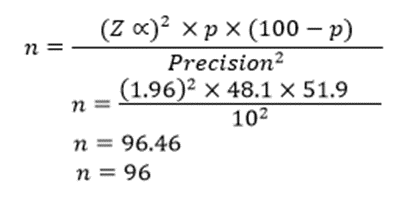
Minimum sample size n = 96
Total response obtained (n) = 162
Sampling Method:
Convenient sampling was applied to select the subject participants for this study. This sampling method was chosen as it ensures easy accessibility during the Movement Control Order (MCO) period where all the staff in the selected universities of Perak, Malaysia had to abide by the rules set by the government. Besides, it also ensured an easy mode of collection of data, which was suitable for the limited study period.
Data Collection:
This study was planned to be conducted by the distribution of online questionnaires to the study subjects. The online questionnaire settings through Google Forms were considerably easy to form and distributed to the large scale of participants from different geographical settings within the state. The online questionnaire was sent via the internal communication system of respective universities within the state of Perak, Malaysia. To make it possible, an official letter of permission approved by our esteemed Dean of Faculty was sent to the head of respective universities prior to the collection of online data of respondents upon receiving the approval of the ethical committee. Participants were given the freedom to comfortably answer the questionnaires according to their perspective and had enough time to read each question thoroughly. The data collected was within the time frame set which was till 15th December 2020. Results obtained after this date were not included in the study analysis. This method of data collection drastically reduced all possible financial and time constraints besides maintaining a clean and safe environment throughout the study.
Study Instruments:
The questionnaire will consist of three sections. In the first section, there will be 5 questions related to the sociodemographic details, the second section will include 6 questions on the impact of COVID-19. The questionnaires of the first two sections are the modified version of questions adapted from a reference source of a research article that was recently published by a Spanish university[7]. A final section based on a psychological parameter scale which includes a set of 21 questions that is adapted to analyse the psychological parameters of the Depression, Anxiety and Stress Scale (DASS-21)[8].
Statistical Analysis:
The statistical analysis of data from this research study was determined by the standardized list of independent and dependent variables. In this study, descriptive statistics were used in order to understand in-depth and explore further the distribution of collected data. All the categorical data were demonstrated through the value of frequency and valid percentage. Meanwhile, the continuous variables were evaluated through a set of histograms, a measure of distribution, and an assessment of normality test. Categorization or transformation will be taken into consideration in the context of skewed numerical data. In the case of normally distributed data, a parametric test was applied (Independent T-test / One Way ANOVA test). On the contrary, for data that were not normally distributed, a non-parametric test was applied (Mann-Whitney U test/ Kruskal Wallis test). All these analyses was performed using the Statistical Package for Social Sciences (SPSS) version 25.
Ethical Approval:
Prior to the study, ethical approval was obtained from the University Research & Ethics Committee. Participants were given a detailed explanation about the purpose and objectives in conducting this research and were allowed to participate based on informed and written consent. Adequate information and assurances were given to every participant preceding this study and to come to a free will in their decision of participation, without any coercion. The individuals answered each question voluntarily and independently to the best of their knowledge. Participants were also given the right to withdraw from the study at any stage if they wish to do so. The data collected were solely for research purposes only. Lastly, the confidentiality of the research data was well maintained throughout the survey.
RESULTS:
A total of 162 participants agreed to participate in this research titled “Assessment on Impact of the Movement Control Order (MCO) Period during the COVID-19 Pandemic on Psychosocial Well-Being of Staff in the Selected Universities of Perak, Malaysia.
Descriptive statistics on sociodemographic characteristics of respondents:
Table 1 shows the sociodemographic characteristics of respondents of the research. Based on the statistical analysis, a majority of respondents were in the age range of 26-35 having 56 respondents making up 34.6% of the total respondents. These numbers were equally matched by those aged 36-45 as this category also had 56 respondents making up 34.6% of the total respondents.
Among the 162 participants, 93 are males (57.4%) and 69 are females (42.6%). The majority of participants did not have underlying illnesses making up 75.9% of total respondents, followed by those with hypertension at 8.6%, those with other forms of illnesses at 6.2%, those with asthma at 5.6%, and those with diabetes mellitus at 3.7%. 7.1%, and others, 5.6% with the lowest number of participants. The majority of participants were academic staff, 78.4%, and the rest were administrative staff, 16.0%, and laboratory staff, 5.6%. Academic staff was of the majority with 78.4% compared to the non-academic staff, 21.6%.
Table 1: Descriptive statistics on sociodemographic characteristics of respondents.
|
Sociodemographic characteristics |
N |
(%) |
|
Age |
|
|
|
18-25 |
3 |
(1.9) |
|
26-35 |
56 |
(34.6) |
|
36-45 |
56 |
(34.6) |
|
46-55 |
23 |
(14.2) |
|
56-65 |
18 |
(11.1) |
|
66-75 |
6 |
(3.7) |
|
Gender |
|
|
|
Male |
93 |
(57.4) |
|
Female |
69 |
(42.6) |
|
Comorbidities |
|
|
|
Asthma |
9 |
(5.6) |
|
Diabetes mellitus |
6 |
(3.7) |
|
Hypertension |
14 |
(8.6) |
|
No illness |
123 |
(75.9) |
|
Others |
10 |
(6.2) |
|
Field of employment in the university setting |
|
|
|
Academic staff |
127 |
(78.4) |
|
Administrative staff |
26 |
(16.0) |
|
Laboratory staff |
9 |
(5.6) |
|
Academic / Non-Academic Staff |
|
|
|
Academic staff |
127 |
(78.4) |
|
Non-Academic staff |
35 |
(21.6) |
Descriptive statistics on impacts of the Movement Control Order (MCO) period during the COVID-19 pandemic on the well-being of the respondents:
Table 2 shows the descriptive analysis of a total of 162 responses. Out of that, 154 respondents did not manifest symptoms of COVID-19 such as fever, cough, or breathing difficulty. During this MCO period, about 136 people do not avoid health services because the Malaysian Government has imposed Standard Operating Procedures (SOPs) if there is a need to go to hospitals or clinics. However, there are still 26 respondents who hesitated to seek medical attention during this MCO due to the spread of the disease. Many of the institutions are facing financial constraints that caused pay cuts for their employees. About 172 respondents stated that they had a pay cut during this pandemic.
Table 2: Descriptive statistics on impacts of the Movement Control Order (MCO) period during the COVID-19 pandemic on the well-being of the respondents.
|
Impact of MCO during the COVID-19 pandemic towards well-being |
N |
(%) |
|
Reported COVID-19 symptoms |
|
|
|
No |
154 |
(95.1) |
|
Yes |
8 |
(4.9) |
|
Avoidance of health services |
|
|
|
No |
136 |
(84.0) |
|
Yes |
26 |
(16.0) |
|
Change in the financial structure |
|
|
|
No impact |
37 |
(22.8) |
|
Pay cut |
125 |
(77.2) |
|
Change in employment activity |
|
|
|
Work online from home |
132 |
(81.5) |
|
Alternating work schedule in campus |
20 |
(12.3) |
|
No impact |
10 |
(6.2) |
|
Living setting |
|
|
|
Alone |
34 |
(21.0) |
|
Colleagues |
6 |
(3.7) |
|
Family |
122 |
(75.3) |
|
Effects on social contacts |
|
|
|
Negative effects |
98 |
(60.5) |
|
Positive effects |
64 |
(39.5) |
Descriptive statistics on the DASS-21 Questionnaire:
Table 3 shows descriptive statistics on the scoring of the DASS-21 scale of the respondents. Stress score questions denoted as S, Anxiety score questions denoted as A, and Depression score questions denoted as D. For S1 question, 8.6% said it is applied to them while it did not apply for most of the respondents (44.4%). For the S6 question, 4.9% said it is applied to them where they tend to overreact for situations. For S8 questions, 80.9 % reported it did not apply to them but 4.3 % felt that they were using a lot of nervous energy. As per the S11 question, 61.1% reported it did not apply to them while 4.9% of respondents found themselves feeling agitated. For S12 questions, more than half (52.5 %) said it did not apply to them, 22.2 % said it applied to them to a certain degree, 19.1% said it applied to them to a considerable degree and 6.2% reported that it applied to them very much as they had difficulty to relax. For S14 questions, 61.1% said it did not apply to them while 1.9% claimed it applied to them very much. Lastly for S18 questions, 65.4% claimed it did not apply to them while 3.1% claimed it did apply to them very much.
Table 3: Descriptive statistics on the DASS-21 Questionnaire. (n=162)
|
No |
DASS-21 Questions |
Do not apply to me at all times
|
Applied to me at some degree
|
Applied to me to a considerable degree
|
Applied to me very much
|
|
|||||
|
|
|
n |
(%) |
n |
(%) |
n |
(%) |
n |
(%) |
Mean |
Std Deviation |
|
S1 |
I found it hard to wind down |
72 |
44.4 |
49 |
30.2 |
27 |
16.7 |
14 |
8.6 |
0.9 |
0.976 |
|
A2 |
I was aware of dryness of my mouth. |
110 |
67.9 |
26 |
16.0 |
17 |
10.5 |
9 |
5.6 |
0.54 |
0.893 |
|
D3 |
I couldn't seem to experience any positive feeling at all. |
83 |
51.2 |
55 |
34.0 |
15 |
9.3 |
9 |
5.6 |
0.69 |
0.858 |
|
A4 |
I experienced breathing difficulty |
136 |
84 |
21 |
13 |
4 |
2.5 |
1 |
0.6 |
0.2 |
0.496 |
|
D5 |
I found it difficult to work up the initiative to do things. |
87 |
53.7 |
49 |
30.2 |
18 |
11.1 |
8 |
4.9 |
0.67 |
0.862 |
|
S6 |
I tended to over-react to situations. |
86 |
53.1 |
49 |
30.2 |
19 |
11.7 |
8 |
4.9 |
0.69 |
0.867 |
|
A7 |
I experienced trembling (eg, in the hands). |
131 |
80.9 |
24 |
14.8 |
4 |
2.5 |
3 |
1.9 |
0.25 |
0.593 |
|
S8 |
I felt that I was using a lot of nervous energy. |
106 |
65.4 |
32 |
19.8 |
17 |
10.5 |
7 |
4.3 |
0.54 |
0.85 |
|
A9 |
I was worried about situations in which I might panic and make a fool of myself. |
102 |
63 |
39 |
24.1 |
15 |
9.3 |
6 |
3.7 |
0.54 |
0.812 |
|
D10 |
I felt that I had nothing to look forward to. |
108 |
66.7 |
36 |
22.2 |
13 |
8 |
5 |
3.1 |
0.48 |
0.774 |
|
S11 |
I found myself getting agitated. |
99 |
61.1 |
39 |
24.1 |
16 |
9.9 |
8 |
4.9 |
0.59 |
0.861 |
|
S12 |
I found it difficult to relax. |
85 |
52.5 |
36 |
22.2 |
31 |
19.1 |
10 |
6.2 |
0.79 |
0.962 |
|
D13 |
I felt down-hearted and blue. |
103 |
63.6 |
39 |
24.1 |
15 |
9.3 |
5 |
3.1 |
0.52 |
0.79 |
|
S14 |
I was intolerant of anything that kept me from getting on with what I was doing. |
99 |
61.1 |
43 |
26.5 |
17 |
10.5 |
3 |
1.9 |
0.53 |
0.757 |
|
A15 |
I felt I was close to panic. |
112 |
69.1 |
35 |
21.6 |
11 |
6.8 |
4 |
2.5 |
0.43 |
0.729 |
|
D16 |
I was unable to become enthusiastic about anything. |
96 |
59.3 |
43 |
26.5 |
11 |
6.8 |
12 |
7.4 |
0.62 |
0.906 |
|
D17 |
I felt I wasn't worth much as a person. |
125 |
77.2 |
21 |
13 |
11 |
6.8 |
5 |
3.1 |
0.36 |
0.744 |
|
S18 |
I felt that I was rather touchy. |
106 |
65.4 |
37 |
22.8 |
14 |
8.6 |
5 |
3.1 |
0.49 |
0.782 |
|
A19 |
I was aware of the action of my heart in the absence of physical exertion |
109 |
67.3 |
35 |
21.6 |
16 |
9.9 |
2 |
1.2 |
0.45 |
0.723 |
|
A20 |
I felt scared without any good reason. |
113 |
69.8 |
30 |
18.5 |
11 |
6.8 |
8 |
4.9 |
0.47 |
0.828 |
|
D21 |
I felt that life was meaningless. |
125 |
77.2 |
23 |
14.2 |
9 |
5.6 |
5 |
3.1 |
0.35 |
0.725 |
Descriptive statistics on the Scoring of DASS-21 Scale:
Table 4 depicts the descriptive analysis on the total scoring of psychological parameters such as depression, anxiety, and stress among the staff of selected universities in Perak, Malaysia which was calculated based on the DASS-21 scoring scale. By performing a normality test, it was concluded that the data is not normally distributed. The conclusion was made based on the significant values of the Shapiro-Wilks test for normality where the test rejects the hypothesis of normality if the value of significance or p-value is less than or equal to 0.05. The mean for Depression score is (3.69) with a standard deviation, SD (4.53). Whereas, the mean for Anxiety score is (2.87) with SD (3.82). Finally, the mean for Stress score is (4.52) with SD (4.86). In conclusion, the normality test for data is not normally distributed based on the significant values of the Shapiro-Wilks test for normality as the p-value for the scoring of depression, anxiety and stress are 0.05 at a similar range of p-value at 0.00 of which (p-value<0.05).
Table 4: Descriptive statistics on the Scoring of DASS-21 Scale
|
Psychological Parameters |
Mean |
Standard Deviation |
|
Depression |
3.6852 |
4.528 |
|
Anxiety |
2.8704 |
3.82398 |
|
Stress |
4.5185 |
4.85597 |
DISCUSSION:
As was covered in previous chapters, COVID-19 is a newly recognized respiratory illness that is rapidly spreading to many different nations worldwide. Up to date, the number of cases is only showing a steady spike and leading to cascading effects on the economy of countries including Malaysia. Academic institutions have had to adjust to a new teaching and learning system that uses an online platform due to the current laws that are in place to regulate the rate of infectivity. As a result, the main goal of this study is to assess the psychological risk factors that have an impact on the mental health of university faculty and staff. Over time, these individuals may grow resentful and disillusioned, which may lead them to doubt their status as healthy individuals. The reference article that served as the basis for this study compared the psychological well-being of faculty staff members and students using the DASS-21 evaluation tool.
When comparing the university faculty staff to the faculty during the early lockdown phase, the distribution of DASS-21 mean scores on specific areas of study, which included the three subscales of depression, anxiety, and stress, showed that the faculty staff had significantly lower scores on all psychological parameter measures. From the data, we can understand that there was a situation where faculty members—who are typically considerably older than students—were able to adapt to the effects of a pandemic in the context of a university and research institution. The abrupt lockdown would have been difficult for amateur fresh blooded kids to comprehend and adjust to, and they would have experienced psychological and emotional imbalance that may have led to stress, worry, and despair[7].
Yet in this study, "Assessment on Impact of the Movement Control Order (MCO) Period during the COVID-19 Pandemic on Psychosocial Well-Being of Staff in the Selected Universities of Perak, Malaysia," the purpose is to investigate how the movement control order that was imposed on university employees from a variety of sociodemographic backgrounds, both in academic and non-academic fields, across different faculties, has affected their psychosocial well-being.
The data analysis indicates that there is no statistically significant variation in the levels of psychological parameters, such as stress, anxiety, and depression, among the staff members in the chosen universities in Perak, Malaysia, during the COVID-19 Movement Control Order (MCO) period, based on different sociodemographic characteristics. The data distribution demonstrates a significant value (p value>0.05) for many sociodemographic attributes, including age, gender, underlying chronic illness, and employment field in a university setting.
The authors believe that there is a relationship between age factors and psychosocial well-being during this pandemic time because the p-value for all sociodemographic parameters is exactly 0.05 (p-value<0.05). This is due to the fact that multiple studies have shown that people in the older age group are more likely to have the virus, and the situation is considerably worse when a senior citizen has underlying comorbidity. This particular element may have a direct effect on senior university staff members' insecurities, which could then cause psychological disorders. Therefore, more thorough research in this field is required.
CONCLUSION:
In conclusion, employees in both academic and non-academic sectors of the workforce report high rates of self-reported stress, anxiety, and depression. It can be stated that a number of issues regarding the psychosocial well-being of university staff members from particular universities that are impacted by changes in the financial structure and social contact loss as a result of the Movement Control Order that was imposed during the COVID-19 pandemic need to be addressed.
The implementation of a lower percentage of a pay cut for all employees, regardless of their career position, keeping track of expenses, saving up a portion of salary, and utilizing government aids like loan moratoriums are just a few of the suggestions made for how people should adjust to the changes in the financial structure. Furthermore, given the setting in which the quality of psychological well-being is negatively impacted by the loss of social contact, individuals can attempt to adapt to the new norm by contacting their loved ones via online platforms and holding brief get-together sessions with distant family members and friends.
It is highly recommended that those experiencing an uncontrollable emotional imbalance that results in feelings of hopelessness and lost interest in daily activities get advice from a healthcare professional to ensure correct management. In summary, this research study emphasizes the importance of providing psychosocial care to people who have elevated concerns, particularly during this epidemic. Therefore, there has to be a larger focus on longitudinal studies and interventions in educational institutions like universities in order to support psychological well-being among working people who have more responsibilities and are more likely to encounter psychosocial problems.
Acknowledgment:
Not Applicable
Funding:
No targeted funding was reported.
Availability of data and materials:
All data and materials are presented in this manuscript. No additional materials are available.
Competing interests:
Authors declare no competing interest
Ethics declaration:
Not Applicable
REFERENCES:
1. Dubey, S., et al., Psychosocial impact of COVID-19. Diabetes & Metabolic Syndrome: clinical research & reviews, 2020. 14(5): p. 779-788.
2. Wang, C., et al., A longitudinal study on the mental health of general population during the COVID-19 epidemic in China. Brain, behavior, and immunity, 2020. 87: p. 40-48.
3. Harapan, H., et al., Coronavirus disease 2019 (COVID-19): A literature review. Journal of infection and public health, 2020. 13(5): p. 667-673.
4. Singhal, T., A review of coronavirus disease-2019 (COVID-19). The indian journal of pediatrics, 2020. 87(4): p. 281-286.
5. Wang, C., et al., A novel coronavirus outbreak of global health concern. The lancet, 2020. 395(10223): p. 470-473.
6. Abdullah, N., Pengesanan Kes Baharu yang Disahkan Dijangkiti 2019 Novel Coronavirus (2019-nCoV) di Malaysia. Kenyataan Akhbar KP KKM 25 Januari 2020, 2020: p. 1-3.
7. Odriozola-González, P., et al., Psychological effects of the COVID-19 outbreak and lockdown among students and workers of a Spanish university. Psychiatry research, 2020. 290: p. 113108.
8. Lovibond, P.F. and S.H. Lovibond, The structure of negative emotional states: Comparison of the Depression Anxiety Stress Scales (DASS) with the Beck Depression and Anxiety Inventories. Behaviour research and therapy, 1995. 33(3): p. 335-343.