Lateral Tenodesis Along with ACL Reconstruction in Patients with High-Grade Pivot Shift: A Prospective Analysis of 70 Patients
- AG Sravan Kumar , Junior Consultant, Department of Orthopaedic, Suvira Hospital, Jaipur, India.
- Rajiv Gupta , Senior Consultant, Department of Orthopaedic, Suvira Hospital, Jaipur, India.
- Ankur Gupta , Consultant, Department of Orthopaedic, Suvira Hospital, Jaipur, India.
Article Information:
Abstract:
Background: Residual rotational instability following anterior cruciate ligament reconstruction (ACLR) remains a significant cause of suboptimal outcomes, particularly in patients demonstrating a high-grade pivot shift. Increasing evidence suggests that injury to the anterolateral structures contributes to persistent laxity despite technically successful ACL reconstruction. Purpose: To evaluate the clinical and functional outcomes of combined arthroscopic ACL reconstruction with lateral extra-articular tenodesis (LET) in patients presenting with high-grade pivot shift. Materials and Methods: This prospective study included 70 patients with ACL rupture and grade III pivot shift who underwent arthroscopic ACL reconstruction combined with modified Lemaire lateral tenodesis between November 2016 and December 2019. Patients were followed for a minimum of two years. Clinical assessment included pivot-shift testing, Lysholm knee score, Tegner activity score, and Limb Symmetry Index (LSI). Outcomes were documented preoperatively, at one year, and at two years postoperatively. Results: At final follow-up, none of the patients demonstrated a positive pivot shift. Mean Lysholm score improved significantly from 46.6 ± 11.0 preoperatively to 94.0 ± 4.2 at two years. Tegner activity score improved from 4.3 ± 0.2 to 7.24 ± 0.3. Mean LSI increased from 92.8% at one year to 94.0% at two years. Sixty-three patients (90%) returned to their previous level of activity, while seven modified their sporting participation. Conclusion: Combined ACL reconstruction with lateral tenodesis provides excellent rotational stability and functional outcomes in patients with high-grade pivot shift. This combined approach appears to reduce residual laxity and facilitates earlier return to sports compared with isolated ACL reconstruction.
Keywords:
Article :
INTRODUCTION:
Anterior cruciate ligament (ACL) rupture is among the most common knee injuries encountered in young and athletic populations. Despite advances in surgical technique and rehabilitation protocols, return to preinjury levels of sport after ACL reconstruction remains inconsistent. Population-based studies have demonstrated that although ACL reconstruction restores anterior stability, many patients continue to experience residual rotational laxity, which adversely affects functional recovery and athletic performance
The pivot-shift test is widely recognized as a clinical surrogate for dynamic rotatory instability. Persistence of a positive pivot shift after ACL reconstruction correlates strongly with inferior subjective outcomes and increased risk of long-term degenerative changes. Several authors have reported that isolated ACL reconstruction often fails to fully restore native knee kinematics, particularly in patients presenting with high-grade pivot shift
Renewed interest in the anterolateral structures of the knee, especially the anterolateral ligament (ALL), has enhanced understanding of rotational instability. Cadaveric and biomechanical studies have demonstrated that combined ACL and anterolateral injuries result in excessive internal tibial rotation and lateral tibial translation. Reconstruction of the ACL alone does not consistently address this instability, suggesting that supplementary procedures targeting the anterolateral complex may be necessary in selected patients.
Lateral extra-articular tenodesis (LET) refers to a group of procedures designed to control anterolateral laxity by reinforcing the lateral side of the knee. Historically, LET procedures were widely used before the advent of modern arthroscopic ACL techniques, but fell out of favor due to concerns regarding over-constraint and lateral compartment degeneration. However, contemporary biomechanical evidence and refined surgical techniques have renewed interest in LET as an adjunct to ACL reconstruction, particularly in patients with high-grade pivot shift, generalized laxity, revision ACL surgery, or high-risk athletic profiles.
Cadaveric investigations have shown that ACL reconstruction combined with LET significantly reduces anterior tibial translation and internal rotation during pivot-shift testing compared with isolated ACL reconstruction. Modified Lemaire tenodesis, which utilizes a strip of the iliotibial band (ITB) while preserving its tibial attachment, provides a favorable force vector to resist anterolateral tibial subluxation.
Clinical studies have similarly demonstrated reduced rates of residual pivot shift, graft failure, and improved functional outcomes when LET is added to ACL reconstruction in appropriately selected patients. Systematic reviews have reported significantly lower prevalence of postoperative laxity in combined procedures compared with isolated ACL reconstruction.
The present study prospectively evaluates the outcomes of arthroscopic ACL reconstruction combined with lateral tenodesis in patients presenting with high-grade pivot shift. The primary objective was to assess restoration of rotational stability. Secondary objectives included evaluation of functional scores, return to activity, and limb symmetry over a minimum follow-up period of two years
MATERIALS AND METHODOLOGY:
Study Design : Prospective observational study.
Patient Selection
Seventy patients with complete ACL rupture and clinically documented high-grade (grade III) pivot shift were included between November 2016 and December 2019. All patients underwent combined arthroscopic ACL reconstruction and lateral extra-articular tenodesis. Minimum follow-up was two years
.Inclusion criteria
• Symptomatic ACL rupture
• Grade III pivot shift
• Age 18–45 years
• Willingness for regular follow-u
Exclusion criteria
• Advanced osteoarthritis
• Multiligament knee injuries
• Previous knee surgery.
Surgical Technique
Arthroscopic ACL reconstruction was performed using standard portals. With the knee in 80° flexion, a 6-cm longitudinal incision was made 1 cm posterior to the lateral femoral condyle, beginning 2 cm proximal to Gerdy’s tubercle. An 8 cm × 1 cm strip of iliotibial band was harvested, preserving its tibial attachment.
The graft was passed beneath the fibular collateral ligament in an extra-articular plane. Femoral fixation was performed just anterior and proximal to the lateral head of gastrocnemius using a biodegradable interference screw, with the knee at 60° flexion and foot in neutral rotation. Partial ITB closure was done to avoid lateral patellofemoral over-constraint.
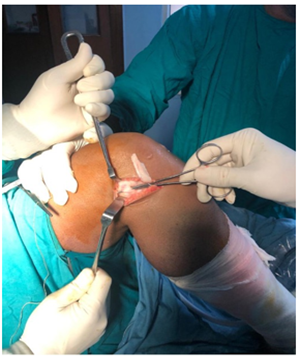
Figure 1: Showing the harvested ITB with attached tibial insertion and identification of FC
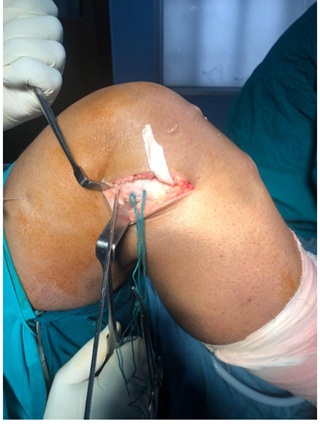
Figure 2: Showing insertion point in femur marked with a Beith pin
Postoperative Rehabilitation
A standardized rehabilitation protocol emphasizing early range of motion, quadriceps strengthening, and progressive return to sports was followed.
Outcome Measures
• Pivot shift test
• Lysholm knee score
• Tegner activity score
• Limb Symmetry Index (LSI)
Assessments were performed preoperatively, at 1 year, and at 2 years postoperatively, minima and maxima were calculated for all parameters. The Mann-Whitney U-test was used for group comparisons.
RESULTS:
Table 1: Demographic Data (n = 70)
|
Parameter |
Value |
|
Mean age(years) |
27.8 ± 5.4 |
|
Male /female |
54 / 16 |
|
Sports related injury |
82% |
|
Mean follow up |
24 months |
Table 2: Lysholm Knee Scores
|
Time Point |
Lysholm Score (Mean ± SD) |
|
Pre-op Score |
46.6 ± 11.0 |
|
6 months post-op |
89.9 ± 4.3 |
|
1 year post-op |
93.6 ± 4.2 |
|
2 year post-op |
94.0 ± 4.2 |
Table 3: Tegner Activity Score
|
Parameter |
Value |
|
Pre-op Score |
4.3 ± 0.2 |
|
Post-op Score |
7.2 ± 0.3 |
|
Patient resuming previous sports activities |
63 (90%) |
Table 4. Limb Symmetry Index (LSI) at 1-Year and 2-Year Follow-Up
|
1 Year Follow-Up LSI |
2 Year Follow-Up LSI |
|||
|
Triple Hop |
Crossover Hop |
Single Hop |
Triple Hop |
Crossover Hop |
|
93.1% |
92.4% |
95.9% |
94.3% |
93.1% |
|
Mean LSI 1 year follow up |
Mean LSI 2 year follow up |
|||
|
92.8% |
94.0% |
|||
Table 5: Limb Symmetry Index (LSI) at Follow-Up
|
Test Type |
1 Year Follow-Up LSI |
2 Year Follow-Up LSI |
|
Triple Hop |
93.1% |
94.3% |
|
Crossover Hop |
92.4% |
93.1% |
|
Single Hop |
95.9% |
— |
|
Mean LSI |
92.8% |
94.0% |
Table 6: Return to Activity
|
Outcome |
Number (%) |
|
Returned to previous sport |
63 (90%) |
|
Modified activity |
7 (10%) |
At final follow-up, no patient demonstrated a positive pivot shift. Functional scores showed statistically and clinically significant improvement. Ninety percent of patients returned to their preinjury activity level.
DISCUSSION:
Persistent rotational instability following ACL reconstruction is increasingly recognized as a major contributor to patient dissatisfaction and graft failure. High-grade pivot shift indicates substantial anterolateral structural deficiency, which isolated ACL reconstruction frequently fails to address.
Biomechanical studies have consistently demonstrated that combined ACL and anterolateral injuries lead to abnormal knee kinematics. Inderhaug et al. showed that isolated ACL reconstruction could not restore native laxity in knees with combined ACL and anterolateral lesions, whereas modified Lemaire tenodesis successfully normalized rotational stability. Similarly, systematic reviews have reported significantly lower rates of residual pivot shift when LET is added to ACL reconstruction.
In the present study, none of the patients exhibited a positive pivot shift at final follow-up, supporting the biomechanical rationale for lateral augmentation. Functional outcomes were excellent, with mean Lysholm scores improving to 94 and Tegner scores to 7.24. These results align with previous clinical studies demonstrating superior stability and functional recovery with combined procedures.
A key biomechanical advantage of the modified Lemaire technique lies in the anterior attachment of the ITB at Gerdy’s tubercle, providing a more effective restraint against anterior translation of the lateral tibial plateau compared with isolated ALL reconstruction. This force vector is particularly relevant during pivoting activities, which explains the high rate of return to sport observed in this cohort.
Zaffagnini et al. reported significantly better functional outcomes in patients undergoing combined ACL reconstruction and lateral tenodesis compared with isolated ACL reconstruction. Song et al., in their systematic review, demonstrated reduced postoperative laxity and improved stability in patients with high-grade pivot shift treated with lateral augmentation.
Graft failure is another important consideration. High-risk patients—including young athletes and those with high-grade pivot shift—exhibit higher rerupture rates following isolated ACL reconstruction. Recent literature suggests that LET may reduce graft failure by decreasing rotational loads on the intra-articular graft, thereby protecting it during early rehabilitation and return to sport.
In our cohort, 90% of patients returned to their previous activity level, with only 10% modifying sports participation. The progressive improvement in LSI from one to two years further suggests ongoing neuromuscular recovery and restoration of limb confidence.
Concerns regarding over-constraint and lateral compartment degeneration have historically limited the use of LET. However, modern techniques emphasizing appropriate graft tensioning and partial ITB closure appear to mitigate these risks. No clinical signs of over-constraint were observed in this study.
The findings support growing evidence that lateral tenodesis should be considered in patients with high-grade pivot shift undergoing ACL reconstruction. Rather than being a routine adjunct for all ACL injuries, LET appears best reserved for carefully selected high-risk populations.
CONCLUSION:
Combined arthroscopic ACL reconstruction with lateral extra-articular tenodesis provides excellent rotational stability and functional outcomes in patients presenting with high-grade pivot shift. In this prospective series of 70 patients, complete elimination of pivot shift was achieved, with significant improvements in Lysholm and Tegner scores and a 90% return-to-sport rate at two years.
These results reinforce the biomechanical and clinical rationale for addressing anterolateral instability in addition to intra-articular ACL reconstruction. The modified Lemaire technique, utilizing an ITB graft with preserved tibial attachment, offers a reliable method for restoring knee kinematics while avoiding excessive constraint.
Although isolated ACL reconstruction remains effective for many patients, those with pronounced rotational instability represent a distinct subgroup that benefits from lateral augmentation. Incorporating LET in such cases may reduce residual laxity, protect the ACL graft, and facilitate earlier and safer return to athletic activity.
Longer-term studies with larger cohorts are required to determine whether these short- to medium-term benefits translate into reduced osteoarthritis and sustained functional superiority.
Limitations of the Study
• Absence of a control group undergoing isolated ACL reconstruction
• Relatively short follow-up period
• Single-center design
• Lack of objective instrumented rotational measuremen.
REFERENCES:
1. Sung H, Ferlay J, Siegel RL, et al. Global cancer statistics 2020: GLOBOCAN estimates of incidence and mortality worldwide for 36 cancers in 185 countries. CA Cancer J Clin. 2021;71:209- 249.
2. Kurman RJ. WHO classification of tumours of female reproductive organs. 4th ed. International Agency for Research on Cancer, 2014:307.
3. Chikandiwa A, Pisa PT, Sengayi M, Singh E, Delany- Moretlwe S. Patterns and trends of HPV- related cancers other than cervix in South Africa from 1994– 2013. Cancer Epidemiol. 2019;58:121- 129.
4. Hansen BT, Campbell S, Nygard M. Long- term incidence trends of HPV- related cancers, and cases preventable by HPV vaccination: a registry- based study in Norway. BMJ Open. 2018;8:e019005.
5. Shack L, Lau HY, Huang L, Doll C, Hao D. Trends in the incidence of human papillomavirus- related noncervical and cervical cancers in Alberta, Canada: a population- based study. CMAJ Open. 2014;2:E127- E132.
6. Bertoli HK, Baandrup L, Aalborg GL, Kjaer AK, Thomsen LT, Kjaer SK. Time trends in the incidence and survival of vaginal squamous cell carcinoma and high- grade vaginal intraepithelial neoplasia in Denmark - A nationwide population- based study. Gynecol Oncol. 2020;158:734- 739.
7. Adams TS, Cuello MA. Cancer of the vagina. Int J Gynaecol Obstet. 2018;143(Suppl 2):14- 21.
8. Alemany L, Saunier M, Tinoco L, et al. Large contribution of human papillomavirus in vaginal neoplastic lesions: a worldwide study in 597 samples. Eur J Cancer. 2014;50:2846- 2854.
9. Fuste V, del Pino M, Perez A, et al. Primary squamous cell carcinoma of the vagina: human papillomavirus detection, p16(INK4A) overexpression and clinicopathological correlations. Histopathology. 2010;57:907- 916.
10. Bertoli HK, Rasmussen CL, Sand FL, et al. Human papillomavirus and p16 in squamous cell carcinoma and intraepithelial neoplasia of the vagina. International J Cancer. 2019;145:78- 86.
11. Rasmussen CL, Sand FL, Hoffmann Frederiksen M, Kaae Andersen K, Kjaer SK. Does HPV status influence survival after vulvar cancer? Int J Cancer. 2018;142:1158- 1165.
12. Urbute A, Rasmussen CL, Belmonte F, et al. Prognostic significance of HPV DNA and p16(INK4a) in anal cancer: a systematic review and meta- analysis. Cancer Epidemiol Biomarkers Prev. 2020;29:703- 7103.
13. De Vivar, A. D., Dawlett, M., Wang, J. P., Jack, A., Gong, Y., Staerkel, G., & Guo, M. (2015). Clinical performance of hybrid capture 2 human papillomavirus testing for recurrent high-grade cervical/vaginal intraepithelial neoplasm in patients with an ASC-US Papanicolaou test result during long-term posttherapy follow-up monitoring. Archives of Pathology and Laboratory Medicine, 139(2), 219-224.
14. de Sanjose, S., Brotons, M., & Pavon, M. A. (2018). The natural history of human papillomavirus infection. Best practice & research Clinical obstetrics & gynaecology, 47, 2-13.
15. Joura, E. A., Giuliano, A. R., Iversen, O. E., Bouchard, C., Mao, C., Mehlsen, J., ... & Luxembourg, A. (2015). A 9-valent HPV vaccine against infection and intraepithelial neoplasia in women. New England Journal of Medicine, 372(8), 711-723.
16. Garnaes, E., Frederiksen, K., Kiss, K., Andersen, L., Therkildsen, M. H., Franzmann, M. B., ... & von Buchwald, C. (2016). Double positivity for HPV DNA/p16 in tonsillar and base of tongue cancer improves prognostication: insights from a large population‐ based study. International journal of cancer, 139(11), 2598-2605.
17. Jentschke, M., Hoffmeister, V., Soergel, P., & Hillemanns, P. (2016). Clinical presentation, treatment and outcome of vaginal intraepithelial neoplasia. Archives of gynecology and obstetrics, 293(2), 415-419.
18. Faber, M. T., Sand, F. L., Albieri, V., Norrild, B., Kjær, S. K., & Verdoodt, F. (2017). Prevalence and type distribution of human papillomavirus in squamous cell carcinoma and intraepithelial neoplasia of the vulva. International journal of cancer, 141(6), 1161-1169.
19. Tainio, K., Jakobsson, M., Louvanto, K., Kalliala, I., Paavonen, J., Nieminen, P., & Riska, A. (2016). Randomised trial on treatment of vaginal intraepithelial neoplasia—Imiquimod, laser vaporisation and expectant management. International journal of cancer, 139(10), 2353-2358.