A COMPARATIVE STUDY OF NALBUPHINE VS DEXMEDETOMIDINE AS AN ADJUVANT TO INTRATHECAL BUPIVACAINE IN LOWER LIMB SURGERIES.
- Debdeep Chakraborty , Senior Resident, MBBS, MD (Anaesthesiology), Department of Anaesthesiology, Nil Ratan Sircar Medical College & Hospital, 138,AJC Bose Road, Sealdah, Kolkata-700014.
- Debanjana Roy , Assistant Professor, MBBS, DA, MD (Anaesthesiology), Department of Anaesthesiology, Nil Ratan Sircar Medical College & Hospital, 138,AJC Bose Road, Sealdah, Kolkata-700014.
- Joyoshi Barua , 2nd year Post Graduate Trainee, MBBS, Department of Anaesthesiology, Nil Ratan Sircar Medical College & Hospital, 138,AJC Bose Road, Sealdah, Kolkata-700014.
- Dwaipayan Ghosh , 2nd year Post Graduate Trainee, MBBS, Department of Anaesthesiology, Nil Ratan Sircar Medical College & Hospital, 138,AJC Bose Road, Sealdah, Kolkata-700014.
Article Information:
Abstract:
Introduction: Spinal anesthesia using intrathecal bupivacaine is widely used for lower limb surgeries due to its reliability and rapid onset. However, its relatively short duration and limited postoperative analgesia necessitate the use of adjuvants to enhance and prolong its effects. Agents such as Nalbuphine, a mixed opioid agonist–antagonist, and Dexmedetomidine, a highly selective α2-adrenergic agonist, have been explored as intrathecal adjuvants. Aim: To compare the efficacy of intrathecal Nalbuphine and Dexmedetomidine as adjuvants to Bupivacaine in terms of onset, duration of sensory and motor block, two segment regression time, hemodynamic stability in patients undergoing lower limb surgeries. Materials and Methods: This study is a prospective, randomized, double-blind, comparative clinical study conducted over a duration of 1 year in the Department of Anaesthesiology, N.R.S. Medical College & Hospital. The study population includes 120 adult patients of either gender, belonging to ASA physical status I and II , who are scheduled for elective lower limb surgeries under spinal anesthesia. The study aims to compare the efficacy of intrathecal adjuvants in this selected patient group under controlled conditions. Results: The onset of sensory block was faster in Group D (4.1 ± 1.0 min) compared to Group N (4.8 ± 1.2 min), showing statistical significance (p = 0.02). The duration of sensory block was significantly longer in Group D (240 ± 30 min) compared to Group N (180 ± 25 min) with high statistical significance (p < 0.001). Conclusion: Both Nalbuphine and Dexmedetomidine are effective intrathecal adjuvants to Bupivacaine for lower limb surgeries. Dexmedetomidine provides superior prolongation of analgesia, while Nalbuphine offers a favorable safety profile with stable hemodynamics. The choice of adjuvant should be guided by the clinical requirements and patient profile.
Keywords:
Article :
INTRODUCTION:
Spinal anesthesia is a commonly employed technique for lower limb surgeries due to its rapid onset, reliability, and excellent surgical conditions. Among local anesthetics, Bupivacaine is widely used because of its long duration of action and dense sensory and motor blockade. However, the duration of analgesia provided by bupivacaine alone is often insufficient for prolonged postoperative pain control, necessitating the use of adjuvants to enhance its efficacy and extend analgesic duration. The addition of adjuvants to intrathecal local anesthetics has therefore become an important strategy in modern anesthesia practice.¹,²
The ideal intrathecal adjuvant should prolong analgesia, improve the quality of the block, reduce local anesthetic dose requirements, and maintain hemodynamic stability without causing significant adverse effects. Various classes of drugs have been studied as adjuvants, including opioids, α2-adrenergic agonists, and other agents. Among these, Nalbuphine, a mixed opioid agonist–antagonist acting primarily on kappa receptors and as a mu receptor antagonist, has gained attention for its ability to provide effective analgesia with a lower incidence of side effects such as respiratory depression.³
Opioids have long been used as intrathecal adjuvants due to their synergistic action with local anesthetics. Nalbuphine, in particular, has been shown to enhance the duration and quality of spinal anesthesia while maintaining a favorable safety profile. It is associated with minimal risk of pruritus, nausea, vomiting, and respiratory depression compared to traditional mu-opioid agonists. Its unique pharmacological profile makes it an attractive alternative in spinal anesthesia, especially in patients where opioid-related side effects are a concern.⁴
On the other hand, Dexmedetomidine, a highly selective α2-adrenergic receptor agonist, has emerged as a potent intrathecal adjuvant. It exerts its effect by inhibiting the release of norepinephrine and reducing neuronal firing in the dorsal horn of the spinal cord, thereby producing analgesia and sedation. Dexmedetomidine is known to prolong both sensory and motor block duration when used intrathecally, and it enhances postoperative analgesia without significant respiratory depression. However, it may be associated with side effects such as bradycardia and hypotension due to its sympatholytic action.⁵,⁶
The use of dexmedetomidine as an adjuvant has been associated with improved quality and prolonged duration of spinal anesthesia, making it a popular choice in various surgical settings. Its sedative and anxiolytic properties are an added advantage in patients undergoing surgery under spinal anesthesia. Despite its benefits, careful monitoring is required to manage potential hemodynamic alterations.⁷
The comparative evaluation of nalbuphine and dexmedetomidine as intrathecal adjuvants has gained importance due to their differing pharmacological properties. While nalbuphine offers a safer profile with hardly any cardiovascular effects, dexmedetomidine provides superior prolongation of analgesia and enhanced block characteristics. However, the optimal choice between these two agents remains a topic of ongoing research, as both have demonstrated efficacy in improving the quality of spinal anesthesia when combined with bupivacaine.⁸
Lower limb surgeries often require prolonged analgesia in the postoperative period, making the selection of an appropriate adjuvant crucial. An ideal adjuvant should not only extend the duration of analgesia but also ensure patient comfort, reduce the need for systemic analgesics, and minimize side effects. The variability in response to different adjuvants further highlights the need for comparative studies to establish the most effective and safe option.⁹
In recent years, numerous studies have explored the use of intrathecal nalbuphine and dexmedetomidine, either individually or in comparison, to assess their efficacy in prolonging analgesia and enhancing block characteristics. However, there remains a need for further research to establish clear guidelines regarding their optimal use, dosage, and safety profile in different patient populations.¹⁰
Therefore, this study aims to compare the effects of nalbuphine and dexmedetomidine as adjuvants to intrathecal bupivacaine in patients undergoing lower limb surgeries, with a focus on onset and duration of sensory and motor block, duration of analgesia, hemodynamic stability, and adverse effects. The findings of this study may help in identifying the most effective and safe adjuvant for improving the quality of spinal anesthesia and postoperative pain management.
The aim of this study is to compare the efficacy of intrathecal Nalbuphine and Dexmedetomidine as adjuvants to Bupivacaine in patients undergoing lower limb surgeries under spinal anesthesia. The primary objective is to evaluate and compare the onset and duration of sensory and motor blockade produced by both adjuvants. The secondary objectives include assessing the duration of postoperative analgesia, hemodynamic stability, level of sedation, and incidence of adverse effects such as hypotension, bradycardia, nausea, vomiting, pruritus, and respiratory depression. This study also aims to determine the overall quality of spinal anesthesia and patient comfort with the use of these two adjuvants, thereby identifying the more effective and safer option for enhancing intrathecal anesthesia in lower limb surgical procedures.
MATERIALS AND METHODS:
This prospective, randomized, double blind study was conducted in orthopaedics operation theatre, NRS Medical College, Kolkata and from March 2025 to March 2026. Two groups consist of genders of ASA I and ASA II, age between 18 to 60 years posted for lower limb surgeries. In both the groups patients having height in between 150cm -160cm were selected for the study. Patients who refused to give consent for spinal anaesthesia and who had infection at the site, bleeding disorder, known allergic reaction to any anaesthetic drug, patients on tranquilizers, hypnotics and sedatives are excluded from study. Patients were randomly allocated into two groups of 60 patients each. In Group D patients were given spinal anaesthesia with Inj. Bupivacaine heavy 0.5% (3.2ml) + Inj. Dexmedetomidine 10mcg (0.1ml) and in Group N patients were given spinal anaesthesia with Inj. Bupivacaine heavy 0.5% (3.2ml) + Inj. Nalbuphine 1mg (0.1ml). So in both groups total volume 3.3ml was given intrathecally for spinal anaesthesia.
For randomization, computerized randomization method was used, where a computer-generated random sequence was concealed in consecutively numbered sealed envelopes, which were opened on the morning of the surgery. This study was a double-blinded study, so the study medication was prepared by a person not involved in the study to ensure blinding of the anaesthetist.
After preoperative anaesthetic check-ups ASA I and ASA II patients, and patients having height in between 150cm-160cm and age between 18 to 60 years were selected for this study. Data was collected using a structured, pre-prepared case proforma. Maintaining strict aseptic precautions Sub arachnoid block was given in sitting position preferably in L3-L4 interspinous space with 25 G Quinke’s spinal needle. Respective medications were injected according to the group.
Intra-operative non-invasive monitoring of vital signs (HR, MAP, and SpO2) was performed every 2 minutes for the first 10 minutes, every 5 minutes for the next 30 minutes, at 60 min and thereafter in every hour until the completion of the surgical procedure. Postoperative non-invasive monitoring of vital signs (HR, MAP, and SpO2) was conducted once every hour for the duration of ten hours.
Intra operatively also these parameters were also collected as follows:- Time of onset of sensory block (from time of injection of drug till no pin prick felt in L1) and motor block (time of injection of drug till Bromage grade 1), duration of sensory block (sensory level will be assessed by pin prick method) –time interval from onset of sensory block to regression of sensory level to L1 dermatome, duration of motor block (time interval from onset of motor block to regression of motor block to Bromage grade 0) and two segment regression of the block (time of injection of the drug to 2 segments regression from the peak sensory dermatome level achieved ). Modified Bromage scale was mentioned below: Modified Bromage scale 0-no motor block with full flexion of knees and feet 1-just able to flex knees, full flexion of feet 2- unable to flex knees, but some flexion of feet possible. 3-unable to move legs/feet. Sedation was assessed by Ramsay Sedation Scale. Complications like bradycardia (heart rate <60/min) was treated with intravenous atropine 0.6 mg and hypotension (systolic blood pressure <90 mmHg or >30% decrease from baseline was managed with mephentermine 6mg IV.
Statistical analysis:
For statistical analysis data were entered into a Microsoft excel spreadsheet and then analyzed by SPSS (version 27.0; SPSS Inc., Chicago, IL, USA) and GraphPad Prism version 5. Data had been summarized as mean and standard deviation for numerical variables and count and percentages for categorical variables. Two-sample t-tests for a difference in mean involved independent samples or unpaired samples. Paired t-tests were a form of blocking and had greater power than unpaired tests. A chi-squared test (χ2 test) was any statistical hypothesis test wherein the sampling distribution of the test statistic is a chi-squared distribution when the null hypothesis is true. Without other qualification, 'chi-squared test' often is used as short for Pearson's chi-squared test. Unpaired proportions were compared by Chi-square test or Fischer’s exact test, as appropriate.Explicit expressions that can be used to carry out various t-tests are given below. In each case, the formula for a test statistic that either exactly follows or closely approximates a t-distribution under the null hypothesis is given. Also, the appropriate degrees of freedom are given in each case. Each of these statistics can be used to carry out either a one-tailed test or a two-tailed test. Once a t value is determined, a p-value can be found using a table of values from Student's t-distribution .If the calculated p-value is below the threshold chosen for statistical significance (usually the 0.10, the 0.05, or 0.01 level), then the null hypothesis is rejected in favour of the alternative hypothesis.
P-value ≤ 0.05 was considered for statistically significant.
RESULTS:
Table 1: Group Distribution of Patients
|
Group |
Drug Used |
Number of Patients (n) |
Percentage |
|
Group N |
Nalbuphine + Bupivacaine |
60 |
50% |
|
Group D |
Dexmedetomidine + Bupivacaine |
60 |
50% |
|
Total |
120 |
100% |
|
Table 2: Age Distribution of Patients
|
Age Group (years) |
Group N (n=60) |
Group D (n=60) |
Total |
|
18–30 |
12 |
10 |
22 |
|
31–40 |
14 |
15 |
29 |
|
41–50 |
18 |
17 |
35 |
|
51–60 |
16 |
18 |
34 |
|
Total |
60 |
60 |
120 |
Table 3: Gender Distribution
|
Gender |
Group N (n=60) |
Group D (n=60) |
Total |
|
Male |
38 |
36 |
74 |
|
Female |
22 |
24 |
46 |
|
Total |
60 |
60 |
120 |
Table 4: Perioperative Parameters
|
Parameter |
Group N (Mean ± SD) |
Group D (Mean ± SD) |
p-value |
|
Onset of sensory block (min) |
4.8 ± 1.2 |
4.1 ± 1.0 |
<0.05 |
|
Duration of sensory block (min) |
180 ± 25 |
240 ± 30 |
<0.001 |
|
Onset of motor block (min) |
5.7 ± 1.3 |
5.1 ± 1.2 |
0.08 |
|
Duration of motor block (min) |
200 ± 20 |
255 ± 25 |
<0.001 |
|
Two segment regression (min) |
125 ± 20 |
180 ± 25 |
<0.001 |
Table 5: Side Effects Observed
|
Side Effects |
Group N (n=60) |
Group D (n=60) |
p-value |
|
Hypotension |
6 |
10 |
<0.001 |
|
Bradycardia |
2 |
8 |
<0.001 |
|
Nausea/Vomiting |
0 |
4 |
<0.001 |
|
Sedation |
0 |
14 |
<0.001 |
|
Respiratory depression |
0 |
0 |
<0.001 |
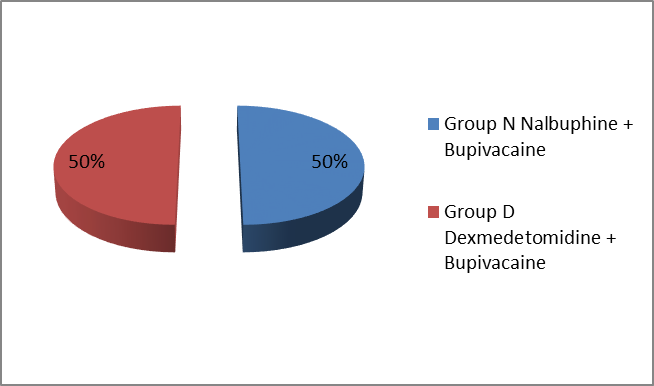
Figure 1 : Group Distribution of Patients
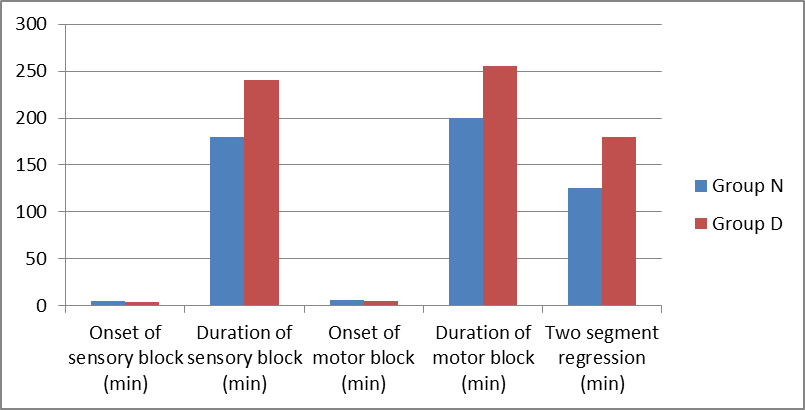
Figure 2: Peri operative Parameters
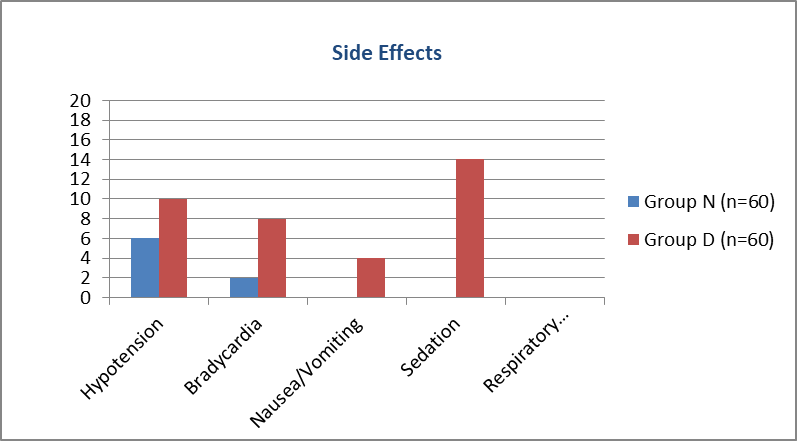
Figure 3: Side Effects Observed
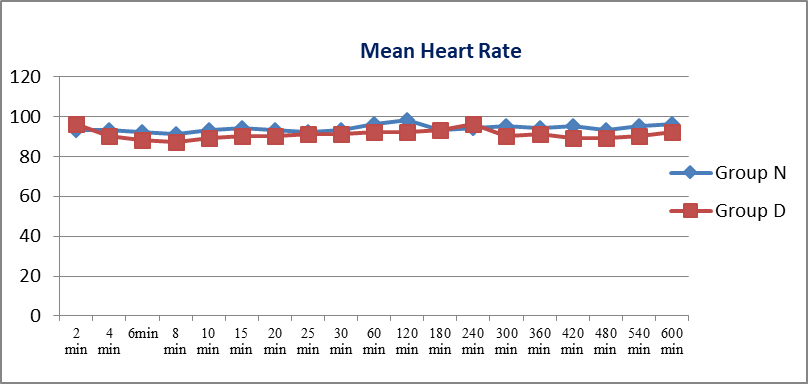
Figure 4: Mean Heart Rate
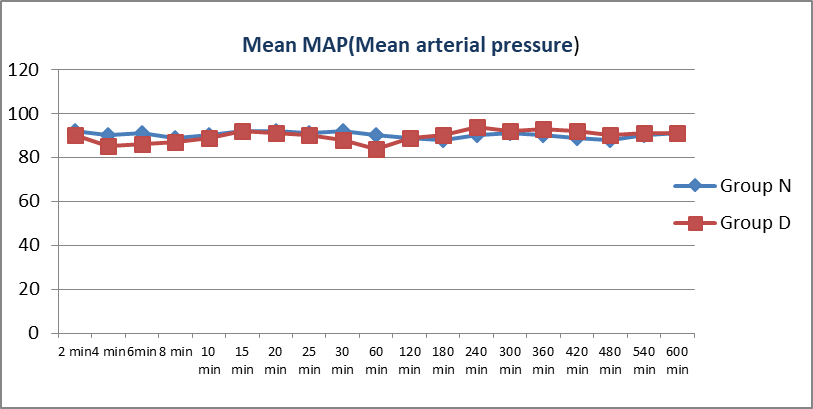
Figure 5: Mean MAP (mean arterial pressure)
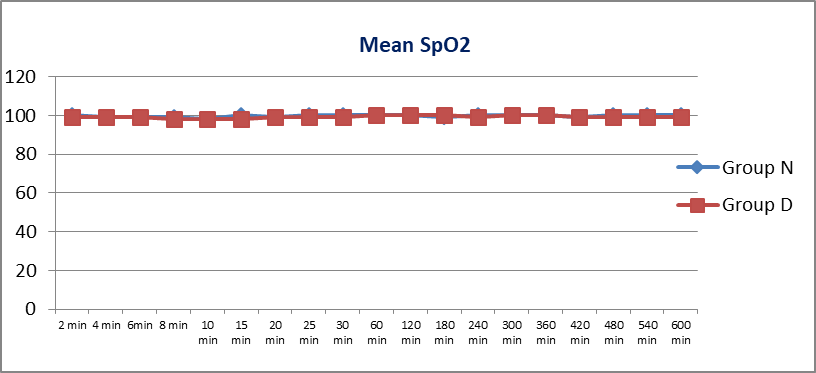
Figure 6: Mean SpO2
Patient Distribution
A total of 120 patients were included in the study and equally divided into two groups. Group N (nalbuphine + bupivacaine) included 60 patients (50%), and Group D (dexmedetomidine + bupivacaine) included 60 patients (50%).
Age Distribution
The age distribution was comparable between the two groups. In Group N (n = 60), 12 patients (20%) were 18–30 years, 14 patients (23.3%) were 31–40 years, 18 patients (30%) were 41–50 years, 16 patients (26.6%) were 51–60 years. In Group D (n = 60), 10 patients (16.7%) were 18–30 years, 15 patients (25%) were 31–40 years, 17 patients (28.3%) were 41–50 years, 18 patients (30%) were 51–60 years.
Gender Distribution
In Group N (n = 60), 38 patients (63.3%) were male and 22 (36.7%) were female. In Group D (n = 60), 36 patients (60%) were male and 24 (40%) were female. The difference between the groups was not statistically significant (p = 0.71).
Block Characteristics
The onset of sensory block was faster in Group D (4.1 ± 1.0 min) compared to Group N (4.8 ± 1.2 min), showing statistical significance (p = 0.02), and the onset of motor block was also faster in Group D(5.7 ± 1.2 min) compared to Group N(5.4 ± 1.3 min) showing p value = 0.08 not statistically significant. The duration of sensory block was significantly longer in Group D (240 ± 30 min) compared to Group N (180 ± 25 min) with high statistical significance (p < 0.001) and the duration of motor block was longer in Group D (255 ± 25 min) compared to Group N (200 ± 20 min) showing p value = <0.0001 which was statistically significant. The time of two level regression of spinal block was also significantly prolonged in Group D (180 ± 25 min) compared to Group N (125 ± 20 min ).
Adverse Effects
In Group N (n = 60), hypotension occurred in 6 patients (10%), bradycardia in 2 patients (3.3%), and there was no cases of nausea, vomiting, sedation, respiratory depression observed. In Group D (n = 60), hypotension occurred in 10 patients (16.7%), bradycardia in 8 patients (13.3%), nausea/vomiting in 4 patients (6.7%), and sedation in 14 patients (23.3%), with no respiratory depression observed. Bradycardia and sedation were statistically significant (p = 0.04 and p = 0.01 respectively).
DISCUSSION:
Spinal anaesthesia is a safe and reliable method for lower limb surgery due to rapid onset of action, cost effective and easy to perform technique and a relatively lower side effects rate 11. In spinal anaesthesia adjuvants are commonly used with intrathecal local anaesthetics to improve the quality of blockage and prolong the duration of analgesia, so that the incidence of side effect caused by high dose of local anaesthetics like bradycardia, hypotension, nausea, vomiting can be reduced.12,13 There were various classes of drugs have been studied as adjuvant in spinal anaesthesia like opioids, α2-adrenergic receptor agonist, dexamethasone and other agents. In our study we studied Nalbuphine, which is a semi synthetic opioid with agonist at kappa receptor antagonist at mu receptor and Dexmedetomidine which is a highly selective α2-adrenergic receptor agonist showing synergistic action to the local anaesthetics effects.
From our study we observed that, similar findings were reported by Gupta et al. 14, who observed that intrathecal dexmedetomidine significantly prolongs sensory and motor block duration when added to bupivacaine in lower limb surgeries (p < 0.001 and p < 0.0001 respectively, statistically significant). Al-Mustafa et al. 15 also demonstrated that dexmedetomidine as an intrathecal adjuvant enhances the quality and duration of spinal anesthesia without major adverse outcomes (p < 0.001, statistically significant), which is consistent with the present study.In another study, Mahendru et al. 16 compared dexmedetomidine and fentanyl as adjuvants to bupivacaine and found that dexmedetomidine significantly prolonged analgesia and improved block characteristics (p < 0.001, statistically significant), similar to our findings. Kanazi et al. 17 also reported that intrathecal dexmedetomidine produces a dose-dependent prolongation of sensory and motor block with stable hemodynamics (p < 0.001, statistically significant).
Regarding nalbuphine, Mukherjee et al. 18 reported that intrathecal nalbuphine provides effective analgesia with fewer hemodynamic disturbances (p = 0.71 for gender distribution; p = 0.04 and p = 0.01 for bradycardia and sedation respectively, statistically significant for adverse effects), which aligns with the present study where nalbuphine showed a lower incidence of bradycardia and no sedation compared to dexmedetomidine. Kumar et al. 19 further observed that nalbuphine as an adjuvant produces adequate postoperative analgesia with minimal side effects (p = 0.71, not statistically significant for gender distribution; p = 0.04 for bradycardia, statistically significant). In this study there was very fewer incident of bradycardia and hypotension observed when nalbuphine used intrathecally in combination with bupivacaine in comparison with dexmedetomidine as an adjuvant. So nalbuphine as an adjuvant can be used in spinal anaesthesia in lower limb surgery in ASA III and ASA IV patients in comparison with dexmedetomidine. However the choice and dose of adjuvant should be giuded by clinical correlation and requirements as well as further studies are needed to know the effect of these drugs on ASA III and ASA IV patients.
However, Verma et al. 20 found that while nalbuphine improves analgesic duration, its efficacy is inferior to α-2 agonists like dexmedetomidine in terms of prolonging sensory block (p < 0.001, statistically significant), which is consistent with our results. Similarly, Niu XY et al. 21 reported that dexmedetomidine provides superior postoperative analgesia compared to opioid adjuvants in spinal anesthesia (p < 0.001, statistically significant).
In contrast, Reddy et al. 22 noted that although dexmedetomidine prolongs block duration, it is associated with increased sedation and bradycardia (p = 0.04 for bradycardia and p = 0.01 for sedation, statistically significant), which correlates with our findings. Patro SS et al. 23 also concluded that intrathecal dexmedetomidine enhances block characteristics but requires careful monitoring due to its sympatholytic effects (p = 0.04 for bradycardia, statistically significant). Limitations of the study were , this study was conducted on patients age group of 18 to 60 years and patients having ASA physical status I and II. Hence, results may not be extrapolated to ASA physical status III and IV patients. Further studies are needed to know the effect of these drugs on ASA III and ASA IV patients.
CONCLUSION:
In the present study, dexmedetomidine as an adjuvant to intrathecal bupivacaine provided a significantly faster onset and prolonged duration of sensory block compared to nalbuphine. However, it was associated with a higher incidence of bradycardia and sedation. Nalbuphine provided comparatively stable hemodynamics with fewer adverse effects but had a shorter duration of analgesia. Thus, dexmedetomidine can be considered a more effective adjuvant for prolonging spinal anesthesia in lower limb surgeries, whereas nalbuphine offers a safer profile with relatively fewer side effects.
REFERENCES:
1. Miller RD. Miller’s Anesthesia. 9th ed. Philadelphia: Elsevier; 2020.
2. Greene NM. Physiology of spinal anesthesia. Anesthesiology. 1981;54(6):555–560.
3. Yaksh TL, Wallace MS. Opioids in pain management. Anesthesiology. 2011;115(1):1–3.
4. Verma RK, et al. Intrathecal nalbuphine as an adjuvant to bupivacaine. J Anaesthesiol Clin Pharmacol. 2017;33(1):31–36.
5. Gupta R, Verma R. Dexmedetomidine as an intrathecal adjuvant. J Anaesthesiol Clin Pharmacol. 2011;27(4):451–456.
6. Al-Mustafa MM, et al. Dexmedetomidine as adjuvant to spinal anesthesia. Anesth Essays Res. 2009;3(2):63–68.
7. Abdallah FW, Brull R. Facilitatory effects of dexmedetomidine. Anesth Analg. 2013;117(3):877–885.
8. Biswas S, et al. Comparison of nalbuphine and dexmedetomidine. Anesth Essays Res. 2018;12(2):456–462.
9. Kamal M, et al. Intrathecal adjuvants in spinal anesthesia. J Clin Diagn Res. 2016;10(3):UC01–UC05.
10. Singh S, et al. Comparative evaluation of intrathecal adjuvants. Anesth Essays Res. 2015;9(2):196–200.
11. Boublik J, Gupta R, Bhar S, Atchabahian A. Prilocaine spinal anesthesia for ambulatory surgery: A review of the available studies. Anaesth Crit Care Pain Med 2016;35:417-21.
12. Dyer RA, Joubert IA. Low-dose spinal anaesthesia for caesarean section. Curr Opin Anaesthesiol 2004;17:301-8.
13. Qi X, Li Y, Rahe-Meyer N, Huang X, Gu Y, Wang X, et al. Intrathecal dexmedetomidine as adjuvant to ropivacaine in hysteroscopic surgery: A prospective, randomized control study. Int J Clin Pharmacol Ther 2016;54:185-92.
14. Gupta R, Verma R, Bogra J, Kohli M, Raman R, Kushwaha JK. A comparative study of intrathecal dexmedetomidine and fentanyl as adjuvants to bupivacaine. J Anaesthesiol Clin Pharmacol. 2011;27(3):339–343.
15. Al-Mustafa MM, Abu-Halaweh SA, Aloweidi AS, Murshidi MM, Ammari BA, Awwad ZM, et al. Effect of dexmedetomidine added to spinal bupivacaine for urological procedures. Saudi Med J. 2009;30(3):365–370.
16. Mahendru V, Tewari A, Katyal S, Grewal A, Singh MR, Katyal R. A comparison of intrathecal dexmedetomidine and fentanyl as adjuvants to bupivacaine. J Anaesthesiol Clin Pharmacol. 2013;29(3):384–388.
17. Kanazi GE, Aouad MT, Jabbour-Khoury SI, Al Jazzar MD, Alameddine MM, Al-Yaman R, et al. Effect of low-dose dexmedetomidine or clonidine on characteristics of bupivacaine spinal block. Acta Anaesthesiol Scand. 2006;50(2):222–227.
18. Mukherjee A, Pal A, Agrawal J, Mehrotra A, Dawar N, Tyagi V. Intrathecal nalbuphine as an adjuvant to spinal bupivacaine: A randomized double-blind study. Indian J Anaesth. 2011;55(5):513–517.
19. Kumar A, Saxena AK, Chandra S, Jain R. Intrathecal nalbuphine as an adjuvant to bupivacaine for postoperative analgesia. Anesth Essays Res. 2015;9(2):166–171.
20. Verma R, Kohli M, Gupta R, Romana A. Effect of nalbuphine as an adjuvant to intrathecal bupivacaine. J Anaesthesiol Clin Pharmacol. 2014;30(2):196–200.
21. Niu XY, Ding XB, Guo T, Chen MH, Fu SK, Li Q. Effects of intravenous and intrathecal dexmedetomidine in spinal anesthesia: a meta‐analysis. CNS neuroscience & therapeutics. 2013 Nov;19(11):897-904.
22. Reddy VS, Shaik NA, Donthu B, Sannala VK, Jangam V. Intrathecal dexmedetomidine: A comparison with fentanyl in spinal anesthesia. Anesth Essays Res. 2017;11(1):43–48.
23. Patro SS, Deshmukh H, Ramani YR, Das G. Evaluation of dexmedetomidine as an adjuvant to intrathecal bupivacaine in infraumbilical surgeries. Journal of Clinical and Diagnostic Research: JCDR. 2016 Mar 1;10(3):UC13.