Integrated Clinical Peradeniya OP score and Biochemical Correlation in Organophosphorus Compound Poisoning: A Prospective Prognostic Study.
- Syed Farooque Ali , Assistant professor, Department of Endocrinology, Ballari Medical College and Research Centre, Ballari, Karnataka, India.
- Syed Hyder Ali , Assistant professor, Department of Pediatrics, Karwar Institute of Medical Sciences,Karwar, Karnataka, India.
- Mansoor Ali Savadathi , Senior Resident, Department of Anesthesia, Ballari Medical College and Research Centre, Ballari, Karnataka, India.
- Syeda Haafiza Begum4 , Assistant professor, Department of OBG, Akash Institute of Medical Sciences and Research Centre, Devanahalli, Bengaluru, Karnataka, India.
- Suresh Harsoor , Professor and unit head, Department of Medicine, MR Medical College, Kalaburagi, Karnataka, India.
Article Information:
Abstract:
Background: Organophosphorus poisoning is the most common medicotoxic emergency in India. So this study was conducted to assess the severity of Organophosphorus poisoning using clinical Peradeniya OP Poisoning Score (POP Score) and biochemical parameters using Sr. Pseudocholinesterase, Sr. Amylase, Sr. Lipase and Total Creatinine Phosphokinase levels. Material and Methods: The cross-sectional study was conducted at Basaveshwar Teaching and General Hospital attached to MR Medical College, Kalaburagi from January 2016 to December 2016. There were 189 patients with OP compound poisoning admitted to the Department of Medicine during the study period. After applying inclusion and exclusion criteria, 50 patients who fulfilled all the criteria were chosen as study subjects. The results were analyzed using chi-square test. Data was analyzed using SPSS 22 and P<0.05 was considered statistically significant. Results: The majority of patients (64%) in our study belonged to the mild grade of poisoning with a POP score less than 4. Only 1 patient had a score of more than 7 and had severe poisoning. The percentage of patients requiring ventilator support was comparatively higher in moderate (70.6%) and severe grade of poisoning using POP score (100%). In this study, 64% of patients had Pseudocholinesterase levels more than 50%. Only 4% of patients had severe poisoning with Pseudocholinesterase levels less than 10%. 40% of patients had increased serum amylase, lipase and Total CPK of which 10% of patients had documented pancreatitis. Mortality in our study was 18% and 80% of them had increased serum amylase, lipase, and total CPK levels. Conclusion: It is concluded that organophosphate poisoning in this study predominantly affected young adults from rural and low socioeconomic backgrounds, with suicidal ingestion being the most common mode of exposure.
Keywords:
Article :
INTRODUCTION:
Organophosphorus (OP) compounds have been widely used for a few decades in agriculture for crop protection and pest control, thousands of these compounds have been screened and over one hundred of them have been marketed for these purposes [1]. OPs constitute a heterogeneous category of chemicals specifically designed for the control of pests, weeds or plant diseases [2]. Their application is still the most effective and accepted means of protecting plants from pests and has contributed significantly to enhanced agricultural productivity and crop yields [3]. Organophosphorous poisoning is the most common medicotoxic emergency in India. Acute organophosphorous poisoning is an important indication for emergency admission in most hospital throughout India [4].
The importance of pesticides in India can be understood from the fact that agriculture is a major component of the Indian economy: It contributes 22% of the nation’s GDP and is the livelihood of nearly 70% the country’s workforce. Although poisoning can result from occupational exposure or accidental ingestion, in most cases there is suicidal intent [5]. Their easy availability renders op insecticide poisoning a worldwide health problem affecting millions of people. As in India the majority of people are agriculturist, it allows easy availability of these compounds [6]. The World Health Organization estimated that there were 873,000 suicides worldwide in 2002 which make suicide a major cause of premature mortality globally. The effective number of cases of pesticide poisoning occurring in India annually has been estimated by G. Ravi et al 2007 to be up to 76000, much higher than the figure of NCRB ( National Crime Records Bureau) [7]. Furthermore, Gunell et al, 2007 calculate that the number of intentional cases alone reaches some 126,000 cases annually.[4] The organophosphate compounds are most commonly associated with serious human toxicity, accounting for more than 80% of pesticide-related hospitalizations [8]. Organophosphates act by irreversibly inhibiting the enzyme cholinesterase, resulting in accumulation of acetylcholine at synapses and myoneural junctions leading to cholinergic over activity. Direct cardio toxic effect of organophosphorous compounds is also reported. Mortality ranges from 4-30% in Indian studies. Recent study from south India reported mortality rate of 4% in poisoning cases [9].
The most common cause of death is from respiratory infections. Organophosphorous compounds decrease the level of cholinesterase in the blood. As its level can be easily estimated, they are used frequently for assessment of the severity of OP poisoning [10]. Peradeniya OP poisoning scale, is a clinical scoring system and has not been studied much in the Indian scenario. This can be a very useful tool in predicting the severity and outcome of the patient with OP poisoning. And thus predict the need of ventilator support [11].
MATERIALS AND METHODS:
The cross-sectional study was conducted at Basaveshwar Teaching and General Hospital attached to MR Medical College, Kalaburagi from January 2016 to December 2016. There were 189 patients with OP compound poisoning admitted to the Department of Medicine during the study period. After applying inclusion and exclusion criteria, 50 patients who fulfilled all the criteria were chosen as study subjects. The results were analyzed using chi-square test. A history of exposure to organophosphorus compound within previous 24 hours with characteristic clinical manifestations of organophosphorus compound poisoning. Patients who receive treatment with atropine, before admission, Patients with doubtful diagnosis, Mixed poisoning with other substances and history of serious systemic illness. Data was analyzed using SPSS 22 and P<0.05 was considered statistically significant.
RESULTS:
The patients were in the age group of 17 to 60 years. Majority of the patients were in the age group of 21-30 years (46%). 62% of the patients were from rural areas and 28% of them were housewives. 72% of patients were from low socio economic status. Route of intake of poison was oral in majority of patients. 98% of patients consumed poison with a suicidal intent. Amount of poison consumed did not correlate with the severity of poisoning. The most common symptom reported by patients in our study was nausea (78%), vomiting (76%).The most commonly found clinical sign was tachypnoea in 70% of patients followed by fasciculations which was seen in 56% of patients. Mortality (5%) was least among the patients who presented to the hospital early as compared to those who presented late. Mild poisoning was seen in 64% of patients whereas 34% of the patients had moderate poisoning according to POP scale.
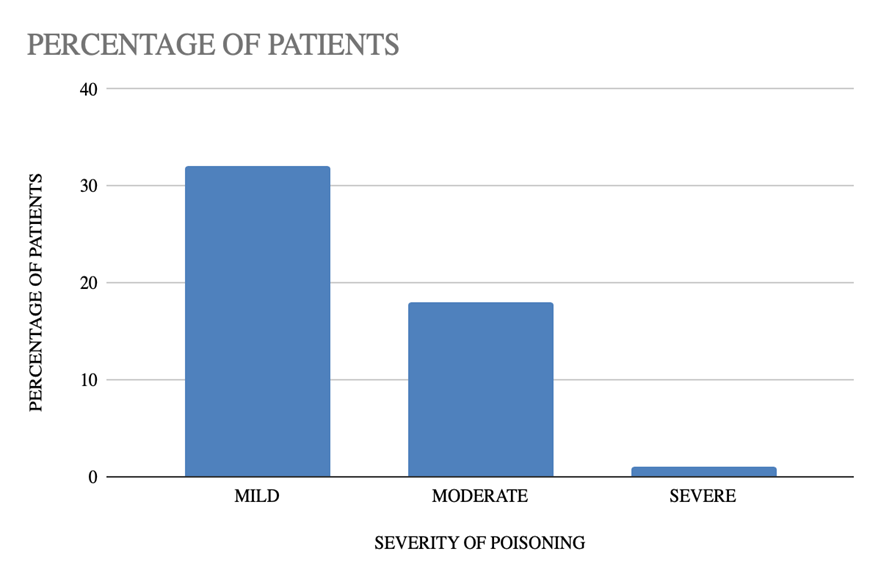
15.6% of the patients with mild grade of poisoning (POP scale) required ventilator support. The percentage of patients requiring ventilator support was comparatively higher in moderate (70.6%) and severe cases (100%) of poisoning. The mortality rate was 3.1% with mild ,41.2% with moderate and 100% with severe grade of poisoning according to POP score. In this study, 64% of the patients had PChE levels of more than 50% which is within the normal limits. Only four percent of the patients had severe poisoning with PChE levels less than 10%. 30 (93.7%) of cases with normal grade of poisoning did not require ventilator support, 88.9% of patients with pche levels <50% required ventilator support. Majority of patients 32 (64%) had subclinical poisoning with their Pseudocholinesterase levels being >50% out of which 1 patient expired. Patients with pseudocholinesterase levels <50% had higher mortality compared to patients with Pche level >50.
Table 1: Severity, Biochemical Profile, Management, and Outcomes (n = 50)
|
Variable |
Category |
n (%) |
|
Severity (POP Scale) |
Mild |
32 (64.0%) |
|
Moderate |
17 (34.0%) |
|
|
Severe |
1 (2.0%) |
|
|
Ventilator Requirement (by Severity) |
Mild |
5 (15.6%) |
|
Moderate |
12 (70.6%) |
|
|
Severe |
1 (100.0%) |
|
|
Mortality (by Severity) |
Mild |
1 (3.1%) |
|
Moderate |
7 (41.2%) |
|
|
Severe |
1 (100.0%) |
|
|
Overall Outcome |
Survived |
41 (82.0%) |
|
Expired |
9 (18.0%) |
|
|
Pseudocholinesterase Levels |
>50% |
32 (64.0%) |
|
10–50% |
16 (32.0%) |
|
|
<10% |
2 (4.0%) |
|
|
Ventilator Requirement (PChE Levels) |
>50% |
2 (6.3%) |
|
<50% |
16 (88.9%) |
|
|
Time to Presentation vs Survival |
≤2 hours |
Survival 95.0%, Mortality 5.0% |
|
>4 hours |
Survival 62.5%, Mortality 37.5% |
|
|
Biochemical Abnormalities |
Raised Amylase/Lipase/CPK |
20 (40.0%) |
|
Pancreatitis |
5 (10.0%) |
|
|
Mortality with Raised Enzymes |
Present among deaths |
8 (80.0%) |
|
Absent among deaths |
2 (20.0%) |
DISCUSSION:
In our study, about 27 patients had consumed less than 30 ml of poison. Most patients in this group had mild (62.5%) and moderate grade (41.2%) of poisoning according to the Peradeniya OP Poisoning (POP) scale. Pseudo cholinesterase (PChe) levels were in the normal range in about 64% of patients who had consumed less than 30ml and none had severe poisoning according to PChe levels. As the amount of poison increased to more than 50 ml, the severity of poisoning did not correlate with either PChe levels or the POP scale [12]. Majority of patients (64%) had subclinical poisoning with their pseudo cholinesterase levels being >50%, out of which only 1 patient expired. Patients with PChe levels <50% had more mortality compared to patients with PChe levels >50%. p value - <0.001.
This in accordance with findings from Namba et al who found definitive correlation between PChe levels and severity of poisoning and considered it a valid marker of severity and to prognosticate patients with OP poisoning [13]. Respiratory failure requiring ventilator support was observed in 36.0% of patients in our study. In this study, PChe levels had a sensitivity of 88.9% and specificity of 93.2% in predicting the need for ventilator support. The positive predictive value is 89%, and the negative predictive value of 93%. So, it can be concluded that PChe levels can be a better predictor to categorize patients who might not require ventilator support at admission. However, studies with large sample sizes and heterogeneous populations are needed to confirm the results. The POP scale was calculated for all patients on admission. 64% of patients had mild poisoning, and 34% had moderate poisoning [14]. 1 patient in our study belonged to severe grade of poisoning and required ventilator support and expired. The individual components of the POP scale, namely miosis, fasciculation, respiratory rate, bradycardia, and level of consciousness, were compared with the need for ventilator support. The POP score ranges from 0 to 11.
In our study, only 5 of 32 patients (15.6%) with mild poisoning required ventilator support. Among patients with moderate and severe poisoning 13 out of 18 patients required. 72.2% of patients with a POP score>4 required ventilator support. This was statistically significant in predicting the need for ventilator support [15]. Reihman et al found significant associations between the POP score and PChe levels, the POP score and hospital stay, the total atropine dose required, and mechanical ventilation. The higher the POP scale score, the greater the suppression of PChe levels. Goel et al compared individual components of the POP scale and concluded that they can be used in predicting the need for ventilator support. In this study, POP scoring had a sensitivity of 70% and specificity of 83% in predicting the need for ventilator support. The positive predictive value is 67%, and the negative predictive value of 85% [16-18]. Overall accuracy is 78%. So, it can be concluded that the POP score is a better predictor of patients who might not require ventilator support at admission. However, as mentioned earlier, studies with large sample sizes and heterogeneous populations are needed to confirm the results.India is an agriculture-based country wide easy accessibility to op poison hence it remains one of the common modes of suicide in our country.
CONCLUSION:
It is concluded that organophosphate poisoning in this study predominantly affected young adults from rural and low socioeconomic backgrounds, with suicidal ingestion being the most common mode of exposure. The severity of poisoning, as assessed by the POP scale, showed a strong association with clinical outcomes, including ventilator requirement and mortality. Patients with moderate and severe poisoning had markedly higher rates of ventilatory support and death compared to those with mild poisoning.
REFERENCES:
1. G Ravi, C Rajendiran, P Thirumalaikolundusubramanian, N Babu. Poison control, training and research center, Institute of Internal Medicine, Government General Hospital, Madras Medical College, Chennai, India. Presented at 6th Annual congress of Asia Pacific Association of Medical Toxicology, Bangkok, Thailand 2-14 December 2007.
2. L Haddad, J Winchester. Clinical management of poisoning and overdose. Philedelphia, WB Saunders, 1983, 575-586
3. John.P.,Morgan.M.D. The Jamaican Ginger Paralysis, JAMA 1982; 248 (15):1864-67.
4. Kenneth D Katz M. Organophosphate Toxicity 2012 [updated Jan 23, 2012; cited.
5. Pawar KS, Bhoite RR, Pillay CP, Chavan SC, Malshikare DS, Garad SG. Continuous pralidoxime infusion versus repeated bolus injection to treat organophosphorus pesticide poisoning: a randomised controlled trial. Lancet. 2006;368(9553):2136-41.
6. Guyton Arthur.C : Text book of Medical Physiology 8th ed
7. Katzung.B.G, Masters.S.B, Trevor.A.J, Basic & Clinical Pharmacology, McGraw-Hill Medical; 11 ed
8. Churchill Davidson Wylie: A Practice of Anaesthesia 6th ed.
9. Taylor P. Anticholinesterase agents. In: Brunton LL, editor. The pharmacological basis of therapeutics. 12 ed2012. p. 239-55.
10. Jhon B, Sullivan Jr. Gary. R. Hazardous Materials Toxicology 1992.
11. Karalliedde L, Sananayake N. Organophosphorus insecticide poisoning. Br J Anaesth 1989; 63: 736-750.
12. Aaron C K, Howland M A. Insecticides: Organophosphates and carbamates. Goldfrank Toxicological Emergencies, Gold Frank L.R., Flomenbaum NE et al, 6th edition, Appleton and Lange, 1998, page 1429.
13. Carlton FB, Simpson W.M., Haddad L.M. Pesticides: The organophosphate and other insecticides. In: Clinical management of poisoning and drug over dosage, Lister M. Haddad, 3rd edition WB Saunders 1998; page 836-840.
14. Lawrence P.N.Bennet : Clinical Pharmacology 6th ed.
15. Bardin P G, van Eeden S F, Moolman J A, Foden A P, Joubert J R. Organophosphate and carbamate poisoning. Arch Intern Med 1994; 154: 1433-41.
16. Karalliedde L. Organophosphorus poisoning and anaesthesia. Anaesthesia 1999; 54: 1073-1088.
17. Senanayake N. Organophosphorus poisoning, In: Neurology in tropics, Chopra J S, Sawhney I M S, B I Churchill Livingstone 1999; page102-109.
18. Namba T, Nolte C T, Jackrel J, Grob D. Poisoning due to organophosphate insecticides. Acute and chronic manifestations. Am J Med 1971;50:475-92.