SERUM URIC ACID LEVELS AND END-ORGAN DAMAGE IN ESSENTIAL HYPERTENSION.
- M.Bathragiri , Assistant professor, department of general medicine, government Kilpauk medical College & hospital, Chennai.
- SARATH KUMAR , Senior Resident, Department of Cardiology, Government Kapv Medical College, Trichy.
Article Information:
Abstract:
Background: Essential hypertension is a major risk factor for cardiovascular morbidity and mortality, often leading to end-organ damage. Serum uric acid has been increasingly recognized as a potential contributor to the pathogenesis and progression of hypertension and its complications. Aim: To evaluate the correlation between serum uric acid levels and end-organ damage in patients with essential hypertension. Materials and Methods: This observational cross-sectional study was conducted among 100 patients with essential hypertension admitted to the Department of General Medicine, Government Kilpauk Medical College, over six months. Serum uric acid levels were measured using the enzymatic colorimetric method. End-organ damage was assessed by echocardiography for left ventricular dysfunction, dipstick method for albuminuria, and fundus examination using Keith-Wagener classification. Statistical analysis was performed using SPSS version 23.0, with p < 0.05 considered significant. Results: The majority of patients were aged 51–60 years (30%) and predominantly male (76%). Most had normal serum uric acid levels (82%), while 10% had elevated levels. A significant association was observed between serum uric acid levels and age (p = 0.005). However, no significant association was found with gender, BMI, lifestyle factors, diabetes mellitus, left ventricular hypertrophy, coronary artery disease, albuminuria, or retinopathy. Conclusion: Serum uric acid showed limited association with end-organ damage in essential hypertension, though it may serve as a supportive biomarker. Further large-scale studies are required to establish its clinical significance.
Keywords:
Article :
INTRODUCTION:
Essential hypertension is a major global public health concern and a leading contributor to cardiovascular morbidity and mortality, affecting nearly one-third of the adult population worldwide. It is a multifactorial disorder characterized by sustained elevation of arterial blood pressure with no identifiable secondary cause. Over time, uncontrolled hypertension leads to progressive end-organ damage involving the heart, kidneys, brain, and vasculature, manifesting as left ventricular hypertrophy, chronic kidney disease, stroke, and retinopathy. Increasing attention has been directed toward identifying modifiable risk factors and biomarkers that may predict the severity and complications of hypertension. Among these, serum uric acid has emerged as a potential contributor to both the development and progression of hypertensive target organ damage. [1]
Uric acid, the final oxidation product of purine metabolism in humans, has traditionally been associated with gout and metabolic disorders. However, growing evidence suggests that elevated serum uric acid levels may play a pathogenic role in cardiovascular and renal diseases. Hyperuricemia has been linked with endothelial dysfunction, oxidative stress, inflammation, and activation of the renin–angiotensin–aldosterone system, all of which are key mechanisms in the pathophysiology of hypertension and its complications. Furthermore, uric acid may promote vascular smooth muscle cell proliferation and impair nitric oxide production, contributing to arterial stiffness and reduced vascular compliance. [2,3]
Several epidemiological and clinical studies have demonstrated a strong association between serum uric acid levels and hypertension, with higher levels observed in hypertensive individuals compared to normotensive controls. More importantly, elevated uric acid levels have been correlated with the severity of hypertension and the extent of end-organ damage. In the cardiovascular system, hyperuricemia has been associated with left ventricular hypertrophy and increased arterial stiffness. In the renal system, it contributes to glomerular hypertension, afferent arteriolar thickening, and tubulointerstitial fibrosis, ultimately leading to chronic kidney disease. Additionally, in the cerebral circulation, it has been implicated in increased risk of stroke and small vessel disease. [4–6]
The relationship between serum uric acid and hypertensive end-organ damage is complex and appears to be bidirectional. While elevated uric acid may contribute to the initiation and progression of hypertension, hypertension itself can reduce renal excretion of uric acid, thereby exacerbating hyperuricemia. This interplay creates a vicious cycle that accelerates vascular injury and organ dysfunction. Moreover, hyperuricemia often coexists with other metabolic abnormalities such as insulin resistance, obesity, and dyslipidemia, further amplifying cardiovascular risk. [7,8]
Given these observations, serum uric acid has gained attention not only as a biomarker but also as a potential therapeutic target in essential hypertension. Early identification of hyperuricemia in hypertensive patients may help stratify risk and guide more aggressive management strategies to prevent end-organ damage. However, despite accumulating evidence, the causal role of uric acid in hypertension-related complications remains a subject of ongoing research and debate. Therefore, studying the association between serum uric acid levels and end-organ damage in essential hypertension is of significant clinical importance, as it may provide insights into disease mechanisms and improve patient outcomes. [9,10]. The study aims to evaluate the correlation between serum uric acid levels and end-organ damage in essential hypertension. Objectives include identifying hypertensive patients, measuring serum uric acid, assessing albuminuria, evaluating left ventricular dysfunction by echocardiography, and examining fundus changes for hypertensive retinopathy.
MATERIALS AND METHODS:
Study Design: Observational cross-sectional study.
Study Population: Patients diagnosed with essential hypertension admitted to the Department of General Medicine.
Sample Size: A total of 100 patients, calculated using nMaster software (Version 2.0) based on a prevalence of left ventricular hypertrophy of 46%, with 5% precision and 95% confidence interval.
Study Duration: Six months from the date of approval by the Institutional Ethical Committee.
Study Place: Government Kilpauk Medical College and Hospital.
Inclusion Criteria:
• Patients with essential hypertension of at least one-year duration
• Patients willing to provide informed consent
Exclusion Criteria:
• Age more than 70 years
• Diabetes mellitus
• Pre-existing cardiac diseases
• Chronic kidney disease
• Patients on diuretics, ACE inhibitors, or angiotensin receptor blockers
• Secondary hypertension
• Patients presenting with hypertensive emergency
Statistical Analysis: We put the data into Microsoft Excel and then used SPSS software version 27.0 (SPSS Inc., Chicago, IL, USA) and GraphPad Prism version 5 to look at it. Mean ± standard deviation was used to show continuous variables, and frequencies and percentages were used to show categorical variables. The unpaired t-test was utilized to examine continuous variables between independent groups, whereas the paired t-test was employed for comparisons within the same group. The Chi-square test or Fisher's exact test was used to look at categorical variables, depending on which one was better. A p-value of less than 0.05 was seen to be statistically important.
RESULTS:
Table 1: Demographic Characteristics of Study Population
|
Variable |
Category |
Frequency |
Percentage (%) |
|
Age group (years) |
<30 |
7 |
7 |
|
31–40 |
9 |
9 |
|
|
41–50 |
24 |
24 |
|
|
51–60 |
30 |
30 |
|
|
61–70 |
26 |
26 |
|
|
>71 |
4 |
4 |
|
|
Gender |
Female |
24 |
24 |
|
Male |
76 |
76 |
|
|
Total |
100 |
100 |
|
Table 2: BMI and Lifestyle Factors
|
Variable |
Category |
Frequency |
Percentage (%) |
|
BMI |
Underweight |
11 |
11 |
|
Normal |
59 |
59 |
|
|
Overweight |
23 |
23 |
|
|
Obese |
7 |
7 |
|
|
Alcohol |
No |
77 |
77 |
|
Yes |
23 |
23 |
|
|
Smoking |
No |
61 |
61 |
|
Yes |
39 |
39 |
|
|
Total |
100 |
100 |
|
Table 3: Clinical Comorbidities
|
Variable |
Category |
Frequency |
Percentage (%) |
|
Diabetes Mellitus |
No |
81 |
81 |
|
Yes |
19 |
19 |
|
|
LVH |
No |
86 |
86 |
|
Yes |
14 |
14 |
|
|
CAD |
No |
64 |
64 |
|
Yes |
36 |
36 |
|
|
Albuminuria |
No |
56 |
56 |
|
Yes |
44 |
44 |
|
|
Retinopathy |
Nil |
56 |
56 |
|
Stage I |
26 |
26 |
|
|
Stage II |
18 |
18 |
Table 4: Serum Uric Acid Distribution
|
Uric Acid Level |
Frequency |
Percentage (%) |
|
Low |
8 |
8 |
|
Normal |
82 |
82 |
|
High |
10 |
10 |
|
Total |
100 |
100 |
Table 5: Association of Serum Uric Acid with Demographic Variables
|
Variable |
Category |
Low |
Normal |
High |
Total |
p-value |
|
Age group |
<30 |
0 |
5 |
2 |
7 |
0.005 |
|
31–40 |
1 |
8 |
0 |
9 |
||
|
41–50 |
1 |
21 |
2 |
24 |
||
|
51–60 |
3 |
25 |
2 |
30 |
||
|
61–70 |
3 |
22 |
1 |
26 |
||
|
>71 |
0 |
1 |
3 |
4 |
||
|
Gender |
Female |
3 |
20 |
1 |
24 |
0.39 |
|
Male |
5 |
62 |
9 |
76 |
Table 6: Association of Serum Uric Acid with BMI and Lifestyle
|
Variable |
Category |
Low |
Normal |
High |
Total |
p-value |
|
BMI |
Underweight |
1 |
10 |
0 |
11 |
0.342 |
|
Normal |
3 |
49 |
7 |
59 |
||
|
Overweight |
4 |
16 |
3 |
23 |
||
|
Obese |
0 |
7 |
0 |
7 |
||
|
Alcohol |
No |
6 |
63 |
8 |
77 |
0.965 |
|
Yes |
2 |
19 |
2 |
23 |
||
|
Smoking |
No |
7 |
47 |
7 |
61 |
0.205 |
|
Yes |
1 |
35 |
3 |
39 |
Table 7: Association of Serum Uric Acid with Comorbidities (Part 1)
|
Variable |
Category |
Low |
Normal |
High |
Total |
p-value |
|
Diabetes Mellitus |
No |
7 |
67 |
7 |
81 |
0.591 |
|
Yes |
1 |
15 |
3 |
19 |
||
|
LVH
|
No |
7 |
71 |
8 |
86 |
0.845 |
|
Yes |
1 |
11 |
2 |
14 |
||
|
CAD |
No |
4 |
56 |
4 |
64 |
0.147 |
|
Yes |
4 |
26 |
6 |
36 |
||
|
Albuminuria |
No |
5 |
47 |
4 |
56 |
0.54 |
|
Yes |
3 |
35 |
6 |
44 |
||
|
Retinopathy |
Nil |
5 |
47 |
4 |
56 |
0.262 |
|
Stage I |
3 |
21 |
2 |
26 |
||
|
Stage II |
0 |
14 |
4 |
18 |
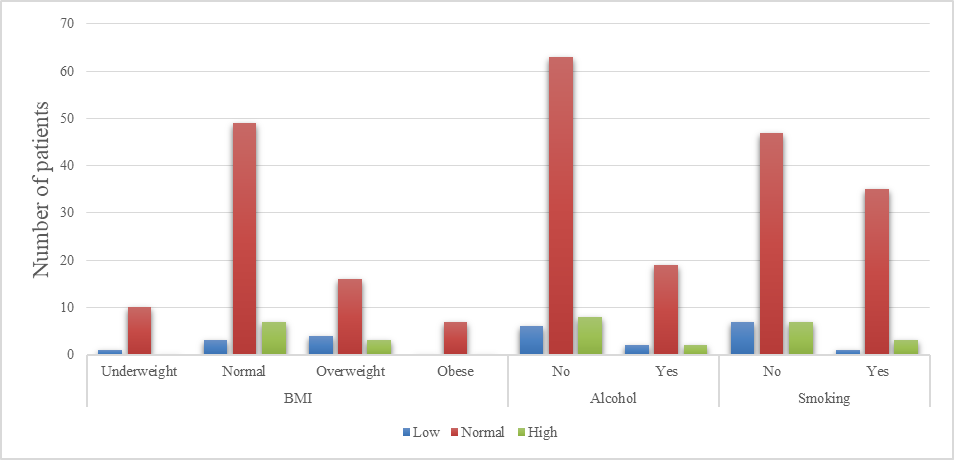
Figure: 1. Association of Serum Uric Acid with BMI and Lifestyle
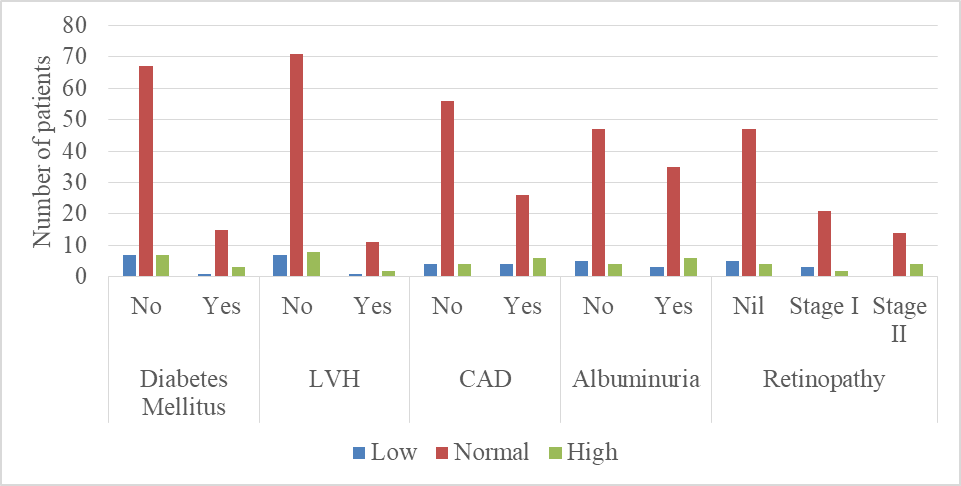
Figure: 2.
Table 1: Demographic Characteristics
The majority of patients belonged to the 51–60 years age group (30%), followed by 61–70 years (26%) and 41–50 years (24%). Younger age groups constituted a smaller proportion, with only 7% below 30 years. Males predominated (76%) compared to females (24%), indicating a male preponderance in the study population.
Table 2: BMI and Lifestyle Factors
Most patients had a normal BMI (59%), while 23% were overweight, 11% underweight, and 7% obese. A majority were non-alcoholic (77%) and non-smokers (61%), whereas 23% reported alcohol consumption and 39% were smokers.
Table 3: Clinical Comorbidities
Diabetes mellitus was present in 19% of patients, while 81% were non-diabetic. Left ventricular hypertrophy (LVH) was observed in 14% of patients. Coronary artery disease (CAD) was present in 36%. Albuminuria was detected in 44% of patients. Retinopathy was absent in 56%, while 26% had Stage I and 18% had Stage II retinopathy.
Table 4: Serum Uric Acid Distribution
Most patients had normal serum uric acid levels (82%), while 10% had elevated levels and 8% had low levels, indicating that hyperuricemia was present in a minority of the study population.
Table 5: Association with Demographic Variables
A statistically significant association was observed between serum uric acid levels and age group (p = 0.005), with higher uric acid levels more frequently seen in older age groups, particularly >71 years. However, no significant association was found with gender (p = 0.39), although males showed a higher frequency of elevated uric acid levels.
Table 6: Association with BMI and Lifestyle Factors
There was no statistically significant association between serum uric acid levels and BMI (p = 0.342), alcohol consumption (p = 0.965), or smoking status (p = 0.205). Uric acid levels appeared to be evenly distributed across different BMI categories and lifestyle factors.
Table 7: Association with Comorbidities (Part 1)
No significant association was found between serum uric acid levels and diabetes mellitus (p = 0.591) or LVH (p = 0.845). Both conditions showed a similar distribution of uric acid levels across categories.
Table 8: Association with Comorbidities (Part 2)
Serum uric acid levels were not significantly associated with CAD (p = 0.147), albuminuria (p = 0.54), or retinopathy (p = 0.262). However, a relatively higher proportion of elevated uric acid levels was observed in patients with CAD and Stage II retinopathy, though this did not reach statistical significance.
DISCUSSION:
The present study demonstrated that the majority of patients with essential hypertension belonged to the 51–60 years age group (30%), followed by 61–70 years (26%), with a clear male predominance (76%). This age distribution is consistent with the findings of Francesca Viazzi et al., who reported a higher prevalence of hypertension and target organ damage in middle-aged and elderly populations, attributing this to cumulative vascular injury and prolonged exposure to risk factors [11]. Similarly, the male predominance observed in this study aligns with the work of M. Kuwabara et al., who noted that males tend to have higher serum uric acid levels and greater cardiovascular risk compared to females [12].
In terms of BMI and lifestyle factors, the majority of patients in the present study had normal BMI (59%), with smaller proportions being overweight (23%) and obese (7%). No significant association was found between serum uric acid levels and BMI, alcohol intake, or smoking. This finding is comparable to the study by Peter C. Grayson et al., which also did not find a strong independent relationship between lifestyle factors and hyperuricemia after adjusting for confounders [13]. However, in contrast, Riccardo Mazzali et al. reported that obesity and alcohol consumption significantly contribute to elevated uric acid levels, suggesting that regional and genetic variations may influence these associations [14].
Regarding comorbidities, diabetes mellitus was present in 19% of patients, LVH in 14%, CAD in 36%, albuminuria in 44%, and retinopathy in varying grades. These findings are in agreement with Giovanni Leoncini et al., who reported a substantial burden of subclinical organ damage in hypertensive patients, particularly involving the kidneys and heart [15]. The relatively high prevalence of albuminuria (44%) in this study further supports the observations of Kunitoshi Iseki et al., who highlighted albuminuria as an early marker of hypertensive nephropathy [16].
In the present study, most patients had normal serum uric acid levels (82%), while 10% had hyperuricemia. This is slightly lower compared to the findings of Daniel I. Feig et al., who reported a higher prevalence of hyperuricemia among hypertensive individuals, possibly due to differences in study population and inclusion criteria [17].
A significant association was observed between serum uric acid levels and age (p = 0.005), with higher levels seen in older individuals. This finding is consistent with the study by M. Kanbay et al., who demonstrated that serum uric acid increases with age and is associated with vascular aging and endothelial dysfunction [18]. However, no significant association was found with gender in the present study, which contrasts with the findings of Hiroshi Yamada et al., who reported higher uric acid levels in males, suggesting that hormonal factors may play a role [19].
The study did not find any significant association between serum uric acid levels and BMI, alcohol, or smoking status. This is in line with the findings of B. Afsar et al., who suggested that while these factors influence cardiovascular risk, their direct association with uric acid may not always be statistically significant [20].
Furthermore, no statistically significant association was observed between serum uric acid levels and comorbidities such as diabetes mellitus, LVH, CAD, albuminuria, and retinopathy. These findings are partially consistent with previous studies; however, several authors, including Viazzi et al., have demonstrated a strong association between hyperuricemia and target organ damage. The lack of significance in the present study may be attributed to the relatively small sample size, cross-sectional design, and exclusion of patients with severe comorbid conditions. Nevertheless, a higher proportion of elevated uric acid levels was noted in patients with CAD and advanced retinopathy, suggesting a possible trend that warrants further investigation.
Overall, the findings of this study are largely comparable with existing literature, although certain variations highlight the need for larger, longitudinal studies to better elucidate the role of serum uric acid in the pathogenesis of end-organ damage in essential hypertension.
CONCLUSION:
The present study highlights the role of serum uric acid as a potential marker in patients with essential hypertension, particularly in relation to end-organ damage. Although the majority of patients had normal uric acid levels, a subset with elevated levels showed a trend toward increased target organ involvement, including coronary artery disease and higher grades of retinopathy. A significant association was observed between serum uric acid levels and age, suggesting that hyperuricemia may increase with advancing age and contribute to vascular changes. However, no statistically significant association was found between serum uric acid and other parameters such as BMI, lifestyle factors, diabetes mellitus, left ventricular hypertrophy, albuminuria, or retinopathy. These findings indicate that while serum uric acid may not independently predict end-organ damage, it could still serve as an adjunctive biomarker. Larger, longitudinal studies are needed to further clarify its causal role and clinical utility in hypertension management.
REFERENCES:
1. Whelton PK, Carey RM, Aronow WS, et al. 2017 ACC/AHA guideline for hypertension. Hypertension. 2018;71(6):e13–e115.
2. Feig DI, Kang DH, Johnson RJ. Uric acid and cardiovascular risk. N Engl J Med. 2008;359(17):1811–1821.
3. Johnson RJ, Segal MS, Srinivas T, et al. Essential hypertension, uric acid, and kidney disease. Hypertension. 2005;45(1):18–20.
4. Borghi C, Rosei EA, Bardin T, et al. Serum uric acid and cardiovascular disease risk. J Hypertens. 2015;33(9):1729–1741.
5. Viazzi F, Leoncini G, Ratto E, et al. Serum uric acid and target organ damage in hypertension. Hypertension. 2005;45(5):991–996.
6. Iseki K, Oshiro S, Tozawa M, et al. Significance of hyperuricemia on renal disease. Kidney Int. 2001;60(2):765–771.
7. Grayson PC, Kim SY, LaValley M, Choi HK. Hyperuricemia and incident hypertension. Arthritis Care Res. 2011;63(1):102–110.
8. Mazzali M, Hughes J, Kim YG, et al. Elevated uric acid increases blood pressure. Hypertension. 2001;38(5):1101–1106.
9. Kuwabara M. Hyperuricemia, cardiovascular disease, and hypertension. Pulse (Basel). 2016;3(3-4):242–252.
10. Kanbay M, Segal M, Afsar B, et al. The role of uric acid in hypertension. Nat Rev Nephrol. 2013;9(12):720–729.
11. Viazzi F, Leoncini G, Ratto E, et al. Serum uric acid and target organ damage in primary hypertension. Hypertension. 2005;45(5):991–996.
12. Kuwabara M, Niwa K, Nishihara S, et al. Asymptomatic hyperuricemia without comorbidities predicts cardiometabolic diseases. Hypertension. 2017;69(6):1036–1044.
13. Grayson PC, Kim SY, LaValley M, Choi HK. Hyperuricemia and incident hypertension. Arthritis Care Res. 2011;63(1):102–110.
14. Mazzali M, Hughes J, Kim YG, et al. Elevated uric acid increases blood pressure. Hypertension. 2001;38(5):1101–1106.
15. Leoncini G, Viazzi F, Parodi D, et al. Mild renal dysfunction and subclinical cardiovascular damage. Hypertension. 2003;42(1):14–18.
16. Iseki K, Oshiro S, Tozawa M, et al. Significance of hyperuricemia in renal disease. Kidney Int. 2001;60(2):765–771.
17. Feig DI, Kang DH, Johnson RJ. Uric acid and cardiovascular risk. N Engl J Med. 2008;359(17):1811–1821.
18. Kanbay M, Segal M, Afsar B, et al. The role of uric acid in hypertension. Nat Rev Nephrol. 2013;9(12):720–729.
19. Yamada H, et al. Gender differences in serum uric acid levels. Clin Exp Hypertens. 2014;36(5):310–315.
20. Afsar B, et al. Uric acid and cardiovascular risk factors. Int Urol Nephrol. 2014;46(4):707–714.