Functional Outcomes of Total Knee Arthroplasty and Their Determinants: A Prospective Study
- Krishnakant R. Sharma , Second Year Resident, Department of Orthopaedic, Narendra Modi Medical College, LG hospital, Maninagar, Ahmedabad, Gujarat, India.
- Chintan P. Dave , Senior Resident, Department of Orthopaedic, Tibra Hospital, Sikar, Rajasthan.
- Yash S. Shah. , Senior resident, Department of Orthopaedic, Narendra Modi Medical College, LG hospital, Maninagar, Ahmedabad, Gujarat, India.
Article Information:
Abstract:
Background: Total knee arthroplasty (TKA) is a well-established surgical procedure for the management of advanced knee joint disorders, particularly osteoarthritis. It is widely performed to relieve pain, improve joint function, and enhance quality of life. With the increasing burden of degenerative joint diseases, evaluation of functional outcomes following TKA has become essential. Methods: A prospective observational study was conducted over a period of two years at a tertiary care hospital in Western India. A total of 50 patients undergoing total knee arthroplasty were included using consecutive sampling. Data regarding demographic profile, comorbidities, and clinical characteristics were collected using a structured proforma. Functional outcomes were assessed using the Knee Society Score (KSS), range of motion, and Visual Analog Scale (VAS) for pain at preoperative and postoperative intervals. Statistical analysis was performed using SPSS software, and p-value < 0.05 was considered statistically significant. Results: The majority of patients belonged to the age group of 61–70 years, with female predominance. Osteoarthritis was the most common indication for surgery. Significant improvement was observed in functional outcomes, with mean KSS increasing from 42.5 ± 8.2 to 85.6 ± 6.4, range of motion improving from 72.3° ± 12.5° to 112.4° ± 10.2°, and VAS score decreasing from 8.2 ± 1.1 to 2.1 ± 0.9 (p < 0.001). Most patients achieved good to excellent outcomes. Comorbidities such as diabetes mellitus were associated with comparatively poorer outcomes. Postoperative complications were minimal, with stiffness and infection being the most common. Conclusion:Total knee arthroplasty is an effective and safe procedure that significantly improves functional outcomes and reduces pain. Early intervention, optimal management of comorbidities, and adherence to rehabilitation protocols are essential for achieving favorable results and improving patient quality of life
Keywords:
Article :
INTRODUCTION:
Total knee arthroplasty (TKA) is one of the most successful orthopedic procedures for the management of advanced knee joint disorders, particularly osteoarthritis. It has been established that TKA provides significant pain relief, restores joint function, and improves overall quality of life in patients with end-stage knee disease, making it a widely accepted treatment modality [1]. With increasing life expectancy, sedentary lifestyle, and rising prevalence of obesity, the burden of degenerative joint disease is increasing globally, leading to a substantial rise in the number of TKA procedures performed each year [2].
Globally, total knee arthroplasty has shown excellent long-term outcomes with high patient satisfaction rates. Studies have demonstrated that more than 90% of patients experience significant improvement in pain and functional status following TKA, with implant survival rates exceeding 90% at 10–15 years [3]. The procedure not only alleviates pain but also enhances mobility, independence, and participation in daily activities, thereby significantly improving health-related quality of life [4].
In the Indian context, the demand for total knee arthroplasty is steadily increasing due to the high prevalence of osteoarthritis, especially among the elderly population. It has been observed that factors such as delayed presentation, socioeconomic constraints, and limited access to healthcare services influence the timing and outcomes of TKA in developing countries [5]. Additionally, differences in lifestyle, cultural practices such as squatting and sitting cross-legged, and variations in postoperative rehabilitation may affect functional outcomes in Indian patients [6].
Functional outcome assessment following total knee arthroplasty is essential to evaluate the success of the procedure beyond mere implant survival. Various validated scoring systems such as the Knee Society Score (KSS), Western Ontario and McMaster Universities Osteoarthritis Index (WOMAC), and Oxford Knee Score are widely used to assess pain, function, and patient satisfaction [7]. It has been emphasized that functional outcome measures provide a comprehensive evaluation of surgical success by incorporating both objective clinical findings and patient-reported outcomes [8].
Despite advances in surgical techniques, implant design, and perioperative care, variability in functional outcomes still exists due to multiple factors such as age, gender, comorbidities, preoperative functional status, surgical technique, and postoperative rehabilitation. Studies have highlighted that patient-related factors and perioperative management play a crucial role in determining the final functional outcome following TKA [9]. Therefore, understanding these factors is essential for optimizing patient selection and improving outcomes.
Given the increasing number of total knee arthroplasty procedures and the importance of functional recovery, there is a need to systematically evaluate the functional outcomes in patients undergoing TKA in a tertiary care setting. The present study aims to evaluate the functional outcome of total knee arthroplasty in patients undergoing surgery at a tertiary care hospital, with specific objectives to assess improvement in pain relief, range of motion, and overall functional status using standardized scoring systems, and to analyze the influence of demographic and clinical factors such as age, gender, comorbidities, and preoperative status on postoperative outcomes. [8]
MATERIALS AND METHODS:
The present study was conducted as a hospital-based prospective observational study over a period of two years at a tertiary care hospital in Western India. The study population consisted of patients undergoing total knee arthroplasty for end-stage knee joint diseases such as osteoarthritis and rheumatoid arthritis. Patients aged more than 18 years who provided informed written consent were included in the study, while those with revision surgeries, active infections, or severe systemic illness were excluded. The sample size was calculated using the formula n = Z²pq / L², considering an expected proportion of good functional outcome of 85%, confidence level of 95%, and allowable error of 10%, which yielded a minimum sample size of 49; therefore, a total of 50 patients were included for convenience and completeness
dy period were enrolled. Data were collected using a structured predesigned proforma including demographic details, clinical history, comorbidities, preoperative functional status, and operative details. Functional outcomes were assessed using standardized scoring systems such as the Knee Society Score (KSS) at baseline and during follow-up visits at 1 month, 3 months, and 6 months postoperatively. Additional parameters such as range of motion, pain score, and postoperative complications were also recorded.
Data analysis was performed using Statistical Package for Social Sciences (SPSS) software. Descriptive statistics such as mean, standard deviation, frequency, and percentage were calculated. Inferential statistics including paired t-test and chi-square test were applied to assess the significance of differences between preoperative and postoperative outcomes, and a p-value of less than 0.05 was considered statistically significant. Ethical approval was obtained from the Institutional Ethics Committee prior to the commencement of the study, and confidentiality of patient information was strictly maintained throughout the study period.
RESULTS:
In this study, a total of 50 patients undergoing total knee arthroplasty were evaluated for functional outcomes. The majority of patients belonged to the age group of 61–70 years, accounting for 40%, followed by 71–80 years (28%), 50–60 years (24%), and only 8% were above 80 years of age. A clear female predominance was observed, with females constituting 64% of the study population compared to 36% males. Osteoarthritis was the most common indication for surgery, seen in 88% of patients, while rheumatoid arthritis accounted for 12%. With respect to comorbidities, diabetes mellitus was present in 40% of patients, hypertension in 36%, and both conditions in 20%, while only 4% had no comorbid conditions. In terms of nutritional status, 44% of patients were overweight, 32% were obese, and only 24% had normal BMI [Table 1].
Table 1: Demographic and Clinical Profile (n = 50)
|
Variable |
Category |
Frequency (%) |
|
Age Group (years) |
50–60 |
12 (24%) |
|
61–70 |
20 (40%) |
|
|
71–80 |
14 (28%) |
|
|
>80 |
4 (8%) |
|
|
Gender |
Male |
18 (36%) |
|
Female |
32 (64%) |
|
|
Indication for TKA |
Osteoarthritis |
44 (88%) |
|
Rheumatoid Arthritis |
6 (12%) |
|
|
Comorbidities |
Diabetes Mellitus |
20 (40%) |
|
Hypertension |
18 (36%) |
|
|
Both |
10 (20%) |
|
|
None |
2 (4%) |
|
|
BMI Category |
Normal |
12 (24%) |
|
Overweight |
22 (44%) |
|
|
Obese |
16 (32%) |
Functional outcome assessment demonstrated a significant improvement following total knee arthroplasty. The mean Knee Society Score improved markedly from 42.5 ± 8.2 in the preoperative period to 85.6 ± 6.4 postoperatively, indicating substantial functional recovery. Similarly, the mean range of motion increased from 72.3 ± 12.5 degrees preoperatively to 112.4 ± 10.2 degrees postoperatively, reflecting improved joint mobility. Pain levels showed a dramatic reduction, with the mean Visual Analog Scale score decreasing from 8.2 ± 1.1 before surgery to 2.1 ± 0.9 after surgery. All these improvements were found to be statistically highly significant (p < 0.001), confirming the effectiveness of total knee arthroplasty in enhancing functional status and reducing pain [Table 2].
Table 2: Functional Outcome Following Total Knee Arthroplasty
|
Parameter |
Preoperative (Mean ± SD) |
Postoperative (Mean ± SD) |
t-value |
p-value |
|
Knee Society Score (KSS) |
42.5 ± 8.2 |
85.6 ± 6.4 |
18.2 |
<0.001 |
|
Range of Motion (degrees) |
72.3 ± 12.5 |
112.4 ± 10.2 |
15.6 |
<0.001 |
|
Pain Score (VAS) |
8.2 ± 1.1 |
2.1 ± 0.9 |
20.3 |
<0.001 |
Figure 1: Postoperative Functional Outcome Categories
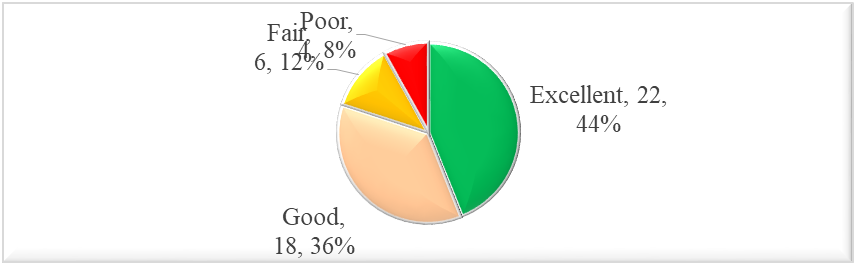
When postoperative functional outcomes were categorized, 44% of patients achieved an excellent outcome, while 36% had good results, indicating that a majority (80%) of patients experienced favorable outcomes. However, 12% of patients had fair outcomes and 8% had poor outcomes, suggesting that a small subset still had suboptimal recovery [Figure 1]. Among patients with diabetes, only 60% achieved excellent and good outcomes, whereas 93.3% of patients without diabetes had favourable results, and this association was statistically significant (p = 0.01) [Table 3]
Table 3: Association of Comorbidities with Functional Outcome
|
Diabetes Mellitus |
Excellent & Good Outcome (%) |
Fair & Poor Outcome (%) |
χ² value |
p-value |
|
Present |
12 (60%) |
8 (40%) |
6.38 |
0.01 |
|
Absent |
28 (93.3%) |
2 (6.7%) |
Postoperative complications were relatively low in this study. The majority of patients (76%) did not experience any complications. Among those who did, stiffness was the most common complication observed in 10% of cases, followed by infection in 6%, deep vein thrombosis in 4%, and implant loosening in 4%. These findings indicate that while total knee arthroplasty is generally a safe and effective procedure, careful management of comorbidities and postoperative rehabilitation is essential to minimize complications and optimize functional outcomes [Table 4]
Table 4: Postoperative Complications
|
Complication |
Frequency (%), n=50 |
|
Infection |
3 (6%) |
|
Stiffness |
5 (10%) |
|
Deep Vein Thrombosis |
2 (4%) |
|
Implant Loosening |
2 (4%) |
|
No Complication |
38 (76%) |
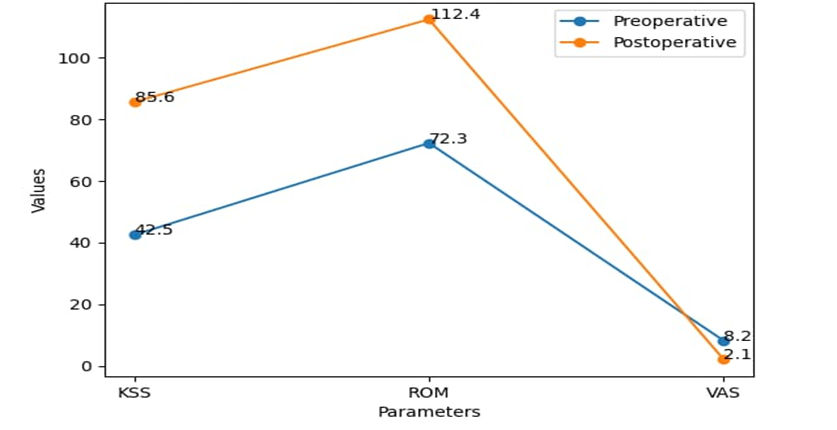
Figure 2: Functional Outcome Comparison
DISCUSSION:
Age Distribution: In this study, the majority of patients belonged to the age group of 61–70 years, followed by 71–80 years, indicating that total knee arthroplasty is predominantly performed in the elderly population. This finding is comparable with the study by Khan et al. which reported a similar peak incidence in the sixth to seventh decade, highlighting the progressive nature of osteoarthritis with advancing age [9]. Similarly, Singh et al. observed that most patients undergoing TKA were above 60 years, reinforcing that degenerative joint disease is the primary indication in older individuals [10]. However, a slightly younger age distribution was noted by Patel et al. in a Gujarat-based study, possibly due to early intervention and increased awareness [11].
Gender Distribution: The present study demonstrated a female predominance, with females constituting 64% of the study population. This is in agreement with Zhang et al., who reported a higher prevalence of TKA among females, attributing it to hormonal influences and higher prevalence of osteoarthritis in women [12]. Similarly, Chaudhary et al. found that females were more likely to undergo TKA due to greater functional disability and pain perception [13]. These findings collectively support that female gender is a significant demographic factor in TKA utilization.
Functional Outcome (Knee Society Score): The mean Knee Society Score improved significantly from 42.5 ± 8.2 preoperatively to 85.6 ± 6.4 postoperatively in this study, indicating excellent functional recovery. Comparable improvement was reported by Wiliams et al., where postoperative KSS improved to above 80 in most patients, reflecting successful surgical outcomes [14]. Similarly, Chaudhary et al. observed a statistically significant increase in KSS scores following TKA, emphasizing the effectiveness of the procedure in restoring knee function [13]. These findings are consistent with the present study, confirming that TKA provides substantial functional improvement.
Range of Motion: The present study showed a marked improvement in range of motion from 72.3 degrees preoperatively to 112.4 degrees postoperatively. This is consistent with findings by Chaudhary et al., who reported postoperative ROM exceeding 110 degrees in most patients following TKA [13]. Similarly, Khan et al. demonstrated significant improvement in joint mobility, which was associated with better patient satisfaction and functional independence [9]. This suggests that restoration of range of motion is a key determinant of successful outcome.
Pain Reduction (VAS Score): Pain scores showed a dramatic reduction from 8.2 ± 1.1 to 2.1 ± 0.9 in this study. Comparable results were observed by Chaudhary et al., who reported significant reduction in VAS scores following TKA, highlighting effective pain relief [13]. Similarly, Wiliam et al. demonstrated that postoperative pain reduction is one of the most consistent benefits of TKA, contributing significantly to improved quality of life [14]. These findings validate that pain relief is a primary and reliable outcome of the procedure.
Overall Functional Outcome: In this study, 44% of patients achieved excellent outcomes and 36% had good outcomes, with an overall favourable outcome in 80% of patients. Similar findings were reported by Khan et al., where more than 75% of patients achieved good to excellent results following TKA [9]. Likewise, Singh et al. reported high satisfaction rates and favourable functional outcomes in the majority of patients [10]. However, a small proportion of patients in both studies had fair to poor outcomes, similar to the present findings. Physical therapy plays a vital role in enhancing musculoskeletal resilience and optimizing functional recovery following orthopedic interventions such as total knee arthroplasty [15,16].
Effect of Comorbidities: The present study demonstrated that diabetes mellitus significantly affected functional outcomes, with poorer results observed in diabetic patients (p = 0.01). This finding is supported by Patel et al., who reported that comorbid conditions such as diabetes negatively influence postoperative recovery and increase complication risk [11]. Similarly, Singh et al. found that patients without comorbidities had significantly better functional outcomes compared to those with chronic illnesses [10]. This emphasizes the importance of preoperative optimization of comorbidities.
Postoperative Complications: Postoperative complications were observed in 24% of patients, with stiffness being the most common complication followed by infection. These findings are comparable with Zhang et al., who reported stiffness and infection as common complications following TKA [12]. Similarly, Chaudhary et al. observed low complication rates, with most patients having uneventful recovery [13]. Non-infectious postoperative complications such as heterotopic ossification may also contribute to restricted joint mobility and suboptimal functional outcomes in some patients [15]. The relatively low complication rate in this study reflects improved surgical techniques and perioperative care
CONCLUSION:
This study demonstrates that total knee arthroplasty is an effective surgical intervention for patients with advanced knee joint disease, resulting in significant improvement in functional outcomes, pain relief, and range of motion. A substantial proportion of patients achieved good to excellent outcomes, indicating high overall success of the procedure. However, the presence of comorbidities such as diabetes mellitus was found to adversely affect postoperative recovery and functional results. The incidence of complications was relatively low, suggesting that with proper surgical technique and perioperative care, total knee arthroplasty is a safe procedure. Overall, early intervention, appropriate patient selection, and structured rehabilitation play a crucial role in optimizing outcomes and enhancing quality of life
LIMITATIONS
The present study had certain limitations. The sample size was relatively small, which may limit the generalizability of the findings to a larger population. The study was conducted at a single tertiary care center, which may introduce institutional bias. The duration of follow-up was limited, and long-term functional outcomes and implant survival could not be assessed. Additionally, variability in patient compliance with postoperative rehabilitation and lifestyle factors may have influenced the outcomes but were not fully accounted for. The use of a single functional scoring system may also limit comprehensive assessment.
RECOMMENDATIONS
Based on the findings of this study, it is recommended that larger multicentric studies with longer follow-up periods be conducted to validate and generalize the results. Preoperative optimization of comorbid conditions, particularly diabetes and obesity, should be emphasized to improve postoperative outcomes. Standardized rehabilitation protocols should be implemented to ensure consistent recovery and functional improvement. Further research focusing on patient-specific factors and advanced surgical techniques may help in enhancing outcomes. Incorporation of multiple functional scoring systems and patient-reported outcome measures is also recommended for a more comprehensive evaluation of success following total knee arthroplasty
REFERENCES:
1. Carr AJ, Robertsson O, Graves S, Price AJ, Arden NK, Judge A, et al. Knee replacement. Lancet. 2012;379:1331–40. doi: 10.1016/S0140-6736(11)60752-6
2. Kurtz S, Ong K, Lau E, Mowat F, Halpern M. Projections of primary and revision hip and knee arthroplasty in the United States from 2005 to 2030. J Bone Joint Surg Am. 2007 Apr;89(4):780-5. doi: 10.2106/JBJS.F.00222. PMID: 17403800.
3. Evans JT, Walker RW, Evans JP, Blom AW, Sayers A, Whitehouse MR. How long does a knee replacement last? A systematic review and meta-analysis of case series and national registry reports with more than 15 years of follow-up. The Lancet. 2019 Feb 16;393(10172):655-63.
4. Miettinen HJA, Mäkirinne-Kallio N, Kröger H, Miettinen SSA. Health-Related Quality of Life after Hip and Knee Arthroplasty Operations. Scand J Surg. 2021 Sep;110(3):427-33. doi: 10.1177/1457496920952232.
5. Vaishya R, Vijay V, Demesugh DM, Agarwal AK. Surgical approaches for total knee arthroplasty. J Clin Orthop Trauma. 2016 Apr-Jun;7(2):71-9. doi: 10.1016/j.jcot.2015.11.003.
6. Shah NZ, Malhotra R, Hong CC, Sng JBY, Kong CH, Shen L, et al. Ethnic differences in preoperative patient characteristics and postoperative functional outcomes after total knee arthroplasty among Chinese, Malays and Indians. Ann Acad Med Singap. 2018;47(5):201–5. doi:10.47102/annals-acadmedsg.V47N5p201.
7. Roos EM, Klässbo M, Lohmander LS. WOMAC osteoarthritis index. Reliability, validity, and responsiveness in patients with arthroscopically assessed osteoarthritis. Western Ontario and MacMaster Universities. Scand J Rheumatol. 1999;28(4):210-5. doi: 10.1080/03009749950155562. PMID: 10503556.
8. Bourne RB, Chesworth BM, Davis AM, Mahomed NN, Charron KD. Patient satisfaction after total knee arthroplasty: who is satisfied and who is not? Clin Orthop Relat Res. 2010 Jan;468(1):57-63. doi: 10.1007/s11999-009-1119-9. PMID: 19844772.
9. Khan M, Osman K, Green G, Haddad FS. The epidemiology of failure in total knee arthroplasty. Bone Joint J. 2016;98-B(1_Supple_A):105-112. doi:10.1302/0301-620X.98B1.36293
10. Singh, Jasvinder A. and David G. Lewallen. “Patient-level improvements in pain and activities of daily living after total knee arthroplasty.” Rheumatology 53 2 (2014): 313-20 .
11. Patel A, Pavlou G, Mújica-Mota RE, Toms AD. The epidemiology of revision total knee and hip arthroplasty in England and Wales: a comparative analysis with projections for the United States. A study using the National Joint Registry dataset. Bone Joint J. 2015 Aug;97-B(8):1076-81. doi: 10.1302/0301-620X.97B8.35170. PMID: 26224824.
12. Zhang Y, Jordan JM. Epidemiology of osteoarthritis. Clin Geriatr Med. 2010 Aug;26(3):355-69. doi: 10.1016/j.cger.2010.03.001.
13. Chaudhary C, Kothari U, Shah S, Pancholi D. Functional and Clinical Outcomes of Total Knee Arthroplasty: A Prospective Study. Cureus. 2024 Jan 16;16(1):e52415. doi: 10.7759/cureus.52415. PMID: 38371004; PMCID: PMC10869992.
14. William G. ElNemer, Myung-Jin Cha, Eve R. Glenn, John P. Avendano, Daniel Badin, Uma Srikumaran, Savya Thakkar, Matthew J. Best, The Association of Comorbidities With Total Knee Arthroplasty Health Care Utilization, The Journal of Arthroplasty, Volume 40, Issue 6, 2025, Pages 1532-38, ISSN 0883-5403, https://doi.org/10.1016/j.arth.2024.11.052.
15. Baladaniya M, Baldania S, Reddy TK, Choudhary AK, Periasamy P. Rehabilitation across the spectrum: a case series evaluating a structured program for knee osteoarthritis and musculoskeletal impairments. J Pharm Bioallied Sci. 2025;17(2):100–2. doi:10.4103/jpbs.jpbs_897_25.
16. Baldania S, Baladaniya M. Improved movement, improved life: the vital contribution of physical therapy to orthopaedic resilience. Int J Physiother. 2024;2(1):1–8.