Game-Changer Potential in Foot Dynamics for Bonus: Unlock with Smart Insole Technology in Kabaddi.
- P. Sivakumar , Research Scholar (Full time) and 2Director of Physical Education.
- C. Sugumar , The Gandhigram Rural Institute (Deemed to be University),Gandhigram, Dindigul District, Tamil Nadu, India.
Article Information:
Abstract:
Background: Sports performance analytics depends on the sensors embedded wearable technology. Wearable electronic devices monitor the individuals’ sitting, standing, walking, running, jumping gestures, static, dynamic movements, fall-detection, bio-mechanical metrics, health parameters and to prevent the injuries. Aim: The sport of Kabaddi consists of two primary components: offensive and defensive strategies. The raider’s legs play a pivotal role to execute a bonus manoeuvre successfully. This research focused on precise execution of bonus technique of the raider. Methodology: To achieve the purpose, 21 right and 8 left male riders from the Gandhigram Rural Institute (Deemed to be University), Gandhigram were selected as subjects. “Salted Smart Insole” was tailored to each participant's shoe size and slides into raider’s shoe. During the test trial, raider executed the bonus skill with their shoes, in which the smart insole was slid. The test trial was administered during the Gandhigram Rural Institute (GRI) Kabaddi team training sessions and the state level open Kabaddi tournaments as well. During the test trial, Raiders’ entire movement of bonus execution was recorded by using Salted Smart Insole mobile app. From the recorded videos, researchers keenly observed the raider’s foot mechanics in terms of right and left foot pressure, force and balance at the event of bonus. Results: Insole converts raiders’ bonus skill into measurable insights i.e. foot mechanics. Raiders’ foot mechanics of quantitative and qualitative data were spotted from the pressure, force and balance map sections of the app. Conclusion: Salter Smart Insole is a user-friendly system with powerful insights which helps the players to learn and refine the basic movements, calibrate or recalibrate the execution of skills and sustain his performance.
Keywords:
Article :
INTRODUCTION:
Kabaddi is one of the indigenous sports. It fascinates people in Asian countries and around the world. By its nature, Kabaddi played in small hamlets to metro-cities of India. In its early days, Kabaddi is a sport played primarily by individual’s possessing a robust physique. In the modern sports era, the game demands not only physique but also needs significant intellectual perception and laser focused concentration. Unlike in the past, transformation of strategic plan and tactical intelligence of defensive Kabaddi players and raiders sharpening their skill by practicing and aggressively experimenting the variety of maneuvers during the competitions. Raiders tighten their shoelace and technically revamped by experimenting. In the current scenario, by combining sheer physical exertion with "smart work", Kabaddi has overwhelmingly proven that it is no longer merely a wild or brute-force sport.
Sky-high expectations of the Kabaddi spectators, the game needs smart technology to recalibrate the officiating procedures and to enrich the performance analytics by using technologies interlaced with human touch. In that aspects, smart-phones has been swapped by the sensor embedded wearable devices like smart watch, ring, ornaments, medical/health devices, sports jerseys, jackets, gloves, sacks, shoes, insole, ear-wear, smart glass, posture correcting devices. Among the most advanced examples of wearable technology are AI-enabled hearing aids, Meta Quest, and Microsoft's HoloLens a three-dimensional computer in the form of a virtual reality (VR) headset. A simpler example of wearable technology is a disposable skin patch equipped with sensors, which wirelessly transmits patient data to a monitoring console located in a healthcare facility. For instance, activity trackers or smart watches the most common types of wearable devices come with a wristband worn around the user's wrist to monitor their physical activity or vital signs throughout the day. Wearable Technology (WT) has emerged as a promising avenue for providing clinically precise data at a low cost, thereby coach can track the player or team movements and skill execution in real-time. Sensor fusion methodologies bridge the gap between motor educability and skill execution at high-octane competitions. Smart work embedded with smart technology wins the podium finish in Olympics.
Thomas & Alex 2017 Validated the Moticon’s Open Go sensor insoles under complex field conditions. For instance, Oks et al. 2017 study explained that, DAid pressure sock system accurately measure the heel strike/non-heel strike patterns of walking/ running movements. Rene Leveaux 2012, described the Taekwondo official’s decision-making technology and video analysis software used in 2012 Olympic Games. Sang-II Choi et al. 2019 utilize the smart insole device and analysed the walking gait pattern data. Andrei et al. 2020 monitored the foot motion analysis by using smart socks and pressure sensitive insole. Rafique et al. 2022, validated the foot pressure distribution and body posture measurements through the smart insole. Torben Kjaersgaard 2024, stated that technological official tools added to the progress of officiating procedure. Researchers have acknowledged the smart technological impact on smart sports era. This study is inspired by the practical advantages of the findings presented in previous research articles. Consequently, it aims to uncover facts regarding smart insoles and their potential to reveal insights that could enhance Kabaddi raiders’ skill. Now a days, Inertial Measurement Units (IMUs) is a pulsating device to monitor the individual’s gestures and metrics during training, match and recovery sessions. In performance analytics, sensors played a very significant role to magnify the players’ kinematic and kinetic data in a useful way. Further it steered the trainer to predict the injury risks through historical data, forecast the fatigue and to avoid over-load from the work-load data. IMUs converts individual skills into measurable insights. Based on the above facts, researchers utilize the technological advancements and face-lift the present research methodology.
Objectives of the study
To ensure fair play in the game of Kabaddi, researcher’s mind instigated to adopt the smart insole procedure to understand the raider’s foot mechanics while they exhibit bonus technique. Based on that, the following objectives have been outlined in this study.
1. Designing a suitable real-time innovative foot tracking procedure using force plate sensor fixed in conventional insole; to observe weather the raider abides the rules while they secure a bonus point.
2. To find out the quantitative and qualitatively procedure to measure the raiders’ foot mechanics by a “Salted Smart Insole” device.
3. To assess the raiders’ foot mechanics namely foot pressure, force and balance while they exhibit bonus technique.
4. To define the clear-cut methodology in executing a bonus manoeuvre for scoring a bonus point (s).
METHODOLOGY :
Participants
To achieve the purpose, 21 right and 8 left male riders from the Gandhigram Rural Institute (Deemed to be University), Gandhigram were selected as subjects and they were free of injury at the time of testing procedure. Before the commencement of the study, written consent was obtained from all raiders. The present research focused on raiders’ foot mechanics involved in bonus technique. In that prospective, the investigators intended to describe the bonus technique in Kabaddi. In playing situations, when opposition has six or more players on the mat, the bonus line becomes active. In such a case, raiders foot lands over the bonus line without cutting it, then the raiding team will receive a bonus (+1) point even the raider is successfully tackled during the raid. To achieve the objectives of the present study, integrated “Salted Smart Insole” & video analysis technique was used by the researchers. The test trial was administered during the GRI Kabaddi team training sessions and the state level open Kabaddi tournaments as well. The details are given in Table -2
Table -2
DETAILS OF TEST TRIAL COLLECTED
|
Details of the Tournament |
Held on |
Number of Test raid |
|
State Level Open tournament held at Mettupatti, Dindigul District |
10&11May 2025 |
1 |
|
State Level Open tournament held at Thiruparangundram, Madurai District. |
29&30May 2025 |
4 |
|
State Level Open tournament held at Natchikulam (Madurai District) |
9&10 Aug, 2025 |
3 |
|
State Level Inter-Collegiate Tournament held at GRI, Gandhigram. |
26&27 Sep, 2025 |
8 |
|
GRI Kabaddi team Training sessions, held at GRI, Gandhigram. |
23-25Apr,2025, 29-30Apr,2025, 2May2025 & 9Aug,2025. |
137 |
|
Total number of test raids |
153 |
|
Test Device and its specifications
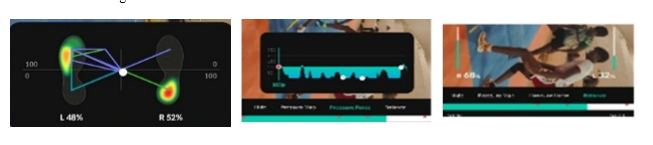
Smart Insole (Salted ltd., South Korea) is one of the crafted ultra-thin models, customizable, wearable device, and sophisticated insole, having force plates to measure and map the ground-reaction forces during players’ movement. It provides access to pairs easily with the SALTED GOLF mobile app through Bluetooth connectivity. It works with four-point pressure sensory technology which accurately measures the wearer’s foot mechanics in real-time visualization on a smartphone interface. It features to display the foot pressure, gait pattern, bodyweight imbalance, and muscle movement in graphics and audio. The researchers understood the utilities of Salted Smart Insole and to utilize this device in the present research to gain yardage and improvise the raiders’ bonus execution. “Salted Smart Insole” was tailored to each participant's shoe size and slides into raider’s shoe. During the test trial, raider executed the bonus skill with their shoes, in which the smart insole was slid. Figure-1 illustrated the test device sensors, paring with mobile app, slides into the raider’s shoe and the data streamed to the app in real-time.
Method of Data Extraction
The research focused on precise execution of bonus technique of the raider. The objectives were achieved by “Salted Smart Insole” which is readily available in the Centre for Physical Education and Yoga, GRI, Gandhigram. Once the calibration trial was done, the “Salted Smart Insole” was slide into the raider’s shoe to establish connectivity between the insole and the mobile app. The paired mobile was fixed at the height of 1.5 meters and 3 meters away from playing area to record the raiders’ entire movement of bonus execution during the test trial by using the mobile app. From the recorded videos, researchers keenly observed the raider’s foot mechanics in terms of right and left foot pressure, force and balance at the event of bonus. Likewise, occurrence of raiders’ foot mechanics was fixed from the recorded videos of Salted Golf app by the following methods:
i. Depends upon the raiders’ foot pressure, in the pressure map section displayed the image to be appeared in mixtures of green, yellow, red and white colors.
ii. The raiders’ foot force was displayed in a graphical manner in the force section.
iii. Variations in raiders’ right and left foot balance were clearly exhibited in the balance section through bar-graph with numerical data (from 0 to 100). The variations in the colour (White and Green) displayed in bar-graph was in accordance with change of balance.
RESULTS:
Right raiders’ anthropometric profile, number of raids performed, success and failure percentage of their raids were presented in Table 2.
Table 2
|
Right Raider |
Age (yrs) |
Height (cms) |
Weight (kgs) |
Test Days |
Total Raid |
Bonus Secured Raid |
no bonus raid |
% |
|||||||
|
1 |
2 |
3 |
4 |
5 |
6 |
7 |
Success in |
Failure in |
|||||||
|
Number of raids performed |
Bonus Secured Raid |
no bonus raid |
|||||||||||||
|
1 |
19 |
172 |
78.7 |
1 |
0 |
1 |
0 |
3 |
5 |
0 |
10 |
1 |
9 |
10.00 |
90 |
|
2 |
21 |
162 |
69 |
1 |
0 |
2 |
1 |
5 |
3 |
3 |
15 |
6 |
9 |
40 |
60 |
|
3 |
24 |
175 |
62 |
1 |
0 |
0 |
0 |
2 |
0 |
0 |
3 |
1 |
2 |
33.33 |
66.67 |
|
4 |
21 |
180 |
88 |
1 |
0 |
0 |
0 |
1 |
1 |
0 |
3 |
2 |
1 |
66.67 |
33.33 |
|
5 |
24 |
176 |
68 |
0 |
1 |
0 |
1 |
0 |
0 |
0 |
2 |
0 |
2 |
0.00 |
100 |
|
6 |
18 |
195 |
66.5 |
0 |
1 |
0 |
1 |
3 |
3 |
3 |
11 |
4 |
7 |
36.36 |
63.64 |
|
7 |
18 |
176 |
70 |
0 |
0 |
1 |
0 |
3 |
0 |
0 |
4 |
1 |
3 |
25.00 |
75 |
|
8 |
19 |
177 |
77.04 |
0 |
0 |
1 |
0 |
0 |
0 |
0 |
1 |
0 |
1 |
0.00 |
100 |
|
9 |
24 |
179.5 |
64.4 |
0 |
0 |
1 |
1 |
3 |
0 |
0 |
5 |
2 |
3 |
40.00 |
60 |
|
10 |
21 |
180 |
73.1 |
0 |
0 |
0 |
1 |
3 |
0 |
0 |
4 |
0 |
4 |
0.00 |
100 |
|
11 |
18 |
168 |
64.6 |
0 |
0 |
0 |
0 |
3 |
0 |
3 |
6 |
3 |
3 |
50.00 |
50 |
|
12 |
19 |
175.4 |
61.9 |
0 |
0 |
0 |
0 |
0 |
0 |
4 |
4 |
4 |
0 |
100.00 |
0 |
|
13 |
19 |
177 |
73.4 |
0 |
0 |
0 |
0 |
0 |
0 |
3 |
3 |
1 |
2 |
33.33 |
66.67 |
|
14 |
19 |
177 |
68 |
0 |
0 |
0 |
0 |
0 |
0 |
3 |
3 |
1 |
2 |
33.33 |
66.67 |
|
15 |
17 |
179 |
63 |
0 |
0 |
0 |
0 |
0 |
0 |
3 |
3 |
3 |
0 |
100.00 |
0 |
|
16 |
17 |
173 |
57.7 |
0 |
0 |
0 |
0 |
0 |
0 |
3 |
3 |
3 |
0 |
100.00 |
0 |
|
17 |
19 |
164 |
61.1 |
0 |
0 |
0 |
0 |
0 |
0 |
3 |
3 |
1 |
2 |
33.33 |
66.67 |
|
18 |
17 |
169 |
58.5 |
0 |
0 |
0 |
0 |
0 |
0 |
3 |
3 |
0 |
3 |
0.00 |
100 |
|
19 |
21 |
172 |
73.1 |
0 |
0 |
0 |
0 |
0 |
0 |
3 |
3 |
0 |
3 |
0.00 |
100 |
|
20 |
18 |
173 |
52.1 |
0 |
0 |
0 |
0 |
0 |
0 |
3 |
3 |
1 |
2 |
33.33 |
66.67 |
|
21 |
21 |
170 |
54.4 |
0 |
0 |
0 |
0 |
0 |
0 |
3 |
3 |
3 |
0 |
100.00 |
0 |
|
Total |
95 |
37 |
58 |
39.75 |
60.25 |
||||||||||
Left raiders’ anthropometric profile, number of raiders performed, success and failure percentage of their raids were presented in Table 3.
Table 2
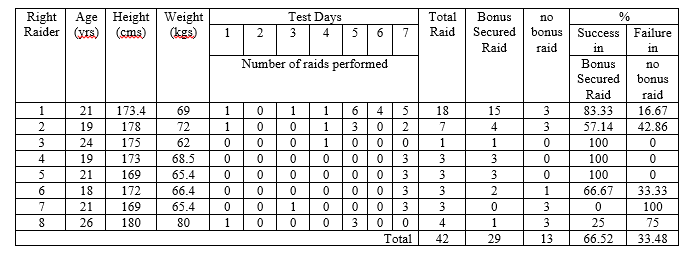
During the course of test trial consisted of seven days, each raider was given random raiding opportunities from 1 to 7 to execute bonus maneuvers. Each raid was facilitated wearing a “Salted Smart Insole”. The Salted Smart Insole virtually visualizes the quantitative values of the raiders’ right and left foot mechanics patterns, i.e., foot pressure and balance, and were presented in Tables 3, 4 & 5.
Table 3
|
Right Raider |
Test Days |
Raids |
Balance (%) in |
|
|
Right Foot |
Left Foot |
|||
|
1 |
1 |
I |
74 |
26 |
|
3 |
I |
50 |
50 |
|
|
5 |
I |
91 |
9 |
|
|
II |
50 |
50 |
||
|
III |
90 |
10 |
||
|
6 |
I |
21 |
79 |
|
|
II |
52 |
48 |
||
|
III |
100 |
0 |
||
|
IV |
57 |
43 |
||
|
V |
6 |
94 |
||
|
2 |
1 |
I |
86 |
14 |
|
3 |
I |
64 |
36 |
|
|
4 |
I |
100 |
0 |
|
|
5 |
I |
56 |
44 |
|
|
II |
34 |
66 |
||
|
III |
50 |
50 |
||
|
IV |
50 |
50 |
||
|
V |
30 |
70 |
||
|
6 |
I |
32 |
68 |
|
|
II |
100 |
0 |
||
|
III |
100 |
0 |
||
|
7 |
I |
100 |
0 |
|
|
II |
100 |
0 |
||
|
III |
100 |
0 |
||
|
IV |
25 |
75 |
||
|
3 |
1 |
I |
8 |
92 |
|
5 |
I |
87 |
13 |
|
|
II |
100 |
0 |
||
|
4 |
1 |
I |
100 |
0 |
|
5 |
1 |
9 |
91 |
|
|
6 |
1 |
100 |
0 |
|
Table -4
|
Right Raider |
Test Days |
Raids |
Balance (%) in |
|
|
Right Foot |
Left Foot |
|||
|
5 |
2 |
I |
58 |
42 |
|
4 |
I |
95 |
5 |
|
|
6 |
2 |
I |
71 |
29 |
|
4 |
I |
100 |
0 |
|
|
5 |
I |
0 |
100 |
|
|
II |
43 |
57 |
||
|
III |
58 |
41 |
||
|
6 |
I |
100 |
0 |
|
|
II |
50 |
50 |
||
|
III |
50 |
50 |
||
|
7 |
I |
0 |
100 |
|
|
II |
0 |
100 |
||
|
III |
0 |
100 |
||
|
7 |
3 |
I |
72 |
48 |
|
5 |
I |
43 |
57 |
|
|
II |
100 |
0 |
||
|
III |
67 |
33 |
||
|
8 |
3 |
I |
43 |
57 |
|
9 |
3 |
I |
92 |
8 |
|
4 |
I |
100 |
0 |
|
|
5 |
I |
38 |
62 |
|
|
II |
100 |
0 |
||
|
III |
35 |
65 |
||
|
10 |
4 |
I |
58 |
41 |
|
5 |
I |
23 |
77 |
|
|
II |
63 |
37 |
||
|
III |
60 |
40 |
||
Table 5
|
Right Raider |
Test Days |
Raids |
Balance (%) in |
|
|
Right Foot |
Left Foot |
|||
|
11 |
5 |
I |
50 |
50 |
|
II |
34 |
66 |
||
|
III |
0 |
100 |
||
|
7 |
I |
100 |
0 |
|
|
II |
100 |
0 |
||
|
III |
100 |
0 |
||
|
12 |
7 |
I |
100 |
0 |
|
II |
100 |
0 |
||
|
III |
100 |
0 |
||
|
IV |
100 |
0 |
||
|
13 |
7 |
I |
50 |
50 |
|
II |
0 |
100 |
||
|
III |
50 |
50 |
||
|
14 |
7 |
I |
50 |
50 |
|
II |
50 |
50 |
||
|
III |
0 |
100 |
||
|
15 |
7 |
I |
100 |
0 |
|
II |
100 |
0 |
||
|
III |
100 |
0 |
||
|
16 |
7 |
I |
100 |
0 |
|
II |
100 |
0 |
||
|
III |
100 |
0 |
||
|
17 |
7 |
I |
100 |
0 |
|
II |
50 |
50 |
||
|
III |
50 |
50 |
||
|
18 |
7 |
I |
50 |
50 |
|
II |
50 |
50 |
||
|
III |
100 |
0 |
||
|
19 |
7 |
I |
50 |
50 |
|
II |
50 |
50 |
||
|
III |
50 |
50 |
||
|
20 |
7 |
I |
99 |
1 |
|
II |
100 |
0 |
||
|
III |
98 |
2 |
||
|
21 |
7 |
I |
0 |
100 |
|
II |
0 |
100 |
||
|
III |
0 |
100 |
||
Left raiders’ foot mechanics pattern i.e. left and right foot pressure and balance were presented in table 6 & 7.
Table 6
|
Left Raider |
Test Days |
Raids |
Balance (%) in |
|
|
Right Foot |
Left Foot |
|||
|
1 |
1 |
1 |
52 |
47 |
|
3 |
I |
78 |
22 |
|
|
4 |
I |
0 |
100 |
|
|
5 |
I |
0 |
100 |
|
|
II |
0 |
100 |
||
|
III |
35 |
65 |
||
|
IV |
0 |
100 |
||
|
V |
0 |
100 |
||
|
VI |
0 |
100 |
||
|
6 |
I |
0 |
100 |
|
|
II |
0 |
100 |
||
|
III |
0 |
100 |
||
|
IV |
0 |
100 |
||
|
7 |
I |
0 |
100 |
|
|
II |
0 |
100 |
||
|
III |
0 |
100 |
||
|
IV |
0 |
100 |
||
|
V |
0 |
100 |
||
Table 7
|
Left Raider |
Test Days |
Raids |
Balance (%) in |
|
|
Right Foot |
Left Foot |
|||
|
2 |
1 |
I |
44 |
56 |
|
4 |
I |
34 |
66 |
|
|
5 |
I |
50 |
50 |
|
|
II |
0 |
100 |
||
|
III |
0 |
100 |
||
|
7 |
I |
0 |
100 |
|
|
II |
0 |
100 |
||
|
3 |
4 |
I |
0 |
100 |
|
7 |
I |
0 |
100 |
|
|
4 |
II |
0 |
100 |
|
|
III |
0 |
100 |
||
|
5 |
7 |
I |
0 |
100 |
|
II |
0 |
100 |
||
|
III |
0 |
100 |
||
|
6 |
7 |
I |
0 |
100 |
|
II |
0 |
100 |
||
|
III |
0 |
100 |
||
|
7 |
7 |
I |
100 |
0 |
|
II |
100 |
0 |
||
|
III |
3 |
97 |
||
|
8 |
1 |
I |
48 |
52 |
|
5 |
I |
38 |
62 |
|
|
7 |
I |
100 |
0 |
|
|
II |
35 |
65 |
||
Raiders’ foot mechanics pattern i.e. left and right foot pressure and balance while they performed in state level open tournaments and were presented in table 8.
Table 8
|
Tournament details |
Raids |
Right Foot (%) |
Left Foot (%) |
|
State Level Open tournament held at Mettupatti, Dindigul District |
1 |
100 |
0 |
|
State Level Open tournament held at Thirupparankundram, Madurai District |
1 |
0 |
100 |
|
2 |
100 |
0 |
|
|
3 |
100 |
0 |
|
|
4 |
0 |
100 |
|
|
State Level Open tournament held at Natchikulam (Madurai District) |
1 |
0 |
100 |
|
2 |
0 |
100 |
|
|
3 |
0 |
100 |
|
|
State Level Inter-Collegiate Tournament held at GRI, Gandhigram |
1 |
0 |
100 |
|
2 |
0 |
100 |
|
|
3 |
0 |
100 |
|
|
4 |
0 |
100 |
|
|
5 |
34 |
66 |
|
|
6 |
50 |
50 |
|
|
7 |
0 |
100 |
|
|
8 |
0 |
100 |
Analysis:
Salted GOLF app evidently exhibited the quantitative values of raiders’ right and left foot mechanics patterns, i.e., right and left foot pressure, force and balance, and were presented in figures 2, 3 & 4. The raiders’ foot mechanics analysis criteria are: A mixture of green, yellow, red and white colours are appeared in the pressure map section; Raiders’ right and left foot balance changes observed in the balance section and colour of bar-graph from white to green linked with numerical data from 0 to 100. Though which the researcher understood that, raider’s foot pressure and balance depart to right side or left side and the bi-pedal is equally or unequally balanced. Figure 2 illustrate the right raider’s foot mechanics while they execute a successful bonus technique.
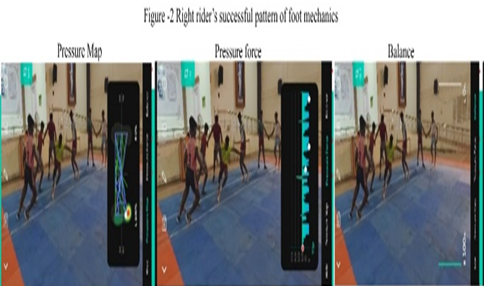
In figure 2 the integrated approach of balance and pressure are examined. In the balance section of figure 2 clearly shows that, the balance of the right raider’s left foot is 0 at the same time raider’s right foot balance is 100 simultaneously, raider’s right foot pressure is displayed in the pressure map section, on the successful execution of the bonus technique. Figure 3 illustrates the right raider’s foot mechanics while they perform an un-successful bonus technique.
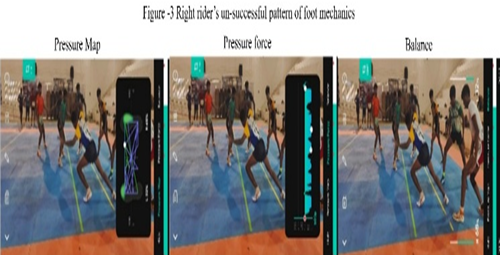
In figure 3 the integrated approach of balance and pressure are examined. In the balance section of figure 3 clearly shows that, the balance of the right raider’s left foot is 32 at the same time raider’s right foot balance is 68 simultaneously, raider’s right and left foot pressure is displayed in the pressure map section, an unsuccessful execution of the bonus technique. Figure 4 illustrates the left raider’s foot mechanics while they perform the successful bonus technique.
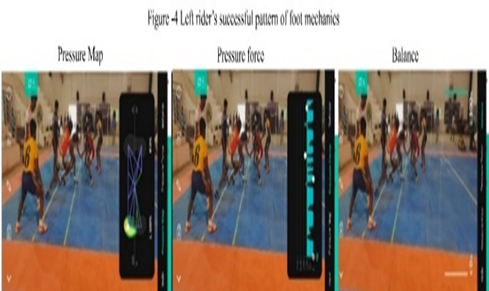
In figure 4 the integrated approach of balance and pressure are examined. In the balance section of figure 4 clearly shows that, the balance of the left raider’s left foot is 100 at the same time raider’s right foot balance is 0 simultaneously, raider’s left foot pressure is displayed in the pressure map section, on the successful execution of the bonus technique. Figure 5 illustrates the left raider’s foot mechanics while they perform an un-successful bonus technique.
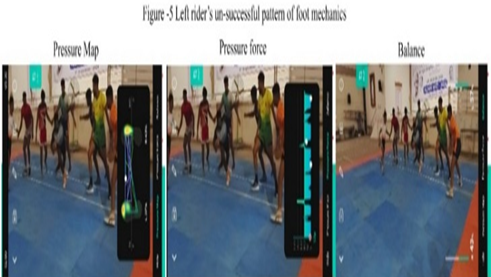
In figure 5 the integrated approach of balance and pressure are examined. In the balance section of figure 5 clearly shows that, the balance of the left raider’s left foot is 57 at the same time raider’s right foot balance is 43 simultaneously, raider’s left and right foot pressure is displayed in the pressure map section, an unsuccessful execution of the bonus technique. Figures 6, & 7 illustrated the right raider’s foot mechanics while they executed a successful bonus technique during the State level tournament held at Thiruparankundram and Nachikulam respectively.
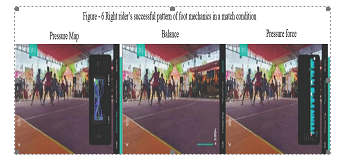
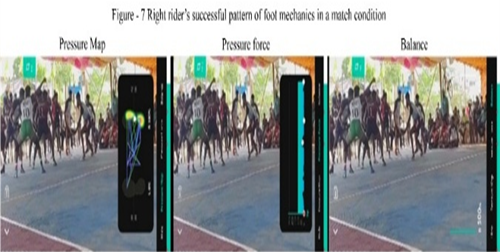
In figures 6 & 7 the integrated approach of balance and pressure are examined. In the balance section of figures 6 & 7 clearly shows that, the balance of the right raider’s left foot is 0 at the same time raider’s right foot balance is 100 simultaneously, raider’s right foot pressure is displayed in the pressure map section, on the successful execution of the bonus technique. Figure 8 illustrated the left raider’s foot mechanics while they executed a successful bonus technique during the state level inter-collegiate tournaments held at GRI, Gandhigram.
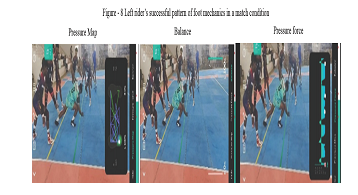
Figure – 8 clearly displayed the left raider’s right and left foot balance is 0 and 100 respectively. Left raider’s foot pressure and balance also deviated to left side. From this, the left raider successfully executed the bonus technique during the match conditions.
DISCUSSION:
The prime idea of the present study is to measure the raiders’ foot mechanics of bonus skill in real-time on field-based conditions. The observations of the authors, opined that the right and left raiders are imperatively to raid against the great defenders or the teams or in do-or-die raid situations or in circumstance to score a bonus point (s) to favour his/her side. According to the nature of the game, in every occasion, scoring a point (s) depends on the common phenomena such as raider touching or crossing the bulk line / bonus line / side line / back line / center line / lobby and defender touching or crossing the side line / back line / center line / lobby in Kabaddi. Figures 3, 4, 5, 6,7&8 clearly visualized the raiders’ foot mechanics patterns with the support of Salted Smart Insole data. A study in recent past conducted by the Sivakumar et al. (2026), obviously clears that, thermal images serve as an unbiased eye that monitors raiders’ footprint to justify whether the raiders’ foot in touch with the line or inside the bonus zone.
Esfahani and Nusshaum 2019 study differentiates the normal and abnormal gait patterns by using the smart garments. For instance, Oagaz et al., 2018 recognized the varied foot gestures by utilizing a pressure insole during the Soccer VR game. Rafique et al. 2022 validated the plantar pressure and postural measurements by using smart insole. For instance, Yang et al. 2018 evaluated the timed-Up and Go (TUG) test by using smart insoles procedure. Gonzalez et al. 2015 and Hua and Wang (2019) recognize the walking and non-walking activities predicted through the monitoring insole. Qi Wang et al. 2025 stated that, static and dynamic activities are accurately recognized by using self-powered smart insole. Kim, Kang and Kim 2022 suggested that, Salted insoles accurately measure the chronic ankle instability patients’ single leg and double leg heel raise, hold and drop movements’ data. In the present study, “Salted Smart Insole” was used by the researchers and to confirm whether the raiders’ foot lands on the court or not while they secure a bonus point(s). For instance, the result also justifies the bonus skill, through “Salted Smart Insole” to measure accurately foot mechanics of the right and left raiders’ during the training sessions as well as in the match conditions.
Customized, “Salted Smart Insole” could help the TV umpire in taking instant eye-catching objective decision in the following ways:
Salted smart insole delivers detailed qualitative and quantitative observation about the raiders’ foot contact on the court which confirms to award the bonus point (s).
2. The advantages of insole technology add additional strength to the referees which is not accessible in the existing video referral system.
3. Existing video referral system strongly notifies the visual changes meanwhile, Salted smart insole visualize the quantitative data of the raiders’ foot balance.
4. Salted smart insole instantaneously transfer information to the referees, leaving no room for doubt in awarding bonus point.
5. Video referrals methods could be substituted by “Salted Smart Insole” which enrich spectator understanding, in the way of actual occurrence while raiders are to secure a bonus point.
6. To minimalize the human error and endorse the open-minded play with maximum satisfaction.
CONCLUSION:
Execution of bonus technique was thoroughly studied by Salted Smart Insole through the raiders’ foot mechanics. From the view of methodology, results and analysis of the study, the following conclusions have been drawn.
|
|
Salted Smart Insole is found to be a suitable as a real-time test device to observe weather the raider secures a bonus point under the field-based conditions by abiding the rules. |
|
|
Force plate sensor embedded in conventional insole ensures the raiders’ foot mechanics. |
|
|
It is the indoor and outdoor foot tracking procedures integrate with live insights of raiders’ foot mechanics and enhanced accuracy to contextualize raiders’ data through qualitative videos and quantitative values. |
|
|
Salted smart insole instantly display real-time visualization of the raiders’ foot mechanics (foot pressure, force, balance) in executing bonus skill. |
|
|
Salter Smart Insole is a user-friendly system with powerful insights which helps the players to learn and refine the basic movements, calibrate or recalibrate the execution of skills and sustain his/her performance. |
REFERENCES:
1. Abbott, C. A., Chatwin, K. E., Foden, P., Hasan, A. N., Sange, C., Rajbhandari, S. M., Reddy, P. N., Vileikyte, L., Bowling, F. L., Boulton, A. J. M., & Reeves, N. D. (2019). Innovative intelligent insole system reduces diabetic foot ulcer recurrence at plantar sites: A prospective, randomised, proof‑of‑concept study. The Lancet Digital Health, 1(6), e308–e318. https://doi.org/10.1016/S2589‑7500(19)30128‑1
2. Agrawal, D. K., Wattanapan, P., & Usaha, W. (2023). Fall risk prediction using wireless sensor insoles with machine learning. IEEE Access, 11, 24779–24789. https://doi.org/10.1109/ACCESS.2023.3252886
3. Ahmed, S., Barwick, A., Butterworth, P., & Nancarrow, S. (2020). Footwear and insole design features that reduce neuropathic plantar forefoot ulcer risk in people with diabetes: A systematic literature review. Journal of Foot and Ankle Research, 13, 30. https://doi.org/10.1186/s13047-020-00400-4
4. Alfonso, A. R., Rao, S., Everett, B., & Chiu, E. S. (2017). Novel pressure-sensing smart insole system used for the prevention of pressure ulceration in the insensate foot. Plastic and Reconstructive Surgery Global Open, 5(12), e1582. https://doi.org/10.1097/GOX.0000000000001582
5. Almuteb, P., Hua, R., & Wang, Y. (2022). Smart insoles review (2008–2021). Sensors and Actuators in Health Monitoring, 25, 100301. https://doi.org/10.1016/j.smhl.2022.100301
6. Antwi-Afari, M. F., Li, H., Yu, Y., & Kong, L. (2018). Wearable insole pressure system for automated detection and classification of awkward working postures in construction workers. Automation in Construction, 96, 433–441. https://doi.org/10.1016/j.autcon.2018.10.015
7. Berengueres, J., Fritschi, M., & McClanahan, R. (2013). A smart pressure-sensitive insole that reminds you to walk correctly: An orthotic-less treatment for over pronation. 2013 IEEE International Conference on Body Sensor Networks, 1–6. https://doi.org/10.1109/BSN.2013.6575476
8. Charlon, Y., Piau, A., Brulin, D., & Campo, E. (2019). Design and evaluation of a connected insole to support healthy aging of frail patients at home. Wireless Sensor Network, 11, 67–80. https://doi.org/10.4236/wsn.2019.114005
9. Chatzaki, C., Skaramagkas, V., Tachos, N., Christodoulakis, G., Maniadi, E., Kefalopoulou, Z., Fotiadis, D. I., & Tsiknakis, M. (2021). The smart-insole dataset: Gait analysis using wearable sensors with a focus on elderly and Parkinson’s patients. Sensors, 21(9), 3209. https://doi.org/10.3390/s21093209
10. Chen, D., Cao, H., Chen, H., Zhu, Z., Qian, X., Xu, W., & Huang, M.-C. (2019). Smart insole‑based indoor localization system for Internet of Things applications. IEEE Internet of Things Journal, 6(4), 7253–7265. https://doi.org/10.1109/JIOT.2019.2915791
11. Choi, S.-I., Moon, J., Park, H.-C., & Choi, S. T. (2019). User identification from gait analysis using multi‑modal sensors in smart insole. Sensors, 19(17), 3785. https://doi.org/10.3390/s19173785
12. Chou, L.-W., Shen, J.-H., Lin, H.-T., Yang, Y.-T., & Hu, W.-P. (2023). A study on the influence of number/distribution of sensing points of the smart insoles on the center of pressure estimation for Internet of Things applications. Sensors, 23(14), 6543. https://doi.org/10.3390/s23146543
13. Ciniglio, A., Guiotto, A., Spolaor, F., & Sawacha, Z. (2021). The design and simulation of a 16-sensors plantar pressure insole layout. Sensors, 21, 1450. https://doi.org/10.3390/s21041450
14. Cristiani, A. M., Bertolotti, G. M., Marenzi, E., & Ramat, S. (2014). An instrumented insole for long-term monitoring movement, comfort, and ergonomics. IEEE Sensors Journal, 14(5), 1568–1575. https://doi.org/10.1109/JSEN.2013.
2294333
15. Cudejko, T., Button, K., & Al-Amri, M. (2018). Wireless pressure insoles for measuring ground reaction forces and trajectories of the centre of pressure during functional activities. Scientific Reports, 8, 17395. https://doi.org/10.1038/s41598-018-35888-3
16. D’Arco, L., McCalmont, G., Wang, H., & Zheng, H. (2024). Application of smart insoles for recognition of activities of daily living: A systematic review. ACM Transactions on Computing for Healthcare. https://doi.org/10.1145/3633785
17. D’Arco, L., Wang, H., & Zheng, H. (2023). Integration of smart insoles for gait assessment in exoskeleton-assisted rehabilitation. Sensors, 23(18), 7796. https://doi.org/10.3390/s23187796
18. De Fazio, R., Mastronardi, V. M., De Vittorio, M., & Visconti, P. (2021). Wearable sensors and smart devices to monitor rehabilitation parameters and sports performance: An overview. Sensors, 21(13), 4355. https://doi.org/10.3390
/s21134355
19. Domingues, M. F., Tavares, C., Leitão, C., Frizera-Neto, A., Alberto, N., Marques, C., Radwan, A., Rodriguez, J., Postolache, O., Rocon, E., André, P., & Antunes, P. (2017). Insole optical fiber Bragg grating sensors network for dynamic vertical force monitoring. Journal of Biomedical Optics, 22(9), 091507. https://doi.org/10.1117/1.JBO.22.9.091507
20. Dragulinescu, A., Drăgulinescu, A.-M., Zincă, G., Bucur, D., Feies, V., & Neagu, D.-M. (2020). Smart socks and in-shoe systems: State-of-the-art for foot motion analysis, sports, and medical applications. Sensors, 20, 4316. https://doi.org/10.3390/s20154316
21. Errekagorri, I., Castellano, J., Echeazarra, I., & Lago-Peñas, C. (2020). Effects of VAR on soccer performance. International Journal of Performance Analysis in Sport. https://doi.org/10.1080/24748668.2020.1788350
22. Esfahani, M. I. M., & Nussbaum, M. A. (2019). Using smart garments to differentiate gait patterns. Journal of Biomechanics, 93, 70–76.
23. Gasavi Nezhad, Z., & Arazpour, M. (2025). Effects of footwear and insoles on balance and gait parameters in athletes with ankle injuries: Protocol for a systematic review. BMJ Open, 15, e105397. https://doi.org/10.1136/bmjopen-2025-105397
24. Gonzalez, I., Fontecha, J., Hervás, R., & Bravo, J. (2015). Ambulatory gait monitoring system using sensorized insoles. Sensors, 15(7), 16589–16613.
25. Guldemond, N. A., Leffers, P., Schaper, N. C., Sanders, A. P., Nieman, F., Willems, P., & Walenkamp, G. H. I. M. (2007). The effects of insole configurations on forefoot plantar pressure and walking convenience in diabetic patients with neuropathic feet. Clinical Biomechanics, 22(1), 81–87. https://doi.org/10.1016
/j.clinbiomech.2006.08.004
26. R., & Wang, Y. (2019). MONI: Low-power insole monitoring system. IEEE Sensors Journal, 19(15), 6410–6420.
27. Ivanov, K., Lubich, L., Mei, Z., Penev, M., Mumini, O. O., Nguyen Van, S., Wang, L., & Yan, Y. (2020). Identity recognition by walking outdoors using multimodal sensor insoles. IEEE Access, 8, 151984–151995. https://doi.org/10.1109
/ACCESS.2020.3016970
28. Kang, S., Kim, J., & Kim, S.-J. (2021). Application of smart insoles in assessing dynamic stability in patients with chronic ankle instability: A comparative study. Sensors, 21(21), 7140. https://doi.org/10.3390/s21217140
29. Keys, G., Ryan, L., Faulkner, M., & McCann, M. (2023). International Journal of Computer Science in Sport, 22(3). https://doi.org/10.2478/ijcss-2023-0008
30. Khandakar, A., Mahmud, S., Chowdhury, M. E. H., Kiranyaz, S., Mahbub, Z. B., Ali, S. H. M., Reaz, M. B. I., Bakar, A. A. A., Ayari, M. A., Alhatou, M., Abdul-Moniem, M., & Faisal, M. A. A. (2023). Design and implementation of a smart insole system to measure plantar pressure and temperature. Sensors, 23(5), 2452. https://doi.org/10.3390/s23052452 (3TIME)
31. Kim, J., Kang, S., & Kim, S. J. (2022). Smart insole system for ankle rehabilitation. Scientific Reports, 12(1), 10796. https://doi.org/10.1038/s41598-022-14313-8
32. Kim, S., Kim, H. S., & Yoo, J.-I. (2023). Sarcopenia classification model for musculoskeletal patients using smart insole and artificial intelligence gait analysis. Journal of Cachexia, Sarcopenia and Muscle, 14, 2793–2803. https://doi.org/10.1002/jcsm.13356
33. Kjaersgaard, T. (2024). Defending technology in referee decisions. Sport, Ethics and Philosophy. https://doi.org/10.1080/17511321.2024.2329909
34. Kranzinger, C., Bernhart, S., Kremser, W., Venek, V., Rieser, H., Mayr, S., & Kranzinger, S. (2023). Classification of human motion data using IMUs in sports: A scoping review. Applied Sciences, 13(15), 8684. https://doi.org/10.3390
/app13158684
35. Kumar, Y., & Rukhsana. (2024). Smart insoles: A cutting-edge technology in the field of orthotics-A review. International Journal of Health Sciences and Research, 14(4), 302–310. https://doi.org/10.52403/ijhsr.20240441
36. Lakho, R. A., Abro, Z. A., Chen, J., & Min, R. (2020). Smart insole based on Flexi force and flex sensor for monitoring different body postures. Sensors, 20(22), 6608. https://doi.org/10.3390/s20226608
37. Lakho, R. A., Abro, Z. A., Chen, J., & Min, R. (2022). Smart insole based on flexi force and flex sensor for monitoring different body postures. Sensors, 22, 5469. https://doi.org/10.3390/s22155469
38. Latsch, B., Herbst, F., Suppelt, M., Altmann, A. A., Seiler, J., Grimmer, M., Schaumann, S., Kupnik, M., & Suppelt, S. (2025). Sensor insoles: A review. IEEE Sensors Journal. Advance online publication. https://doi.org/10.1109/JSEN.
2025.3638124
39. Lee, J., Lee, J., Lee, Y. J., Kim, H., Kwon, Y., Huang, Y., Kuczajda, M., Soltis, I., & Yeo, W.-H. (2025). Flexible smart insole and plantar pressure monitoring using screen-printed nanomaterials and piezoresistive sensors. ACS Applied Materials & Interfaces, 17(47), 47153–47161. https://doi.org/10.1021/acsami.5cXXXXX
40. Leemets, K., Terasmaa, T., Jaakson, P., Kume, A., & Tamm, T. (2015). Development of a smart insole system for gait and performance monitoring. International Conference on Material Science and Application.
41. Leveaux, R. (2012). Olympic games decision-making technologies for taekwondo competition. Communications of the IBIMA. https://doi.org/10.5171/2012.834755
42. Li, Z., Tang, L., Gan, W. C., & Aw, K. C. (2023). Triboelectric energy harvesting shoe insole. In Proceedings of the XXXV Eurosensors Conference (Lecce, Italy, September 10–13, 2023).
43. Lin, F., Wang, A., Zhuang, Y., Tomita, M. R., & Xu, W. (2016). Smart insole: A wearable sensor device for unobtrusive gait monitoring in daily life. IEEE Transactions on Industrial Informatics. Advance online publication. https://doi.org/10.1109/TII.2016.2585643
44. Liu, T., Inoue, Y., & Shibata, K. (2010). A wearable ground reaction force sensor system and its application to the measurement of extrinsic gait variability. Sensors, 10, 10240–10255. https://doi.org/10.3390/s101110240
45. Liu, X., He, M., Hu, R., & Chen, Z. (2022). Randomized controlled trial study of intelligent rehabilitation training system for functional ankle instability. Scientific Reports, 12, 17609. https://doi.org/10.1038/s41598-022-22338-3
46. Luna-Perejón, F., Salvador-Domínguez, B., Rodríguez Corral, J. M., Escobar-Linero, E., Perez-Peña, F., & Morgado-Estévez, A. (2021). Smart shoe insole based on polydimethylsiloxane composite capacitive sensors. Sensors, 21(11), 3693. https://doi.org/10.3390/s21113693
47. Martini, E., Fiumalbi, T., Dell’Agnello, F., Ivanić, Z., Munih, M., Vitiello, N., & Crea, S. (2020). Pressure-sensitive insoles for real-time gait-related applications. Sensors, 20(5), 1448. https://doi.org/10.3390/s20051448
48. Mather, G., & Breivik, S. (2020). Perception of intent influenced by video playback speed. Royal Society Open Science, 7, 192026. https://doi.org/10.1098/rsos.192026
49. Mavrogiannis, P., Maglogiannis, I., Milić, L., Panagopoulos, C., Stojanović, G. M., & Menychtas, A. (2022). Smart insoles with textile capacitive sensors for efficient gait phase recognition. IEEE Sensors Journal, 22(15), 14471–14481. https://doi.org/10.1109/JSEN.2022.3174123
50. Mendes, J. J. A., Vieira, M. E. M., Pires, M. B., & Stevan, S. L. (2016). Sensor fusion and smart sensor in sports and biomedical applications. Sensors, 16, 1569. https://doi.org/10.3390/s16101569
51. Mishra, S., Dash, S. K., Mishra, S., & Rajgude, R. (2025). A systematic review and meta-analysis on the effectiveness of insoles for managing pes planus (flat foot) in children. South Eastern European Journal of Public Health, 26, 2769.
52. Movrin, D., Chatpun, S., Simić, M., & Sanghan, T. (2025). Design and evaluation of a smart insole system for real-time gait and plantar pressure monitoring. Advanced Technologies and Materials, 50(2), 31–37. https://doi.org/10.24867
/ATM-2025-2-005.
53. Ntagios, M., & Dahiya, R. (2023). 3D printed soft and flexible insole with intrinsic pressure sensing capability. IEEE Sensors Journal, 23(20), 23995–24002. https://doi.org/10.1109/JSEN.2023.3309117
54. Oagaz, H., Sable, A., Choi, M.-H., Xu, W., & Lin, F. (2018). VRInsole: Mobility training system for stroke rehabilitation. IEEE Conference on Wearable and Implantable Body Sensor Networks, 5-8.
55. Oks, A., Katashev, A., Bernans, E., & Abolins, V. (2017). Comparison of smart sock system accuracy for temporal gait parameters. IOP Conference Series: Materials Science and Engineering, 254, 072017. https://doi.org/10.1088/1757-899X/254/7/072017
56. Park, J., Kim, M., Hong, I., Kim, T., Lee, E., Kim, E.-a., Ryu, J.-K., Jo, Y., Koo, J., Han, S., Kang, D., & Koh, J. (2019). Foot plantar pressure measurement system using highly sensitive crack-based sensor. Sensors, 19(24), 5504. https://doi.org/10.3390/s19245504
57. Peebles, A. T., Maguire, L. A., Renner, K. E., & Queen, R. M. (2018). Validity and repeatability of single-sensor Loadsol insoles during landing. Sensors, 18(12), 4087. https://doi.org/10.3390/s18124087
58. Raghav, S., Singh, A., Mani, S., Kandasamy, G., & Anand, A. (2020). The role of sensor-based insole as a rehabilitation tool in improving walking among patients with lower limb arthroplasty: A protocol for systematic review. Asian Journal of Medicine and Health, 18(9), 22–27. https://doi.org/10.9734/ajmah/2020
/v18i930230
59. Salpavaara, T., Verho, J., Lekkala, J., & Halttunen, J. (2009). Wireless insole sensor system for plantar force measurements during sport events. XIX IMEKO World Congress, 2118–2123.
60. Santos, V. M., Gomes, B. B., Amaro, A. M., Neto, M. A., & Rodrigues, P. F. (2023). A systematic review on smart insole prototypes: Development and optimization pathways. Sensors, 23(10), 4621. https://doi.org/10.3390/s23104621
61. Santos, V. M., Gomes, B. B., Neto, M. A., & Amaro, A. M. (2024). A systematic review of insole sensor technology: Recent studies and future directions. Applied Sciences, 14, 6085. https://doi.org/10.3390/app1414608
62. Schwirtz, A. (2018). Accuracy and precision of loadsol® insole force-sensors for running parameters. European Journal of Sport Science. https://doi.org/10.1080/17461391.2018.1477993
63. Semjonova, G., Davidovica, A., Kozlovskis, N., Okss, A., & Katashevs, A. (2022). Smart textile sock system for athletes’ self-correction. Sensors, 22, 4779. https://doi.org/10.3390/s22134779
64. Sivakumar, P., Alagarsamy, P., James, A. D. X., & Sugumar, C. (2025). Understanding the role of body composition in athletic performance: Insights from cricket fast bowlers and kabaddi raiders. Global Journal for Research Analysis, 14(7). https://doi.org/10.36106/gjra
65. Sivakumar, P., James, A. D. X., & Sugumar, C. (2025). A video analytical approach on navigation of running bonus technique: Strategic implementations. International Journal for Multidisciplinary Research, 7(4). https://doi.org/10.36948/ ijfmr. 2025.v07i04.52568
66. Sivakumar. P, C. Sugumar., (2026). Seeing The Unseen Essence of Players’ Footprints Beyond the Game of Kabaddi: Decoding the Infrared Images. Int J Drug Deliv Technol.16(12s)130-139.
67. Sorrentino, I., Andrade Chavez, F. J., Traversaro, S., Rapetti, L., Latella, C., Tirupachuri, Y., Maggiali, M., Dussoni, S., Metta, G., Fiorio, L., Guedelha, N., & Pucci, D. (2020). A novel sensorised insole for sensing feet pressure distributions. Sensors, 20(22), 6609. https://doi.org/10.3390/s20226609
68. Stoggl, T., & Martiner, A. (2017). Validation of Moticon’s Open Go sensor insoles during gait, jumps, balance, and cross-country skiing specific imitation movements. Journal of Sports Sciences, 35(2), 196–206. https://doi.org/10.1080/02640414.
2016.1161205
69. Subramaniam, S., Majumder, S., Faisal, A. I., & Deen, M. J. (2022). Insole-based systems for health monitoring: Current solutions and research challenges. Sensors, 22(18), 7015. https://doi.org/10.3390/s22187015
70. Tan, A. M., Fuss, F. K., Weizman, Y., Woudstra, Y., & Troynikov, O. (2015). Design of low cost smart insole for real-time measurement of plantar pressure. Procedia Technology, 20, 117–122. https://doi.org/10.1016/j.protcy.2015.02.017
71. Tana, A. M. C., Fuss, F. K., Weizman, Y., & Troynikov, O. (2015). Development of a smart insole for medical and sports purposes. Procedia Engineering, 152–156.
72. V., Mileo, A., & Roantree, M. (2024). Engineering features from raw sensor data to analyze player movements. Sensors, 24(4), 1308. https://doi.org/10.3390/s24041308
73. Wang, L., Jones, D., Jones, A., et al. (2022). A portable insole system to simultaneously measure plantar pressure and shear stress. IEEE Sensors Journal, 22(9), 9104–9113. https://doi.org/10.1109/JSEN.2022.316271
74. Wang, Q., Guan, H., Wang, C., Lei, P., Sheng, H., Bi, H., Hu, J., Guo, C., Mao, Y., Yuan, J., Shao, M., Jin, Z., Li, J., & Lan, W. (2025). A wireless, self-powered smart. Science Advances, 11, eadu1598 insole for gait monitoring and recognition via nonlinear synergistic pressure sensing. https://doi.org/10.1126/sciadv.adu1598
75. Yang, Z., Song, C., Lin, F., Langan, J., & Xu, W. (2018). Smart timed-up-and-go system with sensor insoles. IEEE Internet of Things Journal, 6(2), 1298–1305.