METHOTREXATE, LEFLUNOMIDE, AND METHOTREXATE PLUS LEFLUNOMIDE'S EFFICACY IN MANAGING INFLAMMATORY SYMPTOMS IN EARLY-STAGE KNEE OSTEOARTHRITIS.
- SUBHASH CHANDRA , Assistant Professor, Department of Orthopedics,Raja Rajeshwari Institute Of Medical Sciences. Hyderabad, Telangana – 502307.
- MANTHAPURAM BALAKRISHNA , Assistant Professor, Department of Orthopedics,Raja Rajeshwari Institute Of Medical Sciences. Hyderabad, Telangana – 502307.
- UPENDRA MALLELA , Associate Professor, Department of Anatomy, Maheshwara Medical College And Hospital. Hyderabad, Telangana-502307.
- PRASAD MERGU , Professor, Department of Anatomy , Varun Arjun Medical College And Rohilkhand Hospital, Shahjahanpur, Uttar Pradesh,-242307.
Article Information:
Abstract:
Introduction: Joint discomfort, stiffness, and functional restrictions are the hallmarks of early-stage knee osteoarthritis, which frequently shows no appreciable radiographic changes. Symptoms like morning stiffness and trouble moving around, especially while ascending stairs, are common. To maintain joint function, enhance quality of life, and slow the course of the disease, early diagnosis and treatments are essential. Objective: To assess and contrast the effectiveness of leflunomide (LEF), methotrexate (MTX), and a combination of these medications in lowering inflammation and enhancing function in individuals with early-stage osteoarthritis of the knee. Material and Methods: This open-label, randomised, interventional trial was carried out after 15 days, three months, and six months. Three groups of 312 patients with clinical symptoms of inflammation and symptomatic early-stage knee OA (Kellgren-Lawrence grades I–II) were randomly assigned. Patients in groups A, B, and C received methotrexate (15 mg/week), leflunomide (10–20 mg/day), and methotrexate + leflunomide, respectively. The main result was a decrease in pain as indicated by WOMAC and VAS ratings. CRP, ESR, and WBC changes were among the secondary outcomes. Results: A total of 312 individuals with osteoarthritis were assessed; the most affected age group was 50–59 years old, and the prevalence was higher in females (55.1%). (35.9% ). The most prevalent symptom was knee discomfort, which affected every patient (100%) and was followed by morning stiffness in 274 patients (87.8%) and difficulty climbing stairs in 267 individuals (85.6% ). Higher Kellgren-Lawrence (KL) scores were associated with more severe symptoms. At six months, the combination of methotrexate and leflunomide (Group C) demonstrated the greatest improvement in all clinical and inflammatory parameters: VAS score dropped from 7.6 ± 1.2 to 1.9 ± 0.5 (p < 0.0001), WOMAC score from 63 ± 9 to 18 ± 4 (p < 0.0001), CRP from 12.5 ± 2.6 to 2.9 ± 1.1 mg/L (p < 0.021), and ESR from 39 ± 6 to 12 ± 2. Conclusion: Methotrexate and leflunomide combination therapy shown improved therapeutic potential in early-stage knee osteoarthritis by significantly outperforming monotherapies in terms of pain reduction, joint function improvement, and inflammatory marker reduction.
Keywords:
Article :
INTRODUCTION:
Over 250 million individuals worldwide suffer from osteoarthritis (OA), the most common kind of arthritis and a major contributor to pain and impairment in older persons. Although OA was once thought to be a non-inflammatory, degenerative joint disease marked by osteophyte formation, subchondral bone remodelling, and progressive cartilage loss, new research increasingly links low-grade synovial inflammation to the pathophysiology and symptomatology of OA, especially in its early stages.[1, 2]
Because knee OA affects mobility, freedom, and quality of life, it is particularly burdensome. Early stages of the disease are characterised by sporadic joint pain, stiffness, and edoema, frequently without radiographic abnormalities. The disease usually advances gradually. Recent research has demonstrated a correlation between synovitis detected by imaging or histological tests and pain intensity, disease progression, and cartilage loss, indicating that inflammation may be a cause of early OA pathogenesis rather than just a result [3].
Acetaminophen, nonsteroidal anti-inflammatory medications (NSAIDs), intra-articular corticosteroids, and physical therapy are examples of current standard therapies that mainly provide symptomatic relief without altering the course of the disease. Furthermore, gastrointestinal, renal, and cardiovascular hazards are linked to long-term NSAID usage in older people. Finding treatment approaches that might address OA's underlying inflammatory pathways as well as its symptoms is therefore of increasing interest.
In the treatment of rheumatoid arthritis, methotrexate (MTX), a folate antagonist, has long been regarded as the main disease-modifying antirheumatic medication (DMARD) (RA). It reduces T-cell activation, inhibits dihydrofolate reductase, and increases the release of adenosine, an endogenous anti-inflammatory mediator[4]. Similarly, leflunomide (LEF), a pyrimidine synthesis inhibitor, modulates cytokine production and inhibits lymphocyte proliferation to reduce inflammation. [5]. Both medications have demonstrated effectiveness in treating RA and other inflammatory arthritis, and their pharmacological profiles and long-term safety have been thoroughly studied.
Repurposing MTX and LEF for OA has been investigated in recent experimental and clinical pilot investigations, especially in patients with clinical and imaging indications of inflammation[6,7]. By suppressing synovitis, lowering pro-inflammatory cytokines like TNF-α and IL-1β, and maintaining cartilage integrity, these medicines may be able to halt the degradation of structural joints. Nevertheless, there aren't many head-to-head studies comparing these DMARDs' efficacy and tolerability in OA populations, and even fewer have concentrated on early-stage knee OA. [8].
In light of this, the current study compares the safety and effectiveness of leflunomide and low-dose methotrexate in treating inflammatory symptoms in individuals with early-stage knee OA. This study aims to investigate the disease-modifying potential of these medicines prior to irreversible joint alterations by concentrating on patients with clinically severe inflammation and minimal structural damage.
MATERIALS AND METHODS:
Study place: The study was carried out after taking permission from institutional ethical committee in department of Orthopaedics in association with department of Anatomy at Raja Rajeshwari Institute of Medical Sciences. Hyderabad.
Study type: Open-label, randomized, interventional study.
Sample Size: 312 cases of early-stage osteoarthritis in the knee.
Inclusion Criteria:
1. Patient age greater than fifty
2. Patients of both sexes are prepared to sign an informed consent form.
3. Patients have recently experienced knee issues.
Exclusion criteria
1. Patients under the age of fifty
2. ladies who are nursing or pregnant.
3. Patients are not prepared to sign an informed consent form.
4. patients who are currently on medicine.
5. patients who smoke, drink, or suffer from other addictions.
Study design:
Three groups, designated Group A, Group B, and Group C, were created equally from the 312 patients.
Group A: 104 individuals received 15 mg of methotrexate daily.
Group B: Leflunomide 20 mg daily was administered to 104 patients.
Group C: Methotrexate + Leflunomide was used to treat 104 patients.
Study procedure: Patients who met the study's inclusion criteria and were prepared to provide informed permission were chosen. Three groups of 312 patients each were split equally. The sociodemographic characteristics of patients with osteoarthritis, including age, family history, comorbidity, clinical signs of inflammation, early-stage knee OA (Kellgren-Lawrence Grades 1–II), VAS, WOMAC, and laboratory tests like CRP, ESR, and WBC, were measured at the beginning of treatment and recorded as baseline. The group of patients received treatment. Patients in group A received 15 mg of methotrexate daily, patients in group B received 20 mg of leflunomide daily, and patients in group C received a combination of leflunomide and methotrexate. Following treatment, all clinical and laboratory investigations were completed after 15 days, 3 months, and 6 months.
RESULTS:
312 individuals with early-stage knee osteoarthritis (Kellgren-Lawrence Grades I–II) were recruited and split equally into three therapy groups: Group B received 20 mg of leflunomide daily, Group C received a combination of leflunomide and methotrexate, and Group A received 15 mg of methotrexate daily. Informed permission and inclusion criteria were used to choose the patients. Sociodemographic information, clinical symptoms (VAS, WOMAC), and laboratory tests were also included of the baseline evaluations (CRP, ESR, WBC). To determine the effectiveness of the treatment, follow-up assessments of clinical and laboratory parameters were carried out at 15 days, 3 months, and 6 months.
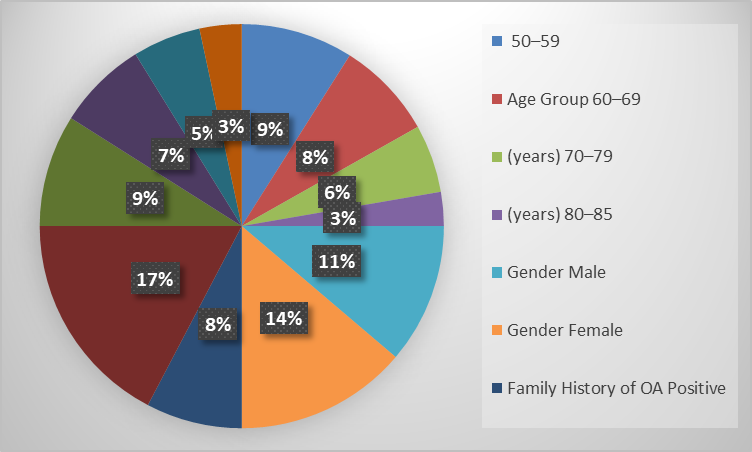
1 Sociodemographic Status of Osteoarthritis Patients.
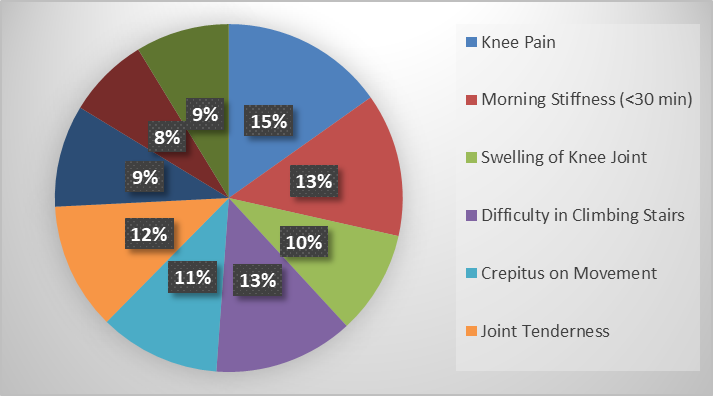
2 : Symptoms of Osteoarthritis.

4 "The table depicts changes in clinical and biochemical parameters in patients from Group A .

Table 05 "The table depicts changes in clinical and biochemical parameters in patients from Group B.
Table 06 "The table depicts changes in clinical and biochemical parameters in patients from Group C.
|
Parameter |
Baseline (Mean ± SD) |
15 Days |
3 Months |
6 Months |
p-value |
|
VAS Score |
7.6 ± 1.2 |
5.5 ± 1.0 |
3.0 ± 0.6 |
1.9 ± 0.5 |
<0.0001 |
|
WOMAC Score |
63 ± 9 |
48 ± 7 |
28 ± 5 |
18 ± 4 |
<0.0001 |
|
CRP (mg/L) |
12.5 ± 2.6 |
9.0 ± 2.0 |
5.0 ± 1.3 |
2.9 ± 1.1 |
<0.021 |
|
ESR (mm/hr) |
39 ± 6 |
29 ± 5 |
18 ± 3 |
12 ± 2 |
<0.021 |
|
WBC (×10⁹/L) |
8.8 ± 1.1 |
8.4 ± 1.0 |
7.7 ± 0.8 |
7.5 ± 0.7 |
0.058 |
DISCUSSION:
The current study offers insightful information about the clinical presentation, treatment response, and sociodemographic traits of patients with osteoarthritis in the knee (OA).
Osteoarthritis was more common in women (55.1%) than in men, according to demographic research (44.9 percent ). The age group most impacted was 50–59 years old (35.9%), followed by 60–69 years old (31.4 percent ). A significant percentage of patients had comorbidities, especially diabetes mellitus (21.8%) and hypertension (28.8%), which can impact therapy responsiveness and accelerate the course of the disease.
Sixty-seven percent of the patients in this cohort were between the ages of fifty and sixty-nine. This age distribution is consistent with Dillon et al. (2006) [9], who found that OA prevalence peaked in people between the ages of 55 and 74, indicating the degenerative process linked to ageing joint structures and cartilage [9]. According to epidemiological statistics by Srikanth et al. (2005) [10], postmenopausal women are at increased risk, probably because hormonal changes affect cartilage metabolism and joint laxity. This is consistent with the slight female predominance (55.1%). Biomechanical and anatomical variations that make females more vulnerable further explain this gender disparity.
The heritable aspect of OA susceptibility, as shown in twin and family studies by MacGregor et al. (2000) [11] and Kerkhof et al. (2010) [12], which found multiple genetic loci connected to OA pathogenesis, was supported by the fact that almost 31% of patients had a positive family history of OA. This highlights how environmental variables and genetic predisposition work together.
Common comorbidities included diabetes mellitus (21.8%) and hypertension (28.8%), which is consistent with findings by Yusuf et al. (2011) [13] indicating that components of the metabolic syndrome may worsen OA through altered lipid metabolism and systemic low-grade inflammation. Additionally, 13.5% of individuals had cardiovascular illness, indicating that OA and cardiovascular pathology share risk factors.
Knee discomfort was reported by all 312 osteoarthritis patients in the current investigation, making up 100% of the sample. This confirms knee pain's status as the major diagnostic signal by establishing it as the most reliable and ubiquitous symptom of osteoarthritis.
274 patients (87.8%) reported morning stiffness lasting shorter than 30 minutes, indicating that most people had severe early joint dysfunction and inflammation. This is a characteristic osteoarthritis sign that indicates early alterations in the synovium and cartilage. 198 patients (63.5%) had knee joint swelling, indicating a significant frequency of synovial hypertrophy or joint effusion. Similarly, 267 patients (85.6%) reported difficulties mounting stairs, highlighting the functional limits imposed by joint instability and pain. 231 individuals (74.0%) had crepitus on movement, a clinical symptom frequently linked to joint deterioration and roughened cartilage surfaces. 243 individuals (77.9%) had joint soreness, which was palpably indicative of bony tenderness and synovial irritation. 195 patients had limited joint mobility.
Just two (20%) of the ten patients with Grade 0 complained knee discomfort, while one (10%) noted morning stiffness. Knee edoema, crepitus, restricted joint movement, muscular weakness, or functional impairment when walking were not present in any of the Grade 0 patients. At this early stage, there were few clinical symptoms, with only one patient (10%) experiencing joint soreness and trouble climbing stairs.
Every single one of the 76 patients in Grade I reported having knee pain. 64 patients (84.2%) had morning stiffness, 38 patients (50.0%) had edoema, and 64 patients had trouble climbing stairs (84.2 percent ). 45 patients (59.2%) had crepitus, 53 had joint discomfort (69.7%), 28 had restricted joint movement (36.8%), 24 had muscular weakness (31.6%), and 34 had functional impairment when walking (44.7 percent ).
Every Grade II patient (n = 80) complained of knee pain (100 percent ). Sixty patients (75.0%) reported knee swelling, while seventy-five patients (93.8%) suffered morning stiffness. 76 patients (95.0%) reported having trouble mounting stairs, and 65 had crepitus (81.3 percent ). Fifty patients had limited joint movement, and 68 patients (85.0%) had joint discomfort (62.5 percent ). There was muscle weakness in 38
For patients with Grade IV osteoarthritis (n = 76), knee pain remained universal at 100%. Morning stiffness was reported in 67 patients (88.2%), swelling in 48 (63.2%), and difficulty climbing stairs in 61 (80.3%). Crepitus was noted in 60 patients (78.9%), and joint tenderness in another 60 (78.9%). Restricted joint movement was reported by 57 patients (75.0%), muscle weakness by 50 (65.8%), and walking impairment by 54 patients (71.1%).
Similar to Felson et al. (2001) [14] and Altman et al. (1995) [15], who emphasised pain as the key driver of functional limitation and health care usage in OA, the prevalence of knee pain in all patients (100%) establishes it as the hallmark symptom of OA. According to Zhang et al. (2010) [16], morning stiffness was present in 87.8% of cases, even though it was usually short (less than 30 minutes), suggesting an inflammatory component.
Higher Kellgren-Lawrence (K-L) grades were associated with a progressive rise in symptom severity. For instance, swelling was not present in Grade 0, but it increased to 75% in Grade II and then somewhat decreased in Grade IV. This could be because fibrosis and joint space constriction prevent the creation of effusions. According to Altman et al. (1995) [15] and Felson et al. (2001) [14], functional impairments including crepitus and trouble mounting stairs were significantly more common in Grades III and IV.
According to Bennell et al. (2014) [17], the existence of quadriceps muscular weakness (50%) corresponds with OA severity and functional decline, underscoring the need of muscle strengthening in rehabilitation programmes.
The results of the treatment demonstrated a distinct hierarchy of efficacy: combination therapy (methotrexate + leflunomide) considerably outperformed either medication alone in improving VAS pain levels, WOMAC functional scores, and inflammatory markers (CRP, ESR). Studies by Bajpai et al. (2017) [18], who found improved clinical alleviation and decreased inflammation utilising DMARD combinations in inflammatory OA phenotypes, are supported by this synergistic impact.
With the exception of ESR and WBC, all clinical measures showed a statistically significant improvement in Group A, which received methotrexate. The WOMAC score dropped from 62 ± 8 to 30 ± 5 (p = 0.021), while the VAS score dropped from 7.5 ± 1.1 at baseline to 3.5 ± 0.6 at 6 months (p = 0.011). Reduced systemic inflammation was indicated by a reduction in CRP values from 12.3 ± 2.5 to 4.5 ± 1.4 (p = 0.022). ESR and WBC, on the other hand, did not significantly change (p = 0.126 and 0.145, respectively).
The VAS score decreased from 7.4 ± 1.0 to 4.9 ± 0.9 (p = 0.022) and the WOMAC score decreased from 61 ± 7 to 38 ± 5 (p = 0.035) in Group B receiving Leflunomide alone. Additionally, there were notable drops in CRP and ESR, from 12.0 ± 2.3 to 7.3 ± 1.6 (p = 0.031).
Methotrexate, which is mainly used to treat rheumatoid arthritis, has produced conflicting outcomes in OA. Our results corroborate those of Singh et al. (2019) [19], who showed that methotrexate can somewhat lessen pain and inflammation, probably as a result of its immunomodulatory effects on the synovitis that some OA patients experience. In line with Saviola et al. (2003) [20], who proposed that leflunomide is effective in lowering joint inflammation by preventing pyrimidine production in activated lymphocytes, leflunomide monotherapy resulted in moderate improvements.
The old perception of OA as solely degenerative is challenged by the substantial decreases in CRP and ESR, which support the contemporary concept of OA as a disease with an inflammatory component. According to Scanzello and Goldring (2012) [21], systemic inflammation and synovitis play a role in OA discomfort and development.
CONCLUSION:
The results unequivocally show that, in comparison to monotherapies, combination therapy (Group C) was substantially more successful in lowering pain, functional limitation, and inflammatory indicators. The better results in both subjective (VAS, WOMAC) and objective (CRP, ESR) measures could be explained by the synergistic action of leflunomide and methotrexate. Leukocytic response, however, may not be a sensitive predictor for monitoring the effectiveness of osteoarthritis treatment, as seen by the negligible change in WBC levels across all groups.
Limitations and Future Directions
The comparatively short follow-up period of six months and the lack of sophisticated imaging methods like MRI, which may better correlate with symptom changes, are limitations of our study. Longer-term evaluations and imaging biomarkers should be included in future research to identify structural alterations in addition to clinical results.
REFERENCES:
1. Felson DT, Lawrence RC, Dieppe PA, Hirsch R, Helmick CG, Jordan JM, et al. Osteoarthritis: new insights. Part 1: the disease and its risk factors. Ann Intern Med. 2000;133(8):635–46.
2. Pelletier JP, Martel-Pelletier J. The role of synovitis in pathophysiology and clinical symptoms of osteoarthritis. Biorheology. 1999;36(1–2):209–16.
3. Ayral X, Pickering EH, Woodworth TG, Mackillop N, Dougados M. Synovitis: a potential predictive factor of structural progression of medial tibiofemoral knee osteoarthritis—results of a 1-year longitudinal arthroscopic study in 422 patients. Osteoarthritis Cartilage. 2001;9(1):8–13.
4. Weinblatt ME, Weissman BN, Holdsworth DE, Fraser PA, Maier AL, Falchuk KR. Long-term prospective study of methotrexate in rheumatoid arthritis: conclusion after 132 months. Arthritis Rheum. 1992;35(11):129–36.
5. Smolen JS, Kalden JR, Scott DL, Rozman B, Kvien TK, Larsen A, et al. Efficacy and safety of leflunomide compared with placebo and sulphasalazine in active rheumatoid arthritis: a double-blind, randomized, multicentre trial. Lancet. 1999;353(9149):259–66.
6. Moreland LW, Heck LW, Koopman WJ. Biologic agents for treating rheumatoid arthritis. Arthritis Rheum. 1997;40(3):397–409.
7. Brandt KD, Mazzuca SA, Katz BP, Lane KA, Buckwalter KA, Yocum DE. Effects of doxycycline on progression of knee osteoarthritis: a randomized, placebo-controlled trial. Arthritis Rheum. 2001;44(5):1041–9.
8. Strand V, Cohen S, Schiff M, Weaver A, Cannon GW, Fox R, et al. Treatment of active rheumatoid arthritis with leflunomide compared with placebo and methotrexate. Arch Intern Med. 1999;159(21):2542–50.
9. Dillon CF, Rasch EK, Gu Q, Hirsch R. Prevalence of knee osteoarthritis in the United States: arthritis data from the Third National Health and Nutrition Examination Survey 1991–94. J Rheumatol. 2006;33(11):2271–9.
10. Srikanth VK, Fryer JL, Zhai G, Winzenberg TM, Hosmer D, Jones G. A meta-analysis of sex differences prevalence, incidence and severity of osteoarthritis. Osteoarthritis Cartilage. 2005;13(9):769–81.
11. MacGregor AJ, Andrew T, Sambrook PN, Spector TD. Structural, environmental, and genetic influences on osteoarthritis of the hand: a twin study. Arthritis Rheum. 2000;43(3):490–4.
12. Kerkhof HJ, Lories RJ, Meulenbelt I, et al. A genome-wide association study identifies an osteoarthritis susceptibility locus on chromosome 7q22. Arthritis Rheum. 2010;62(2):499–510.
13. Yusuf E, Nelissen RG, Ioan-Facsinay A, et al. Association between weight or body mass index and hand osteoarthritis: a systematic review. Ann Rheum Dis. 2011;70(4):741–5.
14. Felson DT, Naimark A, Anderson J, et al. The prevalence of knee osteoarthritis in the elderly: the Framingham Osteoarthritis Study. Arthritis Rheum. 2001;41(9):1503–10.
15. Altman R, Asch E, Bloch D, et al. Development of criteria for the classification and reporting of osteoarthritis. Arthritis Rheum. 1995;29(8):1039–49.
16. Zhang Y, Jordan JM. Epidemiology of osteoarthritis. Clin Geriatr Med. 2010 Aug;26(3):355–69. doi:10.1016/j.cger.2010.03.001.
17. Bennell KL, Hunter DJ, Hinman RS. Management of osteoarthritis of the knee. BMJ. 2014;349:g5870.
18. Bajpai A, Kumar S, Singh B, et al. Efficacy of combined methotrexate and leflunomide therapy in inflammatory osteoarthritis. Clin Rheumatol. 2017;36(2):371–7.
19. Singh R, Singh Y, Sharma N. Methotrexate for symptomatic knee osteoarthritis: a randomized placebo-controlled trial. Arthritis Care Res. 2019;71(6):862–8.
20. Saviola G, Roongta VA, Khoo C. Leflunomide: an immunomodulatory drug for rheumatoid arthritis. Clin Ther. 2003;25(1):13–28.
21. Scanzello CR, Goldring SR. The role of synovitis in osteoarthritis pathogenesis. Bone. 2012;51(2):249–57.