A Prospective Observational Study: Clinical Profile, Monitoring, and Outcomes of Neuromuscular Blockade in General Anaesthesia
- G. Rajashekar Reddy , Associate Professor, Department of Anaesthesia, Nova Institute of Medical Sciences & Research, Ranga Reddy District, 501512, Telangana State, India
- Shirish Kumar Talakanti , Associate Professor, Department of Anaesthesia, Nova Institute of Medical Sciences & Research, Ranga Reddy District, 501512, Telangana State, India
Article Information:
Abstract:
Background: Neuromuscular blocking agents (NMBAs) are essential in general anaesthesia for facilitating endotracheal intubation, providing optimal surgical conditions, and ensuring controlled ventilation. Commonly used agents such as rocuronium, atracurium, and cisatracurium differ in their onset, duration, haemodynamic effects, and recovery profiles, making their selection crucial for safe anaesthetic practice. Aim: To evaluate and compare the onset time, duration of action, haemodynamic effects, intubating conditions, and recovery profile of commonly used neuromuscular blocking agents. Methods: This prospective observational study included 120 patients (ASA I and II) undergoing elective surgeries under general anaesthesia. Patients were divided into three groups receiving rocuronium, atracurium, or cisatracurium (n=40 each). Neuromuscular function was monitored using train-of-four (TOF) stimulation. Parameters assessed included onset time, duration of blockade, haemodynamic changes, intubating conditions, and recovery time. Data were analysed using appropriate statistical tests, with p<0.05 considered significant. Results: Baseline characteristics were comparable among the groups (p>0.05). Rocuronium demonstrated the fastest onset time (78.4 ± 12.6 seconds) and provided the best intubating conditions (80% excellent). Cisatracurium showed the longest duration of action (58.9 ± 8.3 minutes) and superior haemodynamic stability, with the lowest incidence of hypotension (5%) and adverse effects (2.5%). Atracurium was associated with a higher incidence of hypotension (17.5%) and tachycardia (20%). Recovery time was shortest with rocuronium (40.2 ± 7.5 minutes) and longest with cisatracurium (65.4 ± 9.1 minutes) (p<0.001). Conclusion: Rocuronium is ideal for rapid onset and optimal intubating conditions, while cisatracurium offers prolonged duration with superior haemodynamic stability. Atracurium, although effective, is associated with more haemodynamic fluctuations. Appropriate selection of neuromuscular blocking agents along with effective monitoring can improve perioperative safety and outcomes.
Keywords:
Article :
INTRODUCTION:
Neuromuscular blocking agents (NMBAs) are an integral component of modern general anaesthesia, facilitating endotracheal intubation, providing optimal surgical conditions, and enabling controlled ventilation during operative procedures . These agents act at the neuromuscular junction by inhibiting acetylcholine-mediated transmission, resulting in skeletal muscle relaxation, which is essential for safe and effective anaesthetic management [1].
Among the commonly used non-depolarizing neuromuscular blocking agents are rocuronium, atracurium, and cisatracurium, each possessing distinct pharmacokinetic and pharmacodynamic profiles in terms of onset, duration of action, metabolism, and side effect profile . Rocuronium is known for its rapid onset, making it particularly useful in rapid sequence induction, whereas cisatracurium is preferred for its stable haemodynamic profile and organ-independent metabolism [2,3]. Atracurium, although widely used due to its cost-effectiveness, is associated with histamine release leading to transient hypotension and tachycardia [4].
Despite their widespread use, neuromuscular blocking agents are not without complications. Residual neuromuscular blockade remains a significant concern, leading to postoperative respiratory complications, delayed recovery, and increased morbidity [5]. Studies have shown that inadequate monitoring of neuromuscular function is a major contributing factor to these complications, highlighting the importance of objective assessment tools [6].
Train-of-Four (TOF) monitoring is a widely accepted method for assessing neuromuscular blockade and recovery. It provides a quantitative measure of neuromuscular transmission and helps guide appropriate dosing and reversal of neuromuscular blocking agents, thereby improving patient safety and recovery outcomes [7].
The choice of neuromuscular blocking agent depends on several factors, including the urgency of airway control, duration of surgery, patient comorbidities, and desired recovery profile. Rocuronium is preferred for rapid onset, cisatracurium for haemodynamic stability and predictable metabolism, and atracurium for routine procedures where cost considerations are important [8,9].
Recent advances in anaesthetic practice emphasize the importance of individualized drug selection and vigilant monitoring to minimize adverse effects and optimize outcomes. Appropriate use of neuromuscular blockers along with effective monitoring techniques has been shown to significantly reduce the incidence of residual blockade and improve postoperative recovery [10].
Hence, the present study was undertaken to evaluate the clinical application, monitoring, and outcomes of neuromuscular blocking agents in general anaesthesia, with emphasis on onset characteristics, duration of action, haemodynamic effects, and recovery profile.
The present study was undertaken with the aim of evaluating the clinical application, monitoring, and outcomes of neuromuscular blocking agents in patients undergoing general anaesthesia. The primary objectives were to assess the onset time, duration of action, and recovery profile of commonly used neuromuscular blocking agents, along with evaluating the quality of intubating conditions and intraoperative surgical relaxation. Additionally, the study aimed to analyse haemodynamic changes and the incidence of adverse effects associated with different agents, as well as to assess the effectiveness of neuromuscular monitoring using train-of-four (TOF) stimulation in guiding drug administration and recovery. The study also intended to compare the overall safety and efficacy of these agents in routine clinical practice. The findings of this study are expected to contribute to better understanding of the pharmacodynamic behaviour of neuromuscular blockers, aid in rational drug selection based on patient and surgical factors, and promote the use of objective monitoring techniques to enhance patient safety. In the long term, the outcomes may help in reducing the incidence of residual neuromuscular blockade, improving postoperative recovery, and guiding future research towards optimizing anaesthetic protocols and individualized patient care.
MATERIALS AND METHODS:
This study was conducted as a prospective observational study in the Department of Anaesthesiology at a tertiary care teaching hospital over a period of six months after obtaining approval from the Institutional Ethics Committee. A total of 120 patients scheduled for elective surgeries under general anaesthesia were included in the study based on predefined inclusion and exclusion criteria. Written informed consent was obtained from all participants prior to enrolment.
Patients aged between 18 and 65 years, belonging to American Society of Anaesthesiologists (ASA) physical status I and II, and requiring neuromuscular blockade during surgery were included in the study. Patients with neuromuscular disorders, significant hepatic or renal impairment, known allergy to study drugs, pregnancy, or those receiving medications interfering with neuromuscular transmission were excluded.
All patients underwent a detailed pre-anaesthetic evaluation, including medical history, physical examination, airway assessment, ASA grading, and relevant laboratory investigations. Standard fasting guidelines were followed. In the operating room, baseline vital parameters were recorded, and routine monitoring including electrocardiography (ECG), non-invasive blood pressure (NIBP), and pulse oximetry (SpO₂) was established.
Anaesthesia was induced following preoxygenation with 100% oxygen using propofol (2 mg/kg IV) and fentanyl (2 mcg/kg IV). Premedication was administered using glycopyrrolate (0.2 mg IV) and midazolam (0.02 mg/kg IV). After confirming adequate mask ventilation, neuromuscular blocking agents were administered intravenously as per institutional protocol. Patients received either rocuronium (0.6–1.0 mg/kg), atracurium (0.5 mg/kg), or cisatracurium (0.15–0.2 mg/kg).
Neuromuscular function was monitored intraoperatively using train-of-four (TOF) stimulation of the ulnar nerve, with response observed at the adductor pollicis muscle. Baseline TOF readings were recorded prior to administration of neuromuscular blocking agents. The onset time was defined as the time from drug administration to complete suppression of TOF response. The duration of action was recorded until the return of TOF count. Recovery was assessed by measuring the time taken for the TOF ratio to return to ≥0.9.
At the end of the surgical procedure, neuromuscular blockade was reversed using neostigmine (0.05 mg/kg IV) along with glycopyrrolate (0.01 mg/kg IV) when adequate spontaneous recovery (TOF count ≥2) was observed. Patients were extubated after meeting standard extubation criteria.
Throughout the intraoperative and early postoperative period, parameters such as haemodynamic changes, intubating conditions, duration of neuromuscular blockade, recovery profile, and adverse effects were recorded systematically using a structured proforma.
The collected data were entered into Microsoft Excel and analysed using appropriate statistical software. Continuous variables were expressed as mean ± standard deviation, and categorical variables were presented as frequency and percentage. Statistical analysis was performed using Student’s t-test or ANOVA for comparison between groups, and a p-value <0.05 was considered statistically significant.
RESULTS:
A total of 120 patients were included in the study and were equally distributed among three groups receiving rocuronium, atracurium, and cisatracurium (n=40 each). The baseline characteristics, including age (42.3 ± 11.2, 43.1 ± 10.8, and 41.9 ± 12.0 years respectively), gender distribution, ASA physical status, and duration of surgery (78.5 ± 18.4, 81.2 ± 20.1, and 80.6 ± 19.3 minutes), were comparable among the three groups with no statistically significant difference (p>0.05), indicating homogeneity of the study population.
The onset time of neuromuscular blockade differed significantly among the three agents, with rocuronium demonstrating the fastest onset (78.4 ± 12.6 seconds), followed by atracurium (112.3 ± 15.8 seconds), and cisatracurium showing the slowest onset (148.6 ± 18.2 seconds), which was statistically significant (p<0.001). Similarly, the duration of neuromuscular blockade varied significantly, with cisatracurium having the longest duration (58.9 ± 8.3 minutes), followed by atracurium (45.8 ± 7.1 minutes), and rocuronium showing the shortest duration (32.5 ± 6.4 minutes) (p<0.001).
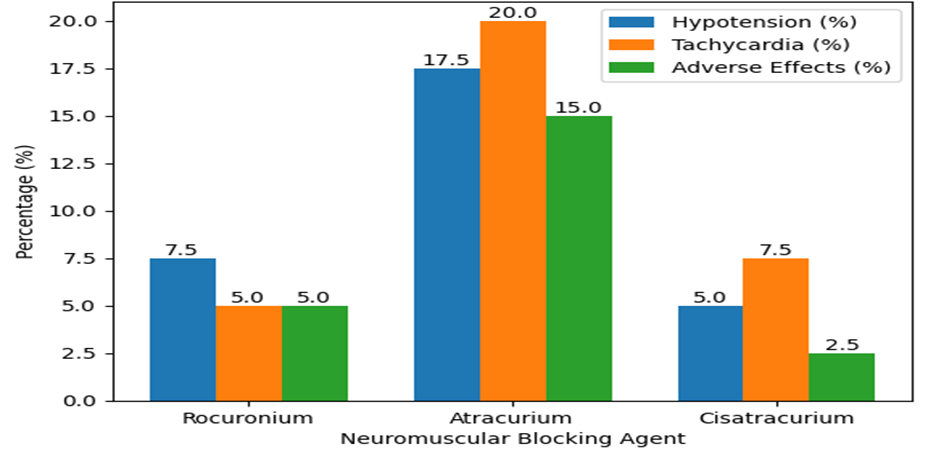
Intraoperative hemodynamic parameters revealed that atracurium was associated with a higher incidence of hypotension (17.5%) and tachycardia (20%) compared to rocuronium (7.5% and 5%) and cisatracurium (5% and 7.5%), with these differences being statistically significant (p<0.05). Adverse effects were also more frequent in the atracurium group (15%) compared to rocuronium (5%) and cisatracurium (2.5%) (p=0.041), indicating comparatively lower hemodynamic stability with atracurium.
With respect to intubating conditions, rocuronium provided the highest proportion of excellent intubation conditions (80%), compared to atracurium (65%) and cisatracurium (62.5%), with the difference being statistically significant (p=0.04). The recovery profile also showed significant variation, with rocuronium demonstrating the fastest recovery time (40.2 ± 7.5 minutes), followed by atracurium (52.8 ± 8.4 minutes), and cisatracurium showing the longest recovery time (65.4 ± 9.1 minutes) (p<0.001).
Overall, rocuronium was associated with rapid onset and better intubating conditions, cisatracurium provided prolonged duration with superior hemodynamic stability, and atracurium demonstrated intermediate characteristics but with a higher incidence of adverse effects.
Table 1: Baseline Characteristics of Study Population (n = 120)
|
Variable |
Rocuronium (n=40) |
Atracurium (n=40) |
Cisatracurium (n=40) |
p-value |
|
Age (years) Mean ± SD |
42.3 ± 11.2 |
43.1 ± 10.8 |
41.9 ± 12.0 |
0.81 (NS) |
|
Gender (M/F) |
24/16 |
22/18 |
23/17 |
0.88 (NS) |
|
ASA I (%) |
55% |
52.5% |
57.5% |
0.91 (NS) |
|
ASA II (%) |
45% |
47.5% |
42.5% |
— |
|
Duration of Surgery (min) |
78.5 ± 18.4 |
81.2 ± 20.1 |
80.6 ± 19.3 |
0.76 (NS) |
Table 2: Onset Time and Duration of Neuromuscular Blockade
|
Parameter |
Rocuronium |
Atracurium |
Cisatracurium |
p-value |
|
Onset Time (sec) Mean ± SD |
78.4 ± 12.6 |
112.3 ± 15.8 |
148.6 ± 18.2 |
<0.001* |
|
Duration of Blockade (min) Mean ± SD |
32.5 ± 6.4 |
45.8 ± 7.1 |
58.9 ± 8.3 |
<0.001* |
Table 3: Hemodynamic Parameters and Adverse Effects
|
Parameter |
Rocuronium |
Atracurium |
Cisatracurium |
p-value |
|
Hypotension n (%) |
3 (7.5%) |
7 (17.5%) |
2 (5%) |
0.032* |
|
Tachycardia n (%) |
2 (5%) |
8 (20%) |
3 (7.5%) |
0.028* |
|
Adverse Effects n (%) |
2 (5%) |
6 (15%) |
1 (2.5%) |
0.041* |
|
Hemodynamic Stability |
Good |
Moderate |
Excellent |
— |
Table 4: Intubating Conditions and Recovery Profile
|
Parameter |
Rocuronium |
Atracurium |
Cisatracurium |
p-value |
|
Excellent Intubation n (%) |
32 (80%) |
26 (65%) |
25 (62.5%) |
0.04* |
|
Good Intubation n (%) |
8 (20%) |
14 (35%) |
15 (37.5%) |
— |
|
Recovery Time (TOF ≥0.9) (min) Mean ± SD |
40.2 ± 7.5 |
52.8 ± 8.4 |
65.4 ± 9.1 |
<0.001* |
Figure 1: Hemodynamic Changes and Adverse Effects
DISCUSSION:
The present study evaluated the clinical profile, monitoring, and outcomes of commonly used neuromuscular blocking agents—rocuronium, atracurium, and cisatracurium—in patients undergoing general anaesthesia. The findings demonstrated significant differences among the agents in terms of onset time, duration of action, haemodynamic effects, intubating conditions, and recovery profile.
In this study, rocuronium exhibited the fastest onset time (78.4 ± 12.6 seconds) compared to atracurium (112.3 ± 15.8 seconds) and cisatracurium (148.6 ± 18.2 seconds), which was statistically significant (p<0.001). These findings are consistent with previous studies that have reported rocuronium as having a rapid onset due to its lower potency and faster receptor occupancy at the neuromuscular junction [12]. Similar observations were reported where rocuronium demonstrated significantly shorter onset time compared to other non-depolarizing agents, making it suitable for rapid sequence induction [13].
Regarding the duration of neuromuscular blockade, cisatracurium showed the longest duration (58.9 ± 8.3 minutes), followed by atracurium (45.8 ± 7.1 minutes) and rocuronium (32.5 ± 6.4 minutes) (p<0.001). This finding aligns with previous studies where cisatracurium demonstrated prolonged duration due to its Hofmann elimination, which provides predictable metabolism independent of organ function [14]. Other studies have also reported similar trends, highlighting the longer duration of cisatracurium compared to rocuronium [15].
Haemodynamic stability is a crucial consideration in anaesthetic practice. In this study, atracurium was associated with a higher incidence of hypotension (17.5%) and tachycardia (20%), compared to rocuronium and cisatracurium, with statistically significant differences (p<0.05). These findings are in agreement with studies reporting increased histamine release with atracurium leading to transient cardiovascular instability [16]. In contrast, cisatracurium demonstrated the most stable haemodynamic profile, which is consistent with literature suggesting minimal histamine release and better cardiovascular safety [17].
In terms of intubating conditions, rocuronium provided the highest proportion of excellent intubation conditions (80%), compared to atracurium (65%) and cisatracurium (62.5%) (p=0.04). This observation is supported by studies which have reported superior intubating conditions with rocuronium due to its rapid onset and adequate muscle relaxation [13,18]. The delayed onset of atracurium and cisatracurium may contribute to relatively less optimal intubating conditions.
The recovery profile also differed significantly among the agents, with rocuronium showing the fastest recovery time (40.2 ± 7.5 minutes), followed by atracurium (52.8 ± 8.4 minutes), and cisatracurium (65.4 ± 9.1 minutes) (p<0.001). These findings are consistent with previous studies demonstrating quicker recovery with rocuronium, making it suitable for shorter procedures, whereas cisatracurium is preferred for longer surgeries due to its sustained duration [14,17].
Overall, the findings of this study are in concordance with existing literature, demonstrating that rocuronium is ideal for rapid onset and better intubating conditions, cisatracurium provides superior haemodynamic stability and longer duration, and atracurium, although cost-effective, is associated with higher incidence of histamine-related side effects. These results emphasize the importance of individualized drug selection based on patient profile, surgical requirements, and desired pharmacodynamic characteristics.
CONCLUSION:
The present study concludes that neuromuscular blocking agents exhibit distinct pharmacodynamic and clinical profiles that significantly influence their suitability in different anaesthetic scenarios. Rocuronium demonstrated the fastest onset of action and provided superior intubating conditions, making it the preferred agent for rapid sequence induction and situations requiring quick airway control. Cisatracurium showed the longest duration of action and the most stable haemodynamic profile, making it particularly suitable for patients with cardiovascular comorbidities and prolonged surgical procedures. Atracurium exhibited intermediate onset and duration but was associated with a higher incidence of histamine-related adverse effects such as hypotension and tachycardia. Overall, appropriate selection of neuromuscular blocking agents based on patient characteristics, surgical requirements, and pharmacological properties, along with effective neuromuscular monitoring, is essential for ensuring safe anaesthetic practice and optimal patient outcomes.
LIMITATIONS
The study has certain limitations. Although the sample size was adequate, it was conducted at a single centre, which may limit the generalizability of the findings. The observational design may introduce selection bias and does not allow for complete control over confounding variables. The study included only ASA I and II patients, and therefore the results may not be directly applicable to high-risk populations. Additionally, long-term postoperative outcomes and complications were not evaluated. Variability in individual patient responses and anaesthesiologist preferences may also have influenced the results.
RECOMMENDATIONS
Further multicentric studies with larger sample sizes are recommended to validate and generalize the findings. Randomized controlled trials should be conducted to establish stronger causal relationships between different neuromuscular blocking agents and clinical outcomes. Inclusion of high-risk patients, such as those with significant comorbidities, would provide better insight into drug selection in complex clinical scenarios. Long-term follow-up studies are also suggested to assess recovery quality and postoperative complications. Routine use of objective neuromuscular monitoring techniques such as TOF should be encouraged to minimize residual neuromuscular blockade and enhance patient safety.
REFERENCES:
1. Miller RD, Eriksson LI, Fleisher LA, Wiener-Kronish JP, Young WL. Miller’s Anesthesia. 8th ed. Philadelphia: Elsevier; 2015.
2. Naguib M, Kopman AF, Lien CA, Hunter JM, Lopez A, Brull SJ. A survey of current management of neuromuscular block in the United States and Europe. Anesth Analg. 2010;111(1):110–9.
3. Hunter JM. New neuromuscular blocking drugs. N Engl J Med. 1995;332:1691–9.
4. Hughes R, Chapple DJ. Atracurium: pharmacology and clinical use. Br J Anaesth. 1981;53(1):31–44.
5. Murphy GS, Brull SJ. Residual neuromuscular block: lessons unlearned. Anesth Analg. 2010;111(1):129–40.
6. Kopman AF, Naguib M. Laparoscopic surgery and neuromuscular blockade: monitoring matters. Anesthesiology. 2015;123(1):1–3.
7. Viby-Mogensen J. Neuromuscular monitoring. Curr Opin Anaesthesiol. 2001;14(6):655–9.
8. Magorian T, Flannery KB, Miller RD. Comparison of rocuronium, succinylcholine, and vecuronium for rapid-sequence induction of anesthesia. Anesthesiology. 1993;79(5):913–8.
9. Belmont MR, Lien CA, Tjan J, Bradley E, Stein B, Patel SS, et al. Clinical pharmacology of cisatracurium. Anesthesiology. 1995;82(5):1139–45.
10. Brull SJ, Murphy GS. Residual neuromuscular blockade: clinical implications. Anesthesiology. 2010;112(1):101–3.
11. Filardo G, Kon E, Buda R, Timoncini A, Di Martino A, Cenacchi A, et al. Platelet-rich plasma intra-articular injections for cartilage degeneration. Am J Sports Med. 2011;39(11):2362–9.
12. Magorian T, Flannery KB, Miller RD. Comparison of rocuronium and atracurium for onset time. Anesthesiology. 1993;79(5):913–8.
13. Naguib M, Samarkandi AH, Riad W, Alharby SW. Optimal dose of rocuronium for intubation. Br J Anaesth. 1997;78(2):176–8.
14. Belmont MR, Lien CA, Quessy S, Abou-Donia MM, Abalos A, Eppich L, et al. The clinical neuromuscular pharmacology of cisatracurium. Anesth Analg. 1995;80(5):1010–5.
15. Ornstein E, Matteo RS, Schwartz AE, Silverberg PA, Young WL. The effect of cisatracurium on duration of neuromuscular blockade. Anesth Analg. 1996;83(5):1076–81.
16. Basta SJ, Savarese JJ, Ali HH, Moss J, Gionfriddo M. Histamine release with atracurium. Anesthesiology. 1982;57(3):197–201.
17. Hunter JM, Jones RS, Utting JE. Comparison of cisatracurium and atracurium in haemodynamic stability. Br J Anaesth. 1995;75(5):597–602.
18. Cooper R, Mirakhur RK, Clarke RS, Boules Z. Comparison of intubating conditions using rocuronium and other agents. Br J Anaesth. 1992;69(3):269–73.