Central sensitisation and failure of interventional pain procedures: implications for mechanism-based pain management.
- Ambika Prasad Tripathy , Assistant Professor, Department of Anaesthesiology, SLN Medical College And Hospital, Koraput, Odisha.
- Aratiprava Sahu , Associate Professor, Department Of Anaesthesia Acharya Harihar PG Institute Of Cancer, Cuttack, Odisha.
- Laxmi Narayan Dash , Associate Professor, Department of Anaesthesiology, Pabitra Mohan Pradhan Medical College And Hospital, Talcher , Angul, Odisha.
Article Information:
Abstract:
Background: Interventional pain procedures such as epidural steroid injections, nerve0 blocks, radiofrequency ablation, and neuromodulation are widely used for the treatment of chronic pain conditions. However, clinical outcomes remain inconsistent, and many patients experience persistent pain despite technically successful procedures targeting peripheral pathology. Increasing evidence suggests that altered central pain processing, particularly central sensitisation, may contribute to treatment failure in interventional pain management. Objective: To examine the role of central sensitisation as a determinant of poor outcomes following interventional pain procedures and to discuss its implications for patient selection and treatment planning. Methods: A narrative review of clinical and mechanistic studies examining the relationship between central sensitisation and outcomes of interventional pain procedures was conducted. Literature was identified from major biomedical databases including PubMed, Scopus, Web of Science, and Google Scholar using keywords related to central sensitisation, nociplastic pain, and interventional pain management. Results: Evidence indicates that central sensitisation alters nociceptive processing within the central nervous system, leading to amplification of pain signals and persistence of symptoms despite treatment of peripheral pathology. Patients exhibiting features of central sensitisation frequently demonstrate reduced response to interventional pain procedures and may experience ongoing pain even after technically successful interventions. Conclusion: Central sensitisation represents an important factor influencing the success of interventional pain procedures. Incorporating screening tools and mechanism-based assessment into routine clinical practice may improve patient selection and guide personalized pain management strategies.
Keywords:
Article :
INTRODUCTION:
Chronic pain represents a major global health challenge and is among the leading causes of disability worldwide. It affects a significant proportion of the adult population and is associated with reduced quality of life, functional impairment, and substantial socioeconomic burden.¹ As the prevalence of chronic pain conditions continues to rise, clinicians increasingly rely on interventional pain procedures as part of multidisciplinary pain management strategies.
Interventional techniques such as epidural steroid injections, facet joint blocks, radiofrequency ablation, and spinal cord stimulation are commonly used to target specific anatomical pain generators. These procedures aim to interrupt nociceptive signaling arising from peripheral tissues and thereby alleviate pain.² Advances in imaging guidance and procedural techniques have improved the precision and safety of many of these interventions.
Despite these developments, treatment outcomes remain highly variable. A substantial proportion of patients experience minimal or short-term benefit even when procedures are technically successful and the presumed peripheral pain generator has been appropriately targeted.³ This discrepancy between procedural success and clinical outcome suggests that mechanisms beyond peripheral pathology may contribute to persistent pain.
One important mechanism proposed to explain this phenomenon is central sensitisation. Central sensitisation refers to increased responsiveness of neurons within the central nervous system that results in amplification of nociceptive signals.⁴ Through a series of neuroplastic changes, the central nervous system becomes hypersensitive to sensory input, producing exaggerated pain responses.
Central sensitisation can develop following prolonged nociceptive input resulting from tissue injury or inflammation. Persistent stimulation of peripheral nociceptors can lead to increased excitability of dorsal horn neurons in the spinal cord and altered pain processing within the brain.⁵ As a result, stimuli that would normally produce mild or no pain may evoke exaggerated responses, a phenomenon known as hyperalgesia or allodynia.
These central nervous system changes may persist even after the initial peripheral injury has resolved. Consequently, pain can become self-sustaining and independent of ongoing peripheral pathology.⁶ This has important implications for interventional pain management because many procedures are designed to treat peripheral nociceptive sources.
Emerging research suggests that patients with features of central sensitisation often experience poorer outcomes following medical or surgical treatments.⁷ In such cases, interventions directed solely at peripheral pathology may fail to adequately relieve pain because the underlying mechanism involves altered central nervous system processing.
A related concept is nociplastic pain, which refers to pain arising from altered nociceptive processing without clear evidence of tissue damage or nerve injury.⁸ Conditions such as fibromyalgia and certain chronic musculoskeletal pain syndromes frequently involve nociplastic mechanisms and may demonstrate limited response to interventions targeting peripheral structures.
Recognition of central sensitisation has therefore become increasingly important in modern pain medicine. Screening tools such as the Central Sensitization Inventory (CSI) and quantitative sensory testing methods have been developed to help identify patients with features suggestive of central pain amplification.⁹ Incorporating such assessments into clinical practice may improve patient selection and optimize treatment strategies.This review examines the role of central sensitisation as a potential determinant of treatment failure in interventional pain procedures and explores its implications for mechanism-based pain management.
MATERIALS AND METHODS:
This article was conducted as a narrative review aimed at synthesizing available evidence regarding the influence of central sensitisation on outcomes of interventional pain procedures.
Literature search strategy
Relevant literature was identified through searches of PubMed, Scopus, Web of Science, and Google Scholar. Keywords included central sensitisation, central sensitization, nociplastic pain, interventional pain management, epidural injections, radiofrequency ablation, spinal cord stimulation, and treatment outcomes.
Inclusion criteria
Studies were included if they:
• evaluated central sensitisation mechanisms in chronic pain
• examined outcomes of interventional pain procedures
• explored predictors of treatment response in chronic pain conditions
Both clinical and experimental studies were considered.
Exclusion criteria
Non-English articles without available translations and studies lacking relevance to interventional pain outcomes were excluded.
Findings were organized into thematic categories addressing neurobiology, clinical manifestations, and implications of central sensitisation for interventional pain procedures.
RESULTS:
Central sensitisation: mechanisms and neurobiology
Central sensitisation is characterized by increased excitability of neurons within the central nervous system. Woolf first described this phenomenon as a mechanism underlying post-injury pain hypersensitivity.¹⁰ Persistent nociceptive input can induce long-term potentiation in dorsal horn neurons, enhancing synaptic transmission within pain pathways.¹¹ At the molecular level, excitatory neurotransmitters such as glutamate and substance P play a key role in amplifying nociceptive signals. Activation of NMDA receptors contributes to sustained neuronal excitability and prolonged pain responses.¹²
Neuroinflammatory processes also contribute to central sensitisation. Activation of microglia and astrocytes leads to release of pro-inflammatory cytokines that enhance neuronal excitability and disrupt inhibitory pain modulation.¹³ Functional neuroimaging studies demonstrate altered activity in brain regions involved in pain processing, including the anterior cingulate cortex and insula, in patients with chronic pain associated with central sensitisation.¹⁴ These alterations further contribute to heightened pain perception.
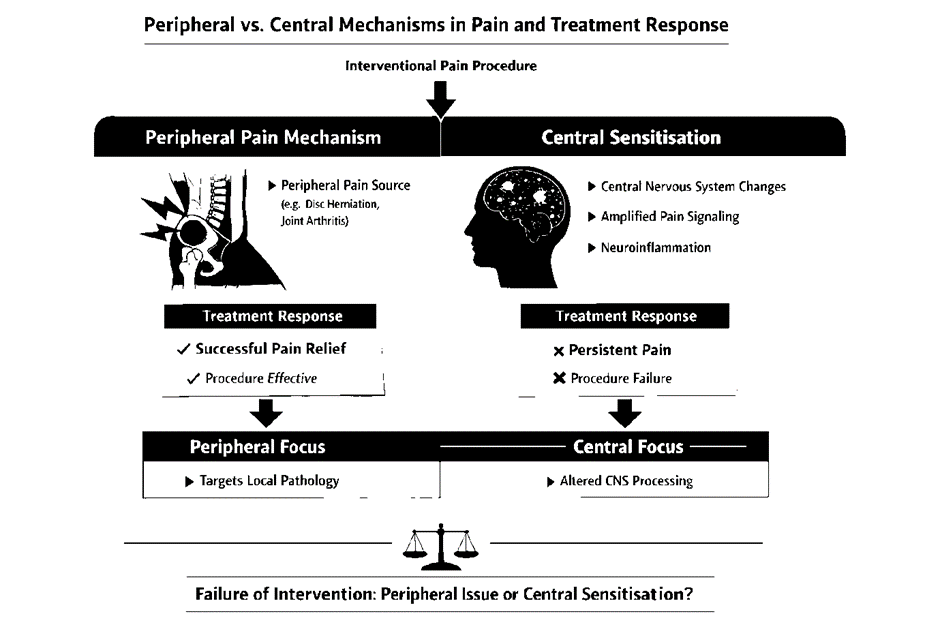
Figure 1. Conceptual framework illustrating peripheral versus central mechanisms in pain and treatment response. When pain originates from peripheral pathology, interventional procedures targeting the local source often provide effective relief. In contrast, when central sensitisation predominates, altered central nervous system processing may lead to persistent pain despite technically successful interventions.
Clinical manifestations of central sensitisation
Central sensitisation often manifests clinically as widespread pain sensitivity and exaggerated responses to stimuli. Hyperalgesia and allodynia are common features of centrally mediated pain.¹⁵ Patients may also report fatigue, sleep disturbances, and cognitive difficulties, reflecting broader effects of altered central nervous system processing.¹⁶ Conditions frequently associated with central sensitisation include fibromyalgia, chronic low back pain, migraine, and temporomandibular disorders.¹⁷ In these disorders, structural abnormalities may not fully explain symptom severity. Assessment tools such as the Central Sensitization Inventory provide a practical method for identifying patients with symptoms suggestive of central pain amplification.¹⁸
Central sensitisation as a predictor of poor outcomes in interventional pain procedures
Increasing evidence suggests that central sensitisation influences the outcomes of interventional pain procedures. Patients with features of central sensitisation often experience persistent pain despite technically successful interventions.¹⁹ In chronic low back pain, studies have shown that individuals with higher central sensitisation scores are less likely to achieve sustained pain relief following spinal injections.²⁰ Similarly, patients undergoing radiofrequency ablation for facet joint pain may continue to experience pain even after successful denervation, suggesting that central mechanisms maintain pain perception.²¹ Research in surgical populations further supports this relationship. Preoperative central sensitisation has been associated with increased risk of persistent postoperative pain.²² These findings emphasize that pain phenotypes characterized by central sensitisation may respond poorly to treatments targeting peripheral nociceptive sources.
Clinical implications for interventional pain practice
Recognition of central sensitisation has important implications for clinical practice. Assessment of central pain amplification may help clinicians identify patients less likely to benefit from invasive procedures. Incorporating screening tools and mechanism-based evaluation into patient assessment may improve treatment selection and reduce unnecessary interventions.
Patients with significant central sensitisation may benefit more from therapies targeting central pain modulation, including pharmacologic neuromodulators, psychological therapies, and multidisciplinary rehabilitation programs.
DISCUSSION:
Further prospective studies are needed to determine whether screening for central sensitisation can reliably predict outcomes of interventional procedures. Standardized assessment protocols and validated clinical biomarkers may facilitate identification of central pain amplification in routine clinical practice. Advances in neuroimaging and neurophysiology may also provide objective tools for identifying central sensitisation and guiding personalized treatment strategies.
The variability in outcomes of interventional pain procedures highlights the complex nature of chronic pain. Central sensitisation provides a plausible explanation for persistent pain despite technically successful interventions. Adopting a mechanism-based approach that considers both peripheral and central contributors to pain may improve treatment outcomes and promote more personalized pain management strategies.
CONCLUSION:
Identifying patients with centrally mediated pain may improve clinical decision-making and reduce unnecessary invasive interventions. Integrating mechanism-based assessment into pain management may ultimately enhance the effectiveness of interventional therapies and advance precision pain medicine.
REFERENCES:
1. Goldberg DS, McGee SJ. Pain as a global public health priority. BMC Public Health. 2011;11:770.
2. Deer TR, Pope JE, Hayek SM, et al. The role of interventional pain management in chronic pain treatment. Pain Medicine. 2019;20(Suppl 1):S1–S5.
3. Cohen SP, Raja SN. Pathogenesis, diagnosis, and treatment of lumbar facet joint pain. Anesthesiology. 2007;106(3):591–614.
4. Woolf CJ. Central sensitization: implications for the diagnosis and treatment of pain. Pain. 2011;152(3 Suppl):S2–S15.
5. Latremoliere A, Woolf CJ. Central sensitization: a generator of pain hypersensitivity by central neural plasticity. The Journal of Pain. 2009;10(9):895–926.
6. Sandkühler J. Models and mechanisms of hyperalgesia and allodynia. Physiological Reviews. 2009;89(2):707–758.
7. Nijs J, Van Houdenhove B. Central sensitisation in chronic pain conditions: latest discoveries and their potential for precision medicine. Clinical Rheumatology. 2010;29(5):465–473.
8. Kosek E, Cohen M, Baron R, et al. Do we need a third mechanistic descriptor for chronic pain states? Pain. 2016;157(7):1382–1386.
9. Mayer TG, Neblett R, Cohen H, et al. The development and psychometric validation of the Central Sensitization Inventory. Pain Practice. 2012;12(4):276–285.
10. Woolf CJ. Evidence for a central component of post-injury pain hypersensitivity. Nature. 1983;306(5944):686–688.
11. Sandkühler J. Understanding LTP in pain pathways. Molecular Pain. 2007;3:9.
12. Woolf CJ, Salter MW. Neuronal plasticity: increasing the gain in pain. Science. 2000;288(5472):1765–1769.
13. Ji RR, Nackley A, Huh Y, Terrando N, Maixner W. Neuroinflammation and central sensitization in chronic pain. Nature Reviews Neuroscience. 2018;19(8):465–480.
14. Apkarian AV, Baliki MN, Geha PY. Towards a theory of chronic pain. Progress in Neurobiology. 2009;87(2):81–97.
15. Baron R, Binder A, Wasner G. Neuropathic pain: diagnosis, pathophysiological mechanisms, and treatment. Lancet Neurology. 2010;9(8):807–819.
16. Yunus MB. Central sensitivity syndromes: a unified concept for fibromyalgia and related conditions. Seminars in Arthritis and Rheumatism. 2007;36(6):339–356.
17. Häuser W, Ablin J, Fitzcharles MA, et al. Fibromyalgia. The Lancet. 2015;386(9997):999–1007.
18. Neblett R, Cohen H, Choi Y, et al. The Central Sensitization Inventory: clinical utility in chronic pain assessment. Clinical Journal of Pain. 2013;29(4):323–332.
19. Arendt-Nielsen L, Skou ST, Nielsen TA, Petersen KK. Altered central sensitization and pain modulation in chronic musculoskeletal pain. Pain. 2015;156(10):1970–1981.
20. Petersen KK, Finnerup NB, Nørskov KN, et al. The role of central sensitization in chronic low back pain. Pain Reports. 2017;2(3):e593.
21. Cohen SP, Huang JH, Brummett C. Facet joint pain—advances in patient selection and treatment. Nature Reviews Rheumatology. 2013;9(2):101–116.
22. Wylde V, Palmer S, Learmonth ID, Dieppe P. The association between preoperative pain sensitization and chronic pain after surgery. Pain. 2013;154(11):2550–2557.
23. Yarnitsky D, Granot M, Granovsky Y. Pain modulation profile and pain therapy: between pro- and antinociception. Pain. 2014;155(4):663–665.
24. Apkarian AV, Hashmi JA, Baliki MN. Pain and the brain: specificity and plasticity of the brain in chronic pain. Neuroscientist. 2011;17(5):463–484.