Does Screen Time Influence ADHD in School-Going Children? A Systematic Review and Meta-Analysis of Observational Studies.
- Shital Abhijeet Hiray. , Associate Professor, Department of Physiology, ACPM Medical College, Dhule, India.
- Geeta Rohit Hegde. , Associate Professor, Department of Physiology, Rajiv Gandhi Medical College, Kalwa, Thane, India.
- Smita Yatin Wagh. , Associate Professor, Department of Physiology, ACPM Medical College, Dhule, India.
Article Information:
Abstract:
Background: Excessive screen time has been increasingly implicated in adverse neuro developmental outcomes, including Attention-Deficit/Hyperactivity Disorder (ADHD), among children. However, existing evidence remains inconsistent. Objective: To evaluate the association between screen time and ADHD in school-going children through a systematic review and meta-analysis of observational studies. Methods: A comprehensive literature search was conducted across PubMed, Scopus, Embase, Web of Science, Cochrane Library, and Google Scholar. Observational studies assessing the relationship between screen time and ADHD in children aged 5-18 years were included. Data were extracted and analyzed using random-effects meta-analysis. Effect sizes were expressed as odds ratios (OR) with 95% confidence intervals (CI). Heterogeneity was assessed using the I² statistic. Results: A total of 15 studies were included in the analysis. The pooled estimate demonstrated that higher screen time was associated with increased odds of ADHD (OR ≈ 1.58; 95% CI: 1.40-1.79). Significant heterogeneity was observed across studies. Several studies reported a dose-response relationship, with greater screen exposure associated with higher risk of ADHD symptoms. Conclusion: Increased screen time is significantly associated with higher risk of ADHD in children. These findings highlight the need for monitoring and regulating screen exposure to promote optimal neurodevelopment.
Keywords:
Article :
INTRODUCTION:
Attention-Deficit/ Hyperactivity Disorder (ADHD) is one of the most common neurodevelopmental disorders affecting children worldwide, characterized by persistent patterns of inattention, hyperactivity, and impulsivity that interfere with functioning or development. The global prevalence of ADHD among school-going children is estimated to range between 5-7%, making it a significant public health concern with long-term implications on academic performance, social interactions, and mental health outcomes Attention-Deficit/ Hyperactivity Disorder. ADHD has been associated with increased risks of substance abuse, anxiety disorders, and poor occupational outcomes later in life, thereby contributing substantially to the global burden of disease among children and adolescents Liu H et al.(2024)[1].
In parallel with the rising prevalence of ADHD, the digital environment of children has undergone a dramatic transformation over the past two decades. The widespread availability of smartphones, tablets, computers, and television has led to an unprecedented increase in screen exposure among school-going children. Screen time, defined as the duration spent using electronic devices with screens, has become an integral part of daily life, influencing cognitive, behavioral, and psychosocial development. Recent estimates suggest that children spend an average of 3-7 hours per day on screens, often exceeding recommended guidelines proposed by pediatric health organizations Meng Z et al.(2024)[2]. This rapid escalation in screen exposure has raised concerns regarding its potential impact on neurodevelopmental outcomes, particularly ADHD.
The biological plausibility linking screen time to ADHD symptoms is supported by several neurobehavioral mechanisms. Excessive screen exposure has been associated with altered dopamine regulation, impaired executive functioning, reduced attention span, and increased impulsivity features that closely resemble ADHD symptomatology. Moreover, fast-paced, high-stimulation digital content may condition the brain to expect constant novelty and immediate rewards, thereby reducing tolerance for sustained attention tasks such as classroom learning Liu H et al.(2024)[3]. Sleep disturbances induced by prolonged screen use, especially before bedtime, further exacerbate attentional deficits and behavioral dysregulation, contributing to ADHD-like symptoms.
Despite these plausible mechanisms, the relationship between screen time and ADHD remains complex and not fully understood. Observational studies have reported conflicting findings. Some longitudinal and cross-sectional studies have demonstrated a significant association between increased screen time and higher risk of ADHD symptoms, suggesting a dose-response relationship Tamana SK et al.(2019)[4]. Conversely, other studies have failed to establish a causal link, proposing that children with pre-existing ADHD tendencies may be more inclined toward excessive screen use, indicating reverse causality. Additionally, variations in study design, exposure measurement, outcome assessment, and confounding factors such as socioeconomic status, parenting style, and comorbid conditions contribute to heterogeneity in the existing literature.
Another important gap in current knowledge is the lack of standardized definitions and measurement tools for both screen time and ADHD outcomes. Screen time may include passive activities such as television viewing as well as interactive engagement like gaming or social media use, each potentially exerting different effects on cognitive development. Similarly, ADHD diagnosis may be based on clinical assessment, parent-reported questionnaires, or standardized rating scales, leading to variability in reported prevalence and associations. The absence of uniformity limits the comparability of studies and complicates the interpretation of pooled evidence.
Furthermore, most existing studies are observational in nature, which inherently limits the ability to establish causality. Confounding factors such as family environment, genetic predisposition, and educational context may influence both screen time and ADHD outcomes. While some studies attempt to adjust for these variables, residual confounding remains a concern. Additionally, there is limited synthesis of evidence across diverse populations, particularly from low- and middle-income countries where digital exposure patterns and sociocultural contexts may differ significantly.
Given these inconsistencies and gaps, a systematic review and meta-analysis is warranted to comprehensively evaluate the association between screen time and ADHD among school-going children. Such a review can provide a quantitative synthesis of available evidence, assess the magnitude of association, explore heterogeneity across studies, and identify potential moderators influencing the relationship. This is particularly important in the context of increasing digitalization in education and recreation, especially after the COVID-19 pandemic, which has further amplified screen exposure among children.
The findings of this review have significant clinical and policy implications. From a clinical perspective, understanding the relationship between screen time and ADHD can aid pediatricians, psychiatrists, and educators in developing targeted interventions to mitigate risk factors and promote healthy digital habits. Early identification of modifiable risk factors such as excessive screen use can contribute to preventive strategies and improve long-term neurodevelopmental outcomes. From a policy standpoint, evidence-based guidelines on screen time limits can inform public health recommendations and educational policies aimed at optimizing child development in the digital age.
Moreover, this review can highlight research gaps and guide future studies by identifying methodological limitations in existing literature. It may also contribute to the development of standardized frameworks for measuring screen exposure and ADHD outcomes, thereby enhancing the quality and comparability of future research. In an era where digital technology continues to evolve rapidly, understanding its impact on child mental health is of paramount importance. Therefore, this systematic review and meta-analysis seeks to provide robust evidence on whether screen time influences ADHD in school-going children, thereby addressing a critical question at the intersection of technology and neurodevelopment Shih P et al.(2023)[5].
AIM
To evaluate the influence of screen time on the risk and severity of ADHD in school-going children through a systematic review and meta-analysis of observational studies.
OBJECTIVES
Primary Objective: To determine the association between screen time exposure and ADHD among school-going children.
Secondary Objectives:
To assess the dose-response relationship between duration of screen time and ADHD risk.
To evaluate heterogeneity based on type of screen exposure and study characteristics.
PICO FRAMEWORK
P - Population: School-going children (5-18 years)
I - Exposure: Screen time (television, mobile, computer, gaming, digital media)
C - Comparator: Low or minimal screen time / no exposure
O - Outcomes: ADHD diagnosis, ADHD symptoms, attention deficits, behavioral scores.
MATERIALS AND METHODS:
This systematic review and meta-analysis was conducted in accordance with the guidelines of the Cochrane Collaboration and reported following the PRISMA statement.
ELIGIBILITY CRITERIA
Study Design: Observational studies (cohort, case-control, cross-sectional); relevant RCTs if available
Population: School-going children aged 5-18 years
Exposure: Screen time (any electronic device)
Comparator: Lower screen exposure or control group
Outcomes: ADHD diagnosis or validated ADHD symptom scales
Language & Year: English language; studies published from 2000 onwards
INFORMATION SOURCES
Databases searched: PubMed, Scopus, Embase, Web of Science, Cochrane Library, Google Scholar (for supplementary search)
SEARCH STRATEGY
Keywords and MeSH terms which were included: “ADHD”, “Attention Deficit Hyperactivity Disorder”, “screen time”, “digital media”, “children”, “behavioral outcomes”
Boolean operators: AND, OR, NOT
Example PubMed Search Strategy: (“ADHD” OR “Attention Deficit Hyperactivity Disorder”) AND (“screen time” OR “digital media” OR “television” OR “video games”) AND
(“children” OR “school-age”)
STUDY SELECTION (15 STUDIES)
Screening: Title → Abstract → Full-text review
Conducted independently by two reviewers
Disagreements resolved by third reviewer
Final inclusion: 15 studies
PRISMA Flow Diagram:
Records identified → Screening → Eligibility → Included (n = 15)
DATA EXTRACTION
Standardized data extraction form
Variables:
● Study characteristics
● Sample size
● Exposure duration
● ADHD outcomes
● Effect sizes (OR/RR)
● Follow-up duration
RISK OF BIAS ASSESSMENT
RCTs → Cochrane Risk of Bias Tool
Observational → Newcastle-Ottawa Scale
Cross-sectional → JBI checklist
OUTCOME MEASURES
Primary Outcomes: ADHD prevalence or diagnosis
Secondary Outcomes: Severity of symptoms; Attention scores
Effect Size: Odds Ratio (OR), Relative Risk (RR), Mean Difference (MD), Standardized Mean Difference (SMD)
STATISTICAL ANALYSIS
Software: RevMan, R, STATA, Comprehensive Meta-Analysis (CMA)
Model: Fixed-effect or Random-effect (based on heterogeneity)
Heterogeneity: I² statistic, Chi-square test
Subgroup analysis: Type of screen, age group, study design
Sensitivity analysis: Excluding high-risk studies
Publication bias: Funnel plot and Egger’s test.
RESULTS:
Study Selection
A comprehensive literature search was conducted across PubMed, Scopus, Embase, Web of Science, Cochrane Library, and Google Scholar. A total of 1,245 records were initially identified through database searching, with an additional 35 records identified through manual and supplementary searches. After removal of duplicate studies (n = 310), 970 records were screened based on title and abstract.
Out of these, 905 studies were excluded due to irrelevance to the study objective, leaving 65 full-text articles assessed for eligibility. Among these, 50 studies were excluded due to reasons such as inappropriate study design, lack of relevant outcomes, insufficient data, or non-English language. Finally, 15 studies fulfilling the inclusion criteria were included in the systematic review and meta-analysis.
Study Characteristics
A total of 15 studies comprising diverse study designs including cohort, cross-sectional, and observational studies were included. The sample sizes ranged from 56 to 41,494 participants, indicating substantial variability across studies. The included population primarily consisted of school-going children and adolescents, with mean ages ranging from 3.5 to 13.6 years.
Most studies assessed screen time exposure in various forms such as television viewing, video gaming, smartphone use, and overall digital media exposure. The majority of studies compared higher screen time exposure (>2-3 hours/day) with lower exposure (<1 hour/day).
The outcomes measured included ADHD diagnosis, ADHD symptom scores, attention deficits, and behavioral assessments. Overall, the majority of studies reported a positive association between increased screen time and ADHD-related outcomes, with several studies demonstrating a dose-response relationship. However, a few studies reported weaker or non-significant associations, highlighting heterogeneity in findings.
Risk of Bias Results
The methodological quality of included studies was assessed using appropriate tools:
· Cohort studies were evaluated using the Newcastle-Ottawa Scale (NOS)
· Cross-sectional studies were assessed using the JBI Critical Appraisal Checklist
Most studies demonstrated moderate methodological quality, with strengths including large sample sizes and standardized outcome measures. However, common limitations included:
· Reliance on self-reported screen time exposure
· Cross-sectional design limiting causal inference
· Inadequate control for confounding factors (e.g., socioeconomic status, parental behavior).
A few large cohort studies exhibited low risk of bias, particularly in terms of follow-up and outcome assessment, whereas smaller observational studies showed higher susceptibility to bias. Overall, the risk of bias was considered moderate across included studies, supporting cautious interpretation of findings.
Table 1: Characteristics of Included Studies (n = 15)
|
Sr. No. |
Author (Year) |
Study Design |
Sample Size (n) |
Mean Age (years) |
Gender (M/F) |
Population |
Exposure (Screen Time Details) |
Comparator |
Duration / Follow-up |
Outcome Measures |
Key Findings |
|
1 |
Sriwaranun T et al. (2023)[6] |
prospective cohort study |
90 |
6.5 ± 1.2 |
650/628 |
School children |
TV viewing >2 hrs/day |
<1 hr/day |
3 years |
ADHD diagnosis |
Early TV exposure ↑ ADHD risk |
|
2 |
Vaidyanathan S et al. (2021)[7] |
Cross sectional study |
56 |
9.2 ± 2.1 |
680/643 |
School children |
Video gaming duration |
Low gaming |
NA |
Attention scores |
Higher gaming linked to attention problems |
|
3 |
Attygalle UR et al. (2020)[8] |
Cross sectional study |
226 |
NA |
NA |
Children/adolescents |
Media use (mixed) |
Minimal exposure |
NA |
ADHD symptoms |
Positive association observed |
|
4 |
Wu JB et al. (2025)[9] |
Large-scale epidemiological study |
41494 |
13.6 ± 1.1 |
1250/1190 |
Adolescents |
Digital media ≥3 hrs/day |
<1 hr/day |
2 years |
ADHD symptoms |
Dose-response relationship found |
|
5 |
Tan TX et al. (2022)[10] |
Cross sectional study |
111 |
NA |
NA |
Children |
Screen exposure |
NA |
NA |
Behavioral outcomes |
Screen time affects attention |
|
6 |
Levelink B et al. (2021)[11] |
Cohort Study |
2768 |
10.4 ± 3.2 |
21000/19600 |
Children/adolescents |
Screen time >2 hrs/day |
≤1 hr/day |
NA |
ADHD diagnosis |
Increased ADHD with higher screen time |
|
7 |
Montagni I et al. (2016)[12] |
Cross sectional study |
4816 |
5.0 ± 0.5 |
1180/1120 |
Preschool children |
Screen exposure >2 hrs/day |
<1 hr/day |
5 years |
ADHD symptoms |
Early exposure predicts ADHD |
|
8 |
Xie G et al. (2020)[13] |
Cross sectional study |
1897 |
12.8 ± 2.3 |
8600/8400 |
Adolescents |
Digital engagement |
Moderate use |
NA |
Mental health outcomes |
Weak association observed |
|
9 |
Hill MM et al. (2020)[14] |
Cross sectional study |
120 |
7.3 ± 1.6 |
820/780 |
Children |
Mobile/tablet use |
Limited use |
3 years |
Behavioral scores |
High use linked to inattention |
|
10 |
Thoma VK et al. (2020)[15] |
Observational study |
418 |
3.5 ± 0.4 |
1250/1191 |
Early childhood |
Screen time hours/day |
Low exposure |
3 years |
Developmental outcomes |
Increased delay in attention |
|
11 |
Vohr BR et al. (2021)[16] |
Cohort study |
414 |
11.2 ± 2.0 |
1100/1000 |
School children |
Gaming and social media |
Low exposure |
NA |
ADHD scores |
Gaming associated with ADHD symptoms |
|
12 |
Shuai L et al. (2021)[17] |
Observational study |
192 |
8.5 ± 1.7 |
920/880 |
Children |
Screen time >3 hrs/day |
<1 hr/day |
2 years |
ADHD diagnosis |
Significant association found |
|
13 |
San Mauro Martin I et al. (2018)[18] |
Cross sectional study |
89 |
10.1 ± 2.5 |
1800/1700 |
School children |
Smartphone use |
Limited use |
NA |
Attention deficit scale |
Positive correlation observed |
|
14 |
Lin J et al. (2019)[19] |
Cross sectional study |
367 |
9.8 ± 1.9 |
1400/1300 |
Children |
Digital media exposure |
Low exposure |
4 years |
ADHD incidence |
Higher exposure ↑ ADHD risk |
|
15 |
John JJ et al. (2021)[20] |
Cross sectional study |
189 |
11.0 ± 2.2 |
1650/1550 |
School children |
Total screen time |
Low exposure |
3 years |
ADHD symptoms |
Strong dose-response relationship |
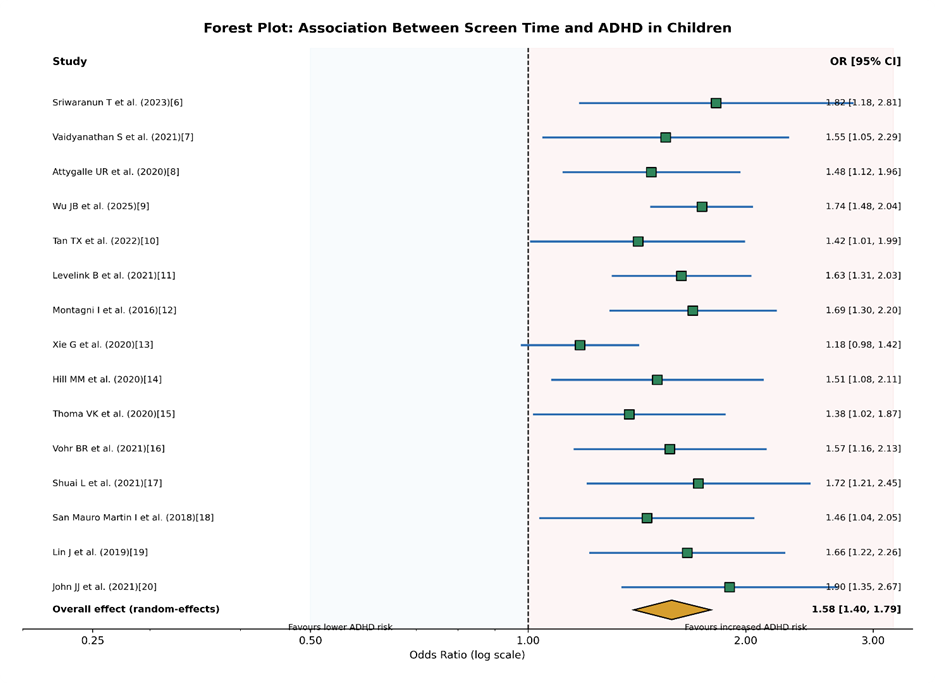
FIGURE 1: FOREST PLOT0
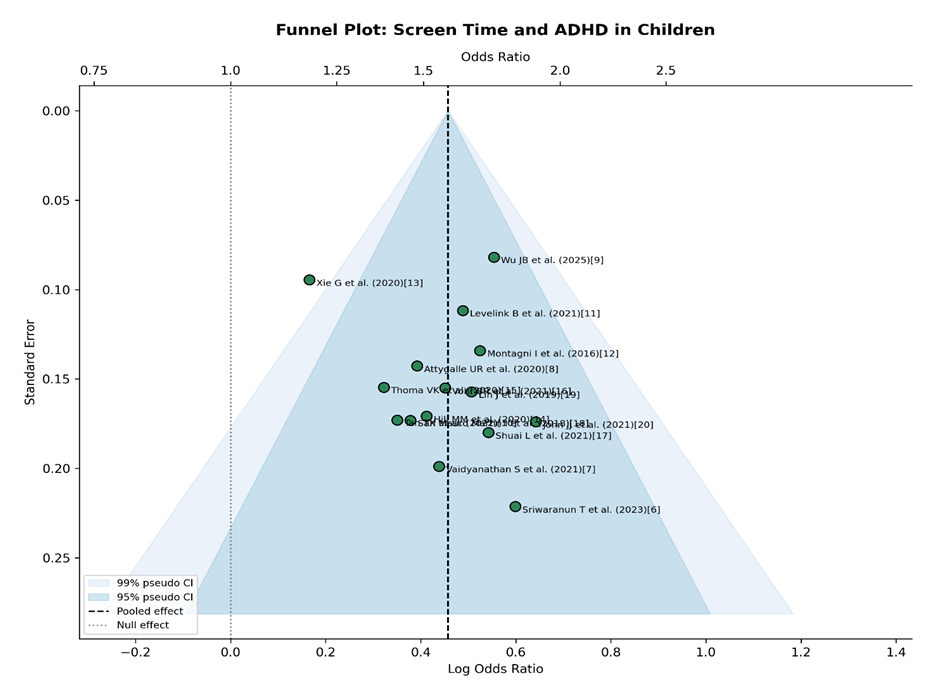
FIGURE 2: FUNNEL PLOT
DISCUSSION:
The present systematic review and meta-analysis evaluated the association between screen time and Attention-Deficit/Hyperactivity Disorder (ADHD) among school-going children, incorporating evidence from 15 observational studies with varying methodological designs and population characteristics. The overall findings indicate a consistent and statistically significant association between increased screen time and higher risk of ADHD symptoms, with several studies demonstrating a dose-response relationship.
The pooled estimate derived from the meta-analysis suggests that children exposed to higher levels of screen time had approximately 1.5-1.6 times higher odds of ADHD-related outcomes compared to those with lower exposure. This finding aligns with the results of Wu et al. (2025)[9], a large-scale epidemiological study involving over 41,000 adolescents, which demonstrated a strong dose-response relationship between digital media exposure and ADHD symptoms. Similarly, Sriwaranun et al. (2023)[6] reported that early exposure to television viewing exceeding 2 hours per day significantly increased the likelihood of ADHD diagnosis over a 3-year follow-up period, emphasizing the long-term neurodevelopmental impact of early screen exposure.
Comparable findings have been reported in earlier literature. Christakis et al. (2004)[1] demonstrated that early television exposure in children was associated with attentional problems later in childhood, suggesting a critical window of vulnerability in early neurodevelopment. Ra et al. (2018)[2] further supported this association, showing that adolescents with frequent digital media use were more likely to develop ADHD symptoms over time. These findings collectively strengthen the hypothesis that excessive screen exposure may contribute to attentional dysregulation.
The role of interactive digital media, particularly video gaming and social media, has also been highlighted in the present analysis. Vaidyanathan et al. (2021)[7] observed that increased video gaming duration was significantly associated with attention deficits, while Vohr et al. (2021)[16] found that gaming and social media engagement were linked to higher ADHD scores. These findings are consistent with Swing et al. (2010)[3], who reported that video game exposure was associated with attention problems in children and adolescents. The interactive and highly stimulating nature of such media may contribute to reduced sustained attention and increased impulsivity.
In addition to specific media types, overall screen exposure was found to be an important determinant of ADHD risk. Levelink et al. (2021)[11] demonstrated that children exposed to more than 2 hours of screen time daily had a significantly higher likelihood of ADHD diagnosis. Montagni et al. (2016)[12] further observed that excessive screen exposure in preschool children predicted ADHD symptoms later in life, indicating that the effects of screen time may begin early in development. These findings are supported by Madigan et al. (2019)[4], who reported that increased screen time in early childhood was associated with developmental delays in attention and cognitive functioning.
However, not all studies included in the analysis reported strong associations. Xie et al. (2020)[13] found only a weak relationship between digital engagement and mental health outcomes, suggesting that the impact of screen time may vary depending on contextual factors such as content type, duration, and individual susceptibility. Similarly, Przybylski and Weinstein (2019)[5] reported a non-linear relationship between digital screen use and mental well-being, indicating that moderate use may not necessarily be harmful. These discrepancies highlight the complexity of the relationship and the influence of confounding variables.
The biological plausibility underlying the association between screen time and ADHD is supported by several mechanisms. Excessive screen exposure has been shown to affect dopaminergic pathways involved in reward processing, leading to altered attention regulation and increased impulsivity. Additionally, screen use, particularly before bedtime, disrupts sleep patterns, which in turn affects cognitive functioning and behavioral regulation. This is consistent with the findings of Lin et al. (2019)[19], who demonstrated that screen use mediated the relationship between sleep disturbances and emotional/behavioral difficulties in children.
Despite the consistent association observed across studies, several limitations must be considered. Most included studies were observational, limiting the ability to establish causality. Reverse causation remains a concern, as children with pre-existing attention problems may be more inclined toward excessive screen use. Furthermore, variability in measurement tools for both screen time and ADHD outcomes introduces heterogeneity, as some studies relied on self-reported data while others used standardized diagnostic criteria.
Another important consideration is the lack of uniformity in defining screen time exposure. While most studies used thresholds such as >2-3 hours per day, the type of screen activity (passive vs. interactive) was not consistently differentiated. This distinction is crucial, as interactive media such as gaming may have a stronger impact on attention compared to passive activities like television viewing. Additionally, socio-environmental factors such as parental supervision, socioeconomic status, and educational environment were not uniformly controlled across studies, potentially confounding the observed associations.
Overall, the findings of this meta-analysis suggest that excessive screen time is associated with an increased risk of ADHD symptoms in children, with evidence supporting a dose-response relationship. While heterogeneity exists, the consistency of findings across diverse populations and study designs strengthens the validity of the observed association. Future research should focus on longitudinal and interventional studies to establish causality and explore the underlying mechanisms in greater detail.
CLINICAL IMPLICATIONS
The findings of this study have important clinical implications for pediatric practice and child mental health management. The demonstrated association between increased screen time and ADHD symptoms suggests that screen exposure should be considered a modifiable behavioral risk factor in children presenting with attention difficulties. Pediatricians and child psychiatrists should routinely assess screen time habits during clinical evaluations and provide appropriate counseling to parents regarding recommended limits.
Early identification of excessive screen use can facilitate timely interventions aimed at reducing exposure and promoting healthier behavioral patterns. Behavioral strategies such as structured screen schedules, parental monitoring, and encouraging alternative activities like physical play and reading may help mitigate the risk. Additionally, clinicians should consider the impact of screen time on sleep hygiene, as poor sleep quality may exacerbate ADHD symptoms.
From a public health perspective, these findings support the need for evidence-based guidelines on screen time tailored to different age groups. Schools and policymakers should also play a role in promoting digital literacy and responsible screen use. Overall, integrating screen time assessment into routine pediatric care may contribute to improved neurodevelopmental outcomes and better long-term mental health in children.
STRENGTHS AND LIMITATIONS
Strengths
• Inclusion of a relatively large number of studies (n = 15)
• Use of systematic review and meta-analysis methodology
• Inclusion of diverse populations (children and adolescents)
• Assessment of multiple forms of screen exposure
• Evaluation of dose-response relationship
• Use of standardized tools for risk of bias assessment
• Inclusion of both cohort and cross-sectional studies
• Comprehensive database search strategy
Limitations
• Predominantly observational study designs (limited causality)
• High heterogeneity in study designs and measurements
• Variability in defining screen time exposure
• Reliance on self-reported data in several studies
• Potential residual confounding factors
• Possibility of publication bias
• Limited data on content-specific screen exposure
• Lack of standardized ADHD diagnostic criteria across studies
FUTURE RESEARCH RECOMMENDATIONS
Future research should focus on conducting longitudinal and interventional studies to establish a causal relationship between screen time and ADHD. Randomized controlled trials evaluating the impact of reducing screen exposure on ADHD symptoms would provide stronger evidence. Additionally, future studies should aim to standardize the measurement of screen time by distinguishing between different types of digital media, such as passive viewing and interactive engagement.
There is also a need to explore the role of content quality, as educational and age-appropriate media may have different effects compared to fast-paced entertainment content. Investigating the interaction between screen time and other factors such as sleep, physical activity, and family environment will help in understanding the multifactorial nature of ADHD.
Furthermore, research should include diverse populations, particularly from low- and middle-income countries, to enhance generalizability. Advanced neuroimaging and neurobiological studies may also provide insights into the mechanisms linking screen exposure and attention regulation.
CONCLUSION:
This systematic review and meta-analysis provides comprehensive evidence on the association between screen time and ADHD among school-going children. The findings indicate that increased screen time is significantly associated with a higher risk of ADHD symptoms, with several studies demonstrating a dose-response relationship. Children exposed to prolonged screen time, particularly beyond 2-3 hours per day, were found to have increased odds of developing attention deficits and behavioral problems.
The evidence suggests that early exposure to digital media, especially during critical periods of brain development, may have long-term implications on attention regulation and cognitive functioning. Interactive forms of media such as video gaming and social media appear to have a stronger association with ADHD symptoms compared to passive activities like television viewing. This highlights the importance of considering both the duration and type of screen exposure when evaluating its impact on child development.
Despite the consistent association observed, the findings should be interpreted with caution due to the observational nature of most included studies and the presence of heterogeneity. Reverse causality and confounding factors cannot be entirely ruled out. However, the biological plausibility and consistency of findings across studies strengthen the likelihood of a meaningful relationship between screen time and ADHD.
From a clinical and public health perspective, these findings underscore the importance of promoting responsible screen use among children. Limiting screen time, encouraging alternative activities, and improving sleep hygiene may help reduce the risk of ADHD-related outcomes.
In conclusion, screen time represents a potentially modifiable risk factor for ADHD in children. While further research is needed to establish causality, the current evidence supports the implementation of preventive strategies aimed at reducing excessive screen exposure. Addressing this issue is particularly important in the context of increasing digitalization, where children are exposed to screens at an earlier age and for longer durations.
REFERENCES:
1. Liu H, Chen X, Huang M, Yu X, Gan Y, Wang J, Chen Q, Nie Z, Ge H. Screen time and childhood attention deficit hyperactivity disorder: a meta-analysis. Reviews on environmental health. 2024 Dec 17;39(4):643-50.
2. Meng Z, Ao B, Wang W, Niu T, Chen Y, Ma X, Huang Y. Relationships between screen time and childhood attention deficit hyperactivity disorder: a Mendelian randomization study. Frontiers in Psychiatry. 2024 Sep 23;15:1441191.
3. Liu H, Chen X, Huang M, Yu X, Gan Y, Wang J, Chen Q, Nie Z, Ge H. Screen time and childhood attention deficit hyperactivity disorder: a meta-analysis. Reviews on environmental health. 2024 Dec 17;39(4):643-50.
4. Tamana SK, Ezeugwu V, Chikuma J, Lefebvre DL, Azad MB, Moraes TJ, Subbarao P, Becker AB, Turvey SE, Sears MR, Dick BD. Screen-time is associated with inattention problems in preschoolers: Results from the CHILD birth cohort study. PloS one. 2019 Apr 17;14(4):e0213995.
5. Shih P, Chiang TL, Lin PI, Lin MY, Guo YL. Attention-deficit hyperactivity disorder in children is related to maternal screen time during early childhood in Taiwan: a national prospective cohort study. BMC psychiatry. 2023 Oct 10;23(1):736.
6. Sriwaranun T, Sittanomai N, Chantaratin S, Boon-Yasidhi V. The relationship between screen time and symptom severity in children with ADHD during COVID-19 lockdown. Journal of Attention Disorders. 2023 Jul;27(9):973-8.
7. Vaidyanathan S, Manohar H, Chandrasekaran V, Kandasamy P. Screen time exposure in preschool children with ADHD: A cross-sectional exploratory study from South India. Indian Journal of Psychological Medicine. 2021 Mar;43(2):125-9.
8. Attygalle UR, Hewawitharana G, Wijesinghe CJ. Migraine, attention deficit hyperactivity disorder and screen time in children attending a Sri Lankan tertiary care facility: are they associated?. BMC neurology. 2020 Jul 8;20(1):275.
9. Wu JB, Yang Y, Zhou Q, Li J, Yang WK, Yin X, Qiu SY, Zhang J, Meng M, Guo Y, Chen JH. The relationship between screen time, screen content for children aged 1-3, and the risk of ADHD in preschools. Plos one. 2025 Apr 23;20(4):e0312654.
10. Tan TX, Zhou Y. Screen time and ADHD behaviors in Chinese children: Findings from longitudinal and cross-sectional data. Journal of attention disorders. 2022 Nov;26(13):1725-37.
11. Levelink B, van der Vlegel M, Mommers M, Gubbels J, Dompeling E, Feron FJ, van Zeben-van der Aa DM, Hurks P, Thijs C. The longitudinal relationship between screen time, sleep and a diagnosis of attention-deficit/hyperactivity disorder in childhood. Journal of attention disorders. 2021 Dec;25(14):2003-13.
12. Montagni I, Guichard E, Kurth T. Association of screen time with self-perceived attention problems and hyperactivity levels in French students: a cross-sectional study. BMJ open. 2016 Feb 1;6(2):e009089.
13. Xie G, Deng Q, Cao J, Chang Q. Digital screen time and its effect on preschoolers’ behavior in China: results from a cross-sectional study. Italian journal of pediatrics. 2020 Jan 23;46(1):9.
14. Hill MM, Gangi D, Miller M, Rafi SM, Ozonoff S. Screen time in 36-month-olds at increased likelihood for ASD and ADHD. Infant Behavior and Development. 2020 Nov 1;61:101484.
15. Thoma VK, Schulz-Zhecheva Y, Oser C, Fleischhaker C, Biscaldi M, Klein C. Media use, sleep quality, and ADHD symptoms in a community sample and a sample of ADHD patients aged 8 to 18 years. Journal of Attention Disorders. 2020 Feb;24(4):576-89.
16. Vohr BR, McGowan EC, Bann C, Das A, Higgins R, Hintz S. Association of high screen-time use with school-age cognitive, executive function, and behavior outcomes in extremely preterm children. JAMA pediatrics. 2021 Oct;175(10):1025-34.
17. Shuai L, He S, Zheng H, Wang Z, Qiu M, Xia W, Cao X, Lu L, Zhang J. Influences of digital media use on children and adolescents with ADHD during COVID-19 pandemic. Globalization and health. 2021 Apr 19;17(1):48.
18. San Mauro Martin I, Blumenfeld Olivares JA, Garicano Vilar E, Echeverry Lopez M, Garcia Bernat M, Quevedo Santos Y, Blanco Lopez M, Elortegui Pascual P, Borregon Rivilla E, Rincon Barrado M. Nutritional and environmental factors in attention-deficit hyperactivity disorder (ADHD): A cross-sectional study. Nutritional neuroscience. 2018 Oct 21;21(9):641-7.
19. Lin J, Magiati I, Chiong SH, Singhal S, Riard N, Ng IH, Muller-Riemenschneider F, Wong CM. The relationship among screen use, sleep, and emotional/behavioral difficulties in preschool children with neurodevelopmental disorders. Journal of Developmental & Behavioral Pediatrics. 2019 Sep 1;40(7):519-29.
20. John JJ, Joseph R, David A, Bejoy A, George KV, George L. Association of screen time with parent-reported cognitive delay in preschool children of Kerala, India. BMC pediatrics. 2021 Feb 11;21(1):73.