Perception and effectiveness of electives among Phase III part I MBBS Students: A Cross-Sectional Study.
- Hajera Rabbani , Associate professor, Department of Community Medicine, Mamata Academy of Medical Sciences, Bachupally, Hyderabad
- Farha Tarannum , Associate professor, Department of Community Medicine, Mamata Academy of Medical Sciences, Bachupally, Hyderabad.
- Mehaboobi Shaik , Associate professor, Department of Community Medicine, Deccan College of Medical Sciences, Hyderabad
- M A Thaher , Professor & HOD, Department of Community Medicine, SVS Medical College, Mahabubnagar.
- Krishna Prakash Joshi , Professor & Principal, Department of Community Medicine, SVS Medical College, Mahabubnagar.
Article Information:
Abstract:
Background: Electives are defined as learning experiences, which are student centric, has been introduced for the first time in Indian undergraduate medical curriculum from the year 2019. This study was formulated to assess whether the design and manner of implementation of the electives modules in Community Medicine could be helpful in imparting knowledge regarding Electives and designing Electives as per the perceptions of the students. Materials and Methods: A cross-sectional study was conducted among 40 undergraduate students who completed electives in community medicine department at a private medical college in Hyderabad. 20 students from each block I & block II were enrolled in community medicine department which were subdivided into 4 groups, each group consisting of 5 students for a duration of 15 days. Each group was allotted one topic as per internal meeting conducted in the department. Topics were School health programme, Immunisation, Research methodology, and Integrated child development scheme. Pre- and post-tests were used to assess knowledge levels in their selected topics. A Likert scale-based perception survey was conducted at the end of the elective posting to 156 students' perception of the design, implementation, and effectiveness of the electives. Results: Mean knowledge scores were significantly improved after the electives (p<0.05). Overall, students had a positive perception of the design, implementation, and faculty knowledge of the electives. Conclusion: Medical students should be allowed to pursue electives in medical education, allowing them to develop proficiency as effective educators.
Keywords:
Article :
INTRODUCTION:
In western world the implementation of electives is ages old and to have multiple benefits in the form of orienting the students and boosting their interest while in developing countries the reasons for pursuing electives are to gain experience in diverse health-care settings.1 National Medical Commission (NMC), India is a body that frames curriculum for the undergraduate medical students of India. A new Competency Based Undergraduate Medical Curriculum has been launched by NMC from the year 2019. In this new curriculum, NMC has introduced Elective module for the first time in India. The purpose of Elective module is mentioned as “a learning experience created in the curriculum to provide an opportunity for the learner to explore, discover and experience areas or streams of interest. 2 Electives are conducted at the end of Phase III (Part I) and before the beginning of Phase III (Part II). Every Elective needs to have specified learning objectives, well defined plan of its execution, a logbook and an assessment at the end. 3
As per the NMC guidelines,4 an Elective is an area or a stream that a speciality will offer which will help the students to learn and explore something new. Even Superspeciality departments (which are not involved in undergraduate teaching) can offer Electives. The total duration for Electives is one month divided into two Blocks (Block 1 and Block 2) each having a duration of fifteen days. Students will have to choose from Electives offered by Pre- and Para-Clinical departments (Anatomy, Physiology, Biochemistry, Pathology, Microbiology, Pharmacology and Forensic Medicine and Toxicology) in Block 1 and from Clinical (Broad Speciality), Superspeciality departments and Community Clinics (rural/urban) in Block 2. Each student is supposed to do two Electives, one in each block. Presently, MBBS students move through four Phases while undergoing their training. Phase I (Pre Clinical) starts with entry to the Medical College followed by Phase II (Phase II), Phase III (Part I) and finally Phase III (Part II). Electives are conducted at the end of Phase III (Part I) and before the beginning of Phase III (Part II). Every Elective needs to have specified learning objectives, well define plan of its execution, a logbook and an assessment at the end. Every Elective can have only a fixed number of students that can be trained in that Elective.
This study was formulated to assess whether the design and manner of implementation of the electives modules in Community Medicine could be helpful in imparting knowledge regarding Electives and designing Electives as per the perceptions of the students.
MATERIALS AND METHODS:
A cross-sectional study was conducted at a private medical college in Telangana among undergraduate MBBS students of the batch 2020 who opted for electives in Community Medicine. The study was carried out over a period of three months, from February to April 2024.
METHOD:
Out of the total 156 students of phase III part 1 were divided into 2 Block (Block1& 2) each consisting of 78 students. Allocation of electives to students is based on students’ preferences and availability of elective postings. The students in each block were posted to respected speciality for a duration of 15 days, followed by a crossover between the two blocks. Among these, 40 students who opted for community medicine electives were enrolled in the study, who met the minimum attendance requirement of 75% were included in the final analysis. Ethical approval was obtained from the Institutional Ethics Committee, and participants were provided with an information sheet and gave informed consent.
Designing of the Elective modules
A total of 20 students were enrolled in the Department of community medicine, which were subdivided into 4 groups each group consisting of 5 students. The focus areas selected were school health programme, Immunization, Research Methhodology, Integrated Child development Schemes Each group were allotted one topic as per internal meeting conducted in the department. Each group was supervised by a facilitator from the same department. Group 1 was given school health programme. Under this topic activities such as sensitization by the facilitator, visit to Primary school attached to RHTC, Srirangavaram where students collected height, weight, general health checkup parameters of the children, presentation of report. Group 2 were allotted Immunization. Activities were seminar by the students, demonstration of various routes of administration of vaccines in skill lab followed by assisting in administration of vaccine under supervision in PHC Bollaram. Group 3 was given a topic research methodology. Activities such a lecture on basic concept of research, preparation of research proposalby the students. Group 4 was given a topic Integrated Child development Scheme.
Activities such as small group discussion on the topic, visit to aanganwadi centre attached to PHC Bollaram, counseling done by students to pregnant and lactating women regarding diet, hygiene and family planning. On the first day of the elective posting, students received their specific elective module and were briefed on learning objectives, resources, and activities. A pre-test was conducted, covering questions related to their chosen topic. The 15-days schedule was displayed for students to be aware of the planned activities. At the end post test was conducted related to their topics. The same procedure was repeated in the next set of 20 students. Hence all the three domains cognitive, psychomotor and affective domains were included in all the activities.Effectiveness of electives will be assessed by a pre-test and post test scores and logbook completion.
Measuring tool for outcomes of Electives
The students' knowledge level was assessed through a pre-test and post-test consisting of 10 multiple-choice questions, including questions related to their chosen topic. A Likert scale-based perception survey was conducted at the end of the elective posting to 156 students' perception of the design, implementation, and effectiveness of the electives. Data was analyzed using SPSS version 24, with paired t-tests used to assess the difference in knowledge before and after the elective postings. p value < 0.05 was considered as significant, while qualitative data were analyzed using manual theoretical thematic content analysis following the steps endorsed in Braun and Clarke’s six phase framework.5,6 The transcripts were read and re-read, and the themes were framed as per answers from the open ended questions. It was ensured that the themes make sense, it supports the data and no overlap is present between the themes. .
RESULTS:
elective programme conducted in community medicine department. Total 39 students successfully completed the program with a minimum attendance rate of 75%. One student who failed to meet the attendance requirement was excluded from the study. Under this programme four different elective modules were selected are school health programme, Immunisation, ICDS and research methodology. gain in knowledge regarding their selected elective was assess by pre and post test score.
Table 1: Comparison of pre and post test scores of students.
|
Test |
N |
Mean±SD |
Mean difference |
t |
df |
p-value |
|
Pre -tet |
39 |
6.0256±1.063 |
-2.12821 |
13.977 |
38 |
<0.001 |
|
Post -test |
39 |
8.1538±1.039 |
|
|
|
|
Stastically Significant (p-<0.05)
Figure: Bar Chart Illustrating Percentage Results from the Five-Point Likert Scale-Based Student Perception Questionnaire.
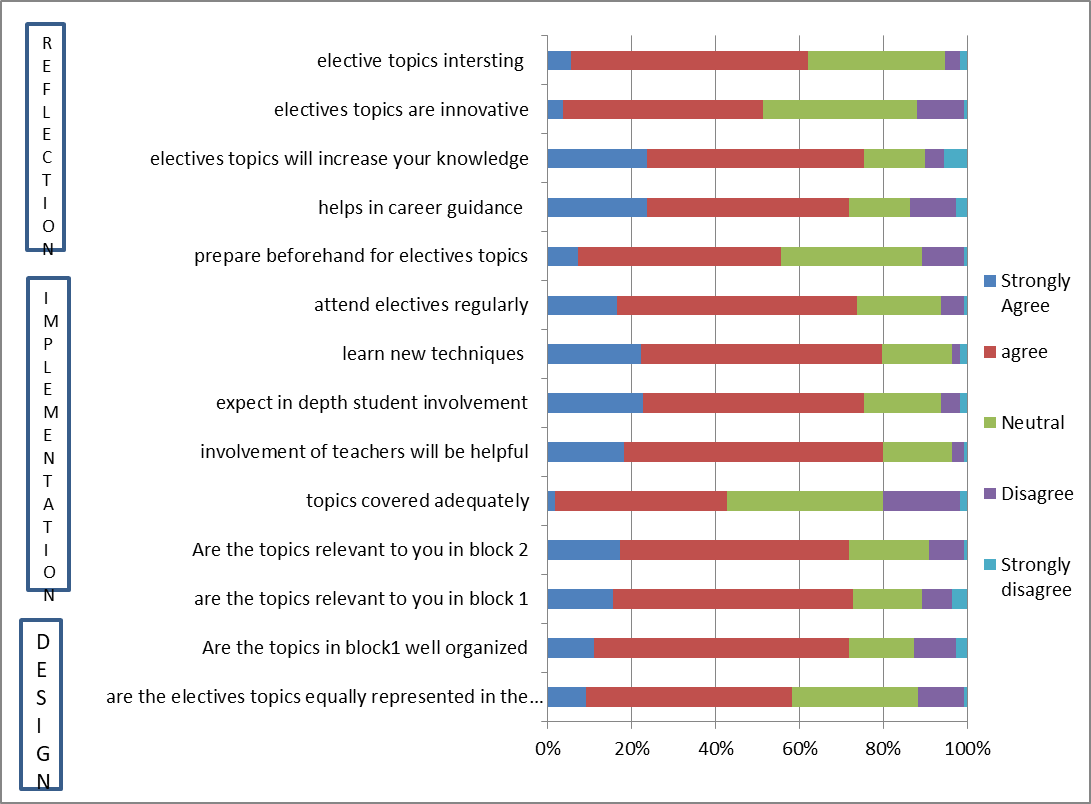
Figure.1 shows percentage results from the five-point likert scale-based student perception questionnaire. Responses to various statements were grouped under 3 main categories: Design of the module, Implementation of the module, students’ reflection of electives.
Table 3: Students' feedback in response to open-ended question about their experience with the elective postings.
Strong points of the programme as described by the students (Thematic Analysis)
|
Strong points |
count |
% |
|
Well organized |
23 |
17.5 |
|
Good Experience |
21 |
16 |
|
Interesting and interactive |
15 |
11.4 |
|
In-depth knowledge |
12 |
9.1 |
|
Good clinical exposure |
11 |
8.3 |
|
Enjoyable and informative |
9 |
6.8 |
|
Helpful in future |
7 |
5.3 |
|
innovative |
5 |
3.8 |
|
Good involvement of teachers |
3 |
2.3 |
|
Co-curricular activities-like Seminar, role play, project presentation and Research
|
3 |
2.3 |
|
Opportunity to work with health care team |
1 |
0.76 |
|
Weak points of the programme |
||
|
Weak points |
Count |
% |
|
Students’ preference should be considered to choose subject |
7 |
5.3 |
|
Limited time |
5 |
3.8 |
|
Lack of proper schedule |
4 |
3 |
|
Not as expected due to busy schedule of faculty |
3 |
2.3 |
|
Should be more practical oriented |
2 |
1,5 |
Thematic Analysis of Student’s feedback on elective postings reveals on overall positive perception of the programme. Students reported that electives were well organized (17.5%) and provided good learning Experience (16%) indicating effective planning and implementation. The interactive nature of the sessions (11.4%) and opportunities for gaining in depth knowledge (9.1%) and clinical exposure (8.3%) whereas some students reported relevance to their future career (5.3%). Despite these strengths, few limitations also identified need to incorporate student’s preference in subject selection (5.3%), limited time duration (3.8%) and a few students also reported that the experience did not fully meet expectations due to busy schedule of faculty (2.3%).
DISCUSSION:
This study is focusing mainly on design of the module, implementing elective in community medicine considering students learning objectives and perception of students about the electives. The effectiveness of the elective module was evaluated using a pre-test post-test design, and the assessment showed a significant improvement in students' knowledge after completing the elective postings. These findings are consistent with the findings of previous study done by Thomas NE et al7 showed the significant improvement in knowledge after electives. Other studies also demonstrate the positive effect on students’ knowledge and skills. 8,9,10. A student perception questionnaire was used to evaluate students' perception of the elective design, implementation and effectiveness, The Likert scale responses were analyzed and categorized into three main areas: elective module design, module implementation, student reflection on the electives.
Design of the module: The design of the modules received positive feedback from the students. 71.8% of students responded to a well-organized elective topic in their respective department. 72.8 said topic relevant to the elective’s module. Whereas these findings are aligned with study done by Thomas NE et al7
Implementation of the Elective Module: Most students (80%) agreed that involvement of teachers was helpful for providing adequate material. They felt 75.4% in depth involvement, attend regularly. Reflection of Students about the Electives: Most students (71.8%) agreed that electives help as career guidance , 75.4% felt increases knowledge , 50.9% agreed it was innovative and topics were interesting perceived by 69.9%.Various other studies have also reported that participation in research activities during undergraduate studies brings positive attitude among medical students towards scientific research.11,12,13
Table 3 summarizes the students’ feedback in response to an open-ended question regarding their experiences with elective postings. The responses reflected a mix of strong and weak points about the electives. Gathering such feedback is essential for continuous improvement and for maintaining a student-centered approach. It enables the identification of both strengths and areas needing improvement within the program, there by guiding necessary modifications and enhancements. Additionally, feedback contributes to the professional development of faculty by highlighting their strengths and pinpointing areas for further growth.14,15
Previous studies have identified a range of challenges and barriers that contribute to reduced interest in research among medical students.16,17,18
Limitations:
This study was conducted in a single institution with a relatively small sample size for knowledge assessment, which may limit the generalizability of the findings. The short duration of the elective posting and reliance on self-reported student perceptions may introduce response bias. Additionally, the perspectives of faculty members were not included, which could have provided a more comprehensive evaluation of the elective program.
CONCLUSION:
Elective modules in Community Medicine significantly improved students’ knowledge and were positively perceived in terms of their design and implementation. These findings highlight the importance of electives as a valuable component of the undergraduate medical curriculum. Expanding the range of elective options and optimizing their structure may further enhance student engagement and learning outcomes. Recommendations-It is recommended that medical colleges strengthen elective programs by offering a wider range of student-centered topics, incorporating structured scheduling, and ensuring adequate faculty engagement, as this can enhance learning outcomes, improve student satisfaction, and maximize the educational impact of electives within the CBME curriculum. Similar & multicentric studies can be conducted.
REFERENCES:
1. Banerjee A.Medical electives: A chance for international health. J R SocMed 2010;103:6-8
2. Mathur M, Mathur N, Verma A, Kaur M, Patyal A. Electives in Indian medical education: An opportunity to seize. Adesh Univ J Med Sci Res2022;4:53-5.
3. UG curriculum. Org.in. Available from: https://www.nmc.org.in/information-desk/for-colleges/ug-curriculum/
4. Medical Council of India. Electives for the Undergraduate Medical Education Training Program. New Delhi: Medical Council of India; 2020. p. 1-30.
5. Braun V, Clarke V. Thematic analysis: American Psychological Association; 2012.
6. Maguire M, Delahunt B. Doing a thematic analysis: A practical, step-by-step guide for learning and teaching scholars. AllIreland Journal of Higher Education. 2017;9(3).
7. Thomas NE, Bahuleyan B, Shilpa AV, Babu R, Davis A, Archana S. Designing, Implementation and of Effectiveness of Physiology Electives in CBME Curriculum. GAIMS J Med Sci 2024;4(1):145 151.
8. Leschied JR, Knoepp US, Hoff CN, Mazza MB, Klein KA, Mullan PB, et al. Emergency radiology elective improves second-year medical students’ perceived confidence and knowledge of appropriate imaging utilization. Acad Radiol. 2013;20:1168–76.
9. Rong K, Lee G, Herbst MK. Effectiveness of Near-Peer Versus Faculty Point-of-Care Ultrasound Instruction to Third-Year Medical Students. POCUS J. 2022 Nov 21;7(2):239-44.
10. Puljak L, Sapunar D. Web-based elective courses for medical students: an example in pain. Pain Med. 2011 Jun;12(6):854-63.
11. Devi V, Abraham RR, Adiga A, Ramnarayan K, Kamath A. Fostering research skills in undergraduate medical students through mentored students projects: example from an Indian medical school. Kathmandu Univ Med J (KUMJ). 2010 Jul-Sep;8(31):294-98.
12. Houlden RL, Raja JB, Collier CP, Clark AF, Waugh JM. Medical students' perceptions of an undergraduate research elective. Med Teach. 2004 Nov;26(7):659-61.
13. El Achi D, Al Hakim L, Makki M, Mokaddem M, Khalil PA, Kaafarani BR, et al. Perception, attitude, practice and barriers towards medical research among undergraduate students. BMC Medical Education. 2020;20(1):195.
14. Jacqueline D, Alex D, Barry B. Measuring student satisfaction at a UK university. Qual Assur Educ. 2006;14(3):251–67.
15. Ramalho AR, Vieira-Marques PM, Magalhães-Alves C, Severo M, Ferreira MA, Falcão-Pires I. Electives in the medical curriculum – an opportunity to achieve students’ satisfaction?. BMC Medical Education. 2020 Nov 23;20(1):449.
16. Fatemeh K, Alavinia SM. Students' perception about logbooks: advantages, limitation and recommendation - a qualitative study. J Pak Med Assoc. 2012 Nov;62(11):1184-86.
17. Vidja K, Patel J, Patidar H, Akhani P, Patel P. A study on perception of medical students regarding implementation of elective module in India. RADEN [Internet]. 2023 May 23;3(2):137-45.
18. Devi V, Abraham RR, Adiga A, Ramnarayan K, Kamath A. Fostering research skills in undergraduate medical students through mentored students projects: example from an Indian medical school. Kathmandu Univ Med J (KUMJ). 2010 Jul-Sep;8(31):294-98.