Early Lactate Kinetics versus Base Deficit as Predictors of Mortality in Trauma and Sepsis: A Prospective Observational Study.
- Veer Kavita. , Associate professor, Department of surgery, ABVIMS & Dr RML Hospital, Delhi.
- Rahul Rohitaj. , Assistant Professor, Department of surgery, UCMS & GTB Hospital, Delhi.
- Ram Bharosh Kumar. , Assistant Professor, Department of surgery, UCMS & GTB Hospital, Delhi.
- Atul Jain. , Associate professor, Department of surgery, ABVIMS & Dr RML Hospital, Delhi.
Article Information:
Abstract:
Background: Serum lactate and base deficit are commonly used markers of tissue hypo perfusion in critically ill patients. While both have prognostic significance, the relative utility of lactate kinetics, particularly lactate clearance, compared to base deficit remains uncertain in mixed populations of trauma and sepsis. Methods: This prospective observational study included 50 adult patients with shock secondary to trauma or sepsis admitted to a surgical intensive care unit over a 12-month period. Serial measurements of serum lactate and base deficit were obtained at admission, 6, 12, and 18 hours. Lactate clearance was calculated. The primary outcome was in-hospital mortality. Multivariable logistic regression was used to identify independent predictors of mortality. Receiver operating characteristic (ROC) curves were constructed to compare predictive performance. Results: Among 50 patients (28 survivors, 22 non-survivors), non-survivors had significantly higher initial and 18-hour lactate levels (p = 0.002 and p < 0.001, respectively), along with reduced lactate clearance (p < 0.001).. Lactate clearance was significantly lower in non-survivors (p < 0.001). Base deficit at admission was not associated with mortality, though 18-hour values showed modest significance (p = 0.02). On multivariable analysis, lactate clearance (adjusted OR 0.78, 95% CI 0.65–0.92, p = 0.004) and 18-hour lactate (adjusted OR 1.21, 95% CI 1.05–1.40, p = 0.01) were independent predictors of mortality, while base deficit was not. ROC analysis showed superior discrimination for lactate clearance (AUC 0.82) compared to base deficit (AUC 0.64). Conclusion: Lactate kinetics, especially lactate clearance, are superior predictors of mortality compared to base deficit in ICU patients with shock. Serial lactate monitoring should be incorporated into early resuscitation strategies.
Keywords:
Article :
INTRODUCTION:
Shock is defined as a state of circulatory failure resulting in inadequate tissue perfusion and oxygen delivery, leading to cellular hypoxia and organ dysfunction. Despite advances in critical care, shock due to trauma and sepsis remains a major cause of morbidity and mortality worldwide. Early identification of tissue hypoperfusion is essential to guide resuscitation and improve outcomes [1,2].
Serum lactate has emerged as a key biomarker of anaerobic metabolism and tissue hypoxia. Elevated lactate levels are associated with increased mortality in both trauma and septic shock [3,4]. More recently, the concept of lactate kinetics, particularly lactate clearance, has gained importance as a dynamic marker reflecting response to therapy [5,6]. Early lactate clearance has been shown to correlate with improved survival and is now recommended as a resuscitation target in sepsis guidelines [2].
Base deficit, defined as the amount of base required to normalize blood pH, has traditionally been used as an indicator of metabolic acidosis and tissue hypoperfusion, particularly in trauma patients [7]. However, its reliability as an independent predictor of outcomes remains debated.
Although both lactate and base deficit are widely used, comparative studies evaluating their prognostic accuracy, especially in mixed ICU populations, are limited. This study was designed to evaluate the predictive value of lactate levels, lactate clearance, and base deficit in patients with shock due to trauma and sepsis.
MATERIALS AND METHODS:
This prospective observational study was conducted in the Surgery department of a tertiary care teaching hospital over a period of twelve months. Fifty adult patients aged 18 years and above presenting with shock due to trauma or sepsis and admitted within twelve hours of onset were included. Patients with chronic liver disease, advanced cardiac illness, malignancy, poisoning, or other conditions affecting lactate metabolism were excluded.
Upon admission, detailed clinical evaluation and laboratory investigations were performed. Baseline demographic data, vital parameters, and biochemical values were recorded. Serial measurements of serum lactate and base deficit were obtained at admission (0 hours), 6 hours, 12 hours, and 18 hours. Lactate clearance was calculated as the percentage reduction from baseline lactate levels over time.
The primary outcome was in-hospital mortality. Secondary outcomes included development of organ dysfunction and duration of ICU stay.Shock was defined as persistent hypotension (MAP <65 mmHg) or requirement of vasopressor support with evidence of tissue hypoperfusion.
Statistical analysis was performed using SPSS version 26 (IBM Corp., USA). Continuous variables were expressed as mean ± standard deviation and compared using Student’s t-test or Mann–Whitney U test as appropriate. Categorical variables were compared using chi-square or Fisher’s exact test. Multivariable logistic regression analysis was performed to identify independent predictors of mortality, adjusting for age, sex, and etiology of shock (trauma vs sepsis). Receiver operating characteristic (ROC) curves were constructed to evaluate predictive performance. A p-value <0.05 was considered statistically significant.
RESULTS:
A total of 50 patients were included, of whom 28 survived and 22 died during hospitalization. Baseline characteristics were comparable between the two groups, as shown in Table 1.
Table 1: Baseline Characteristics
|
Variable |
Survivors (n=28) |
Non-survivors (n=22) |
p-value |
|
Age (years) |
38 ± 12 |
42 ± 15 |
0.28 |
|
Male (%) |
65 |
70 |
0.67 |
|
Trauma (%) |
55 |
58 |
0.81 |
Non-survivors had significantly higher lactate levels at admission and at 18 hours compared to survivors. Lactate clearance was significantly lower in non-survivors, indicating poor response to resuscitation. These findings are summarized in Table 2.
Table 2: Comparison of Biomarkers
|
Parameter |
Survivors (n=28) |
Non-survivors (n=22) |
p-value |
|
Initial lactate (mmol/L) |
3.4 ± 1.2 |
6.9 ± 2.5 |
0.002 |
|
18-hour lactate (mmol/L) |
1.8 ± 0.7 |
5.6 ± 2.1 |
<0.001 |
|
Lactate clearance (%) |
47 ± 14 |
19 ± 10 |
<0.001 |
|
Initial base deficit (mmol/L) |
−3.1 ± 1.4 |
−3.8 ± 1.9 |
0.12 |
|
18-hour base deficit (mmol/L) |
−1.4 ± 0.9 |
−3.6 ± 1.7 |
0.02 |
Multivariable logistic regression analysis identified lactate clearance and 18-hour lactate as independent predictors of mortality, while base deficit was not statistically significant (Table 3).
Table 3: Multivariable Logistic Regression
|
Variable |
Adjusted OR |
95% CI |
p-value |
|
Lactate clearance |
0.78 |
0.65–0.92 |
0.004 |
|
18-hour lactate |
1.21 |
1.05–1.40 |
0.01 |
|
Base deficit |
1.05 |
0.90–1.22 |
0.42 |
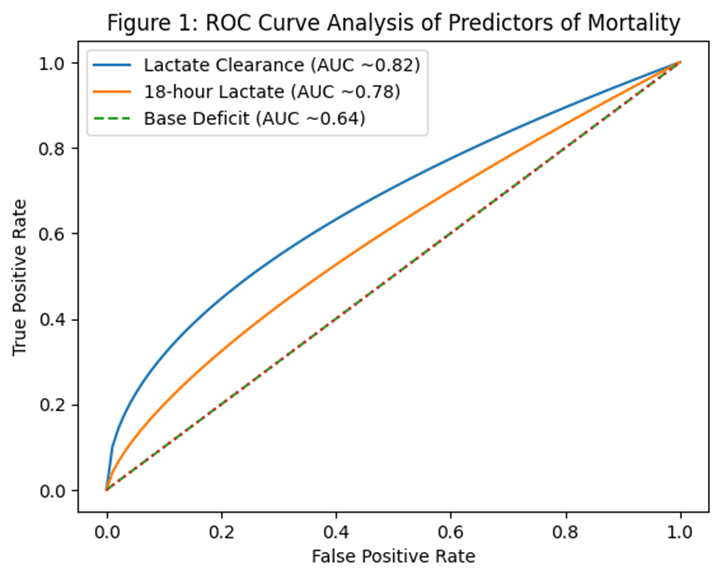
Receiver operating characteristic curve analysis demonstrated that lactate clearance had the highest predictive accuracy (AUC 0.82), followed by 18-hour lactate (AUC 0.78), whereas base deficit showed lower predictive value (AUC 0.64), as illustrated in Figure 1which demonstrates superior discriminative ability of lactate clearance.
DISCUSSION:
This study demonstrates that lactate kinetics, particularly lactate clearance, are superior predictors of mortality compared to base deficit in critically ill patients with shock. Elevated lactate levels reflect global tissue hypoxia and impaired oxygen utilization, while lactate clearance indicates restoration of perfusion and metabolic recovery.
Our findings are consistent with previous studies showing that early lactate clearance is associated with improved outcomes in septic shock and trauma patients [5,6]. Current Surviving Sepsis Campaign guidelines recommend targeting lactate normalization during resuscitation [2]. In contrast, base deficit, although useful in trauma, did not independently predict mortality in this study.
The superiority of lactate kinetics may be explained by its dynamic nature, capturing both the severity of hypoperfusion and the response to treatment. Base deficit, on the other hand, is influenced by multiple metabolic factors and may not accurately reflect ongoing tissue hypoxia.
From a clinical perspective, serial lactate monitoring provides a simple and reliable tool for guiding resuscitation. Patients with poor lactate clearance should be identified early and managed aggressively. While base deficit may serve as an adjunct parameter, it should not replace lactate-based assessment.
The findings of this study highlight the importance of dynamic monitoring over static biochemical measurements. While initial lactate reflects severity of hypoperfusion, lactate clearance reflects the adequacy of resuscitation and restoration of tissue perfusion. This explains its superior predictive performance. Similar findings have been reported in multicenter studies, where early lactate clearance was associated with reduced mortality independent of baseline severity [5,6].
This study has several limitations. The relatively small sample size may limit statistical power and generalizability. The single-center design introduces potential selection bias. Additionally, standardized severity scoring systems such as SOFA or APACHE II were not incorporated, which may have improved adjustment for illness severity. Finally, serial measurements were limited to 18 hours and may not fully capture long-term lactate kinetics
CONCLUSION:
Lactate kinetics, particularly lactate clearance, are strong independent predictors of mortality in patients with shock due to trauma and sepsis. Serial lactate monitoring provides superior prognostic information compared to base deficit and should be incorporated into routine critical care practice.Lactate clearance should be considered a key resuscitation target in critically ill patients with shock.
REFERENCES:
1. Vincent JL, De Backer D. Circulatory shock. N Engl J Med. 2013 Oct 31;369(18):1726-34. doi: 10.1056/NEJMra1208943. PMID: 24171518.
2. Evans L, Rhodes A, Alhazzani W, et al. Surviving sepsis campaign: international guidelines for management of sepsis and septic shock 2021. Intensive Care Med. 2021;47(11):1181-1247. doi:10.1007/s00134-021-06506-y
3. Shapiro NI, Howell MD, Talmor D, et al. Serum lactate as a predictor of mortality in emergency department patients with infection. Ann Emerg Med. 2005;45(5):524-528. doi:10.1016/j.annemergmed.2004.12.006
4. Kruse O, Grunnet N, Barfod C. Blood lactate as a predictor for in-hospital mortality in patients admitted acutely to hospital: a systematic review. Scand J Trauma Resusc Emerg Med. 2011;19:74. Published 2011 Dec 28. doi:10.1186/1757-7241-19-74
5. Nguyen HB, Rivers EP, Knoblich BP, et al. Early lactate clearance is associated with improved outcome in severe sepsis and septic shock. Crit Care Med. 2004;32(8):1637-1642. doi:10.1097/01.ccm.0000132904.35713.a7
6. Jones AE, Shapiro NI, Trzeciak S, et al. Lactate clearance vs central venous oxygen saturation as goals of early sepsis therapy: a randomized clinical trial. JAMA. 2010;303(8):739-746. doi:10.1001/jama.2010.158
7. Mutschler M, Nienaber U, Brockamp T, et al. Renaissance of base deficit for the initial assessment of trauma patients: a base deficit-based classification for hypovolemic shock developed on data from 16,305 patients derived from the TraumaRegister DGU®. Crit Care. 2013;17(2):R42. Published 2013 Mar 6. doi:10.1186/cc12555.