Economic Burden, Treatment Pathways, and Health-System Barriers in Rabies Post-Exposure Prophylaxis: A Community-Based Sequential Explanatory Mixed-Methods Study from Urban Chhattisgarh, India
- Ikshit Singh , Dept. of Community Medicine, Pt JNM Medical College Raipur, Chhattisgarh, 492001, India.
- Nirmal Verma , Dept. of Community Medicine, Late Smt. Indra Gandhi memorial Govt. Medical college, Uttar Bastar, Kanker, Chhattisgarh, India.
- Kamlesh Jain , Dept. of Community Medicine, Maa Padmavati Institute of Medical Sciences (MPIMS) Pacheda, Raipur, Chhattisgarh, 492001, India.
- Prashant Jaiswal , Dept. of Community Medicine, Pt JNM Medical College Raipur, Chhattisgarh, 492001, India.
- Shubhra Agrawal Gupta , Dept. of Community Medicine, Pt JNM Medical College Raipur, Chhattisgarh, 492001, India.
Article Information:
Abstract:
Background: Rabies is a vaccine-preventable zoonotic disease with nearly 100% fatality once clinical symptoms develop. Despite availability of effective post-exposure prophylaxis (PEP), delays in treatment, financial burden, and health-system barriers continue to hinder timely care in India. This study aimed to assess the economic burden, treatment pathways, and barriers affecting rabies PEP uptake among animal-bite victims in urban Chhattisgarh. Methods: A community-based sequential explanatory mixed-methods study was conducted in urban Raipur, Chhattisgarh, from January to April 2025. Quantitative data were collected through a cross-sectional household survey using multistage random sampling across 320 households (1,664 individuals). Eligible bite victims from the preceding 1–12 months were interviewed regarding sociodemographic profile, bite characteristics, treatment pathways, out-of-pocket expenditure (OOPE), and catastrophic health expenditure (CHE). Statistical analysis included non-parametric tests, generalized linear models, and Poisson regression. Qualitative in-depth interviews were subsequently conducted with 12 bite victims and 3 key informants to explain quantitative findings. Data were analyzed using thematic analysis. Results: A total of 41 eligible animal-bite victims were identified, yielding an individual period prevalence of 2.46% and household prevalence of 12.8%. Dogs accounted for 82.9% of bites, while 12.2% were Category III exposures. Median OOPE was highest in private facilities (₹3,328), followed by government facilities (₹1,121) and traditional healers (₹550) (p<0.001). Intradermal vaccination was associated with 36% lower median OOPE compared to intramuscular regimens (p=0.004). CHE was observed in 24.4% of households. Private facility use and wage loss were significant predictors of CHE. Among Category III victims, only 40% received rabies immunoglobulin, with all doses procured privately. Qualitative findings revealed three themes: reliance on traditional healers for minor bites, systemic barriers in government facilities, and private care as a rapid but costly fallback option. Conclusion: Rabies PEP barriers in urban Chhattisgarh are driven primarily by economic hardship and health-system inefficiencies rather than patient non-compliance. Strengthening public vaccine and immunoglobulin supply, promoting intradermal vaccination, reducing waiting time, and expanding financial protection mechanisms are essential to improve equitable access and support rabies elimination goals.
Keywords:
Article :
INTRODUCTION:
Rabies is a neglected yet fully preventable zoonotic disease with an almost 100% case-fatality rate once clinical symptoms appear (1). Globally, rabies accounts for an estimated 59,000 human deaths annually, of which India contributes a disproportionately high burden due to endemic canine transmission (2). Although urban regions report higher healthcare access, dense settlements, limited awareness, and fragmented service delivery continue to sustain risks for both animal bites and delayed post-exposure prophylaxis (PEP) (3,4). Large multicentric Indian studies have indicated persistent gaps in timely wound management and adherence to vaccination schedules, yet urban low-income communities remain under-represented in epidemiological and economic analyses (3,4).
The National Rabies Control Programme (NRCP) emphasizes immediate wound washing, timely administration of potent cell-culture vaccines, and provision of rabies immunoglobulin (RIG) for category III exposures (5). However, operational barriers—such as overcrowded outpatient departments, limited workforce, stock-outs of RIG, vaccination workflow inefficiencies, and multiple facility visits—continue to restrict effective implementation in public health facilities (4,6,10). These system constraints frequently push patients toward private care, intensifying economic vulnerability. Studies across India demonstrate that PEP incurs substantial out-of-pocket expenditure (OOPE) on vaccines, RIG, consultation fees, transport, and repeated visits, often leading to catastrophic health expenditure (CHE), particularly among economically disadvantaged households (6–9,21). For the present study, OOPE is defined as the sum of direct medical, direct non-medical, and indirect costs (including wage loss), while CHE is defined as expenditure exceeding 10% of monthly household income (7–9,21).
The World Health Organization recommends the intradermal (ID) vaccination regimen as a safe, cost-effective alternative to intramuscular (IM) schedules, reducing vaccine volume and total program expenditure without compromising efficacy (1,11). Evidence from India and Southeast Asia has demonstrated improved compliance and reduced direct costs with ID regimens; however, utilization remains poor due to provider hesitancy, fear of vaccine wastage from multi-dose vials, and perceived logistical complexity (11,12,22). Parallel challenges in RIG access, including procurement delays, inadequate forecasting, and procedural norms in public hospitals, continue to hinder complete PEP, especially for high-risk exposures (13–15).
In addition to structural and economic barriers, sociocultural determinants strongly influence treatment-seeking pathways. Evidence from India, Sri Lanka, and Nepal shows widespread reliance on traditional healers and practices such as application of “black stone” or herbal remedies following animal bites (16–18). Importantly, such practices represent parallel care pathways, often perceived as culturally trustworthy, time-saving, and cost-effective rather than merely causes of delay (16–18). These behaviors undermine early initiation of PEP and RIG, threatening attainment of regional elimination targets under the World Health Organization South-East Asia Regional Office (WHO SEARO) Rabies Elimination Roadmap 2030 (19,20).
Despite considerable research on rabies epidemiology, cost burden, and care-seeking behaviors, most studies examine these domains in isolation, rarely integrating quantitative estimates of OOPE and CHE with qualitative understanding of health-system and cultural drivers (3,4,6–9,16–18,21,22). Mixed-methods approaches offer a robust framework for addressing this evidence gap by linking treatment costs and pathways with patient experiences and provider insights (23–25). To our knowledge, no study from Central India has simultaneously quantified OOPE and CHE while elucidating the sociocultural and systemic factors influencing treatment pathways across public, private, and traditional sectors. Against this backdrop, the present study employs a sequential explanatory mixed-methods design to quantify the economic burden, delineate treatment pathways, and explore health-system and sociocultural barriers affecting PEP uptake among animal-bite victims in urban Chhattisgarh. By integrating numerical estimates with thematic insights, this study aims to generate policy-actionable evidence to strengthen NRCP implementation, inform equitable financing strategies, and advance regional rabies elimination goals in vulnerable urban environments (19,23–25).
MATERIALS AND METHODS:
Study Design and Setting
This study employed a sequential explanatory mixed-methods design, comprising an initial quantitative cross-sectional household survey followed by qualitative in-depth interviews to explain and contextualize quantitative findings (23). This approach was appropriate to elucidate complex interactions among economic, behavioral, and health-system determinants of rabies post-exposure prophylaxis (PEP) uptake.
The study was conducted in urban Raipur, Chhattisgarh, a tier-2 city with approximately 1.4 million residents administratively divided into ten municipal zones. Available healthcare services include government primary health centers, urban community health centers, district hospitals, private clinics, and informal traditional healer services.
Study Period
Data were collected between January and April 2025.
Study Population and Eligibility Criteria
Eligible participants were individuals aged ≥5 years who sustained an animal bite—defined as penetration of the skin by teeth or scratches causing bleeding per WHO classification—between 1 and 12 months prior to data collection and had resided in the study area for at least 3 months.
The lower limit ensured that participants had sufficient time to complete or discontinue the 28-day PEP vaccination schedule (intradermal or intramuscular), allowing valid determination of regimen completion, RIG use, and expenditure outcomes. The upper limit ensured the availability of expenditure records while maintaining acceptable recall reliability.
Exclusion criteria included inability to provide informed consent, absence of permanent residence or verifiable contact information, and severe psychiatric disorders hindering participation.
Sample Size and Sampling Technique
Sample size was calculated to estimate animal-bite prevalence with 95% confidence and ±2% absolute precision, assuming an urban incidence of 2% from prior studies (3,4):
n=Z2p(1−p)/d2=(1.96)2×0.02×0.98/(0.02)2≈188 households
To account for multistage cluster sampling, a design effect of 1.5 was applied:
n adjusted=188×1.5=282 households
Allowing for a 90% response rate, the final target sample size was 314 households.
Multistage sampling was applied as follows:
1. Five municipal zones randomly selected from ten using simple random sampling.
2. Four wards randomly selected from each chosen zone (total = 20 wards).
3. Sixteen households systematically sampled within each ward using a random start and fixed interval from ward lists.
Quantitative Component
Data Collection
Face-to-face interviews were conducted using a semi-structured, pretested questionnaire that captured:
• Sociodemographic information: age, gender, education, occupation, household income, and family size.
• Bite characteristics: animal type, anatomical site, WHO category, and multiple bites.
• Treatment pathways: sequence of providers (traditional healer, government facility, private facility) and time from exposure to first vaccine dose.
• Out-of-pocket expenditure (OOPE):
• Direct medical: anti-rabies vaccine (ARV), rabies immunoglobulin (RIG), consultation, diagnostics.
• Direct non-medical: transport, meals.
• Indirect: wage loss (lost workdays × local standardized wage ₹400–600).
Recall aids included vaccination cards, receipts, travel logs, wage documents, and event calendars. The questionnaire was pretested in 20 non-study households, achieving content validity 92% and Cronbach's α = 0.82 for OOPE items.
Traditional healer consultation was treated as an independent treatment pathway and not automatically classified as delay. Delay referred exclusively to the time between exposure and receipt of the first ARV dose.
Operational Definitions
• OOPE: Sum of direct medical, direct non-medical, and indirect costs incurred during PEP.
• Catastrophic Health Expenditure (CHE): OOPE exceeding 10% of monthly household income (7-9,21).
• Delayed PEP: First vaccine dose received >24 hours after exposure (5).
Statistical Analysis
Data were double-entered with 10% verification (discrepancy <2%) and analyzed using SPSS. The Shapiro-Wilk test (p < 0.001) confirmed non-normal OOPE distribution, justifying non-parametric tests (Kruskal-Wallis and Mann-Whitney U).
Regression models applied:
• OOPE predictors: Generalized Linear Model (GLM) with gamma family and log link (model selection via AIC/BIC).
• CHE predictors: Poisson regression with robust variance to estimate adjusted prevalence ratios for binary outcomes.
Model diagnostics included goodness-of-fit statistics, multicollinearity testing (VIF < 5), and overdispersion assessment. Missing data (<5%) were handled through complete-case analysis after confirming missing completely at random using Little's MCAR test. The significance level was set at p < 0.05.
Qualitative Component
Participants and Data Collection
Following quantitative analysis, maximum-variation purposive sampling identified participants across major treatment-seeking pathways: exclusive traditional healer users, government facility users, and private facility users.
The sample comprised 12 bite victims and 3 key informants (1 traditional healer, 1 government vaccinator, 1 private practitioner). Interviews lasting 30-45 minutes were conducted by trained non-clinical researchers using a pilot-tested semi-structured guide. All interviews were audio-recorded, transcribed verbatim, translated into English, and de-identified to ensure confidentiality.
Qualitative Analysis
Transcripts were analyzed using Braun and Clarke's six-step thematic analysis framework (24) with NVivo software. Coding was inductive and performed independently by two coders. Discrepancies were resolved through consensus discussions. Thematic saturation was achieved after the 12th interview, and inter-coder reliability was high (κ = 0.82). Reflexivity was maintained through positionality memos and analytic audit trails.
Mixed-Methods Integration
Integration followed a three-stage sequential explanatory framework (23,25):
1. Connection: Quantitative findings guided qualitative sampling and informed development of interview topics.
2. Analytic integration: Qualitative themes were triangulated with quantitative variables (OOPE tertiles, facility type, vaccination completion, and delay categories).
3. Interpretive integration: Joint displays and narrative weaving integrated economic, behavioral, and system dimensions to interpret observed patterns in CHE, treatment delays, RIG/ID access, and pathway shifts.
Ethical Considerations
This study received approval from the Institutional Ethics Committee, Pt. J.N.M. Medical College, Raipur (Approval No.: [No./MC./Ethics/PG/2023/136]). Written informed consent was obtained from all participants, and confidentiality was maintained throughout the research process.
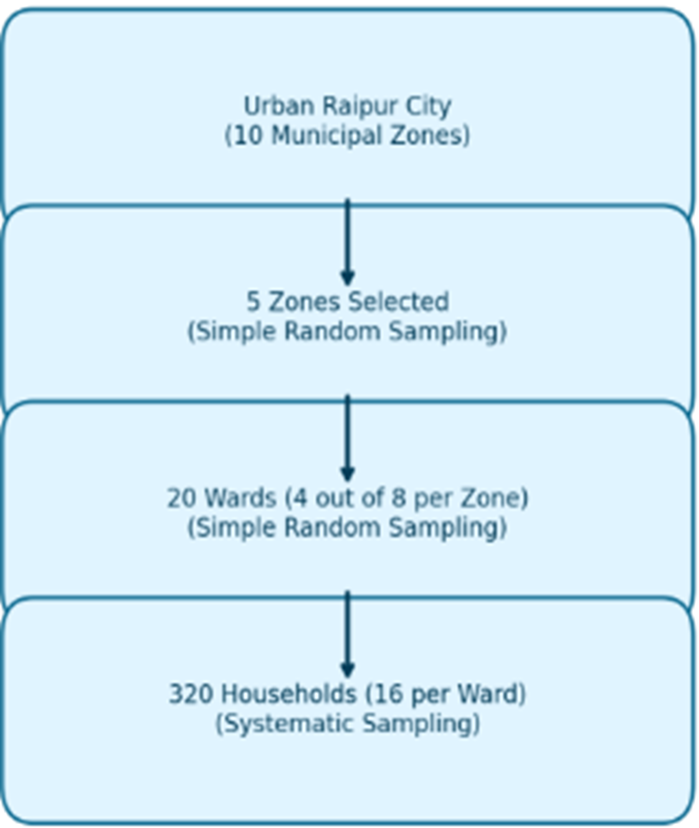
Flow Diagram:1 Multistage Random Sampling Framework.
RESULTS:
Quantitative Findings
Study Population
A total of 320 households comprising 1,664 individuals were surveyed across 20 wards in 5 urban zones using multistage random sampling (5 of 10 zones; 4 wards per zone; 16 households per ward). From this screened population, 41 eligible animal-bite victims (bites between 1 and 12 months prior to survey) were identified, corresponding to a household-level period prevalence of 12.8% (95% CI: 9.3–16.3) and an individual period prevalence of 2.46% over the recall period. All identified victims participated (response rate 100%).
Missing data was 3.2%, restricted to income and wage-loss variables. These were missing completely at random (Little’s test p=0.41) and retained for complete-case multivariable analysis.
Sociodemographic and Bite Characteristics
Most bite victims were male (63.4%), and 39.0% were aged <18 years. Over half (58.5%) belonged to households with monthly income <₹20,000. Dogs accounted for 82.9% of bites and cats for 17.1%. The majority of wounds were WHO Category II (87.8%), with 12.2% Category III.
Table 1. Sociodemographic and Bite Characteristics (n=41)
|
Characteristic |
Category |
n (%) |
|
Gender |
Male |
26 (63.4) |
|
|
Female |
15 (36.6) |
|
Age group |
<18 years |
16 (39.0) |
|
|
≥18 years |
25 (61.0) |
|
Monthly household income |
<₹20,000 |
24 (58.5) |
|
|
≥₹20,000 |
17 (41.5) |
|
Animal type |
Dog |
34 (82.9) |
|
|
Cat |
7 (17.1) |
|
WHO wound category |
Category II |
36 (87.8) |
|
|
Category III |
5 (12.2) |
Out-of-Pocket Expenditure (OOPE)
Median OOPE differed significantly by facility type (Kruskal–Wallis χ²=14.9, df=2, p<0.001). Post-hoc tests showed that median OOPE in private facilities was almost three times that in government facilities and more than six times that in traditional healer care; government facility OOPE was also significantly higher than that for traditional healers.
Table 2. OOPE by Facility Type (Kruskal–Wallis χ²=14.9, p<0.001)
|
Facility type |
Median OOPE (₹) |
IQR (₹) |
n |
|
Government |
1,121 |
745–1,580 |
18 |
|
Private |
3,328 |
2,150–4,920 |
15 |
|
Traditional healer |
550 |
280–890 |
8 |
Vaccination route also influenced cost. Intradermal (ID) vaccination was associated with 36% lower median OOPE than intramuscular (IM) schedules (Mann–Whitney U=92.5, p=0.004).
Table 3. OOPE by Vaccination Route (Mann–Whitney U=92.5, p=0.004)
|
Route |
Median OOPE (₹) |
IQR (₹) |
n |
|
ID |
1,049 |
680–1,420 |
16 |
|
IM |
1,637 |
1,200–2,340 |
17 |
RIG Utilization
Among Category III bite victims (n=5), only 40% received RIG and all doses were procured from private sources. The remaining 60% did not receive RIG, and all reported stockouts in government facilities despite guideline recommendations for RIG use in all Category III exposures.
Table 4. RIG Utilization Among Category III Cases (n=5)
|
RIG status |
n |
% |
|
Received (private purchase) |
2 |
40.0 |
|
Not received (government stockout) |
3 |
60.0 |
Catastrophic Health Expenditure (CHE)
CHE (OOPE ≥10% of monthly household income) was observed in 24.4% (10/41) of victims. In crude analyses, CHE was strongly associated with private facility use and wage loss.
Multivariable Predictors of OOPE and CHE
In GLM models with gamma family and log link, private facility use and IM vaccination remained independent predictors of higher OOPE. Delay of >24 hours from exposure to first vaccine dose did not significantly influence OOPE after adjustment.
Table 5. Predictors of Higher OOPE (GLM, Gamma Family, Log Link)
|
Predictor |
Adjusted cost ratio |
95% CI |
p |
|
Private facility (vs government) |
2.3 |
1.6–3.2 |
<0.01 |
|
IM vaccination (vs ID) |
1.5 |
1.1–2.0 |
0.03 |
|
Delay >24 h (vs ≤24 h) |
1.2 |
0.8–1.8 |
0.41 |
In Poisson regression with robust variance, private facility use and wage loss were significant predictors of CHE, while low household income showed a non-significant trend.
Table 6. Predictors of CHE (Poisson Regression, Robust SE)
|
Predictor |
Adjusted PR |
95% CI |
p |
|
Private facility use |
2.8 |
1.3–6.0 |
0.02 |
|
Wage loss |
3.1 |
1.4–6.8 |
0.01 |
|
Low income (<₹20,000) |
2.2 |
0.9–5.2 |
0.08 |
No overdispersion was detected (p=0.32); multicollinearity was low (VIF<2.1). Model fit was acceptable (deviance≈1.2; pseudo-R²≈0.67). Shapiro–Wilk tests confirmed non-normality of cost data (p<0.001), supporting the use of non-parametric and GLM-based methods.
Qualitative Findings
From 12 in-depth interviews (saturation at 12th, κ=0.82) with bite victims purposively selected (4 traditional healer users, 4 government, 4 private) and 3 KIIs (1 govt vaccinator, 1 private practitioner, 1 traditional healer), the first overarching theme focuses exclusively on traditional healer users (n=4 qualitative from 8 quantitative, 19.5%). This theme explains their preference as endpoints for minor Category II bites, linking to lowest OOPE (₹550 median).
Theme 1: Exclusive Reliance on Traditional Healers for Minor Bites
Traditional healer users described preference driven by practical, trusted access, corroborated by healer KII—avoiding formal systems entirely.
· Subtheme 1: Spatial and temporal proximity
"The healer lives two streets away—no need to travel far for small scratch; he's always home, no waiting like government queues." (Male victim, 27y, traditional healer user); (Female victim, 38y, traditional healer user).
· Subtheme 2: Cost-effectiveness and time savings
"Just ₹50-100, very cost-effective; done in 10 minutes—hospitals take full day, lose wage and spend thousands on transport/injections." (Male victim, 32y, traditional healer user); (Female victim, 42y, traditional healer user).
· Subtheme 3: Long-standing trust and community legitimacy
"My family goes to him for years for all issues, scratches—very trusted person." (Male victim, 45y, traditional healer user); "People trust me because the treatment I give is what I've done for years on minor bites." (Traditional healer, KII).
· Subtheme 4: Avoidance of hospitals for low-risk with conditional referral
"For minor scratches, people don't want hospital—lose too much time and money there." (Traditional healer, KII); "If I feel the bite is serious, I ask them to go to hospital for injection right away." (Traditional healer, KII).
Theme 2: Systemic Barriers in Government Facilities
Government users and vaccinator KII highlighted operational inefficiencies—queues, stockouts, wastage fears—pushing patients toward private care despite lower nominal costs.
· Subtheme 1: Long queues and multiple counters
"3-4 counters to cross, long queues everywhere—takes entire day." (Male victim, 29y, government user).
· Subtheme 2: Vaccine unavailability at local UPHC
"No vaccine at centre near home, had to go to district hospital—far travel." (Female victim, 35y, government user).
· Subtheme 3: Wage loss from full-day delays
"Almost entire day lost at government hospital, daily wage gone." (Male victim, 41y, government user).
· Subtheme 4: RIG non-availability forcing private purchase
"Severe bite but no RIG at government—asked to buy from outside." (Female victim, Category III, government user). "Vaccine supply not proper and RIG not available most of the times, so unable to administer complete PEP." (Government vaccinator, KII).
· Subtheme 5: IM preference due to vial wastage accountability
"Wastage of vial if not enough patients gather for ID; we are held responsible for wastage." (Government vaccinator, KII); "People not ready to wait for sufficient patients, all in hurry and shout, so we give IM vaccine." (Government vaccinator, KII).
Theme 3: Private Care as Time-Efficient Resort After Government Failure
Private users universally started at government facilities but switched due to systemic failures, accepting high costs for speed and reliability, corroborated by private practitioner KII.
Subtheme 1: Initial government attempt thwarted by unavailability
"Went to government first—no vaccines, RIG not available, had to wait entire half day but turn never came." (Male victim, 33y, private user).
Subtheme 2: Rapid private service enabling work continuity
"Private treated in 20-30 minutes—vaccines and RIG available immediately; at least didn't miss full day's work." (Female victim, 28y, private user); "Government doesn't provide quick service, no vaccines—what can be done?" (Male victim, 39y, private user).
Subtheme 3: Acknowledged high costs justified by reliability
"Very costly but got complete treatment without delay." (Female victim, 44y, private user).
Subtheme 4: Private KII rationale—speed via low volume and IM
"We provide fast service; low patient load allows IM regime—no vaccine wastage issues." (Private practitioner, KII).
Subtheme 5: Cost justification via service maintenance
"High cost covers quick service, maintaining stocks, staff for reliable delivery." (Private practitioner, KII).
Mixed-Methods Integration
The integrated analysis showed strong complementarity between quantitative patterns and qualitative explanations.
• The substantially higher OOPE and increased CHE risk associated with private facilities were illuminated by narratives indicating that households shifted to private care when government services failed or imposed excessive time and income loss, treating private PEP as a time-protective strategy rather than a luxury choice.
• The 36% lower median OOPE with ID vaccination, and the identification of IM route as an independent cost driver, were explained by government providers’ concerns about vial-wastage accountability and patient unwillingness to wait for sufficient numbers for ID sessions, illustrating how system-level norms constrained adoption of the more cost-efficient regimen.
• Low RIG coverage among Category III bites, quantitatively linked to government stockouts, was corroborated by reports of routine referral to private purchase for severe bites and acknowledgement by private providers that maintaining RIG stocks contributed to higher treatment costs.
• The relatively high use of traditional healers for minor Category II bites, and their very low OOPE, were explained by their spatial proximity, cultural legitimacy, and negligible wage loss, indicating that traditional healers function as economically rational endpoints for low-perceived-risk bites with conditional referral for more severe exposures.
Together, these findings depict a three-step adaptive pathway in which minor bites are often managed exclusively by traditional healers, moderate and severe bites initially present to government facilities, and failures in public service availability or timeliness drive a subset of patients into high-cost private care with a substantial risk of CHE.
Mixed-Methods Integration Table
Table 7. Sequential Explanatory Mixed-Methods Integration: Quantitative Findings, Qualitative Mechanisms, and Policy Actions
|
Core Finding (Quantitative) |
Explanatory Mechanism (Qualitative Themes) |
Meta-Inference (Integrated Interpretation) |
Policy Action (NRCP/WHO Zero-by-30 Aligned) |
|
Private facilities had 2.97× higher median OOPE than government; CHE = 24.4%, strongly predicted by wage loss (aPR=3.1) |
Private care chosen only after government failure due to queues, vaccine unavailability, and full-day delays (Theme 3: Private as time-efficient resort) |
Economic vulnerability exceeds nominal cost difference. Private PEP serves as time-protection strategy for daily wage earners, not luxury choice. Wage loss—not vaccine cost—drives CHE. |
After-hours/single-window PEP counters to protect wages. Price regulation/strategic purchasing for private PEP subsidies. |
|
ID vaccination cost 36% less than IM; IM independently increased OOPE (cost ratio=1.5) |
IM preferred due to provider audit fears and vial wastage accountability; patients unwilling to wait for ID sessions (Theme 2: Systemic barriers in government facilities) |
System cost inflation is provider-driven, not patient-driven. ID underused due to audit pressures and workflow constraints, not awareness gaps. |
Fixed ID sessions with revised wastage audit norms. Allow multi-dose vial opening without punitive tracking. |
|
Only 40% of Category III received RIG; all private. 60% denied due to government stockouts |
Routine RIG stockouts force private purchase even for severe bites; private providers maintain stocks at higher cost (Themes 2 & 3) |
Stockouts = ethical exclusion. Public supply failure displaces medical/financial risk onto households, forcing RIG into private market → catastrophic spending for high-risk victims. |
PHC/UCHC RIG buffer stocks with ring-fenced funds. Procurement forecasting reforms under NRCP. |
|
19.5% exclusive traditional healer endpoint use; lowest median OOPE (₹550) |
Spatial proximity, negligible fees, time savings, and community trust for minor Category II bites; conditional referral for serious cases (Theme 1: Exclusive reliance on traditional healers) |
Traditional care represents rational economic choice, not ignorance. Functions as low-risk triage system with built-in referral pathways. |
Healer referral sensitization (not opposition). Position healers as first-line triage partners for Category II/III bites. |
DISCUSSION:
This sequential explanatory mixed-methods study in urban Raipur, Chhattisgarh screened 1,664 individuals across 320 households using multistage random sampling, identifying 41 bite victims with an individual-level period prevalence of 2.46% and household prevalence of 12.8% (95% CI: 9.3–16.3) over a 1–12 month recall window . Although numerically comparable to multicentric urban estimates (2–3%) , the community-based design uniquely captured non-facility attendees—especially untreated Category II cases exclusively managed by traditional healers (19.5%)—revealing a substantial "invisible baseline" absent from routine antirabies clinic surveillance . This suggests that rabies epidemiology is underestimated not merely because of underreporting, but due to systematic invisibility of community-managed exposures that never enter formal care pathways.
OOPE Burden and Cost Disparities
Private facilities imposed 2.97-fold higher median out-of-pocket expenditure (OOPE) than government facilities (₹3,328 vs ₹1,121; Kruskal–Wallis χ²=14.9, p<0.001), consistent with multicentric estimates across six Indian states (₹1,050–₹3,800) [6–9]. Intradermal (ID) vaccination reduced expenses by 36% compared to intramuscular (IM) routes (Mann–Whitney U=92.5, p=0.004), corroborating South Indian evidence. Qualitative data revealed the mechanism: government vaccinators avoided ID due to vial-wastage accountability fears, echoing Southeast Asian implementation challenges. Multivariable GLM confirmed IM vaccination as an independent OOPE predictor (adjusted cost ratio: 1.5, 95% CI: 1.1–2.0, p=0.03) . Thus, cost escalation originates from systemic procurement, stock, and audit constraints rather than patient choice or provider incompetence.
Catastrophic Health Expenditure and Indirect Costs
Catastrophic health expenditure (CHE) affected 24.4% of households (OOPE ≥10% monthly income), with wage loss as the strongest predictor (aPR=3.1, 95% CI: 1.4–6.8, p=0.01) [7–9,21]. Among low-income households (58.5% earning <₹20,000 monthly), indirect costs from multi-visit schedules, long queues, and travel exceeded direct medical costs, even when vaccines were free/subsidized. Only 40% of Category III victims (2/5) received RIG—all through private purchase due to public stockouts—reflecting persistent supply-chain gaps across Indian states [13–15]. This constitutes a major equity concern within NRCP implementation and contradicts WHO guidance for universal RIG provision in high-risk exposures.
Pluralistic Care-Seeking as Economic Rationality
Traditional healers exclusively managed 19.5% of bites—predominantly minor Category II injuries—due to spatial proximity, negligible fees (median OOPE ₹550), and time efficiency, rather than vaccine mistrust [16–18]. Many healers functioned as trusted triage agents with conditional referral for severe bites, challenging assumptions of cultural resistance. Government service failures (stockouts, queues) then shifted moderate/severe cases to private facilities, explaining the private care–CHE association (aPR=2.8, 95% CI: 1.3–6.0, p=0.02).
This study proposes the "Economic–Systemic Cascade Model of Rabies PEP Pathways":
1. Minor triage → Traditional healers (low perceived risk, minimal OOPE)
2. Moderate/severe attempt → Government facilities (stockouts, delays, ID audit pressures)
3. Fallback resort → Private facilities (high OOPE/CHE but time-protected)
This model reframes pluralistic utilization as rational economic adaptation to systemic constraints rather than behavioural deficits [16–18,23,25].
Methodological Considerations
Multistage random sampling (5/10 zones → 20 wards → 314 households) with 100% response among eligible victims minimized selection bias beyond facility-based surveys. Non-parametric tests addressed skewed cost distributions (Shapiro–Wilk p<0.001). GLM (gamma-log) and Poisson regression (robust SE) provided robust predictors with strong diagnostics (no overdispersion p=0.32, VIF<2.1). Qualitative analysis followed Braun & Clarke's six-step framework (κ=0.82) , while Fetters' connection–analytic–interpretive integration enabled explanatory linkage of quantitative patterns to qualitative mechanisms.
Limitations
Small Category III sample (n=5) limited RIG-specific analyses. Urban-only design precludes rural generalizability. Income-based CHE threshold aligns with Indian literature [7–9,21] but may under-estimate irregular earners. Purposive qualitative sampling prioritized explanatory depth over statistical representativeness. Recall bias was mitigated through card/receipt verification (75%) and timeline reconstruction.
Policy Implications
Structural reforms over awareness campaigns:
• ARV/RIG buffer stocks with forecasting at PHC/UCHC levels [5,13–15]
• Fixed ID sessions + revised wastage audits
• Single window/after-hours PEP counters to cut wage loss
• Private price regulation/strategic purchasing for 3-fold OOPE gap
• Healer referral sensitization as triage partners [16–18]
• Ayushman Bharat PEP inclusion for financial protection [19–21]
These would dismantle the cost-inducing cascade, establishing a guideline-compliant urban PEP system aligned with “NRCP “ and “WHO SEARO Zero-by-2030 “..
CONCLUSION:
This sequential explanatory mixed-methods study reveals that urban rabies post-exposure prophylaxis (PEP) challenges in Chhattisgarh stem primarily from systemic and economic constraints rather than individual non-adherence. Key findings include a 2.97-fold private-public OOPE disparity (₹3,328 vs ₹1,121), 36% cost savings with intradermal vaccination undermined by provider audit fears, 24.4% catastrophic health expenditure driven by wage loss (aPR=3.1), 60% RIG denial among Category III victims due to stockouts, and 19.5% exclusive traditional healer use for minor bites reflecting rational economic triage rather than vaccine mistrust [3-25].
The community-based multistage sampling (1,664 individuals screened → 41 bite victims identified; 100% response) captured "invisible" non-facility cases absent from routine surveillance, while purposive qualitative inquiry (n=15 interviews, κ=0.82) provided explanatory depth through Fetters' three-level integration (connection→analytic→interpretive) [23-25]. Although the modest Category III sample (n=5) limited high-risk sub-analyses and urban findings require rural validation, methodological triangulation enhances internal validity and transferability to similar tier-2 urban settings.
These results advocate a six-pillar structural reform agenda aligned with **NRCP operational guidelines ** and **WHO
SEARO Zero-by-2030 roadmap **:
1. PHC/UCHC ARV/RIG buffer stocks with procurement forecasting [5,13-15]
2. Fixed ID sessions + revised wastage audit norms
3. Single window/after-hours PEP counters to protect daily wages
4. Healer referral sensitization leveraging triage legitimacy [16-18]
5. Private PEP price regulation/strategic purchasing
6. Ayushman Bharat PEP inclusion for financial protection [19-21]
Implementing this "Economic-Systemic Cascade Model"—traditional triage → public attempt → private fallback—would transform fragmented, cost-inducing pathways into an equitable, guideline-compliant urban PEP system, advancing India's rabies elimination while safeguarding vulnerable households from financial ruin.
Acknowledgements
The authors express sincere gratitude to the Ward Parshads of the selected municipal wards for facilitating community access and providing updated household listings, and to the ASHA workers and ANMs for their support in community mobilization during field visits. Appreciation is extended to the local health authorities for administrative cooperation, the Institutional Ethics Committee (Approval No. [No./MC./Ethics/PG/2023/136]/2024) for ethical oversight, and to all participating bite victims and key informants for generously sharing their lived experiences. The Department of Community Medicine, Pt. JNM Medical College, Raipur, provided SPSS and NVivo access along with statistical support. The study was conducted solely by the investigators without external field staff, utilizing institutional resources exclusively.
REFERENCES:
1. World Health Organization. Rabies vaccines and immunoglobulins: WHO position paper – April 2018. Wkly Epidemiol Rec. 2018;93(16):201–20.
2. Hampson K, Coudeville L, Lembo T, Sambo M, Kieffer A, Attlan M, et al. Estimating the global burden of endemic canine rabies. PLoS Negl Trop Dis. 2015;9(4):e0003709.
3. Sudarshan MK, Madhusudana SN, Mahendra BJ, Rao NSN, Ashwath Narayana DH, Rahman A, et al. Epidemiology of animal bites in India: a multicentric study. J Commun Dis. 2007;39(1):35–40.
4. Menezes R. Incidence of animal bites and barriers to post-exposure prophylaxis in urban India. Indian J Public Health. 2008;52(4):234–6.
5. Ministry of Health and Family Welfare, Government of India. National Rabies Control Programme: Operational Guidelines for Rabies Prophylaxis. New Delhi: MoHFW; 2019.
6. Haradanhalli RS, Narayana DH, Ashwath U, et al. Cost of rabies post-exposure prophylaxis in different health-care settings in six Indian states. Indian J Public Health. 2019;63(Suppl 1):S44–7.
7. Hardanahalli RS. Economic cost of rabies post-exposure prophylaxis. Indian J Community Health. 2017;29(2):156–61.
8. Qureshi M, Wani A, Qureshi H, et al. Economic burden of PEP in a tertiary care hospital in Kashmir, India. Int J Trop Dis Health. 2019;35(1):1–7.
9. Sarkar S, Sabarwal R, Singh P. Cost burden and determinants of rabies PEP in urban India. PLoS Negl Trop Dis. 2020;14(5):e0008187.
10. Abraham A, Sudarsan B, Soman B. Patient waiting time and its determinants in the OPD of a public hospital in Kerala. Indian J Public Health. 2018;62(3):201–6.
11. Kandasamy S, Ashwath Narayana DH, Sudarshan MK, et al. Cost and compliance of intradermal versus intramuscular rabies vaccination regimens in South India. Vaccine. 2019;37(12):214–21.
12. Matibag GC, Ohbayashi Y, Kanda K, et al. Challenges in the implementation of intradermal rabies vaccination in Thailand. Southeast Asian J Trop Med Public Health. 2015;46(4):649–57.
13. Sudarshan SM. Challenges in rabies immunoglobulin availability in India. Vaccine. 2011;29(1):42–7.
14. Menon G, Vadivoo S, Krishnan A. Availability of rabies immunoglobulin in public hospitals in Tamil Nadu. Int J Infect Dis. 2018;70:23–8.
15. Saseendran AS, Shaji M, Nair NS, et al. Barriers in provision of RIG in Indian health facilities: a cross-sectional survey. Trop Med Int Health. 2022;27(2):188–96.
16. Dilawar A, Ali S, Qureshi MA, et al. Traditional healer use and misconceptions associated with rabies care in India. J Glob Health. 2017;7(1):010402.
17. Suraweera WR, Warrell DA, Rodrigues R, et al. Rabies epidemiology and traditional beliefs in Sri Lanka. Epidemiol Infect. 2012;140(11):1187–95.
18. Reeti SP, Shah B, Shrestha K, et al. Rabies treatment-seeking behaviour in Nepal. BMC Public Health. 2014;14:1–7.
19. World Health Organization – Regional Office for South-East Asia. Rabies Elimination Roadmap: South-East Asia Region – 2023 Update. New Delhi: WHO SEARO; 2023.
20. World Health Organization. Rabies post-exposure prophylaxis: recommendations for use. Geneva: WHO; 2018.
21. Haradanhalli RS, Sudarshan MK, et al. Cost of rabies post-exposure prophylaxis and catastrophic health expenditure in India. Indian J Public Health. 2019;63(Suppl 1):S48–52.
22. Sudarshan MK, Mahendra BJ, Narayana DH, et al. Animal bites and rabies prophylaxis in India: current status and challenges. Indian J Public Health. 2007;51(3):124–7.
23. Creswell JW, Plano Clark VL. Designing and Conducting Mixed Methods Research. 3rd ed. Thousand Oaks: Sage Publications; 2017.
24. Braun V, Clarke V. Using thematic analysis in psychology. Qual Res Psychol. 2006;3(2):77–101.
25. Fetters MD, Curry LA, Creswell JW. Achieving integration in mixed methods designs: principles and practices. Health Serv Res. 2013;48(6 Pt 2):2134–56.