Predictors of Morbidity and Mortality in Combined Abdominal Injury and Pelvic Fractures.
- Prashant Rajput , Assistant Professor, Department of Surgery, Dr B S Kushwaha Institute of Medical Sciences, Kanpur, Uttar Pradesh, India.
- Rahul Rishi , Professor, Department of Orthopaedics, Naraina Medical College, Gangaganj, Panki, Kanpur, Uttar Pradesh, India.
- Sushant Verma , Associate Professor, Department of Orthopaedics, Naraina Medical College, Gangaganj, Panki, Kanpur, Uttar Pradesh, India.
Article Information:
Abstract:
Background: Combined abdominal injury and pelvic fractures are among the most severe forms of polytrauma encountered in emergency trauma care. These injuries are associated with significant hemorrhage, visceral organ damage, prolonged hospitalization, and increased risk of morbidity and mortality. Early identification of factors predicting poor outcome is essential for timely intervention and improved survival. Aim: To evaluate the predictors of morbidity and mortality in patients presenting with combined abdominal injury and pelvic fractures. Materials and Methods: This prospective observational study was conducted in the Department of Orthopaedics at Naraina Medical College over a period of one year from March 2025 to February 2026. A total of 25 patients with combined abdominal injury and pelvic fractures were included in the study. Data regarding demographic profile, mechanism of injury, hemodynamic status, Injury Severity Score (ISS), type of pelvic fracture, associated abdominal organ injury, blood transfusion requirement, ICU admission, complications, and mortality were collected and analyzed. Statistical analysis was performed using SPSS version 25.0, and p<0.05 was considered statistically significant. Results: The mean age of patients was 38.6 ± 14.2 years, with male predominance (76%). Road traffic accidents were the most common mechanism of injury (72%). Unstable pelvic fractures were observed in 60% of patients. Liver injury was the most common associated abdominal organ injury (28%). Hemodynamic instability was present in 44% of patients, while 28% had ISS >25. Overall mortality was 20%. Significant predictors of mortality included hemodynamic instability, ISS >25, massive blood transfusion requirement, delayed surgical intervention beyond 12 hours, and multiple abdominal organ injury. Common morbidities included prolonged ICU stay (32%), wound infection (24%), sepsis (20%), and acute respiratory distress syndrome (16%). Conclusion: Combined abdominal injury with pelvic fractures is associated with substantial morbidity and mortality. Hemodynamic instability, severe injury burden, delayed intervention, and associated multiple organ injuries are major predictors of poor outcome. Early multidisciplinary management, aggressive resuscitation, and prompt surgical intervention are essential to improve patient survival and reduce complications.
Keywords:
Article :
INTRODUCTION:
Pelvic fractures are commonly associated with high-energy trauma and frequently coexist with abdominal injuries due to the significant force involved during trauma events. These injuries are often encountered following road traffic accidents, falls from height, and crush injuries. The combination of pelvic fracture and abdominal trauma substantially increases the risk of hemorrhagic shock, visceral injury, sepsis, multiorgan dysfunction, prolonged hospitalization, and death [1].
The pelvis contains major vascular structures and is anatomically close to abdominal organs, making combined injuries particularly dangerous. Hemorrhage remains one of the leading causes of early mortality in pelvic trauma, whereas delayed mortality is commonly related to sepsis and multiorgan failure [2]. Patients presenting with unstable pelvic fractures and concomitant abdominal injuries often require rapid multidisciplinary management involving orthopaedics, general surgery, trauma surgery, anesthesiology, and critical care teams [3].
Several factors have been implicated in determining outcomes in such patients, including age, mechanism of injury, hemodynamic instability, associated visceral damage, blood transfusion requirement, Injury Severity Score (ISS), and timing of surgical intervention [4]. Identification of these predictors is important for risk stratification, prioritization of treatment, and optimization of trauma protocols.
Despite advances in trauma management, combined abdominal injuries with pelvic fractures continue to be associated with substantial morbidity and mortality, particularly in developing countries where delays in referral and limited trauma infrastructure may affect outcomes [5]. There remains limited institutional data from North India evaluating the determinants of adverse outcomes in these patients.
Therefore, the present study was undertaken to evaluate the predictors of morbidity and mortality in patients presenting with combined abdominal injury and pelvic fractures treated at a tertiary care teaching hospital.
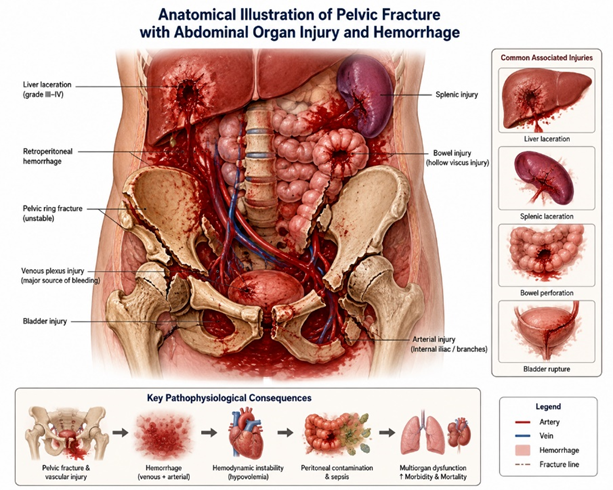
Figure 1: Anatomical illustration demonstrating unstable pelvic fracture associated with abdominal organ injuries and retroperitoneal hemorrhage in polytrauma patients, highlighting major mechanisms contributing to morbidity and mortality including vascular injury, hemorrhagic shock, visceral perforation, sepsis, and multiorgan dysfunction.
MATERIALS AND METHODS:
Study Design and Setting
This prospective observational study was conducted in the Department of Orthopaedics at Naraina Medical College over a period of one year from March 2025 to February 2026. The study was carried out after obtaining approval from the Institutional Ethics Committee, and informed written consent was obtained from all patients or their legally authorized attendants.
Study Population
The study included patients presenting with combined abdominal injury and pelvic fractures following trauma who were admitted through the emergency department during the study period. A total of 25 patients fulfilling the eligibility criteria were enrolled consecutively.
Inclusion Criteria
• Patients aged ≥18 years.
• Patients diagnosed with pelvic fracture associated with abdominal injury.
• Patients admitted within 24 hours of sustaining trauma.
• Patients willing to participate in the study.
Exclusion Criteria
• Isolated pelvic fractures without abdominal injury.
• Isolated abdominal injuries without pelvic fracture.
• Pathological pelvic fractures.
• Patients brought dead or who died before complete evaluation.
• Patients with incomplete clinical records.
Initial Assessment and Management
All patients were initially evaluated according to Advanced Trauma Life Support (ATLS) protocol. Primary survey included assessment of airway, breathing, circulation, disability, and exposure. Hemodynamic status at admission was documented, and patients with systolic blood pressure <90 mmHg were considered hemodynamically unstable.
Resuscitation measures including intravenous fluids, blood transfusion, oxygen supplementation, and vasopressor support were initiated when required. Simultaneous multidisciplinary evaluation was performed by orthopaedic surgeons, general surgeons, anesthesiologists, and critical care specialists.
Diagnostic Evaluation
Detailed history regarding mechanism of injury, duration since trauma, and associated complaints was recorded. Clinical examination included abdominal examination, pelvic stability assessment, neurological evaluation, and identification of associated injuries.
Radiological investigations included:
• Plain radiographs of pelvis with anteroposterior view.
• Focused Assessment with Sonography for Trauma (FAST).
• Ultrasonography abdomen and pelvis.
• Contrast-enhanced computed tomography (CECT) scan in hemodynamically stable patients.
Pelvic fractures were classified based on radiographic findings into stable and unstable fracture patterns. Abdominal injuries involving liver, spleen, bowel, urinary bladder, or multiple organs were documented.
Variables Studied
The following parameters were recorded in all patients:
Demographic Variables
• Age
• Gender
Injury-Related Variables
• Mechanism of injury
• Type of pelvic fracture
• Type of abdominal organ injury
• Associated extra-abdominal injuries
Clinical Variables
• Hemodynamic status at admission
• Glasgow Coma Scale (GCS)
• Injury Severity Score (ISS)
• Requirement of blood transfusion
• Need for ICU admission
• Duration of hospital stay
• Surgical intervention performed
• Time interval between admission and surgery
Outcome Measures
Primary Outcome
• In-hospital mortality.
Secondary Outcomes
Assessment of morbidity in terms of:
• Wound infection
• Sepsis
• Acute respiratory distress syndrome (ARDS)
• Multiple organ dysfunction syndrome (MODS)
• Prolonged ICU stay (>5 days)
• Prolonged hospital stay (>14 days)
Treatment Protocol
Patients with unstable pelvic fractures underwent pelvic stabilization using pelvic binders, external fixation, or definitive surgical fixation depending on hemodynamic condition and fracture pattern. Abdominal injuries were managed conservatively or surgically according to the extent of organ damage and clinical condition.
Exploratory laparotomy was performed in patients with evidence of hollow viscus perforation, uncontrolled intra-abdominal bleeding, or peritonitis. Blood products were transfused as required, and massive transfusion protocol was followed in patients with severe hemorrhage.
Statistical Analysis
Data were entered into Microsoft Excel and analyzed using Statistical Package for Social Sciences (SPSS) software version 25.0. Continuous variables were expressed as mean ± standard deviation, whereas categorical variables were presented as frequency and percentage.
Association between predictor variables and morbidity/mortality outcomes was analyzed using Chi-square test or Fisher’s exact test for categorical variables and Student’s t-test for continuous variables. A p-value of less than 0.05 was considered statistically significant.
RESULTS:
A total of 25 patients with combined abdominal injury and pelvic fractures were included in the present study. The majority of patients belonged to the economically productive age group, with a mean age of 38.6 ± 14.2 years. Most patients were males, reflecting the increased exposure of males to high-velocity trauma and road traffic accidents.
Table 1: Demographic Characteristics of Study Population
|
Variable |
Number (n=25) |
Percentage |
|
Age 18-30 years |
8 |
32% |
|
Age 31-50 years |
11 |
44% |
|
Age >50 years |
6 |
24% |
|
Male |
19 |
76% |
|
Female |
6 |
24% |
Among the 25 patients, 11 (44%) belonged to the age group of 31-50 years, followed by 8 patients (32%) in the 18-30 years age group. Patients older than 50 years constituted 24% of the study population. Male predominance was observed, with 19 male patients (76%) and 6 female patients (24%).
Road traffic accidents were identified as the most common mechanism of injury, accounting for nearly three-fourths of the cases. Falls from height and crush injuries constituted the remaining cases.
Table 2: Mechanism of Injury
|
Mechanism of Injury |
Number |
Percentage |
|
Road traffic accident |
18 |
72% |
|
Fall from height |
5 |
20% |
|
Crush injury |
2 |
8% |
Out of the total patients, 18 (72%) sustained injuries following road traffic accidents, while 5 patients (20%) presented after falls from height. Crush injuries were seen in 2 patients (8%). High-energy trauma was therefore the predominant mechanism responsible for combined abdominal and pelvic injuries.
Assessment of pelvic fracture patterns demonstrated that unstable pelvic fractures were more frequently associated with severe abdominal trauma and poorer outcomes.
Table 3: Type of Pelvic Fracture
|
Pelvic Fracture Pattern |
Number |
Percentage |
|
Stable pelvic fracture |
10 |
40% |
|
Unstable pelvic fracture |
15 |
60% |
Fifteen patients (60%) had unstable pelvic fractures, whereas 10 patients (40%) had stable fracture patterns. Patients with unstable fractures more commonly required ICU admission, blood transfusion, and surgical stabilization.
Evaluation of associated abdominal injuries revealed that solid organ injuries were common, with liver and splenic trauma being the predominant findings.
Table 4: Associated Abdominal Organ Injuries
|
Organ Injury |
Number |
Percentage |
|
Liver injury |
7 |
28% |
|
Splenic injury |
6 |
24% |
|
Bowel injury |
5 |
20% |
|
Bladder injury |
4 |
16% |
|
Multiple organ injury |
3 |
12% |
Liver injury was observed in 7 patients (28%), followed by splenic injury in 6 patients (24%). Bowel injury was documented in 5 patients (20%), while bladder injury occurred in 4 patients (16%). Multiple abdominal organ injuries were noted in 3 patients (12%), all of whom required intensive care management.
Hemodynamic instability at admission was observed in a considerable proportion of patients and was significantly associated with adverse outcomes.
Table 5: Clinical and Trauma Severity Parameters
|
Parameter |
Number |
Percentage |
|
Hemodynamically unstable |
11 |
44% |
|
ISS >25 |
7 |
28% |
|
ICU admission required |
14 |
56% |
|
Massive blood transfusion required |
8 |
32% |
|
Surgical intervention performed |
17 |
68% |
A total of 11 patients (44%) were hemodynamically unstable at the time of admission. Injury Severity Score greater than 25 was recorded in 7 patients (28%). ICU admission was required in 14 patients (56%), while 8 patients (32%) required massive blood transfusion. Surgical intervention, including exploratory laparotomy and pelvic fixation procedures, was performed in 17 patients (68%). Post-traumatic complications contributed substantially to patient morbidity during hospitalization. Prolonged ICU stay and infective complications were frequently encountered.
Table 6: Morbidity Profile Among Study Patients
|
Complication |
Number |
Percentage |
|
Prolonged ICU stay |
8 |
32% |
|
Wound infection |
6 |
24% |
|
Sepsis |
5 |
20% |
|
ARDS |
4 |
16% |
|
MODS |
3 |
12% |
Prolonged ICU stay of more than five days was the most common morbidity observed, affecting 8 patients (32%). Wound infection developed in 6 patients (24%), while sepsis occurred in 5 patients (20%). Acute respiratory distress syndrome (ARDS) was documented in 4 patients (16%), and multiple organ dysfunction syndrome (MODS) occurred in 3 patients (12%).
Mortality was observed predominantly among patients with severe trauma, unstable hemodynamics, and multiple abdominal organ involvement.
Table 7: Predictors of Mortality
|
Predictor Variable |
Mortality Present (n=5) |
Mortality Absent (n=20) |
p-value |
|
Hemodynamic instability |
5 |
6 |
0.01 |
|
ISS >25 |
4 |
3 |
0.02 |
|
Massive blood transfusion |
4 |
4 |
0.03 |
|
Delayed surgery (>12 hrs) |
3 |
2 |
0.04 |
|
Multiple organ injury |
3 |
1 |
0.01 |
Overall mortality in the present study was 20% (5 patients). Hemodynamic instability at admission showed a statistically significant association with mortality (p=0.01). Similarly, Injury Severity Score greater than 25 was strongly associated with fatal outcome (p=0.02). Requirement of massive blood transfusion and delayed surgical intervention beyond 12 hours were also identified as significant predictors of mortality. Patients with multiple abdominal organ injuries demonstrated markedly increased mortality compared to those with isolated organ injuries. Patients who survived generally had stable hemodynamic parameters, lower ISS scores, earlier surgical intervention, and shorter ICU stay compared to non-survivors.
DISCUSSION:
Combined abdominal injury with pelvic fractures represents one of the most severe forms of polytrauma encountered in trauma centers and is associated with substantial morbidity and mortality. The coexistence of pelvic skeletal disruption and intra-abdominal organ injury contributes significantly to hemorrhagic shock, septic complications, prolonged hospitalization, and multiorgan dysfunction. Early recognition of predictors associated with poor outcomes is therefore essential for improving trauma management and survival rates [1].
In the present study, the majority of patients belonged to the age group of 31-50 years, with a mean age of 38.6 ± 14.2 years. Male predominance was observed, accounting for 76% of the cases. Similar demographic patterns have been reported in previous trauma studies, where young males constituted the majority of victims because of greater exposure to vehicular travel, occupational hazards, and high-energy trauma mechanisms [2]. The predominance of younger individuals highlights the socioeconomic burden associated with these injuries due to loss of productivity and prolonged rehabilitation.
Road traffic accidents were identified as the most common mechanism of injury in the present study, accounting for 72% of cases. This finding is consistent with previous reports demonstrating that high-velocity vehicular trauma is the leading cause of pelvic fractures associated with abdominal injuries [2]. The increasing incidence of motor vehicle accidents in developing countries has contributed substantially to the burden of polytrauma cases encountered in tertiary care centers.
Unstable pelvic fractures were observed in 60% of patients and were associated with increased morbidity and mortality. Pelvic instability contributes to disruption of venous plexuses and arterial vessels, leading to severe hemorrhage and hemodynamic compromise [3]. Patients with unstable fractures in the present study more frequently required ICU admission, blood transfusion, and surgical stabilization procedures. Similar observations were reported by Holstein et al., who demonstrated that unstable pelvic ring injuries are associated with significantly higher mortality rates compared to stable fracture patterns [4].
Among abdominal injuries, liver and splenic injuries were the most common solid organ injuries identified in the current study. However, bowel injuries were associated with greater septic complications and prolonged ICU stay. Hollow viscus injuries are known to increase the risk of intra-abdominal contamination, sepsis, and multiple organ dysfunction syndrome [5]. Patients with bowel injuries in the present study demonstrated higher rates of wound infection and postoperative complications compared to those with isolated solid organ injuries.
Hemodynamic instability at presentation emerged as one of the most significant predictors of mortality in the current study. All patients who expired during hospitalization were hemodynamically unstable at admission. Hemorrhagic shock remains the primary cause of early mortality in combined pelvic and abdominal trauma due to massive blood loss from pelvic vascular injury and associated visceral damage [2,6]. Early aggressive resuscitation, hemorrhage control, and rapid stabilization are therefore critical components in improving patient outcomes.
Injury Severity Score (ISS) greater than 25 was significantly associated with mortality in the present study. Patients with higher ISS values had increased incidence of ICU admission, transfusion requirement, and multiorgan dysfunction. Similar findings have been reported in previous studies where ISS was identified as an independent predictor of mortality in polytrauma patients [4]. Higher ISS reflects the severity of multisystem injury and correlates directly with physiological derangement and poorer prognosis.
Massive blood transfusion requirement was another important predictor of adverse outcome observed in this study. Patients requiring multiple blood transfusions often represented severe hemorrhagic trauma and were more likely to develop coagulopathy, acidosis, and hypothermia, collectively referred to as the “lethal triad” of trauma [6]. These patients demonstrated significantly higher mortality and longer ICU stay.
Delayed surgical intervention beyond 12 hours was also significantly associated with mortality. Patients undergoing delayed exploratory laparotomy or delayed pelvic stabilization had increased complications including sepsis, prolonged ICU stay, and multiorgan dysfunction. Early definitive management of abdominal bleeding and pelvic instability has been emphasized in several trauma protocols and damage control strategies [7]. Prompt surgical intervention minimizes ongoing hemorrhage and reduces secondary systemic complications.
The morbidity profile observed in the present study included prolonged ICU stay, wound infection, sepsis, ARDS, and MODS. Prolonged ICU stay was the most common complication, affecting 32% of patients. Septic complications were particularly common among patients with bowel injuries and delayed intervention. Similar postoperative and critical care complications have been reported by previous investigators managing severe pelvic trauma associated with abdominal injuries [8].
The overall mortality rate in the present study was 20%, which is comparable to previously published literature reporting mortality rates ranging from 15% to 35% in combined pelvic-abdominal trauma [4,6]. Mortality in such patients is influenced by the severity of hemorrhage, associated visceral injuries, physiological reserve, and availability of prompt multidisciplinary trauma care.
The findings of the present study emphasize the importance of coordinated multidisciplinary management involving orthopaedic surgeons, general surgeons, anesthesiologists, and critical care specialists. Early diagnosis, rapid resuscitation, timely surgical intervention, and intensive postoperative monitoring remain essential in reducing morbidity and mortality in these critically injured patients.
However, the present study had certain limitations. The sample size was relatively small, and the study was conducted at a single tertiary care center, which may limit the generalizability of the findings. In addition, long-term functional outcomes were not assessed. Despite these limitations, the study provides valuable institutional data regarding predictors of adverse outcomes in combined abdominal injury and pelvic fractures in the Indian trauma care setting.
CONCLUSION:
Combined abdominal injuries with pelvic fractures are associated with substantial morbidity and mortality. Hemodynamic instability, high Injury Severity Score, multiple abdominal organ injuries, delayed surgical intervention, and massive blood transfusion requirement are major predictors of poor outcome. Early diagnosis, rapid resuscitation, multidisciplinary management, and timely surgical intervention are essential to reduce complications and improve survival.
REFERENCES:
1. Tile M. Acute pelvic fractures: I. Causation and classification. J Am Acad Orthop Surg. 1996 May;4(3):143-151.
2. Demetriades D, Karaiskakis M, Toutouzas K, Alo K, Velmahos G, Chan L. Pelvic fractures: epidemiology and predictors of associated abdominal injuries and outcomes. J Am Coll Surg. 2002 Jan;195(1):1-10.
3. Pohlemann T, Bosch U, Gänsslen A, Tscherne H. The Hannover experience in management of pelvic fractures. Clin Orthop Relat Res. 1994 Aug;(305):69-80.
4. Holstein JH, Culemann U, Pohlemann T; Working Group Mortality in Pelvic Fracture Patients. What are predictors of mortality in patients with pelvic fractures? Clin Orthop Relat Res. 2012 Aug;470(8):2090-2097.
5. Flint L, Cryer HG. Pelvic fracture and associated injuries. Surg Clin North Am. 1998 Aug;78(4):879-892.
6. Balogh Z, King KL, Mackay P, McDougall D, Mackenzie S, Evans JA, et al. The epidemiology of pelvic ring fractures: a population-based study. J Trauma. 2007 Nov;63(5):1066-1073.
7. Giannoudis PV, Pape HC. Damage control orthopaedics in unstable pelvic ring injuries. Injury. 2004 Jul;35(7):671-677.
8. Suzuki T, Smith WR, Moore EE. Pelvic packing or angiography: competitive or complementary? Injury. 2009 Apr;40(4):343-353.