Prevalence of Vitamin B12 Deficiency and Its Association with Dose and Duration of Metformin Therapy in Patients with Type 2 Diabetes Mellitus: A Cross-Sectional Study.
- Hrishikesh Hulawale , Junior Resident, Department of General Medicine, MGM Medical College and Hospital, Kamothe, Navi Mumbai, INDIA.
- Tejaswini Shinde , Senior Resident, Department of General Medicine, MGM Medical College and Hospital, Kamothe, Navi Mumbai, INDIA.
- Suhasini Mahendrakar , Assistant Professor, Department of General Medicine, MGM Medical College and Hospital, Kamothe, Navi Mumbai, INDIA.
- Sandeep Rai , HOU & Professor, Department of General Medicine, MGM Medical College and Hospital, Kamothe, Navi Mumbai, INDIA.
Article Information:
Abstract:
Background: Vitamin B12 deficiency is a recognized complication of long-term metformin therapy in patients with type 2 diabetes mellitus (T2DM), with varying prevalence reported across populations. Limited data are available from Indian settings regarding its association with dose and duration of metformin therapy. Objectives: To estimate the prevalence of vitamin B12 deficiency and assess its association with metformin dose and duration among patients with T2DM. Methods: A cross-sectional observational study was conducted among 130 patients with T2DM receiving metformin therapy at a tertiary care hospital. Sociodemographic, clinical, and treatment-related data were collected using a structured proforma. Serum vitamin B12 levels were measured, and deficiency was defined as <200 pg/mL. Statistical analysis was performed using IBM SPSS Statistics version 26.0. Associations were analyzed using the Chi-square test, and correlation was assessed using Pearson correlation. Receiver Operating Characteristic (ROC) curve analysis was performed to determine the optimal cut-off value of metformin dose for predicting vitamin B12 deficiency. Results: The prevalence of vitamin B12 deficiency was 22.3% (n = 29). A significantly higher prevalence of deficiency was observed among patients with longer duration of diabetes (≥5 years) (34.3% vs 10.6%, p = 0.001) and those receiving higher doses of metformin (≥1000 mg/day) (40.0% vs 7.1%, p = 0.001). A strong negative correlation was observed between vitamin B12 levels and duration of metformin therapy (r = –0.90, p < 0.001). ROC analysis demonstrated good diagnostic accuracy (AUC = 0.72), with an optimal cut-off dose of 650 mg/day (sensitivity 92.6%, specificity 79.6%). Conclusion: Vitamin B12 deficiency is common among T2DM patients on metformin therapy and is significantly associated with higher doses and longer duration of use. Routine monitoring of vitamin B12 levels is recommended in long-term metformin users to prevent complications.
Keywords:
Article :
INTRODUCTION:
Type 2 diabetes mellitus (T2DM) is a major global health challenge characterized by chronic hyperglycemia resulting from insulin resistance and impaired insulin secretion. According to the International Diabetes Federation, approximately 537 million adults were living with diabetes in 2023, with projections rising to 783 million by 2045. [1, 2]
India contributes significantly to this burden, with nearly 80 million affected individuals, driven by rapid urbanization, sedentary lifestyles, and genetic susceptibility. [2, 3] T2DM is associated with significant morbidity and mortality due to microvascular complications such as retinopathy, nephropathy, and neuropathy, as well as macrovascular complications including coronary artery disease and stroke. [4, 5]
Metformin, a biguanide, is the first-line pharmacological therapy for T2DM due to its proven efficacy, safety, and cost-effectiveness. [6, 7] It primarily acts by reducing hepatic gluconeogenesis and improving peripheral insulin sensitivity. Despite its widespread use for over six decades, long-term metformin therapy has been associated with certain adverse effects, among which vitamin B12 deficiency has gained increasing clinical importance. [8, 9]
Vitamin B12 deficiency has been reported in approximately 10–30% of patients on metformin globally, with higher prevalence rates ranging from 32% to 47% reported in Indian populations. [9–11] The mechanism is thought to involve interference with calcium-dependent absorption of the vitamin B12–intrinsic factor complex in the terminal ileum. [12] Clinically, vitamin B12 deficiency can lead to megaloblastic anemia, peripheral neuropathy, and neuropsychiatric manifestations. Importantly, these neurological symptoms may mimic diabetic neuropathy, resulting in underdiagnosis or delayed treatment6. [13] Additionally, elevated homocysteine levels associated with deficiency may contribute to increased cardiovascular risk.[14]
Although several studies have evaluated the association between metformin use and vitamin B12 deficiency, the relationship with dose and duration of therapy remains inconsistent, with conflicting findings reported. [15, 16] Furthermore, there is limited data from Indian settings, and routine screening guidelines are lacking despite the high prevalence of both T2DM and dietary risk factors such as vegetarianism. [10, 17]
Therefore, the present study was undertaken to estimate the prevalence of vitamin B12 deficiency and assess its association with metformin dose and duration among patients with type 2 diabetes mellitus.
MATERIALS AND METHODS:
This cross-sectional observational study was conducted in the Department of General Medicine at a tertiary care teaching hospital. The study was carried out over a period of [mention study duration, e.g., January 2023 to June 2024]. A total of 130 patients diagnosed with type 2 A total of 130 patients diagnosed with type 2 diabetes mellitus (T2DM) and receiving metformin therapy were included in the study. The sample size of 130 was determined based on feasibility and previous literature reporting the prevalence of vitamin B12 deficiency among metformin-treated patients, which ranges between 10% and 30%. All eligible patients who met the inclusion criteria during the study period were enrolled consecutively.
Patients aged 18 years and above with a confirmed diagnosis of type 2 diabetes mellitus and on metformin therapy for at least six months were included in the study. Only those patients who were willing to provide informed consent were enrolled.
Patients receiving vitamin B12 supplementation or having known causes of vitamin B12 deficiency such as pernicious anemia, malabsorption syndromes, or chronic gastrointestinal disorders were excluded. Additionally, patients on medications known to affect vitamin B12 levels, including proton pump inhibitors and anticonvulsants, as well as those with severe systemic illness or those unwilling to participate, were excluded from the study.
Data were collected using a structured and pretested proforma. Information regarding sociodemographic characteristics such as age, sex, dietary pattern, and socioeconomic status was recorded. Clinical details including duration of diabetes, body mass index (BMI), and associated comorbidities were documented.
Treatment-related variables such as dose and duration of metformin therapy and the use of other antidiabetic drugs were also noted. Blood samples were collected from all participants for estimation of serum vitamin B12 levels using standard laboratory methods.
The variables studied included sociodemographic factors (age, sex, diet, socioeconomic status), clinical parameters (duration of diabetes, BMI, comorbidities), treatment-related variables (dose and duration of metformin therapy), and biochemical parameters (serum vitamin B12 levels). Vitamin B12 deficiency was defined as serum vitamin B12 levels less than 200 pg/mL, or according to the reference standards of the laboratory.
Data were entered in Microsoft Excel and analyzed using IBM SPSS Statistics version 26.0. Continuous variables were expressed as mean ± standard deviation, while categorical variables were presented as frequency and percentage. The association between categorical variables was analyzed using the Chi-square test.
Independent t-test or ANOVA was used for comparison of means where appropriate. Pearson or Spearman correlation was used to assess relationships between variables. Receiver Operating Characteristic (ROC) curve analysis was performed to determine the optimal cut-off value of metformin dose for predicting vitamin B12 deficiency. A p-value < 0.05 was considered statistically significant.
RESULTS:
Table 1 describes the baseline characteristics of the study participants (N = 130). The majority of patients belonged to the middle age groups, with the highest proportion in the 41–50 years category (46, 35.4%), followed by 51–60 years (42, 32.3%), indicating that most participants were in the economically productive age group. A clear male predominance was observed, with 83 (63.8%) males compared to 47 (36.2%) females.
Most participants were non-vegetarian (110, 84.6%), while only 20 (15.4%) followed a vegetarian diet. In terms of socioeconomic status, the majority belonged to the middle class (78, 60.0%), followed by the lower class (34, 26.2%) and upper class (18, 13.8%). Regarding family size, nearly half of the participants had 2–4 members (64, 49.2%), while 40.8% had 5–10 members and only 10.0% had more than 10 members. Overall, the study population predominantly consisted of middle-aged, male, non-vegetarian individuals from middle socioeconomic background with moderate family size.
Table 1: Baseline Characteristics of Study Participants
|
Variable |
Category |
Frequency n (%) |
|
Age (years) |
18–30 |
7 (5.4%) |
|
31–40 |
21 (16.1%) |
|
|
41–50 |
46 (35.4%) |
|
|
51–60 |
42 (32.3%) |
|
|
61–70 |
14 (10.8%) |
|
|
Sex |
Male |
83 (63.8%) |
|
Female |
47 (36.2%) |
|
|
Dietary Pattern |
Vegetarian |
20 (15.4%) |
|
Non-vegetarian |
110 (84.6%) |
|
|
Socioeconomic Status |
Upper class |
18 (13.8%) |
|
Middle class |
78 (60.0%) |
|
|
Lower class |
34 (26.2%) |
|
|
Family Size |
2–4 members |
64 (49.2%) |
|
5–10 members |
53 (40.8%) |
|
|
>10 members |
13 (10.0%) |
Table 2 shows the distribution of serum vitamin B12 levels among the study participants (N = 130). Vitamin B12 deficiency was observed in 29 (22.3%) patients, while the majority, 101 (77.7%), had normal vitamin B12 levels. This indicates that nearly one-fourth of the study population had vitamin B12 deficiency, highlighting a substantial burden among patients with type 2 diabetes mellitus on metformin therapy.
Table 2: Distribution of Serum Vitamin B12 Levels among Study Participants
|
Vitamin B12 Status |
Frequency n (%) |
|
Deficient |
29 (22.3%) |
|
Normal |
101 (77.7%) |
|
Total |
130 (100%) |
Table 3 presents the association between vitamin B12 deficiency and various sociodemographic and clinical variables among the study participants. There was no statistically significant association between vitamin B12 deficiency and age (p = 0.74), sex (p = 0.91), marital status (p = 0.71), socioeconomic status (p = 0.72), dietary pattern (p = 0.65), BMI (p = 0.82), alcohol intake (p = 0.49), or smoking status (p = 0.92). Although a slightly higher proportion of deficiency was observed among vegetarians, alcohol users, and obese individuals, these differences were not statistically significant.
In contrast, a statistically significant association was observed with duration of diabetes and metformin dose. Patients with a duration of diabetes ≥5 years had a significantly higher prevalence of vitamin B12 deficiency compared to those with duration <5 years (34.3% vs 10.6%, p = 0.001). Similarly, patients receiving higher doses of metformin (≥1000 mg/day) showed a markedly higher prevalence of deficiency compared to those on lower doses (40.0% vs 7.1%, p = 0.001). The odds ratios further indicate a strong association of vitamin B12 deficiency with longer duration of diabetes (OR = 11.1) and higher metformin dose (OR = 20.8). Overall, these findings suggest that metformin-related factors, particularly dose and duration, play a significant role in the development of vitamin B12 deficiency, whereas sociodemographic and lifestyle factors have minimal influence.
Table 3: Association of Vitamin B12 Deficiency with Sociodemographic and Clinical Variables
|
Variable |
Category |
B12 Normal n (%) |
B12 Deficient n(%) |
Odds Ratio |
p-value |
|
Age |
<40 |
25 (78.1%) |
7 (21.8%) |
1.18 |
0.74 |
|
≥40 |
76 (77.5%) |
22 (22.4%) |
|||
|
Sex |
Female |
36 (76.6%) |
11 (23.4%) |
0.95 |
0.91 |
|
Male |
65 (78.3%) |
18 (21.6%) |
|||
|
Marital Status |
Married |
92 (77.9%) |
26 (22.0%) |
0.74 |
0.71 |
|
Others |
9 (75.0%) |
3 (25.0%) |
|||
|
Socioeconomic Status |
Upper |
9 (50.0%) |
9 (50.0%) |
1.18 |
0.72 |
|
Middle/Lower |
92 (82.1%) |
20 (17.8%) |
|||
|
Diet Pattern |
Vegetarian |
15 (75.0%) |
5 (25.0%) |
0.25 |
0.65 |
|
Mixed |
92 (83.6%) |
18 (16.3%) |
|||
|
BMI |
UW/Normal |
50 (76.9%) |
15 (23.0%) |
0.04 |
0.82 |
|
Overweight/Obese |
51 (78.5%) |
14 (21.5%) |
|||
|
Alcohol Intake |
Absent |
98 (80.9%) |
23 (19.0%) |
0.69 |
0.49 |
|
Present |
13 (68.4%) |
6 (31.5%) |
|||
|
Smoking |
Absent |
80 (78.4%) |
22 (21.6%) |
0.009 |
0.92 |
|
Present |
21 (75.0%) |
7 (25.0%) |
|||
|
Duration of Diabetes |
<5 years |
59 (89.4%) |
7 (10.6%) |
11.1 |
0.001* |
|
≥5 years |
42 (65.6%) |
22 (34.3%) |
|||
|
Metformin Dose |
<1000 mg |
65 (92.8%) |
5 (7.1%) |
20.8 |
0.001* |
|
≥1000 mg |
36 (60.0%) |
24 (40.0%) |
Table 5 demonstrates the correlation between serum vitamin B12 levels and duration of metformin therapy. A strong negative correlation was observed between vitamin B12 levels and duration of metformin intake (r = –0.90, p < 0.001), which was statistically highly significant. This indicates that as the duration of metformin therapy increases, serum vitamin B12 levels decrease substantially. The magnitude of the correlation suggests a very strong inverse relationship, highlighting prolonged metformin use as a key factor contributing to vitamin B12 deficiency among patients with type 2 diabetes mellitus.
Table 5: Correlation between Serum Vitamin B12 Levels and Metformin Therapy
|
Variable |
Correlation Coefficient (r) |
p-value |
|
Duration of Metformin Intake (months) |
–0.90 |
<0.001* |
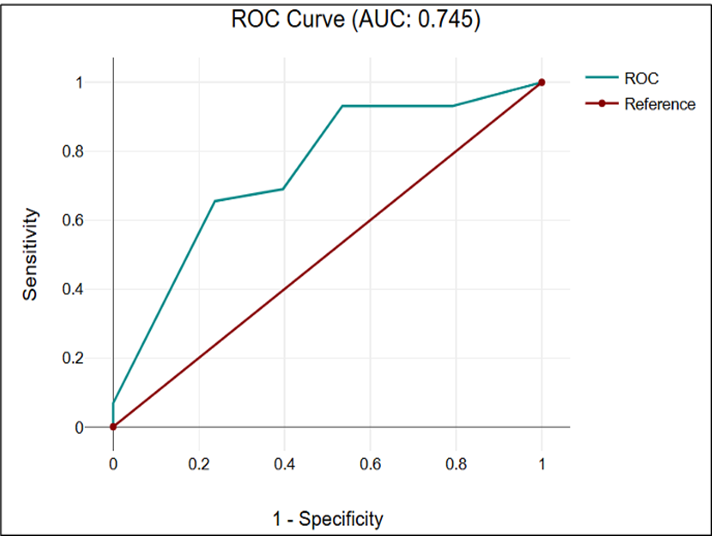
Table 6 presents the Receiver Operating Characteristic (ROC) curve analysis evaluating the ability of metformin dose to predict vitamin B12 deficiency. The area under the curve (AUC) was 0.72 (95% CI: 0.62–0.83, p < 0.001), indicating good diagnostic accuracy. The optimal cut-off value of metformin dose for predicting vitamin B12 deficiency was identified as 650 mg/day. At this threshold, the sensitivity was 92.6%, suggesting that the majority of patients with vitamin B12 deficiency can be correctly identified, while the specificity was 79.6%, indicating a good ability to correctly classify those without deficiency. Overall, these findings suggest that metformin dose is a reliable predictor of vitamin B12 deficiency and may be useful as a screening parameter in clinical practice.
Table 6: ROC Curve Analysis for Metformin Dose in Predicting Vitamin B12 Deficiency
|
Parameter |
Value |
|
Area Under Curve (AUC) |
0.72 |
|
95% Confidence Interval |
0.62 – 0.83 |
|
p-value |
<0.001* |
|
Optimal Cut-off (mg/day) |
650 mg/day |
|
Sensitivity (%) |
92.60% |
|
Specificity (%) |
79.60% |
|
Diagnostic Accuracy |
Good |
DISCUSSION:
The present study evaluated the prevalence of vitamin B12 deficiency and its association with metformin therapy among patients with type 2 diabetes mellitus (T2DM). The study demonstrated a prevalence of vitamin B12 deficiency of 22.3%, indicating that nearly one-fourth of patients on metformin were affected. A significant association was observed between vitamin B12 deficiency and both duration of diabetes (p = 0.001) and metformin dose (p = 0.001). Additionally, a strong negative correlation was found between serum vitamin B12 levels and duration of metformin therapy (r = –0.90, p < 0.001), suggesting a progressive decline in vitamin B12 levels with prolonged exposure. However, sociodemographic factors such as age, sex, dietary pattern, and socioeconomic status did not show a significant association, indicating that treatment-related factors play a more dominant role.
The prevalence observed in this study is consistent with global estimates ranging from 10–30% among metformin-treated patients. [9, 10] Indian studies have reported higher prevalence rates, ranging from 32% to 47%, likely due to dietary factors such as vegetarianism and lower baseline vitamin B12 levels. [18, 19] Our findings are comparable to those reported by Kim et al., who observed a prevalence of 22.2% [20], while studies by Gupta et al. and Satapathy et al. reported higher prevalence rates in Indian populations. [18, 19] The significant association of vitamin B12 deficiency with higher metformin dose and longer duration of therapy observed in this study is in agreement with previous studies by de Jager et al. and Aroda et al., which demonstrated that prolonged metformin use is a key risk factor for deficiency. [9, 16] Similarly, Liu et al. reported a dose-dependent relationship between metformin and vitamin B12 deficiency. [15]
The underlying mechanism of metformin-induced vitamin B12 deficiency is believed to involve interference with the absorption of the vitamin B12–intrinsic factor complex in the terminal ileum. This process is calcium-dependent, and metformin is thought to alter calcium-mediated membrane action, thereby reducing uptake of the complex. [12] This results in decreased absorption and gradual depletion of body stores over time. Elevated homocysteine levels and methylmalonic acid accumulation further reflect functional deficiency.[14] These mechanisms explain the strong negative correlation observed between vitamin B12 levels and duration of metformin therapy in the present study.
From a clinical perspective, these findings highlight the importance of routine screening for vitamin B12 deficiency in patients on long-term metformin therapy, especially those receiving higher doses or with longer disease duration. Early detection is crucial, as deficiency may lead to neuropathy, anemia, and neuropsychiatric manifestations, which can mimic diabetic complications and delay appropriate management. [13] The study has certain limitations, including its cross-sectional design, which limits causal inference, and the use of serum vitamin B12 levels alone without functional biomarkers such as methylmalonic acid. Additionally, being a single-center study, the findings may have limited generalizability. Despite these limitations, the study provides important insights into the burden and determinants of vitamin B12 deficiency in metformin-treated T2DM patients.
CONCLUSION:
Vitamin B12 deficiency is a common finding among patients with type 2 diabetes mellitus receiving metformin therapy. The present study demonstrates a significant association of deficiency with higher metformin doses and longer duration of therapy, along with a strong inverse relationship between vitamin B12 levels and duration of use. These findings highlight the need for routine screening and timely supplementation in long-term metformin users to prevent hematological and neurological complications and improve overall patient outcomes.
REFERENCES:
1. International Diabetes Federation. IDF Diabetes Atlas, 10th ed. Brussels: IDF, 2021.
2. Sun H, Saeedi P, Karuranga S, et al. IDF Diabetes Atlas: global estimates. Diabetes Res Clin Pract 2022; 183: 109119.
3. Anjana RM, Deepa M, Pradeepa R, et al. Prevalence of diabetes in India. Lancet Diabetes Endocrinol 2017; 5: 585–596.
4. Fowler MJ. Microvascular and macrovascular complications of diabetes. Clin Diabetes 2008; 26: 77–82.
5. Emerging Risk Factors Collaboration. Diabetes and cardiovascular disease. Lancet 2010; 375: 2215–2222.
6. American Diabetes Association. Standards of Medical Care in Diabetes. Diabetes Care 2023; 46: S1–S291.
7. UK Prospective Diabetes Study Group. Effect of intensive glucose control. Lancet 1998; 352: 837–853.
8. Bailey CJ, Turner RC. Metformin. N Engl J Med 1996; 334: 574–579.
9. de Jager J, Kooy A, Lehert P, et al. Long-term treatment with metformin and vitamin B12 deficiency. BMJ 2010; 340: c2181.
10. Reinstatler L, Qi YP, Williamson RS, et al. Association of metformin use with B12 deficiency. Diabetes Care 2012; 35: 327–333.
11. Pflipsen MC, Oh RC, Saguil A, et al. Vitamin B12 deficiency in metformin-treated patients. J Am Board Fam Med 2009; 22: 528–534.
12. Bauman WA, Shaw S, Jayatilleke E, et al. Increased homocysteine levels with metformin. Arch Intern Med 2000; 160: 1005–1009.
13. Lindenbaum J, Healton EB, Savage DG, et al. Neuropsychiatric disorders due to B12 deficiency. N Engl J Med 1988; 318: 1720–1728.
14. Selhub J. Homocysteine metabolism. Annu Rev Nutr 1999; 19: 217–246.
15. Liu Q, Li S, Quan H, et al. Vitamin B12 status in metformin-treated patients. PLoS One 2014; 9: e100379.
16. 1Aroda VR, Edelstein SL, Goldberg RB, et al. Long-term metformin use and B12 deficiency. J Clin Endocrinol Metab 2016; 101: 1754–1761.
17. Yajnik CS, others. Vitamin B12 deficiency in India. J Assoc Physicians India 2004; 52: 673–676.
18. Yousef Khan F, Yousif AB, Suliman A, et al. Association of vitamin B12 deficiency with metformin use in patients with type 2 diabetes treated in the largest tertiary care hospital in Qatar. Qatar Med J 2021; 2021: 39.
19. Ahmed MA, Muntingh G, Rheeder P. Vitamin B12 deficiency in metformin-treated type-2 diabetes patients, prevalence and association with peripheral neuropathy. BMC Pharmacol Toxicol 2016; 17: 44.
20. Kim J, Ahn CW, Fang S, et al. Association between metformin dose and vitamin B12 deficiency in patients with type 2 diabetes. Medicine (Baltimore) 2019; 98: e17918.