RANDOMISED COMPARATIVE STUDY OF DEXMEDETOMIDINE VERSUS TRAMADOL FOR POST SPINAL ANESTHESIA SHIVERING.
- Sandeep Killedar , Assistant Professor, Department of Anaesthesia and Critical Care, Shridevi Institute of Medical Sciences and Research Hospital, Tumkur, Karnataka, India.
- Senthil Kumar Ayyaswamy , Senior Resident, Department of Anaesthesia and Critical Care, Kovai Medical Center and Hospital, Coimbatore, India.
- Varun Singatagere H E , Assistant Professor, Department of Anaesthesia and Critical Care, CDSIMER, Harohalli, Bangalore, Karnataka, India.
- Ramesh Kumar N , Professor, Department of Anaesthesia and Critical Care, Shridevi Institute of Medical Science and Research Hospital, Tumkur, Karnataka, India.
Article Information:
Abstract:
Background: Post-spinal anesthesia shivering (PSAS) is a common complication that causes patient discomfort, increases oxygen consumption, and leads to hemodynamic instability. MATERIALS AND METHODS: This was a hospital based prospective randomised double blind comparative study was conducted including 100 patients undergoing elective surgeries under spinal anesthesia. Patients were randomly allocated into two groups: Group D (Dexmedetomidine 0.5 mcg/kg IV) and Group T (Tramadol 1 mg/kg IV) at the onset of shivering. Primary outcome: Shivering grade reduction at 5, 10, and 30 minutes. Secondary outcomes: Sedation, hemodynamic parameters (HR, SBP, DBP), respiratory rate (RR), and incidence of nausea and vomiting at Operation theatre complex of Rangadore Memorial Hospital, Bangalore. RESULTS: Both dexmedetomidine and tramadol effectively reduced PSAS, with no significant difference at 5 minutes (p = 0.146) and 10 minutes (p = 0.126). However, dexmedetomidine caused higher sedation (p = 0.0005) and a greater reduction in HR at 15 minutes (p = 0.012) and 20 minutes (p = 0.015), while SBP and DBP remained stable in both groups. Tramadol was associated with a higher incidence of nausea and vomiting (p = 0.003). CONCLUSION: Both drugs are effective for PSAS, but dexmedetomidine provides faster relief with increased sedation, while tramadol has a higher risk of nausea and vomiting. Drug selection should be individualized based on hemodynamic stability, sedation needs, and tolerance for side effects
Keywords:
Article :
INTRODUCTION:
Perioperative hypothermia, which is characterised by a core body temperature below 36°C, is a frequent issue during and after surgeries. One of the most common consequences of this is post-anesthesia shivering, which affects 40-60% of patients undergoing spinal anesthesia1. Shivering not only causes discomfort to the patient it has significant physiological consequences. The muscle activity involved in shivering can increase oxygen consumption by as much as 400%, which can result in hypoxemia and hypercapnia2. For patients who are older or have cardiovascular or respiratory conditions, these physiological changes can lead to severe complications like myocardial ischemia, arrhythmias, or respiratory failure3. In addition to these effects, shivering also raises metabolic demands, which can aggravate conditions such as lactic acidosis and lead to coagulopathies due to increased fibrinolytic activity and platelet dysfunction. This can cause excessive bleeding during and after surgery4. Moreover, the increased metabolic strain can hinder wound healing and lead to prolonged hospital stays, further raising healthcare costs. Thus, it is crucial to prevent and treat postanesthesia shivering effectively to improve patient outcomes and reduce the risk of perioperative complications.
Spinal anesthesia interferes with thermoregulation by causing vasodilation, which leads to the redistribution of body heat from the core to the extremities, resulting in a decrease in core temperature. Spinal anesthesia interrupts the transmission of thermal signals from the lower body to the brain’s hypothalamus, which is responsible for regulating body temperature. As a result, the body’s ability to detect and appropriately respond to a drop in temperature is impaired, triggering shivering as a compensatory response3.
However, shivering under spinal anesthesia is not only caused by hypothermia. It may also be influenced by other factors such as the activation of the sympathetic nervous system, pain, or systemic inflammation3. Because shivering can arise from multiple causes, an effective treatment strategy must integrate both non-pharmacological and pharmacological approaches.
Shivering management can be divided into two categories: non-pharmacological interventions and pharmacological treatments.
1. Non-Pharmacological Interventions:
• Forced Air Warming Systems: Devices like the Bair Hugger actively warm the patient’s body surface, reducing heat loss and helping prevent hypothermia3.
• Warm Intravenous Fluids: Infusing IV fluids at 37°C helps preserve core body temperature since cold fluids may exacerbate hypothermia5.
• Increasing Room Temperature: Raising the operating room temperature can minimise heat loss to the environment, further protecting against temperature drops6.
• Warm Blankets: Wrapping patients in pre-warmed blankets helps maintain peripheral warmth and prevents the redistribution of core heat6.
Although non-pharmacological measures are effective for preventing shivering, they may not be sufficient once shivering has already occurred, necessitating the use of pharmacological agents.
2. Pharmacological Treatments:
A variety of drugs have been investigated for their ability to prevent or treat shivering, acting through different mechanisms that affect thermoregulation:
• Opioids: Tramadol, a commonly used opioid, reduces the shivering threshold by acting on μ-opioid receptors and inhibiting the re uptake of serotonin and norepinephrine. However, it is associated with common side effects like nausea, vomiting, and dizziness7.
• Alpha-2 Adrenergic Agonists: Dexmedetomidine, an α2-adrenergic agonist, is gaining popularity for its dual function as both a sedative and an anti-shivering agent. It reduces the shivering threshold centrally and modulates the sympathetic nervous system. The side effects are generally mild, including hypotension and bradycardia7.
• Magnesium Sulfate: This NMDA receptor antagonist works by reducing neuromuscular transmission and modifying the central mechanisms involved in thermoregulation, thus controlling shivering8.
• 5-HT3 Antagonists: Drugs like ondansetron have been studied for their potential to control shivering by modulating serotonergic pathways that affect thermoregulation9.
• NMDA Receptor Antagonists: Ketamine, for example, reduces shivering by blocking
NMDA receptors in the central nervous system, which are involved in thermoregulation10.
Post-spinal anesthesia shivering (PSAS) is a common, discomforting complication with significant physiological risks. Although various pharmacological agents have been studied for post-spinal anesthesia shivering (PSAS), inconsistencies in dosing regimens and study designs limit the ability to draw definitive conclusions. Dexmedetomidine and tramadol have been widely used, but previous studies have employed different dosages and administration protocols, leading to variability in reported outcomes. Some studies have investigated dexmedetomidine at 0.5 µg/kg, while others used 1 µg/kg, making it difficult to compare sedation and haemodynamic effects consistently. Similarly, tramadol studies differ in dosage and timing of administration, affecting the reliability of comparisons across trials.
Furthermore, while dexmedetomidine is known to reduce heart rate (HR) and blood pressure (BP), its clinical significance in spinal anesthesia settings remains unclear. On the other hand, tramadol’s association with nausea and vomiting has not been thoroughly evaluated in PSASfocused studies. Additionally, there is no clear guidance on when to choose dexmedetomidine over tramadol based on patient-specific factors such as age, cardiovascular risk, and surgical setting. Special populations, including elderly patients, obstetric cases, and those with preexisting bradycardia or hypotension, require tailored drug selection, but this has not been systematically addressed in previous research.
This study is necessary to provide a standardised, head-to-head comparison of dexmedetomidine and tramadol, offering a comprehensive evaluation of efficacy, haemodynamic stability, and side effects in the same clinical setting. Unlike previous research that primarily focused on shivering reduction, this study systematically examines heart rate, blood pressure, and sedation levels, which are critical for patient safety and recovery. Additionally, by analyzing nausea, vomiting, and sedation profiles, this study will help determine the more suitable drug for different patient groups. The findings will provide evidence-based guidance for anesthesiologists in making informed decisions, particularly for high-risk populations such as elderly patients and those with cardiovascular comorbidities. Through this research, a clearer understanding of the clinical advantages and limitations of dexmedetomidine and tramadol will be established, allowing for optimized postoperative care and better patient outcomes in PSAS management.
MATERIALS AND METHODS:
Design:
This study was a hospital based prospective randomised double blind comparative study which was conducted at Operation theatre complex of Rangadore Memorial Hospital, Bangalore. From May 2023 to December 2024 after obtaining institutional ethical committee clearance.
Participants:
100 patients, aged between 18 and 65 years of both genders planned for elective surgical procedures, belonging to American society of Anesthesiologists(ASA) physical status class 1 and 2, were included in this study after obtaining informed consent from all the patients.
Patients who refused to participate at any stage of the study, those with history of allergies to drug in the study, pregnant women, patient with abnormal thyroid function, patient with psychological disorders were excluded from the study. Patients were selected with the following inclusion and exclusion criteria. Inclusion criteria comprise, Age 18 to 65, American Society of Anesthesiologist (ASA) 1 or 2. Exclusion criteria comprise, History of allergies to tramadol and dexmedetomidine, patients with Psychological disorders, ASA grade 3 and 4, pregnant women, patients with abnormal thyroid function.
Study procedure:
Considering possible discontinuation of participation in the study/loss to follow up, total of 100 patients were assessed.
A total of 100 patients were randomly allocated into two groups, Group D and Group T, with 50 patients in each group. Simple Randomisation11 was performed using computer-generated random numbers, which were concealed in sequentially numbered, opaque, sealed envelopes. These envelopes were prepared by an anesthesiology resident who was not involved in the study. Both the patients and the investigator assessing outcomes were blinded to the group allocation, ensuring a double-blind study design.
1) GROUP D: inj. dexmedetomidine 0.5mcg/kg intravenously diluted to 10ml in normal saline slow intravenous injection.
2) GROUP T: inj. Tramadol 1 mg/kg intravenously diluted to 10 ml in normal saline slow intravenous injection.
Preanesthetic evaluation along with routine investigations were done. Patients were kept nil per oral for 6 hours as per routine. After arrival in operation theatre, the 18G IV cannula secured and preloading the patient with 500ml of ringer lactate. Before starting the procedure, standard monitors were attached and all the baseline parameters such as Heart rate, non invasive blood pressure (NIBP), oxygen saturation (SPO2), electrocardiography (ECG), and body temperature were recorded. Under all aseptic precautions, L3-L4 space identified with 26-gauge quincke needle intrathecal injection of 0.5% bupivacaine heavy 3 to 3.5 ml given intrathecaly in sitting position. Sensory and motor levels of anesthesia were noted. Ambient temperature of 21 to 23 degree Celsius were maintained in the operating room and all intravenous fluids and drugs are administered in room temperature. Grading of shivering will be done according to “Tsai and Chu Grading12” Tsai and Chu grading:
0 – no shivering
1 – pilo erection or peripheral vasoconstriction with no visible shivering
2 – visible muscular activity in only one muscle group
3 – visible muscular activity in more than one muscle group, but not generalized
4 – shivering involving whole body
After patient developed shivering, they were randomly selected to receive either of the drug as per randomisation list and resident who is giving and observing was unaware of group allocation. The drug was diluted in 10 ml syringes and infused over 10 minutes. Patients were observed and time noted from the time of giving of study drug to the disappearance of shivering. Other parameters noted were reappearance of shivering, adverse events if any, hemodynamic monitoring (the time of administration of study drug was considered to be zero and hemodynamic monitoring was done every five minutes thereafter). If shivering did not subside in 30 minutes, the study drug was considered not effective for this study and further repeat dose of either drug inj.dexmedetomine 0.2mcg/kg or inj.tramadol 0.5mcg/kg was given. Continuous variables, hemodynamic parameters, respiratory rate, adverse events were noted and compared in between two groups. Monitoring of patients was continued in the postoperative period till 4 hrs at intervals of 5 minutes, 10 minute, 30 minute, 1 hour, 2 hour, 4 hour. Nausea and vomiting was treated with injection ondansetron 4mg IV as and when required.
Sample size:
P=0.4 (average proportion of patient develop post anesthesia shivering in spinal anesthesia) d = 0.1(margin of permissible error)
1-p = 0.6
Sample size (n) = z2p(1-p)/d2
= (1.96)2*(0.4) (0.6)/ (0.1)2
= 92(100)
The sample size for this study was determined based on the reported incidence of post-spinal anesthesia shivering. According to Amsalu et al. (2022)13, the incidence of perioperative shivering ranges from 40% to 60%, to ensure a conservative and reliable estimate, a 40% incidence (p = 0.4) was selected for sample size calculation. Rounding up, the required sample size was 93 participants. To account for potential dropouts and incomplete data collection, the final sample size was increased to 100 participants. This calculation ensures adequate statistical power to detect differences in post-spinal anesthesia shivering rates, thereby strengthening the validity of the study findings.
Data analysis:
The collected data were entered in the Microsoft Excel 2016 and analysed with IBM SPSS Statistics for Windows, Version 29.0. (Armonk, NY: IBM Corp). To describe about the data descriptive statistics frequency analysis, percentage analysis was used for categorical variables and the mean & S.D were used for continuous variables. To find the significant difference between the bivariate samples in independent groups the independent sample t-test was used. To find the significance in qualitative categorical data Chi-Square test was used similarly if the expected cell frequency is less than 5 in 2×2 tables then the Fisher's Exact was used. In all the above statistical tools the probability value .05 is considered as significant level
RESULTS:
Table 1: Comparison of Nause and Vomiting between Groups by Fisher’s exact test
|
|
|
|
Groups |
|
|
|
|||
|
|
|
|
|
Total |
ꭓ 2 - value |
p-value |
|||
|
Group D |
Group T |
||||||||
|
Nause and Vomiting |
|
No |
Count |
50 |
41 |
91 |
9.89 |
0.003 ** |
|
|
% |
100.0% |
82.0% |
91.0% |
||||||
|
|
Yes |
Count |
0 |
9 |
9 |
||||
|
% |
0.0% |
18.0% |
9.0% |
||||||
|
Total |
|
Count |
50 |
50 |
100 |
||||
|
% |
100.0% |
100.0% |
100.0% |
||||||
|
|
* |
* Highly Statistical Significance at p < 0.01 level |
|
|
|||||
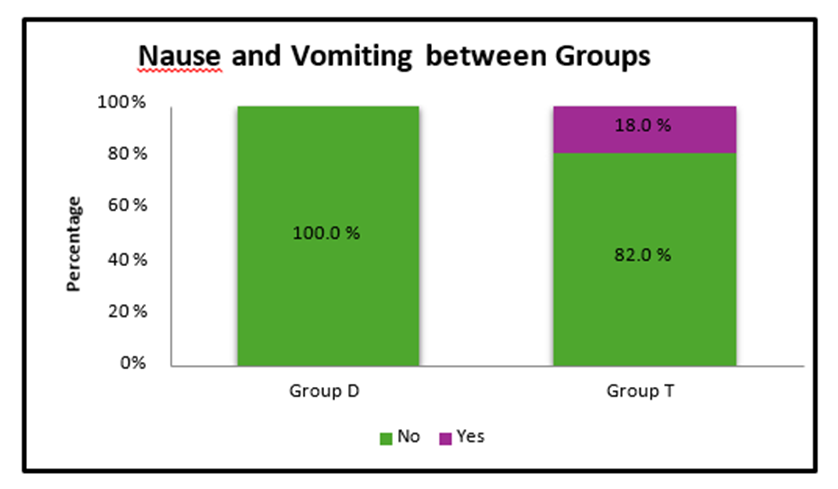
Figure 1
The above table shows comparison of Nause and Vomiting between Groups by Fisher's exact test where ꭓ²=9.89, p=0.003 < 0.01, which shows a highly statistically significant association between Nause and Vomiting and Groups.
Table 2: Comparison of Sedation between Groups by Pearson’s Chi-Square test
|
|
|
|
Groups |
|
|
|
||
|
|
|
|
|
Total |
ꭓ 2 - value |
p-value |
||
|
Group D |
Group T |
|||||||
|
Sedation |
|
No |
Count |
20 |
45 |
65 |
27.473 |
0.0005 ** |
|
% |
40.0% |
90.0% |
65.0% |
|||||
|
|
Yes |
Count |
30 |
5 |
35 |
|||
|
% |
60.0% |
10.0% |
35.0% |
|||||
|
Total |
|
Count |
50 |
50 |
100 |
|||
|
% |
100.0% |
100.0% |
100.0% |
|||||
|
|
* |
* Highly Statistical Significance at p < 0.01 level |
|
|
||||
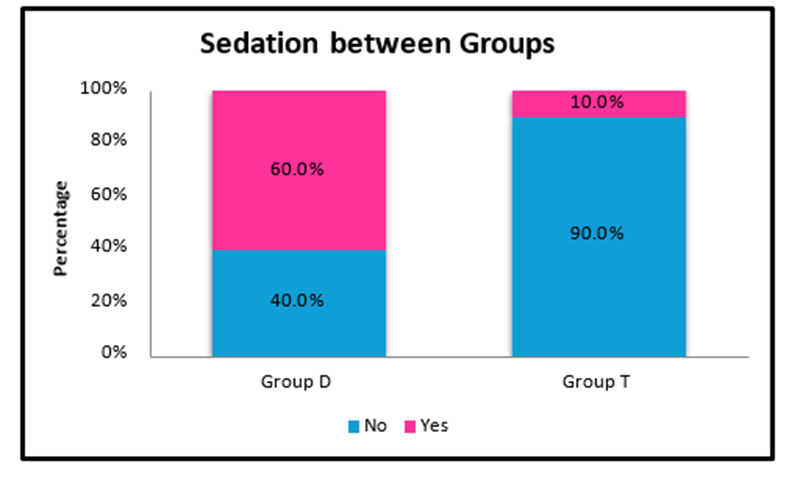
Figure 2
The above table shows comparison of Sedation between Groups by Fisher's exact test where ꭓ²=27.473, p=0.0005< 0.01, which shows a highly statistically significant association between Sedation and Groups.
Table 3: Comparison of HR between Groups by Independent sample t-test
|
HR |
Groups |
N |
Mean |
SD |
t-value |
p-value |
|
5 minutes |
Group D |
50 |
84.6 |
11.2 |
0.987 |
0.326 # |
|
Group T |
50 |
82.1 |
14.0 |
|||
|
10 minutes |
Group D |
50 |
77.1 |
11.0 |
1.532 |
0.129 # |
|
Group T |
50 |
80.9 |
13.9 |
|||
|
15 minutes |
Group D |
50 |
75.0 |
10.8 |
2.572 |
0.012 * |
|
Group T |
50 |
81.3 |
13.6 |
|||
|
20 minutes |
Group D |
50 |
75.2 |
9.3 |
2.468 |
0.015 * |
|
Group T |
50 |
80.8 |
13.0 |
|||
|
25 minutes |
Group D |
50 |
76.4 |
10.0 |
1.583 |
0.117 # |
|
Group T |
50 |
80.0 |
12.6 |
|||
|
30 minutes |
Group D |
50 |
76.6 |
10.0 |
1.461 |
0.147 # |
|
Group T |
50 |
79.8 |
12.2 |
|||
|
|
# No Significance at p > 0.05 & * Significant at p < 0.05 level |
|
||||
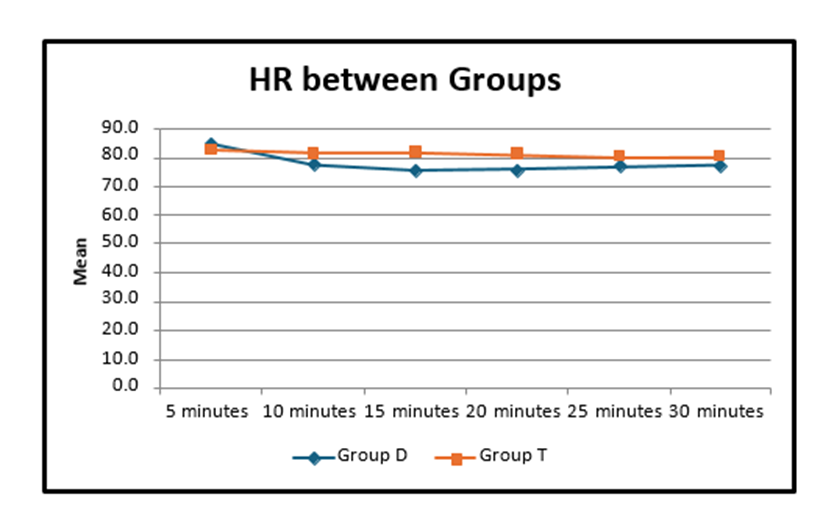
Figure3
The above table shows comparison of HR between Groups by Independent sample t-test where 5 minutes, t-value = 0.987, p = 0.326>0.05, with mean±SD of Group D is (84.56±11.20) and Group T is (82.06±13.98), which shows no statistically significant difference at p > 0.05 level, in 10 minutes, t-value = 1.532, p = 0.129>0.05, with mean±SD of Group D is (77.08±11.04) and Group T is (80.92±13.87), which shows no statistically significant difference at p > 0.05 level, in 15 minutes, t-value = 2.572, p = 0.012<0.05, with mean±SD of Group D is (74.98±10.76) and Group T is (81.28±13.58), which shows a statistically significant difference at p < 0.05 level, in 20 minutes, t-value = 2.468, p = 0.015<0.05, with mean±SD of Group D is (75.24±9.29) and Group T is (80.82±13.01), which shows a statistically significant difference at p < 0.05 level, in 25 minutes, t-value = 1.583, p = 0.117>0.05, with mean±SD of Group D is (76.44±10.02) and Group T is (80.04±12.58), which shows no statistically significant difference at p > 0.05 level, and in 30 minutes, t-value = 1.461, p = 0.147>0.05, with mean±SD of Group D is (76.58±9.96) and Group T is (79.84±12.24), which shows no statistically significant difference at p > 0.05 level.
Table 4: Comparison of DBP between Groups by Independent sample t-test
|
DBP |
Groups |
N |
Mean |
SD |
t-value |
p-value |
|
5 minutes |
Group D |
50 |
79.8 |
8.0 |
0.987 |
0.326 # |
|
Group T |
50 |
78.2 |
8.3 |
|||
|
10 minutes |
Group D |
50 |
75.2 |
7.9 |
2.094 |
0.039 * |
|
Group T |
50 |
78.4 |
7.4 |
|||
|
15 minutes |
Group D |
50 |
77.6 |
8.5 |
0.356 |
0.723 # |
|
Group T |
50 |
77.0 |
8.4 |
|||
|
20 minutes |
Group D |
50 |
77.4 |
8.0 |
0.769 |
0.444 # |
|
Group T |
50 |
78.6 |
7.6 |
|||
|
25 minutes |
Group D |
50 |
77.8 |
8.4 |
0.493 |
0.623 # |
|
Group T |
50 |
78.6 |
7.8 |
|||
|
30 minutes |
Group D |
50 |
76.8 |
8.9 |
0.949 |
0.345 # |
|
Group T |
50 |
78.4 |
7.9 |
|||
|
|
# No Significance at p > 0.05 & * Significant at p < 0.05 level |
|
||||
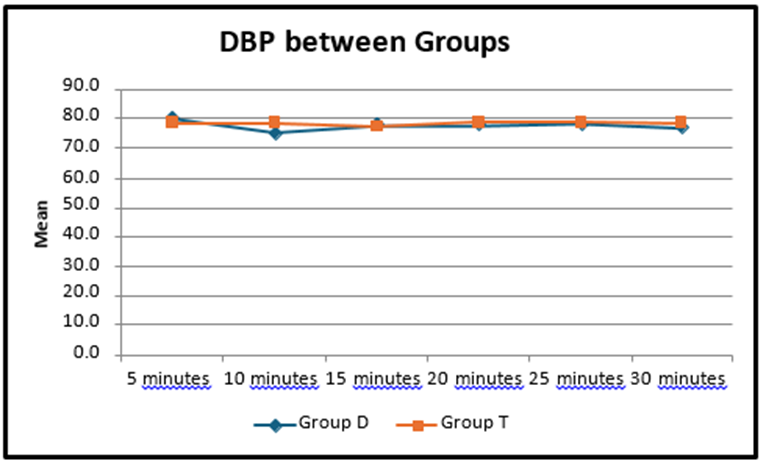
Figure4
The above table shows comparison of DBP between Groups by Independent sample t-test where 5 minutes, t-value = 0.987, p = 0.326>0.05, with mean±SD of Group D is (79.80±7.95) and Group T is (78.20±8.25), which shows no statistically significant difference at p > 0.05 level, in 10 minutes, t-value = 2.094, p = 0.039<0.05, with mean±SD of Group D is (75.20±7.89) and Group T is (78.40±7.38), which shows a statistically significant difference at p < 0.05 level, in 15 minutes, t-value = 0.356, p = 0.723>0.05, with mean±SD of Group D is (77.60±8.47) and Group T is (77.00±8.39), which shows no statistically significant difference at p > 0.05 level, in 20 minutes, t-value = 0.769, p = 0.444>0.05, with mean±SD of Group D is (77.40±8.03) and Group T is (78.60±7.56), which shows no statistically significant difference at p > 0.05 level, in 25 minutes, t-value = 0.493, p = 0.623>0.05, with mean±SD of Group D is (77.80±8.40) and Group T is (78.60±7.83), which shows no statistically significant difference at p > 0.05 level, and in 30 minutes, t-value = 0.949, p = 0.345>0.05, with mean±SD of Group D is (76.80±8.91) and Group T is (78.40±7.92), which shows no statistically significant difference at p > 0.05 level.
Table 5: Comparison of RR between Groups by Independent sample t-test
|
RR |
Groups |
N |
Mean |
SD |
t-value |
p-value |
|
5 minutes |
Group D |
50 |
19.3 |
3.0 |
0.478 |
0.634 # |
|
Group T |
50 |
19.5 |
2.9 |
|||
|
10 minutes |
Group D |
50 |
19.2 |
2.8 |
1.329 |
0.187 # |
|
Group T |
50 |
20.0 |
2.9 |
|||
|
15 minutes |
Group D |
50 |
18.9 |
2.6 |
2.962 |
0.004 ** |
|
Group T |
50 |
20.5 |
2.7 |
|||
|
20 minutes |
Group D |
50 |
18.9 |
2.4 |
1.880 |
0.063 # |
|
Group T |
50 |
19.8 |
2.2 |
|||
|
25 minutes |
Group D |
50 |
19.2 |
2.5 |
1.379 |
0.171 # |
|
Group T |
50 |
19.8 |
2.4 |
|||
|
30 minutes |
Group D |
50 |
19.2 |
2.1 |
0.989 |
0.325 # |
|
Group T |
50 |
19.6 |
2.2 |
|||
|
** Highly Significant at p < 0.01 and # No Statistical Significance at p > 0.05 level |
||||||
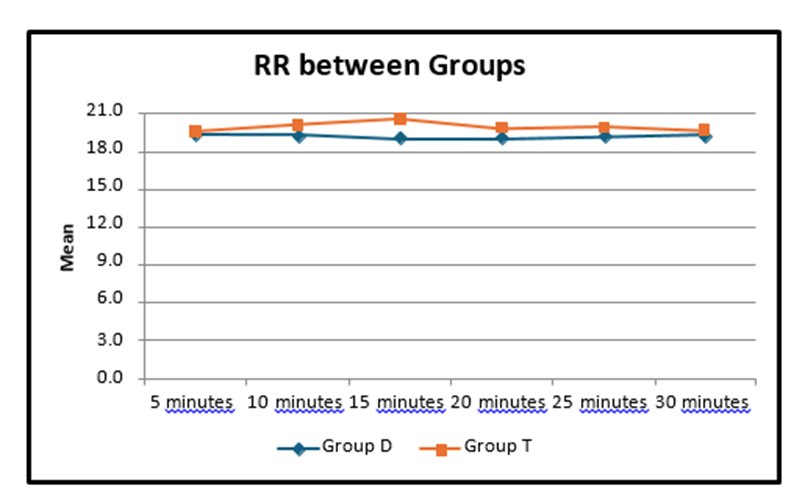
Figure5
The above table shows comparison of RR between Groups by Independent sample t-test where
5 minutes, t-value = 0.478, p = 0.634>0.05, with mean±SD of Group D is (19.26±3.00) and Group T is (19.54±2.87), which shows no statistically significant difference at p > 0.05 level, in 10 minutes, t-value = 1.329, p = 0.187>0.05, with mean±SD of Group D is (19.24±2.80) and Group T is (20.00±2.92), which shows no statistically significant difference at p > 0.05 level, in 15 minutes, t-value = 2.962, p = 0.004<0.01, with mean±SD of Group D is (18.94±2.62) and Group T is (20.52±2.71), which shows a highly statistically significant difference at p < 0.01 level, in 20 minutes, t-value = 1.88, p = 0.063>0.05, with mean±SD of Group D is (18.94±2.37) and Group T is (19.80±2.20), which shows no statistically significant difference at p > 0.05 level, in 25 minutes, t-value = 1.379, p = 0.171>0.05, with mean±SD of Group D is (19.16±2.51) and Group T is (19.84±2.42), which shows no statistically significant difference at p > 0.05 level, and in 30 minutes, t-value = 0.989, p = 0.325>0.05, with mean±SD of Group D is (19.20±2.07) and Group T is (19.62±2.17), which shows no statistically significant difference at p > 0.05 level.
DISCUSSION:
Patient Demographics and Baseline Characteristics
A well-balanced study population is crucial for minimizing bias and ensuring that any observed differences in outcomes can be attributed to the intervention rather than pre-existing variability in patient characteristics. In this study, demographic parameters, including age and gender distribution, were comparable between the dexmedetomidine (Group D) and tramadol (Group T) groups.
• Age Distribution: The mean age in both groups were statistically similar (p = 0.111), indicating that age-related variations in thermoregulation, drug metabolism, and autonomic responses did not influence the study results.
• Gender Distribution: There was no statistically significant difference in gender distribution (p = 0.529), ensuring that the inherent physiological differences in thermoregulation between males and females did not skew the results.
Previous studies have suggested that age and gender can influence shivering responses due to variations in basal metabolic rate, body surface area, and hormonal influences on thermoregulation27. However, the well-matched demographic distribution in this study eliminates such confounding factors, allowing for a more reliable comparison of the two drugs.
Effectiveness in Reducing Shivering Severity
Shivering Grade Analysis
The primary objective of this study was to compare the effectiveness of dexmedetomidine and tramadol in reducing shivering severity. Shivering was graded at various time intervals post-administration:
• At 5 minutes: No statistically significant difference was observed (p = 0.146).
• At 10 minutes: Again, no significant difference was noted (p = 0.126).
• At later time points (30 minutes, 1 hour, 2 hours, 4 hours): Statistical analysis was not applicable (p = NA), suggesting that shivering had resolved in both groups.
Mechanisms of Action in Controlling Shivering
Both drugs effectively controlled PSAS, but through different mechanisms:
• Dexmedetomidine: Dexmedetomidine is an α2 adrenoceptor agonist, with antihypertensive, sedative, analgesic, and anti-shivering properties14. The anti-shivering effects of alpha adrenoceptor agonists are mediated by binding to α2 receptors that mediate vasoconstriction and the anti-shivering effect15. In addition, it has hypothalamic thermoregulatory effects.
Additionally, it provides sedation, which may reduce the subjective perception of shivering.
• Tramadol: Tramadol is an opioid analgesic that primarily exerts its effects through muopioid receptors, with minimal interaction with kappa and delta receptors. Additionally, it influences the monoaminergic receptors in the descending spinal inhibitory pain pathway. Its anti-shivering properties are believed to be associated with either its opioid mechanism, serotonergic and noradrenergic activity, or a combination of both16.
The lack of a statistically significant difference in shivering reduction at early time points suggests that both drugs are equally effective in controlling PSAS. However, the subjective experience of the patient, particularly in terms of comfort and sedation, may favor dexmedetomidine.
Adverse Effects: Nausea, Vomiting, and Sedation
Adverse effects are an important consideration in the selection of any pharmacological intervention. In this study, significant differences were observed between the two groups in terms of nausea, vomiting, and sedation.
• Nausea and Vomiting: A significantly higher incidence of nausea and vomiting was observed in the tramadol group (p = 0.003). This is consistent with tramadol’s known tendency to stimulate the chemoreceptor trigger zone (CTZ), leading to increased nausea.
• Sedation: The dexmedetomidine group exhibited significantly higher sedation scores (p =
0.0005). This is expected given its potent sedative action mediated via α2-receptor activation.
Haemodynamic Parameters
Heart Rate (HR)
• A significant reduction in HR was observed in the dexmedetomidine group at 15 minutes (p = 0.012) and 20 minutes (p = 0.015).
• Tramadol had no significant effect on HR.
Dexmedetomidine’s ability to reduce HR is attributed to its sympatholytic effect, which decreases norepinephrine release, leading to bradycardia. This effect can be beneficial in patients with high sympathetic tone but may pose a risk in bradycardia-prone individuals.
Systolic and Diastolic Blood Pressure (SBP & DBP)
• SBP: No significant difference was observed, indicating that neither drug caused profound hypotension.
• DBP: A transient reduction in the dexmedetomidine group at 10 minutes (p = 0.039) suggests mild vasodilatory effects, though it was not clinically significant.
Respiratory Rate (RR)
• A significant difference was observed at 15 minutes (p = 0.004), with the tramadol group maintaining a higher RR.
• Neither drug caused respiratory depression, confirming their safety in this regard.
Recurrence
In this study there is no recurrence of shivering in both groups.
Comparison with Previous Studies
Several studies have investigated the effects of dexmedetomidine and tramadol in PSAS management:
• Elvan et al. (2013) 17reported superior efficacy of dexmedetomidine in shivering prevention, with better haemodynamic stability.
• Wang et al. (2020)18 conducted a meta-analysis of randomized controlled trials, concluding that dexmedetomidine is superior to tramadol in PSAS management due to its higher effective rate, earlier onset of action, and lower recurrence of shivering. However, it was associated with a higher incidence of sedation. In contrast, tramadol had a more favorable safety profile concerning sedation but was associated with higher nausea and vomiting.
Our study corroborates these findings, reinforcing the idea that dexmedetomidine is preferable in patients at risk of PONV, while tramadol may be preferred in cases requiring rapid recovery.
CONCLUSION:
Dexmedetomidine causes sedation and bradycardia which was statistically significant but has a lower risk of nausea and vomiting. Whereas Tramadol has minimal haemodynamic effects but was associated with higher nausea and vomiting which was statistically significant. The choice between these two agents should be individualised based on patient-specific factors, including the need for sedation, risk of PONV, and cardiovascular stability.
REFERENCES:
1. Esmat IM, Mohamed MM, Abdelaal WA, et al. Postspinal anesthesia shivering in lower abdominal and lower limb surgeries: a randomized controlled comparison between paracetamol and dexamethasone. BMC Anesthesiol. 2021;21:262.
2. Xu R, Hu X, Sun Z, et al. Incidence of postoperative hypothermia and shivering and risk factors in patients undergoing malignant tumor surgery: a retrospective study. BMC Anesthesiol. 2023;23:31. doi:10.1186/s12871-023-01991-8.
3. Lopez MB. Postanaesthetic shivering - from pathophysiology to prevention. Rom J Anaesth Intensive Care. 2018;25(1):73-81. doi:10.21454/rjaic.7518.251.xum. PMID: 29756066; PMCID: PMC5931188.
4. Luggya TS, Kabuye RN, Mijumbi C, Tindimwebwa JB, Kintu A. Prevalence, associated factors and treatment of post spinal shivering in a Sub-Saharan tertiary hospital: a prospective observational study. BMC Anesthesiol. 2016;16(1):100. doi:10.1186/s12871-016-0268-0. PMID: 27756210; PMCID: PMC5070127.
5. Ni TT, Zhou ZF, He B, et al. Effects of combined warmed preoperative forced-air and warmed perioperative intravenous fluids on maternal temperature during cesarean section: a prospective, randomized, controlled clinical trial. BMC Anesthesiol. 2020;20:48.
6. Simegn GD, Bayable SD, Fetene MB. Prevention and management of perioperative hypothermia in adult elective surgical patients: A systematic review. Ann Med Surg (Lond). 2021;72:103059. doi:10.1016/j.amsu.2021.103059. PMID: 34840773; PMCID: PMC8605381.
7. Mittal G, Gupta K, Katyal S, Kaushal S. Randomised double-blind comparative study of dexmedetomidine and tramadol for post-spinal anaesthesia shivering. Indian J Anaesth. 2014;58(3):257-62. doi:10.4103/0019-5049.135031. PMID: 25024466; PMCID: PMC4090989.
8. Mohamed SA, El Mekawy NM, Abdelfattah RM, et al. Magnesium sulfate intravenous infusion versus intrathecal injection for prevention of post-spinal shivering during lower limb fracture surgery: a randomized controlled study. Ain-Shams J Anesthesiol. 2021;13:27.
9. Tie HT, Su GZ, He K, et al. Efficacy and safety of ondansetron in preventing postanesthesia shivering: a meta-analysis of randomized controlled trials. BMC Anesthesiol. 2014;14:12.
10. Zhou Y, Mannan A, Han Y, et al. Efficacy and safety of prophylactic use of ketamine for prevention of postanesthetic shivering: a systematic review and meta-analysis. BMC Anesthesiol. 2019;19:245.
11. World Medical Association. Declaration of Helsinki: Ethical principles for medical research involving human subjects. Jahrbuch für Wissenschaft und Ethik. 2009;14(1):233–8. doi: 10.1515/9783110208856.233.
12. Usta B, Gozdemir M, Demircioglu RI, Muslu B, Sert H, Yaldiz A. Dexmedetomidine for the prevention of shivering during spinal anesthesia. Clinics (Sao Paulo). 2011;66(7):118791. doi:10.1590/s1807-59322011000700011. PMID: 21876972; PMCID: PMC3148462.
13. Amsalu H, Zemedkun A, Regasa T, Adamu Y. Evidence-based guideline on prevention and management of shivering after spinal anesthesia in resource-limited settings: review article. Int J Gen Med. 2022 Sep 5;15:6985-6998. doi: 10.2147/IJGM.S370439.
14. Grewal A. Dexmedetomidine: New avenues. J Anaesthesiol Clin Pharmacol. 2011;27(3):297–302. doi: 10.4103/0970-9185.83670.
15. Bajwa SJ, Bajwa SK, Kaur J, Singh G, Arora V, Gupta S, et al. Dexmedetomidine and clonidine in epidural anaesthesia: A comparative evaluation. Indian J Anaesth. 2011;55(2):116–21. doi: 10.4103/0019-5049.79883.
16. Mathews S, Al Mulla A, Varghese PK, Radim K, Mumtaz S. Postanaesthetic shivering – A new look at tramadol. Anaesthesia. 2002;57(4):394–8. doi: 10.1046/j.13652044.2002.2457.
17. Elvan EG, Oc B, Uzun S, Karabulut E, Coskun F. Dexmedetomidine and post-spinal anesthesia shivering in pregnant women: A randomized controlled study. J Clin Anesth. 2013;25(4):275-80.
18. Wang J, Wang Z, Liu J, Wang N. Intravenous dexmedetomidine versus tramadol for treatment of shivering after spinal anesthesia: a meta-analysis of randomized controlled trials. BMC Anesthesiol. 2020 May 4;20(1):104. doi: 10.1186/s12871-020-01020-y. PMID: 32366218; PMCID: PMC7199340