The Prognostic Primacy of Hypoalbuminemia within the Critical Care Milieu: A Bio-Clinical Integration.
- Abin Mathew , Assistant Professor, Department of General Medicine, Dr Moopens Medical College, Wayanad, Kerala, India.
- Tomy Philip , Professor, Department of General Medicine, Pushpagiri Institute of Medical Science & Research Centre, Thiruvalla, Kerala, India.
Article Information:
Abstract:
Background: In the demanding environment of critical care medicine, accurately identifying prognostic markers is essential for effective risk stratification and informed clinical decision-making. This study explores the clinico-pathological relevance of hypoalbuminemia as a potential predictor of mortality in patients admitted to the Medical Intensive Care Unit (MICU) of a tertiary care hospital. Albumin, the most abundant plasma protein, plays a central role in maintaining oncotic pressure and transporting a wide range of substances. In critically ill patients, particularly those with sepsis, the relationship between colloid osmotic pressure and the albumin concentration is complex, and influenced by altered permeability and increased transcapillary escape rates.[1,2] However, as a negative acute-phase reactant, its serum concentration declines rapidly during systemic inflammation, limiting its stability as a physiological marker in critical illness. Methods: Despite its broad clinical significance, serum albumin is notably absent from the Acute Physiology and Chronic Health Evaluation (APACHE II) scoring system. Addressing this gap, the present longitudinal observational study was conducted over an 18-month period and included 190 critically ill patients. The objective was to assess the relationship between serum albumin levels and patient outcomes in the MICU. Results: The findings demonstrated a clear difference in mortality between groups. Patients with hypoalbuminemia (<3.2 g/dL) experienced significantly higher mortality rates (22.1%) compared with those who had normal albumin levels (10.5%), a difference that reached statistical significance (p = 0.031). Consistent with this observation, non-survivors had substantially lower mean serum albumin levels (2.9 ± 0.6 g/dL) alongside higher APACHE II scores (19.4 ± 7.1) than survivors, reflecting more severe physiological compromise in the former group. Although multivariate logistic regression analysis showed that hypoalbuminemia was associated with a 2.17-fold increase in the odds of mortality, it did not emerge as an independent predictor once adjusted for APACHE II scores (p = 0.068). In contrast, APACHE II retained strong independent prognostic significance (p = 0.024). These results suggest that while hypoalbuminemia is closely linked to disease severity and adverse outcomes, much of its predictive value is already captured within the APACHE II framework. Conclusion: Taken together, the study highlights hypoalbuminemia as a meaningful surrogate marker of systemic inflammation, physiological vulnerability, and illness severity in critically ill patients. Although not an independent prognostic tool, its presence should prompt heightened clinical awareness and more aggressive management, reinforcing the importance of a comprehensive, multifactorial approach to risk assessment in the ICU setting, as is being investigated in head and neck cancer, thereby maximizing treatment effectiveness.
Keywords:
Article :
INTRODUCTION:
The Intersection of Critical Care Design and Prognostic Accuracy
Intensive Care Units (ICUs) represent the most resource-intensive and technologically advanced domain of modern medicine. They care for patients with extreme physiological instability, where the margin between survival and death is often razor thin. In this high-stakes setting, reliable clinical prognostication is not simply an academic exercise-it is fundamental to sound clinical governance. Accurate risk stratification guides the allocation of limited resources, shapes ethical discussions with families, and provides a framework for objectively evaluating therapeutic effectiveness.
To support this predictive process, several scoring systems have been developed, among which the Acute Physiology and Chronic Health Evaluation II (APACHE II) has become the most widely adopted global standard. APACHE II estimates disease severity by integrating patient age, baseline health status, and twelve acute physiological variables measured within the first 24 hours of ICU admission. Despite its broad acceptance and clinical utility, APACHE II is not comprehensive. One notable omission is serum albumin, a biologically versatile protein that is increasingly recognized as central to the pathophysiology of critical illness.
Albumin: A Multifunctional Biological Sentinel
In adult humans, albumin is the most abundant plasma protein with a concentration ranging from 35 to 50 gram/L.[3] Albumin has molecular weight approximately 66 kDa and half-life of albumin is 21 days but the plasma albumin can fall by 10–15 gram/L in 3 to 5 days in critically ill patients.[4] Its importance extends far beyond its quantitative dominance. Albumin is required to maintain oncotic pressure, microvascular permeability, and to prevent platelet aggregation.[5] It maintain the oncotic pressure within the vascular compartments, preventing leaking of fluids into the extravascular spaces.
Albumin plays a central role in the intravascular transport of water-soluble molecules such as hormones (thyroxine, cortisol, testosterone), cholesterol, calcium, and drugs.[6].Of particular relevance in critical illness, albumin also exhibits antioxidant, anti-inflammatory, and anticoagulant properties. Its sulfhydryl (thiol) groups scavenge reactive oxygen species, helping to mitigate oxidative stress-a key driver of systemic inflammatory response syndrome (SIRS) and sepsis-related organ dysfunction.
Pathophysiological Decline During Acute Illness
Hypoalbuminemia, defined here as a serum albumin level ≤ 3.2 g/dL, is a frequent and early finding in critically ill patients. Its causes are multifactorial. While traditionally attributed to malnutrition or impaired hepatic synthesis, current understanding recognizes albumin as a negative acute-phase reactant. Albumin production may be inhibited by pro-inflammatory mediators such as interleukin-6 (IL-6), interleukin-1 (IL-1) and tumor necrosis factor.[7]
Equally important is the effect of systemic inflammation on vascular integrity. Inflammatory mediators disrupt the endothelial glycocalyx, leading to increased capillary permeability. This “capillary leak” allows albumin to shift rapidly from the intravascular to the extravascular compartment, sharply reducing circulating levels. The decline is often compounded by hypercatabolic states and ongoing protein loss through renal or gastrointestinal pathways.
Clinical Implications and the Need for Focused Research
The clinical consequences of hypoalbuminemia are substantial. Reduced oncotic pressure promotes interstitial edema, impairing oxygen diffusion, complicating mechanical ventilation, and delaying tissue healing. Low albumin levels also alter the pharmacokinetics of highly protein-bound drugs, increasing the risk of subtherapeutic antibiotic concentrations or unintended drug toxicity.
APACHE scoring system is widely used in general intensive care units (ICU) for comparative audit, evaluative research, and clinical management of individual patients.[8].It has been found that APACHE II score accurately reflects the degree of physiological derangement and correlates with subsequent clinical course and length of ICU stay.[9] Although hypoalbuminemia has consistently been associated with poorer outcomes, whether it serves as an independent predictor of mortality-separate from established scoring systems like APACHE II-remains unresolved. This question is particularly relevant in the Indian healthcare context, where patient demographics, disease profiles, and resource constraints differ significantly from the Western populations in which most prognostic models were developed and validated.
OBJECTIVES
This longitudinal observational study, conducted at a tertiary referral center in Kerala, was designed to address these gaps. By evaluating 190 critically ill patients, the study aims to:
• Assess the prevalence and severity of hypoalbuminemia in the ICU population
• Examine its association with in-hospital mortality
• Determine whether incorporating serum albumin into the APACHE II framework enhances prognostic accuracy
By integrating biochemical markers with established clinical scoring systems, this research seeks to refine prognostic assessment and support more precise, informed, and effective management strategies for critically ill patients.
MATERIALS AND METHODS:
Experimental Methodology
Assessment of Hypoalbuminemia as a Predictor of Mortality in Critically Ill Patients
This study was designed to evaluate the prognostic significance of serum albumin levels in critically ill patients.
Study Design and Ethical Considerations
A longitudinal observational study design was employed. Ethical approval was obtained from the Institutional Ethics Committee. The study was conducted in accordance with the Declaration of Helsinki. Written informed consent was obtained from all participants or their legally authorized representatives prior to enrollment.
Study Population and Eligibility Criteria
The study included 190 consecutive adult patients admitted to the Medical Intensive Care Unit and the Department of Critical Care.
Patients aged 18 years or older, of either sex, presenting with acute critical illness requiring intensive hemodynamic or respiratory support were eligible for inclusion. To minimize confounding related to chronic protein synthesis disorders, patients with documented chronic liver disease or nephrotic syndrome were excluded. Patients or proxies who declined consent were also excluded.
Sample Size Estimation and Sampling Method
The sample size was calculated to be 190 patients (95 per group), based on a 95% confidence interval and 80% statistical power. The calculation assumed an expected mortality rate of 18.34% in the normoalbuminemic group and 36.36% in the hypoalbuminemic group. Consecutive sampling was continued until the predetermined sample size was achieved.
Data Collection and Clinical Assessment
Clinical and demographic data were collected using a standardized proforma and interviewer-administered questionnaire.
A detailed medical history and comprehensive physical examination were performed at the time of ICU admission. Serum albumin levels were measured on the day of admission using automated spectrophotometric chemistry analyzers.
Patients were stratified based on a serum albumin cut-off value of 3.2 g/dL. Values below this threshold defined the hypoalbuminemia group, while values at or above the threshold constituted the normoalbuminemic group.
Severity of Illness Assessment
Disease severity was assessed using the Acute Physiology and Chronic Health Evaluation II (APACHE II) score, calculated within the first 24 hours of ICU admission. The score incorporated 12 acute physiological variables—core temperature, mean arterial pressure, heart rate, respiratory rate, oxygenation parameters (FiO₂/PaO₂), arterial pH, serum sodium and potassium levels, serum creatinine, hematocrit, total leukocyte count, and Glasgow Coma Scale score—along with adjustments for age and the presence of severe chronic organ dysfunction or immunocompromised status.
Outcome Measures
The primary outcome was all-cause in-hospital mortality. Patients were followed throughout their hospital stay. Secondary outcomes included length of ICU stay.
Statistical Analysis
Statistical analysis was performed using SPSS version 20.0. Categorical variables were expressed as frequencies and percentages, while continuous variables were reported as mean ± standard deviation.
Comparisons between survivors and non-survivors were conducted using the Independent Samples t-test for continuous variables. Associations between categorical variables were assessed using the Pearson chi-square test. Multiple logistic regression analysis was performed to determine the independent predictive value of serum albumin and to calculate odds ratios. A p-value of less than 0.05 was considered statistically significant.
RESULTS:
Clinico-Statistical Correlation and Prognostic Stratification
The investigation into the prognostic utility of serum albumin encompassed a cohort of 190 critically ill patients. The demographic distribution was nearly equitable, comprising 93 males (48.9%) and 97 females (51.1%). The cohort exhibited a mean age of 63.14 ± 14.7 years, characterizing a predominantly geriatric population susceptible to acute physiological decompensation.
Mortality Outcomes and Albumin Correlation
· The cumulative hospital mortality rate was 16.3% (31 patients). When stratified by albumin concentrations, a stark divergence in clinical outcomes emerged.
· Hypoalbuminemia Group (<3.2 g/dL): Exhibited a significantly elevated mortality rate of 22.1% (21/95 patients).
· Normoalbuminemic Group (≥ 3.2 g/dL): Demonstrated a markedly lower mortality rate of 10.5% (10/95 patients).
· Statistical appraisal via the Pearson Chi-square test confirmed this association as significant (p = 0.031) and depicted in table 1.Quantitative synthesis further substantiated these findings: survivors maintained a mean serum albumin of 3.22 ± 0.52 g/dL, whereas non-survivors manifested a significantly lower mean of 2.94 ± 0.60 g/dL (p = 0.009), underscoring the correlation between proteic attrition and inflammatory burden.
Table 1. Association of mortality outcome with albumin level
|
Albumin |
Alive |
Expired |
χ2 |
P |
||
|
Count |
Percent |
Count |
Percent |
|||
|
Normal |
85 |
89.5 |
10 |
10.5 |
4.66* |
0.031 |
|
Hypoalbuminemia |
74 |
77.9 |
21 |
22.1 |
||
APACHE II Dynamics and Predictive Fidelity
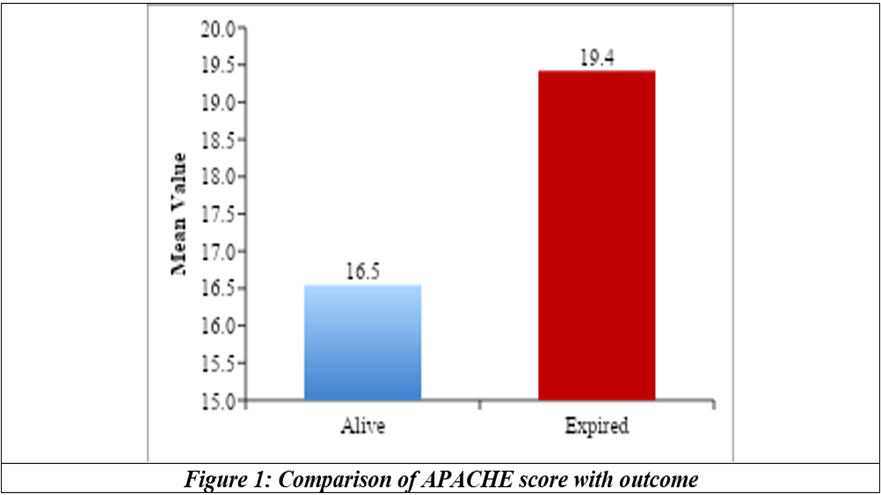
The APACHE II score demonstrated robust prognostic accuracy. The mean score for the total study population was 16.99 ± 5.6. Notably, non-survivors presented with a mean score of 19.42 ± 7.10, significantly higher than the 16.52 ± 5.25 observed in survivors (p = 0.009) and depicted in figure 1
Multivariate Logistic Regression Modeling
To ascertain whether hypoalbuminemia represents an independent driver of mortality, a multiple logistic regression model was constructed, integrating age, gender, albumin status, and APACHE II scores and depicted in table 2.
Table 2: Independent predictors of mortality (Multiple logistic regression)
|
Variable |
Odds Ratio (OR) |
95% Confidence Interval (CI) |
p-value |
|
Hypoalbuminemia |
2.17 |
0.94–4.97 |
0.068 |
|
APACHE II Score |
1.08 |
1.01–1.16 |
0.024 |
While hypoalbuminemia doubled the risk of mortality (OR 2.17), it failed to reach independent statistical significance (p > 0.05), whereas the APACHE II score remained a resilient independent predictor (p = 0.024). Multiple logistic study showed 5.2% of variation in occurrence of mortality can be explained by hypoalbuminemia (R2 = 0.052).
DISCUSSION:
The Pathophysiological Interplay of Albumin and Critical Illness
These findings support the view that albumin is better understood as a marker of physiological resilience than as a simple indicator of nutritional status. Vincent et al[10] identified low albumin as a dose dependent and independent predictor of a poor outcome in patients with acute illness. The strong association between hypoalbuminemia and mortality is consistent with global literature, but the characteristics of this Kerala-based cohort add important local context.
Non-survivors had a mean serum albumin of 2.94 g/dL, a level suggestive of significant capillary leak. In conditions such as sepsis and systemic inflammation, the endothelial glycocalyx-the microvascular barrier that regulates permeability-becomes disrupted. As this barrier breaks down, albumin shifts from the intravascular space into the interstitium, leading to third-space fluid accumulation and a functional depletion of circulating protein. This process is not merely a secondary response to illness; it actively contributes to disease progression. The resulting loss of oncotic pressure worsens microcirculatory flow, further impairing organ perfusion and function.
A central question of this study was whether serum albumin should be incorporated into the APACHE II scoring system. While hypoalbuminemia emerged as a strong predictor of mortality on univariate analysis, its independent predictive value diminished once APACHE II was included in the model. This suggests that the abnormalities captured by APACHE II-such as hypotension, hypoxemia, and renal dysfunction-represent the downstream clinical expression of the same systemic processes that also drive low albumin levels.
In this sense, hypoalbuminemia functions as a biochemical reflection of illness severity already quantified by APACHE II. That said, albumin remains clinically valuable. It is inexpensive, rapidly available, and highly responsive to acute physiological stress, making it a practical early warning marker-especially in resource-limited settings where full APACHE II scoring may be delayed or impractical.
Clinical Implications and Limitations
Our findings identify a serum albumin level below 3.2 g/dL as a meaningful threshold signaling heightened risk of clinical deterioration. While this reinforces albumin’s role as a prognostic marker, its role as a therapeutic target is less clear. Evidence from trials such as ALBIOS suggests potential benefit in selected populations, including patients with septic shock, but does not support routine albumin supplementation as a universal rescue strategy.[11]
This study has several limitations. Its single-center design and the exclusion of patients with chronic organ failure may limit generalizability. In addition, albumin was measured only at admission. Evaluating albumin kinetics over the first 72 hours could provide a more nuanced understanding of its prognostic value and deserves further investigatio.
CONCLUSION:
Hypoalbuminemia remains a meaningful marker of mortality in the Medical ICU. Although it does not serve as an independent predictor after adjustment for APACHE II, its presence reflects a high-risk phenotype associated with systemic inflammation and vascular instability. As a result, assessing albumin levels at admission offers a rapid and cost-effective means of risk stratification and supports early, anticipatory critical care management.
REFERENCES:
1. Fanali G, Masi AD, Trezza V, et al. Human serum albumin: From bench to bedside. Molecular Aspects of Medicine 2012;33(3):209-90.
2. Fleck A, Hawker F, Wallace P, et al. Increased vascular permeability: a major cause of hypoalbuminaemia in disease and injury. The Lancet 1985;325(8432):781-4.
3. Weaving G, Batstone GF, Jones RG. Age and sex variation in serum albumin concentration: an observational study. Annals of Clinical Biochemistry 2016;53(1):106-11.
4. Marik PE. The treatment of hypoalbuminemia in the critically ill patient. Heart Lung 1993;22(2):166-70.
5. Limaye K, Yang JD, Hinduja A. Role of admission serum albumin levels in patients with intracerebral hemorrhage. Acta Neurologica Belgica 2015;116(1):27-30.
6. Nazha B. Hypoalbuminemia in colorectal cancer prognosis: Nutritional marker or inflammatory surrogate? World Journal of Gastrointestinal Surgery 2015;7(12):370.
7. Cabrerizo S, Cuadras D, Gomez-Busto F, et al. Serum albumin and health in older people: Review and meta analysis. Maturitas 2015;81(1):17-27.
8. Su YY, Li X, Li SJ, et al. Predicting hospital mortality using APACHE II scores in neurocritically ill patients: a prospective study. Journal of Neurology 2009;256:1427-33.
9. Shaughnessy TE, Mickler TA. Does acute physiologic and chronic health evaluation (Apache II) scoring predict need for prolonged support after coronary revascularization? Anesth Analg 1995;81(1):24-9.
10. Vincent JL, Dubois MJ, Navickis RJ, et al. Hypoalbuminemia in acute illness: is there a rationale for intervention? Annals of Surgery 2003;237(3):319-34.
11. Caironi P, Tognoni G, Masson S, et al. Albumin replacement in patients with severe sepsis or septic shock. N Engl J Med 2014;370(15):1412-21.