Oral Tofacitinib in Paediatric Vitiligo: A Descriptive Case Series Evaluating Efficacy and Short-Term Safety.
- Vaishnavi Gour , Junior Resident, Department of Dermatology, Venereology, and Leprosy, Dr. Panjabrao Deshmukh Memorial Medical College & Hospital, Amravati.
- Hitesh Khatri , Assistant Professor, Department of Dermatology, Venereology, and Leprosy, Dr. Panjabrao Deshmukh Memorial Medical College & Hospital, Amravati.
- Sanjay N. Agrawal , Professor and Head of the department, Department of Dermatology, Venereology, and Leprosy, Dr. Panjabrao Deshmukh Memorial Medical College & Hospital, Amravati.
- Virendra V. Saoji , Professor, Department of Dermatology, Venereology, and Leprosy, Dr. Panjabrao Deshmukh Memorial Medical College & Hospital, Amravati.
Article Information:
Abstract:
Background: Vitiligo is a chronic autoimmune depigmenting disorder in which activated CD8+ T lymphocytes and interferon-gamma (IFN-γ)-mediated JAK-STAT signalling drive melanocyte destruction. Paediatric cases constitute approximately one-third of all presentations, yet therapeutic options remain limited, inconsistent, and inadequately studied in this age group. Objective: To evaluate the clinical efficacy and short-term safety of oral tofacitinib, a JAK1/3 inhibitor, in paediatric patients with treatment-resistant non-segmental vitiligo. Methods: A prospective descriptive case series of four paediatric patients (age ≤18 years) with clinically confirmed non-segmental vitiligo unresponsive to conventional therapy was conducted at a tertiary care dermatology centre. Oral tofacitinib was administered at 0.2 mg/kg/day, with dosage adjustments based on weight and tolerability. Clinical response was quantified using percentage body surface area (BSA) repigmentation and the Vitiligo Area Scoring Index (VASI) at baseline and at 4-weekly intervals up to 24 weeks. Baseline and follow-up laboratory investigations were obtained. Results: All four patients demonstrated measurable repigmentation. Two patients achieved greater than 50% repigmentation within 12–24 weeks. Facial and truncal lesions responded most favourably, while acral lesions exhibited relative resistance. The mean onset of clinically perceptible repigmentation was 6–12 weeks. No serious adverse events or clinically significant laboratory abnormalities were recorded. Conclusion: Oral tofacitinib demonstrates a favourable short-term efficacy and safety profile in treatment-resistant paediatric vitiligo, particularly for facial and non-acral lesions. These findings support the need for prospective, randomised controlled trials with larger cohorts and extended follow-up to establish long-term safety and durability of response in the paediatric population.
Keywords:
Article :
INTRODUCTION:
Vitiligo is a chronic, acquired disorder of pigmentation characterised by the selective destruction of epidermal melanocytes, resulting in well-defined depigmented macules and patches. With a global prevalence of 0.5–2%, it represents one of the most common pigmentary disorders encountered in clinical practice [1]. Critically, up to one-third of cases manifest during childhood or adolescence, and early-onset disease is frequently associated with greater psychological morbidity, more extensive involvement, and reduced quality of life compared with adult-onset vitiligo [2,3].
The immunopathogenesis of vitiligo is now well-characterised. Autoreactive cytotoxic CD8+ T lymphocytes, under the influence of IFN-γ and the downstream CXCL9/CXCL10 signalling axis, infiltrate the epidermis and orchestrate melanocyte apoptosis [4]. Central to this cascade is the Janus kinase–signal transducer and activator of transcription (JAK-STAT) pathway, which propagates IFN-γ receptor signalling intracellularly. JAK1 and JAK2 are the primary kinases implicated in IFN-γ–mediated signalling, rendering the JAK-STAT axis a mechanistically compelling therapeutic target [5].
Conventional management of paediatric vitiligo, including topical corticosteroids, topical calcineurin inhibitors, and narrowband ultraviolet B (NB-UVB) phototherapy, yields variable and often unsatisfactory outcomes, particularly in patients with widespread or treatment-resistant disease [6]. Furthermore, the safety profiles of prolonged corticosteroid use and practical limitations of phototherapy in young children restrict their long-term applicability.
Tofacitinib, an orally bioavailable selective JAK1/3 inhibitor, was first reported to induce repigmentation in vitiligo by Craiglow and King in 2015 [7]. Since then, a growing body of evidence from case reports and small case series has corroborated its efficacy, with particular benefit observed when combined with phototherapy [8,9]. However, published experience in the paediatric population remains sparse, and questions regarding dosing, safety, and optimal patient selection in children remain unanswered.
We report a descriptive case series of four paediatric patients with non-segmental vitiligo treated with oral tofacitinib at a tertiary dermatology centre in central India. The primary aim was to evaluate clinical efficacy as assessed by VASI and photographic documentation, with secondary objectives encompassing time to response and short-term safety monitoring.
MATERIALS AND METHODS:
Study Design and Setting
This was a prospective, single-centre, descriptive case series conducted in the Department of Dermatology, Venereology, and Leprosy at Dr. Panjabrao Deshmukh Memorial Medical College & Hospital, Amravati, Maharashtra, India. Ethical approval was obtained from the Institutional Ethics Committee (IEC Ref: [insert number]), and written informed consent was obtained from parents or legal guardians of all patients prior to enrolment. The study was conducted in accordance with the Declaration of Helsinki.
Patient Selection
Patients were recruited consecutively between [start date] and [end date]. Inclusion criteria comprised: (i) age below 18 years; (ii) clinical and Wood’s lamp-confirmed diagnosis of non-segmental vitiligo; and (iii) documented inadequate response to at least two prior conventional therapies (topical corticosteroids and/or NB-UVB phototherapy) for a minimum of three months. Patients were excluded if they had active or latent tuberculosis (assessed by tuberculin skin test and chest radiograph), other active infections, primary or secondary immunodeficiency, abnormal baseline laboratory parameters, or known hypersensitivity to tofacitinib.
Baseline Investigations
Prior to treatment initiation, all patients underwent the following evaluations: complete blood count (CBC) with differential; hepatic and renal function panels; fasting lipid profile; tuberculin skin test and chest radiograph; and serological screening for hepatitis B, hepatitis C, and HIV. These investigations were repeated at weeks 4, 12, and 24.
Treatment Protocol
Oral tofacitinib was initiated at a dose of 0.2 mg/kg/day, administered as a single daily dose, with dose titration permitted up to 0.4 mg/kg/day based on clinical response and tolerability, not exceeding 5 mg daily in any patient. Where feasible and tolerated, adjunctive sun exposure (20–30 minutes on affected areas, three to five times weekly) was encouraged as a phototherapy surrogate to facilitate follicular melanocyte activation.
Outcome Assessment
The primary efficacy endpoint was percentage change in VASI from baseline to week 24. VASI was calculated using the formula: VASI = Σ [hand units] × [residual depigmentation], where hand units were used to estimate body surface area involvement and residual depigmentation was graded on a 0–1 scale. Secondary endpoints included: (i) time to first clinically perceptible repigmentation; (ii) distribution of response by anatomical site; and (iii) incidence and nature of adverse events. Standardised clinical photographs were obtained at baseline and at 4-weekly intervals under identical lighting conditions.
RESULTS:
Patient Characteristics
Four patients (three female, one male) with a mean age of 7.75 years (range 2–14 years) and a mean disease duration of 2.5 years (range 1–5 years) were enrolled. All had previously received topical corticosteroids and at least one additional conventional therapy without satisfactory repigmentation. Baseline VASI scores are summarised below.
Individual Case Summaries
Case 1: A 7-year-old girl presented with a 12-month history of non-segmental vitiligo primarily involving the face, neck, and upper trunk. Baseline VASI was 3.4. Following initiation of oral tofacitinib at 0.2 mg/kg/day, initial perifollicular repigmentation was observed at week 8 over facial lesions. At week 16, approximately 75–80% repigmentation was achieved, with a final VASI of 0.7, representing an 80% reduction. Response was classified as excellent.
Case 2: A 2-year-old girl presented with generalised non-segmental vitiligo involving the face, trunk, and extremities. Baseline VASI was 5.1. Given the patient’s age, tofacitinib was initiated at the lower end of the dosing range (0.18 mg/kg/day). At week 24, approximately 50% repigmentation was documented (final VASI 2.6), with preferential response at facial and truncal sites. Response was classified as moderate.
Case 3: An 8-year-old girl presented with non-segmental vitiligo with predominant acral involvement (dorsa of hands and feet, fingertips) and minimal facial lesions. Baseline VASI was 2.8. At week 24, approximately 30% repigmentation was observed (final VASI 1.9), limited almost exclusively to the small facial component. Acral lesions demonstrated minimal response, consistent with the known paucity of follicular melanocyte reservoirs at these sites. Response was classified as partial.
Case 4: A 14-year-old boy presented with mixed-distribution non-segmental vitiligo affecting the face, trunk, and dorsal hands. Baseline VASI was 4.2. Tofacitinib was uptitrated to 0.35 mg/kg/day at week 8 in view of suboptimal initial response. By week 20, approximately 60% repigmentation was achieved (final VASI 1.7), with significant improvement at facial and truncal sites and partial improvement over acral lesions. Response was classified as good.
Summary of Efficacy
All four patients demonstrated clinically meaningful repigmentation. Two patients (Cases 1 and 4) achieved greater than 50% VASI reduction. Facial and truncal lesions consistently responded most favourably across all cases. Acral sites were comparatively resistant. The mean onset of perceptible repigmentation was 6–12 weeks. No patient required treatment discontinuation due to lack of efficacy or adverse events during the observation period.
Adverse Effects
One patient (Case 4) reported mild, self-limiting upper respiratory symptoms during week 6, which resolved without intervention. No haematological, hepatic, renal, or lipid abnormalities were detected on serial monitoring. No serious adverse events, opportunistic infections, or thrombotic events were recorded in any patient throughout the observation period.
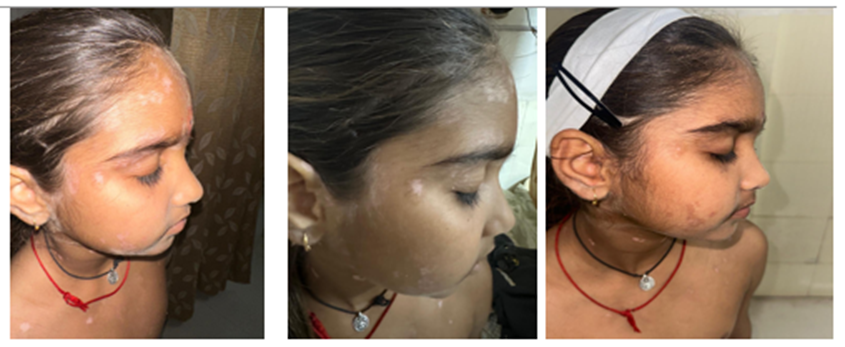
After 6 weeks of treatment. After 12 weeks of treatment.
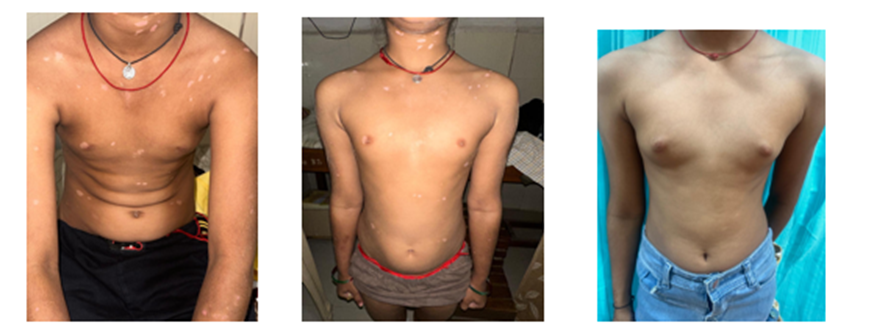
After 6 weeks of treatment. After 12 weeks of treatment.
DISCUSSION:
This case series provides preliminary evidence that oral tofacitinib is an effective and well-tolerated therapeutic option for treatment-resistant non-segmental vitiligo in paediatric patients. Our findings are consistent with the mechanistic rationale for JAK inhibition in vitiligo and corroborate the efficacy signals observed in adult cohorts and the limited available paediatric data.
The therapeutic rationale for tofacitinib in vitiligo derives from its inhibition of JAK1 and JAK3, kinases that are indispensable for IFN-γ receptor and interleukin-mediated STAT1 phosphorylation. By disrupting this pathway, tofacitinib attenuates the IFN-γ/CXCL10 axis, thereby reducing the chemotactic recruitment and activation of autoreactive CD8+ T cells at the dermo-epidermal junction [5,10]. Restoration of the tolerogenic microenvironment permits survival of residual melanocyte precursors within the outer root sheath of hair follicles, which subsequently migrate to repopulate the epidermis, producing the characteristically perifollicular repigmentation observed clinically [11]. The anatomical gradient of response observed in our series—facial and truncal sites responding preferentially over acral lesions—is a well-documented phenomenon in vitiligo treatment studies and reflects differential follicular density across body regions. Acral skin, with its sparse follicular reservoir, has a limited supply of melanocyte stem cells available for repopulation, rendering these sites inherently resistant regardless of the therapeutic modality employed [12]. This finding should be incorporated into patient and family counselling prior to treatment initiation.
The inclusion of a 2-year-old patient in this series is noteworthy, as published data on JAK inhibitor use in children below 5 years are virtually absent. Although the short observation period precludes definitive safety conclusions, the absence of adverse events and laboratory abnormalities in this case is reassuring. The long-term safety profile of tofacitinib in young children, including effects on immune maturation and growth, warrants careful prospective evaluation. Regarding broader safety, tofacitinib is associated with class effects in adult and paediatric rheumatological populations, including increased susceptibility to infections (particularly herpes zoster and upper respiratory infections), dyslipidaemia, and—at higher doses in older patients with cardiovascular risk factors—a small increase in thromboembolic risk [13]. The doses employed in our series (0.2–0.4 mg/kg/day) are substantially below those used in juvenile idiopathic arthritis (5–10 mg twice daily in adolescents), and none of the classical adverse events were observed. Nevertheless, baseline tuberculosis screening and interval laboratory monitoring are mandatory, particularly given the high prevalence of latent tuberculosis in the Indian subcontinent.
The integration of adjunctive light stimulation in our protocol merits mention. NB-UVB phototherapy and sunlight exposure potentiate JAK inhibitor efficacy in vitiligo through direct stimulation of surviving melanocytes and upregulation of stem cell factor, which enhances melanocyte precursor migration [14]. Where phototherapy infrastructure is available, combination therapy represents the preferred treatment strategy. The limitations of this study are acknowledged. The small sample size and absence of a comparator group preclude formal statistical analysis or causal inference. The heterogeneous patient characteristics (age range 2–14 years; variable disease duration and extent) limit the generalisability of pooled findings. Follow-up was restricted to a maximum of 24 weeks, insufficient to characterise long-term response durability or late adverse effects. Tofacitinib is not currently approved for vitiligo in any paediatric age group, and its use in this series was undertaken as an off-label intervention after comprehensive discussion of risks and benefits with families.
Despite these limitations, our series adds to the nascent paediatric evidence base and provides a foundation for prospective controlled studies. Phase 2 and 3 trials employing ruxolitinib cream (a topical JAK1/2 inhibitor) have demonstrated efficacy in adults [15], and oral JAK inhibitors are being evaluated in multicentre trials. Extrapolating these data to children requires dedicated paediatric pharmacokinetic and safety studies.
CONCLUSION:
Oral tofacitinib at weight-adjusted doses demonstrates meaningful clinical efficacy and an acceptable short-term safety profile in paediatric patients with treatment-resistant non-segmental vitiligo. Facial and truncal lesions are most responsive, while acral sites remain refractory, consistent with the follicular melanocyte reservoir hypothesis. These findings justify the conduct of adequately powered, randomised, placebo-controlled trials with standardised dosing protocols, extended follow-up, and paediatric pharmacokinetic data to definitively establish the role of JAK inhibition in the management of vitiligo in children and adolescents.
DECLARATIONS
Ethical Approval
This study was approved by the Institutional Ethics Committee of Dr. Panjabrao Deshmukh Memorial Medical College & Hospital, Amravati. All procedures were conducted in accordance with the 1964 Declaration of Helsinki and its subsequent amendments.
REFERENCES:
1. Alikhan A, Felsten LM, Daly M, Petronic-Rosic V. Vitiligo: a comprehensive overview. Part I. Introduction, epidemiology, quality of life, diagnosis, differential diagnosis, associations, histopathology, etiology, and work-up. J Am Acad Dermatol. 2011;65(3):473–491.
2. Silverberg NB. Vitiligo in children: presentation and management. Pediatric Dermatol. 2023;40(5):788–794.
3. Linthorst Homan MW, Spuls PI, de Korte J, Bos JD, Sprangers MA, van der Veen JP. The burden of vitiligo: patient characteristics associated with quality of life. J Am Acad Dermatol. 2009;61(3):411–420.
4. Harris JE, Harris TH, Weninger W, Wherry EJ, Hunter CA, Turka LA. A mouse model of vitiligo with focused epidermal depigmentation requires IFN-γ for autoreactive CD8+ T-cell accumulation in the skin. J Invest Dermatol. 2012;132(7):1869–1876.
5. Craiglow BG, King BA. Tofacitinib citrate for the treatment of vitiligo: a pathogenesis-directed therapy. JAMA Dermatol. 2015;151(10):1110–1112.
6. Boniface K, Seneschal J. Current and emerging treatments for vitiligo. Clin Exp Dermatol. 2023;48(4):317–326.
7. Craiglow BG, King BA. Op. cit. [7].
8. Liu LY, Strassner JP, Refat MA, Harris JE, King BA. Repigmentation in vitiligo using the JAK inhibitor tofacitinib may require concomitant light exposure. J Am Acad Dermatol. 2017;77(4):675–682.e1.
9. Rosmarin D, Passeron T, Pandya AG, et al. Two phase 3, randomized, controlled trials of ruxolitinib cream for vitiligo. N Engl J Med. 2022;387(16):1445–1455.
10. Strassner JP, Rashighi M, Ahmed Refat M, Richmond JM, Harris JE. Suction blistering the lesional skin of vitiligo patients reveals useful biomarkers of disease activity. J Am Acad Dermatol. 2017;76(5):847–855.e5.
11. Falabella R. Surgical therapies for vitiligo. Clin Dermatol. 1997;15(6):927–939.
12. Ganesan AK, Ho H, Bodemann B, et al. Genome-wide siRNA-based functional genomics of pigmentation identifies novel genes and pathways that impact melanogenesis in human cells. PLoS Genet. 2008;4(12):e1000298.
13. Ytterberg SR, Bhatt DL, Mikuls TR, et al. Cardiovascular and cancer risk with tofacitinib in rheumatoid arthritis. N Engl J Med. 2022;386(4):316–326.
14. Lim HW, Collins SAB, Resneck JS Jr, et al. The burden of skin disease in the United States. J Am Acad Dermatol. 2017;76(5):958–972.e2.
15. Rosmarin D, et al. Op. cit. [9].