Association of Serum 25-Hydroxyvitamin D, Total Calcium, and Ionized Calcium Levels with Essential Hypertension: A Cross-Sectional Analytical Study.
- Roy A K , Junior Resident, Department of Biochemistry, Career Institute of Medical Sciences and Hospital, Lucknow, Uttar Pradesh, India.
- Tiwari D , Associate Professor, Department of Biochemistry, Career Institute of Medical Sciences and Hospital, Lucknow, Uttar Pradesh, India.
- Mishra P , Assistant Professor, Department of Biochemistry, Career Institute of Medical Sciences and Hospital, Lucknow, Uttar Pradesh, India.
- Kumar N , Professor & Head Department of Biochemistry, Career Institute of Medical Sciences and Hospital, Lucknow, Uttar Pradesh, India.
Article Information:
Abstract:
Background: Essential hypertension is a major public health concern and a leading contributor to cardiovascular morbidity and mortality worldwide. Emerging evidence suggests that micronutrient imbalance, particularly involving vitamin D and calcium metabolism, may contribute to the pathogenesis of hypertension. Objective: To evaluate the association of serum 25-hydroxyvitamin D [25(OH)D], total calcium, and ionized calcium levels with essential hypertension and compare these parameters between hypertensive patients and normotensive controls. Methods: This hospital-based cross-sectional analytical study included 486 participants comprising 243 patients with essential hypertension and 243 age-matched normotensive controls. Serum 25(OH)D levels were estimated using the Chemiluminescent Immunoassay (CLIA) method, total calcium by the Arsenazo III method, and ionized calcium using an ion-selective electrode analyzer. Statistical analysis was performed using Student’s t-test, Chi-square test, and multivariate logistic regression analysis. A p-value of less than 0.05 was considered statistically significant. Results: Hypertensive participants demonstrated significantly lower serum vitamin D levels compared to controls (18.9 ± 7.2 ng/mL vs. 27.4 ± 8.3 ng/mL, p < 0.001). Vitamin D deficiency was significantly more prevalent among hypertensive individuals (74.1%) than controls (39.9%) (p < 0.001). Obesity was more common among hypertensives (63.0% vs. 37.4%, p < 0.001), and reduced daily sun exposure (<30 minutes/day) was also significantly higher among hypertensive subjects (64.6% vs. 47.5%, p = 0.002). Ionized calcium levels showed a significant decline with increasing severity of hypertension, with lower levels observed in Stage II hypertension compared to Stage I hypertension (1.02 ± 0.10 mmol/L vs. 1.10 ± 0.09 mmol/L, p < 0.001). Conclusion: Vitamin D deficiency and altered calcium homeostasis were significantly associated with essential hypertension in the present study. Assessment of vitamin D and calcium status may provide additional value in cardiovascular risk evaluation. Further prospective and interventional studies are required to establish causality.
Keywords:
Article :
INTRODUCTION:
Hypertension is a major global health problem and a leading cause of cardiovascular morbidity and mortality, affecting more than 1.28 billion adults worldwide. Essential hypertension accounts for nearly 90–95% of all hypertension cases and results from a complex interaction of genetic, environmental, metabolic, and lifestyle-related factors. [1–3]
Recent evidence suggests that vitamin D and calcium metabolism play important roles in blood pressure regulation. Vitamin D influences cardiovascular function through suppression of the renin–angiotensin–aldosterone system (RAAS), modulation of endothelial function, and regulation of vascular inflammation. Vitamin D deficiency has been associated with increased RAAS activity, endothelial dysfunction, arterial stiffness, and increased vascular resistance, thereby contributing to hypertension. [4,5]
Calcium is essential for myocardial contractility, vascular tone, and intracellular signaling. Alterations in calcium homeostasis, particularly reduced ionized calcium levels, may promote vasoconstriction and elevated blood pressure through increased parathyroid hormone activity and enhanced vascular smooth muscle contraction.[6]
Although several studies have demonstrated an inverse association between vitamin D levels and blood pressure, findings remain inconsistent across different populations. Furthermore, most studies have evaluated vitamin D and calcium independently, while limited data are available regarding the combined assessment of serum 25(OH)D, total calcium, and ionized calcium, particularly in the Indian population.[7]
Ionized calcium represents the biologically active fraction of serum calcium and may provide more accurate insight into calcium-related vascular changes than total calcium alone. However, its role in essential hypertension remains inadequately explored. Therefore, the present study aimed to evaluate serum 25-hydroxyvitamin D [25(OH)D], total calcium, and ionized calcium levels in patients with essential hypertension and compare them with normotensive controls.
MATERIALS AND METHODS:
This hospital-based cross-sectional analytical study was conducted among 486 participants, including 243 patients with previously diagnosed essential hypertension and 243 age-matched normotensive controls.
Inclusion Criteria
• Adults aged more than 18 years
• Previously diagnosed cases of essential hypertension
• Age-matched normotensive individuals for the control group
Exclusion Criteria
Participants with secondary hypertension, chronic kidney disease, chronic liver disease, endocrine disorders, pregnancy, or those receiving vitamin D or calcium supplementation were excluded from the study.
Blood Pressure Measurement
Blood pressure was measured using a standardized protocol after adequate rest in the sitting position. Hypertension was defined according to standard clinical guidelines as systolic blood pressure ≥140 mmHg and/or diastolic blood pressure ≥90 mmHg or current use of antihypertensive medications.
Biochemical Analysis
Venous blood samples were collected under aseptic conditions. Serum 25(OH)D levels were estimated using the Chemiluminescent Immunoassay (CLIA) method. Total serum calcium was measured using the Arsenazo III method, while ionized calcium was measured using an ion-selective electrode analyzer.
Vitamin D status was categorized as follows:
• Deficient: <20 ng/mL
• Insufficient: 20–29 ng/mL
• Sufficient: ≥30 ng/mL
Statistical Analysis
Data were analyzed using SPSS version 29. Continuous variables were expressed as mean ± standard deviation, while categorical variables were presented as frequency and percentage. Student’s t-test was used for comparison of continuous variables, and the Chi-square test was used for categorical variables. Multivariate logistic regression analysis was performed to identify independent predictors of hypertension. A p-value of less than 0.05 was considered statistically significant.
Ethical Considerations
The study protocol was approved by the Institutional Ethics Committee, and written informed consent was obtained from all participants prior to enrolment.
RESULTS:
Age Distribution of Participants
Both groups were appropriately age-matched to minimize the confounding effect of age on hypertension and related metabolic abnormalities.
Table 1. Age Distribution of Participants
|
Age Group (years) |
Hypertensives (n=243) |
Controls (n=243) |
Total (n=486) |
|
<30 |
12 (4.9%) |
15 (6.2%) |
27 (5.6%) |
|
30–39 |
41 (16.9%) |
38 (15.6%) |
79 (16.3%) |
|
40–49 |
76 (31.3%) |
72 (29.6%) |
148 (30.5%) |
|
50–59 |
82 (33.7%) |
88 (36.2%) |
170 (35.0%) |
|
≥60 |
32 (13.2%) |
30 (12.3%) |
62 (12.8%) |
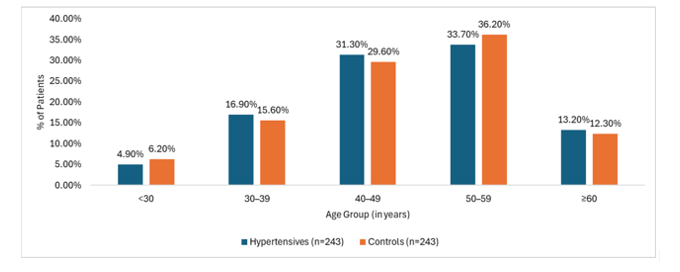
Mean age was approximately 48 years, with no statistically significant difference between the two groups (p = 0.41). Male participants constituted approximately 58% of the study population.
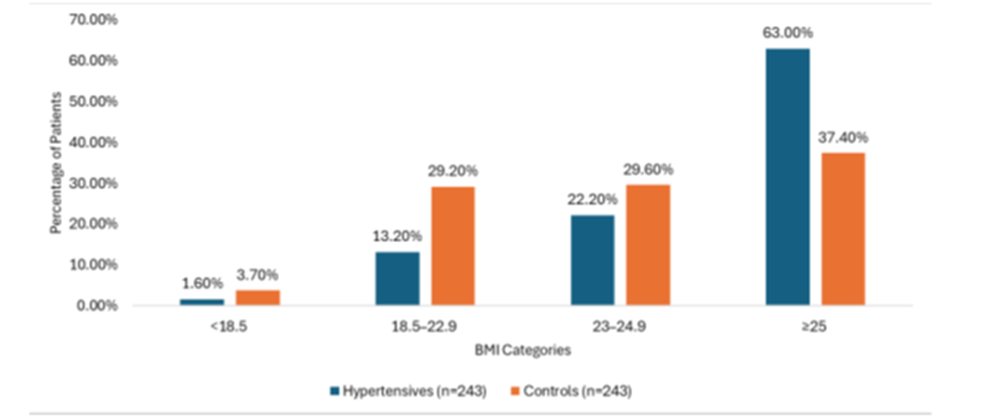
BMI Distribution
Table 2. BMI Distribution
|
BMI Category (kg/m²) |
Hypertensives (n=243) |
Controls (n=243) |
Total (n=486) |
p-value |
|
<18.5 (Underweight) |
4 (1.6%) |
9 (3.7%) |
13 (2.7%) |
<0.001 |
|
18.5–22.9 (Normal) |
32 (13.2%) |
71 (29.2%) |
103 (21.2%) |
|
|
23–24.9 (Overweight) |
54 (22.2%) |
72 (29.6%) |
126 (25.9%) |
|
|
≥25 (Obese) |
153 (63.0%) |
91 (37.4%) |
244 (50.2%) |
The mean BMI was significantly higher among hypertensive participants (26.8 ± 3.4 kg/m²) compared to controls (24.3 ± 3.1 kg/m²) (p < 0.001). Obesity was markedly more prevalent among hypertensive individuals.
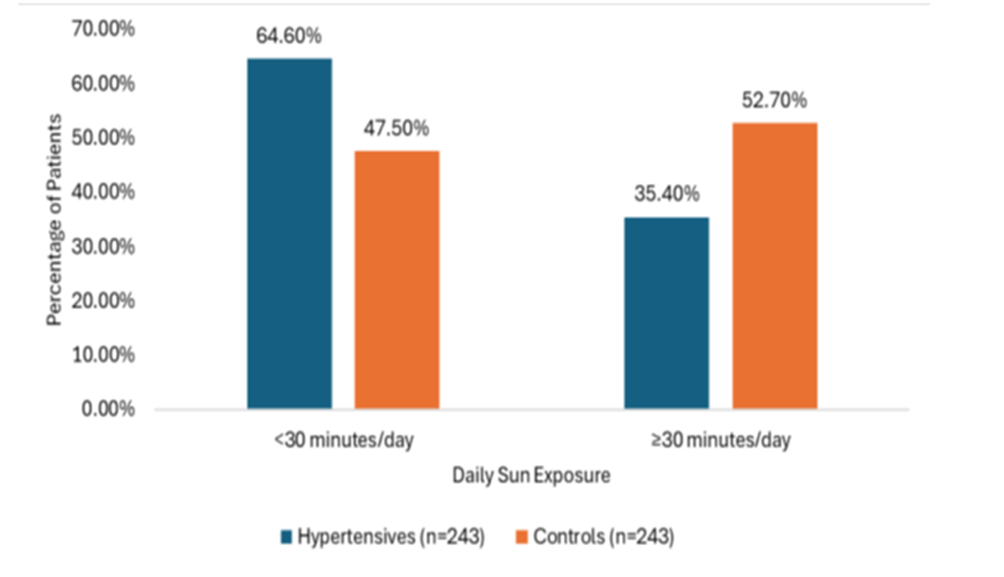
Sun Exposure
Table 3. Daily Sun Exposure Among Participants
|
Daily Sun Exposure |
Hypertensives (n=243) |
Controls (n=243) |
Total (n=486) |
p-value |
|
<30 minutes/day |
157 (64.6%) |
115 (47.5%) |
272 (56.0%) |
0.002 |
|
≥30 minutes/day |
86 (35.4%) |
128 (52.7%) |
214 (44.0%) |
A significantly higher proportion of hypertensive participants reported less than 30 minutes of daily sun exposure compared to controls.
Serum 25(OH)D Levels
Table 4. Serum 25(OH)D Concentration in Hypertensive and Control Groups
|
Group |
Mean ± SD (ng/mL) |
p-value |
|
Hypertensives (n=243) |
18.9 ± 7.2 |
<0.001 |
|
Controls (n=243) |
27.4 ± 8.3 |
Hypertensive participants had significantly lower serum vitamin D levels than normotensive controls.
Vitamin D Status
Table 5. Vitamin D Status Among Hypertensive and Control Groups
|
Vitamin D Status |
Hypertensives (n=243) |
Controls (n=243) |
Total (n=486) |
p-value |
|
Deficient (<20 ng/mL) |
180 (74.1%) |
97 (39.9%) |
277 (57.0%) |
<0.001 |
|
Insufficient (20–29 ng/mL) |
45 (18.5%) |
88 (36.2%) |
133 (27.4%) |
|
|
Sufficient (≥30 ng/mL) |
18 (7.4%) |
58 (23.9%) |
76 (15.6%) |
Vitamin D deficiency was significantly more prevalent among hypertensive individuals.
Ionized Calcium and Hypertension Severity
Table 6. Ionized Calcium Concentration in Stage I and Stage II Hypertension
|
Group |
Mean ± SD (mmol/L) |
p-value |
|
Stage I (n=132) |
1.10 ± 0.09 |
<0.001 |
|
Stage II (n=111) |
1.02 ± 0.10 |
A significant decline in ionized calcium levels was observed with increasing severity of hypertension.
DISCUSSION:
The present study demonstrated a significant association between vitamin D deficiency and essential hypertension. Hypertensive individuals had significantly lower serum 25(OH)D levels and a higher prevalence of vitamin D deficiency compared to normotensive controls. These findings are consistent with previous studies suggesting an inverse relationship between vitamin D status and blood pressure regulation. [8,9]
Vitamin D deficiency may contribute to hypertension through activation of the renin–angiotensin–aldosterone system, endothelial dysfunction, increased vascular stiffness, and enhanced inflammatory responses. Experimental studies have shown that vitamin D suppresses renin expression and modulates vascular smooth muscle function.[8]
Obesity was significantly more prevalent among hypertensive participants, with a higher mean BMI compared to controls. Increased adiposity is known to contribute to hypertension through sympathetic nervous system activation, insulin resistance, chronic inflammation, and RAAS stimulation.[10]
Reduced daily sun exposure observed among hypertensive participants may also have contributed to lower vitamin D levels, as sunlight exposure is the principal source of endogenous vitamin D synthesis.[11]
The present study also demonstrated significantly lower ionized calcium levels among individuals with more severe hypertension. Ionized calcium is the biologically active fraction of serum calcium and plays a critical role in vascular smooth muscle contraction, endothelial function, and peripheral vascular resistance.[12] Reduced ionized calcium levels may therefore contribute to increased vascular tone and elevated blood pressure.
The combined assessment of vitamin D and calcium status may provide useful insight into endocrine and metabolic factors associated with hypertension. However, the cross-sectional design of the present study limits causal inference, and reverse causality cannot be excluded.
CONCLUSION:
Vitamin D deficiency and altered calcium homeostasis were significantly associated with essential hypertension in the present study. Hypertensive individuals demonstrated lower serum vitamin D levels, reduced ionized calcium concentrations, higher BMI, and lower sun exposure compared to normotensive controls.
These findings suggest that assessment of vitamin D and calcium status may have potential value in cardiovascular risk evaluation. Further prospective multicentre studies and randomized controlled trials are required to establish causality and evaluate the role of micronutrient correction in hypertension management.
Clinical Implications
· Screening for vitamin D deficiency in hypertensive patients may be clinically beneficial.
· Adequate sunlight exposure should be encouraged as part of lifestyle modification.
· Identification and correction of micronutrient deficiencies may contribute to comprehensive cardiovascular risk management.
Limitations
· The cross-sectional design does not establish causality between vitamin D, calcium levels, and hypertension.
· Being a single-centre study, the findings may not be generalizable to the wider population.
· Dietary intake, seasonal variation in sunlight exposure, physical activity, smoking status, and parathyroid hormone levels were not assessed.
· Sun exposure data were based on self-reporting and may be subject to recall bias.
· The effect of vitamin D or calcium supplementation was not evaluated.
Recommendations
· Conduct large multicentre prospective studies to validate these findings.
· Include assessment of dietary factors, physical activity, seasonal variation, and parathyroid hormone levels.
· Perform randomized controlled trials to evaluate the effect of vitamin D and calcium supplementation on blood pressure control.
· Consider routine screening for vitamin D deficiency in hypertensive individuals, particularly those with obesity and limited sun exposure.
REFERENCES:
1. Holick MF. Vitamin D deficiency. N Engl J Med. 2007;357(3):266-81.
2. Forman JP, Giovannucci E, Holmes MD, Bischoff-Ferrari HA, Tworoger SS, Willett WC, et al. Plasma 25-hydroxyvitamin D levels and risk of incident hypertension. Hypertension. 2007;49(5):1063-9.
3. Judd SE, Tangpricha V. Vitamin D deficiency and risk for cardiovascular disease. Curr Opin Nephrol Hypertens. 2011;20(4):353-7.
4. Pilz S, Tomaschitz A, Ritz E, Pieber TR. Vitamin D status and arterial hypertension: a systematic review. Nat Rev Cardiol. 2009;6(10):621-30.
5. Sudhakar K, Sujatha M, Babu SR, Padmavathi P, Reddy PP. Serum calcium levels in patients with essential hypertension and their first-degree relatives. Indian J Clin Biochem. 2004;19(1):21-3.
6. Scragg R, Sowers M, Bell C. Serum 25-hydroxyvitamin D, ethnicity, and blood pressure in the Third National Health and Nutrition Examination Survey. Am J Hypertens. 2007;20(7):713-9.
7. Wang TJ, Pencina MJ, Booth SL, Jacques PF, Ingelsson E, Lanier K, et al. Vitamin D deficiency and risk of cardiovascular disease. Circulation. 2008;117(4):503-11.
8. Li YC, Kong J, Wei M, Chen ZF, Liu SQ, Cao LP. 1,25-Dihydroxyvitamin D(3) is a negative endocrine regulator of the renin-angiotensin system. J Clin Invest. 2002;110(2):229-38.
9. Pilz S, Tomaschitz A, Ritz E, Pieber TR. Vitamin D status and arterial hypertension: a systematic review. Nat Rev Cardiol. 2009;6(10):621-30.
10. Hall JE, do Carmo JM, da Silva AA, Wang Z, Hall ME. Obesity-induced hypertension: interaction of neurohumoral and renal mechanisms. Circ Res. 2015;116(6):991-1006
11. Holick MF. Vitamin D deficiency. N Engl J Med. 2007;357(3):266-81.
12. McCarron DA. Calcium metabolism and hypertension. Am J Clin Nutr. 1997;65(2 Suppl):728S-32S.
13. Manson JE, Cook NR, Lee IM, Christen W, Bassuk SS, Mora S, et al. Vitamin D supplements and prevention of cancer and cardiovascular disease. N Engl J Med. 2019;380(1):33-44.
14. Arora P, Song Y, Dusek J, Plotnikoff G, Sabatine MS, Cheng S, et al. Vitamin D therapy in individuals with prehypertension or hypertension: the DAYLIGHT trial. Hypertension. 2015;66(4):691-6.
15. Heaney RP. Calcium intake and disease prevention. Arq Bras Endocrinol Metabol. 2006;50(4):685-93.