ULTRASOUND GUIDED PRE-EMPTIVE BILATERAL SUPRAZYGOMATIC MAXILLARY NERVE BLOCK FOR SEPTOPLASTY: A CASE SERIES.
- Swati Bisht , Professor, Department of Anesthesia , Vydehi Institute of Medical Sciences and Research Centre, Bengaluru, Karnataka, India.
- Sameera Halima R , Assistant Professor, Department of Anesthesia , Vydehi Institute of Medical Sciences and Research Centre, Bengaluru, Karnataka, India.
- Vaishnavi V B , Post Graduate, Department of Anesthesia , Vydehi Institute of Medical Sciences and Research Centre, Bengaluru, Karnataka, India..
Article Information:
Abstract:
Background: Septoplasty is standard surgical method for treating sinonasal pathologies and restore normal function. The maxillary nerve (V2)- a purely sensory nerve which innervates the nose, paranasal sinuses, maxilla, upper jaw, palate and infra-orbital region and thus Suprazygomatic Maxillary Block (SZMB) can provide targeted anesthesia. RESULTS: Septoplasty surgeries performed under general anaesthesia (GA) allows for adequate airway protection, control of cardiovascular function, and provides an immobile surgical field. Addition of SZMB to GA provides adequate postoperative pain relief , decreased incidence of emergence agitation in addition to decreased opioid use in the recovery. CONCLUSION: Ultrasound guided suprazygomatic approach to maxillary nerve block provides excellent postoperative analgesia for patients undergoing septoplasty surgery without significant side effects.
Keywords:
Article :
INTRODUCTION:
The cause of postoperative pain after septoplasty is resection of the facial bones around the nasal cavity and Os nasale . The maxillary nerve is exclusively sensory and carries pain, temperature, and tactile information from the region below the orbits and above mouth, which includes lower eyelid, skin that covers the side of the nose, cheek, maxillary sinus, nasopharynx, nasal cavity, palate, upper teeth, upper lip, and dura mater of the middle cranial fossa. The sensory information from these areas moves along axons whose cell bodies are located in the trigeminal ganglion, located within Meckel’s cave. Thus SZMB can provide targeted anaesthesia.
The Pterygopalatine fossa bock (PPFB), targets the maxillary nerve and sphenopalatine ganglion (SPG). There are several approaches for PPFBs , each associated with a different risk profile. Among them, supra-zygomatic approach is easy and safest as it makes use of the bony anatomy. Thus, SZMB serves as an ideal target, providing broad analgesic coverage and effectively anesthetize multiple structures.
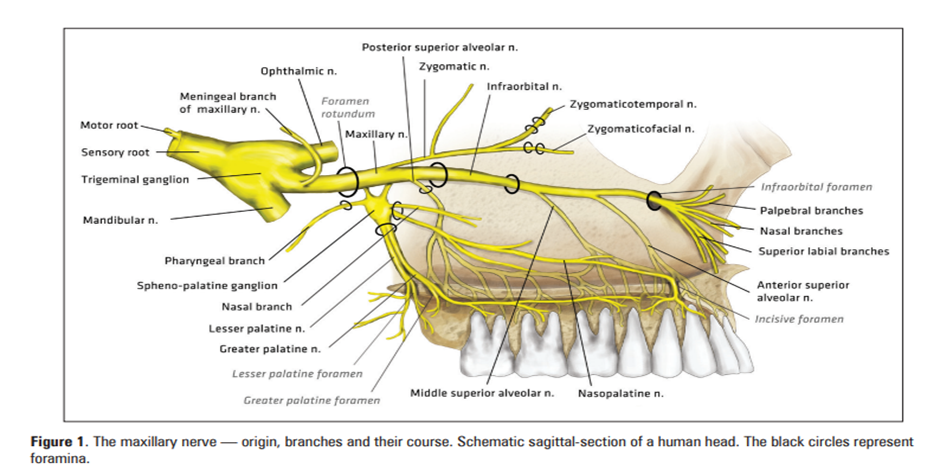
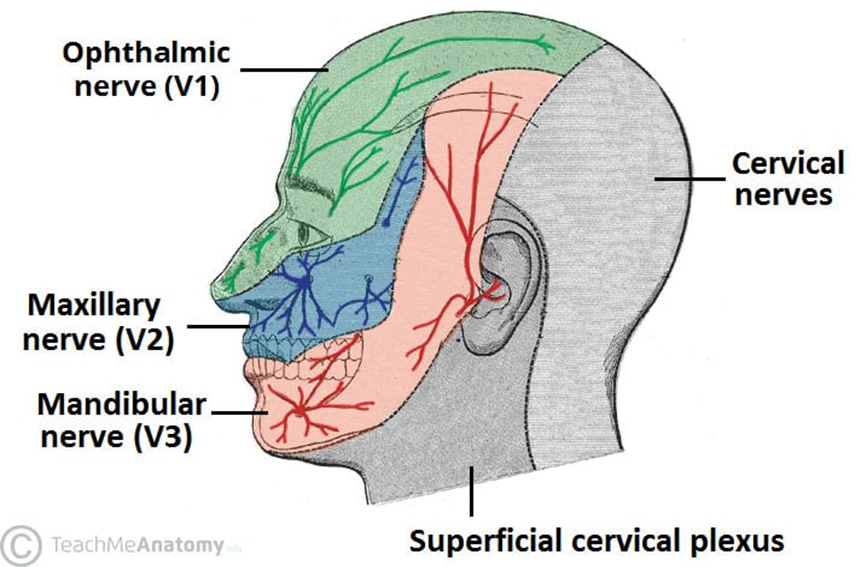
Figure 2- Blue area indicates the supply of the maxillary nerve
METHODLOGY:
Informed and written consent for the procedure was obtained and patient educated on Numerical Pain Rating Scale beforehand (0 for no pain, 5 for moderate pain, and 10 for the worst possible pain).
All patients kept nil orally for a minimum of 6 hours pre-operatively for solids sand 2 hours pre operatively for clear liquids. In the operating room, intravenous access secured, and a multiparameter monitor attached to record ECG (Electrocardiogram), SpO2 (Oxygen saturation), RR (Respiratory rate), NIBP (Non-Invasive Blood Pressure), ETCO2 (End Tidal Carbon dioxide).
Intravenous line secured with 18G to 20G cannula and intravenous fluids Ringer Lactate started. All patients were administered premedications- Inj.Midazolam 0.02 mg/kg IV, Inj glycopyrrolate 0.004 mg/kg and induced with Inj propofol 1.5mg/kg IV, Inj vecuronium 0.1 mg/kg IV and Inj. Fentanyl 2 mcg/kg IV for analgesia. Pre-oxygenation for 3 minutes with 100% oxygen at 6L/min followed by which using direct laryngoscope, appropriate size cuffed endotracheal tube used for intubation and fixed after confirmation of bilateral air entry on 5-point auscultation. Anesthesia maintained with FiO2 of 34% and minimum alveolar concentration of 1, with O2: Air: Isoflurane = 0.5 L/min: 2.5 L/min: 0.8 %.
Suprazygomatic maxillary nerve block performed under aseptic precautions post induction of anesthesia and before commencement of the surgical procedure.
Procedure steps:
A curvilinear ultrasound probe was placed inferior and parallel to the zygomatic arch and angled approximately 45° towards the pterygopalatine fossa. The pterygomaxillary fissure was identified between the maxilla and sphenoid bone. A SonoPlex needle was advanced under ultrasound guidance. After negative aspiration, 5 mL of 0.25% levobupivacaine was injected in divided doses on each side, and adequate spread was confirmed.The procedure was repeated on the opposite side.
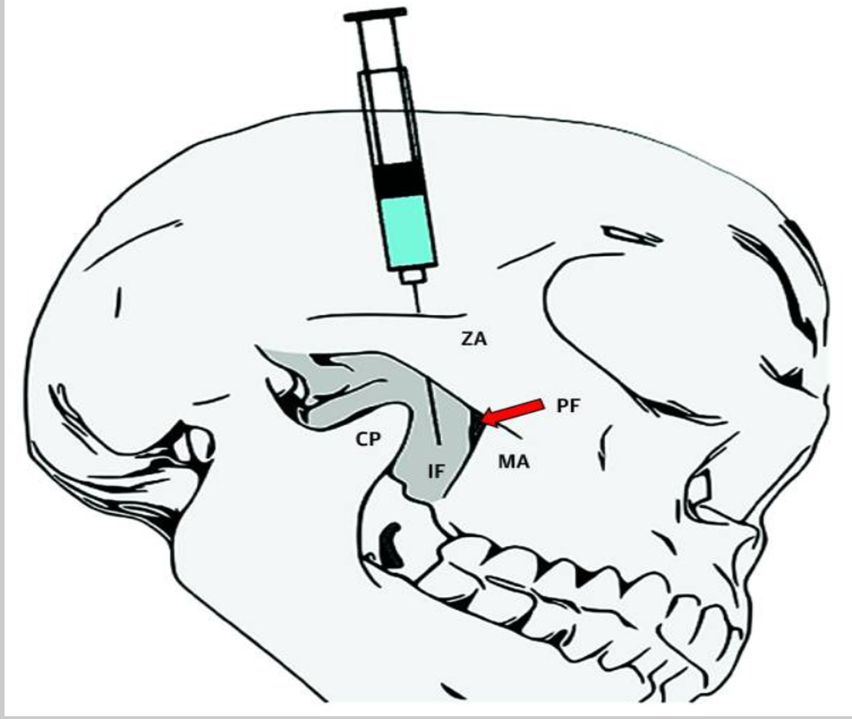
Figure 3- Approach for SZMB
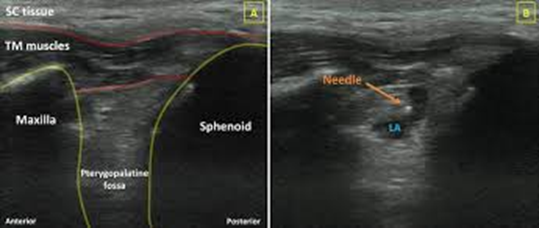
Figure 4- USG image
Pain using NRS was noted upon the transfer to the postoperative care unit (PACU) when the patient could communicate at 0, 4 h, 6 h, 12 h, and 24 h. The cumulative dose of rescue analgesia was noted.
Duration at which rescue analgesia given was noted and was initiated with a NRS more than or equal to 4.
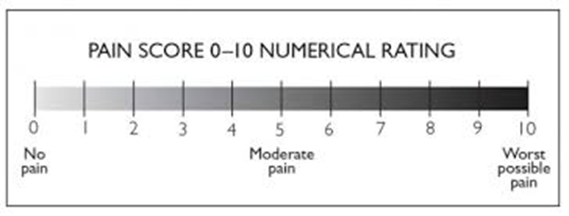
Figure 5- NRS pain score
DISCUSSION:
The results of our study demonstrated a significant reduction in postoperative pain with SZMNB not only in the immediate postoperative period but also at all time points over 24 h after FESS.
The efficacy of the block may be attributed to the inhibition of nociceptive impulses transmitted through the sensory branches of the maxillary nerve and its effectivity in preventing both peripheral and central sensitisation, leading to the reduction of postoperative pain.
Our study used a guided suprazygomatic approach to block the maxillary nerve. This approach provides a safer trajectory due to reliance on the surrounding bony anatomical landmarks of PPF to provide a direct pathway for the needle to navigate through the pterygomaxillary fissure to the fossa, thereby minimising the risk of inadvertently introducing the needle into unintended locations, ensuring a higher level of safety.
In contrast, infra‑zygomatic approach directs the needle towards the infra‑orbital fissure, risking the needle entry into the orbit, and is associated with a higher rate of complications like haematoma formation and swelling over the cheek.
In addition to the primary objective , we also assessed for evaluation of the visibility of the operative field during surgery, the quality scale proposed by Fromm and Boezaart was used and surgeon satisfaction score based on a Likert 5‑point scale from 1 to 5 - very bad, bad, average, good, and excellent.
The operative field conditions were assessed by the operating surgeon as:
Grade 0: No bleeding.
Grade 1: Slight bleeding – No suctioning of blood required.
Grade 2: Slight bleeding – Occasional suctioning required. Surgical field not threatened.
Grade 3: Slight bleeding – Frequent suctioning required. Bleeding threatens surgical field a few seconds after suction is removed.
Grade 4: Moderate bleeding – Frequent suctioning required. Bleeding threatens surgical field directly after suction is removed.
Grade 5: Severe bleeding – Constant suctioning required. Bleeding appears faster than can be removed by suction. Surgical field severely threatened and surgery impossible
All the cases fall under grade 2, which implicates that the block not only abridges pain , but also improves the visibility of surgical field, maintains intra operative haemodynamics and Likert score ranges 4-5 , assuring surgeon satisfaction.
|
|
CASE 1 |
CASE 2 |
CASE 3 |
CASE 4 |
|
CLINICAL EVALUATION |
34/M, ASA II DNS TO LEFT |
18/M, ASA I DNS TO LEFT WITH SPUR |
23/M, ASA II DNS TO LEFT |
21/M, ASA I DNS TO RIGHT |
|
NRS PACU 0 HOUR |
2 |
2 |
1 |
1 |
|
NRS AFTER 4 HOURS |
2 |
1 |
2 |
1 |
|
NRS AFTER 6 HOURS |
2 |
2 |
2 |
1 |
|
NRS AFTER 12 HOURS |
2 |
2 |
2 |
3 |
|
NRS AFTER 24 HOURS |
1 |
0 |
0 |
2 |
|
RESCUE ANALGESIA |
NIL |
NIL |
NIL |
NIL |
|
MEAN SCORE |
1.8 |
1.4 |
1.4 |
1.6 |
|
LIKERT 5 POINT SCALE |
4 |
4 |
4 |
5 |
|
BOEZAART SCALE |
2 |
2 |
2 |
2 |
CONCLUSION:
Ultrasound guided suprazygomatic approach to maxillary nerve block provides excellent postoperative analgesia for patients undergoing septoplasty surgery without significant side effects
REFERENCES:
1. Neupane A, Jain D, Arora S, Gandhi K, Singla V, Goel N et al. Evaluation of ultrasound-guided suprazygomatic maxillary nerve block in functional endoscopic sinus surgery for postoperative pain relief: A randomised controlled trial. Indian J Anaesth 2024;68:706-11.
2. Murdoch I, Surda P, Nguyen-Lu N. Anaesthesia for rhinological surgery. BJA Educ. 2021 Jun;21(6):225-31.
3. Molins G, Valls-Ontañón A, De Nadal M, Hernández-Alfaro F. Ultrasound-Guided Suprazygomatic Maxillary Nerve Block Is Effective in Reducing Postoperative Opioid Use Following Bimaxillary Osteotomy. J Oral Maxillofac Surg. 2024 Apr;82(4):412-21.
4. Jerman A, Umek N, Cvetko E, Snoj Ž. Comparison of the feasibility and safety of infrazygomatic and suprazygomatic approaches to pterygopalatine fossa using virtual reality. Reg Anesth Pain Med. 2023 Jul;48(7):359-64.
5. Afandy ME, Abd Elghafar MS, Shoukr TG, El Mourad MB. Efficacy of ultrasound-guided suprazygomatic maxillary nerve block on emergence agitation and postoperative analgesia after septorhinoplasty: A prospective randomized trial. J Anaesthesiol Clin Pharmacol. 2024 Oct-Dec;40(4):679-85.
6. Lin C, Abboud S, Zoghbi V, Kasimova K, Thein J, Meister KD, Sidell DR, Balakrishnan K, Tsui BCH. Suprazygomatic Maxillary Nerve Blocks and Opioid Requirements in Pediatric Adenotonsillectomy: A Randomized Clinical Trial. JAMA Otolaryngol Head Neck Surg. 2024 Jul 1;150(7):564-71.
7. Ankichetty SP, Ponniah M, Cherian V, Thomas S, Kumar K, Jeslin L, Jeyasheela K, Malhotra N. Comparison of total intravenous anesthesia using propofol and inhalational anesthesia using isoflurane for controlled hypotension in functional endoscopic sinus surgery. J Anaesthesiol Clin Pharmacol. 2011 Jul;27(3):328-32.