Discrepancy Between Clinical and Autopsy Findings in Deaths due to Trauma at a Tertiary Care Centre- Cross Sectional Study
- Santhosh Joy , Associate Professor, Department of Forensic Medicine, Government Medical College, Ernakulam, Kerala, India.
- K Sasikala , Professor in Forensic Medicine and Principal, Azeezia Medical College, Meeyannoor, Kollam, Kerala, India.
- Sharija S. , Professor and Head, Department of Forensic Medicine, Government Medical College, Kollam, Kerala, India.
- Sreechithra P. Karippuram , Assistant Professor, Department of Forensic Medicine, Government Medical College, Kottayam, Kerala, India.
Article Information:
Abstract:
Background: Injuries – both unintentional and violence-related – take the lives of 4.4 million people around the world each year and constitute nearly 8% of all deaths. Trauma takes lives, causes disabilities and creates economic burden at personal, national and international levels. Affluent countries have significantly lowered their trauma mortality rates by remodelling the organisation and planning their trauma care through implementation of trauma care systems. In spite of medical and technological advances, clinicians may under-diagnose or even misdiagnose a patient’s condition or cause of death. The classic autopsy with the complete external and internal examination of each organ, followed by their histopathological examination continues to remain the most accurate method for obtaining final complete diagnosis. The aim of the present study was to estimate the discrepancy between clinical and autopsy findings in deaths due to trauma. Methods: Discrepancy between clinical and autopsy findings in death due to trauma was studied in 136 cases of autopsies conducted at a tertiary care centre. Data collected from April 2022 to August 2022. Consecutive sampling done. Cases of all ages and both sex with definitive history of trauma and treated for minimum of 12 hours were included in the study. Clinical and autopsy findings were recorded in prestructured proforma and conclusions were drawn. Discrepancies were classified according to Battle et al and modified by Anderson et al discrepancy classification. Results: Proportion of cumulative discrepancy between clinical and autopsy findings was 23.53% (CI 16.39to 31.05) Class I discrepancy (Definitely affecting the clinical outcome) detected in 04.41% of cases. Class II discrepancy (Probably affecting the clinical outcome) was also detected in 04.41%. Class III discrepancy (Not affecting the clinical outcome) was detected in 14.7%. 76.47% cases showed complete agreement between clinical and autopsy findings. Among six class I discrepancy cases five were fractures of cervical spine. Spine injuries were most commonly missed, followed by abdominal injuries, head injuries, and injuries to chest. Conclusion: The present study came up with acceptable cumulative and class wise discrepancies which validate the quality of trauma care. In head injury cases CT spine if made mandatory with CT head would decrease major discrepancy and would save lives. Assessment of CT films by two specialist doctors and involvement of experienced sonologist in trauma care could make a difference in quality of care.
Keywords:
Article :
INTRODUCTION:
Trauma is physical injury usually caused by accident or attack.[1] Trauma is a major public health problem affecting millions of people across the world. Good trauma care is critical to lessening the consequences of an accident. Each year millions of people lose their lives due to trauma. In addition, many suffer disabilities. Injuries both unintentional and violence related – take the lives of 4.4 million people around the world each year and constitute nearly 8% of all deaths.[2]
Good trauma care is critical to lessening the consequences of an accident. Improvement in late trauma care may reduce the number of preventable trauma deaths.[3] Improvement in late trauma care may reduce the number of preventable trauma deaths.[3] Deficiency in quality of management of trauma victims at the hospital can take hold of morbidity and mortality. Triage, primary survey, stabilization, secondary survey, investigations, and management are all paramount in pronouncing the survival of the victim. Once the patient has been evaluated and adequately resuscitated definitive care has to be provided. Definitive care is a team work of medical specialties. This involves relevant consultations and patient disposition. The interprofessional team often decides patients’ ultimate disposition. Treating trauma patient is a challenge to health care professionals.
Wrong management even though it is an involuntary omission or error of judgement has ethical and social issues. Confidence of general public and professionals in quality of clinical care is adversely affected by public grievances and legal redressals.
The final disposition is marked by the heath care professional’s competency in gathering the major injuries. Major injuries are the ones that decide the course of the treatment and the prognosis. Picking up the vital injuries and their management is teamwork of multiple specialties including surgeons, orthopaedicians, pulmonologists and radiologists. An omission, oversight or fault might result in irreparable loss including death of the victim.
In this background the present study is undertaken to study the discrepancy between clinical and autopsy findings in deaths due to trauma.
AIMS AND OBJECTIVES
Primary Objective
To estimate proportion of cumulative discrepancy between clinical findings and findings on autopsy in deaths due to trauma.
Secondary Objectives
1. To determine class wise discrepancy as per Battle et al (1987) and modified by Anderson et al. (1990) discrepancy classification.
2. To suggest screening investigations in trauma care
MATERIALS AND METHODS:
Discrepancy between clinical and autopsy findings in death due to trauma was studied in 136 cases of autopsies conducted at a tertiary care centre. Data collected from April 2022 to August 2022.
Study Design
Cross sectional study design was chosen for this study. As the proportion of cumulative discrepancy was to be measured and as data on all variables were to be collected only once, cross sectional study design was selected.
Study Settings
Study was conducted at Department of Forensic medicine, Government medical college, Kottayam. Government medical college, Kottayam is a tertiary care centre catering to the treatment needs of a large population of central Kerala.
Study Population
The study was conducted on 136 cases with history of trauma treated at Government medical college Kottayam, and brought for autopsy at mortuary, Government medical college, Kottayam.
Inclusion Criteria
Cases of both sexes and all ages with definitive history of trauma and treatment received for a minimum of 12 hours from Government medical college, Kottayam were included in the study.
Exclusion Criteria
· Cases whose treatment details were not available or incomplete were excluded from the study.
· Cases in which restricted autopsy were conducted (COVID positive cases).
Sampling Procedure
All cases fulfilling inclusion criteria and exclusion criteria were selected by consecutive sampling.
Sample Size
As the proportion of cumulative discrepancy was to be estimated the following formula was used for calculating sample size.
Sample size = zα/22 P (1-P)/d2
z α/2 = Standard normal variate (at 5% type 1 error, it is 1.96)
P=Expected proportion in population based on previous studies or pilot studies.
d= Precision
In the present study P= proportion of discrepancy between clinical and autopsy findings = 42.5% (Reference: “Clinical Audit-A comparative study of clinical and autopsy finding in death due to trauma”-conducted by Dr. Anoop K Thankappan[4] (Unpublished) in 2014-2015 at Government medical college, Trivandrum)
d=20% of P

Operational Definitions
Clinical findings: Clinical findings include clinical examination findings and the results of investigations obtained during the course of treatment.
Discrepancy: Any difference or lack of compatibility between clinical findings and autopsy findings.
Discrepancy classification: Battle et al modified by Anderson et al classification used in the study.
Table 1: Battle et al(1987) and modified by Anderson et al. (1990) classification[5]
|
Category |
Discrepancy |
|
|
Major |
CLASS I |
Principal diagnoses definitely affecting clinical outcome |
|
CLASS II |
Principal diagnoses possibly affecting clinical outcome |
|
|
Minor |
CLASS III |
Secondary diagnosis either symptomatic but not treated or likely to have affected prognosis |
|
CLASS IV |
Secondary diagnosis that could not have been made clinically |
|
|
CLASS V |
No discrepancy |
|
Methodology of Data Collection
Autopsies are conducted in all cases of death due to trauma. Clinical case records are perused at the time of autopsy in all treated cases. Discrepancies between clinical findings documented in case record and the autopsy finding were studied. Data entry is verified by two investigators to avoid entry errors.
RESULTS:
Sex Distribution of Cases
Males outnumbered female in cases of trauma related deaths with 91.9 % of study population being males and remaining 8.1 % females (Table:2).
Table 2: Sex distribution of cases
|
Sex |
Frequency |
Percent |
|
Male |
125 |
91.9 |
|
Female |
11 |
8.1 |
|
Total |
136 |
100.0 |
Age wise distribution of cases
Victims ranged from 1 year to 99 years. Maximum number of trauma victims was within the age group 51 to 60 years (22.1%). Mean age was 52.65 with standard deviation 17.65 and median age was 54.50 with interquartile range 42 to 65. Extremes of age groups were relatively less
Case distribution according to type of trauma
Road traffic accidents (RTA) were responsible for majority of deaths (64 %) in this study. In 27.2 % of cases death was consequent to fall from height. This was followed by deaths due to fall of heavy objects on the body, assault and other non specific causes occurring in 1.5%, 0.7% and 6.6% of cases respectively
Cumulative discrepancy
Out of 136 cases 32 cases (23.52%) showed discrepancy between clinical and autopsy findings. 104 (76.47%) cases showed total agreement between clinical and autopsy findings (Figure 1).
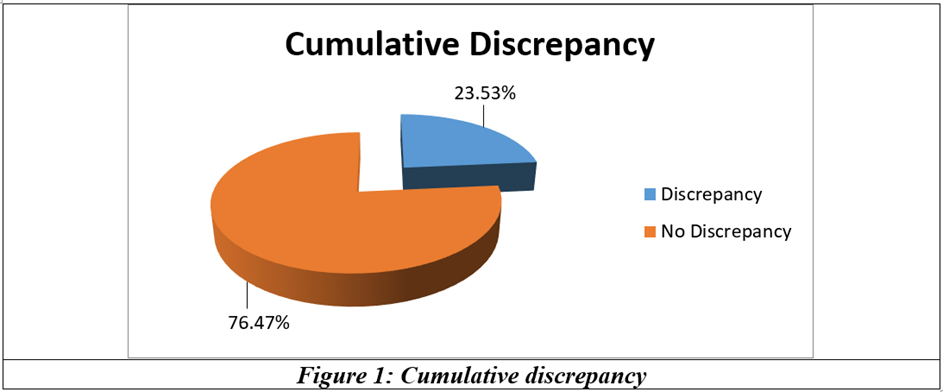
Distribution of cases according to discrepancies
Battle et al (1987) and modified by Anderson et al. (1990) classification is used to classify the discrepancies.
Table 3: Distribution of cases according to discrepancies
|
Discrepancy classification |
Frequency |
Percent |
|
Class I (Definitely affecting the clinical outcome) |
6 |
04.41 |
|
Class II (Possibly affecting the clinical outcome) |
6 |
04.41 |
|
Class III (Not affecting the clinical outcome) |
20 |
14.70 |
|
Class IV (Could not be made clinically) |
0 |
00.00 |
|
Class V (No discrepancy) |
104 |
76.47 |
|
Total |
136 |
100.0 |
Cases under Class I discrepancy
As Class I cases hold at most clinical relevance, they are depicted. Out of six cases under Class I discrepancy, five cases were fractures of cervical spine and the remaining one case was Extradural haemorrhage (Figure 2).
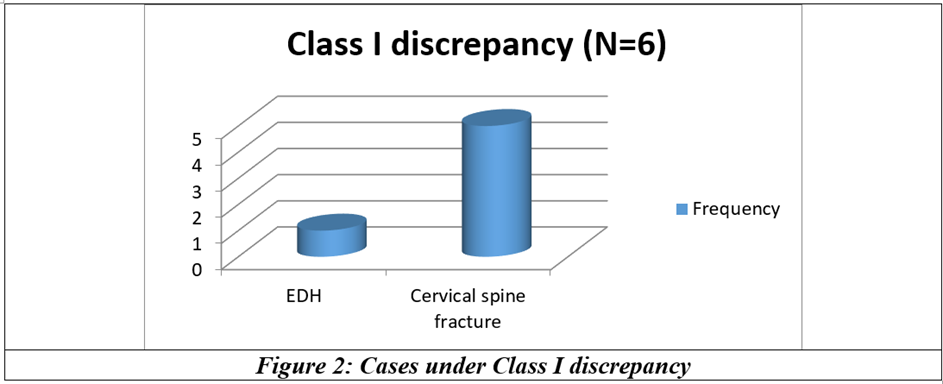
Cases under Class II discrepancy
Cases under class II also affected the course of treatment and prognosis. They consisted of one case of liver laceration, three cases of consolidation of lungs, one Intracerebral hematoma and one case of retroperitoneal hematoma (Figure 3)
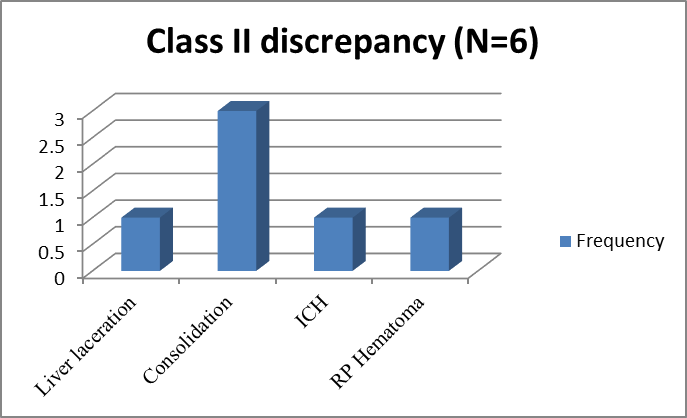
Figure 3: Cases under Class II discrepancy
DISCUSSION:
Factors affecting discrepancy
Age
Kurz et al[6] demonstrated in their study that age group (62-70) years showed more discrepancies. According to the Britton et al[7] diagnostic errors were encountered less in those aged below 70 years. In the present study mean of age discrepant group was 54.38 and of non-discrepant group was 52.13. Independent sample t test revealed that no statistically significant association exit between age and discrepancy. (p=0.537).
Sex
Males outnumbered females in both trauma cases and in discrepant group in the present study. However no statistically significant association could be established between sex and distribution and discrepancy. A retrospective study of 1112 hospital autopsy by Kurz et[6] al also concluded that sex distribution has no significant impact on the occurrence of discrepancies.
Type of treatment given
In the present study 71.88 % of cases in discrepant group were given conservative treatment and the rest received surgical management. However Chi square test revealed that it is not statistically significant. This proves that decision on the choice between conservative or surgical management is taken correctly. No association between type of treatment (conservative or surgical) and discrepancies was noted in any other study on discrepancy between clinical findings and autopsy findings.
Comparison of different injuries – clinically diagnosed or missed
Out of 136 cases, on autopsy, head injury was the most common on region wise classification and was present in 110 cases (80.88%). Chest injury was present in 42 cases (30.88%). Abdomen and spine injuries were present in 14 cases (10.29%) each. Long bone fractures were present in 9 cases (06.61%). Discrepancy between clinical and autopsy findings is maximum in case of spine injuries (35.72%), followed by abdomen (28.58%), head (18.19%) and chest (11.91).in case of long bone fractures there was 100 % agreement between clinical and autopsy findings.
Table 4: Comparison of major discrepancies in various studies
|
Study |
Year of publication |
Sample size |
Major discrepancies (percent) |
||
|
Britton M et al[7] |
1974 |
400 |
7.3 |
||
|
Gut et al[8] |
1999 |
30 |
23.3 |
||
|
Mort T C et al[9] |
1999 |
149 |
23 |
||
|
Connor et al[10] |
2002 |
59 |
7 |
||
|
Ong et al[11] |
2002 |
158 |
3 |
||
|
Ullah K et al[12] |
2007 |
108 |
15 |
||
|
Buschmann et al[13] |
2010 |
19 |
16 |
||
|
Afuwape et al[14] |
2014 |
290 |
17.24 |
||
|
Demirkiran et al[15] |
2015 |
626 |
20.6 |
||
|
Studies in Kerala (State in which this study was conducted) |
|||||
|
Study |
Year of publication |
Sample size |
Class I (percent) |
Class II (Percent) |
Major(I+II) (Percent) |
|
Dr O Geetha[16] |
2010 |
100 |
25 |
3 |
28 |
|
Dr. Anoop K Thankappan[4] |
unpublished |
200 |
4.5 |
10.5 |
15 |
|
Present study |
|
136 |
4.41 |
4.41 |
8.82 |
CONCLUSION:
The present study ‘Discrepancy between clinical and Autopsy finding in the death due to trauma in a tertiary care center’-came up with acceptable cumulative and class wise discrepancies which validate the quality of trauma care. However, we put forward the following suggestions to transpose the trauma care to outstanding standards.
1. Cervical spine fractures could remain overt and hence due care be taken while transporting the trauma patients.
2. CT spine to be made mandatory in all head injury cases.
3. Assessment of CT films by two doctors and by faculty in case of residents could decrease the discrepancies.
4. Abdominal injuries are frequently missed and the presence of an experienced sonologist in the trauma care could make a difference.
5. Trauma needs to be studied as a specialty.
6. As autopsies are conducted in all trauma cases in India a common platform between forensic surgeon and emergency care physicians is vital for the improvement of trauma care. Trauma care should be an interdisciplinary specialty which will be dependent on input and knowledge from both specialties to evolve further.
REFERENCES:
1. trauma [Internet]. [cited 2022 Oct 12]. Available from: https://dictionary.cambridge.org/dictionary/english/trauma
2. Injuries and violence [Internet]. [cited 2022 Oct 12]. Available from: https://www.who.int/news-room/fact-sheets/detail/injuries-and-violence
3. Duke GJ, Morley PT, Cooper DJ, et al. Management of severe trauma in intensive care units and surgical wards. Med J Aust 1999;170(9):416-9.
4. Thankappan AK. Clinical Audit- A Comparative study of Clinical Findings and Autopsy Findings in Deaths due to Trauma. Unpublished dissertation Kerala University of Health Sciences 2016.
5. Geetha O, Girish S. A comparative study of clinical and autopsy findings (Clinical audit) in 100 cases died of trauma [Internet]. [cited 2022 Nov 16]. Available from: https://www.indianjournals.com/ijor.aspx?target=ijor:jiafm&volume=32&issue=2&article=016
6. Kurz SD, Sido V, Herbst H, et al. Discrepancies between clinical diagnosis and hospital autopsy: A comparative retrospective analysis of 1,112 cases. PloS One 2021;16(8):e0255490.
7. Britton M. Clinical diagnostics: experience from 383 autopsied cases. Acta Med Scand 1974;196(3):211-9.
8. Gut A, Ferreira A, Montenegro M. Autopsy: Quality assurance in the ICU. Intensive Care Med. 1999;25:360-3.
9. Mort TC, Yeston NS. The relationship of pre mortem diagnoses and post mortem findings in a surgical intensive care unit. Crit Care Med 1999;27(2):299-303.
10. O’Connor AE, Parry JT, Richardson DB, et al. A comparison of the antemortem clinical diagnosis and autopsy findings for patients who die in the emergency department. Acad Emerg Med Off J Soc Acad Emerg Med 2002;9(9):957-9.
11. Ong BB, Wong JJ, Hashim J. A retrospective study of the accuracy between clinical and autopsy cause of death in the University of Malaya Medical Centre. Malays J Pathol 2004;26(1):35-41.
12. Ullah K, Alamgir W. Comparison of clinical causes of death with autopsy diagnosis using discrepancy classification. J Coll Physicians Surg Pak 2007;16:768-72.
13. Buschmann CT, Gahr P, Tsokos M, et al. Clinical diagnosis versus autopsy findings in polytrauma fatalities. Scand J Trauma Resusc Emerg Med 2010;18:55.
14. Afuwape O, Okolo CA, Ifesanya A. Missed injuries in trauma associated mortalities in a Nigerian teaching hospital. Niger Postgrad Med J 2014;21(1):1-4.
15. Demirkiran DS, Ortanca I, Sahan M, et al. A Comparison between Premortem and Postmortem Diagnosis in Trauma Cases. Forensic Med Anat Res 2015;3(4):89-94.
16. Geetha O, Girish S. A comparative study of clinical and autopsy findings in 100 cases died of trauma. J Indian Acad Forensic Med 2010;32(2):157-9.