Feasibility of using DPOAE/TEOAE as Screening Procedure for Detecting Hearing Impairment in Newborns in Developing Countries - A Prospective Study from a Tertiary Care Center, South India.
- Gururaj S. , Assistant Professor, Department of Pediatrics, SS Institute of Medical Science and Research Centre, Davanagere, Karnataka, India.
- Chandrasekhar Gouli , Professor, Department of Pediatrics, SS Institute of Medical Science and Research Centre, Davanagere, Karnataka, India.
- Prasad B.S , Professor Department of Pediatrics, SS Institute of Medical Science and Research Centre, Davanagere, Karnataka, India.
- Kalappanavar N.K. , Professor, Department of Pediatrics, SS Institute of Medical Science and Research Centre, Davanagere, Karnataka, India.
Article Information:
Abstract:
Background: Test/evaluation for early detection of hearing impairment in high risk newborns to minimize the disability following impaired hearing. Objective: to evaluate distortion product otoacoustic emission (DPOE)/ transient evoked otoacoustic emission (TEOAE) screening for early detection of hearing impairment in high risk newborns. Methods: This is a prospective observational study. All at risk newborns admitted to NICU according to the JCIH 2007 criteria were screened for hearing with DPOAE/TEOAE before discharge and cases which required referral were again screened within 15-30 days of discharge. The babies who failed the second screening were evaluated by BERA (brainstem evoked response audiometry) at 3 months to confirm the hearing loss. Results: A total of 164 high risk neonates were evaluated with DPOAE/TEOAE of which 33 (20.2%) had to be referred in first screening, 19 (11.5%) had to be referred in the second screening. All these 19 (11.5%) cases were confirmed of having hearing impairment by BERA. Conclusion: This study showed that two stages DPOAE/TEOAE hearing screening can be successfully implemented as newborn hearing screening method for early detection of hearing impairement on a large scale to achieve the quality standard of screening which reduces the number of babies requiring BERA.
Keywords:
Article :
INTRODUCTION:
Communication is the ‘Key to Life’. Communication is easily overlooked, but the ability to communicate effectively is necessary to carry out the thoughts and visions of an organization to the people, to convey directions and provide synchronization. Whether it was a small tribe in the Stone Age or a large nation such as the Roman Empire, speech and spoken words have always played a big role in the individual and collective lives of the people. Wars have been won, blood has been shed, men have sacrificed their lives, and peace agreements have been made because of the magical words of a few who knew how to give life to their words.
Speech and hearing are interrelated i.e. a problem with one could mean a problem with the other as speech and language is acquired normally through auditory system.
The prevalence of mild to profound hearing loss is reported to be between 1.1-6per 1,000 live–births and with prevalence of hearing loss is estimated to be between 2.5%- 10% among high-risk infants. In most countries, newborn hearing screening programs that screen only high-risk infants have been inexistence for more than 20years. However, this group of infants with hearing loss comprises only 50% of newborn population with hearing loss. Therefore, hearing screening programs that screened only high-risk neonates missed out 50% of hearing impaired newborns, who are from among infants without any risk factors. Also as hearing loss is an invisible disability it cannot be passively identified until the child fails to develop speech and language.
OBJECTIVES
To study the feasibility of using DPOAE (Distortion product Otoacoustic Emission) / TEOAE (Transient evoked Otoacoustic Emission) as screening procedure for detecting hearing impairment in newborns in developing countries.
MATERIALS AND METHODS:
This study was conducted in the NICU (Neonatal ICU) SSIMS&RC, Davangere. This was a prospective observational study conducted in tertiary care institute in central karnataka. 164 high-risk infants were studied after obtaining ethical clearance from the institutional ethics committee.
Inclusion Criteria
Risk infants having one or more risk factors, according to the criteria stated by American Academy of Pediatrics, JCIH 2007 were selected from SS Institute of Medical Sciences and Research Center, Davangere and 164 risk newborn with one or more risk factors during the study period over one year were included in the study. The risk factors considered included family history of permanent hearing loss, in-utero infections (toxoplasmosis, rubella, cytomegalovirus, herpes-simplex virus infections and syphilis), birth weight less than 1500grams, prematurity less than 32weeks, jaundice requiring phototherapy and exchange transfusion, meningitis, hypoxic-ischemic encephalopathy of any degree, treatment with ototoxic drugs, blindness or any babies receiving intensive or high dependency care.
Study Group and Method of Data Collection
Proper history was taken. Clinical examination including anthropometry, general examination and otoscopy was done. OAE testing of infants was done at 24 to 48 hours prior to the time of discharge, for refer cases repeat OAE testing was done at 15 to 30 days. The infant who failed the second OAE screen was referred to Otorhinolaryngologist and audiologist for further audiological evaluation by Brainstem Evoked Response Testing (BERA) within 3 months to confirm the hearing loss and early intervention. OAE testing was done using NEUROSOFT, NEURO AUDIO SCREEN (Model TC 9442-057137218158-2010).
Newborn babies at risk admitted in SS Institute of medical sciences and research center (SSIMS&RC) were enrolled into the study with prior informed verbal consent obtained from the parents. The enrolled subjects were grouped into at-risk group based on the presence of the risk factors included in the HRR of JCIH2007.[1] “At-risk” group included neonates who had distinct and significant associations with risk factors included in the HRR of JCIH2007.[1] Study was conducted in a noise less environment, on a sleeping baby after ensuring no obstruction in external auditory canal. All subjects underwent the audiological tests as per the Screening– Rescreening Protocol.
Study Procedure
The following information of the infant was noted: gestational age, sex, maternal history, prenatal and maternal risk factors, and birth weight, Apgar score at 5 and 10 minutes and postnatal complications. APGAR score was recorded using colour, heart rate, respiration, reflex response and motor response. After otoscopic examination of the ears, screening was done. With the infant lying comfortably on the bed or the mother‘s lap, testing was carried out in a sound treated room.
Probe with soft flexible tip was gently inserted into the outer part of the ear canal to obtain adequate seal. Two insert ear speakers with a reasonable flat response properties from 0.25 to 10 kHz together with a low noise sensitive microphone system are housed together in a probe which fits into the ear canal. The low amplitude DPOAE are amplified several times and fed where serial averaging of the response is displayed.
Probes different from that used in adults were used, as the probes are calibrated differently because of the significant difference in ear canal volume. The smaller ear canal results in a higher effective sound pressure level (SPL), thus a different probe was used to correct for the difference.
Multiple responses were averaged. All TOAEs or DPOAEs were analyzed relative to the noise floor. For a quiet and cooperative infant, recording usually required less than a few minutes per ear. For an uncooperative or noisy infant, recordings took significantly longer or had to be postponed till infant slept.
It is screening device that can be used for newborn, children, and adults. The OAE detection scheme is based upon signal statistical analysis which guarantees high specificity and sensitivity, with minimal impact of background noise and recording conditions. It has a clinical sensitivity of more than 99%, with-out requiring decisions or equipment adjustment by the user. It has a TEOAE testing frequency range from 1.4 to 4 kHz. Sound stimulus is by non-linear click sequence with stimulus level 45-60dBHL, self-calibration depending on ear canal volume) and click rate is approximate 60Hz. Evaluation of results is by binomial statistics. The instrument do not permit beginning the OAE test until a proper seal of the probe is obtained. A single button push initiates OAE screening which last for approximately 3min (maximum time depends on environmental noise conditions).
The display shows statistical wave form, measurement progress, TEOAE detection level and noise level. The results are given as PASS (PASS is determined by a statistical algorithm, based on binomial statistics) or REFER. PASS indicates that the patient has normal outer hair cell function at the time of testing. A REFER result suggest a possibility of a sensori-neural hearing loss or indicates requirement of further diagnostic hearing evaluation. It also shows A (artifact reject) and S (stimulus stability) values where in, the A‘value greater than 20%, indicate a noisy test. The S‘value less than 80% indicates the ear probe mal-position. When test result shows a A value >20 % and S‘value < 80% a repeat test was advocated.
The OAE screening was conducted in a quiet environment with babies comfortably lying on a bed or on their mother lap ideally in sleeping state. Probe tip of sizes varying from 4mm to 12mm were used for different neonates to obtaining an adequate seal. A suitable probe tip was selected and coupled to the OAE probe. The same was inserted sufficiently deep in to the ear canal to ensure a good seal in the ear canal. Proper hygiene was maintained by cleaning the probe and changing the ear tip after testing each neonate.
Screening / Re-screening Protocol.
The study protocol was carried out in three steps.
1. First–Screening
2. Second-Screening
First-screening was done at 24 to 48 hours prior to discharge from the NICU by TEOAE/DPOAE for all babies “At risk”. Second-screening was done at 1months from discharge who failed the first screening. Babies of “at risk” who failed the first screening (refer category). All infants who failed the second screening were referred to audiologist for detailed further evaluation and early intervention.
Statistical Analysis
The data was entered into Microsoft Excel and analyzed using S.P.S.S package version 12.0.
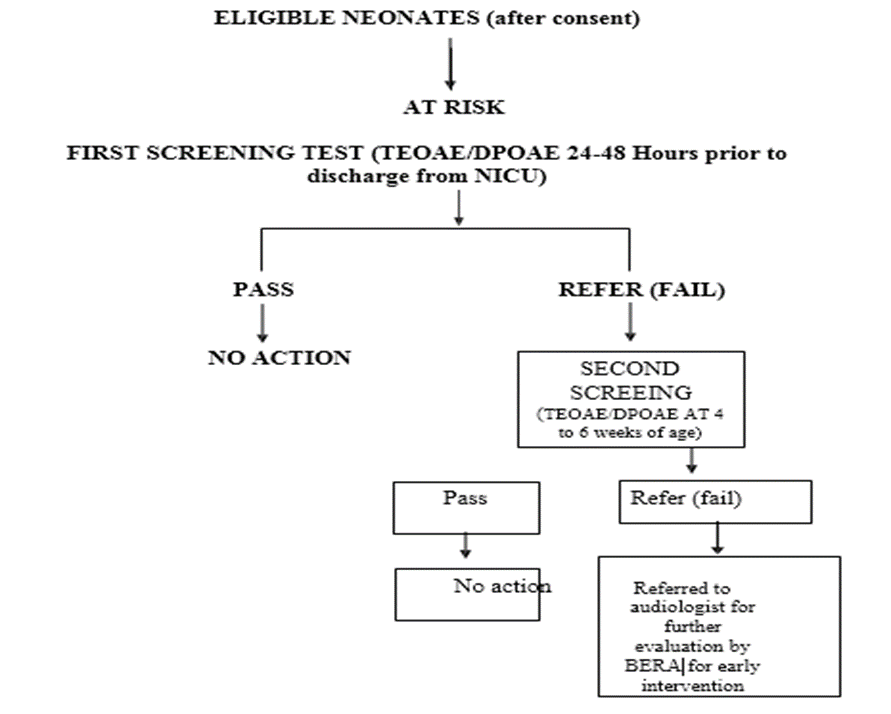
Flow Chart 1. Screening /re-screening protocol
RESULTS:
A total of 164 neonates were included in to the study during the study period, of which 33(20.2%) had refer in first screening, 19(11.5%) with hearing impairment in second screening. Risk factors for hearing impairment as per HRR of as JCIH 2007 at risk group.
Table1: Distribution of Neonates with Risk factors
|
Risk factor |
No. |
% |
|
Receiving intensive or high dependency care |
53 |
32.3 |
|
HIE of any degree |
37 |
22.6 |
|
Prematurity less than 32 weeks |
30 |
18.3 |
|
Jaundice requiring phototherapy |
25 |
15.2 |
|
Birth weight less than 1500gms |
8 |
4.9 |
|
Meningitis |
5 |
3.0 |
|
Suspected intra-uterine infections |
3 |
1.8 |
|
Treatment with oto-toxic drugs |
3 |
1.8 |
|
Total |
164 |
100 |
Table2: Characteristics of 164 neonates with risk factors
|
Characteristic |
Category |
No. |
% |
|
Gender |
Male |
103 |
62.8 |
|
Female |
61 |
37.2 |
|
|
Birth Weight(Kg) |
< 1.5 |
31 |
18.9 |
|
1.5 -2..0 |
46 |
28 |
|
|
≥ 2.5 |
87 |
53 |
|
|
POG(Wks) |
26-32 |
36 |
22 |
|
33-36 |
40 |
24.4 |
|
|
37-41 |
88 |
53.7 |
|
|
Birth Order |
Primi |
98 |
59.8 |
|
Multi |
66 |
40.2 |
The characteristic of the gender distribution out of 164 neonates 62.8% (103) were male and 37.2% (61) were female. It was seen that of 164 neonates screened, 31 infants had birth weight of <1.5kg, 46 neonates between 1.5-2.0kg and 87 neonates >2.5kg. Out of 164 neonates, 36 neonates were of gestation between 26-32wks, 40 neonates between 33- 36 weeks, 88 neonates were between 37–41 weeks of gestation, 98(59.8%) neonates were born to primigravida mother and 66(40.2%) neonates were born to multigravida mothers.
Table 3: Gender distribution and OAE screening
|
Gender |
Affected |
Pass |
||
|
No. |
% |
No. |
% |
|
|
Male |
14 |
13.6 |
89 |
86.4 |
|
Female |
5 |
8.2 |
56 |
91.8 |
|
Total |
19 |
11.6 |
145 |
88.4 |
|
X² = 1.09 P= 0.29, ns |
||||
OAE screen conducted in 164 risk newborn out of 103 male newborns,14 (13.6%) were with hearing impairment and out of 61 females 5(8.2%) were with hearing impairment where calculated p value was 0.29 which showed no significance for relation to sex.
Table 4: Birth weight and OAE Screening
|
Birth Weight(Kg) |
Affected |
Pass |
||
|
No. |
% |
No. |
% |
|
|
< 1.5 |
6 |
19.4 |
25 |
80.6 |
|
1.5 -2..0 |
3 |
6.5 |
43 |
93.5 |
|
≥ 2.5 |
10 |
11.5 |
77 |
88.5 |
|
Total |
19 |
11.6 |
145 |
88.4 |
|
X² = 2.98 P= 0.22, ns |
||||
Out of 164 high-risk newborn screened it was found that, total of 31 newborns were less than1.5kg, among them 6(19.4%) of them were affected with hearing impairment, 1.5-2Kg total of 46 were screened and 3(6.5%) newborns were found with hearing impairment and remaining 87 were more than 2.5kg, among which 10(11.5%) were affected with hearing impairment with p value of 0.22 with suggested no significance with birth weight of newborns.
Among 164 screened it was found that newborns with risk factors between gestational age of 26-32weeks were 36, out of which 6(16.7%) were with hearing impairment, 33-36weeks gestational were total of 40, among them 4(10%) were with hearing impairment, between 37-41 weeks 88 were screened and among them 9(10.2%) were with hearing impairment with p value= 0.56 with no significance to gestational age was seen.
Among 164 high-risks newborn screened the incidence of hearing impairment by oto-aucostic emission screening is 11.6% (19/164).
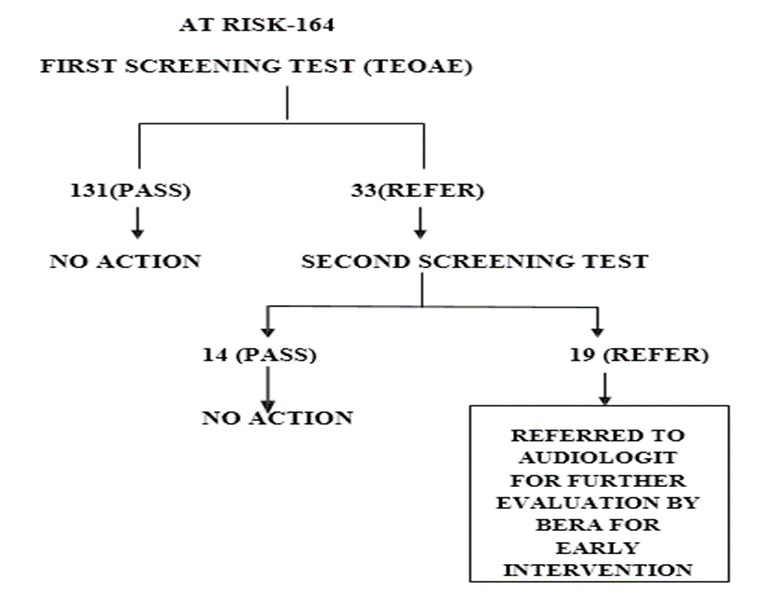
Flow Chart 2. Newborns Screened- 164
Table5: Result of the 1st TEST
|
Out-come |
Frequency |
Percent |
|
B/L pass |
131 |
79.9 |
|
B/L Refer |
27 |
16.5 |
|
R-Pass, L-Refer |
6 |
3.7 |
|
Total |
164 |
100 |
In the first screening out of 164 high-risk screened, 33 newborns failed the initial OAE screening, accounting to a referral rate of 20.2% and pass rate of 79.9%. Of the 33 who failed, 27(16.5%) had bilateral refer and 6(3.7%) newborns had right side pass and left side refer. (Flow chart2).
Table 6: Result of the 2nd TEST
|
Outcome |
No. |
% |
|
B/L Pass |
14 |
8.5 |
|
B/L Refer |
15 |
9.1 |
|
R-Pass, L-Refer |
4 |
2.4 |
|
NA |
131 |
79.9 |
|
Total |
164 |
100 |
In the 2ndscreening out of 33 neonates who were failed in the OAE for the 1st screening 27(16.5%) belonged to bilateral refer and remaining 6(3.7%) belonged to right side pass and left side refer. All these 33 neonates were subjected to OAE screening for 2ndtime. Among them 14(8.5%) got pass, and 15(9.1%) came out as bilateral refer. 4(2.4%) neonates were seen to have right side pass and left side refer (FlowChart2). The referral rate in second screening was 19(11.5%) in the total study cohort.
The 19(11.5%) cases were further referred to confirm hearing deficit, using BERA and further evaluation by the audiologist.
Table7: Incidence of Hearing Impaired
|
Newborns Screened |
Incidence in the cohort |
Incidence expressed% |
|
Total at risk Screened |
19 /164 |
11.5 |
Incidence of hearing impaired in the total study cohort was 19 newborns among the study cohort of 164 screened. These 19 newborns were subjected for further audiological examination for hearing impairment by BERA. The overall incidence of hearing impairment is 11.5% (19/164) screened.
Incidence of hearing impairment in at risk newborns.
Among 164 infants with risk factors screened 19 had hearing impairment, showing an incidence of 11.5% in the high risk newborns, by two staged TEOAE. The distribution of at risk infants screened as per risk their risk factors and the incidence of hearing impairment in various groups of infants with risk factors.
In this study total of 164 high-risk infants, 19 infants were detected to have hearing impairment. Among the risk factors, meningitis was found to have highest percentage of affliction for hearing impairment. Out of total 5cases, 2cases found to have hearing impairment which contributed to 40% of the total hearing impairment among 19 cases. In the infants with prematurity less than 32weeks, out of a total 30 cases, 25 cases found to have normal hearing screening and 5 cases found to have hearing impairment which contributed to second highest of the hearing impairment cases that is 5(16.7%). Among infants with HIE of any degree a total of around 37 cases, 31cases had pass result and 6 cases had refer result and contributed to 16.2% of total refer result which was found to be the third highest in the refer result. The other risk factors like birth-weight less than 1500grams out of 8 cases in 7 cases OAE results were found to be pass and 1case the result was refer and its 12.5 % of the total refer result. Among the risk factor babies receiving high dependency or intensive care, out of 53 cases, 48cases, found to be passed and 5(9.4%) cases had hearing impairment. Among other risk-factors, jaundice requiring phototherapy, suspected intrauterine infections, and newborn on ototoxic, none of the babies went for referral.
Table8: Number of risk factors and OAE outcome depicted in number and percentage
|
OAE RESULT |
|||||
|
No.of Risk factors |
No.of cases |
Pass |
Refer |
||
|
No. |
% |
No. |
% |
||
|
1 |
101 |
95 |
94.1 |
6 |
5.9 |
|
2 |
53 |
42 |
79.2 |
11 |
20.8 |
|
3 |
10 |
8 |
80.0 |
2 |
20.0 |
|
Total |
164 |
145 |
88.4 |
19 |
11.6 |
Out of 164 high-risk infants 10 had >3 risk factors. Among them 2 (20.0%) had hearing impairment. 53 infants had 2 risk factors out of which 11(20.8%) had hearing impairment indicating as the number of risk factors increase the chances of hearing impairment increases.
DISCUSSION:
This study is one of the many steps towards evaluating the need and applicability of universal hearing screening in a developing country like India. We‘ve tried to look into the incidence of hearing impairment in at risk newborns using two staged TEOAE or DPOAE. TEOAE or DPOAE was preferred as screening tool due its numerous advantages over BERA as discussed before. [2] Screening the hearing loss at birth with TEOAEs or DPOAE and later confirming it at three to sixth months was taken as the standard. Deka etal[3] studied the maturation of central auditory connections. They have proposed that though cochlea is fully developed at birth, the myelination of vestibule-cochlear nerve and maturation of brain stem takes nearly six months. This forms the basis of screening and re-screening protocols where final confirmation of hearing loss is made only at around three to six months of age. This accounts for the possible false-positive results that may result from an immature central connection of cochlea.
It is necessary and high time to implement and incorporate universal neonatal screening in our country to secure normal, social and holistic development of the child by detecting hearing loss at birth and providing remedial services at the earliest. National policies in these lines have to be made for neonatal hearing screening in all national health care facilities in India. Universal newborn hearing screening can yield high returns, and the 2-staged hearing screening program is cost effective and feasible. A child who receives early interventions for hearing loss requires less expensive special education in later part of life and has a better chance to have a normal social life and improved quality of life. [4-6]. Considering the infrastructure limitations and financial hindrances in developing country like ours, cost-effective measures like high-risk screening and behavioral observational methods using calibrated noise making toys can be used to screen and follow-up all the newborns, till the time of universal screening policies are made in-to practice. Anganawadi workers can be trained to administer these tests of behavioral observation and reorganization of hearing impaired at earliest so that these neonates can further be referred for proper audio-logical assessment and early intervention or rehabilitation.
Till the national policies are made, private health institutions and pediatricians can screen the newborns for hearing impairment using hand-held TEOAE/DPOAE instruments, as these instruments are less technical, hardly cost around 1.5 to2 lakh rupees and give automated results as pass or fail. A two-staged screening can be planned and the screening timing can be incorporated along with timing of discharge from hospital and timing of 1stdose of triple antigen vaccination (6weeks) without extra burden on follow-up. Those who fail this 2-staged screening and all of those who are having risk factors for hearing loss should undergo a confirmatory BERA and referred for detailed audiological evaluation if necessary. Creating awareness among the parents regarding the importance of hearing screening and available technology and benefits of detecting this hidden defect can it-self decrease the burden of the disease.[7,8].
CONCLUSION:
This study has shown that two–stage TEOAE/DPOAE hearing screening can be successfully implemented as newborn hearing screening method, for early detection of hearing impaired, on a large scale, in a tertiary care hospital to achieve the high quality standard of screening programs. The finding is consistent with previous researches, which have indicated hearing loss to be the most frequently occurring birth defect. Though the incidence of hearing impaired in at risk newborns is higher than the no risk newborns, universal hearing screening is essential to detect large number of hearing impaired in the magnanimous no risk newborn population. Universal newborn hearing screening using two–stage TEOAE/DPOAE proves to be a feasible method for early identification of congenital hearing loss in India. At least all high-risk must be screened for hearing impairment prior to discharge from NICU and followed up during immunization and several times within first year if abnormal responses persist.
REFERENCES:
1. Principles and Guidelines for Early Hearing Detection and Intervention Programs Joint Committee on Infant Hearing Pediatrics 2007;120(4):898-921.
2. Norton SJ, Gorga MP, Widen JE, Folsom RC, Sininger Y, Cone-Wesson B, et al. Identification of neonatal hearing impairment: evaluation of transient evoked otoacoustic emission, distortion product otoacoustic emission, and auditory brain stem response test performance. Ear Hear 2000;21(5):508-28.
3. Deka RC, Deka D, Kacker SK. Maturation of cochlea, auditory nerve and brainstem as observed by Auditory Brainstem Evoked Potentials in human infants and children. Indian Journal of Otolaryngology 1986;38:56-8.
4. Chapchap MJ, Segre CM. Universal newborn hearing screening and transient evoked otoacoustic emission : new concepts in Brazil. Scand Audiol Suppl 2001;30(2):33-6.
5. Mason JA, Herrmann KR. Universal infant hearing screening by automated auditory brain stem response measurement. Pediatrics1998;101(2):221-8.
6. Stewart DL, Mehl A, Hall JW, Thomson V, Carroll M, Hamlett J. Universal newborn hearing screening with automated auditory brainstem response: a multisite investigation. J Perinatol 2000;20(1):S128-31.
7. Watkin PM, Baldwin M. Confirmation of deafness in infancy. Arch Dis Child 1999;81(5):380-9.
8. White KR, Vohr BR, Maxon AB, Behrens TR, McPherson MG, MaukGW. Screening all newborns for hearing loss using transient evoked otoacoustic emissions. International Journal of Pediatric Otorhinolaryngology 1994;29(3):203-17.