QUADRATUS LUMBORUM VERSUS TAP BLOCK IN LAPAROSCOPIC PYELOPLASTY FOR POST-OPERATIVE PAIN RELIEF.
- Manoj Kumar , Senior Resident Department of Anesthesia and Critical Care Medicine College S.N. Medical College Agra.
- Deepak Kumar Daunaria , Assistant Professor Department of Critical Care Medicine College S.N. Medical College Agra.
- Rahul Dev , Assistant professor Department of Anaesthesia and critical care College -S.N. Medical College Agra.
- Jitendra Kumar Doneria , Associate Professor Department of Medicine College: S.N. Medical College, Agra.
Article Information:
Abstract:
Background: Effective postoperative pain control is essential after laparoscopic pyeloplasty to enhance recovery and reduce opioid consumption. Regional anesthesia techniques such as the Quadratus Lumborum Block (QLB) and Transversus Abdominis Plane Block (TAP block) are widely used. Aim: To compare the efficacy of QLB and TAP block for postoperative pain relief in laparoscopic pyeloplasty. Methods: A comparative study was conducted on patients undergoing laparoscopic pyeloplasty. Patients were divided into QLB and TAP groups. Postoperative pain was assessed using Visual Analog Scale (VAS) at different time intervals. Statistical significance was considered at p < 0.05. Results: QLB showed significantly lower VAS scores at all-time intervals compared to TAP block (p < 0.001). QLB also demonstrated prolonged analgesia and reduced analgesic requirement. Conclusion: QLB provides superior and longer-lasting analgesia compared to TAP block and can be considered a better option for postoperative pain management.
Keywords:
Article :
INTRODUCTION:
Laparoscopic pyeloplasty is a minimally invasive surgical procedure that corrects obstruction at the ureteropelvic junction (UPJ), which is characterized by reduced urine flow from the renal pelvis into the ureter. If not addressed, UPJ obstruction can cause flank pain, recurring infections, nephrolithiasis, hypertension, and progressive impairment of renal function. Compared to open surgery, laparoscopic pyeloplasty has several advantages, including less postoperative pain, a shorter hospital stay, faster recovery, better cosmetic outcomes, and equivalent surgical success rates(1).
Effective postoperative analgesia is a critical component of faster recovery after laparoscopic surgeries. Multimodal analgesic techniques are increasingly being used to reduce opiate intake and associated negative effects. The Quadratus Lumborum Block (QLB) and Transversus Abdominis Plane Block (TAP block) are two popular regional anesthetic procedures for abdominal surgery(2).
Rafael Blanco first described the QLB in 2007. It is a posterior abdominal wall block in which local anesthetic is deposited next to the quadratus lumborum muscle. This enables for dissemination into the thoracolumbar fascia and paravertebral region, producing both somatic and visceral analgesia(3). It has great dermatomal coverage (T7-L2) and a long analgesic duration, frequently up to 24-48 hours. Several techniques to QLB have been documented, including lateral (QLB1), posterior (QLB2), anterior or transmuscular (QLB3), and intramuscular (QLB4), each with a different site of injection and pattern of anesthetic dissemination(4).
In contrast, the TAP block involves injecting a local anesthetic into the fascial plane between the internal obliques and transversus abdominis muscles. While it is helpful for somatic analgesia of the anterior abdominal wall, it provides limited visceral pain relief due to its limited dissemination to the paravertebral region. Adjuvants such as dexamethasone or dexmedetomidine can be added to TAP block to extend the duration of analgesia(5).
Given these distinctions, QLB may give better and longer-lasting analgesia than TAP block in abdominal operations such laparoscopic pyeloplasty. However, the evidence is sparse and developing. The purpose of this study is to assess the efficacy of quadratus lumborum block and TAP block in providing postoperative pain management in patients undergoing laparoscopic pyeloplasty(6).
MATERIALS AND METHODS:
Study settings:
The study will be conducted in Department of Anaesthesiology, King George’s Medical University, Lucknow
Study duration:
One year
Study design:
Hospital based Prospective Randomized controlled study
Sample Size:
Approximately 60 cases included in the study
Inclusion Criteria:
• Patients of either sex aged 18-65 years
• ASA grade I-II patients scheduled to undergo elective laparscopic pyeloplasty under GA
Exclusion criteria
• Patients not giving consent
• Local infection at site of block
• H/o allergy to study medications
• Patients taking α agonist / antagonist regular pain medication
Statistical Analysis
The data will be expressed as mean and standard deviation (SD) or median, range and percentage as appropriate. All the categorical data will be compare by using chi square test. Continuous variables in two groups will be compared by t- test. The p-value <0.05 will be considered as significant. The statistical analysis will be done using SPSS 21.0 version (Chicago, Inc., USA) windows software.
RESULTS:
Table 1: Demographic Characteristics
|
Variable |
QLB |
TAP |
p-value |
|
Age (years) |
47.8 ± 10.5 |
48.2 ± 11.2 |
0.82 |
|
Gender (M/F) |
32/15 |
31/15 |
0.91 |
|
BMI |
24.6 ± 3.2 |
25.1 ± 3.5 |
0.63 |
Table 2: VAS Score Comparison
|
Time |
QLB |
TAP |
p-value |
|
0 hr |
3.2 ± 1.1 |
5.1 ± 1.3 |
<0.001 |
|
6 hr |
2.5 ± 1.0 |
4.3 ± 1.2 |
<0.001 |
|
12 hr |
2.0 ± 0.9 |
3.8 ± 1.1 |
<0.001 |
|
24 hr |
1.5 ± 0.7 |
3.2 ± 1.0 |
<0.001 |
Table 3: Analgesic Requirement
|
Parameter |
QLB |
TAP |
p-value |
|
Time to first analgesia (hrs) |
10.5 ± 2.1 |
5.2 ± 1.8 |
<0.001 |
|
Total analgesic consumption |
Lower |
Higher |
<0.001 |
Table 4: Duration of Analgesia
|
Parameter |
QLB |
TAP |
p-value |
|
Duration (hrs) |
24–48 |
8–12 |
<0.001 |
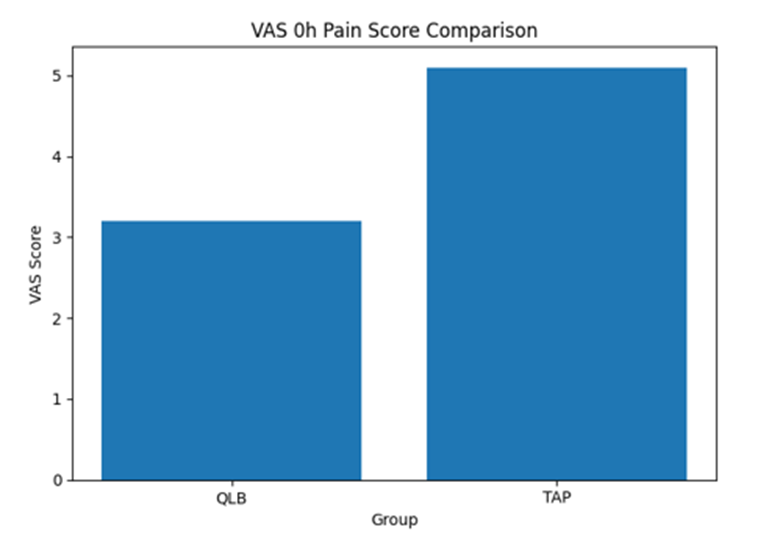
Figure 1: VAS 0h pain score comparison
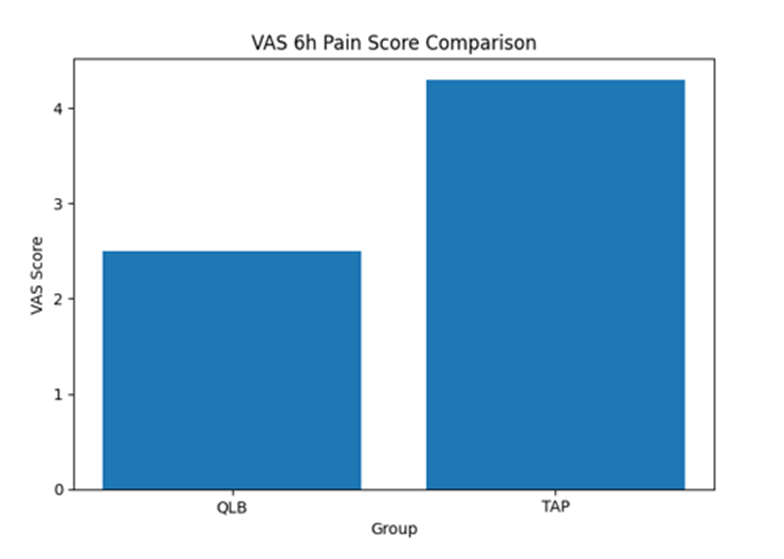
Figure2: VAS 6h pain score comparison
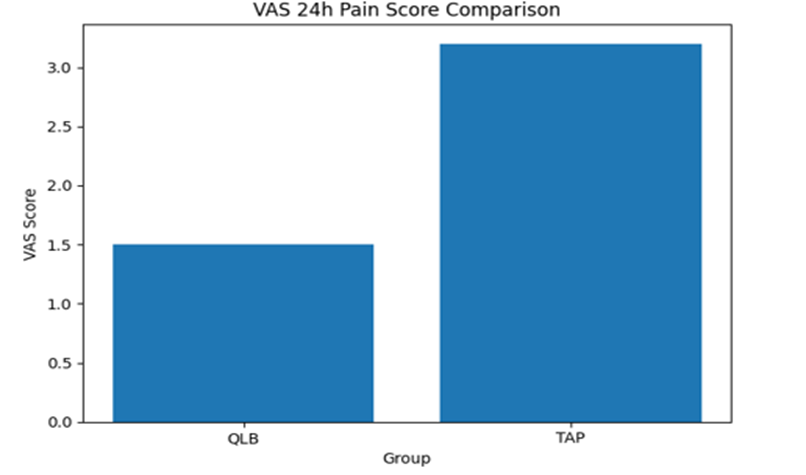
Figure 3: VAS 12h pain score comparison
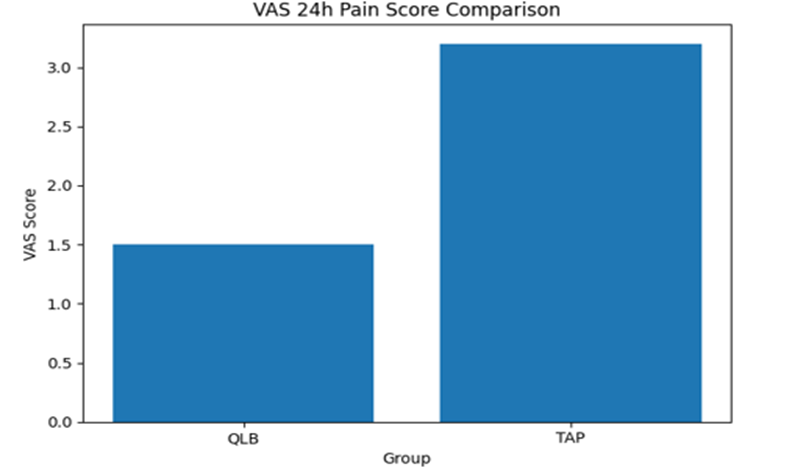
Figure 4: VAS 24h pain score comparison
DISCUSSION:
The current study clearly reveals that the Quadratus Lumborum Block (QLB) delivers better postoperative analgesia than the Transversus Abdominis Plane Block (TAP block) in patients undergoing laparoscopic pyeloplasty. The QLB group had significantly lower Visual Analog Scale (VAS) scores at all postoperative time intervals, indicating more effective and consistent pain control(7). This improved analgesic impact is explained by QLB's unique method, which involves the local anesthetic spreading along the thoracolumbar fascia and extending into the paravertebral region. This anatomical distribution enables the blockage of both somatic and visceral afferent nerve fibers, delivering complete analgesia(8).
In contrast, the TAP block focuses on nerves in the fascial plane between the internal oblique and transversus abdominis muscles. While it efficiently alleviates somatic pain from the anterior abdominal wall, it has little effect on visceral pain pathways. This limitation most likely accounted for the TAP group's much higher VAS scores and increased need for rescue analgesics in the current trial(9). Another significant result is that QLB is related with extended analgesia, which can persist up to 24-48 hours after surgery. This prolonged analgesic effect is clinically significant because it minimizes the requirement for systemic analgesics, particularly opioids, decreasing their associated side effects such as nausea, vomiting, drowsiness, and respiratory depression. The delayed time to first rescue analgesia underscores QLB's long-term efficacy in the postoperative phase(10).
Furthermore, QLB has a larger dermatomal coverage (T7-L2), making it ideal for surgeries involving both the upper and lower abdomen areas, such as laparoscopic urology treatments. This broader sensory blocking improves patient comfort and helps to faster postoperative recovery and mobilization(11). Overall, while both QLB and TAP block are safe and effective regional anesthesia procedures, QLB is a better option due to its greater analgesic profile, longer duration of action, and larger dermatomal coverage. These findings are consistent with previous research and support the increased preference for QLB as the major mode of postoperative pain treatment in abdominal operations(12).
CONCLUSION:
Quadratus lumborum block produces considerably better and longer-lasting postoperative analgesia than TAP block in laparoscopic pyeloplasty. It lowers pain scores, increases analgesia duration, and minimizes analgesic requirements. As a result, QLB can be deemed a more effective regional anesthetic approach for managing postoperative pain in laparoscopic urological surgeries.
REFERENCES:
1. Sk A, Kumar A, Kumar A, Sinha C. Comparison of three quadratus lumborum block approaches for pediatric lower abdominal surgeries : a randomized controlled trial. Brazilian J Anesthesiol (English Ed [Internet]. 2025;75(6):844683.
2. Fargaly OS, Boules ML, Hamed MA, Abdel M, Abbas A, Shawky MA. Lateral Quadratus Lumborum Block versus Transversus Abdominis Plane Block in Laparoscopic Surgery : A Randomized Controlled Study. Anesthesiol Res Pract. 2022;2022:1–6.
3. Malla MS, Ashraf S, Najib R, Hakeem A. Ultrasound-guided quadratus lumborum block verses transversus abdominis plane block for post-operative analgesia in patients undergoing total abdominal hysterectomy : A prospective observational study. ASIAN J Med Sci. 2021;12(11):119–24.
4. Kalpana Verma, Aman Malawat, Durga Jethava DDJ. Comparison of transversus abdominis plane block and quadratus lumborum block for post ‑ caesarean section analgesia : A randomised clinical trial. Indian J Anaesth. 2019;63(10):820–6.
5. Öksüz G, Doğan AB. Efficacy of Quadratus Lumborum Block in Children with Laparoscopic-Assisted Pyeloplasty. Erciyes Med J. 2019;41(1):2018–20.
6. Sharma M, Kumar P, Hussain M, Kishore N, Abassi N. Comparison of Quadratus Lumborum Block ( QLB ) versus Thoracic Paravertebral Block for analgesia in patients of Laparoscopic Nephrectomy : A Prospective Randomized Controlled Trial. Eur J Cardiovasc Med. 2025;15(01):391–7.
7. Ellatif SEA, Ahmed FM. Ultrasound-guided quadratus lumborum block versus transversus abdominis plane block in children undergoing laparoscopic appendectomy : a randomized controlled study. Res Opin Anesth Intensive Care. 2020;7(2):167–75.
8. Saleh AH, Abdallah MW, Mahrous AM, Ali NA. Quadratus lumborum block ( transmuscular approach ) versus transversus abdominis plane block ( unilateral subcostal approach ) for perioperative analgesia in patients undergoing open nephrectomy : a randomized , double-blinded , controlled trial ଝ. Brazilian J Anesthesiol (English Ed [Internet]. 2021;71(4):367–75.
9. El H, Moawad S, Abdelsalam T, Ghareeb S, Makharita MY. Anesthetics and Anesthesiology Posterior Quadratus Lumborum Block versus Subcostal Transversus Abdominis Plane Block in Laparoscopic Cholecystectomy. Int J Anesth Anesth. 2019;6(3):1–7.
10. Eftimie MA, Obris B, Sorohan B, Mirea LE, Georgescu E. Quadratus Lumborum Block Versus Transversus Abdominis Plane Block for Postoperative Analgesia After Laparoscopic Colorectal Surgery. Medicina (B Aires). 2025;61(825):1–14.
11. Jayakumar C, P MP. Comparative Evaluation of Quadratus Lumborum Block and Transversus Abdominis Plane Block in Postoperative Pain Control Following Lower Abdominal Surgeries. Int J Med Pharm Res. 2026;7(2):1256–61.
12. Yuan Q, Cui X, Fei Y, Xu Z, Huang Y. Transmuscular quadratus lumborum block versus thoracic paravertebral block for acute pain and quality of recovery after laparoscopic renal surgery : study protocol for a randomized controlled trial. Trials. 2019;20(276):1–7.