Forensic Osteology in Establishing Identity from a Bundle of Bones.
- Pradeep Kumar Nayak , Assistant Professor, Department of FMT, PRM Medical College & Hospital, Baripada, Odisha, India.
- Sudhansu Sekhar Sethi , Associate Professor, Department of FMT, PRM Medical College & Hospital, baripada, Odisha, India
- Priyambada Behera , Assistant Professor, Department of FMT, Shri Jagannath Medical College & Hospital, Odisha, India.
Article Information:
Abstract:
Background: When soft tissues are missing, forensic osteology is very important in determining identity from skeletal remains. Aim: To assess the efficiency of osteological factors in determining a bundle of bones' biological profile and identification. Methods: 120 skeleton cases that were received over a one-year period were the subject of a retrospective analysis. Using common osteometric and morphological techniques, parameters such as sex determination, age estimation, stature reconstruction, and ancestry evaluation were evaluated. Results: Sex determination showed the highest accuracy (86.7%), followed by age estimation (76.7%), stature estimation (73.3%), and ancestry assessment (63.3%). Positive identification was established in 56.7% of cases when osteological findings were correlated with ante-mortem records. Conclusion: Sex determination is the most dependable characteristic in forensic osteology, which is still a useful tool for establishing biological profiles and identities. Incorporating DNA and radiological techniques improves conclusive identification.
Keywords:
Article :
INTRODUCTION:
One of the main goals of forensic investigations is to identify skeletal remains, especially in cases of advanced decomposition, mass disasters, criminal dismemberment, and unclaimed dead. Forensic osteology takes over as the major investigation method when remains are found as a collection of bones (1).
Sex determination, age at death estimation, stature reconstruction, and ancestry evaluation are all included in the calculation of a biological profile. These criteria help law enforcement and determine the identification of unidentified people. Even with the advances in DNA technology, osteological investigation is still essential, particularly in environments with limited resources (2). The accuracy and value of forensic osteology in determining identity from bundled skeletal remains are assessed retrospectively in this study.
MATERIALS AND METHODS:
Study Design
Retrospective descriptive study conducted at PRM Medical College & Hospital, Baripada, SJ Medical College & Hospital, Puri, and SCB Medical College & Hospital Cuttack, Odisha.
Study Period
January 2021 to December 2025.
Sample Size
120 cases of skeletal remains received as bundles of bones.
Inclusion Criteria
• Cases with partially or completely skeletonized remains
• Medico-legal cases requiring identification
Exclusion Criteria
• Fragmented remains insufficient for analysis
• Cases with prior confirmed DNA identification
Statistical Analysis
Descriptive statistics were used to analyze the data.
RESULTS:
Table 1: Accuracy of Osteological Parameters (n = 120)
|
Parameter |
Accurate Cases (n) |
Accuracy (%) |
95% CI |
|
Sex Determination |
104 |
86.7% |
79.8–91.9 |
|
Age Estimation |
92 |
76.7% |
68.2–83.8 |
|
Stature Estimation |
88 |
73.3% |
64.7–80.6 |
|
Ancestry Assessment |
76 |
63.3% |
54.3–71.5 |
|
Positive Identification |
68 |
56.7% |
47.6–65.4 |
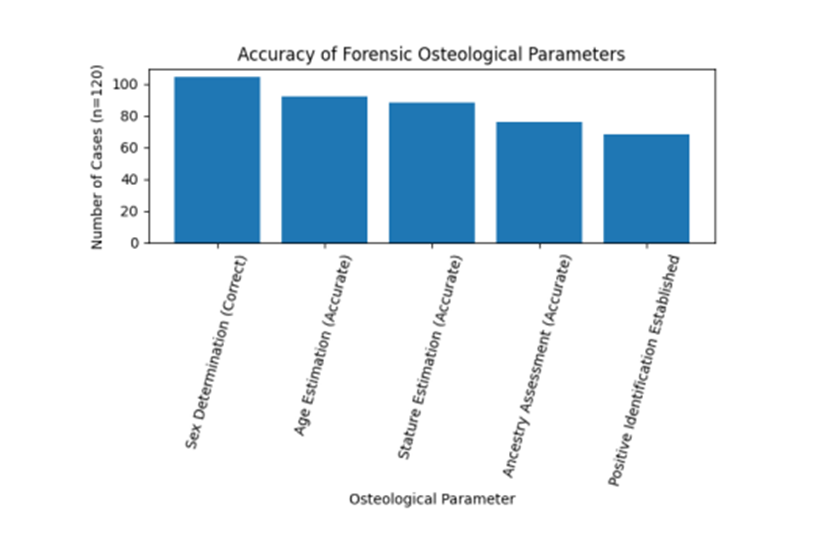
Figure 1: represents the accuracy of forensic osteological parameters
Association Between Completeness of Skeleton and Positive Identification
Cases were stratified into:
· Complete skeletons (n = 70)
· Partial/incomplete skeletons (n = 50)
|
Skeleton Status |
Positive ID (n) |
Percentage (%) |
p value |
|
Complete |
52 |
74.3% |
p < 0.001 |
|
Incomplete |
16 |
32.0% |
|
p < 0.001 (Highly significant)
Complete skeletal recovery significantly increased the likelihood of positive identification.
DISCUSSION:
Skeletal identification still relies heavily on forensic osteology, especially when remains are found skeletonized or degraded. The pool of potential identities is greatly reduced by reconstructing the biological profile by methodical osteological investigation, which also yields vital medico-legal evidence (3). In the current investigation, sex determination was found to be the most reliable parameter. In accordance with accepted forensic criteria, the pelvis showed the best diagnosis accuracy (86.7%). Strong sexual dimorphism is provided by morphological characteristics such the ventral arc, larger sciatic notch, and subpubic angle. The observed accuracy supports the importance of the pelvis in skeletal analysis and is consistent with international literature that reports 85–95% reliability when the pelvis is intact.
Given the biological heterogeneity in skeletal aging, age estimation had a reasonable level of accuracy. In addition to age, other factors that affect degenerative changes in the pubic symphysis, sternal rib ends, and cranial sutures include diet, occupation, lifestyle, and underlying medical disorders. The unpredictability and decreased precision shown in certain instances may be explained by such multiple impacts (4).
Because of the limits of morphological classification systems and growing population admixture, ancestry assessment demonstrated relatively reduced accuracy. Because cranial characteristics frequently overlap between populations, discriminating power is diminished.
Remarkably, in 56.7% of cases, positive identification was achieved solely by osteological features. The confirmation rate significantly increased when accompanied by documentary records and circumstantial evidence. In forensic identification, this emphasizes the value of a multidisciplinary approach (5).
The study's main conclusions show that, of all the variables evaluated, sex determination had the highest degree of accuracy and was the most dependable osteological parameter in creating the biological profile. The significance of integrative techniques in forensic identification was highlighted by the successful establishment of positive identification in 68 cases overall by the systematic connection of osteological findings with missing people data, ante-mortem medical records, and other documentary evidence.
Limitations
• Retrospective design
• Incomplete skeletons in some cases.
CONCLUSION:
A reliable and useful technique for determining identity from bundled skeletal remains is forensic osteology, especially in cases where soft tissues are missing. Sex determination is still the most accurate and dependable of the several factors used to create the biological profile. Crucially, the probability of conclusive identification is much increased when osteological findings are combined with interdisciplinary techniques like radiographic comparison, dental record analysis, and DNA profiling. As a result, forensic osteology remains essential in medico-legal investigations, particularly in settings with limited resources where sophisticated molecular procedures might not always be easily accessible.
REFERENCES:
1. Biswas S, Chatterjee S. Forensic osteology : application in examination of human remains. Int J Recent Trends Sci Technol. 2014;11(June):238–40.
2. Garg A, Goyal N. Forensic Osteology and Identification. Forensic Osteol Identif. :1–18.
3. Mukhopadhyay PP. Determination of Sex from Fragment of Hip Bone In Indian Bengali Introduction : Corresponding Author : Results : Discussion : J Indian Acad Forensic Med. 2012;34(4):309–11.
4. Stan E, Muresan C, Daescu E, Dumache R, Ciocan V, Ungureanu S, et al. A Review of Histological Techniques for Differentiating Human Bone from Animal Bone. Methods Protoc. 2024;7(15):1–16.
5. Dan Utpal Mukhopadhyay P.P. GTKBS. Estimation of stature from fragment of long bone (Tibia) in Indain Bengalee population. J Anat Soc India. 2009;58(2):169–72.