A Cross-Sectional Study to Assess Knowledge, Attitude, and Practice Regarding Over-the-Counter (OTC) Analgesic Use Among Undergraduate Medical Students of Osmania Medical College, Hyderabad.
- Ayesha Vaseem , MBBS, MD pharmacology Associate professor, government medical college, Pillikotyal, medak, Telangana 502110.
- Mohammed Faisal , MBBS, MD pharmacology, senior resident, Government medical college, Pillikotyal, medak, Telangana 502110.
- Khuteja afshan mulgund , MBBS, MD pharmacology, Assistant professor, terna medical college, Sector-12, Phase-2, Terna school road, Nerul West, Navi Mumbai, Maharashtra 400706.
Article Information:
Abstract:
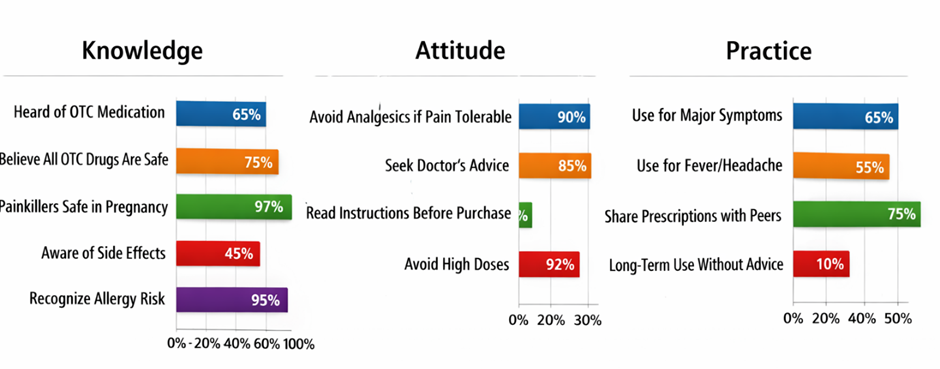
Background: Over-the-counter (OTC) analgesics are widely consumed worldwide due to their accessibility and perceived safety. However, inappropriate use can result in hepatotoxicity, gastrointestinal bleeding, cardiovascular complications, or dependence [5]. Medical students, with their pharmacological knowledge and easy access to drugs, are particularly prone to self-medication practices [6]. Aims and Objectives: This study aimed to assess knowledge, attitude, and practice (KAP) regarding OTC analgesic use among undergraduate medical students of Osmania Medical College, Hyderabad, and to identify gaps that may inform educational interventions. Materials and Methods: A cross-sectional descriptive study was conducted among 300 MBBS students over two months using a structured questionnaire. Data were collected online and analysed using descriptive statistics. Results: While 65% had heard of OTC medications, misconceptions persisted: 75% believed all OTC drugs are safe, and 97% thought painkillers are safe in pregnancy. Attitudes were generally positive, with 90% avoiding analgesics when pain was tolerable and 85% seeking medical advice for unfamiliar drugs. However, practices revealed unsafe behaviours — 75% shared prescriptions, and only 10% read instructions before use. Conclusion: Although awareness of OTC analgesics exists, significant gaps remain in safe usage practices. Educational interventions integrated into the medical curriculum are necessary to promote rational drug use and prevent adverse outcomes [6–10].
Keywords:
Article :
INTRODUCTION:
The overall prevalence of daily analgesic use was 8.5%, and the prevalence of analgesic use a few times a week 13.6%. The adjusted prevalence of using exclusively prescribed analgesics daily or a few times a week was 8.7%, and that of utilizing purely OTC analgesics 8.8%. [2]
Analgesics are among the most frequently consumed drugs globally, both prescribed and OTC [2]. In developed countries, NSAIDs and paracetamol are widely used for musculoskeletal pain, headaches, and fever. In India, self-medication is common due to easy drug availability, cultural acceptance, and limited enforcement of prescription regulations [6]. Studies in Indonesia [11], Malaysia [12], and Saudi Arabia [13] have highlighted similar trends, with high prevalence of OTC analgesic use among students.
Analgesics are classified into non-opioid (NSAIDs, paracetamol), opioid, and adjuvant categories [1]. Opioids act primarily by activating μ-opioid receptor. Opioids are among the most effective analgesics available and are the first choice in the treatment of acute severe pain. However, partial efficacy, a tendency to produce tolerance, and a host of ill-tolerated side effects make clinically available opioids less effective in the management of chronic pain syndromes [4] NSAIDs remain one of the most consumed drugs either by prescription or over the counter. Inhibition of Prostaglandins synthesis as a mechanism of action of aspirin like drugs (NSAIDs) [3]. NSAIDs increase gastrointestinal and cardiovascular risks, and opioids carry dependence potential [5].
Need for Research:
Medical students, due to their pharmacological knowledge, often self-medicate with OTC analgesics. However, inappropriate dosing, misconceptions about safety in pregnancy, and neglect of side effects can lead to harmful outcomes [6–8]. Previous studies have shown gaps in knowledge and unsafe practices among students [6,7]. Therefore, assessing KAP among Indian medical students is crucial to design targeted educational interventions.
MATERIALS AND METHODS:
Study Design: Cross-sectional descriptive study, through structured questionnaire
Study Setting: Osmania Medical College, Hyderabad
Study Period: Two months
Sample Size: 300 MBBS students
Sampling Method: Convenient sampling
Inclusion Criteria: MBBS students willing to participate
Exclusion Criteria: MBBS students unwilling to participate
Methodology: Structured questionnaire (17 items) covering demographics, knowledge, attitude, and practice. Questions included awareness of OTC drugs, perception of safety, reading instructions, and sharing prescriptions. Data were collected via online forms
Statistical Analysis: Responses were tabulated; percentages calculated. Associations between knowledge, attitude, and practice were compared with findings from similar studies
Ethical Approval: Institutional Ethics Committee approval obtained prior to commencement.
RESULTS:
Table 1. Knowledge of OTC Analgesics among Medical Students
|
Question |
Yes (%) |
No (%) |
|
Heard the term OTC Medication |
65 |
35 |
|
Are all OTC drugs safe and effective |
75 |
25 |
|
Painkillers can be taken every hourly when in pain |
10 |
90 |
|
All painkillers have side effects |
45 |
55 |
|
Painkillers relieve all types of pain and inflammation |
65 |
35 |
|
All painkillers are safe during pregnancy |
97 |
3 |
|
Patients can have allergy towards painkillers |
95 |
5 |
Table 2. Attitudes toward OTC Analgesic Use
|
Question |
Yes (%) |
No (%) |
|
Taking multiple analgesics at the same time relieves pain faster |
5 |
95 |
|
Taking high doses of analgesics resolves pain immediately |
8 |
92 |
|
Do you Refuse analgesics when pain was tolerable |
90 |
10 |
|
Is it appropriate to Seek doctor’s advice before using unfamiliar OTC medicine |
85 |
15 |
|
Reading instructions before/after purchasing analgesics |
10 |
90 |
Table 3. Practices of OTC Analgesic Use
|
Question |
Response Options |
% |
|
When do you use analgesics |
a) Major symptoms |
65 |
|
|
b) Minor symptoms |
25 |
|
|
c) Can’t visit doctor |
10 |
|
Illnesses for which OTC drugs are consumed |
a) Fever/Headache |
55 |
|
|
b) Dysmenorrhea |
30 |
|
|
c) Cough/Cold |
10 |
|
|
d) Other |
5 |
|
Do you share prescription with someone having similar symptoms |
Yes |
75 |
|
|
No |
25 |
|
Taking OTC drugs for longer time without medical advice |
Yes |
10 |
|
|
No |
90 |
|
Preferring OTC medication for all types of illness |
Yes |
15 |
|
|
No |
85 |
DISCUSSION:
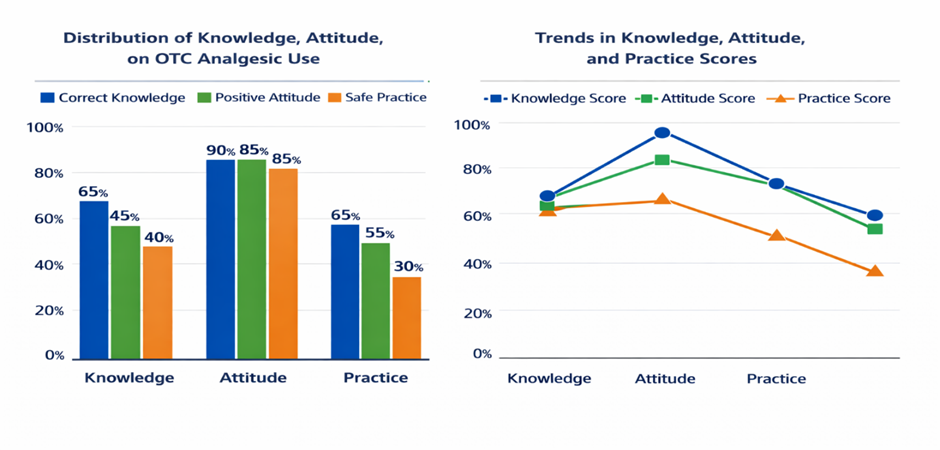
This study highlights widespread use of OTC analgesics among medical students, reflecting convenience and perceived safety. However, misconceptions persist — notably regarding safety in pregnancy and side effects. Positive attitudes toward responsible use were evident, but poor practices such as sharing prescriptions and neglecting instructions remain concerning.
Comparable studies in Indonesia [11] and Malaysia [12] reported moderate knowledge but unsafe practices, while Indian studies [6,7] confirmed similar gaps. The finding that 97% of students believed analgesics are safe in pregnancy is particularly alarming, as NSAIDs are contraindicated in late pregnancy due to risk of premature closure of the ductus arteriosus [5].
The tendency to share prescriptions (75%) reflects a cultural norm of peer reliance but poses risks of inappropriate dosing and adverse reactions. Only 10% reading instructions indicates poor engagement with drug safety information, consistent with findings from Saudi Arabia [13].
Educational interventions, including integration of rational drug use modules into the medical curriculum, are essential. Awareness campaigns, workshops, and case-based learning may improve safe practices.
CONCLUSION:
Medical students demonstrate awareness of OTC analgesics but significant gaps in safe usage remain. Misconceptions about safety in pregnancy, neglect of side effects, and unsafe practices such as sharing prescriptions highlight the urgent need for structured educational programs. Incorporating rational drug use into medical training will promote safe self-medication and reduce adverse outcomes [10].
REFERENCES:
1. Portenoy RK. Current pharmacotherapy of chronic pain. J Pain Symptom Manage. 2000 Jan;19(1 Suppl):S16-20. doi: 10.1016/s0885-3924(99)00124-4. PMID: 10687334.
2. Turunen JHO, Mäntyselkä PT, Kumpusalo EA, Ahonen RS. Frequent analgesic use at population level: prevalence and patterns of use. Pain. 2005 Jun;115(3):374-381. doi: 10.1016/j.pain.2005.03.013. PMID: 15911164.
3. Osafo N, Agyare C, Obiri DD, Antwi AO. Mechanism of Action of Nonsteroidal Anti-Inflammatory Drugs [Internet]. Nonsteroidal Anti-Inflammatory Drugs. InTech; 2017. Available from: http://dx.doi.org/10.5772/68090
4. Gendron L, Cahill CM, von Zastrow M, Schiller PW, Pineyro G. Molecular Pharmacology of δ-Opioid Receptors. Pharmacol Rev. 2016 Jul;68(3):631-700. doi: 10.1124/pr.114.008979. PMID: 27343248; PMCID: PMC4931872.
5. Labianca R, Sarzi-Puttini P, Zuccaro SM, Cherubino P, Vellucci R, Fornasari D. Adverse effects associated with non-opioid and opioid treatment in patients with chronic pain. Clin Drug Investig. 2012 Feb;32 Suppl 1:53-63. doi: 10.2165/11630080-000000000-00000. PMID: 23389876.
6. Bekele KM, Abay AM, Mengistu KA, Atsbeha BW, Demeke CA, Belay WS, Yimenu DK. Knowledge, Attitude, and Practice on Over-the-Counter Drugs Among Pharmacy and Medical Students: A Facility-Based Cross-Sectional Study. Integr Pharm Res Pract. 2020 Sep 15;9:135-146. doi: 10.2147/IPRP.S266786. PMID: 32983946; PMCID: PMC7501988.
7. Susheela F, Goruntla N, Bhupalam PK, Veerabhadrappa KV, Sahithi B, Ishrar SMG. Assessment of knowledge, attitude, and practice toward responsible self-medication among students of pharmacy colleges located in Anantapur district, Andhra Pradesh, India. J Educ Health Promot. 2018 Aug 2;7:96. doi: 10.4103/jehp.jehp_175_17. PMID: 30159342; PMCID: PMC6088819.
8. Kawuma R, Chimukuche RS, Francis SC, Seeley J, Weiss HA. Knowledge, use (misuse) and perceptions of over-the-counter analgesics in sub-Saharan Africa: a scoping review. Glob Health Action. 2021 Jan 1;14(1):1955476. doi: 10.1080/16549716.2021.1955476. PMID: 34420494; PMCID: PMC8386732.
9. Mittal P, Chan OY, Kanneppady SK, Verma RK, Hasan SS. Association between beliefs about medicines and self-medication with analgesics among patients with dental pain. PLoS One. 2018 Aug 2;13(8):e0201776. doi: 10.1371/journal.pone.0201776. PMID: 30071006; PMCID: PMC6072109.
10. Mulka-Gierek M, Krata N, Foroncewicz B, Pączek L, Mucha K. The Different Patterns of Over-the-Counter Nonsteroidal Anti-Inflammatory Drugs or Analgesics Use in Patients with Chronic Kidney Disease and the General Population. Healthcare (Basel). 2022 Oct 14;10(10):2035. doi: 10.3390/healthcare10102035. PMID: 36292481; PMCID: PMC9602380.
11. Sinuraya RK, Wulandari C, Amalia R, Puspitasari IM. Public knowledge, attitudes, and practices regarding the use of over-the-counter (OTC) analgesics in Indonesia: a cross-sectional study. Patient Prefer Adherence. 2023 Oct 17;17:2569‑78. doi:10.2147/PPA.S426290. PMID: 37869729; PMCID: PMC10590111.
12. Mohd Amin SNS, Mohd Rasani AA, Mamat MN. Knowledge, attitude, and practice of over-the-counter analgesics among undergraduate students in Health Campus, Universiti Sains Malaysia. Asian J Med Biomed. 2022;6(S1):211‑3. doi:10.37231/ajmb.2022.6.S1.590.
13. Salih S, Madkhali AA, Al‑Hazmi WM, Al‑Khaldy AY, Moafa TA, Al‑Gahtani EZ, Al‑Muhib MO. Knowledge, attitude, and practices on over-the-counter oral analgesics among female students of Jazan University. Int J Med Dev Ctries. 2019;3(4):311‑5. doi:10.24911/IJMDC.51‑1544048783.