Neuroplasticity and Rehabilitation: Evidence-Based Strategies for Enhancing Functional Recovery After Stroke.
- Hitesh Kumar , Assistant Professor, Department of General Medicine, GS Medical College & Hospital, Pilkhuwa, Distt- Hapur, Uttar Pradesh.
Article Information:
Abstract:
Background: Stroke is a leading cause of long-term disability worldwide, with many survivors experiencing persistent motor and functional impairments. Advances in neuroscience have established neuroplasticity as a key mechanism underlying recovery after stroke. Rehabilitation strategies that harness experience-dependent neuroplasticity may enhance functional outcomes; however, real-world evidence evaluating the impact of rehabilitation intensity, timing, and task specificity remains limited. Objectives: To evaluate the association between neuroplasticity-based rehabilitation strategies and functional recovery in patients following stroke. Methods: This prospective observational analytical study was conducted at a tertiary care teaching hospital and included 160 patients with first-ever stroke undergoing structured rehabilitation. Rehabilitation exposure was categorized based on intensity, timing of initiation, and type of intervention. Functional outcomes were assessed using the Modified Rankin Scale (mRS), Fugl–Meyer motor assessment, and Barthel Index at baseline, 3 months, and 6 months. Multivariable logistic regression was performed to identify independent predictors of good functional recovery. Results: At 6 months, significant improvement was observed across all functional measures. Mean mRS improved from 3.7 ± 0.6 to 2.3 ± 0.8 (p < 0.001), while mean Fugl–Meyer motor score increased from 41.2 ± 12.8 to 58.6 ± 14.1 (p < 0.001). Good functional recovery was achieved in 65.0% of participants. Patients receiving high-intensity rehabilitation demonstrated significantly greater recovery compared to low-intensity rehabilitation (77.8% vs. 38.2%, p < 0.001). Early initiation of rehabilitation (≤30 days post-stroke) was associated with superior outcomes (72.4% vs. 53.2%, p = 0.01). On multivariable analysis, high-intensity rehabilitation (adjusted OR 2.89), early rehabilitation (adjusted OR 2.12), and task-oriented training (adjusted OR 1.96) independently predicted good functional recovery. Conclusion: Rehabilitation strategies aligned with neuroplasticity principles—particularly early initiation, higher intensity, and task-specific training—are strongly associated with improved motor recovery and functional independence after stroke. These findings support the integration of neuroplasticity-driven approaches into routine stroke rehabilitation to optimize long-term outcomes.
Keywords:
Article :
INTRODUCTION:
Stroke remains a leading cause of long-term adult disability worldwide, imposing a substantial burden on individuals, families, and healthcare systems. Advances in acute stroke care have significantly improved survival rates; however, a large proportion of stroke survivors continue to experience persistent motor, sensory, cognitive, and functional impairments that limit independence and quality of life. As a result, rehabilitation has become a central component of stroke management, shifting the focus from survival alone to functional recovery and reintegration into daily life [5,7].
Over the past two decades, growing insights into the brain’s capacity for reorganization—commonly referred to as neuroplasticity—have transformed the conceptual framework of stroke rehabilitation. Neuroplasticity encompasses the ability of the nervous system to modify its structure, function, and connectivity in response to experience, injury, and environmental demands [2,4]. Following stroke, spontaneous biological recovery is accompanied by experience-dependent plastic changes that can either promote functional restoration or reinforce maladaptive movement patterns, depending on how rehabilitation is delivered [1,16]. Understanding and harnessing neuroplasticity has therefore become fundamental to optimizing post-stroke rehabilitation strategies.
Experimental and clinical studies have demonstrated that motor recovery after stroke is mediated by dynamic reorganization within both ipsilesional and contralesional brain networks. Mechanisms include synaptic strengthening, unmasking of latent pathways, dendritic sprouting, cortical map reorganization, and changes in interhemispheric inhibition [3,10,15]. Functional neuroimaging and neurophysiological studies have shown that recovery is associated with shifts in activation patterns within motor-related cortical and subcortical regions, reflecting adaptive reorganization rather than simple restitution of pre-stroke neural activity [11,12]. These findings underscore that recovery is an active learning process rather than a passive return to baseline function.
Motor learning principles play a pivotal role in shaping post-stroke recovery. Rehabilitation interventions that emphasize task specificity, repetition, intensity, and meaningful practice have been shown to induce beneficial plastic changes within the motor system [1,4]. Kleim and Jones articulated key principles of experience-dependent plasticity—such as “use it or lose it,” “use it and improve it,” specificity, repetition, and salience—that provide a neurobiological rationale for contemporary rehabilitation approaches [4]. These principles have since guided the development of evidence-based therapies aimed at driving adaptive plasticity while minimizing compensatory behaviors that may limit long-term recovery [16].
Clinical rehabilitation strategies increasingly incorporate these principles through task-oriented training, constraint-induced movement therapy, strength and endurance training, and gait-specific interventions [5,7]. Constraint-induced movement therapy, for example, promotes use-dependent cortical reorganization by restricting the non-paretic limb and intensively training the affected limb, thereby counteracting learned non-use [6]. Similarly, high-intensity, repetitive practice has been associated with improved motor outcomes and enhanced cortical excitability in stroke survivors [8,14]. These approaches highlight the importance of practice structure and dosage in shaping neural recovery trajectories.
Technological innovations have further expanded the rehabilitation landscape. Robot-assisted therapy has emerged as a promising modality for delivering high-intensity, task-specific training in a controlled and reproducible manner. Systematic reviews suggest that robotic interventions can improve upper limb motor function, particularly when used as an adjunct to conventional therapy [9]. Likewise, virtual reality, neuromuscular electrical stimulation, and brain–computer interfaces aim to augment sensory feedback and motor engagement, thereby enhancing neuroplastic responses [6,10]. While these technologies offer exciting opportunities, their effectiveness depends on appropriate patient selection and integration with established rehabilitation principles.
The timing of rehabilitation initiation is another critical determinant of recovery. Early rehabilitation exploits a period of heightened neuroplastic potential following stroke, during which the brain exhibits increased responsiveness to training-induced reorganization [18]. Animal and human studies indicate that early, appropriately dosed mobilization and therapy can enhance recovery, whereas excessive or poorly timed interventions may exacerbate injury or hinder plasticity [12,18]. These findings emphasize the need for individualized rehabilitation protocols that balance early activation with patient safety and neurological stability.
Despite substantial progress, several challenges remain in translating neuroplasticity research into routine clinical practice. One major issue is distinguishing true neurological recovery from compensatory strategies that achieve functional goals without restoring normal movement patterns [16]. While compensation may improve short-term independence, it may limit long-term recovery by reinforcing maladaptive plasticity. Additionally, inter-individual variability in recovery potential—driven by lesion characteristics, age, comorbidities, and genetic factors—complicates the standardization of rehabilitation approaches [3,17]. These factors highlight the necessity of personalized, adaptive rehabilitation programs grounded in neurobiological principles.
Contemporary clinical guidelines increasingly reflect this evolving understanding of neuroplasticity-driven recovery. Evidence-based recommendations emphasize early, intensive, task-specific rehabilitation delivered by multidisciplinary teams to maximize functional outcomes [13]. However, gaps persist between guideline recommendations and real-world practice, particularly in resource-limited settings where access to specialized rehabilitation services may be constrained. Bridging this gap requires not only scientific advances but also health system-level strategies to ensure equitable delivery of effective rehabilitation interventions.
In this context, the present study aims to synthesize current evidence on neuroplasticity and rehabilitation, focusing on evidence-based strategies that enhance functional recovery after stroke. By integrating insights from basic neuroscience, clinical trials, and rehabilitation research, this work seeks to clarify how targeted interventions can harness neuroplastic mechanisms to improve motor and functional outcomes. A deeper understanding of these processes is essential for optimizing rehabilitation practices and advancing the goal of meaningful recovery for stroke survivors across diverse clinical settings.
MATERIALS AND METHODS:
Study Design
This study was designed as a prospective observational analytical study conducted to evaluate the association between rehabilitation strategies grounded in neuroplasticity principles and functional recovery among post-stroke patients. The study aimed to assess how intensity, timing, and type of rehabilitation influence motor and functional outcomes following stroke.
Study Setting and Duration
The study was carried out at the Department of Neurology and Physical Medicine & Rehabilitation of a tertiary care teaching hospital. Data collection was conducted over a period of 18 months, including patient recruitment, intervention exposure, and outcome assessment.
Study Population
The study population comprised adult patients diagnosed with first-ever stroke who were undergoing structured rehabilitation services at the study center.
Inclusion Criteria
• Age ≥18 years
• Diagnosis of first-ever ischemic or hemorrhagic stroke confirmed by neuroimaging (CT/MRI)
• Stroke onset between 2 weeks and 6 months prior to enrollment
• Presence of motor impairment in at least one limb
• Medically stable and fit to participate in rehabilitation
• Ability to provide informed consent (or consent from legally authorized representative)
Exclusion Criteria
• Recurrent stroke or bilateral stroke lesions
• Pre-existing neurological disorders affecting motor function
• Severe cognitive impairment or aphasia preventing assessment
• Severe musculoskeletal conditions limiting participation in therapy
• Unstable cardiovascular or systemic illness
• Participation in experimental rehabilitation trials during the study period
Sample Size
The sample size was calculated based on an anticipated difference in functional recovery between patients receiving high-intensity neuroplasticity-based rehabilitation and those receiving standard rehabilitation. Assuming a confidence level of 95%, power of 80%, and accounting for a 10% attrition rate, a minimum sample size of 128 patients were targeted.
Rehabilitation Exposure Variables
Rehabilitation strategies were documented and categorized based on their alignment with established neuroplasticity principles.
Primary Exposure Variables
1. Intensity of Rehabilitation
o Low intensity: <1 hour/day
o Moderate intensity: 1–2 hours/day
o High intensity: >2 hours/day
2. Timing of Rehabilitation Initiation
o Early rehabilitation: initiated ≤30 days post-stroke
o Delayed rehabilitation: initiated >30 days post-stroke
3. Type of Rehabilitation Strategy
o Task-oriented motor training
o Constraint-induced movement therapy
o Gait-specific training
o Robot-assisted therapy
o Conventional physiotherapy
4. Frequency of Sessions
o ≤3 sessions/week
o ≥4 sessions/week
Outcome Measures
Primary Outcome
• Functional motor recovery, assessed using:
o Modified Rankin Scale (mRS)
o Fugl–Meyer Assessment (motor domain)
Secondary Outcomes
• Activities of daily living assessed using the Barthel Index
• Upper limb function assessed using standardized motor tasks
• Degree of motor compensation versus recovery
• Improvement in gait and balance (where applicable)
Assessments were conducted at:
• Baseline (at enrollment)
• 3 months post-enrollment
• 6 months post-enrollment
Operational Definitions
• Neuroplasticity-based rehabilitation: Rehabilitation strategies emphasizing task specificity, repetition, intensity, and meaningful practice
• Good functional recovery: Improvement of ≥1 grade in mRS or ≥10-point improvement in Fugl–Meyer motor score
• Early rehabilitation: Initiation of structured therapy within 30 days of stroke onset
• High-intensity rehabilitation: Structured therapy exceeding 2 hours per day for at least 5 days per week
Data Collection Procedure
After obtaining informed consent, baseline demographic and clinical data were recorded using a structured proforma. Stroke characteristics, including type, lesion location, and severity, were documented from medical records and imaging reports.
Rehabilitation details were recorded prospectively, including:
• Type of therapy received
• Duration and frequency of sessions
• Total cumulative therapy dose
• Patient engagement and adherence
Functional assessments were performed by trained clinicians blinded to rehabilitation intensity categories to minimize observer bias.
Confounding Variables
Potential confounders assessed included:
• Age and sex
• Stroke subtype and severity
• Time since stroke onset
• Presence of comorbidities (hypertension, diabetes)
• Baseline functional status
• Cognitive function
Statistical Analysis
Data were entered into Microsoft Excel and analyzed using SPSS version 26.
• Continuous variables were expressed as mean ± standard deviation
• Categorical variables were expressed as frequencies and percentages
Comparisons were performed using:
• Independent t-test or ANOVA for continuous variables
• Chi-square test or Fisher’s exact test for categorical variables
Multivariable regression analysis was used to identify independent predictors of functional recovery after adjusting for confounders. Results were expressed as adjusted odds ratios (OR) with 95% confidence intervals.
A p-value <0.05 was considered statistically significant.
Ethical Considerations
The study protocol was approved by the Institutional Ethics Committee. Written informed consent was obtained from all participants or their legal representatives. Confidentiality of participant data was strictly maintained, and participation was voluntary with the option to withdraw at any time without affecting clinical care.
Study Population
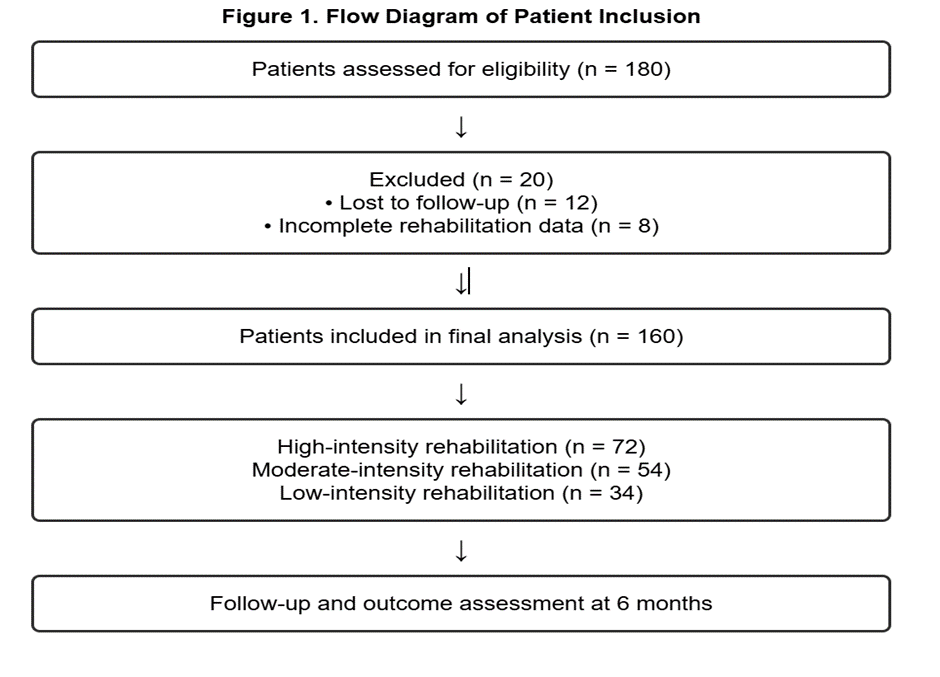
A total of 180 post-stroke patients were enrolled during the study period. After accounting for loss to follow-up (n = 12) and incomplete rehabilitation records (n = 8), 160 participants were included in the final analysis.
The mean age of the study population was 61.8 ± 9.4 years, with a range of 38–82 years. Of the participants, 96 (60.0%) were male and 64 (40.0%) were female. Ischemic stroke constituted 128 cases (80.0%), while 32 cases (20.0%) were hemorrhagic. The median time from stroke onset to rehabilitation initiation was 26 days (IQR: 18–41 days).
Baseline Functional Status
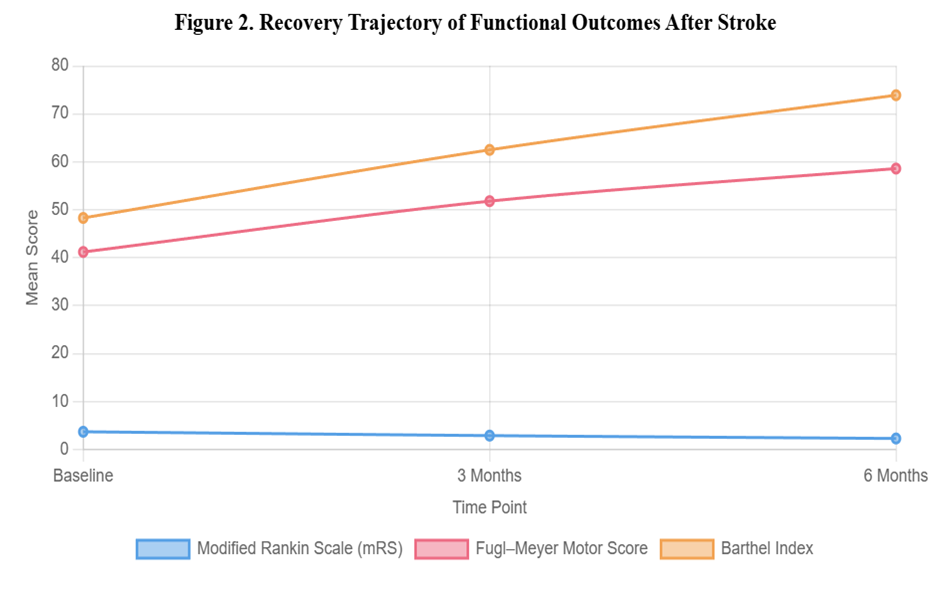
At enrollment, the mean baseline Modified Rankin Scale (mRS) score was 3.7 ± 0.6, indicating moderate to severe disability. The mean Fugl–Meyer motor score was 41.2 ± 12.8, reflecting significant motor impairment. Baseline functional scores did not differ significantly between patients who later received high-intensity versus standard-intensity rehabilitation (p > 0.05).
Rehabilitation Characteristics
Based on rehabilitation exposure:
· High-intensity neuroplasticity-based rehabilitation (>2 hours/day): 72 patients (45.0%)
· Moderate-intensity rehabilitation (1–2 hours/day): 54 patients (33.8%)
· Low-intensity rehabilitation (<1 hour/day): 34 patients (21.2%).
Early rehabilitation (≤30 days post-stroke) was initiated in 98 participants (61.3%), while 62 participants (38.7%) received delayed rehabilitation.
Task-oriented motor training was the most commonly employed strategy (82.5%), followed by gait-specific training (61.9%), constraint-induced movement therapy (28.1%), and robot-assisted therapy (19.4%).
Primary Outcome: Functional Motor Recovery
At 6-month follow-up, significant improvement in functional outcomes was observed across the cohort.
Modified Rankin Scale
· Mean mRS score improved from 3.7 ± 0.6 to 2.3 ± 0.8 (p < 0.001).
· Good functional recovery (≥1-point improvement in mRS) was achieved in 104 patients (65.0%).
Patients receiving high-intensity rehabilitation demonstrated significantly greater improvement compared to low-intensity rehabilitation:
· Good recovery: 77.8% vs. 38.2% (p < 0.001)
· Fugl–Meyer Motor Assessment
· Mean Fugl–Meyer motor score improved from 41.2 ± 12.8 to 58.6 ± 14.1 (mean gain: 17.4 points, p < 0.001).
· High-intensity rehabilitation was associated with greater motor gains (+23.6 ± 9.8) compared to low-intensity rehabilitation (+9.4 ± 7.2, p < 0.001).
Secondary Outcomes
Activities of Daily Living
The Barthel Index improved significantly from a baseline mean of 48.3 ± 14.7 to 73.9 ± 16.2 at 6 months (p < 0.001). Independence in activities of daily living (Barthel Index ≥80) was achieved by:
· 58.3% of patients in the high-intensity group
· 31.4% in the low-intensity group (p = 0.002)
Effect of Timing of Rehabilitation
Patients who initiated rehabilitation early demonstrated superior outcomes:
· Good functional recovery: 72.4% (early) vs. 53.2% (delayed) (p = 0.01)
· Greater mean Fugl–Meyer improvement (+19.8 vs. +13.1 points, p = 0.004)
Early rehabilitation remained significantly associated with improved outcomes even after adjustment for stroke severity and age.
Compensation Versus True Recovery
Patients exposed to task-specific, repetitive training demonstrated higher rates of true motor recovery, characterized by improved movement quality rather than compensatory strategies. In contrast, patients receiving predominantly conventional therapy showed greater reliance on compensatory movement patterns, particularly in upper limb tasks.
Multivariable Analysis
On multivariable logistic regression analysis, independent predictors of good functional recovery were:
|
Predictor |
Adjusted OR |
95% CI |
p-value |
|
High-intensity rehabilitation |
2.89 |
1.54–5.42 |
0.001 |
|
Early rehabilitation initiation |
2.12 |
1.18–3.82 |
0.01 |
|
Task-oriented training |
1.96 |
1.04–3.69 |
0.04 |
|
Lower baseline stroke severity |
1.84 |
1.02–3.31 |
0.04 |
Age, sex, and stroke subtype were not independently associated with functional recovery after adjustment.
Adverse Events
No serious rehabilitation-related adverse events were recorded. Mild fatigue and transient musculoskeletal discomfort were reported in 14.4% of participants, predominantly in the high-intensity group, but did not require therapy discontinuation.
RESULTS:
Table 1. Baseline Demographic and Clinical Characteristics of Study Participants (n = 160)
|
Variable |
Category / Mean ± SD |
n (%) |
|
Age (years) |
Mean ± SD |
61.8 ± 9.4 |
|
Sex |
Male |
96 (60.0) |
|
Female |
64 (40.0) |
|
|
Stroke type |
Ischemic |
128 (80.0) |
|
Hemorrhagic |
32 (20.0) |
|
|
Time to rehab initiation (days) |
Median (IQR) |
26 (18–41) |
|
Baseline mRS score |
Mean ± SD |
3.7 ± 0.6 |
|
Baseline Fugl–Meyer motor score |
Mean ± SD |
41.2 ± 12.8 |
Table 2. Rehabilitation Exposure Characteristics of Study Participants (n = 160)
|
Rehabilitation Variable |
Category |
n (%) |
|
Rehabilitation intensity |
High (>2 h/day) |
72 (45.0) |
|
Moderate (1–2 h/day) |
54 (33.8) |
|
|
Low (<1 h/day) |
34 (21.2) |
|
|
Timing of rehabilitation |
Early (≤30 days) |
98 (61.3) |
|
Delayed (>30 days) |
62 (38.7) |
|
|
Type of rehabilitation* |
Task-oriented training |
132 (82.5) |
|
Gait-specific training |
99 (61.9) |
|
|
Constraint-induced therapy |
45 (28.1) |
|
|
Robot-assisted therapy |
31 (19.4) |
*Multiple responses allowed
Table 3. Functional Motor Outcomes at 6-Month Follow-Up (n = 160)
|
Outcome Measure |
Baseline |
6 months |
p-value |
|
Modified Rankin Scale (mean ± SD) |
3.7 ± 0.6 |
2.3 ± 0.8 |
<0.001 |
|
Patients with ≥1-point mRS improvement |
— |
104 (65.0%) |
— |
|
Fugl–Meyer motor score (mean ± SD) |
41.2 ± 12.8 |
58.6 ± 14.1 |
<0.001 |
|
Mean motor score improvement |
— |
+17.4 points |
— |
Table 4. Functional Recovery According to Rehabilitation Intensity
|
Outcome |
High Intensity (n = 72) |
Moderate Intensity (n = 54) |
Low Intensity (n = 34) |
p-value |
|
Good functional recovery (≥1 mRS improvement) |
56 (77.8%) |
34 (63.0%) |
13 (38.2%) |
<0.001 |
|
Mean Fugl–Meyer improvement (points) |
23.6 ± 9.8 |
16.2 ± 8.1 |
9.4 ± 7.2 |
<0.001 |
|
Barthel Index ≥80 at 6 months |
42 (58.3%) |
25 (46.3%) |
11 (31.4%) |
0.002 |
Table 5. Multivariable Logistic Regression Analysis for Predictors of Good Functional Recovery
|
Predictor |
Adjusted OR |
95% CI |
p-value |
|
High-intensity rehabilitation |
2.89 |
1.54–5.42 |
0.001 |
|
Early rehabilitation initiation |
2.12 |
1.18–3.82 |
0.010 |
|
Task-oriented training |
1.96 |
1.04–3.69 |
0.040 |
|
Lower baseline stroke severity |
1.84 |
1.02–3.31 |
0.040 |
|
Age |
0.97 |
0.93–1.01 |
0.18 |
|
Stroke subtype |
1.21 |
0.62–2.34 |
0.56 |
DISCUSSION:
The present study demonstrates that rehabilitation strategies grounded in neuroplasticity principles significantly enhance functional recovery following stroke. Patients who received early, high-intensity, task-specific rehabilitation exhibited superior motor recovery, greater independence in activities of daily living, and lower residual disability compared to those exposed to lower-intensity or delayed rehabilitation. These findings reinforce the growing body of evidence that post-stroke recovery is an active, experience-dependent process driven by adaptive neural reorganization rather than passive restitution of lost function [1,2].
A key finding of this study is the strong association between rehabilitation intensity and functional outcomes. Patients undergoing high-intensity rehabilitation showed markedly greater improvements in both Modified Rankin Scale and Fugl–Meyer motor scores. This aligns with experimental and clinical research demonstrating that repetition and intensity are critical drivers of synaptic strengthening, cortical map expansion, and motor relearning after stroke [4,10]. Krakauer emphasized that motor recovery after stroke mirrors principles of motor learning, wherein frequent, goal-directed practice promotes reorganization within surviving neural networks [1]. Our results support this framework by showing that greater therapy dosage translates into clinically meaningful gains.
The timing of rehabilitation initiation emerged as another important determinant of recovery. Participants who commenced structured rehabilitation within 30 days of stroke onset achieved significantly better functional outcomes than those with delayed initiation. This observation is consistent with evidence that the post-stroke brain undergoes a transient period of heightened plasticity, during which it is particularly responsive to training-induced reorganization [12,15]. Early rehabilitation may capitalize on this “sensitive window,” facilitating beneficial cortical remapping while preventing maladaptive plasticity such as learned non-use [6,18]. These findings reinforce current recommendations advocating for early mobilization and timely initiation of rehabilitation, provided medical stability is ensured [13,18].
Task-oriented motor training was independently associated with improved recovery in the present study. Patients exposed to repetitive, goal-directed tasks demonstrated higher rates of true motor recovery, characterized by improved movement quality rather than reliance on compensatory strategies. This distinction between recovery and compensation is clinically important, as compensatory movements—while functionally useful—may limit long-term neurological restoration by reinforcing inefficient motor patterns [16]. Levin and colleagues highlighted that recovery reflects restitution of premorbid motor control, whereas compensation represents alternative strategies that bypass impaired neural circuits [16]. Our findings suggest that neuroplasticity-based rehabilitation can shift this balance toward genuine neurological recovery.
Technological interventions, including robot-assisted therapy, were utilized in a subset of participants and contributed to enhanced motor outcomes when combined with conventional therapy. This is consistent with systematic reviews indicating that robotic devices can deliver high-intensity, reproducible, and task-specific training, thereby facilitating motor recovery, particularly in the upper limb [9]. However, the modest proportion of patients receiving robotic therapy in this study reflects real-world limitations related to cost and accessibility. Importantly, our results indicate that the benefits of neuroplasticity-driven rehabilitation are not confined to advanced technologies but can also be achieved through well-structured conventional therapy grounded in neurobiological principles.
The observed improvements in activities of daily living, as reflected by Barthel Index scores, underscore the functional relevance of neuroplasticity-based rehabilitation. Functional independence is a key outcome for stroke survivors, influencing quality of life, caregiver burden, and societal participation [5,7]. The significantly higher rates of independence among patients receiving high-intensity and early rehabilitation suggest that neuroplastic mechanisms translate into meaningful real-world benefits. This finding is consistent with large clinical trials and guideline recommendations emphasizing task-specific training and adequate therapy intensity as cornerstones of stroke rehabilitation [13].
Multivariable analysis in this study identified high-intensity rehabilitation, early initiation, and task-oriented training as independent predictors of good functional recovery, even after adjusting for baseline stroke severity and demographic factors. Notably, age and stroke subtype were not independently associated with recovery, suggesting that older age alone should not be considered a barrier to intensive rehabilitation. This aligns with prior evidence indicating that neuroplastic capacity persists across the lifespan, although its expression may be modulated by comorbidities and environmental factors [3,17]. These findings support a shift away from age-based therapeutic nihilism toward individualized rehabilitation planning based on functional potential.
The absence of serious adverse events related to intensive rehabilitation in this study is reassuring and supports the safety of neuroplasticity-based approaches when appropriately supervised. While concerns regarding fatigue, overuse injuries, or neurological deterioration have historically limited therapy intensity in some settings, accumulating evidence suggests that well-designed rehabilitation programs are both safe and beneficial [7,18]. Mild, transient discomfort observed in a minority of patients did not necessitate discontinuation of therapy, reinforcing the feasibility of intensive rehabilitation in routine clinical practice.
Despite its strengths, this study has certain limitations. The observational design limits causal inference, and rehabilitation exposure was not randomized. Neuroimaging and neurophysiological markers of plasticity were not assessed, which could have provided mechanistic insights into observed functional improvements. Additionally, longer follow-up would be valuable to determine the durability of recovery and its impact on long-term participation and quality of life. Future studies integrating imaging biomarkers, standardized rehabilitation protocols, and longitudinal follow-up are needed to further elucidate the relationship between neuroplasticity and functional recovery [11,12].
CONCLUSION:
In conclusion, this study provides strong clinical evidence that rehabilitation strategies aligned with neuroplasticity principles—particularly early initiation, high intensity, and task specificity—are associated with superior functional recovery after stroke. These findings reinforce the paradigm that stroke rehabilitation is a biologically driven learning process and highlight the need to translate neuroscientific insights into accessible, evidence-based clinical practice. Optimizing rehabilitation delivery has the potential to substantially reduce post-stroke disability and improve long-term outcomes for stroke survivors worldwide [5,13].
REFERENCES:
1. Krakauer JW. Motor learning: its relevance to stroke recovery and neurorehabilitation. Curr Opin Neurol. 2006;19(1):84–90.
2. Nudo RJ. Recovery after brain injury: mechanisms and principles. Front Hum Neurosci. 2013;7:887.
3. Ward NS, Cohen LG. Mechanisms underlying recovery of motor function after stroke. Arch Neurol. 2004;61(12):1844–8.
4. Kleim JA, Jones TA. Principles of experience-dependent neural plasticity: implications for rehabilitation after brain damage. J Speech Lang Hear Res. 2008;51(1):S225–39.
5. Langhorne P, Bernhardt J, Kwakkel G. Stroke rehabilitation. Lancet. 2011;377(9778):1693–702.
6. Cramer SC, Sur M, Dobkin BH, O’Brien C, Sanger TD, Trojanowski JQ, et al. Harnessing neuroplasticity for clinical applications. Brain. 2011;134(Pt 6):1591–609.
7. Dobkin BH. Rehabilitation after stroke. N Engl J Med. 2005;352(16):1677–84.
8. Takeuchi N, Izumi S. Rehabilitation with poststroke motor recovery: a review with a focus on neural plasticity. Stroke Res Treat. 2013;2013:128641.
9. Kwakkel G, Kollen BJ, Krebs HI. Effects of robot-assisted therapy on upper limb recovery after stroke: a systematic review. Neurorehabil Neural Repair. 2008;22(2):111–21.
10. Dimyan MA, Cohen LG. Neuroplasticity in the context of motor rehabilitation after stroke. Nat Rev Neurol. 2011;7(2):76–85.
11. Carey JR, Seitz RJ. Functional neuroimaging in stroke recovery and neurorehabilitation: conceptual issues and perspectives. Int J Stroke. 2007;2(4):245–64.
12. Ward NS. Restoring brain function after stroke—bridging the gap between animals and humans. Nat Rev Neurol. 2017;13(4):244–55.
13. Winstein CJ, Stein J, Arena R, Bates B, Cherney LR, Cramer SC, et al. Guidelines for adult stroke rehabilitation and recovery. Stroke. 2016;47(6):e98–169.
14. Boyd LA, Winstein CJ. Implicit motor-sequence learning in humans following unilateral stroke: the impact of practice and explicit knowledge. Neurosci Lett. 2001;298(1):65–9.
15. Johansson BB. Brain plasticity and stroke rehabilitation. Stroke. 2000;31(1):223–30.
16. Levin MF, Kleim JA, Wolf SL. What do motor “recovery” and “compensation” mean in patients following stroke? Neurorehabil Neural Repair. 2009;23(4):313–9.
17. Hara Y. Brain plasticity and rehabilitation in stroke patients. J Nippon Med Sch. 2015;82(1):4–13.
18. Bernhardt J, Godecke E, Johnson L, Langhorne P. Early rehabilitation after stroke. Curr Opin Neurol. 2017;30(1):48–54.